Whitehot Magazine
September 2026
"The Best Art In The World"
"The Best Art In The World"
September 2026
Chinning Liu: From biological to social metabolism
By Yezi Lou Aug 11th, 2026
On Saturday, August 8, the group exhibition D’étant donnés—evenₙ Good lucks get givenₙ₊₁ by artists Chinning Liu, Danica Ribi, Matthew McGaughey, Catherine Menard, 80, closed at Reisig and Taylor Contemporary in Los Angeles. The exhibition took Marcel Duchamp’s final artwork, Étant donnés: 1° The Waterfall, 2° The Illuminating Gas (1946–66), as its conceptual starting point. Duchamp’s title resembles the opening of a mathematical proposition: it presents two “given” conditions but never states what should follow from them. To see the installation, viewers must press themselves against a closed door and look through two peepholes.
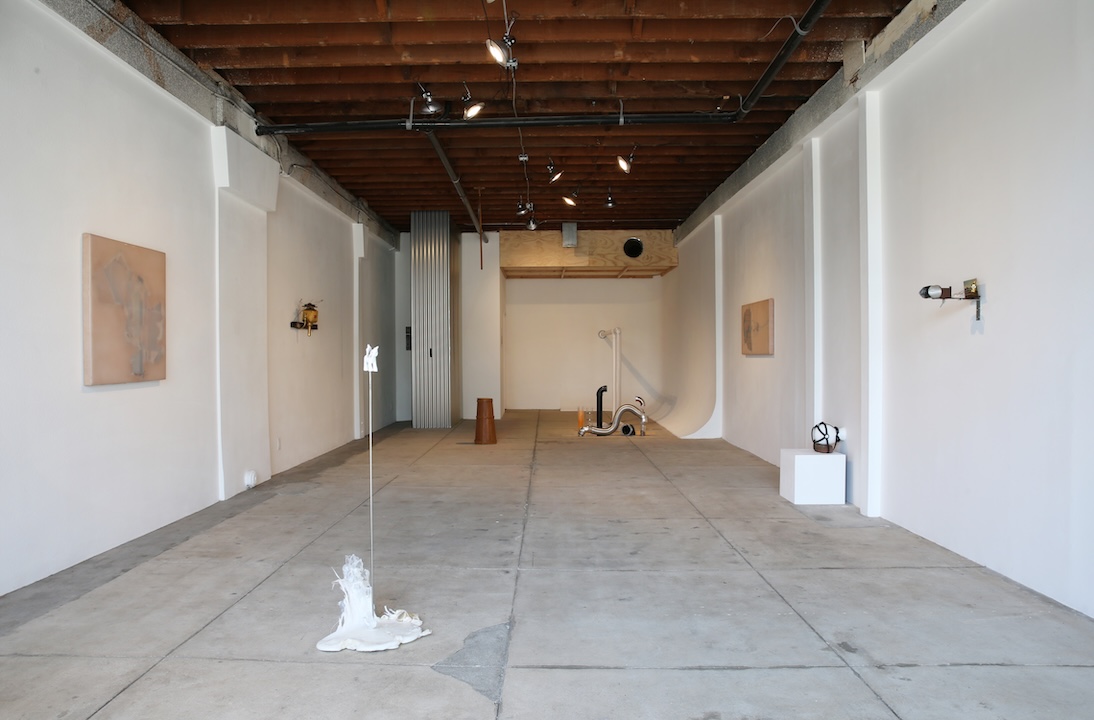 D’étant donnés—evenₙ Good lucks get givenₙ₊₁. Exhibition view at Reisig and Taylor Contemporary, Los Angeles, 2026. Courtesy of Reisig and Taylor Contemporary.
The group exhibition extended this tension between visibility and inaccessibility, offering viewers works without granting them complete access. It occupied a clear, bright, and seemingly straightforward gallery—a rectilinear room whose openness initially suggested an unrestricted field of vision. Yet the works transformed this openness into another kind of hidden chamber: everything appeared exposed, but nothing was entirely reachable or knowable. Chinning Liu, one of the participating artists, approached this tension through her installation Problem (at the end of the day).
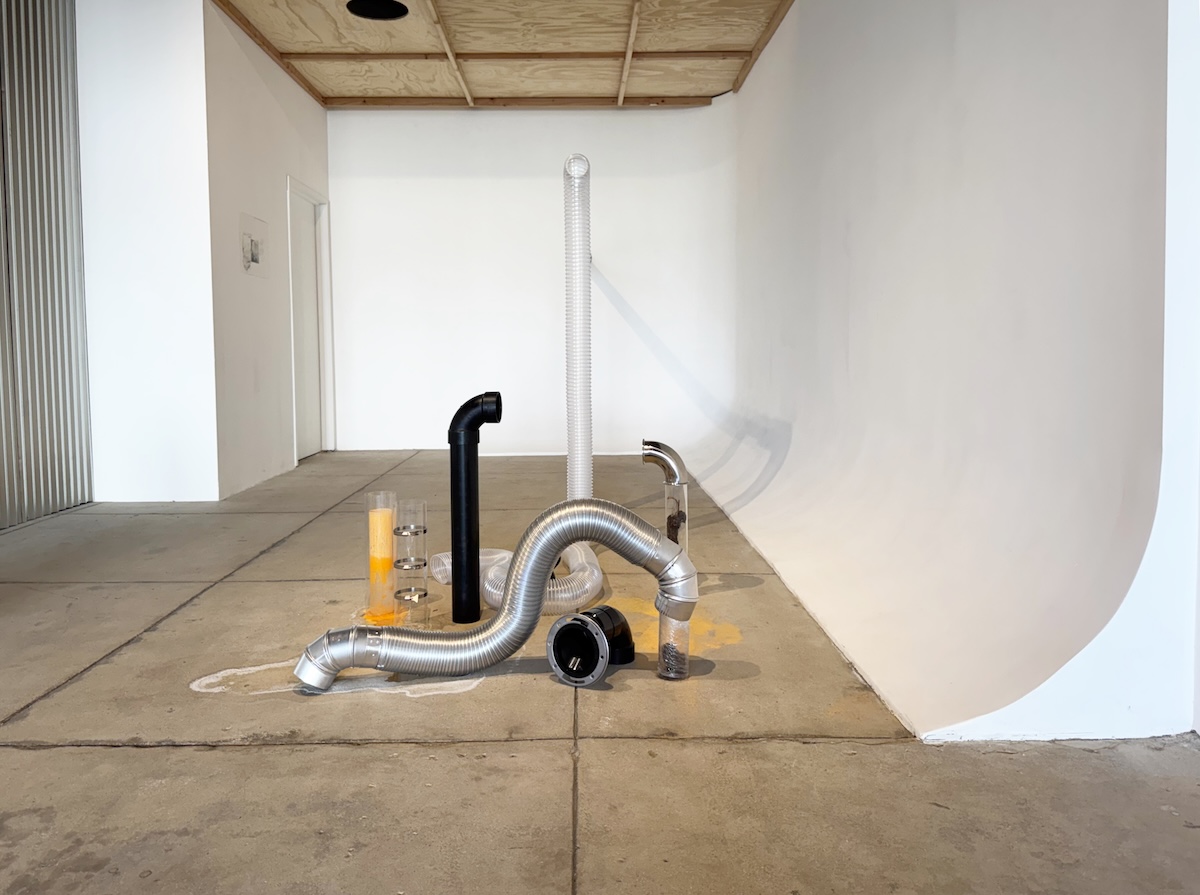 Chinning Liu, Problem (at the end of the day). Installation view at Reisig and Taylor Contemporary, Los Angeles, 2026. Courtesy of the artist and Reisig and Taylor Contemporary. Photography by Reisig and Taylor Contemporary.
Shaped by physical tension and by the position assigned to the viewer, Liu’s work transforms visual restriction into a material relationship. Problem (at the end of the day) is a time-based installation that begins with a blockage and unfolds through accumulation. Throughout the exhibition, one cluster of transparent tubes was replenished each day with a mixture of hard water, calcium, and orange-yellow pigment. The liquid slowly seeped from the bottom of the tubes and collected on the floor. Repeated over the month-long exhibition, this daily action produced concentric rings of mineral sediment. Set in relation to the root system on the opposite side of the installation, pouring liquid into the tubes resembled the ritual of watering a plant. The liquid’s color and mineral content also evoked substances discharged or excreted by the body, as well as rusting pipes and the residue left by California’s hard water.
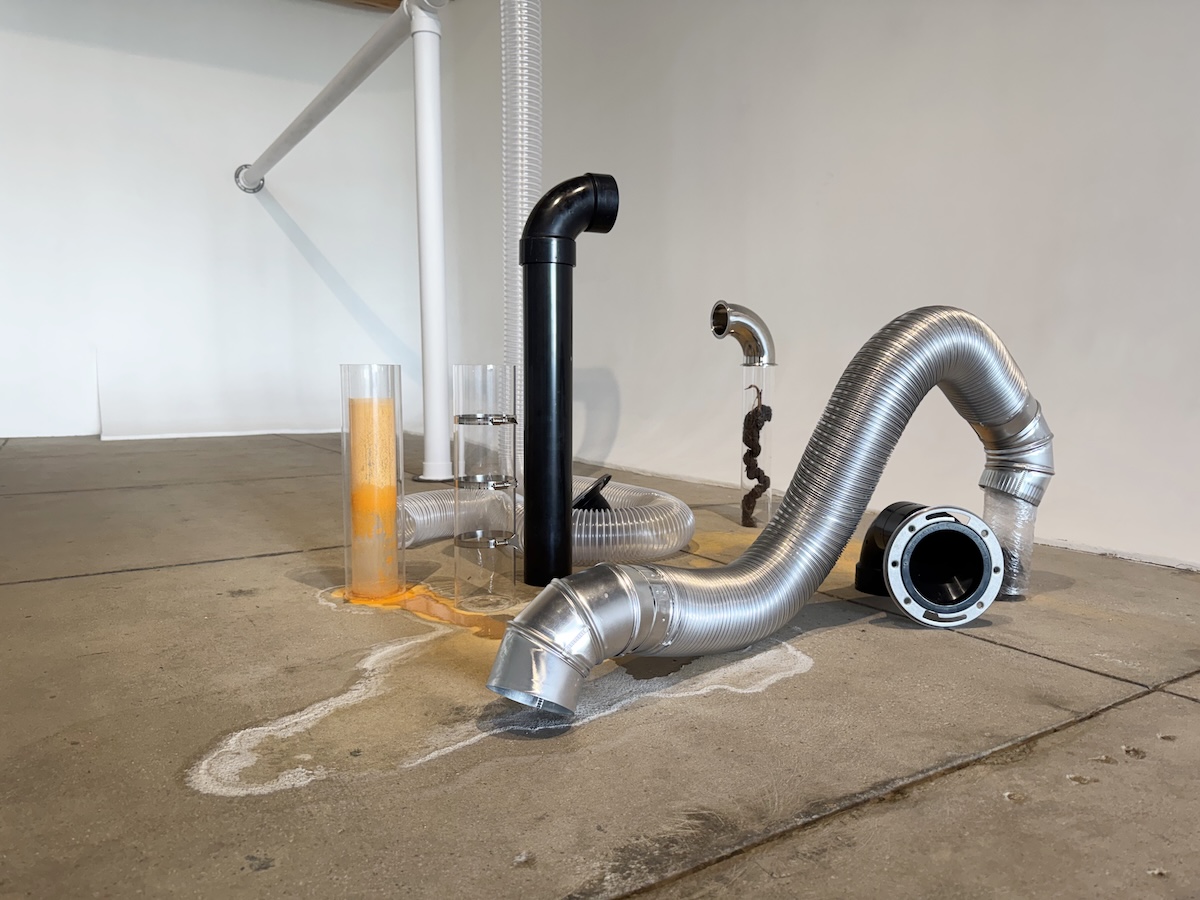 Chinning Liu, Problem (at the end of the day). Installation view at Reisig and Taylor Contemporary, Los Angeles, 2026. Courtesy of the artist and Reisig and Taylor Contemporary. Photography by Reisig and Taylor Contemporary.
The title considers a “problem” both as a difficulty encountered in everyday life and as an abstract question presented in a textbook. It also refers to showering as one of the final rituals performed at the end of each day. The work was inspired earlier this year, when Liu’s shower drain became clogged. For several reasons, she waited months before calling a plumber. For Liu, or perhaps for most people, showering marks the conclusion of the day. When this apparently easy routine could no longer be performed normally, the discomfort became disproportionately intense. The blockage produced a feeling of being unable to take care of oneself or find an answer to an otherwise ordinary problem.
Unclogging the drain gradually came to resemble the process of solving a complicated puzzle. When the plumber arrived, he spent an hour working with multiple tools. At first, he extracted only a small amount of hair. Then, suddenly, the machine pulled out an enormous plant root. The release resembled the sudden relief of constipation; even the root’s form looked like a mass that had been lodged inside an intestine.
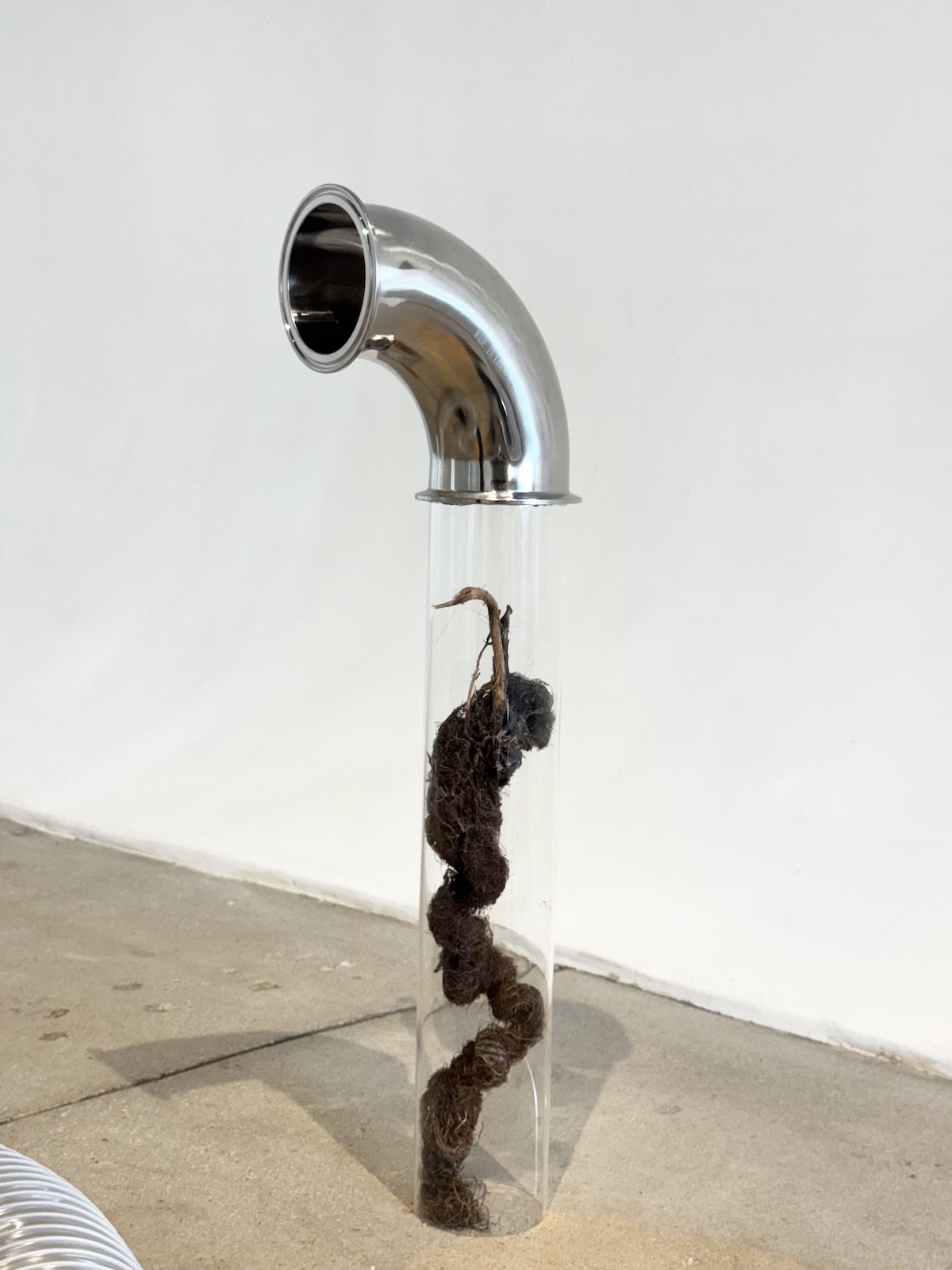 Chinning Liu, Problem (at the end of the day). Installation view at Reisig and Taylor Contemporary, Los Angeles, 2026. Courtesy of the artist and Reisig and Taylor Contemporary. Photography by Reisig and Taylor Contemporary.
Although the drain began working again, the root generated another set of unanswered questions in Liu’s mind. Had it entered the old apartment’s plumbing system from a nearby tree? Had a seed or other plant residue left by a previous resident entered the drain and germinated? How could the root have grown inside a dark pipe with only water and no direct sunlight? How had it withstood the drain-cleaning chemicals previously poured into the pipe? Or had it already died but remained trapped there? The functional problem had been solved, yet its solution produced even stranger mysteries.
The installation was constructed through a similar sequence of problems and provisional solutions. At first, the diameters of the transparent tubes, plumbing pipes, and elbow joints repeatedly failed to align. Liu tested where each component should be positioned, determined how far the metal pipes needed to bend to balance independently, and calculated how the work could support itself without conventional fastening.
“Installing the white pipes on the gallery wall and testing their support points took an entire day,” Liu recalled. “Each solved problem revealed the next one. Even after the structure was completed, I still had to test the liquid’s flow rate, water level, and pressure.”
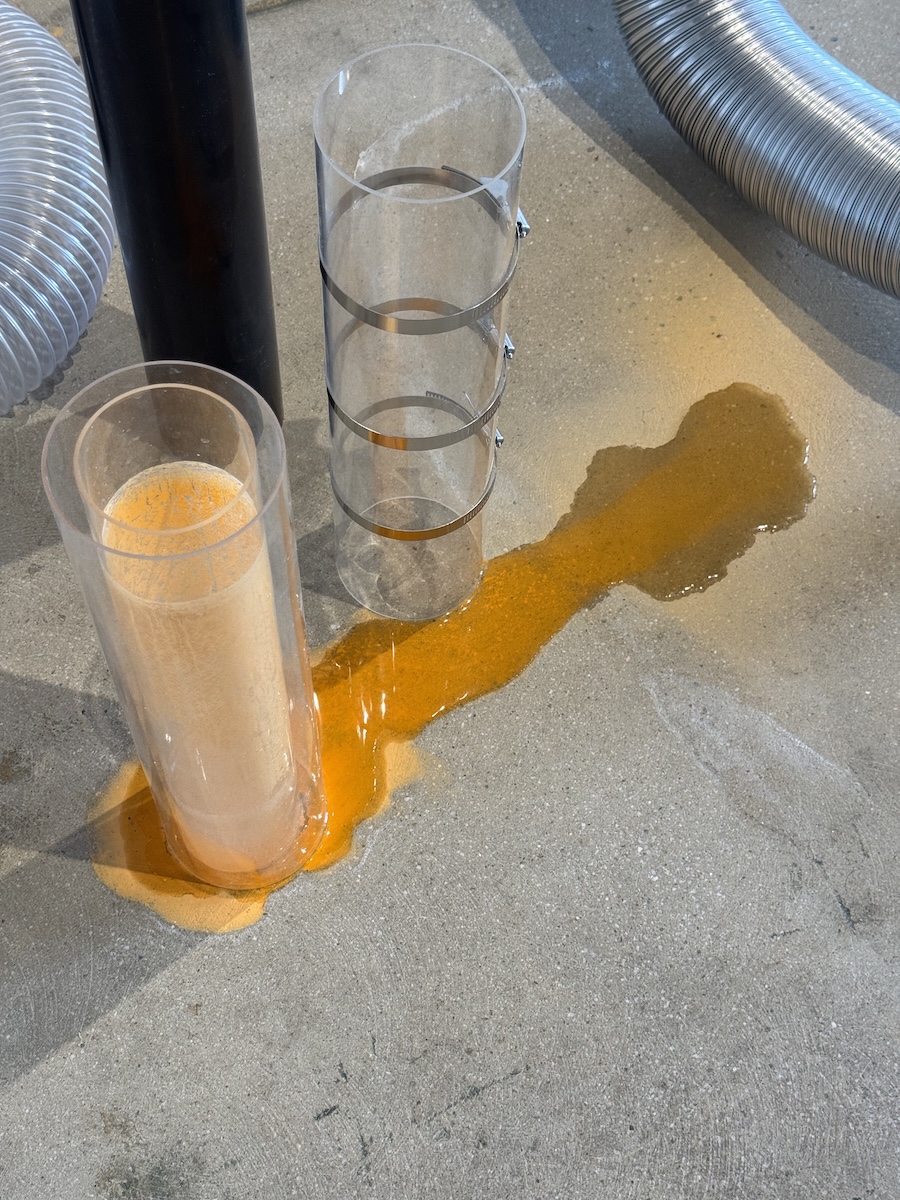 Chinning Liu, Problem (at the end of the day). Installation view at Reisig and Taylor Contemporary, Los Angeles, 2026. Courtesy of the artist and Reisig and Taylor Contemporary. Photography by Reisig and Taylor Contemporary.
The clogged drain, the root of unknown origin, and the production of the installation therefore became interconnected processes of searching, testing, and attempting to solve something. Yet no solution was final; each one simply established the conditions for another problem to emerge.
The work’s visual coherence depends upon an equally provisional solution. Viewed directly from the front, the white pipes supporting the installation nearly disappear, creating the illusion that the transparent tubes are suspended in midair. Every component has been precisely composed for this frontal perspective. If the viewer shifts even slightly to one side, however, the image begins to disassemble and its supporting structure becomes visible.
Although the plumbing products used in the installation were manufactured to be securely fastened and properly fitted, none are installed according to their intended functions. Many of the components stand through delicate balance alone. The transparent tubes appear to float but are supported by white pipes, while the structure holding those pipes upright is not screwed into the floor. The root itself had grown inside a pipe, detached from the soil that would ordinarily ground it. The installation is therefore an ungrounded fiction: its stability depends on concealment, balance, and a carefully controlled point of view.
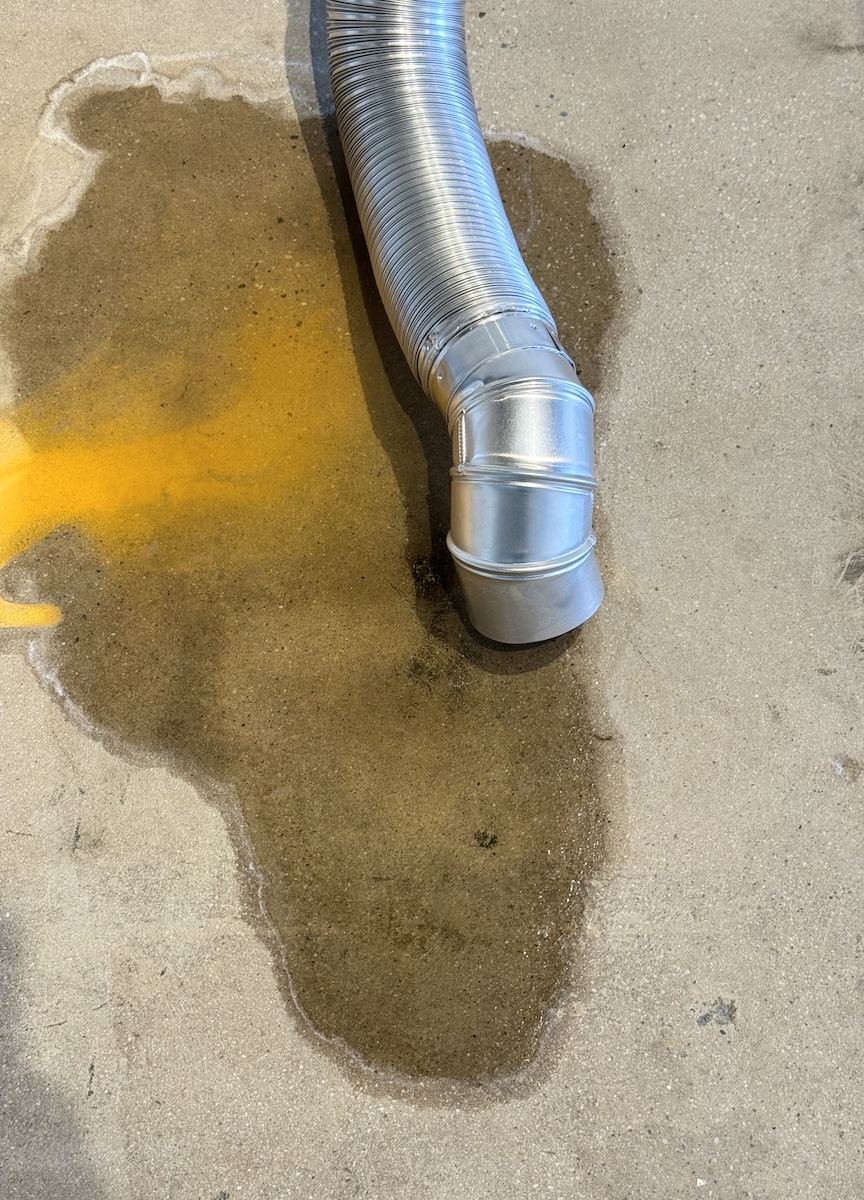 Chinning Liu, Problem (at the end of the day). Installation view at Reisig and Taylor Contemporary, Los Angeles, 2026. Courtesy of the artist and Reisig and Taylor Contemporary. Photography by Reisig and Taylor Contemporary.
This staged instability returns Liu’s work to the conceptual structure of Étant donnés. Duchamp described his installation as an “approximation that can be disassembled,” allowing a degree of freedom in how it was constructed. Liu was drawn not only to its peepholes and the act of looking through an opening, but also to the way its carefully constructed image would fall apart if approached from another angle. By moving away from the prescribed viewpoint, the viewer effectively disassembles Liu’s installation, exposing the material supports behind its illusion. The work asks what must be staged, concealed, illuminated, blocked, or assumed before anything can be seen.
In fact, the element of “hole” is also a recurring visual language in Liu’s practice. Beginning in 2024, she developed Ridgelines, a series of mixed-media wall installations whose hollow centers allow viewers to see through the sculptures to the wall beyond. Through casting and layering burlap, gypsum, papier-mâché, tissue paper, and resin, Liu created structures that oscillate among landscapes, living organisms, and biological tissues. Their openings reveal the absence of an original subject while also tapping into a more primal psychological response to caves, cavities, and spaces that recede beyond sight. The series creates a contradictory viewing dynamic in which emptiness acquires weight, distinctions between positive and negative space become unstable, and the abyss appears to swallow the gaze.
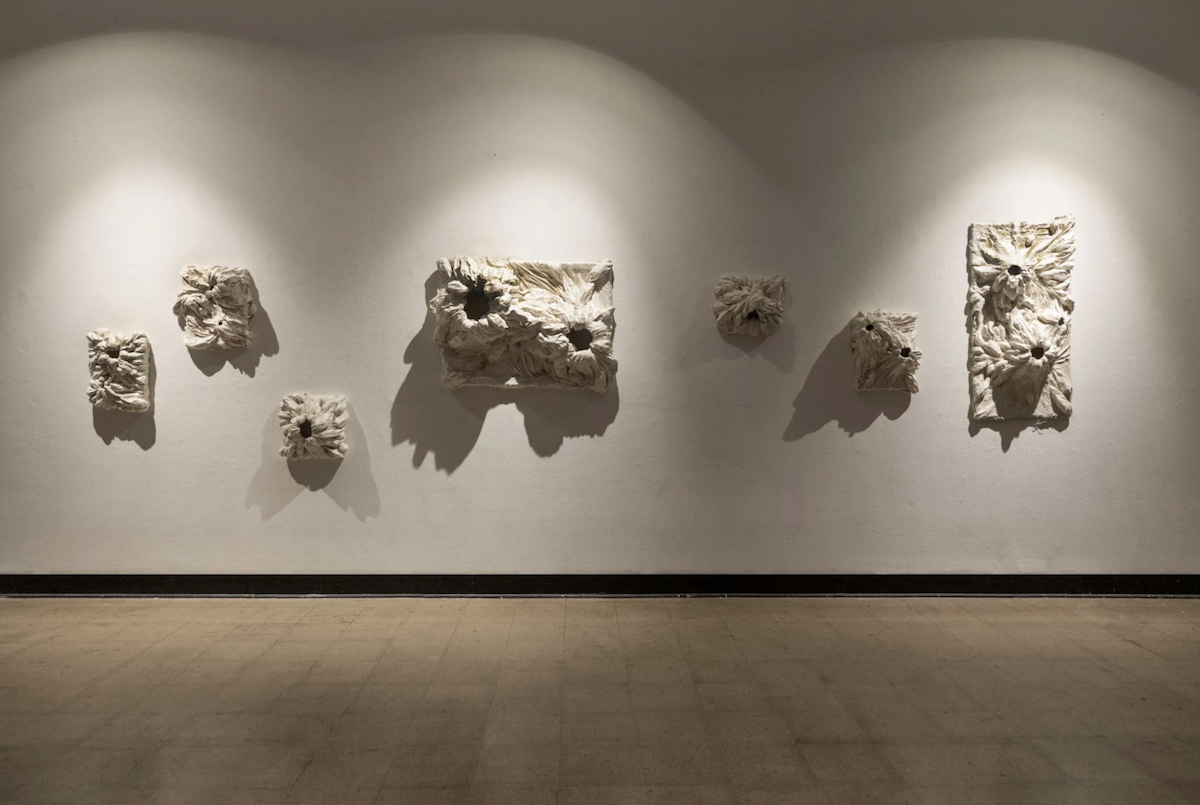 Chinning Liu, Ridgelines, 2024. Courtesy of the Artist. Photography by Siqi Fan.
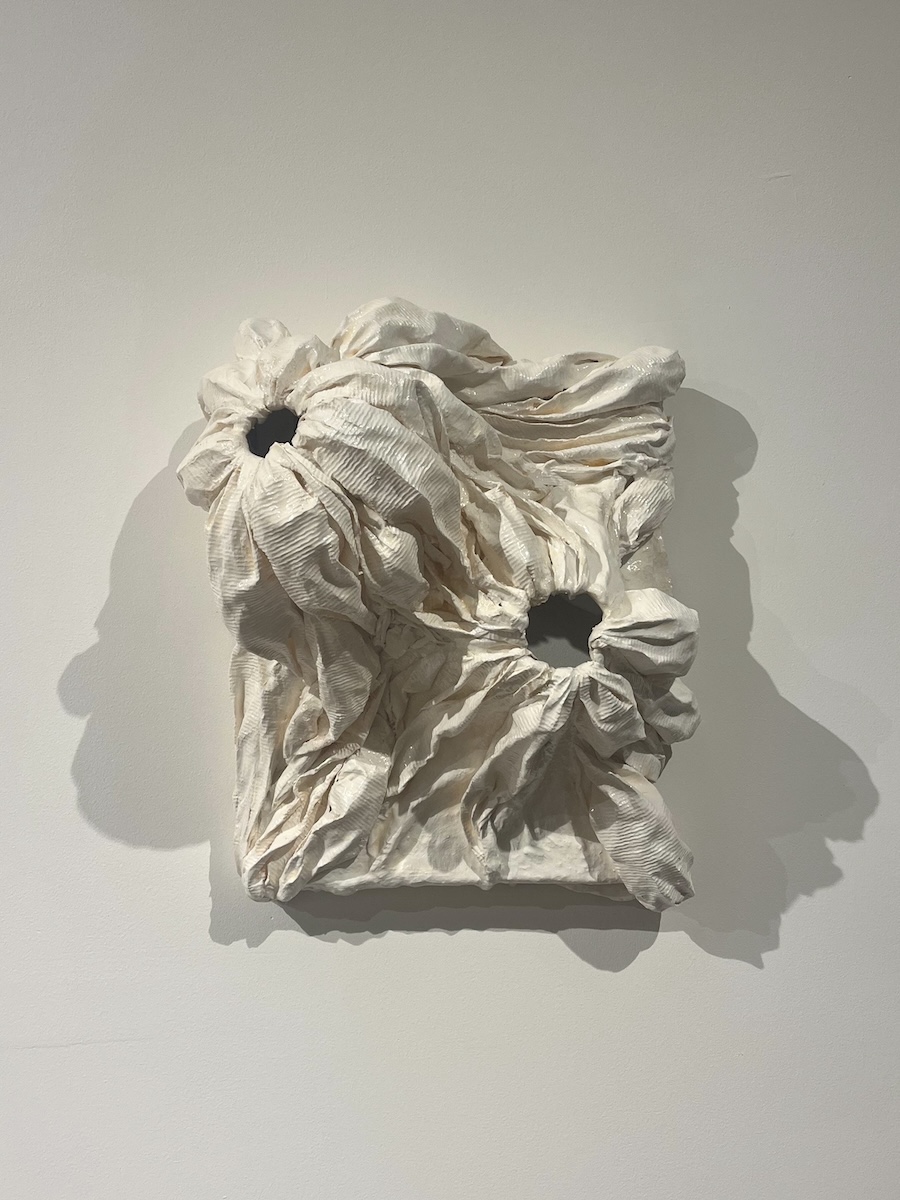 Chinning Liu, Shatters Whisper After the Mutualism, Burlap, embossed, paper, daily life, discard, gypsum, polyurethane, 20 x 16 x 11.5 inches, 2024. Courtesy of the Artist.
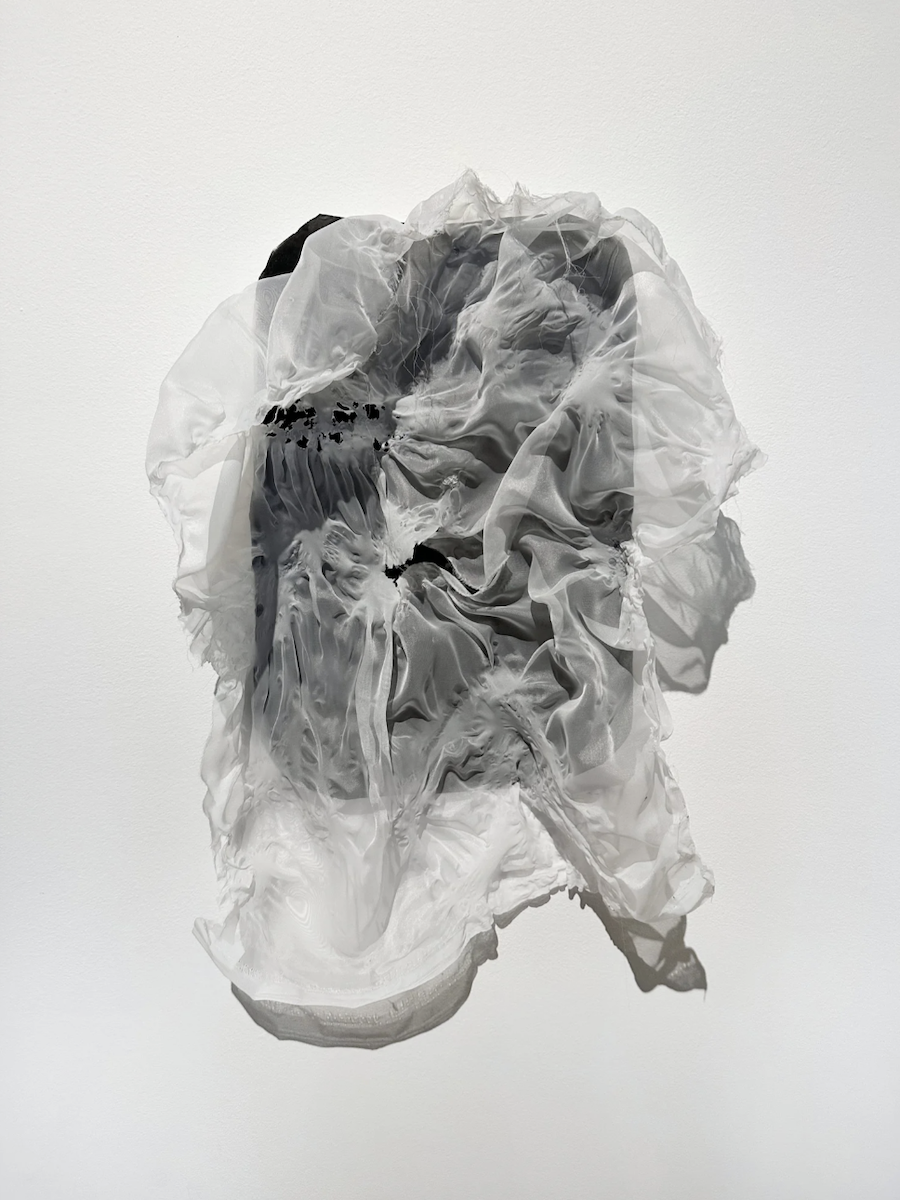 Chinning Liu, Soma, Xuan paper, organza, 23 x 17 x 1.5 inches, 2024. Courtesy of the Artist.
Rather than treating an artwork as a stable presence, Liu understands meaning as something produced through changing relationships among objects, bodies, architecture, and space. This logic expanded in Mitosis, her recent solo exhibition at The Reef, where the gallery itself took on the behavior of a living system. Drawing on the filament-like structures formed during cellular division, Liu treated thread as both a recurring visual motif and an organizing principle. Hoses, ropes, and branching lines extended across the gallery, connecting individual sculptures to the surrounding architecture.
At the center of the exhibition, Follicle took the form of an irregular red sphere inflated with the breath of anonymous participants. Referring to bodily cavities such as hair follicles, lung alveoli, and ovarian follicles, the sculpture transformed individual breath into a collective yet depersonalized body. Red and translucent hoses spread from it like veins, roots, or a circulatory system, making the gallery itself appear to breathe. Elsewhere, Liu extended this biological language into the social and industrial ecology of Los Angeles. California Sunlight expelled dryer lint gathered from across the city alongside a bright orange PVC tube (a deliberately artificial substitute for sunlight) while Before the Fruit constructed an ecosystem of false attractions from artificial fruit flies, scented rubber, deceptive shadows, and precariously supported objects. In both works, familiar systems of consumption, attraction, and causality became visibly unreliable.
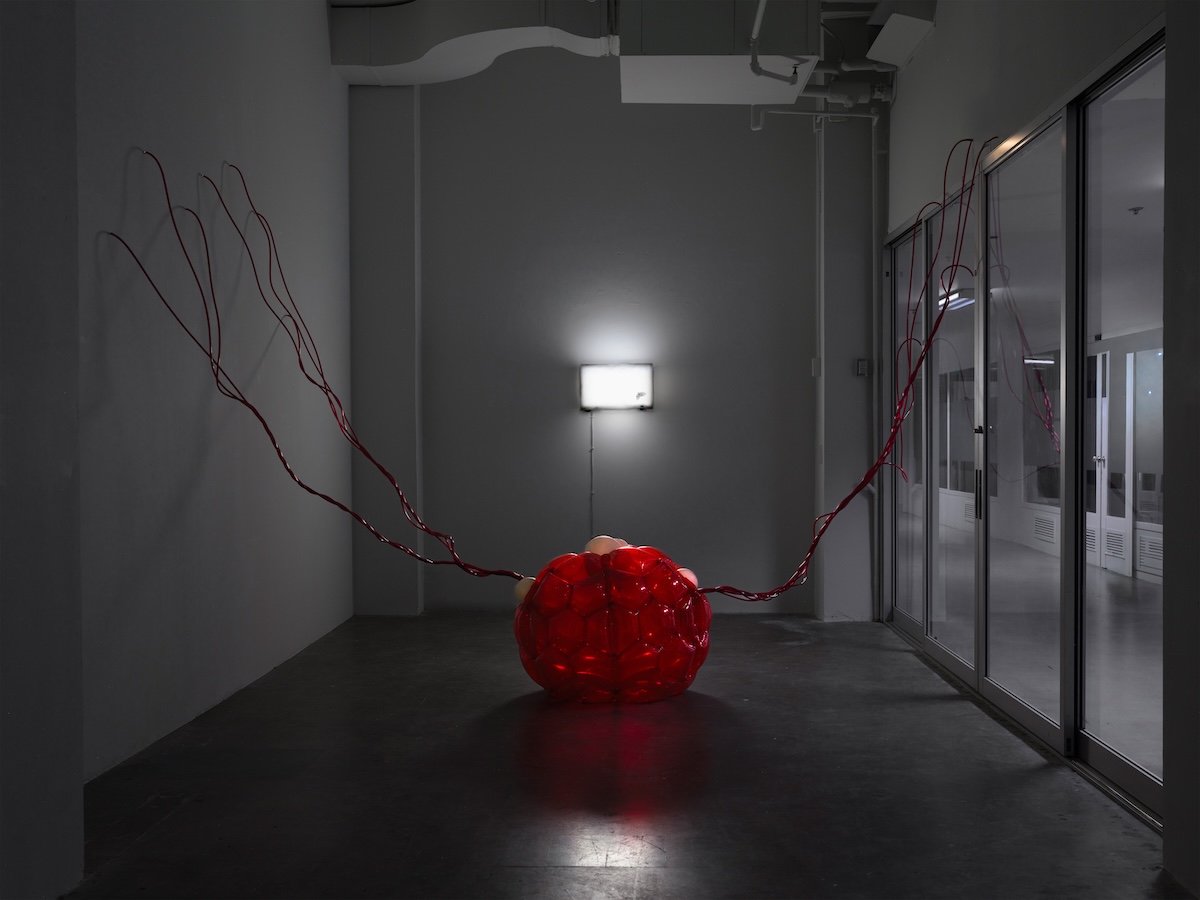 Chinning Liu, Follicle. Installation view at the Reef, Los Angeles, 2026. Courtesy of the artist and the Reef. Photography by Sight Studio.
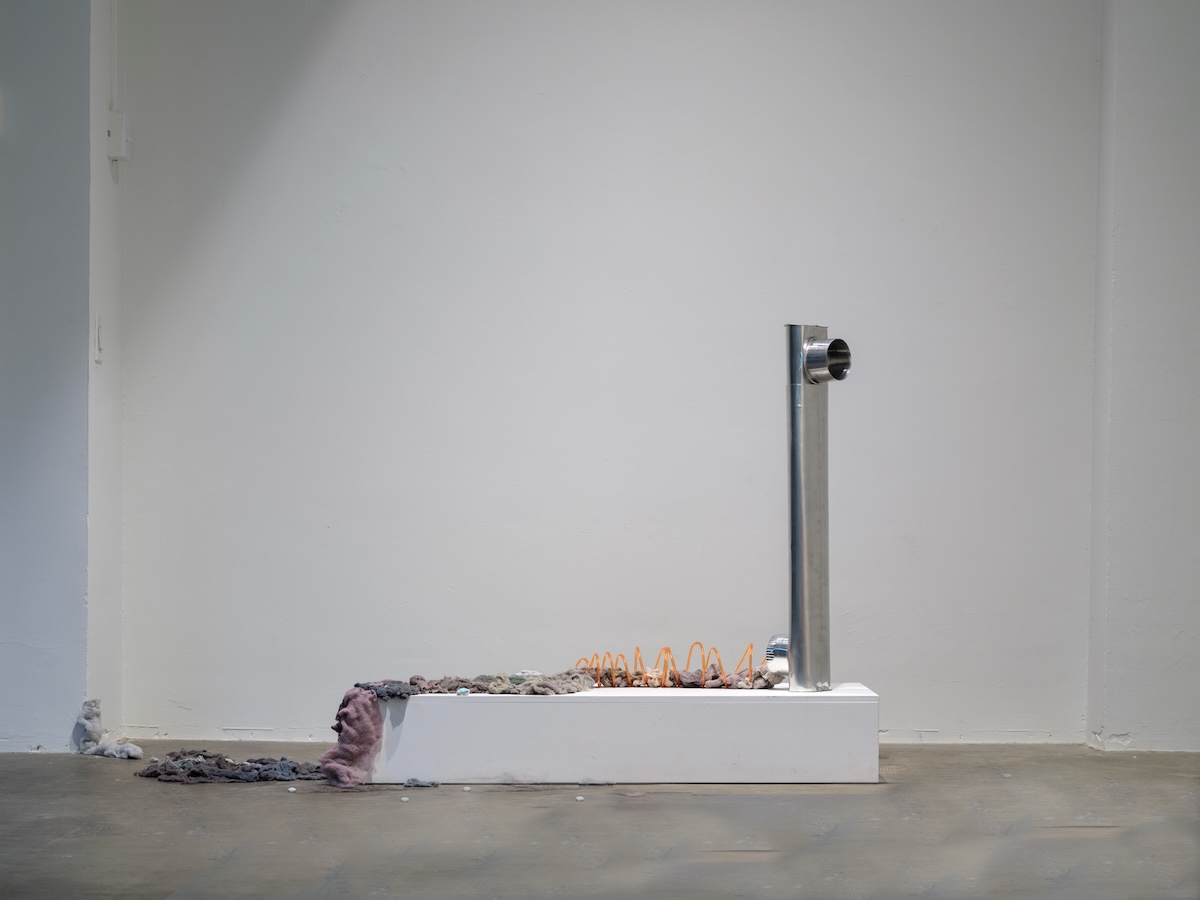 Chinning Liu, California Sunlight. Installation view at the Reef, Los Angeles, 2026. Courtesy of the artist and the Reef. Photography by Zengyi Zhao.
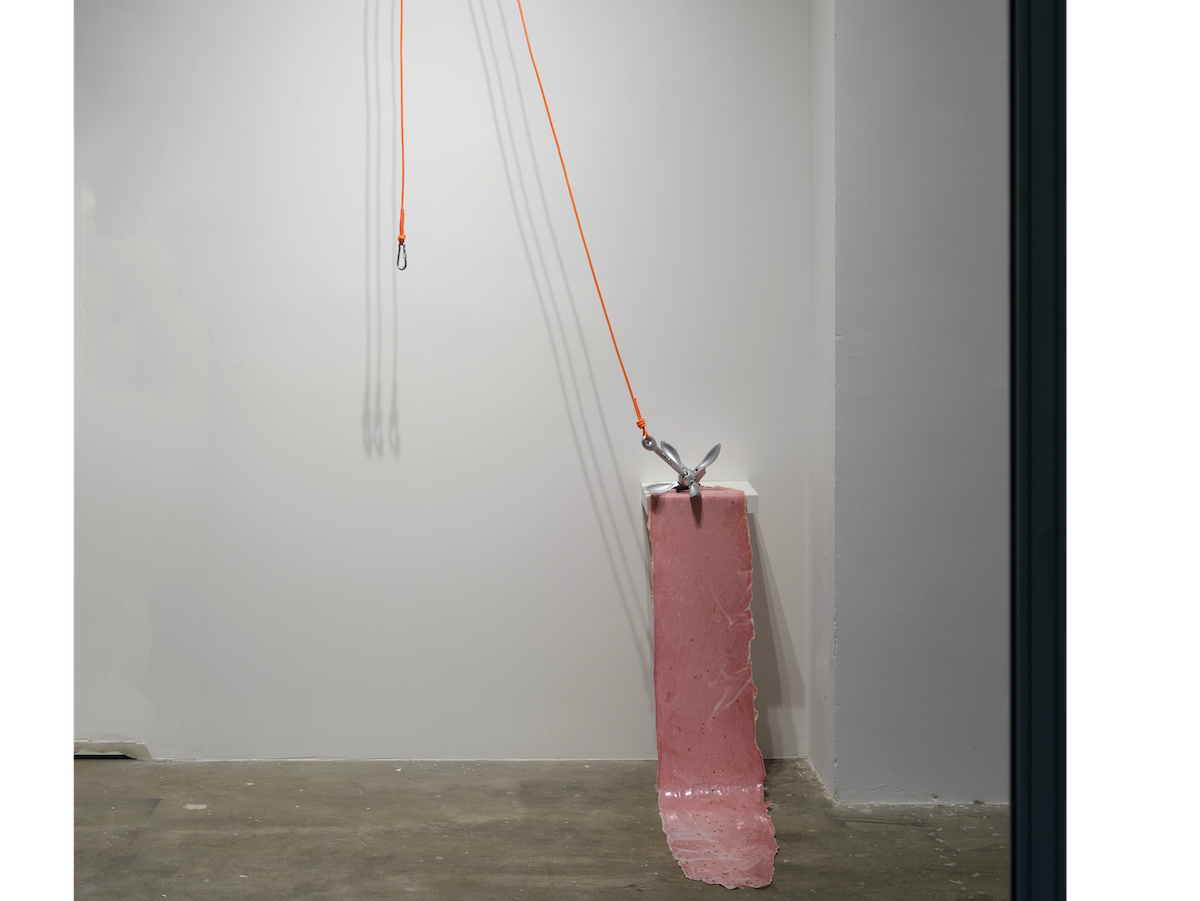 Chinning Liu, Before the Friut. Installation view at the Reef, Los Angeles, 2026. Courtesy of the artist and the Reef.
Like much of Liu’s work, Mitosis positioned viewers between observation and participation. Its installations initially appeared to form coherent bodily or ecological systems, yet their connections were provisional, artificial, and often deceptive. Across Liu’s work, she questions the possibility of remaining a detached witness. Whether confronting a clogged pipe, anonymous breath, industrial residue, or counterfeit fruit, the viewer encounters a network in which every body and object is implicated, while no relationship can be fully explained or controlled.
Drawing on her background in psychology and scientific modes of inquiry, Liu’s work combines human anatomy, living organisms, inorganic matter, and geological formations. Yet her practice moves beyond the promise of scientific objectivity. Biological metabolism forms into social metabolism: breath, lint, water, chemicals, architecture, and human movement circulate through her installations as evidence of shared systems. The tension between distributed agency and artistic control makes her practice resemble a form of sociological inquiry articulated through her biological language.
By regenerating fractured and organic forms, Liu blurs the boundaries between human and nonhuman, while evoking the unconscious traces left behind by time. What is given in her work never remains fixed. Breath becomes sculpture, lint becomes social residue, artificial sunlight enters an institutional ecology, and viewers become organisms drawn through space. Her practice asks what it means to witness processes that humans can initiate but cannot completely control.
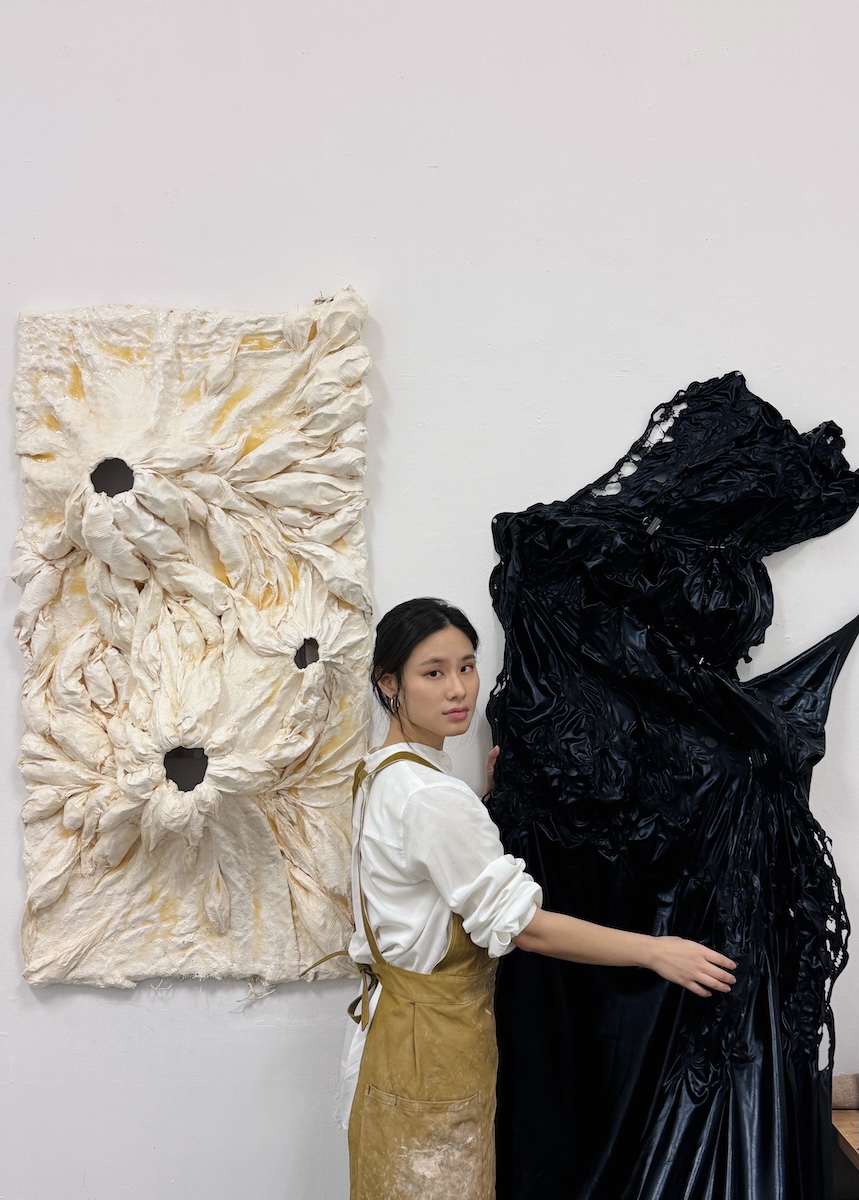 Portrait of Chinning Liu. Courtesy of the artist.
* D’étant donnés—evenₙ Good lucks get givenₙ₊₁ at Reisig and Taylor Contemporary, Los Angeles, on view July 11–August 8, 2026.
* Mitosis, at the Reef, Los Angeles, on view May 16– June 6, 2026.

Yezi Lou
Yezi Lou (b. 1997) is an artist and independent writer based in Los Angeles. Her research centers on material culture, social phenomena, and syncretic spiritual practices in East Asia. She earned her MFA in Painting and Drawing at UCLA.
view all articles from this author