Whitehot Magazine
October 2026
"The Best Art In The World"
"The Best Art In The World"
October 2026
Andy Moses: Into the Light at Laguna Art Museum
Laguna Beach, March 21 – September 20, 2026
By Lorien Suárez-Kanerva
Before Andy Moses’s paintings, perception unmoors. What first registers as surface—color, motion, depth—begins to shift, resisting a fixed point of orientation. The image does not settle; it unravels into movement. One is not simply looking at a painting, but entering a field that continues to resolve and dissolve at once.
Curated by Peter Frank, Into the Light frames Moses’s work within a lineage of perceptual inquiry while clarifying its departures. Moses is often aligned with California Light and Space, but where that trajectory turned to industrial materials to dematerialize the object, he remains committed to paint—not as image, but as event. The surface becomes a site where perception is extended and unsettled. Notably, many of the rectangular works are built on subtly concave supports, introducing a physical curvature that actively shapes the image's perception.
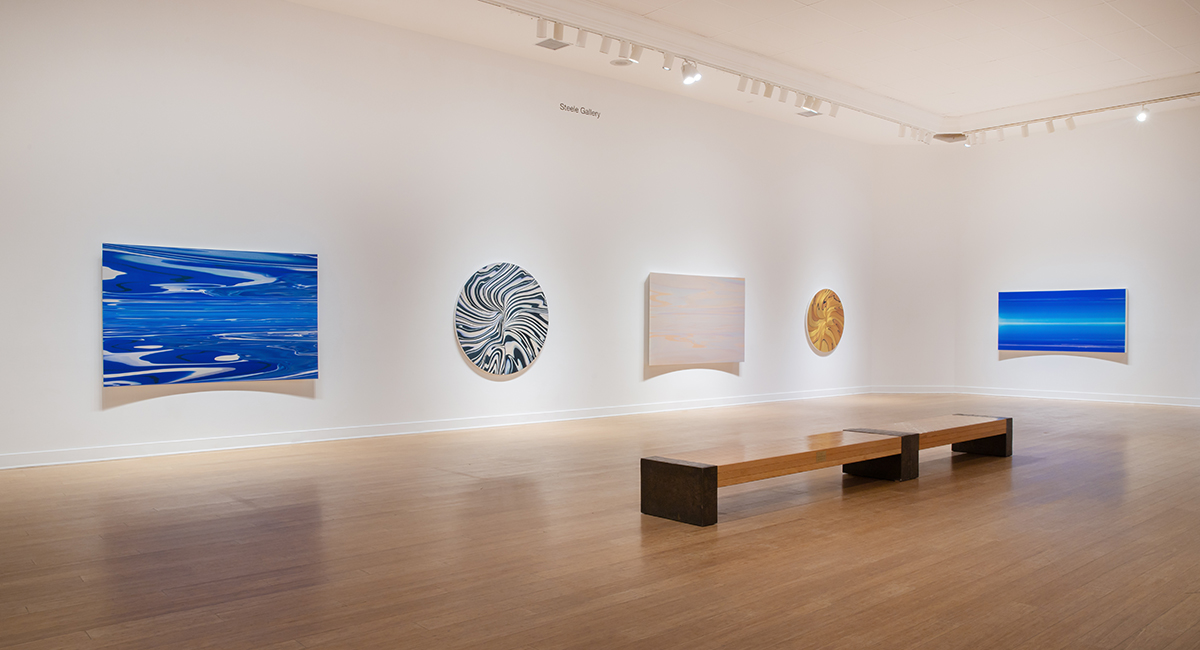
Geomorphology 1607, 2023, acrylic on canvas over concave wood panel, 57 × 90 × 5 inches; Geodesy 1228, 2022, acrylic on canvas over circular wood panel, 60 inches diameter; Geomorphology 1601, 2022, acrylic on canvas over concave wood panel, 57 × 90 × 5 inches; Geodesy 1008, 2024, acrylic on canvas over circular wood panel, 48 inches diameter; Siren Song, 2005, acrylic on canvas over concave wood panel, 45 × 92 × 4.5 inches
Rather than belonging to a single movement, Moses operates across several overlapping fields. Perceptual abstraction shifts emphasis from image to experience—what Maurice Merleau-Ponty understood as perception lived rather than observed. Process-based abstraction foregrounds material behavior—paint as action rather than depiction—recalling Philip Ball’s account of fluid systems, where order emerges through instability. Expanded painting treats the support not as a passive ground but as an active, spatial element—one that shapes how the work is experienced. In Moses’s case, the curvature of the concave panels subtly redirects the viewer’s perception, turning the surface into something closer to a field than a flat plane. Atmospheric or phenomenological painting treats light not as subject but as environment, echoing Gaston Bachelard’s sense of elements as immersive states. And within a contemporary reconfiguration of the sublime, the work resists closure, sustaining what Jean-François Lyotard names both the “differend”—that which cannot be adequately expressed within existing language—and the “unpresentable,” that which exceeds representation and resists resolution.
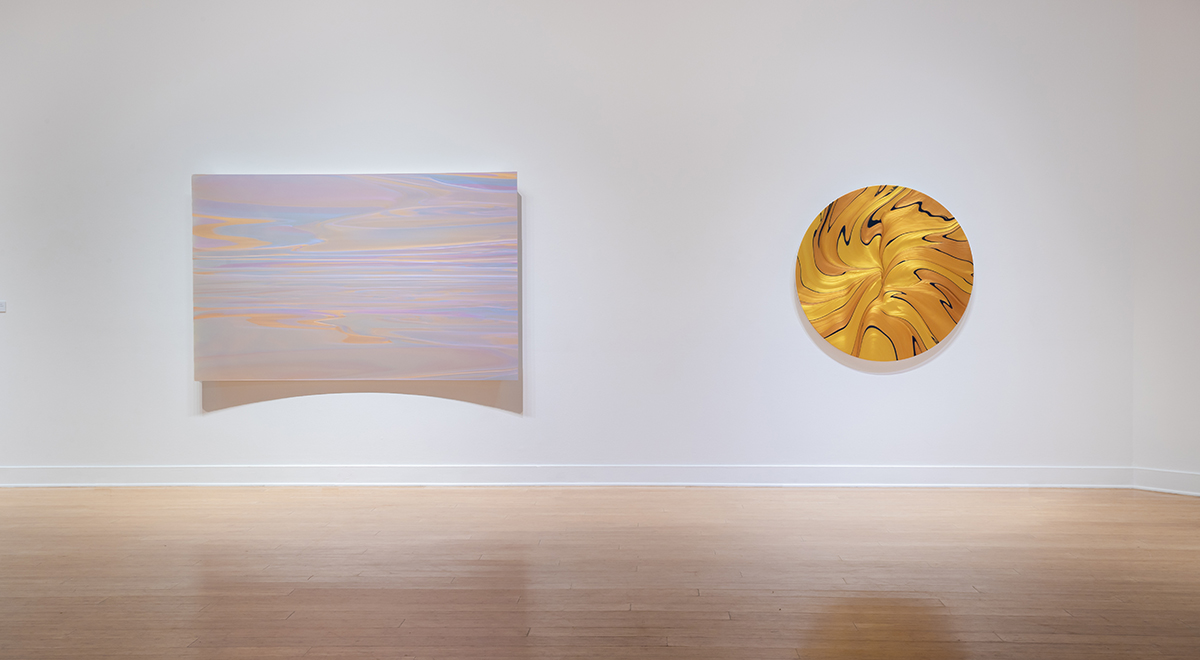
Geomorphology 1601, 2022, acrylic on canvas over concave wood panel, 57 × 90 × 5 inches; Geodesy 1008, 2024, acrylic on canvas over circular wood panel, 48 inches diameter
Moses’s process is inseparable from this condition. The paintings are not composed; they are released. Paint is poured, tilted, and set into motion across concave or planar supports, where gravity, viscosity, and time become active agents. As a scientific writer Philip Ball has noted, flow systems reveal structure through turbulence—patterns discovered rather than imposed. Moses harnesses this behavior without relinquishing control. The result is a productive paradox: surfaces that feel inevitable and exacting, as if shaped by natural forces yet resolved through acute visual intelligence.
In Geomorphology 1607, the surface gathers into a dense, tectonic mass—color folding inward with a geological weight that resists immediate legibility. What reads as accumulation is the residue of motion, a suspended record of flow at the edge of dissolution.
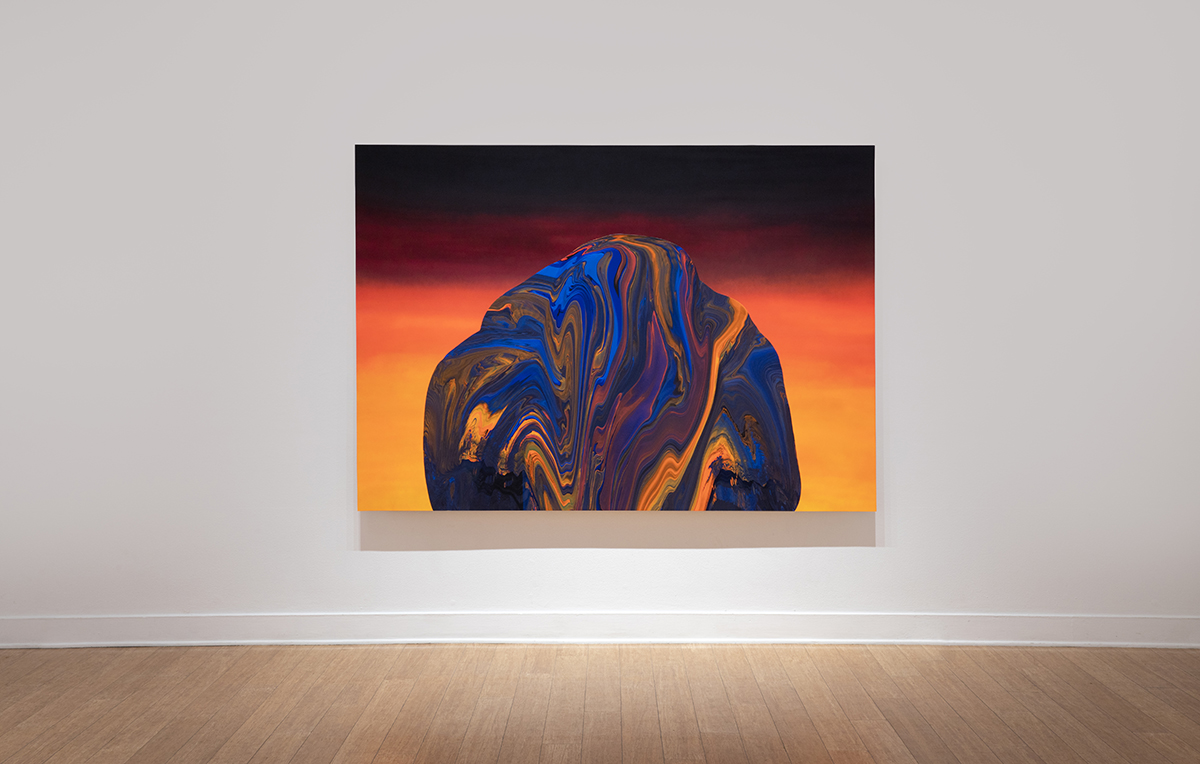
Metamorph 1502, acrylic on polycarbonate, mounted on wood panel, 66 × 95 inches
The circular works intensify this compression. In Geodesy 1228, the image spirals inward, drawing the eye into a vortex that never resolves. The painting behaves less as an object than as a system—reorganizing itself as one looks. A quieter register emerges in Geomorphology 1601, where tonal shifts extend laterally across the concave surface, the curvature gently altering the horizon line and the viewer’s spatial orientation. Perception stretches rather than collapses, producing a horizon that remains present yet just out of reach. In Geodesy 1008, rotational force returns with heightened chromatic clarity. Structure gathers around a center that never fully fixes, reinforcing the provisional nature of form. The gold circular work introduces a warmer, more luminous register—its coherence nearly complete. Yet beneath that optical resolution lies the same underlying turbulence, a surface held in tension between control and release.
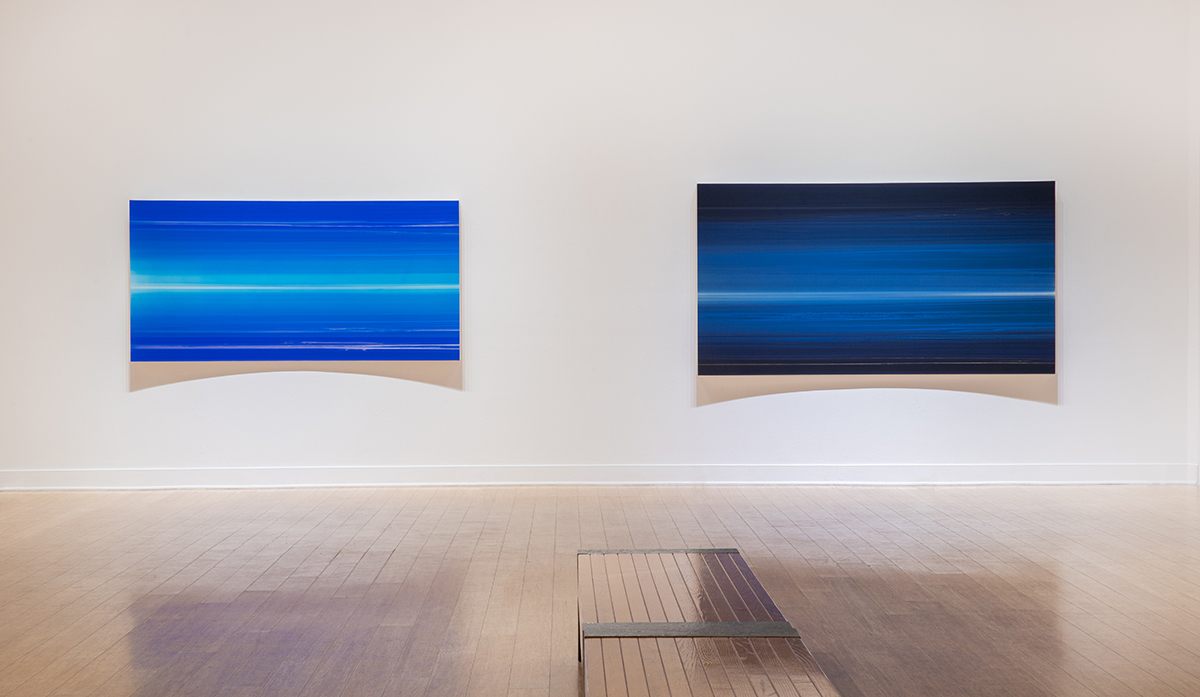
Siren Song, 2005, acrylic on canvas over concave wood panel, 45 × 92 × 4.5 inches; The Deep, 2005, acrylic on canvas over concave wood panel, 54 × 100 × 5 inches
Earlier works such as The Deep underscore the continuity of this investigation. Even here, the image resists depiction, sustaining a state between atmosphere and structure. There is, however, a tension within this precision. The surfaces are remarkably resolved—almost excessively so. Their finish approaches optical perfection, leaving little room for interruption. In this sense, the work stands apart from Japanese concepts such as notan, in which balance arises through dynamic contrast, and from wabi-sabi, in which irregularity and impermanence are integral. Moses’s paintings do not fracture; they cohere. The instability shifts from material to perceptual. One searches for disruption within a surface that quietly refuses it.
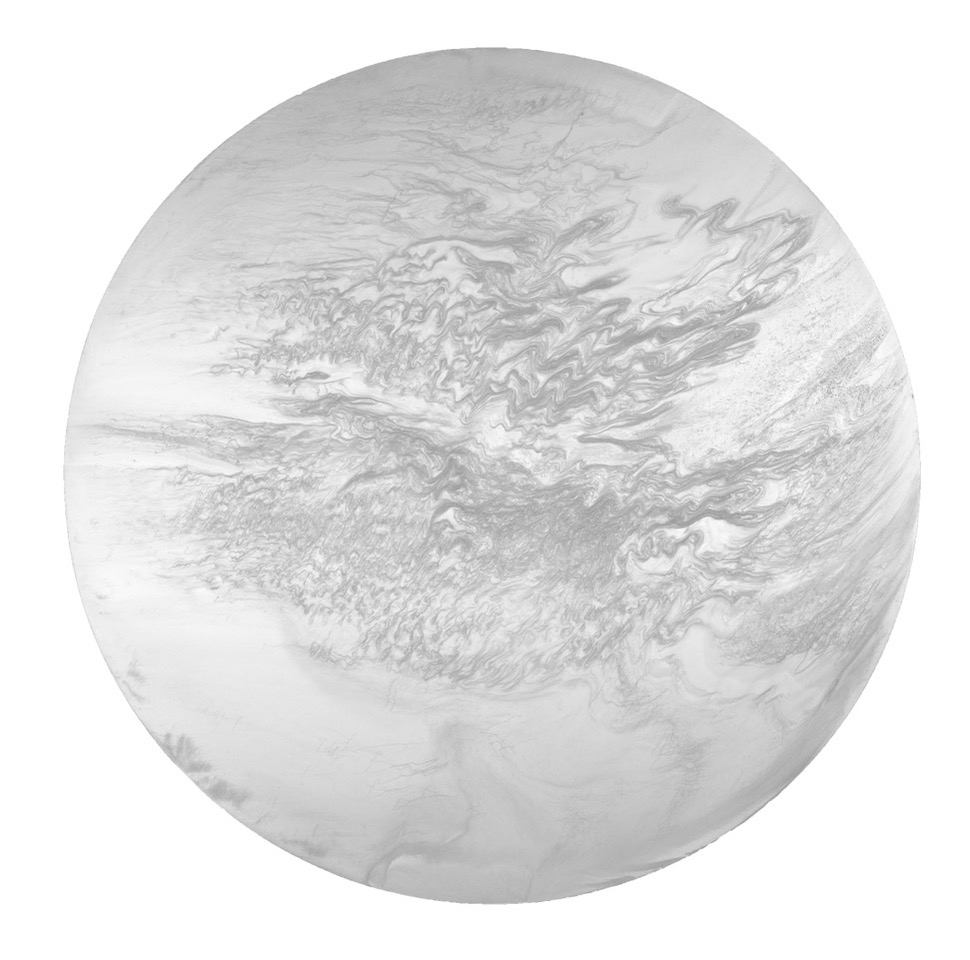
Beyond The Cirrostratus, 2003, acrylic on canvas, 51 inches diameter
This condition finds resonance with Robert Pirsig's Zen and the Art of Motorcycle Maintenance, where quality precedes intellectualization. Moses’s paintings operate in that pre-conceptual register. They are encountered before they are understood. They resist passive viewing, preferring duration over immediacy.
Across the exhibition, Moses does not depict light; he activates it. He does not represent space; he produces it. The viewer is not outside the work but within its perceptual field—engaged in a continuous negotiation between surface and depth, control and contingency, clarity and dissolution.
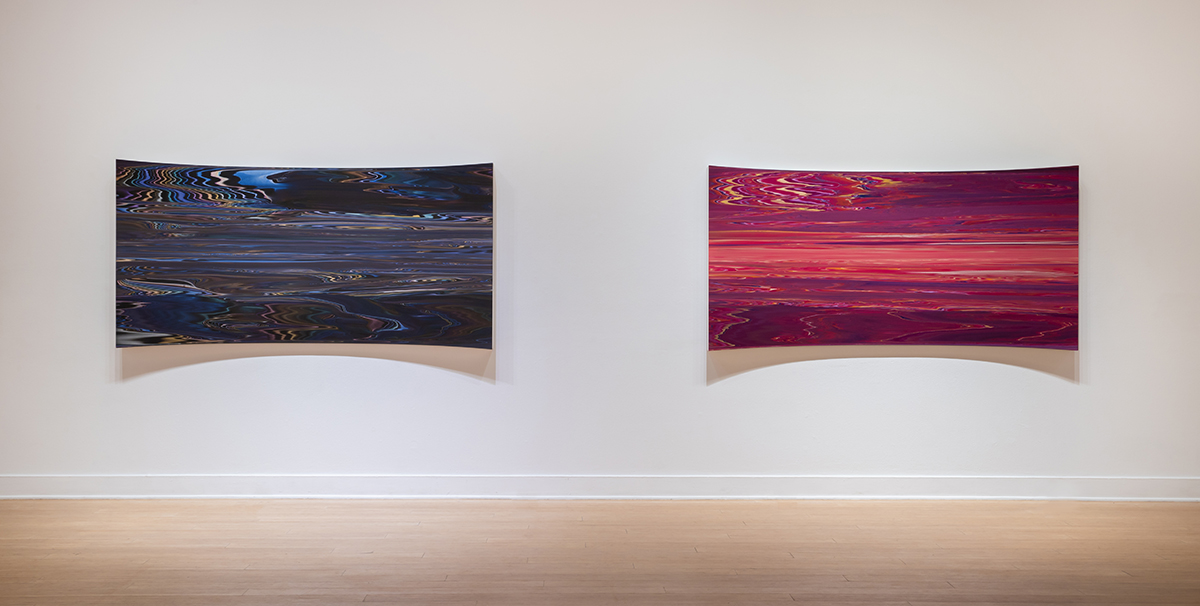
Boreas, 2010, acrylic on canvas over concave parabolic wood panel, 45 × 90 × 4.5 inches; Permian Basin, 2010, acrylic on canvas over concave parabolic wood panel, 45 × 90 × 4.5 inches
Into the Light is less about illumination than about sustaining the conditions under which light becomes experience. Moses does not stabilize perception; he keeps it in motion.
What remains is not resolution, but persistence—a visual field that continues to unfold, holding perception at the threshold of what can be sensed but not fully resolved, where, in Lyotard’s terms, the unpresentable remains active.
Laguna Beach, March 21 – September 20, 2026

Lorien Suárez-Kanerva
As a Geometric Abstract artist, Lorien Suárez-Kanerva explores the dynamic interplay of color, light, and geometric patterns found in nature and the cosmos. A Retrospective of Lorien’s work titled “Coalescing Geometries” won First Place in Non-Fiction at the 2019 International Latino Book Awards. She has exhibited in several curated solo and group shows in NYC, Los Angeles, and Miami. Her artwork appears at International Art Fairs and educational centers including Florida Atlantic University, Boca Raton Museum of Art, and UC Berkeley’s Engineering Department. Lorien resides in Palm Desert, California.
view all articles from this author