Whitehot Magazine
October 2026
"The Best Art In The World"
"The Best Art In The World"
October 2026
Looping Voices: Language Transformation in The Cave of Tongues
Installation view of The Cave of Tongues, 2026. Photo: Anna Arnet. Courtesy of the artists.
By GLADYS LOU August 16th, 2026
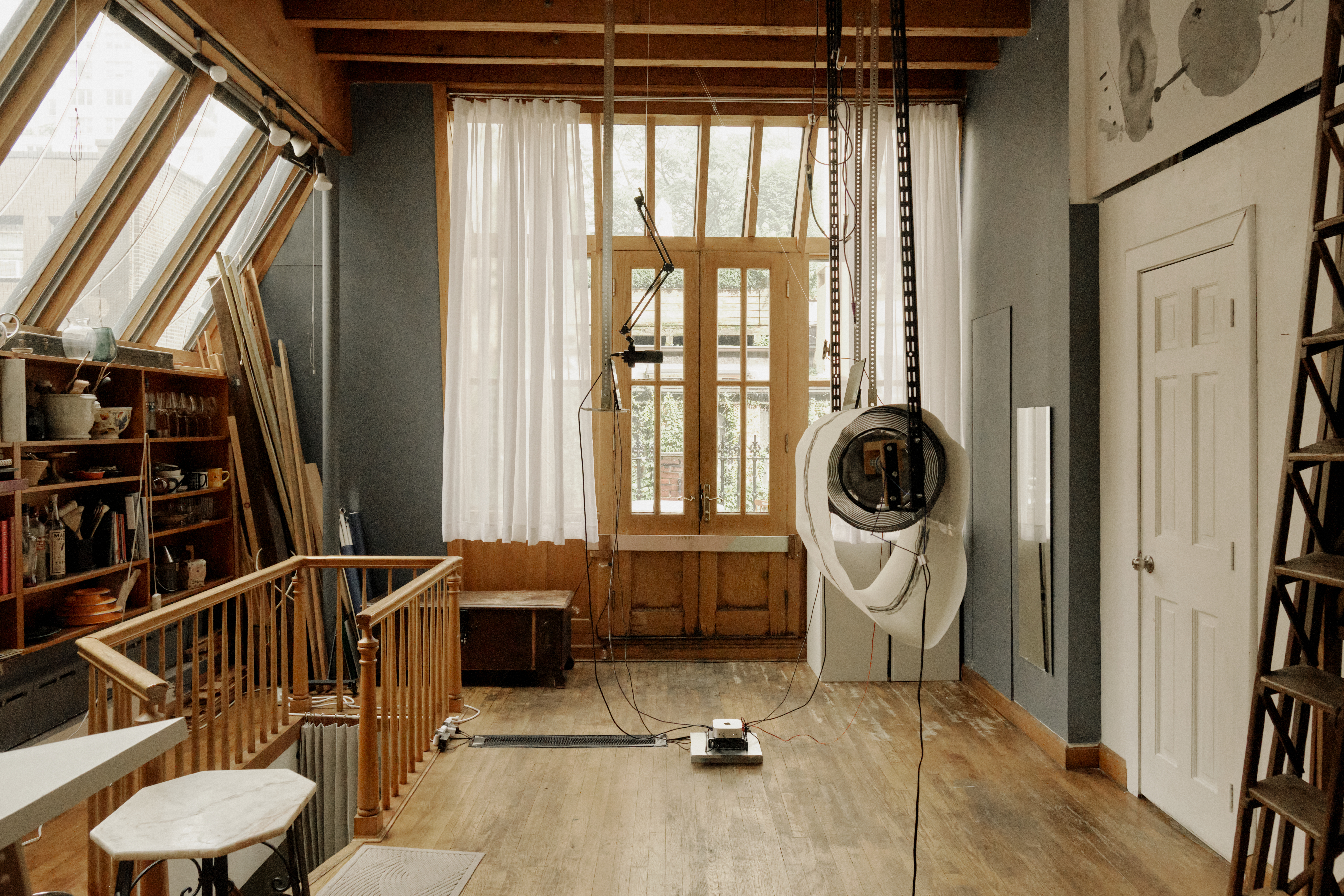
A rolling calligraphy scroll and two opposite-facing monitors enter into dialogue in The Cave of Tongues, a duo exhibition by Nana Shimomura and Chiku Komiya, curated by Rui Hara and organized by Kizuato. Bringing together Shimomura’s calligraphic scores and Komiya’s experiments with voice and electronic music, the exhibition examines the musicality and performativity of language beyond enabling communication through speaking and writing. Passing through mechanical systems, speech and sound become distorted across repeated detection and output. Through endless cycles of creating, receiving, and reinterpreting, language transforms and generates new meanings drastically different from its original source.
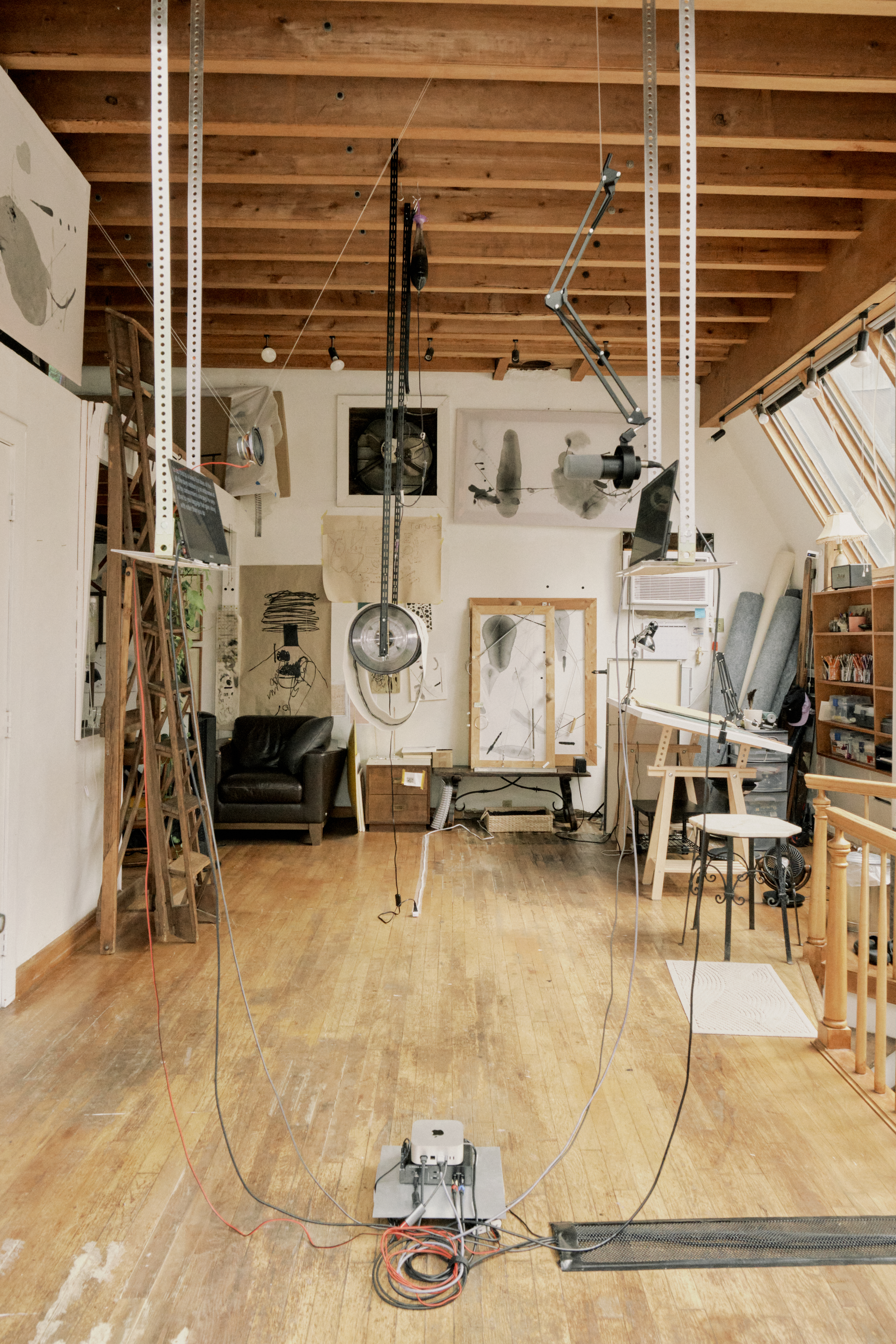
Taking place in a sunlit loft space in New York, the exhibition creates an intimate environment where ink marks and phrases accumulate over time. The space becomes metaphorically a cave — an enclosed chamber where sounds and gestures echo and reverberate. Against the backdrop of New York’s multilingual cityscape, where languages overlap on the streets and in everyday life, the works reflect on the generative possibility of language in deconstructing and reassembling.
Installation view of The Cave of Tongues, 2026. Photo: Anna Arnet. Courtesy of the artists.
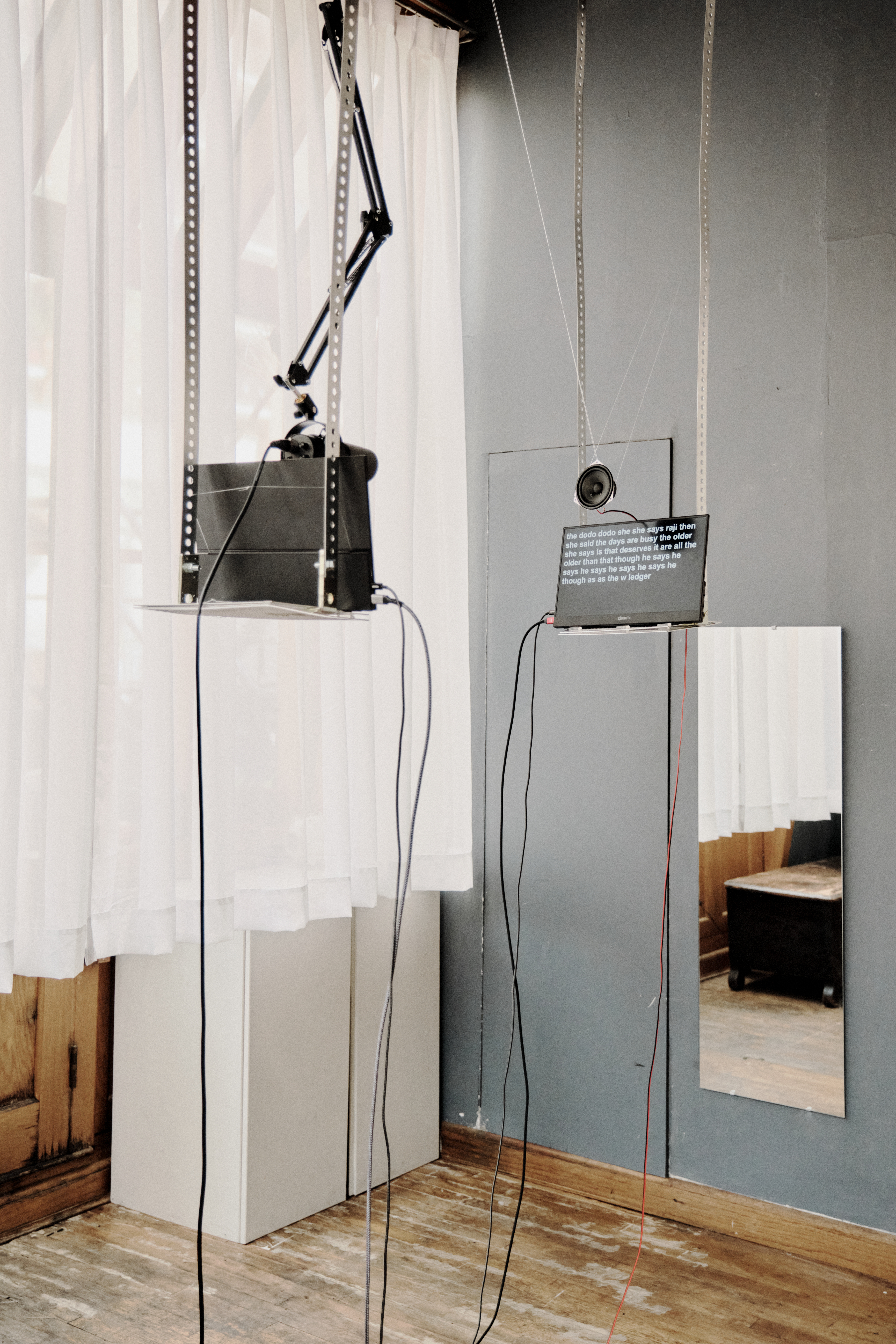
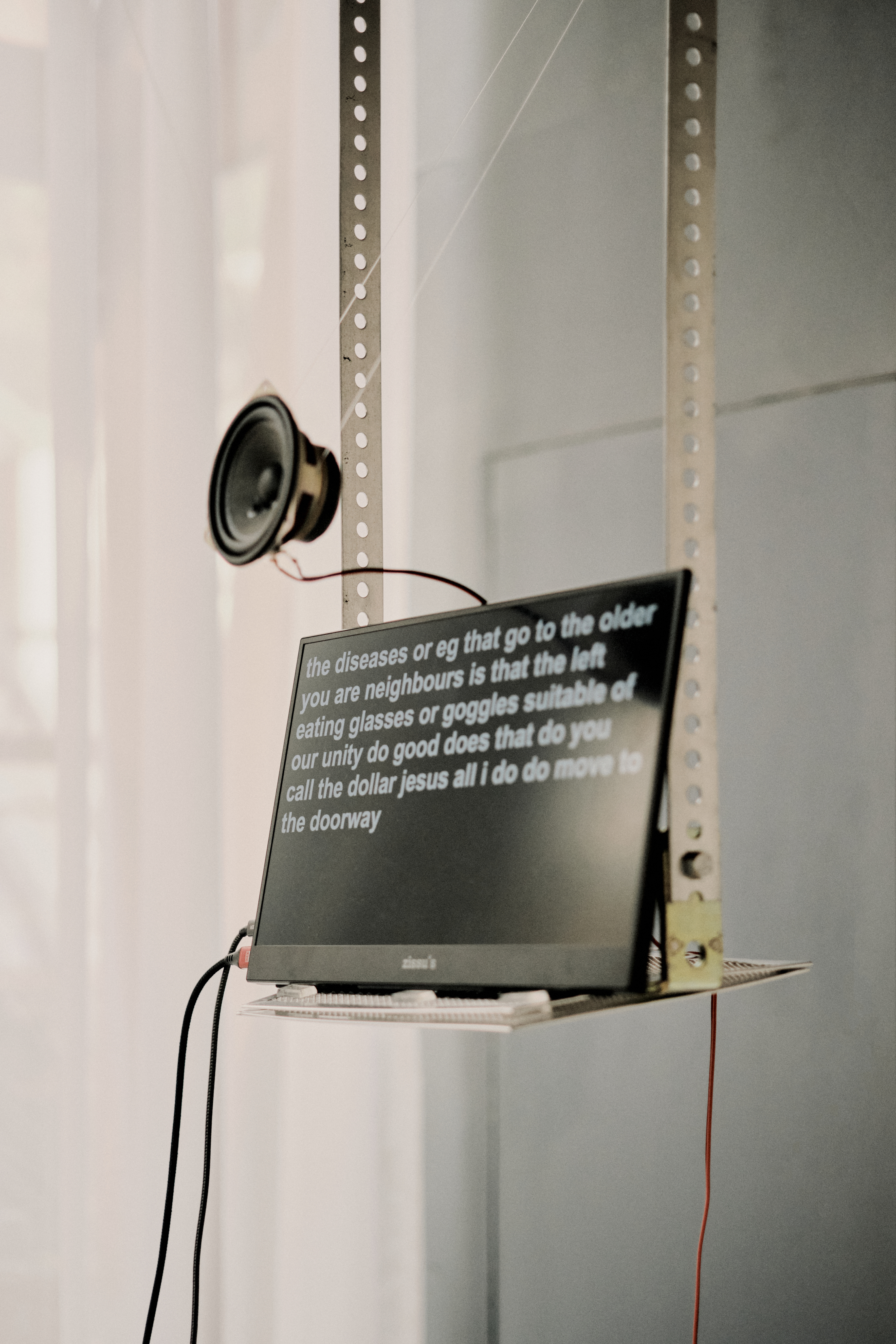
Komiya’s installation centers on a conversation between two computer systems. Two monitors face each other, one paired with a speaker and the other with a microphone. One computer reads English texts aloud with Japanese pronunciation, while the other detects the sound and transcribes it back into English. As a result, the spoken text is interpreted differently. The text is then automatically corrected by the computer system, read aloud, and captured again, producing an endless cycle of listening, transcription, and reinterpretation. Visitors are welcome to interrupt this feedback loop by speaking into the microphones. Their voices enter the system and become part of a chain of misunderstanding and new songwriting. The resulting transcription on screen looks like a strange machine-written diary, filled with nonsense and humorous sentences. Familiar phrases are paired with unexpected words, while shifting tones and rhythms create glitches that draw the mechanical voice closer to singing. Its errors become a form of composition, calling to attention the dissonance between what is spoken, heard, and understood.
Installation view of The Cave of Tongues, 2026. Photo: Anna Arnet. Courtesy of the artists.
Komiya’s background in experimental music is evident in his attention to the physical qualities of voice: pitch, tone, rhythm, and pronunciation. Instead of focusing on semantics—the meaning conveyed through words—the work emphasizes the sonic qualities of language. When different linguistic systems encounter one another, they clash and unify, creating unexpected relationships between sound and meaning. Misinterpretation becomes a generative process where new associations continue to evolve.
Installation view of The Cave of Tongues, 2026. Photo: Anna Arnet. Courtesy of the artists.
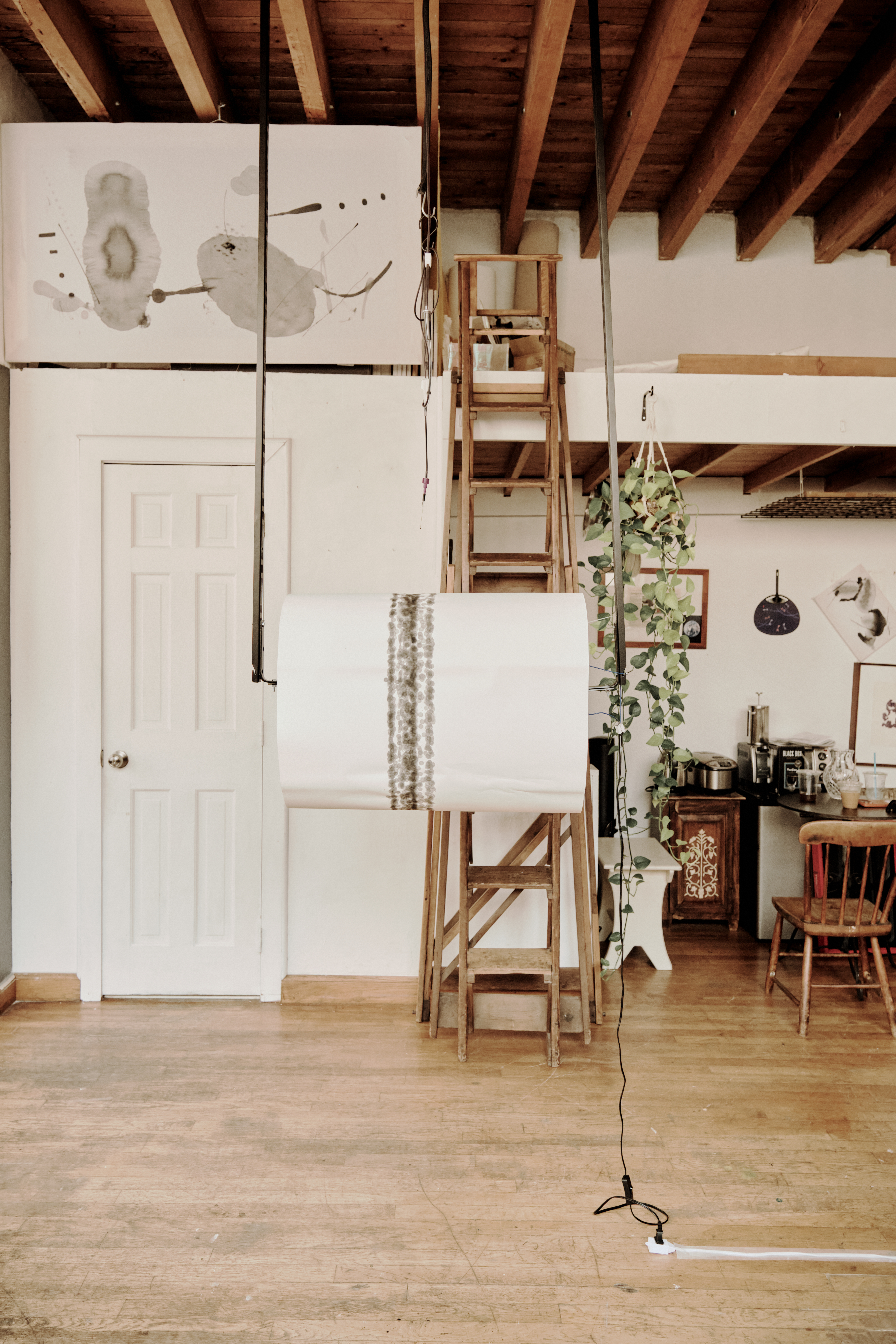
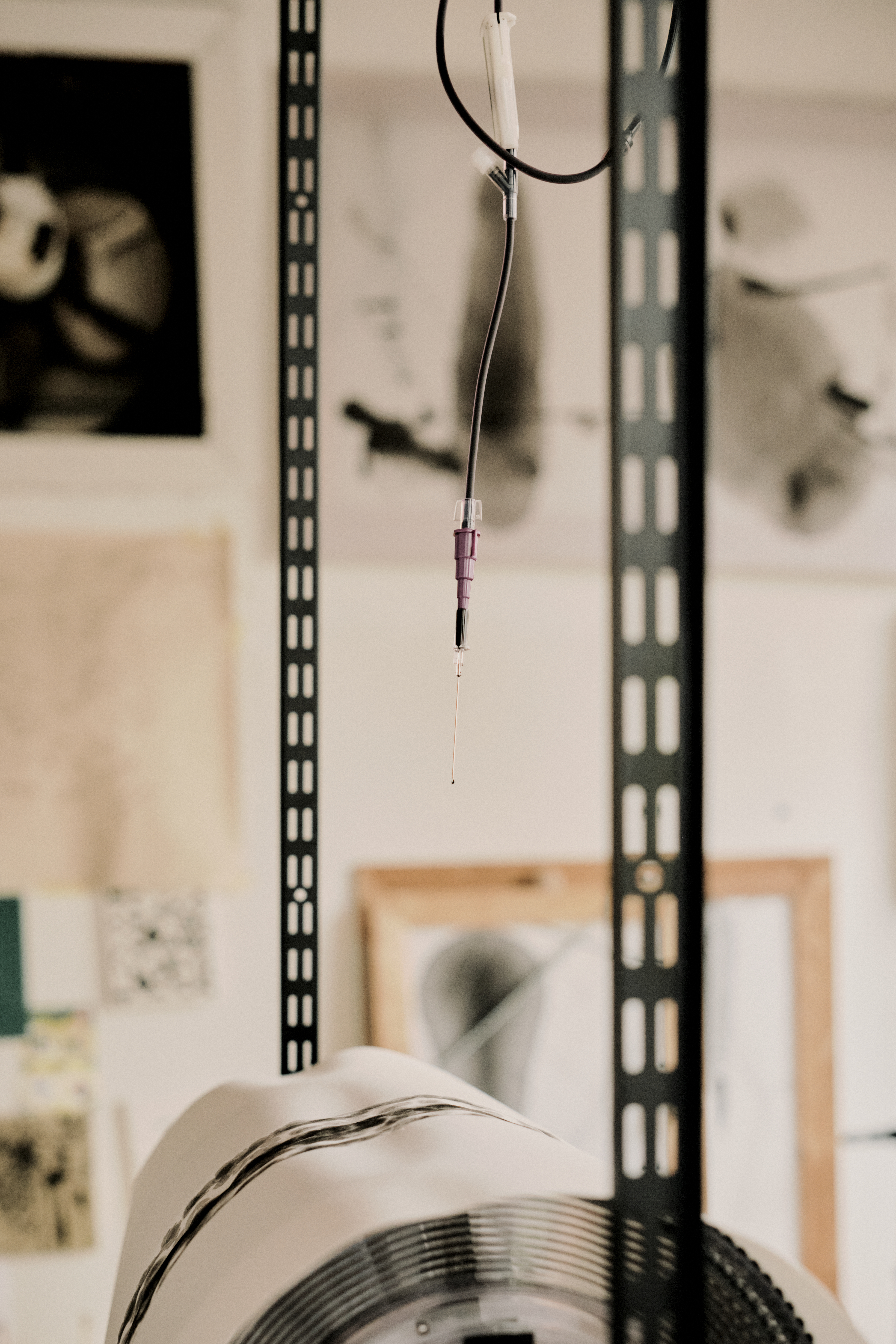
Next to Komiya, Shimomura’s kinetic installation is composed of a long calligraphy scroll continuously rotating in through an automated process. Above the paper hangs a bag of black ink, functioning like a medical IV drip, slowly releasing ink through connected tubes before dropping onto the moving surface below. Over time, the machine, i.e. instrument, produces a series of spots and blotches that recall a constellation map or landscape painting created through chance and randomness. Some areas of the scroll are darker with overlapping layers of ink, while others only leave faint traces and scattered splashes. The work recalls Jackson Pollock’s action paintings, but here the expressive gesture of the artist’s hand is replaced by a machine. The instrument becomes the performer, creating language through forces beyond human control: wind, temperature, climate, and gravity.
Shimomura’s work questions the forms that writing can take. She separates calligraphy from its conventional relationship to readable text, instead exploring the spatial and temporal qualities of writing itself. Similar to tracing the trail of a star, her work documents the way movements create marks, notations, and rhythms over time. Like strings on a harp, wires and coiling springs attached to silkscreens become musical instruments activated through her performance. She expands calligraphy beyond writing or the visual representation of comprehensible language, transforming it into an accumulation of material events.
Installation view of The Cave of Tongues, 2026. Photo: Anna Arnet. Courtesy of the artists.
At a time when artificial intelligence and voice-recognition technologies aim to correct speech and eliminate misunderstanding, The Cave of Tongues embraces the imperfect and unresolved qualities of language. Like a children’s telephone game, sound and meanings become altered and distorted through repetition, while writing becomes abstract through the removal of a singular authorial gesture.
The Cave of Tongues considers language as a living structure constantly transforming through encounters between humans, machines, and natural forces. It reveals the creative possibilities within technological glitches — moments of interruption when communication breaks down and something unexpected begins.
Installation view of The Cave of Tongues, 2026. Photo: Anna Arnet. Courtesy of the artists.

Gladys Lou
Gladys is a curator and writer currently pursuing an MA in Curatorial Studies at the Center for Curatorial Studies, Bard College. Her critical writing and journalism have been published by ArtReview, ArtAsiaPacific, Public Parking, Peripheral Review, Studio Magazine, Femme Art Review, Ornamentum, The AMP, and Impulse Magazine.
view all articles from this author