Whitehot Magazine
September 2026
"The Best Art In The World"
"The Best Art In The World"
September 2026
“Propaganda At Work:” A Conversation about Language and Dadaism with Judy Lichtman
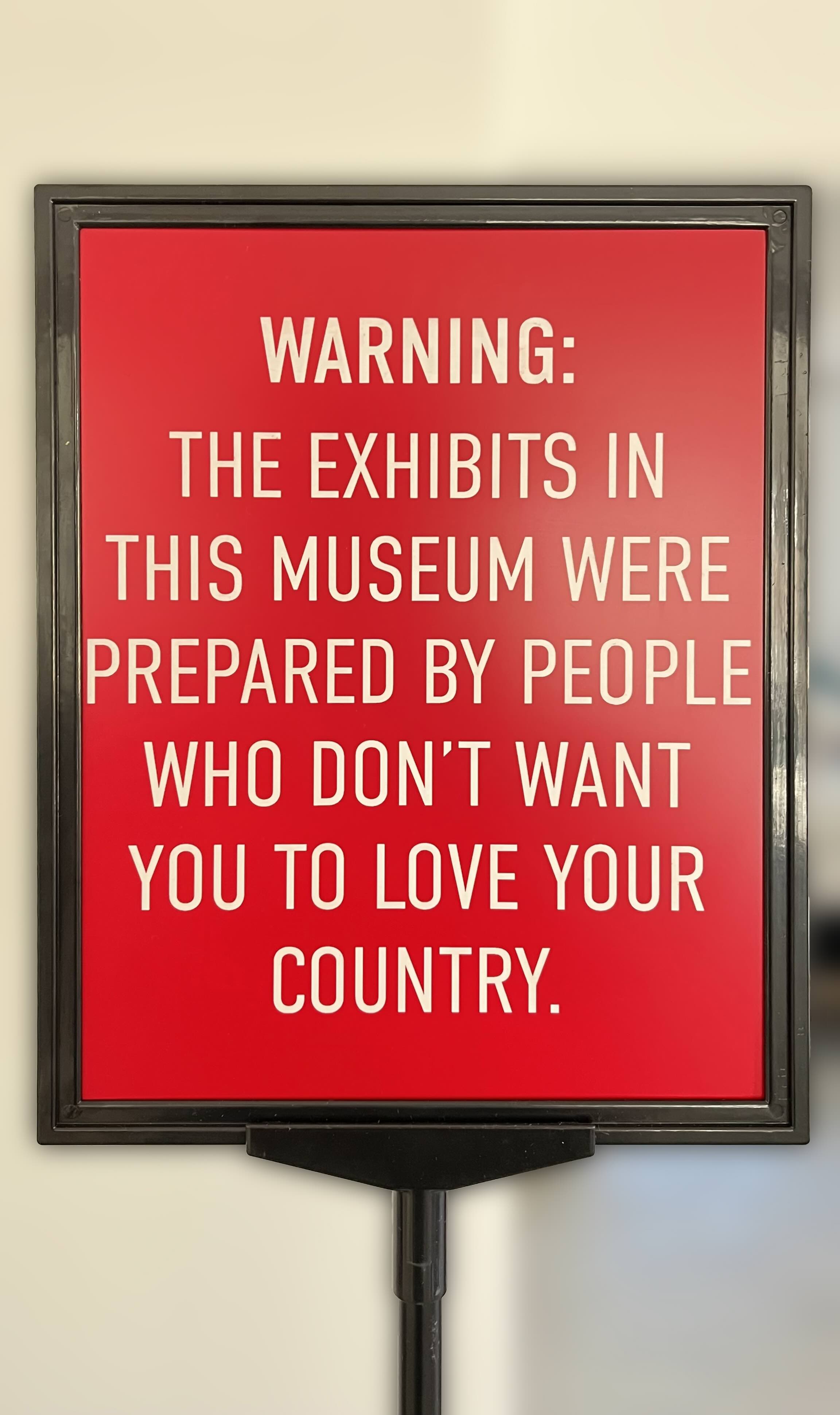
Smithsonian Warning Sign, 2026
Engraved Plastic Sign, Metal Floor-Standing Sign Holder
Photo credit: Judy Lichtman
BY EMMA CIESLIK September 18, 2026 at 6:44 pm EST
Based in Joshua Tree, California, Judy Lichtman’s art explores the power of language in the context of authoritarianism, namely who determines the meaning and enforcement of words in fascist regimes. She received her BFA from the MICA and an MA in Industrial Design from San Francisco State University, and prior to her present explorations, she worked for 30 years as a graphic designer. This career informs how she stretches, warps, and rearranges words--modulating in every way imaginable--to attach meaning to or strip language we know and recognize of all meaning. Her series MAR-A-LAGO, ETC. situated words whose letters split into three vertical columns over black and white depictions of hidden documents, including the Epstein files, and Trump himself.
One of her most powerful projects called Rogue Signage involves creating and placing aluminum signs warning about the reality of fascist empire-making, including propaganda, roving patrols (ICE), and detention camps. After learning about this ongoing project, I sat down with Lichtman to learn more about what inspired this collection and what she hopes to convey.
Emma Cieslik: Would you mind please introducing yourself however you feel comfortable?
Judy Lichtman: I am an artist based in Joshua Tree, California, which is in the Mojave Desert, and for the last 30-plus years, I’ve been a graphic designer. In 2020 when COVID hit and there was political unrest and racial division, I had just spent decades creating work that was effective, clear communication. I looked around me, and the world was unraveling in chaos, and my reaction to that was--after the despair set in--to protest by using nonsense and irrationality, right? So while the work is political and does address authoritarian issues, it really comes out of language and Dadaism. That’s my impetus, and to some degree, it started as a complete rejection of the job I had just been doing for 30 years. That’s how I am a fairly new artist to some degree.
Not too long ago, I uncovered an amazing thing while I was online doing some research on my family. I found out that my mother’s first cousin had a direct connection to Dadaism. I knew of this cousin, although I never met him, but I knew nothing about this part of his life. As a student at Caltech in the 1950s, he became involved with Lettrism, which comes from the French word for “letter”—of all things! The movement had its roots in Dada and Surrealism and involved experimental film, poetry and art. He worked on a film that separated the soundtrack from the imagery and physically scratched into the film itself. It was shown at Cannes and won an avant-garde prize. When I learned of this, I had already been developing my own practice for a number of years, so while it wasn’t my inspiration, somehow it did make a weird kind of sense.
Cieslik: You share on your website that while working as a graphic artist, you also kept making art on the side. How did a background in graphic design inspire and/or inform Rogue Signage? One of your pieces that seems the most resonant is a glowing sign of Target’s red target logo with the word “Regret” underneath. How is your criticism of capitalism and worker exploitation also folded in Rogue Signage?
Lichtman: It’s funny that you pulled out the Target thing because that work is almost 10 years old, and all that work I called Signage 2.0. I basically took language and contrasted it or used it against digital signage. It’s so funny because I didn’t think about it until you brought it up, but it really relates to what I’m doing now, and that one in itself explains how sort of my impetus is less about the political. It’s more that all of the work is when language begins to, the meaning of words, begins to slip, and you don’t really understand. You see one thing, and it means something else. That one in particular is really just a visual pun. I think the political reads are still there, but the impetus is less activist work and more about exploring the effects of language and [what happens] when language breaks down.
In terms of being a graphic designer and how it influenced the Rogue Signage now, when I first started making the work, I wanted to push the graphic design away, reject it, and have a clean break from it altogether, so I was mostly making work with black ink on gridded vellum for years. It was sort of a rejection of graphic design. I wanted to use my hand which was very out of practice, and I was very resistant to use design. Now, the signs are obviously very different. They use all the tricks of graphic design, and that’s what allows them to become rogue because the graphic design is what fools you into believing they’re real signs. When you approach them, they play with you, and so it’s the graphic design skills that allowed me to pull off this act and let them go rogue, as I say.
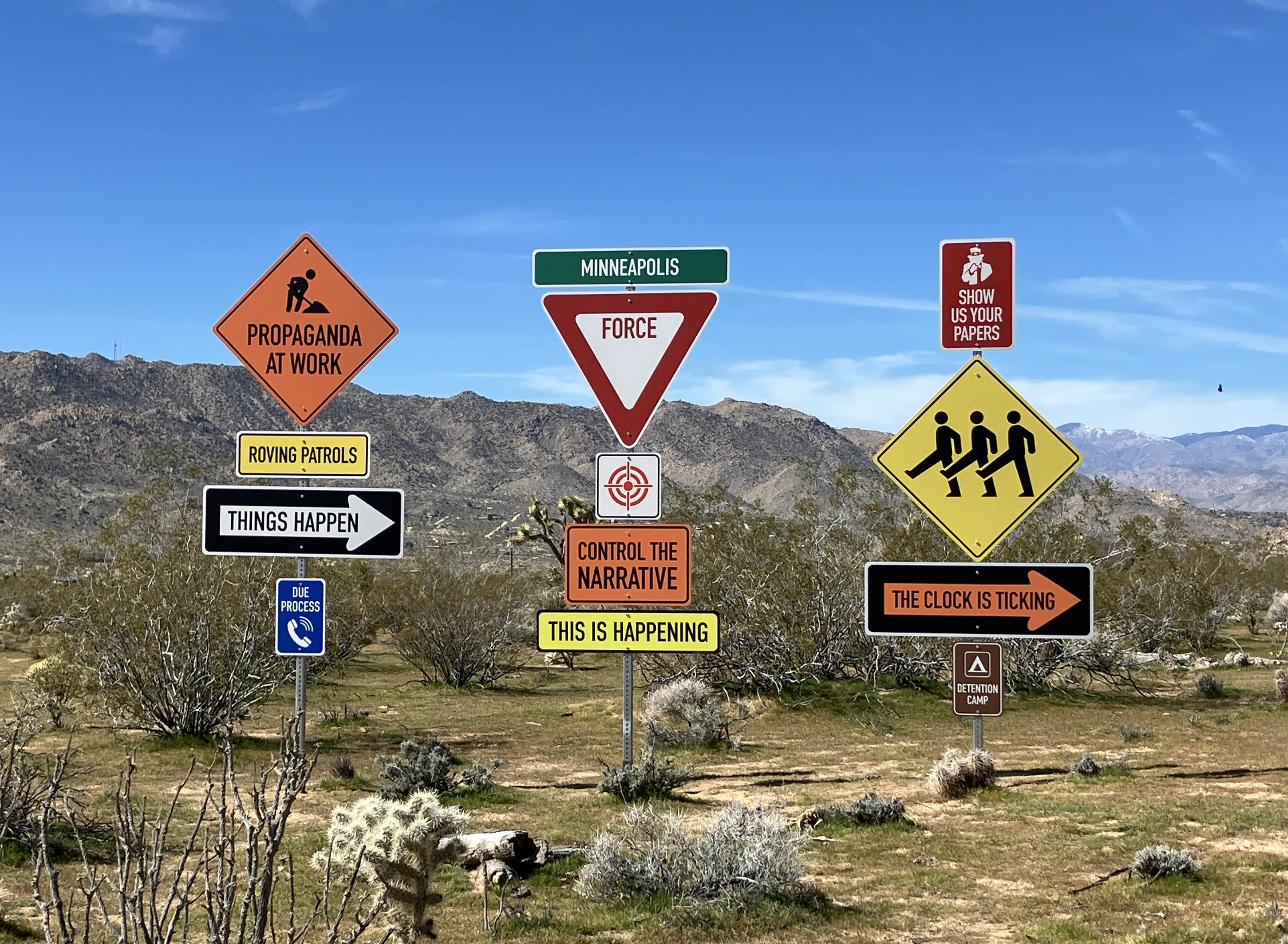
Propaganda at Work (Minneapolis), 2026
Reflective Aluminum Signs, Galvanized Steel
Photo credit: Judy Lichtman
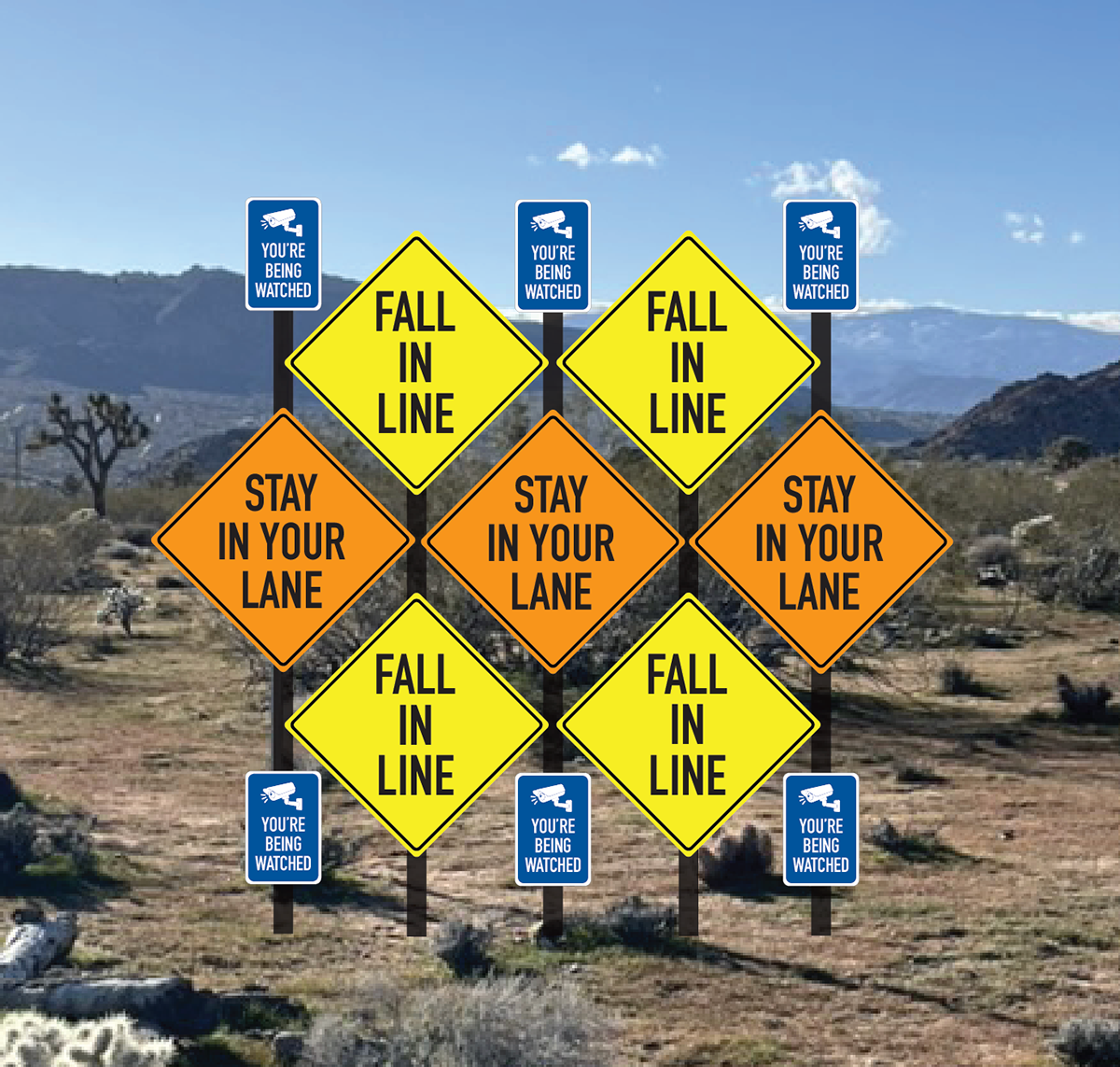
Cieslik: Your piece Discourse also features icon-style talking heads on signs in the desert. Was this the first time that you created and installed signs in this space? What is the intention and impact of situating these signs in the desert? I especially think of the one that warns people they are being watched in the middle of the desert. The signs are incredibly shocking against the bare but beautiful landscape.
Lichtman: The desert is obviously really important in my work. In 2019, we were living in Los Angeles, and we bought a house out here. We were working on it and driving back and forth a lot, and we kept seeing this thing that I knew was art. It looked like a giant glowing orange box had just landed in the desert. I was like: What is this? It was a Sterling Ruby piece, and we drove to the piece. The experience was amazing because the desert itself adds so much. I’ve seen art all over the world, in all different galleries, outside, whatever, but when you see art in the desert, you have to drive to it, you have to go down dirt roads, you don’t know where you’re going, and so we drove to this glowing box. There was a really strong warm wind, and the sand was blowing, and this thing was glowing. It made our skin glow orange, and it kind of blew my mind. I thought I have to figure out how to do this, how to put art in the desert like this.
That’s always been in the back of my mind that I needed to figure out a way to do that. After we saw that piece, I started working on something I was calling 100 Signs in the Desert. It never came to fruition. It was just something I had been thinking about, and so years later, I opened the file and I rejected 99 of the 100 signs, but the one sign that lasted was Discourse. That is the first time I did a sign. I put it outside, and we had an open studio. People came, and they kind of all organically were like, ‘can I go have a primal scream at that sign?” So many people walked up to it and had a different performance, and they just screamed. Clearly people needed to get it out, so it kind of took on a life of its own, which was fun.
I mean for Rogue Signs now, the desert is very important, and part of it is that the signs function because they’re disorienting and a little destabilizing. The desert does that all on its own, so I feel like it’s helping me do that. It’s helping me do that. You don’t know where you are. You don’t know why they’re there. I feel like in the city, they would probably function but just in a very different way because they would not have that disorienting feeling. That’s part of what I think makes them function.
Cieslik: Your Rogue Signage reminds me of a similar example in Philadelphia created by an anonymous artist named Make It Weird. These signs were affixed to actual official street sign posts whereas yours appear in the middle of the Mojave Desert. How is this both different from and similar to what you do, especially as you mention context?
Lichtman: I guess where they’re different is I think their motivation is more activist, and my motivation is more purposeful disorientation, of uncertainty of what’s going on, destabilizing everything. It’s less activist. It’s less guerrilla art, and honestly, it’s just more like sculpture. It’s part of the absurdity because it’s like: why is this out here? And the one that’s like, “fall in line,” and “you’re being watched,” you’re like who is telling me to do this? And then you look around, and it’s just nature. Nature is like I don’t care about your signs. It’s funny.
There are also issues of land ownership. All of that kind of comes into play in the desert a lot. Whose land are you on? What does it all mean? Who has the authority on the land? Who’s got jurisdiction? Jurisdiction, freedom of speech, property rights, they all kind of overlap, and I like playing with those ideas.
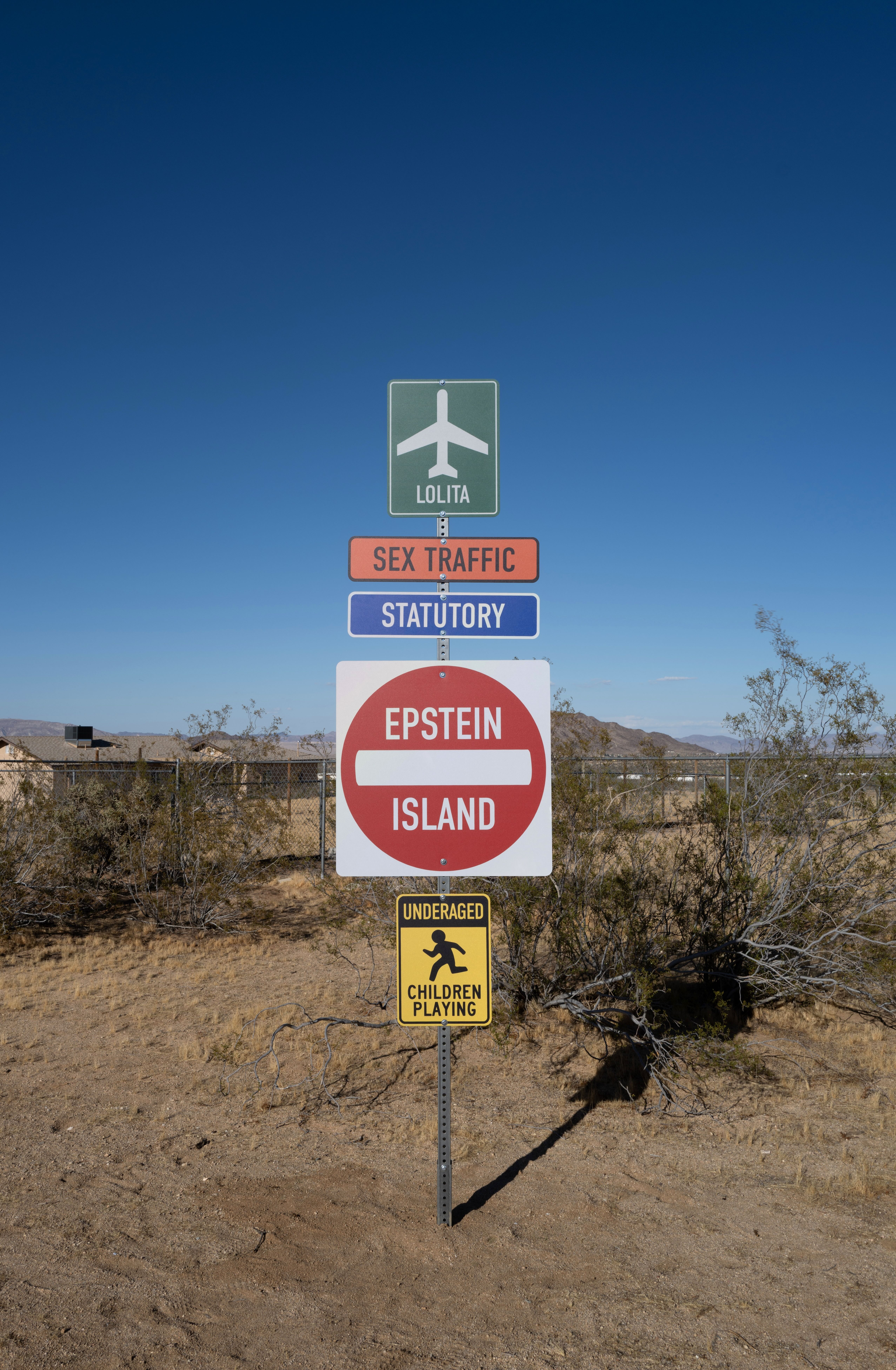
Epstein Island, 2026
Reflective Aluminum Signs, Galvanized Steel
Photo credit: @rd_granados
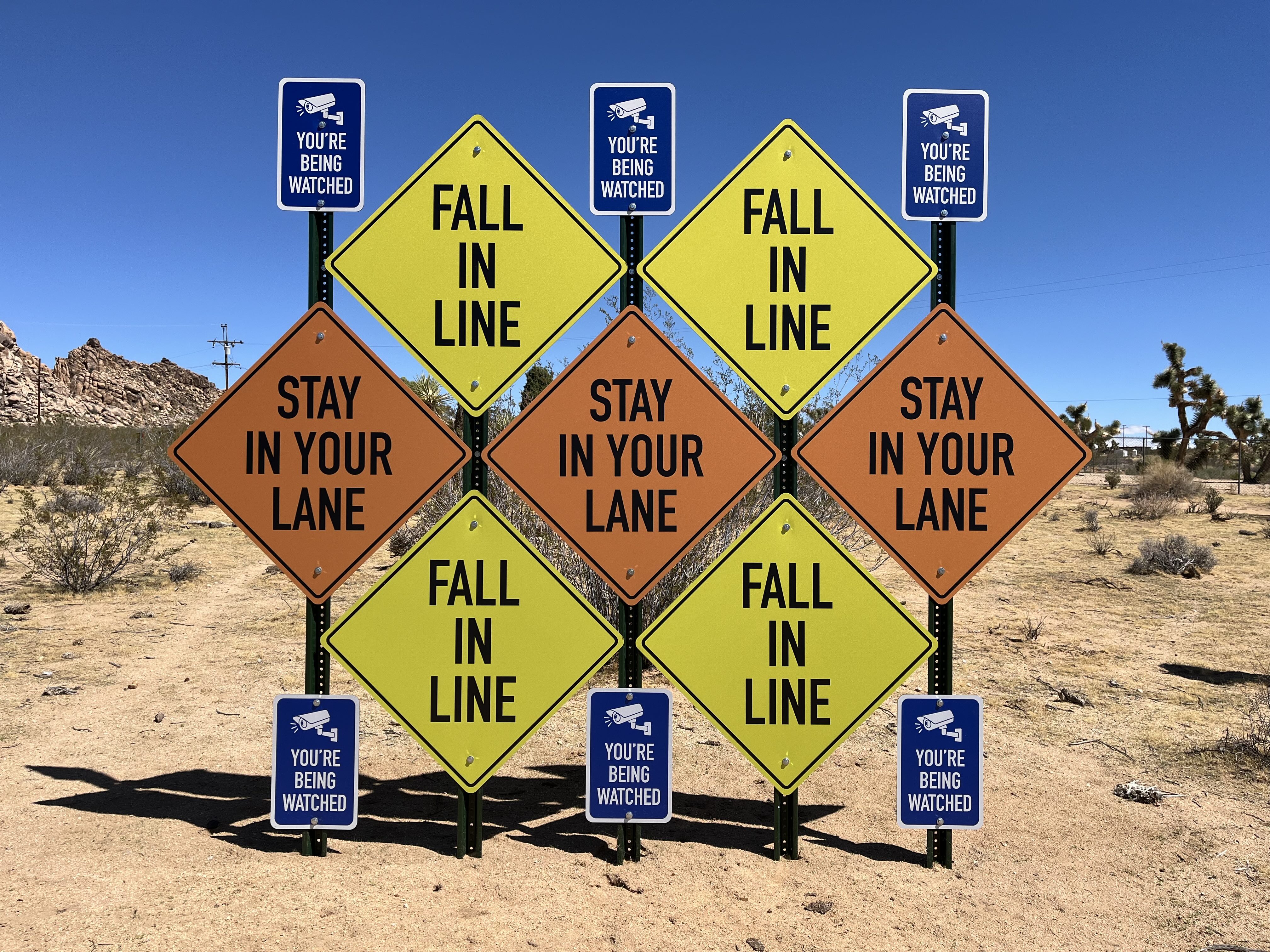
Fall in Line, 2026
Reflective Aluminum Signs, Galvanized Steel
Photo credit: Judy Lichtman
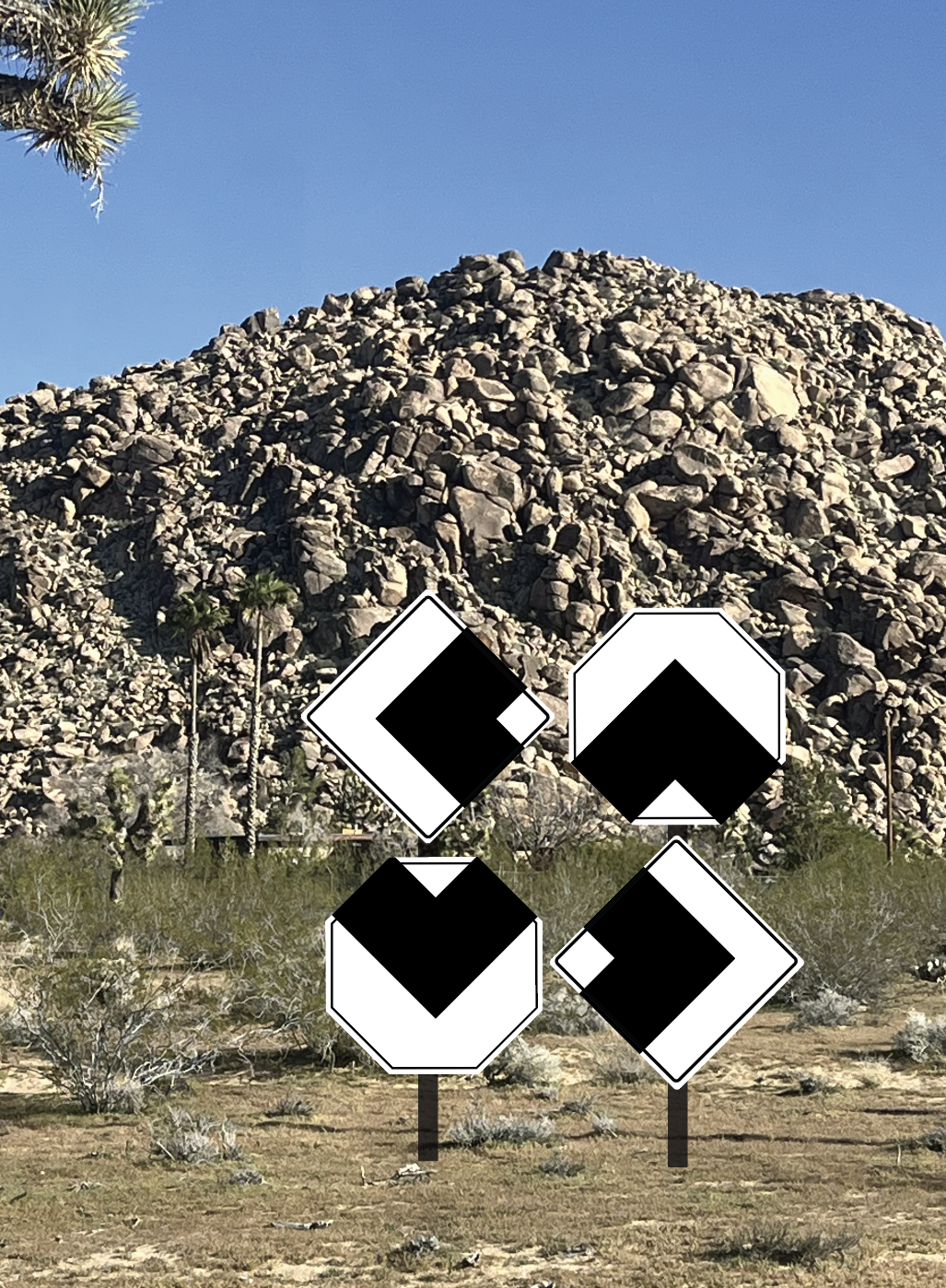
Cieslik: Your signs also refuse to mince words about what is happening, especially your piece created with four signs (two eight-sided signs and two four-sided) that includes a broken swastika, and your sign post depicting a big red circle with the words “Epstein Island” underneath two signs reading “Sex Traffic” and “Statutory” and above a sign reading “Underage Children Playing.” What is the power and importance to break down complex movements to their barest and most bestial realities?
Lichtman: It’s interesting you say I don’t mince my words because the signs are rogue in that they play tricks on you, and sometimes they say exactly what they mean and sometimes they say the exact opposite of what they mean. It depends on how I want the phrase--I don’t know if I even said this. Almost all of the text I use is found. It’s not coming from my voice. I can use it in different ways, and the words aren’t minced, but they trick you sometimes or I hope they do.
I guess in terms of the swastika, that’s a piece that is 40 years in the making. I never intended to make it in that when I was in art school in the 1980s, there was a lot of discussion about taking responsibility for the symbols and the imagery that you put out into the world, and the number one taboo thing was a swastika. That’s how it was for a lot of years. But now I look around and I see fascist, authoritarian behaviors, and you see swastikas pop up all over the place. Now you see it all the time, and I realized that by breaking it down into these deconstructed forms, essentially, and using municipal signage, it just left the gestalt of this swastika.
It forces the viewer to fill it in, and if the viewer fills it in, I’m not going to say they’re culpable, but they participate in the making of the swastika, so it’s kind of disturbing that way. The piece is full of ambiguity. You look at it and say: does she support this? Does she not support this? Does she even know what’s happening? But I think that the ambiguity is what gives the piece a lot of that anxiety that you don’t quite know what it means or why you’re looking at this? Even for me, it’s a scary piece.
Well the funny thing actually is that many people don’t actually see the swastika. I know it’s kind of crazy, but I’ve had people go, and they sort of see it as just arrows because I have another piece with arrows, so I think they tie that together. It’s still, for me, a difficult piece, but I like art that challenges me. Even my own art can do that.
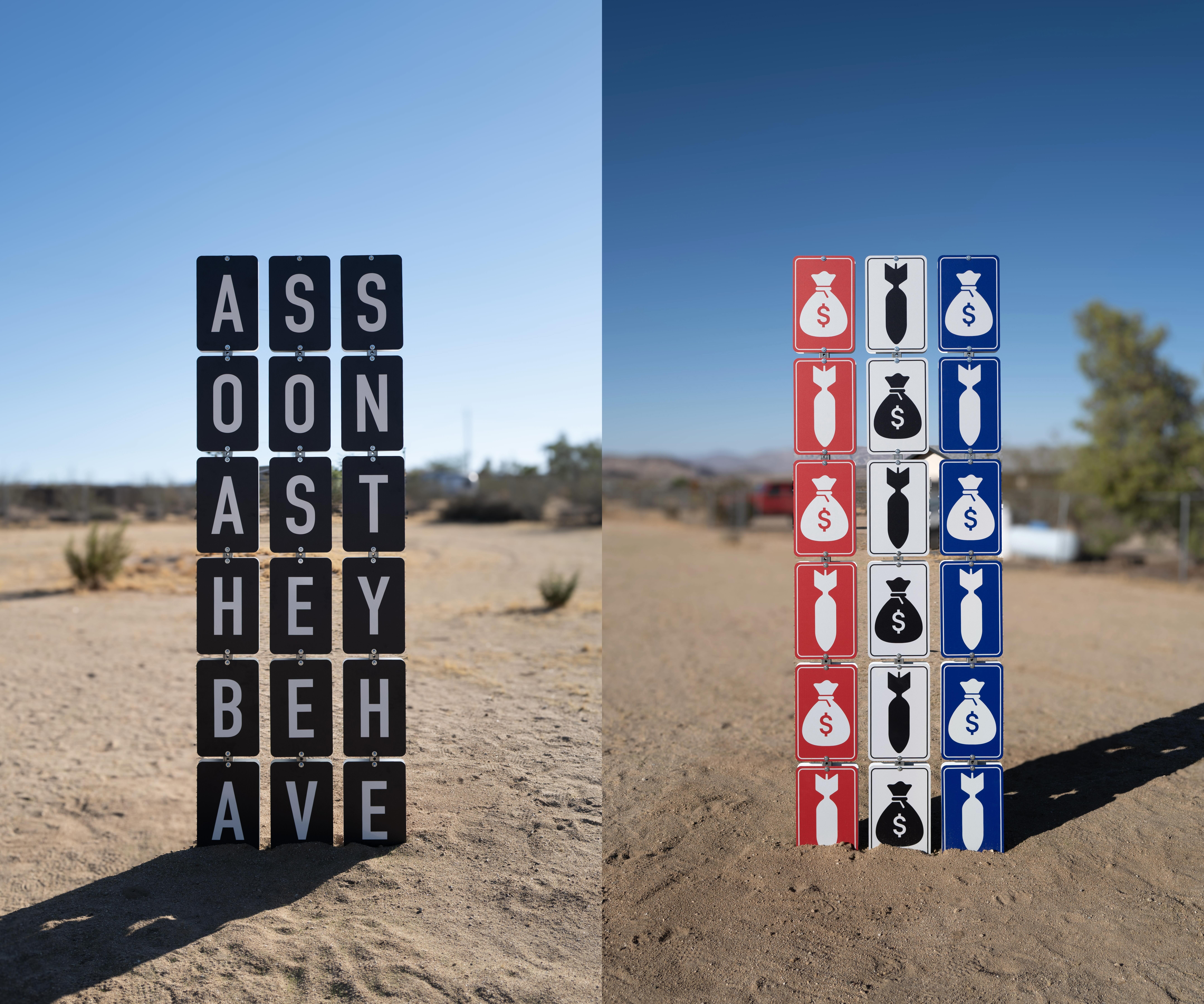
MoneyBomb (As Soon as They Behave), 2026
Reflective Aluminum Signs, Galvanized Steel
Photo credit: @rd_granados
Cieslik: Your new exhibition RAGER opened this past weekend. At the heart of the new show is an examination of rage. How is your practice of creating these signs part of processing, experiencing, and using this rage? What do you hope people who come across your art take away from it?
Lichtman: So the way these signs came about is I purposefully expose myself to some very dark, difficult material. I find like the hottest of the hot potatoes, and I gather language in different ways about these hot potatoes, and then I sit on them so that it kind of distills down. I lose some of that anger and rage, but it still remains a hot potato underneath all that, and so I then figure out what language I need to use without the rage overpowering it. I think it still maintains the resonance of the hot potato, but it’s rage that’s served cold. It’s very cold, and it reads that way. That’s part of this whole feeling that you get from them in terms of what I want people to take away. I want people to kind of be woken up, awakened a little bit, shaken awake a little bit and forced to see things differently, especially things that are very familiar in their lives that they don’t look at very carefully.
I’ve had people come see the signs, and they tell me that when they go driving home or whatever, they see the signs differently in the desert. I mean, there are lots of signs in the desert, and they stand out, but now hoping that you might look at them differently because you’ve been shaken, I guess I’ll say.
Cieslik: I am especially excited for your new piece titled Smithsonian Warning Sign, reading: “Warning: The exhibits in this museum were prepared by people who don’t want you to love your country.” It references the text the Trump administration demanded to be placed outside the Smithsonian museums. How does this evoke and visualize your rage?
Lichtman: This piece made itself obviously. A friend of mine who’s an artist sent me a podcast, so I listened and the woman was talking about what the Trump administration was doing to all of these DC institutions. Since I grew up in D.C., these things are very near and dear to me, and I heard her read the warning. I was just kind of stunned and enraged. Every time I read it, I am enraged, but I thought, I have to make this. It hasn’t been made. It doesn’t exist yet. We don’t know what it’s going to look like, so I envisioned it like a Roy Rogers McDonald’s caution wet floor sign. I made the sign and I didn’t know how timely it would be.
It’s my little protest because I feel like what can you do? What can one person do? It’s hard to know.
RAGER will be on display at Goat (1025 Singer Tree Road, Landers, CA 92285) through October 18. Along with Lichtman, other featured artists include Alice Clements, Carlos Ramirez, Ichiro Irie, Alice Lang, and Macha Suzuki, curated by Nicola Vruwink.

Emma Cieslik
Emma Cieslik (she/her) is a queer, disabled and neurodivergent museum professional and writer based in Washington, DC. She is also a queer religious scholar interested in the intersections of religion, gender, sexuality, and material culture, especially focused on queer religious identity and accessible histories. Her previous writing has appeared in The Art Newspaper, ArtUK, Archer Magazine, Religion & Politics, The Revealer, Nursing Clio, Killing the Buddha, Museum Next, Religion Dispatches, and Teen Vogue
view all articles from this author