Whitehot Magazine
October 2026
"The Best Art In The World"
"The Best Art In The World"
October 2026
Sweat. Clack Clack. Torrential. On Jamie Martinez's My Mother's Labor: The Machines at GHOSTMACHINE Gallery
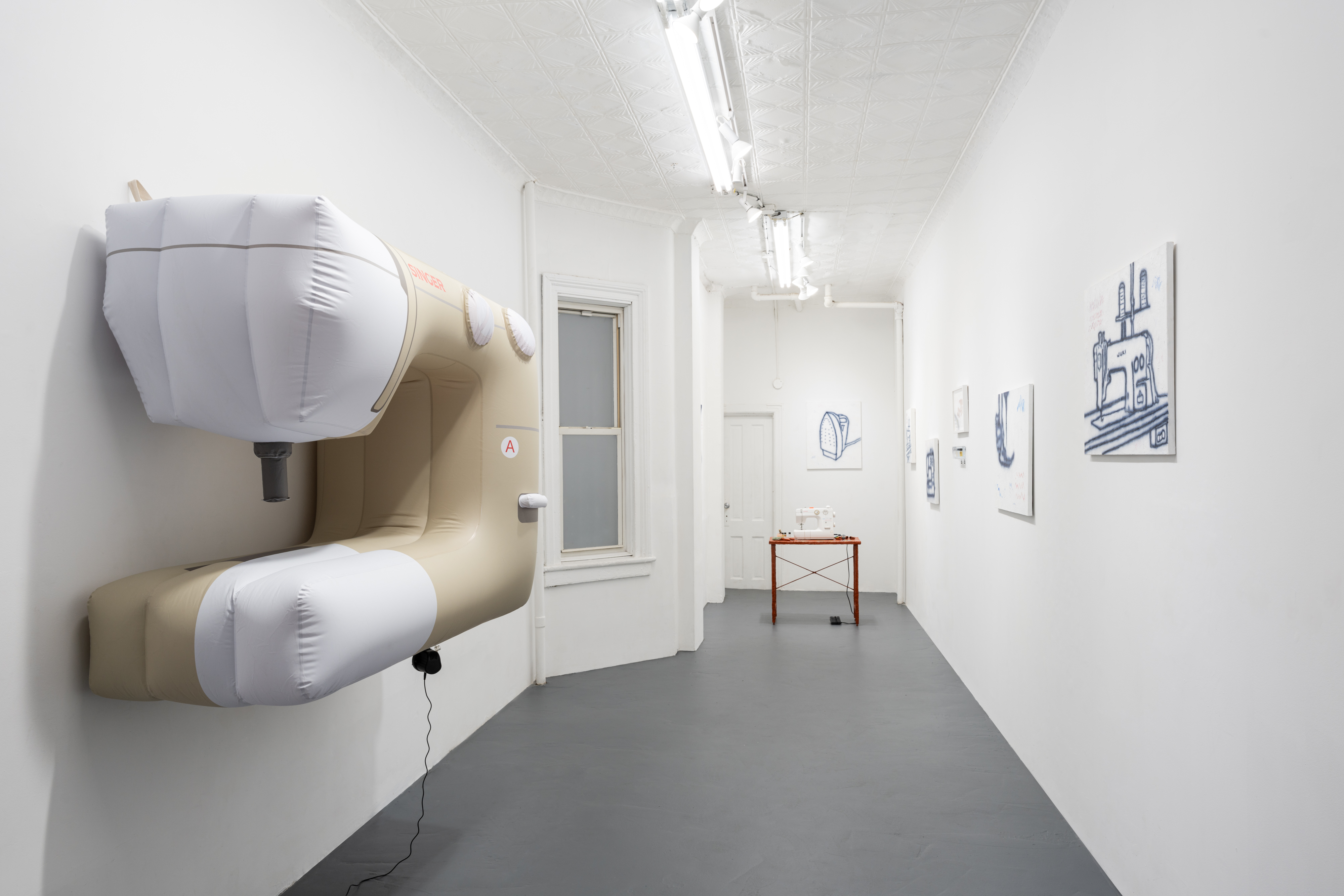
Installation image of Jamie Matinez, My Mother’s Labor: The Machines; GHOSTMACHINE Gallery, New York. Image courtesy of GHOSMACHINE Gallery and the artist.
BY RUI JIANG June 10, 2026
Upon entering GHOSTMACHINE, one first encounters a premonition of sound—the white sewing machine sits silently upon a clay desk, ready to speak at any moment. Immigration. Mother. Sewing machine. Labor. The abyss of a mother's breath and the predicament of immigration roll from the hoarse exhibition text onto the tongue. They have rolled past too many times already, similar linguistic landscapes, like my own. As though they no longer cut. I thought I could stand calmly before this white Singer sewing machine, carrying only the distant column of my own diasporic breath, bearing merely an intention of consolation.
I was not prepared.
 Installation image of Jamie Matinez, My Mother’s Labor: The Machines; GHOSTMACHINE Gallery, New York. Image courtesy of GHOSMACHINE Gallery and the artist.
These sewing machines: The inflatable one, representing the factory in Colombia owned by Jamie Martinez's mother, was one among hummings of machinery; then the real Singer machine, purchased after they immigrated to the United States, was the heartbeat through which an entire family resisted dispersal. It has witnessed the stitching together of sustenance, and also the quiet unmaking and re-stitching of identity through every seam. The hissing and whirring of the sewing machines carry, both naturally and absurdly, the serenity of a mother, like a rushing stream, lulling one to sleep, reverently keeping time with the pulse. Yet that sound comes from those wrestling within desolation, those carrying their own language and forcing roots into the crevices of foreign stone. Chiseled into place, bearing wounds and soil, bearing meagre and forever-undone vocal exercises.
The second performer, the inflatable and deflatable Singer sewing machine replica, My Mother's Labor, La Estrellita 2, composed of PVC, canvas, and blower, expands and contracts according to the rhythm of a timer, resembling—as the curaor Emireth Herrera Valdés writes—a pair of exhausted lungs. It is the apparition of the original object, a lightweight replica of tangible memory, a residue of those things that cannot be carried away amidst diasporic experience. When the blower roars, the sound carries a clumsy fervor, speaking that which a lifetime has found no time to say. Yet when it deflates, gradually going limp and collapsing against the wall, it resembles a weary body that has finally found support to rest upon. Martinez lays bare before you the rise and fall of breath and the politics of the body that breath carries within it. That pulsation is connected to the rapid drone of the motor, and to the resilience of survival, a mournful clamor. The machine's breathing is unstable. Every pause before inflation materializes, with undeniable honesty, structural suffocation on the level of matter itself. Breath is compressed from a necessary physiological phenomenon into a unit of political measurement. It is severed from the body. It detaches from the mother. When the blower begins, the sound is not merciful. It’s not even sad.
 Installation image of Jamie Matinez, My Mother’s Labor: The Machines; GHOSTMACHINE Gallery, New York. Image courtesy of GHOSMACHINE Gallery and the artist.
The humming continues to drift. Further inside, the main performer of the show, My Mother's Labor, La Estrellita, places the actual Singer sewing machine that raised them in the United States, upon a clay desk, modified with oil markers, a crystal with a brass owl, along with 3 important vials: oil, synthetic sweat, and a mixture of both synthetic sweat and oil for the sewing machine. Synthetic sweat is a cruel yet precise decision. Machine and sweat intermingle seamlessly. It is the sole trace left behind after the body's absence. As the remainder beyond your commodity value, it becomes a strange and utterly despairing artificial monument. And it is precisely this murky intimacy that ushers in a sorrow unable to exhaust itself.
 Jamie Martinez, My Mother's Labor, La Estrellita, exhibition My Mother’s Labor: The Machines; GHOSTMACHINE Gallery, New York. Image courtesy of GHOSMACHINE Gallery and the artist.
The Car pushes the narrative toward a bleak geographical dimension: a brown car, rendered in a child's hand, floats innocently and askew on the paper, while beneath it sit resin vials, containing synthetic sweat, motor oil and a mixture of both as one—the fluid of the vehicle and the fluid of the body juxtaposed within the same display frame, like two parallel forms of depletion. It is the memory of a mother rushing back and forth whilst managing the factory; a silent fossil into which the entire history of migration has been compressed; an extension of the image of the ‘machine’ into a broader geography of exile. Beside them, the painting series Juki 1, Juki 2, The Iron, and The Needle 2 continue to crouch above, executed in acrylic airbrush, oil pastel, and oil-based pencil, blue outlines meandering across white canvases. The medium of the airbrush itself carries a history of violence: it is a kind of industrial mass production, a language grown out of street economies. Like a blade of grass breaking through concrete, it arrives displaced — and yet somehow answers to the plaza woven from cloth, to the collective ground stitched together beneath absent hands. Martinez employs it to depict the machines beneath his mother's hands. Machines depicting machines. This gesture constitutes a bloodied dialectic: machines rewritten through the language of machines, labor remembered through the wounds of labor.

Jamie Martinez, The Car, exhibition My Mother’s Labor: The Machines; GHOSTMACHINE Gallery, New York. Image courtesy of GHOSMACHINE Gallery and the artist.
The exhibition remains stretched between two intimate yet mutually surging dimensions, much like a conveyor belt taut with anticipation as a machine prepares to start: one is an almost somatic intimacy with personal family histories, the other a lucid indictment of the structural violence inherent in the labor dynamics of migration. Martinez chooses to allow tenderness and desolation to coexist and wrestle within the same space, just as the inflatable machine is both the exhausted chest cavity of a mother and an industrial ghost that has devoured immigrant bodies, standing once again before us wearing skin. Within the creaking roar, the rootedness of diaspora stitches together the unassignable historical knots and muffled reverberations of a ‘whatever-topia’.
 Jamie Martinez, My Mother’s Labor, The Needle 2, acrylic airbrush, paint, oil stick, oil-based pencil, and oil pastel on canvas, 30 x 24 inches. Image courtesy of GHOSMACHINE Gallery and the artist.
When the timer is triggered, the machine begins again. The hum once more fills the entire narrow space, spreading across the blue paintings, settling heavily upon the viewer like a question unwilling to be withdrawn. Yet between one roar and the next, there is a hesitation. The air pump is slow to arrive. The machine holds its breath. The gallery descends into a silence so dense and so threadbare. The machine uses its remaining breath to chant, and the scattered fabric fragments manage to find themselves a small corner along the path of cloth, leading to a nameless, rootless nowhere. WM
Jamie Martinez: My Mother's Labor: The Machines is on view till June 13th at GHOSTMACHINE Gallery.
Rui Jiang
Rui Jiang is a Baltimore-based independent curator and writer. She holds a Master's degree in Curatorial Practice from Maryland Institute College of Art. Her research moves between semiotics, intimate gestures, and shifting dialogues, examining how art forms deconstruct and reconstruct within a polycentric field. She investigates the tensions embedded in exhibition-making—complicity, reflexivity, and the shifting power dynamics that shape artistic discourse. Through interdisciplinary approaches, she experiments with curatorial strategies that challenge linear narratives, embrace contradictions, and reimagine the relationships between artists, audiences, and institutions.
view all articles from this author