Whitehot Magazine
July 2026
"The Best Art In The World"
"The Best Art In The World"
July 2026
Exhibition Review: "Stan VanDerBeek: Micro Kosmos" at Magenta Plains, Chinatown
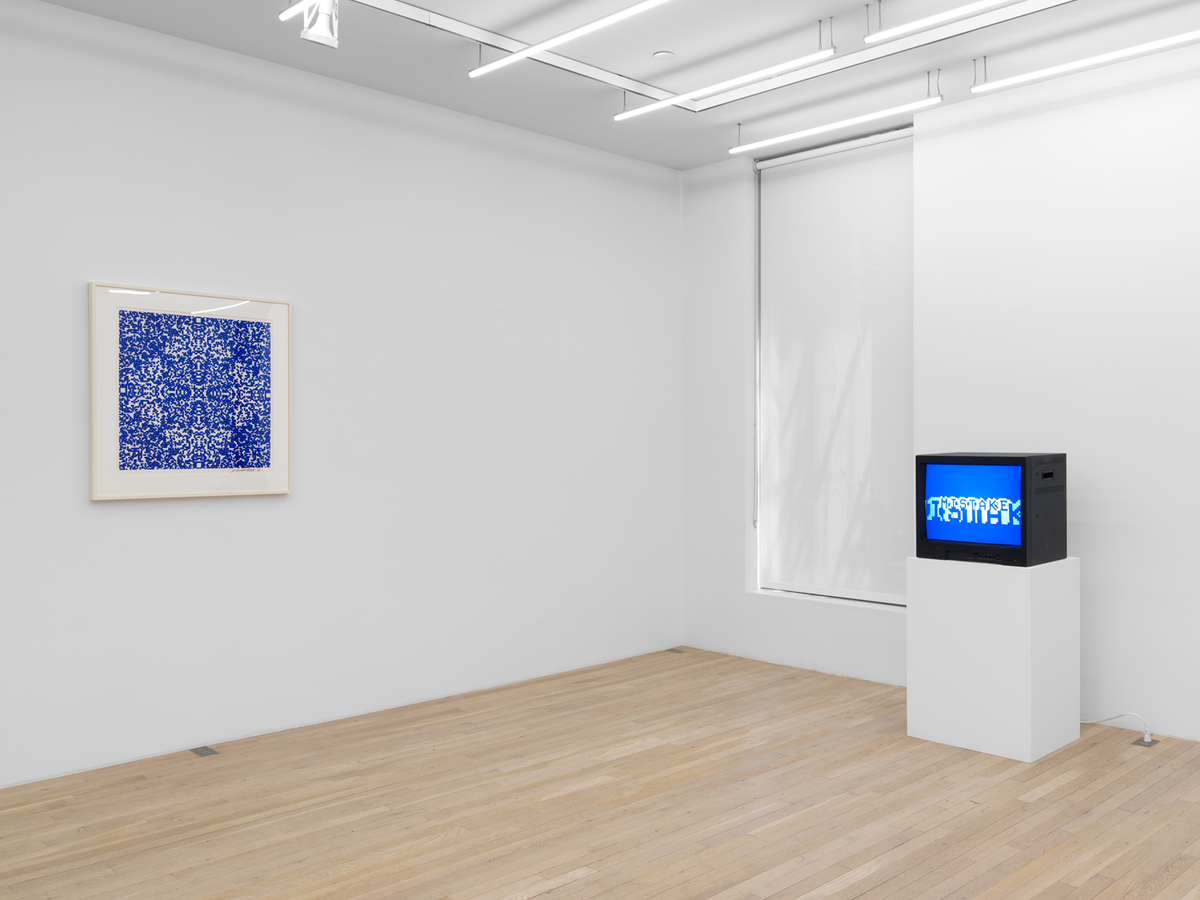 Installation view, Stan VanDerBeek: Micro Kosmos, Magenta Plains. New York, New York, 2026. Image courtesy of the gallery.
By LIAM OTERO July 14, 2026
The interrelationship between art and technology is hardly a new concept, for the origins of today’s queries on these two ideas are rooted in the 1960s. In conjunction with the strides made in the early days of computer technology, an entirely new area of art presented itself: New Media. The premise behind New Media was based on artists who adopted technology as the means through which they communicated, particularly film, analog video, animation, and other time-based modalities. Stan VanDerBeek (American, 1927 - 1984) was one of the artists of that decade who not only discovered potential in experimental filmmaking and computer art, but also in synthesizing these with the more established medium of printmaking; these creative strains formed the basis of a great exhibition on VanDerBeek’s works of the 1960s & early-1970s at Magenta Plains in partnership with the StanVanDerBeek Archive.
 Stan VanDerBeek (American, 1927 - 1984), Poemfield No. 1 (Blue version), 1967, 16mm film and Digital transfer, color, silent, 4:41 min, Edition of 6 plus 2 artist's proofs. Image courtesy of the gallery.
Micro Kosmos is an active reflection of what it means for an artist to grapple with advanced technology in a modern era where change is afoot in a startling rapidity that is difficult to keep pace with - a statement that screams true in describing our present age of uncertainty. The artificial glow of VanDerBeek’s 16mm film Poemfield 1 (1967) silently plays on a boxy television monitor while isolated words or phrases appear over a blue screen before dematerializing into animated grids. Poemfield 1 is an example of concrete poetry in motion where the computer generated animations of language appearing and dissolving into pixels is as much a poetic message as the text itself.
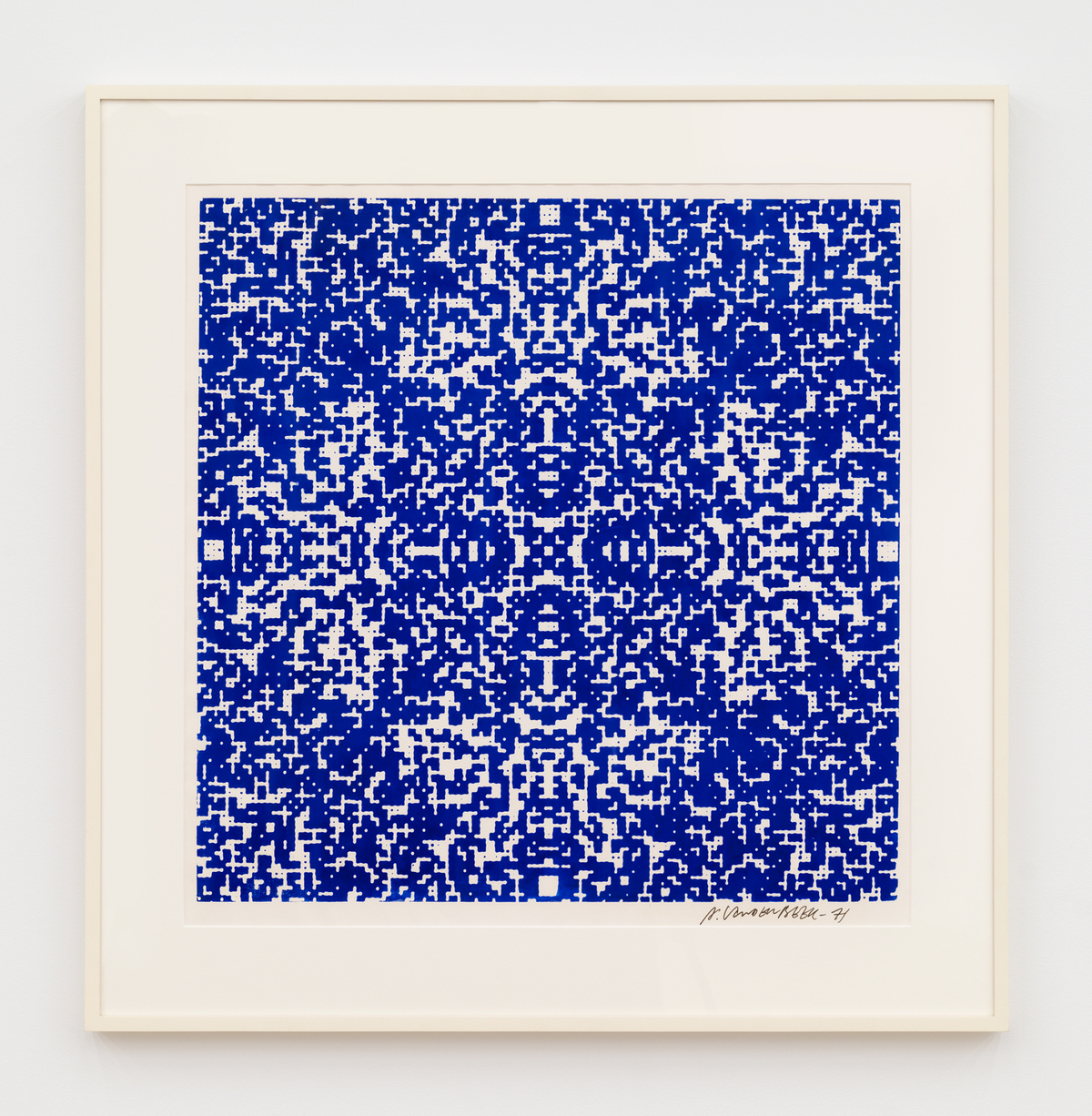 Stan VanDerBeek (American, 1927 - 1984), Untitled, 1971, Silkscreen print on paper, Unique, Paper size: 24 x 24 in., Framed: 32 x 31 1/2 x 1 1/2in. Image courtesy of the gallery.
VanDerBeek, who was a visionary in his understanding of computer art, went full meta in re-engaging with his Poemfield by taking select frames from the films and transferring them through color screenprinting and etching, thus rendering the once-animated imagery into a static abstraction. These square-shaped images that hang near the monitor coincidentally anticipate the general format of a QR code with their individualized pixels that structure a complex network of tiny squares limited to the colors blue and white. Stepping back and taking them in as a whole, each of the squares contained within the buzzing pixels sort of resemble the icons of computer and smartphone apps. It was a privilege to bear witness to these works with that contemporary awareness given that these prints were last publicly exhibited at the Machine Art exhibition in 1976 at the University of Maryland - Baltimore County.
 Stan VanDerBeek (American, 1927 - 1984), Moveable Mandala, 1976, 9 Color silkscreens. Computer graphics from Poemfield series., Paper size: 25 1/2 x 25 1/2 in., Framed: 26 5/8 x 26 5/8 x 1 1/2 in. Image courtesy of the gallery.
The ultimate rounding out of the exhibition’s ideas was realized in the two-part Moveable Mandalas (1976) that each contained nine color silkscreens derived from the computer graphics of VanDerBeek’s earlier Poemfield series. Compared to the Untitled works from the first half of the 1970s, these are rendered in a more psychedelically ranging color palette with intense shades of purples, greens, reds, and so forth that pulsate in dizzying clusters of pixels, a visual effect that can be likened to the “pictures that attack the eye” description applied to 1960s Op Art like that of Richard Anuszkiewicz or Victor Vasarely.
The White Micro Kosmos (1972 - 1975) intaglio prints stand out based on their much quieter presence of a white-on-white imprinting of marks that can only be discerned from a hyper-close observation. These do not exude the visual loudness of the Moveable Mandalas, yet they carry something else and, perhaps, something more powerful: these seem to register as VanDerBeek’s visualization of the invisible sprites upon which computers operate, almost like living cells seen under a microscope.
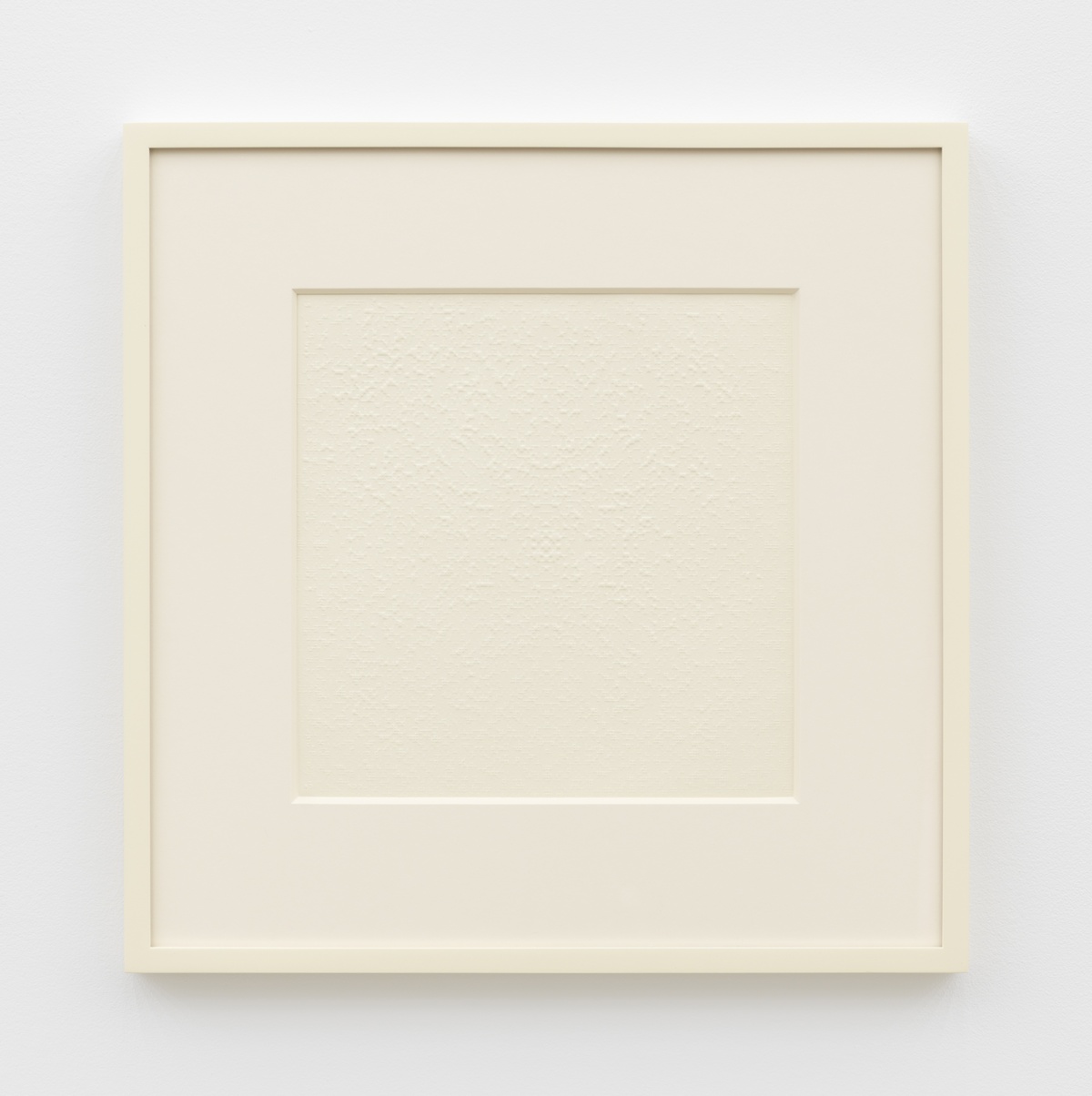 Stan VanDerBeek (American, 1927 - 1984), White Micro Kosmos (Variation 2), 1972-75, Copperplate Intaglio print on paper, Paper Size: 14 x 15 in., Framed: 16 5/8 x 16 1/2 x 1 1/4 in., Edition of 20. Image courtesy of the gallery.
Visually, the works chosen for this exhibition come across as belonging to the era in which they were created, but thematically, they feel so resonant with today’s technological concerns. The very idea of modern life moving at a rapid pace post-1945 - between the advent of television to the early development of computers - looks in hindsight as if it went at a snail’s pace compared to what is going on right now. Computers as we know them took decades of invention and reinvention, whereas generative AI has evolved at light speed. VanDerBeek’s computer art could be described as dual authorship - half human, half artificial. Micro Kosmos’s focused attention on a series of interconnected works by VanDerBeek leaves one with more nuanced questions about what technology’s relationship is to art and life in a time where it is virtually impossible to willfully ignore in contrast to even the artist’s own era. WM

Liam Otero
Liam Otero is a freelance art writer in NYC. He was recently named New York Editor of Whitehot Magazine.
view all articles from this author