
Whitehot Magazine
October 2026
"The Best Art In The World"
"The Best Art In The World"
October 2026
MAGIC MARKER--Franz Kline exhibition at Mnuchin Gallery

Installation view of Franz Kline at Mnuchin Gallery, April 23 - June 21, 2025.
© 2025 The Franz Kline Estate / Artists Rights Society (ARS), New York. Photography by Tom Powel Imaging.
By BRUCE HELANDER June 24, 2025
One should never be surprised at the absolute perfection of the artists’ installations displayed at the Mnuchin Gallery, one of the undisputed great uptown New York art galleries that has a remarkable reputation for showing innovative modern masters in perfect harmony accented by their vintage townhouse interiors show space. Recent outstanding shows in the masterwork categories have included Chamberlain and Stella. The current exhibition, “Franz Kline,” features fifteen memorable paintings from 1950 to 1960, along with a selection of works on paper. The exhibition offers a visitor a delightful reappraisal of Kline’s oeuvre, demonstrating his innovation with compositions of bold black dashing marks on a white canvas background. Kline manages to remain one of the few undisputed leading artists in the Abstract Expressionist fraternity. Eliminating color, recognizable imagery and detail, and supplemented with intuitive, fast-paced, bold, dashing creative strokes—often on a huge white flat canvas platform—that seemed to have been applied with speed, inherent assurance, and Kline’s determination, with no preconceived notion of a plan other than the confidence that the artist appears to have in his hands and eyes directly connected to his extraordinary vision. Like a conductor of a classic orchestra that recognizes every bar and note to create perfect collective harmony, Kline’s ‘baton’ is replaced by a thick dripping brush packed with jazzy rhythm and graceful strokes. The innate and elegant aesthetic power of these compositions presented at Mnuchin coupled with the artist’s fearless energy is unequaled by any other painter, although it clearly inspired others, including the legendary black and white photographer Aaron Siskind, particularly in his “Homage to Franz Kline” series during the 1970s.

Franz Kline, Light Mechanic, 1960, oil on canvas 92 x 67 ⅝ inches (233.7 x 171.8 cm) Lonian Gallery, LLC
© 2025 The Franz Kline Estate / Artists Rights Society (ARS), New York. Photography by Clint Jenkins, Jenkins Imaging.
Kline produced some of the most important and significant artworks of the 20th century. His acclaimed series of bold, magical compositions in black paint on white canvases is critically considered among the most influential paintings executed during the 1950s. Kline’s explosive expressionist experiments and groundbreaking minimalist mark-making with a brush pushed Abstract Expressionism into consideration for producing some of the most revered historical works ever created. During this investigational period Kline began exploring visually poetic expressionist gestures, Japanese calligraphy, intuitive feelings and emotions through highly abstract and imposing non-narrative color fields. The poet and curator Frank O’Hara saw Kline as the quintessential “action painter,” and an important development within Abstract Expressionism. For the first time, viewers could sense a feeling of contrapposto movement, balanced juxtaposition and bold raw energy, like a tree bending in a windstorm, in a non-narrative format. Along with his colleagues Willem de Kooning and Jackson Pollock (major influences), Kline became the foremost force in “action paintings” and permanently changed the way we perceive gestural contemporary art. Kline’s limited inventory of black and white drawings (often painted on the pages of a Manhattan phone book) are now widely collected with rising values, as few original works on canvas exist in the marketplace. A Kline black and white composition, which sold for more than $40 million at a Christie’s auction in 2012, represents the growing importance, value and rarity of his works, particularly the artist’s black and white paintings. In 1992, Kline was included in the Guernsey exhibition “Artists of the Hamptons” with an untitled black and white painting authenticated by the Franz Kline Foundation along with works by Brooks, Hartigan, Jensen, Namuth, Rivers, Rosenquist and Warhol, which further certified his permanent importance and recognition. Artists of this movement embraced spontaneity and improvisation, often working in an instinctive manner. This new fraternity of picture-makers effectively shifted the art world’s focus from Europe (specifically Paris) to Manhattan in the post-war years. At the same time Kline’s paintings and sensitivity to minimalist compositions may also have guided the black and white configurations of renowned photographers Aaron Siskind, Robert Mapplethorpe and Elliott Erwitt and abstract sculptors Mark di Suvero, Yayoi Kusama, Louise Bourgeois, Louise Nevelson and Alexander Calder.
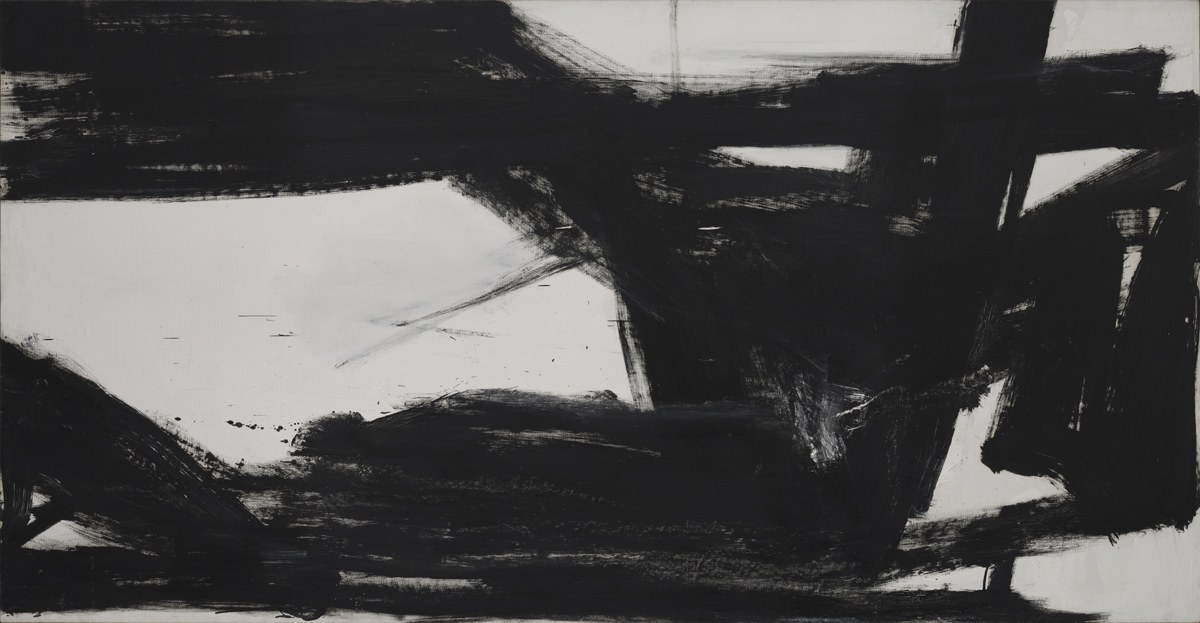
Franz Kline, Harleman, 1960, oil on canvas, 53 x102 inches (134.6 x 259.1 cm), Private Collection. © 2025
The Franz Kline Estate / Artists Rights Society (ARS), New York. Photography by Timothy Doyon.
Art history shows us that for hundreds of years painters struggled for creative independence and invention as they diligently strived to develop novel idiosyncratic painting methods, singular styles, creative new territory and identifiable alternative images that not only were engaging but set them apart from other artists. Prior to the Renaissance, the common goal of visual artists was to generate compositions that were highly realistic, whether their subject matter was portraiture, still-lifes or traditional landscapes. This later pre-abstract period of pioneering efforts was ripe for innovation and often controversial. Works such as in Marcel Duchamp’s “Nude Descending a Staircase” or Georges Braque’s cubist figures set the stage for groundbreaking discoveries.
In looking through the handsome show catalog, which gives you the opportunity to page through the exhibit with your hands, one realizes that “size really doesn’t matter” as the reproductions on a much smaller scale still capture the pure genius and delightful intuitive balanced marks that Kline made up, as his loaded brush raced without a roadmap or speed limit onto a bare white canvas. None of the large works on view had an action plan of attack although often Kline would create a small study on paper or the Manhattan yellow pages, which he could later utilize as a maquette for a much larger painting. Works like “Composition” (1950) offer an exhilarating dynamic that is both mesmerizingly ambulatory and captures a clear sense of movement and intuitive perfect balance.

Franz Kline, Untitled, 1957, oil on canvas, 78 ⅞ x 103 ½ inches (200.3 x 261.9 cm) Glenstone Museum.
© 2025 The Franz Kline Estate / Artists Rights Society (ARS), New York.
“Untitled” (1957), courtesy of Glenstone Museum, is perhaps one of the best examples of Kline’s uncanny ability to “build” a picture, one magic mark at a time. There are no blueprints, no transfers, no projections or plans to guide the artist. Kline simply confronts a blank primed white canvas and goes to work, like constructing a delicate house of cards that requires perfect balance and confidence. In this picture, the artist considers a changing abstract landscape of strokes that require split second decisions as he investigates opportunities to add bold gestures to his growing composition. There are no paintings that seem overdone with unnecessary visual passages. In this memorable show, Kline is on a perpetual minimalist mission to explore filling up a vacant space, whether small-scale phone book pages or large canvases, and, in the history of modern art there is simply no equal.
With those pioneering efforts, artists continued to make breakthroughs in non-narrative imagery. This exhibition provides us with a context of the original ringleaders that is both handsome and balanced, and paved the way for countless artists to follow.
For more information: www.mnuchingallery.com/exhibitions/franz-kline3

Bruce Helander
Bruce Helander is an artist who writes on art. His bestselling book on Hunt Slonem is titled “Bunnies” (Glitterati Press), and Helander exhibited Slonem’s paintings in his Palm Beach galleries from 1994 to 2009. Helander is a former White House Fellow of the National Endowment for the Arts and is a member of the Florida Artists Hall of Fame. He is the former Provost and Vice-President of Academic Affairs at Rhode Island School of Design.
view all articles from this author



