Whitehot Magazine
September 2026
"The Best Art In The World"
"The Best Art In The World"
September 2026
Karen Mosbacher: Choreographing Color
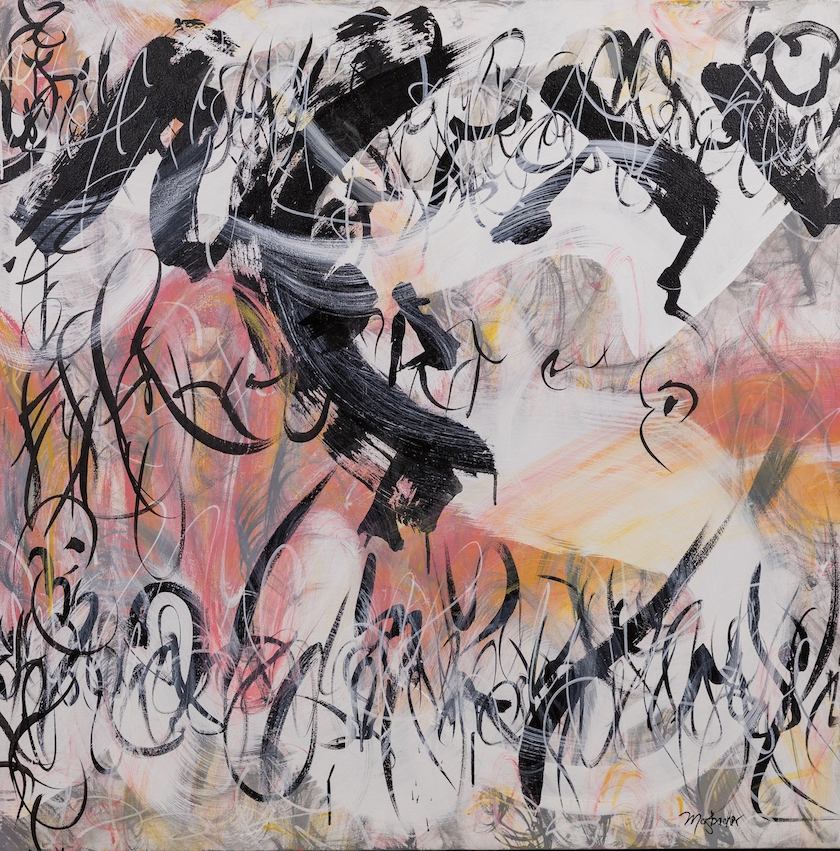
Fantasy No. 4 for Solo Viola, 2024, Acrylic, Charcoal, and Graphite On Canvas, 40 x 40 x 2 in
By Kate Hoag, June 28th, 2026
For Karen Mosbacher, sound is never solely auditory. She sees it as color, movement, texture, rhythm, and emotional force.
For more than five decades, Mosbacher developed an artistic language rooted in embodied perception. Her practice encompasses painting, photography, installation, performance, and interdisciplinary collaboration. Mosbacher gives visual and material form to encounters that exist beyond the reach of words. Chromesthesia, a rare neurological condition in which hearing a sound triggers an automatic, concurrent experience of color, shape, and movement, has shaped Mosbacher’s perception throughout her life. “My work is not an exact rendering of what I see, but comes from my physical and emotional response to sound, music, memory, and lived experience.
"My work is rooted in sound and music, color, movement, emotion," she says. Mosbacher had chromesthesia her entire life. In 1989, she realized there was a term for it after discovering neuroscientist Richard Cytowic's research. Until then, she assumed everyone saw sound as she did.
"For the longest time, I thought everyone saw what I saw," she recalls. The phenomenon can be difficult to describe. Music may appear as flashes of colored light, clouds of shifting color, or forms that rise and dissolve like waves. Even the same composition can sound different depending on who performs it and which instrument they use.
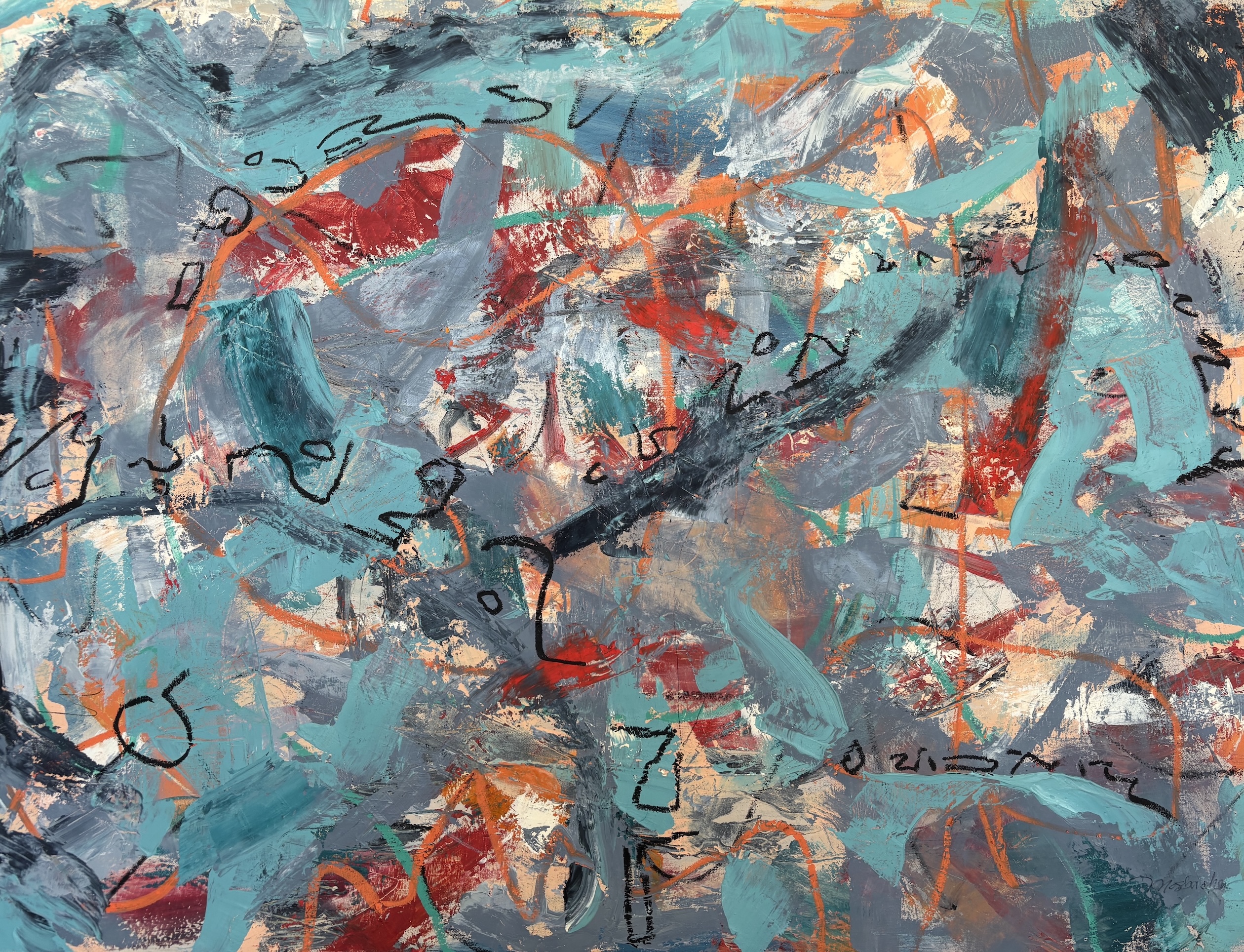 De Luce Et Umbra (From Light to Shadow), 2025, Oil, Cold Wax, Charcoal, Graphite, and Chalk Marker on Canvas, 30 x 40 x 1.5 in
"I asked my son to play the same piece of music on one viola and then exactly the same music on a different viola," she says. "It totally looks different to me, because of the vibrations from different sources."
Long before she understood the science behind chromesthesia, however, she was already trying to make sense of it. Music was a constant presence in her childhood thanks to her father, a classically trained pianist and accomplished jazz musician. While he played, Mosbacher would lie beneath the piano, captivated by the colors and movement she saw surrounding the music.
"I would lie under his piano for hours and hours," she recalls. "In the beginning, I was trying to catch the colors that I saw and try to move them around."
That early fascination with sound and movement continues to shape her work today. Over the years, Mosbacher has studied vibration, consulted physicists, and explored the science of sound waves to better understand what she experiences.
Music remains central to her creative process. While she is particularly drawn to classical compositions, she also finds inspiration in jazz and contemporary works, especially those driven by rhythm and percussion. "For me, it's like receiving some new heartbeats."
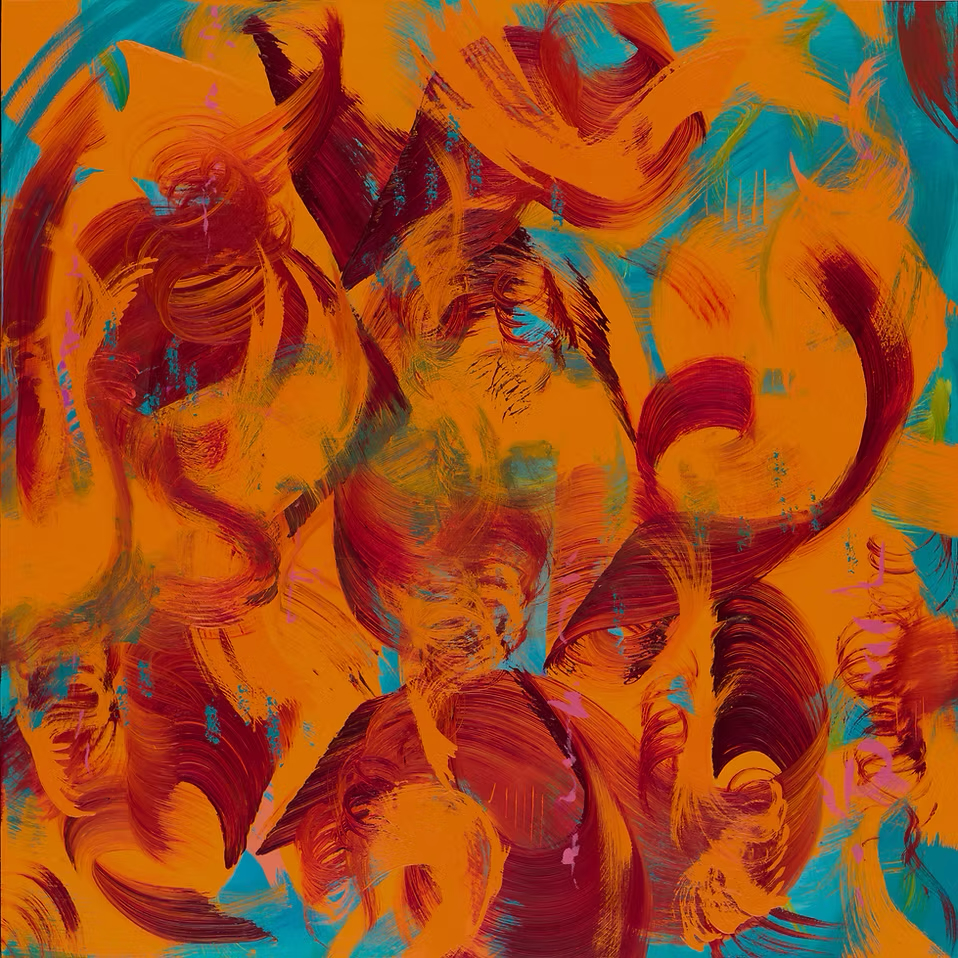 Viola Concerto, Part 2, 2019, Oil and Cold Wax on Linen, 40 x 40 x 2 in
Movement plays an equally important role. Mosbacher began dancing when she was three years old, and that physical relationship to rhythm continues to inform her approach to painting. Many of her recent works measure six by eight feet, requiring sweeping gestures that engage her entire body. "When I paint big, it's a full body experience," she says.
The resulting paintings often feel musical in their own right. Vibrant fields of color, layered marks, and gestural forms move across the canvas like visual traces of sound. The vibrations, colors, and movement Mosbacher sees in sound become the source of her gestures in paintings.
"A lot of times, rather than painting the vibrations themselves, I'll paint how I would dance the gesture," she explains. "It's like choreographing the color."
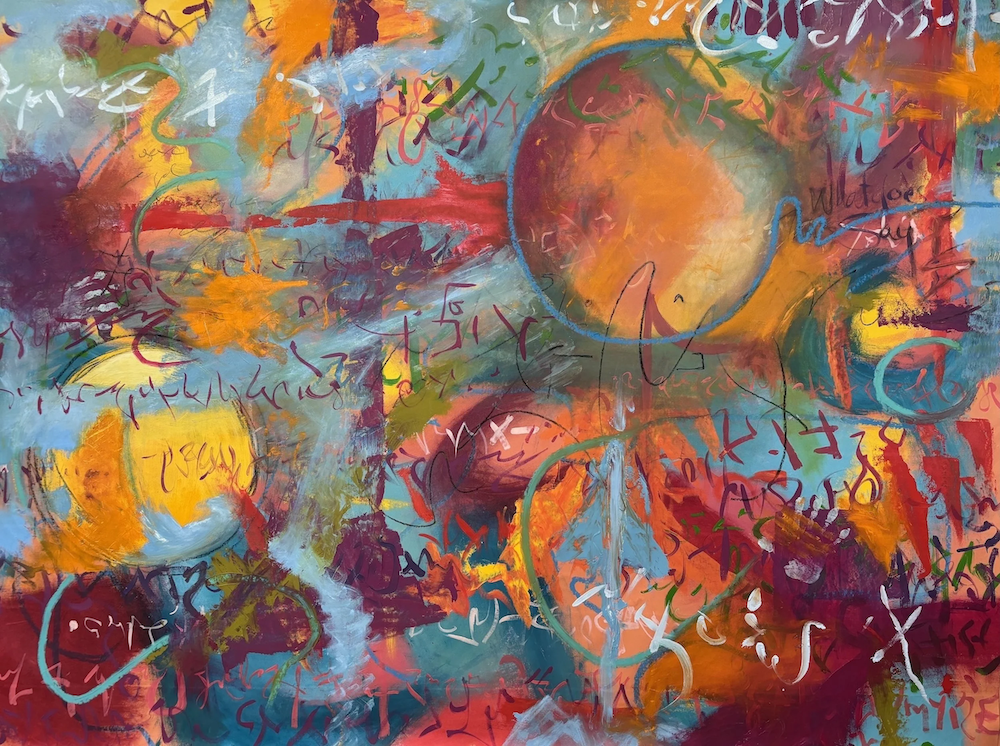 Navigating Angst, 2025, Oil, Cold Wax, Charcoal, Chalk Marker on Canvas, 68 x 74 x 1.5 in
Color functions as a language throughout her work. While cultural associations often assign fixed meanings to certain hues, Mosbacher sees color as something deeply personal and emotionally charged. "I see color as a language of expression," she says. "It's everywhere."
Over time, Mosbacher’s practice expanded beyond sound to encompass memory, emotion, bodily knowledge, and lived experience. Following a near-death experience more than six years ago, she emerged with an intensified awareness of the world around her.
"If there's a catastrophe or something deeply emotional, it will send me straight to the canvas because I need to paint it to understand it," she says.
Painting is a way of processing experience and a means of communication. "I paint because words get stuck in my throat."
That impulse continues in Mosbacher’s developing body of work, Elsewhere. While she is widely known for her vibrant, color-driven paintings, the new series introduces materials including handmade paper, thread, fiber, graphite, charcoal, clay slip, and string. The works emphasize gesture and materiality, which represent the pressures of life while exploring the movement from chaos toward harmony. "Elsewhere is about becoming," she says. "It's not about running away. It is about becoming your authentic self."
The series asks what becomes possible when fear loosens its grip and trust begins to emerge. For Mosbacher, the question feels especially resonant at this stage of her life and career. "I have less interest in asking permission or defending my choices," she says.
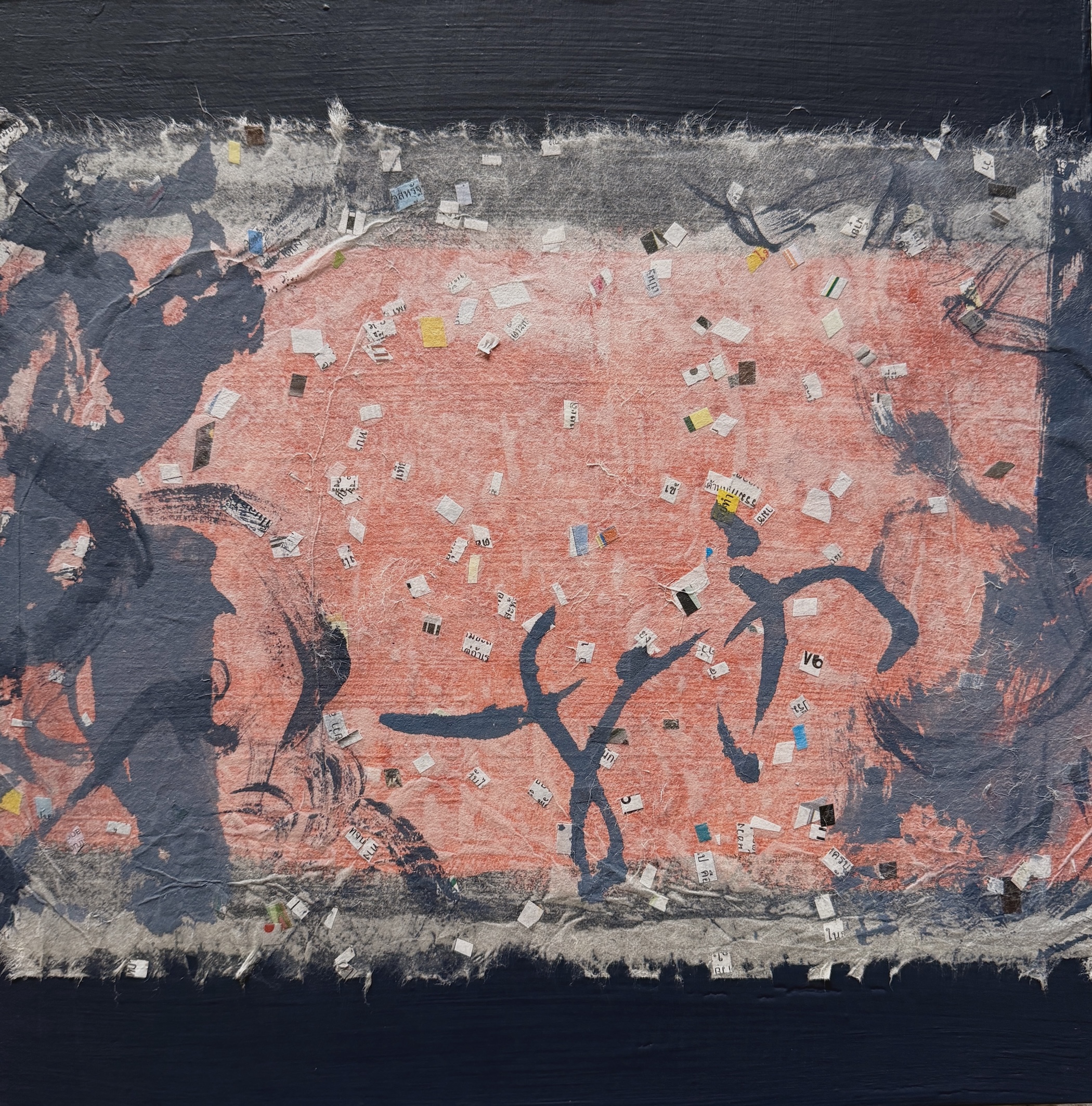 Elsewhere Study 5, ink, acrylic, graphite, charcoal, clay slip, colored pencils, kitchen string, thread on handmade paper
Now 70, she views age not as a period of slowing down but as one of creative freedom. Referencing a sentiment by Tracey Emin, Mosbacher reflects: "When you get to 60, you're doing okay as a woman artist. When you get to 70, you come into your own."
That sense of confidence is evident throughout her practice. Whether collaborating with musicians and dancers, creating immersive installations, or translating visual sound into color, Mosbacher’s appetite for work remains undiminished. "I'm very happy with my work," she says. "I don't worry about whether it sells. I'm making the work that I want to make." For an artist whose work is rooted in expression, curiosity, and transformation, the desire to create remains as strong as ever.
“I have a deep need to express what I carry within me. Choreographing color is how I give it form. “
To learn more about Karen Mosbacher and her upcoming projects, visit her website and follow her on Instagram.

Kate Hoag
Kate Hoag is a Los Angeles-based freelance writer with experience in journalism, academic, creative, and content writing. She holds a B.S. in Theater with a minor in Sociology from Skidmore College, where she graduated magna cum laude with Theater Department Honors. Kate is pursuing her M.A. in Public Relations and Advertising at USC’s Annenberg School for Communication and Journalism.
view all articles from this author