Whitehot Magazine
October 2026
"The Best Art In The World"
"The Best Art In The World"
October 2026
South Paw: Gerasimos Floratos and Karel Appel at Almine Rech
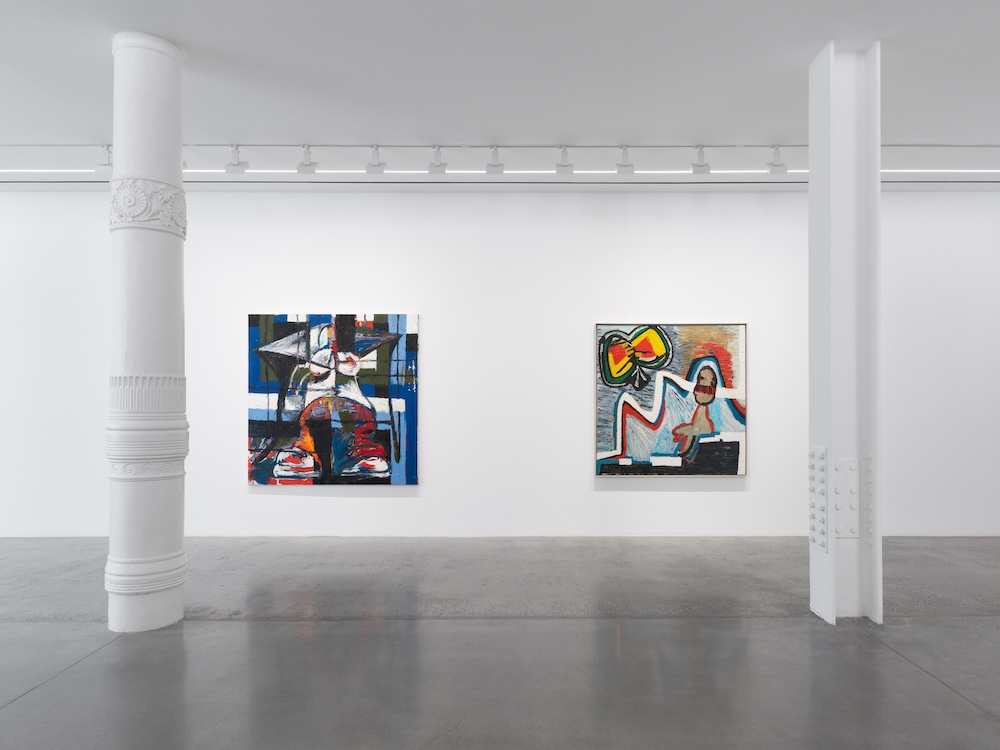 Gerasimos Floratos, 'A Grid of One’s Own', 2025 Oil and acrylic on canvas, 72 x 72 in (left), Karel Appel, 'Butterfly', 1981, Oil on canvas, 63 x 63 in (right) c/o Almine Rech
March 13 — April 25, 2026 | New York, Tribeca
By Alfred Rosenbluth, May 2nd, 2026
It was during the opening for New York-based artist, Gerasimos Floratos’ 2022 show, Hymn, when he made the acquaintance of Harriet Appel, the widow of post-war artist Karel Appel, and Franz Kaiser, Director of the Appel Foundation. The two almost immediately recognized something of Appel’s sensibilities in Floratos’ work, and over the course of this new friendship, the potential for this exhibit was seeded.
For this show, Floratos offers a body of work completed over the past 18 months, executed before and after visiting the Appel Foundation - at Harriet and Franz’s invitation - where he would encounter Karel Appel’s work in person for the first time. Although Karel Appel was widely-known for his work as a founding member of the CoBrA movement (1948 - 1951), this show features his lesser-known paintings completed throughout the 80s and 90s while living in New York City. To the day of his passing in May, 2006, Appel’s practice would preserve CoBrA’s original impulse to question the prevailing standards of Western art in post-war Europe, which resulted in new, vibrant forms of expressionism exploring the spontaneous, ‘authentic’, and primal impulses in artistic expression. For Appel, so-called 'primitive' and outsider art - the drawings of children and psychiatric patients, in particular - served as his primary inspiration. The freedom and emotional authenticity which he perceived in such works remained at the center of his own life-long artistic activity. For Appel, the moving experience of encountering beggar-children in war-torn Germany fueled the work, Questioning Children (1949) [not featured], whose mixed reception inspired his permanent departure from his home country of the Netherlands.
After finally leaving behind the perceived provincialism of the Dutch art world in the late 1950s, Karel settled in New York City, where approximately thirty years later, Gerasimos would be born and remain to this day. For both artists, who draw inspiration from their everyday encounters, New York City’s centrality to their practices can not be overstated; its energetic signature, as channeled through these two artists, verily emerges as this exhibit’s silent main character.
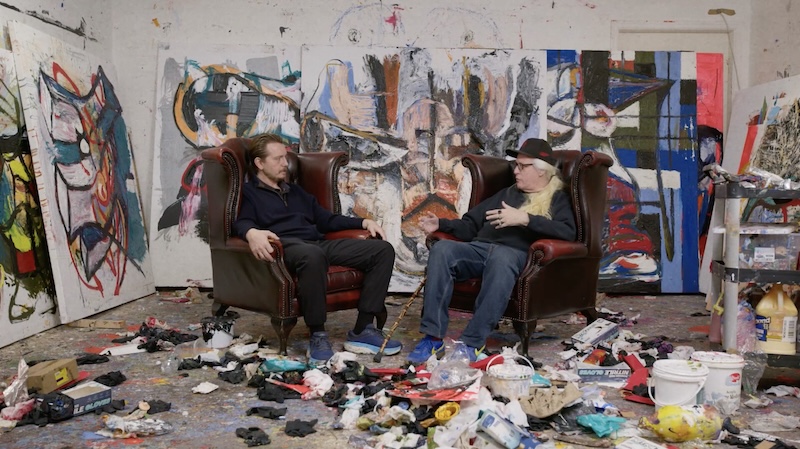
Gerasimos Floratos (left) and Carlo McCormick (right) in conversation at Gerasimos' Midtown studio.
But of course Floratos and Appel complement each other on multiple points beyond their shared environment. For starters, they find commonality in non-traditional, bold applications of paint. Appel would often use his hands, squeeze pigment directly onto the canvas, and often “attack” the canvas with loaded knives of paint. But far from affectation, such unconventional approaches simply suited his natural impulses. Famously Appel would declare, “if I paint like a barbarian, it’s because we live in barbaric times.” The irony of such an apparently anti-intellectual stance is that only a true intellectual like Appel could successfully pull it off.
Floratos recognizes a similarly unconventional approach to paint application in his own practice. While in conversation with Carlo McCormick, Floratos states that his own similarly-unconventional handling is not “too considered” - that “there’s a bit of animal instinct in there [...] there’s no holding back”.*
Very much in spite of his formal training, Appel’s relentless studio activity resisted ever settling upon a formal consistency; if his studio practice adhered to any one standard though, it was to constantly push through whatever appeared limiting to his sense of artistic freedom and growth. Floratos - who is entirely self-taught - admits to holding a similarly uncompromising commitment to growth.
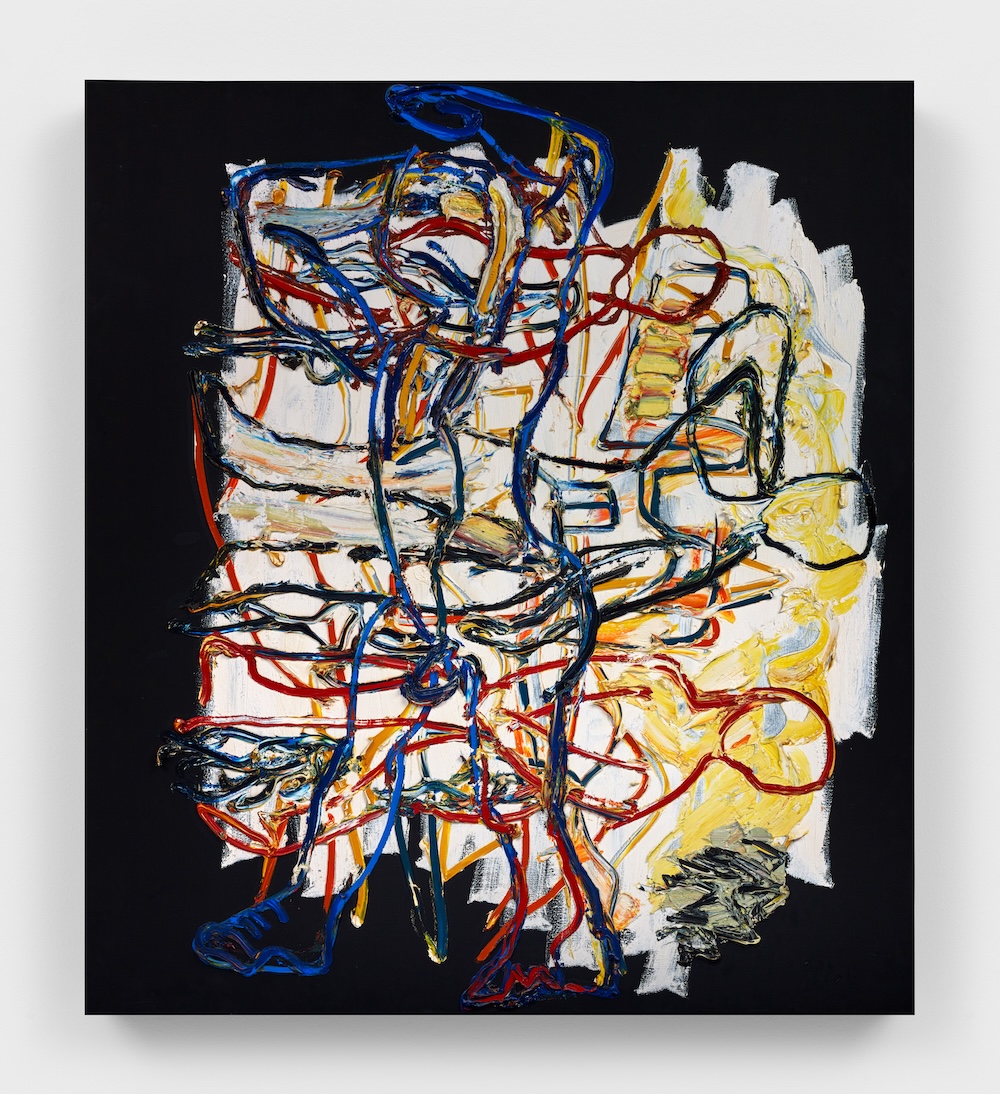
Karel Appel, 'Composition of Nudes' (Tuscan Series), 1990 Oil and acrylic on canvas 180 x 160 cm 70 3/4 x 63 in
However inextricable from Modernity the two are, “both their artistic idioms are ostensibly non-modernist” as Franz Kaiser notes in this show’s press release. “They gather inspiration from popular culture, without however transferring it one-to-one, as postmodern artists tend to do.” Reflecting on his self-education in Western Art History, Floratos himself expresses as much to Carlo McCormick, having learned, that you don’t “react [...] in the moment, you take it in and then you release it out”.
From his first napkin paintings executed in mustard while working in his father’s Times’ Square deli to the release of this article, Floratos has remained highly disciplined in pursuing his self-directed education and draws upon a rich substrate of diverse influences. From commercial advertising and street art, to outsider artists and the entirety of the Western canon, all remain in service to materializing the raw encounter with his canvas.
Although Floratos is an “insider” by all meaningful standards, there remains an “outsider” vernacular in his work, which is indicative of his having been unencumbered by the formal education which Appel received and subsequently worked against in his practice. Franz Kaiser has compared Floratos’ work to that of Basquiat, Lee Lozano, and Philip Guston. As with any of his influences - which are legion - we see only confluence, never copying. In the case of Lozano and Guston, we see a shared focus on cartoonishly-bulked characters and objects - turgid appendages, mouths, and cigarettes abound. Although Guston’s Klansmen carry darker associations, one can’t help but draw a throughline to them from Floratos’ sometimes headless urban figures clad in baggy jeans and baseball caps tucked under jumbo headphones.
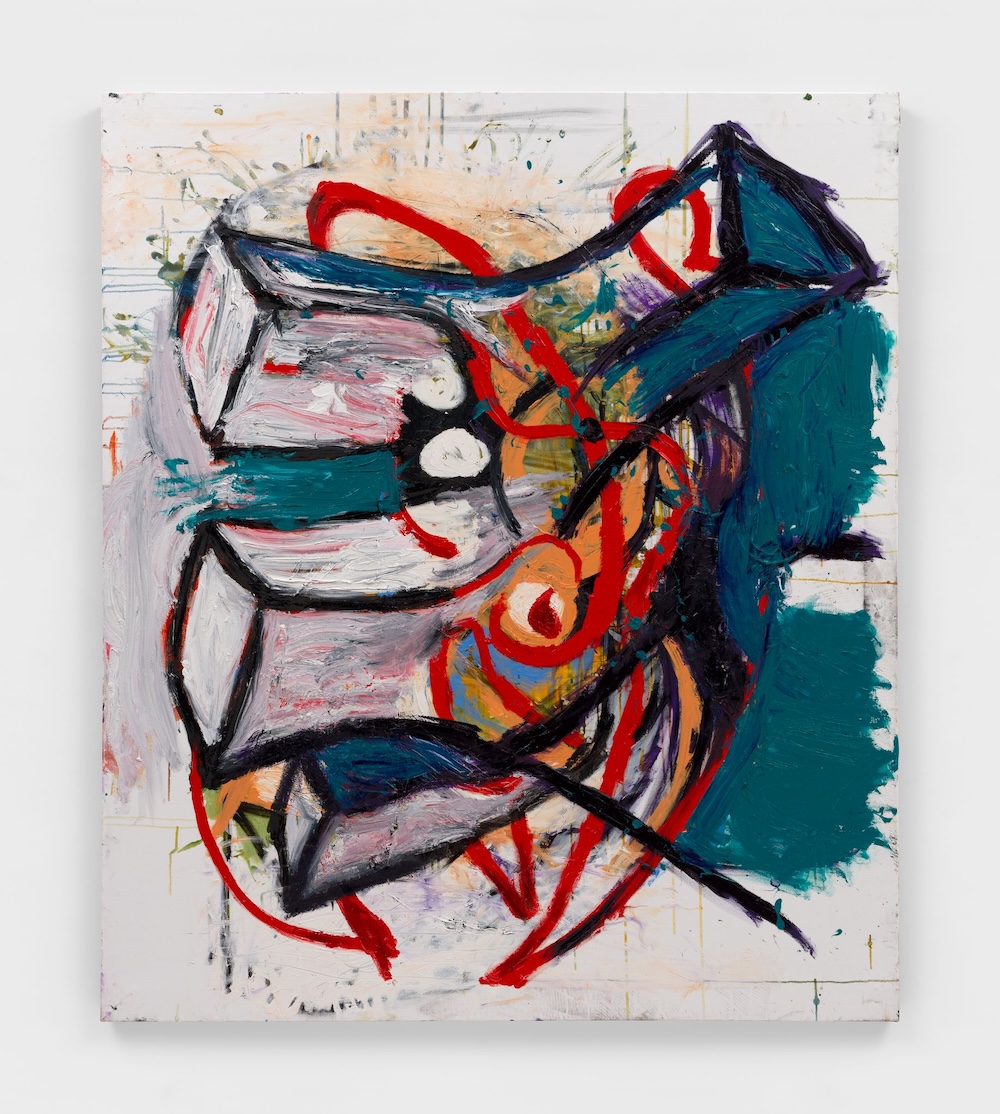
Gerasimos Floratos, 'Life of Concrete', 2025, Oil and acrylic on canvas, 167.6 x 146.1 cm, 66 x 57 1/2 in
But beyond urban subjects, distinctly urban structures participate in Floratos’ vocabulary. In Life of Concrete, concrete edifices protrude from a throbbing rouge-tinted calligraphy, calling to mind an explosive inception in a zero-g environment. In light of this particular piece, an unlikely parallel to the early 20th century masters of Russian Constructivism and Suprematism comes to mind. In similarly explosive gestures within Zero-G environments, El Lissitzky (1890-1941) would configure and reconfigure abstracted building-like elements, while other figures such as Aleksandr Rodchenko (1891-1956) sought to release the revolutionary potential from within basic urban materials.
Here we look to A Grid of One’s Own (2025), where a standing figure remains superimposed against another concrete edifice. This piece recalls one of DeKooning’s Women, but interpenetrated by the angular mapping of urban blueprints, resolving into a body whose interiors are coextensive with its metropolitan habitat.
Russian Avant-garde eschewed emotionality in favor of mechanical perfection. This visual culture intended to impress upon the audience an idealized image of a New Soviet Person, whose body - infused with the urban environment - should operate like a well-oiled machine. In contrast to both, Floratos’ fusion of human and city centers the gritty imperfection of urban subjectivity. He doesn’t cite just any Metropolis, but the unique hyperobject of New York City - Times’ Square, specifically: a place he has dubbed the “center of the center”.
Stepping back to take in the gallery’s southern wall, we see A Grid of One’s Own sustain an unlikely duet with Appel’s Butterfly (1981). Despite the two works’ conceptual differences, their shared palette presents an optical harmony compelling for its asymmetrical balance of fiery reds and oranges accenting dominant white and blue horizontal anchorings. That the two dance so seamlessly together is a testament to both artist’s respective originality; Appel, for being so ahead of his time and Floratos, for being so outside of his time.
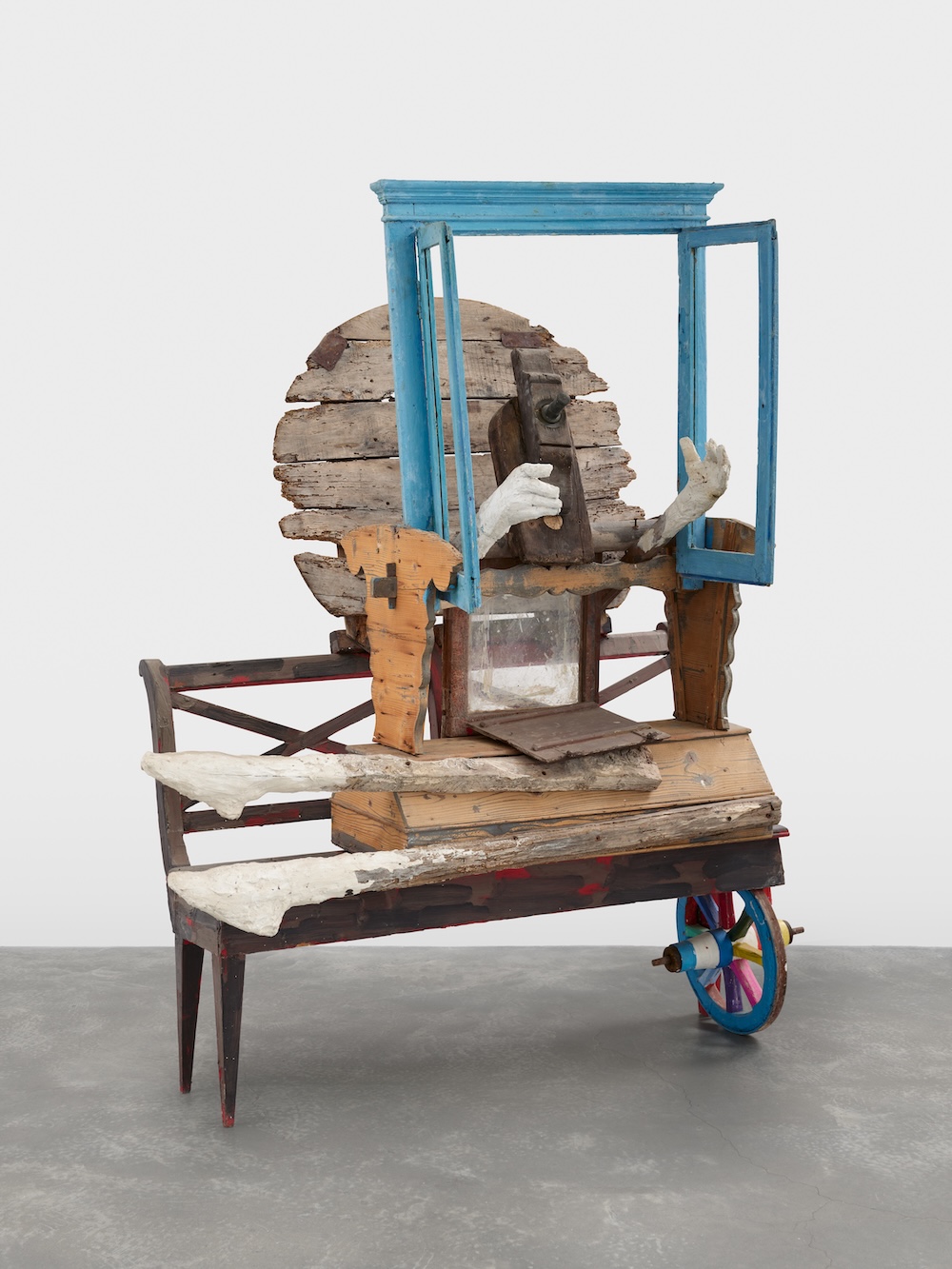
Karel Appel, 'Looking through the Open Window', 1991, Oil, plaster, wood, found objects, 216 x 185 x 110 cm, 85 x 72 3/4 x 43 1/4 in
In the back of the gallery, we come upon a dense constellation of Appel’s and Floratos’ works on paper, where six mixed media and pen and inks orbit the palimpsest of Gerasimos’ Untitled (2026). Within this seamless dance, we glimpse a microcosm of the show’s larger thesis. Almine Rech’s Senior Director, Ethan Buchsbaum has ensured so even a distribution between the two artist’s respective bodies of work, that even on a second lap, one still has to take a beat to think about which artist they are looking at, making the doubletake a pleasantly disorienting feature of experiencing this exhibit. This effect is particularly dizzying at this wall, but keeping a mental catalogue of who’s who obviously misses the point of remaining enthralled with the show’s free jazz. It in fact becomes exhausting to insist on any meaningful points of departure between the two bodies of work, as they’re fundamentally more similar than different. To consider the gulf of time and context between these two artists, born three generations apart, casts all the more significance on this uncanny fraternity.
Moving through the large-scale paintings and the smaller-scale group of works on paper, we come to the painters’ respective sculptural works. It is valid to refer to these particular works as proper sculptures, but I tend to side with Franz Kaiser’s term “3-dimensional work”. In his 2001 interview at the CoBrA museum, Kaiser astutely notes that Appel really produces “painterly sculptures”, that he “looks for something in sculpture that he does in painting [with] 3-d work allow[ing] one to to appropriate something about reality in a more physical way.”** The same can be said of Gerasimos’ sculptures, which although relatively small, outnumber Karel’s monumental Looking through the Open Window (1991) - a found object collage depicting an implied figure that reclines beneath a dilapidated moon and spectral hands.
Floratos’ appropriately-titled All Welcome (2026) - a miniature wood and acrylic instantiation of one of his hooded urban-characters situated atop a black cube - greets visitors at the door. In contrast to Open Window, which sits directly on the ground, Gerasimos’ sculptures are formally presented upon almost 4’-high pedestals. While this serves to compensate for their scale, allowing the viewer to approach them at eye level, we have to consider that for Floaratos, the integrated cube - or some form of it - appears as an integrated motif, functioning as a genre-appropriate framing for these works. Like Appel, Floratos makes sculpture as a painter, working out his ideas in physical reality, but there is more of a one-to-one formal correspondence between his two practices than in Appel’s case. Looking to Reverse Megaphone (2026), for instance, we recognize the same figure with a propped cone lodged into its head from his larger work, Neighbors (2026)- a piece which itself verges on installation, by virtue of its incorporated store-bought window blinds. As far as Floratos’ utilizing everyday experiences, we can glimpse in this piece how he may translate the sometimes contentious conditions of condensed cohabitation in New York City.
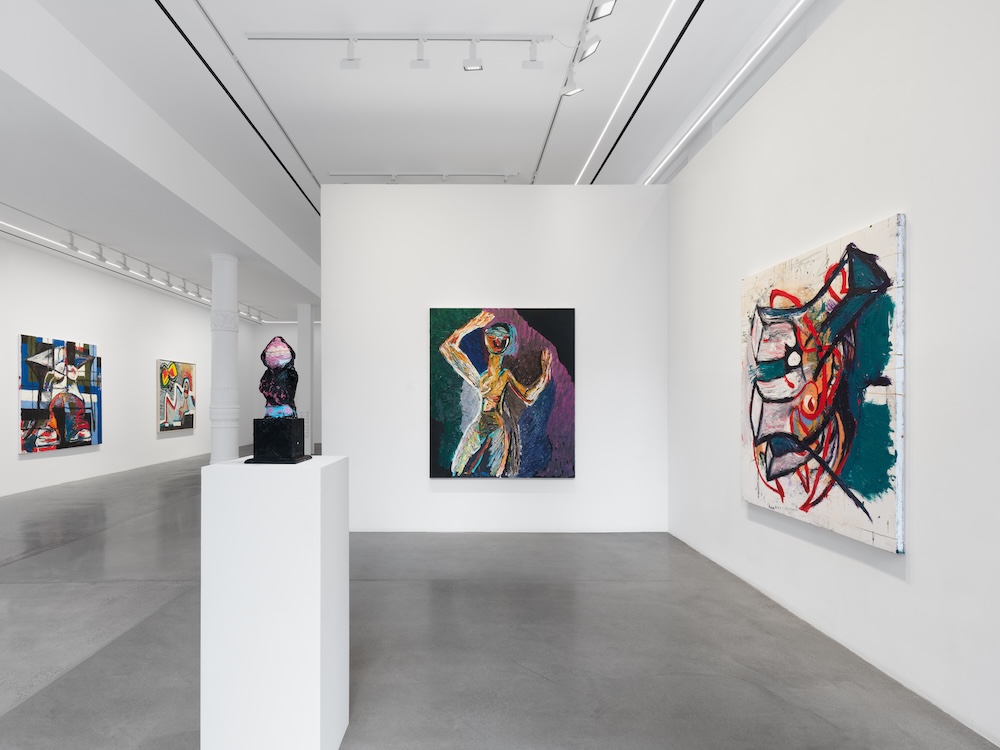 View of the front gallery.
Despite being born and raised in New York City, the degree of hyperstimulation it provides Floratos has reportedly kept him there. His project amounts to a non-linear form of mapping his somatic autobiography juxtaposed with the fluctuating organism of his native New York City. Guy Deboard’s psychogeography, which conceptualizes the imprint of urban design on human experience, has served Floratos as an enduring reference point. Despite having lived and breathed nearly forty years of New York City, Gerasimos’ capacity to encounter and absorb its sensorial intensity as an ever-renewing source material is a testament to his vision’s resilience.
If it weren’t enough that Floratos has cultivated a near perfect incubator for his practice through eschewing formal training and remaining regimented in mining the depths of his circumstances, he further closes the gap by strategically remaining offline. That he deliberately leans into the analog sensorial density of his native city and the faerie glamour of Times’ Square - all the while eschewing the digital commons of social media - leaves us to reconsider what may actually constitute distraction in our current age. Given our oversaturation in the spectacle of digital artifice, the tactile, deeply unselfconscious boldness of these two bodies of work by Gerasimos Floratos and Karel Appel make for an extremely grounding and refreshing show to encounter. With respect to Floratos, whose own oeuvre has yet to be complete, it is all the more significant that despite having been spared of his predecessors’ direct confrontation with atrocities of War-torn Europe, his sense of urgency is no less tangible for it.
* Gerasimos Floratos and Carlo McCormick on ‘South Paw: Gerasimos Floratos and Karel Appel’: https://www.youtube.com/watch?v=WvcrTSPdIlo
**Karel Appel Interview at CoBrA Museum with Curator Franz W. Kaiser, 29 April, 2001:
https://www.youtube.com/watch?v=8MNZK1WaJiM

Alfred Rosenbluth
Alfred Rosenbluth is an artist and researcher currently residing in the Philadelphia area. You can find him at @_aallffrreedd on instagram or through his website at www.alfredrosenbluth.com
view all articles from this author