Whitehot Magazine
November 2026
"The Best Art In The World"
"The Best Art In The World"
November 2026
Leon Kossoff "Trains and Stations" at Annely Juda Fine Art, London UK
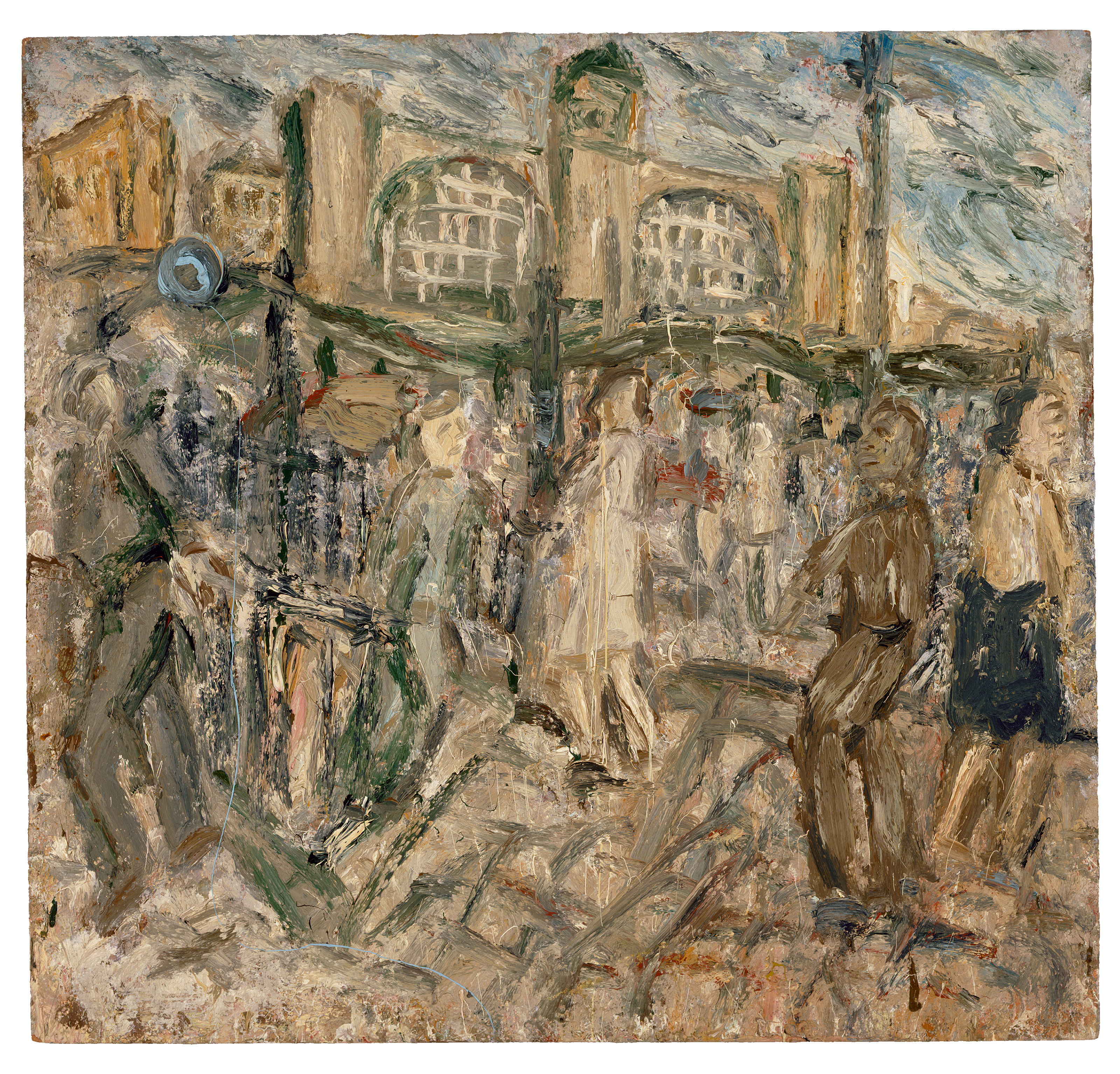 Leon Kossoff, King’s Cross, Spring No. 1, 1998, oil on board, © Estate of Leon Kossoff, Courtesy Annely Juda Fine Art, London, UK
By MICHAEL KLEIN, November 11th, 2026
Think of New York City, and you think subway; think of London and you think underground.
This intriguing exhibition of works by Leon Kossoff, who died in 2019, includes both paintings and works on paper made between 1952 and 2006 that document his seemingly endless fascination with the London Underground, its crowds, and the various stations around London, including King’s Cross, Euston, Kilburn, Dalston, Embankment and Willesden Junction, as he moved studios over the years in East and North London.
Kossoff was one of the School of London figurative painters, along with Frank Auerbach, David Hockney and Lucian Freud.
In a very well-researched and documented catalogue essay, art historian and editor of the Leon Kossoff catalogue raisonné, Andrea Rose ties the painter’s journey as she notes, “in his paintings of trains and stations, these tensions play out with drama and speed, and across his lifetime.” As she outlines in her essay, every move to the next studio opened the door to new paintings of the local station, its notable architecture and the throngs of commuters. As she further notes, “His paintings of the street outside Kilburn Underground are full of incident, people entering and exiting between archways and columns, the ceaseless movement of figures within a complicated space, activating its depths and shallows…”
Rose meticulously documents the changing locales around London, which fired Kossoff anew, providing greater opportunities to explore and record his love of both trains and architecture. She also provides a solid history of the underground’s growth and expansion in and around London.
Other painters have focused on trains in the 19th century, famously Monet and Turner, but here Kossoff, a contemporary artist in the 20th century, works as if the images will be visual records, diaries of his life and times. His first drawn images of the Underground date back to 1943, as a Londoner seeking shelter during the Blitz. The first printing came in 1955 and, as Rose describes them, “in his paintings of trains and stations…tensions play out with drama and speed, and across his lifetime.” The essay then traces his life as he moves from one studio to another, maybe six moves during his lifetime. And with each move, focusing then on the nearby station as his latest subject.
Kossoff remarked, “railways open up the territory, they give you space, and they give you light, and they give you movement.” It is both light and movement that is captured in the very painterly canvases. The same gesture and energy are in the black-and-white works on paper. Drawings seem to be the bones of paintings to come—thoughtful and seemingly well planned. In his paintings, those plans are transformed into thick paint, strong color, and the feel of energy and motion combined in every stroke. Everything is portrayed as if capturing life in action: trains move across tracks, arrive and depart; people move in and around the station. Life in the Kossoff painting is always active, busy and fully charged.
This exhibition is a wonderful testament to the life and career of an artist and a tribute to London itself.
19 November – 30 January 2026
Annely Juda Fine Art
London, UK

Michael Klein
Michael Klein is a private dealer and freelance and independent curator for individuals, institutions and arts organizations.
view all articles from this author