Whitehot Magazine
October 2026
"The Best Art In The World"
"The Best Art In The World"
October 2026
John Zieman’s Video Ecology
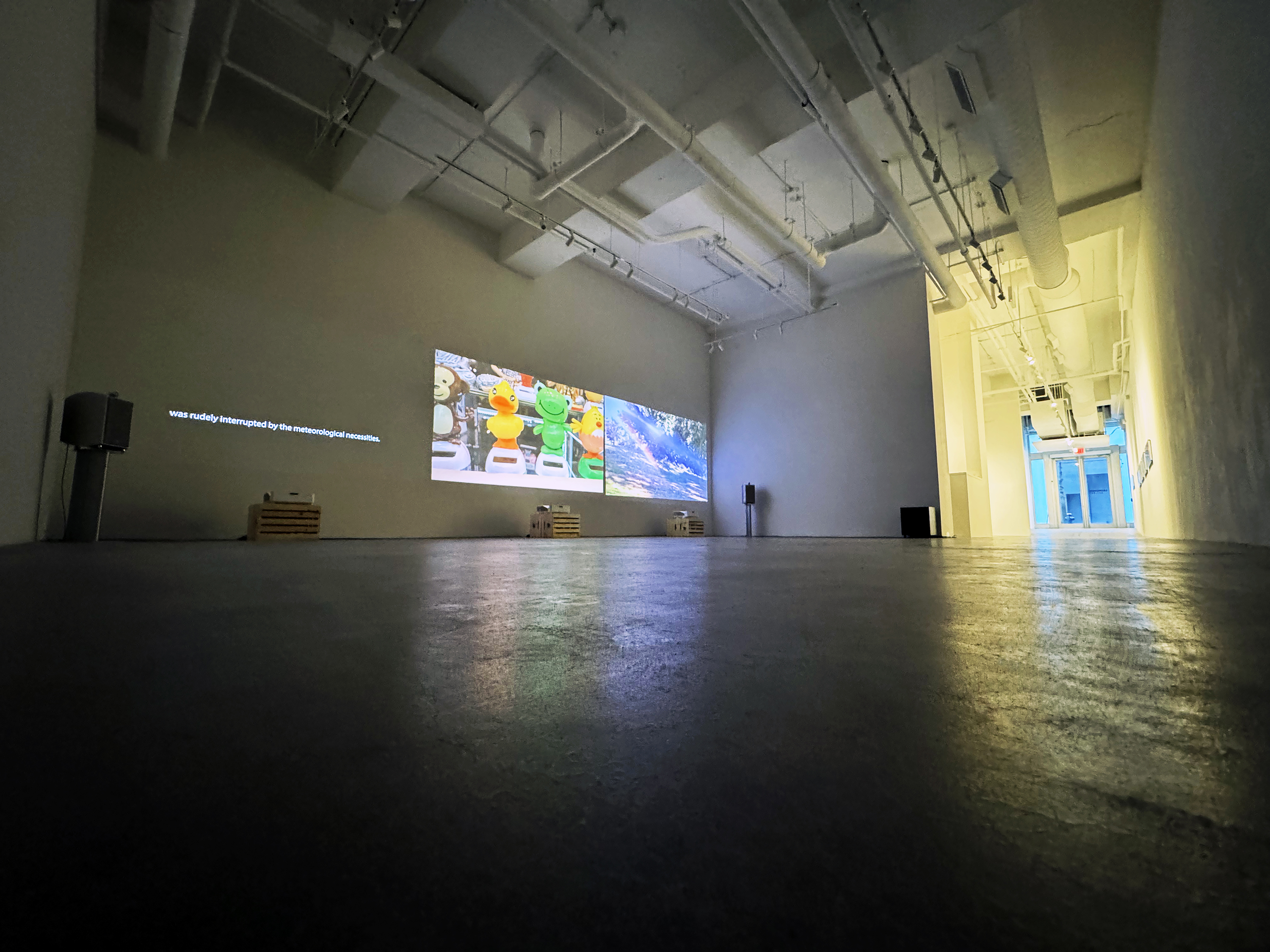 John Zieman, OTOH (On the One Hand), 2026, video, 4 minutes 55 seconds. Courtesy of the artist and Leonovich Gallery.
By RICHARD VINE March 22nd, 2026
Weaponized Beauty, John Zieman’s recent show of at Leonovich Gallery in Chelsea, brought experimental moving-image syntax to bear on several intractable social dilemmas, both contemporary and timeless. Zieman, an artist, musical composer, and hard- and software innovator, has steadily refined this approach since the late 1970s, when his Macgyvered video synthesizer, capable of infusing pictorial input with a variety of mesmerizing effects, caught the attention of Nam June Paik. Zieman helped Paik realize many of his iconic early works—a professional dynamic echoed in the techno wizard’s 40-year working relationship with another video-art legend, Dara Birnbaum.
Along the way, Zieman—while always in demand for commercial projects with the likes of Madonna, music industry mogul Clive Davis, Diane Keaton (in her film-directing guise), and Def Jam Recordings—contributed steadily to the international avant-garde scene. He orchestrated multimedia events and/or presented his own audio-visual creations at venues ranging from the Mudd Club, Anthology Film Archives, Chelsea Museum, and White Box Projects in New York, to the Institute of Contemporary Art and Museum of Fine Art in Boston, to the American Center in Paris. His works turned up on cable TV in Germany and France, as well as at Lincoln Center in New York.
Zieman’s latest show, organized by independent curator Elga Wimmer, comprised three videos and eleven horizontal photo panels (diptychs and triptychs on aluminum), all focused thematically on preservation—of the planet and of the self. The 2026 dual channel OTOH (On the One Hand), accompanied by a text screen, was the most straightforward (or, rather, least oblique) video on view, lyrically lamenting the current ecological crisis. Side-by-side natural world image combos—a fast waterfall and a slow tortoise, a seal and a colorful caterpillar, a tiger and a watery sunset—vivify Zieman’s electronically voiced lyrics as they elaborate on a grim ditty he quasi-sings at the very beginning: “All you wanted was to search for beauty / . . . But if that party is over . . . now instead you’re on a search for safety.” Concrete music, a cagey arrangement of everyday sounds, grounds the work in reality. As more pictures come and go, Zieman intones a catalogue of impending climate disasters: rising temperatures, dry riverbeds, fires.
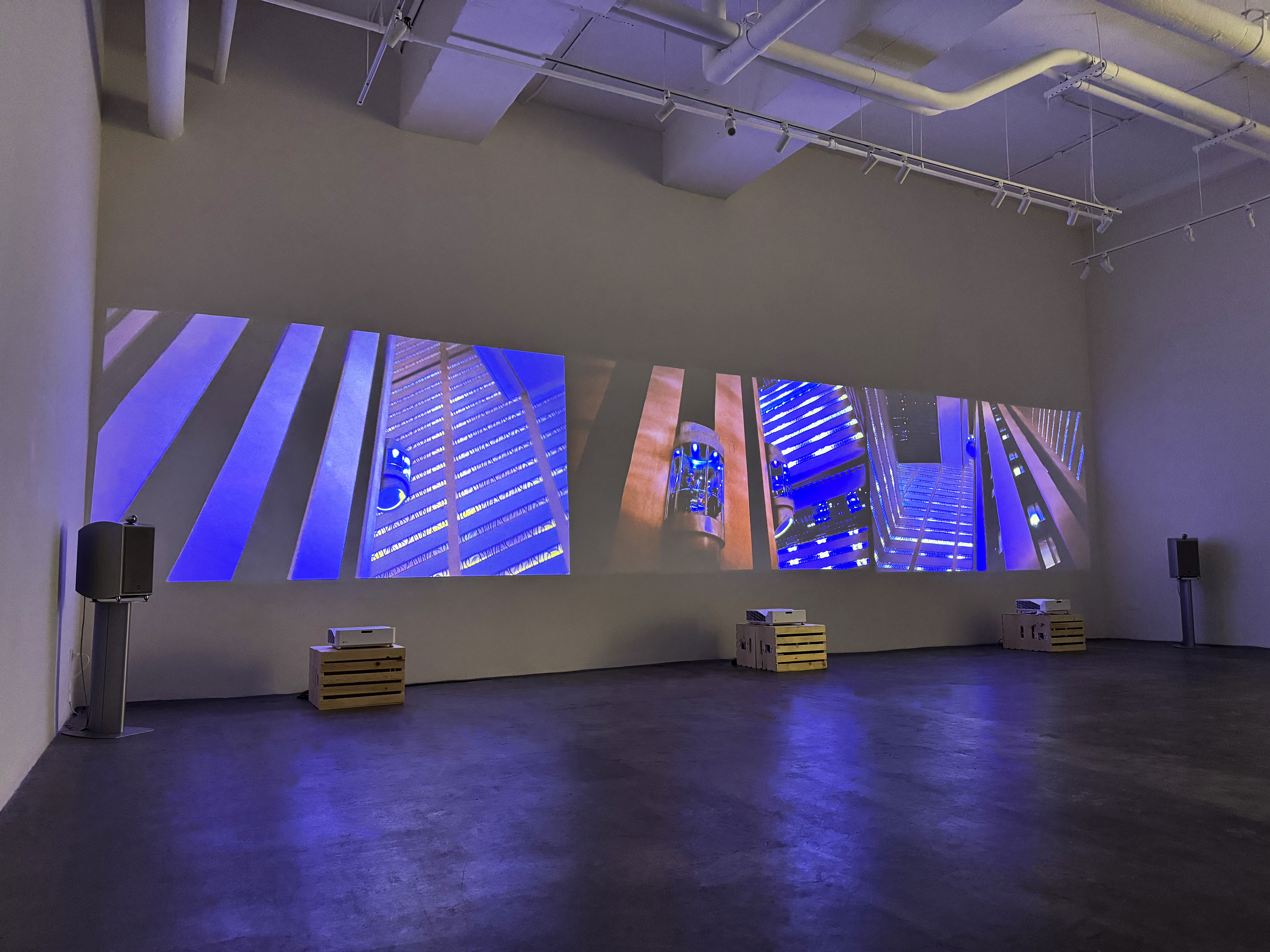 John Zieman, Weaponized Beauty, 2012, video, 5 minutes , 25 seconds. Courtesy of the artist and Leonovich Gallery.
The name of the show’s titular 3-channel video, Weaponized Beauty (2012), might lead viewers to expect an eco-activist response to the earth’s impending depletion, but the work is more elegiac than combative. We begin with an airliner in flight, filling with a steady mist from the ceiling that raises Holocaust associations while remaining bright, colorful, and contemporary. We then behold, by turns, a rainy forest, illuminated urban towers, and a boat at sea partially obscured by the chilling words “serenely precise target extraction.” Yet the closest we come to a weaponization of beauty is a sequence that show an ostrich spreading its magnificent tail: a gesture not of threat but of seduction. This conceptual discrepancy belies any brave Beuysian claims about the sociopolitical efficacy of art. “Engineered beauty implies other compromises” reads one of the video’s many superimposed texts. “Strategic Ambiguity” proclaims a related still print.
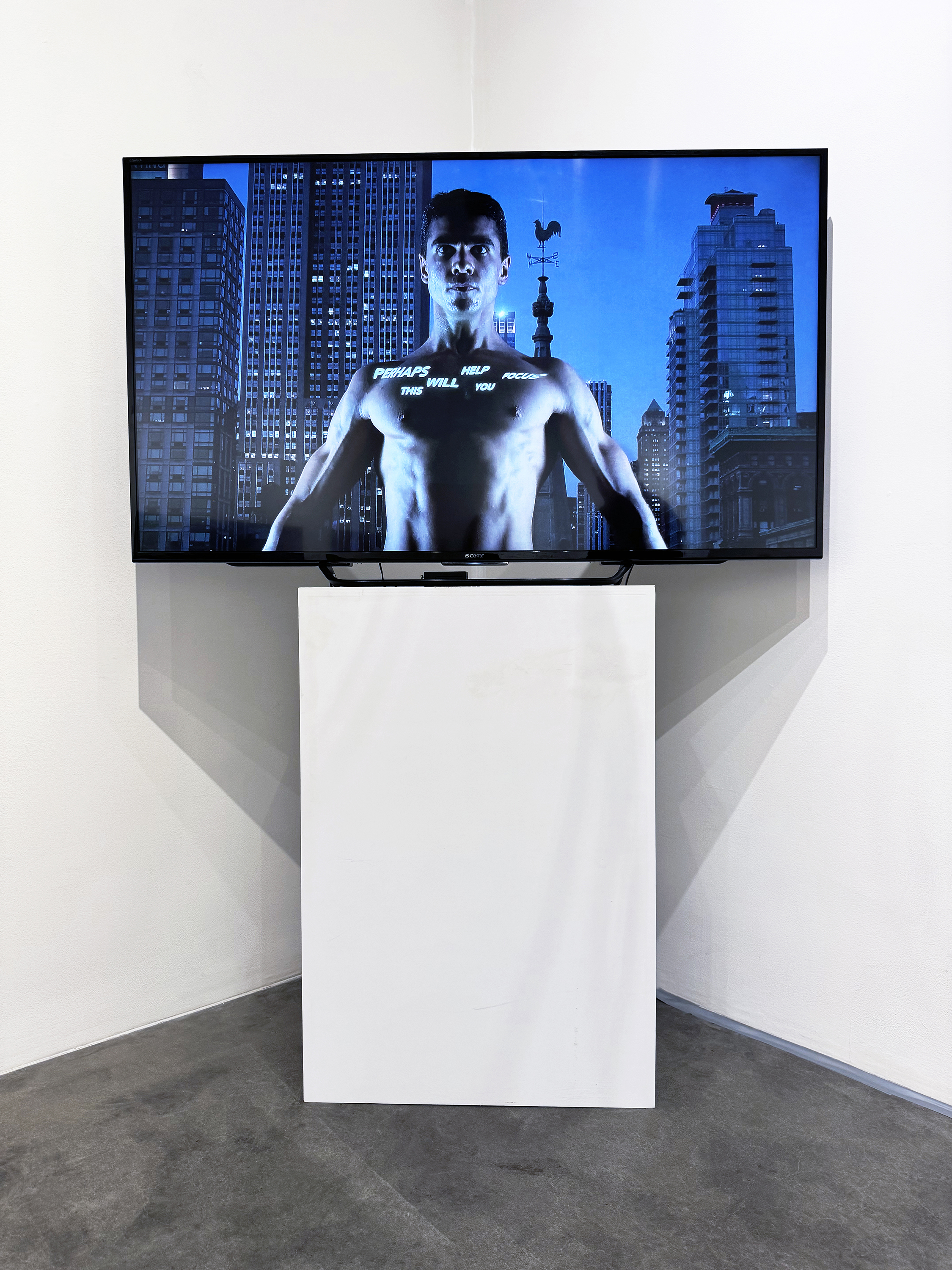 John Zieman, TS3 (Time Suite 3), 2010, video, 3 minutes, 57 seconds. Courtesy of the artist and Leonovich Gallery.
Doubt continued in TS3 (Time Suite 3), 2010, the left-eye channel of a normally 3D piece, which features beautiful young people in various states of undress. As these human peacocks pose fashion-magazine-style in front of New York cityscapes, projected cautionary phrases crawl across their taut bodies: “words circle—but never land,” “your work lacks depth,” “perhaps this will help you focus.” Like director Peter Greenway’s The Pillow Book (1996), about a woman who asks various men to write on her body, Zieman’s video, shot by Manfred Reiff with music by John Petersen, establishes a subliminal link between text and flesh, reading and caressing—a link paralleled by the audience’s own acts of gazing and eroticizing.
Zieman’s career is an object lesson in the ongoing converse between art and the global image business. Pop art was unabashed, even prideful, in its wry borrowings from movies, billboards, and magazines, and many early video works such as Birnbaum’s Wonder Woman (1978-79) depend on the what she calls “aberrated”—sampled, repeated, reversed, recontextualized—footage from mass-market TV shows and films. This benign theft was more than matched by the rapacity with which mainstream entertainment companies, streaming services, and global social media (now including TikTok and Instagram) have adopted the once wild inventiveness of experimental video.
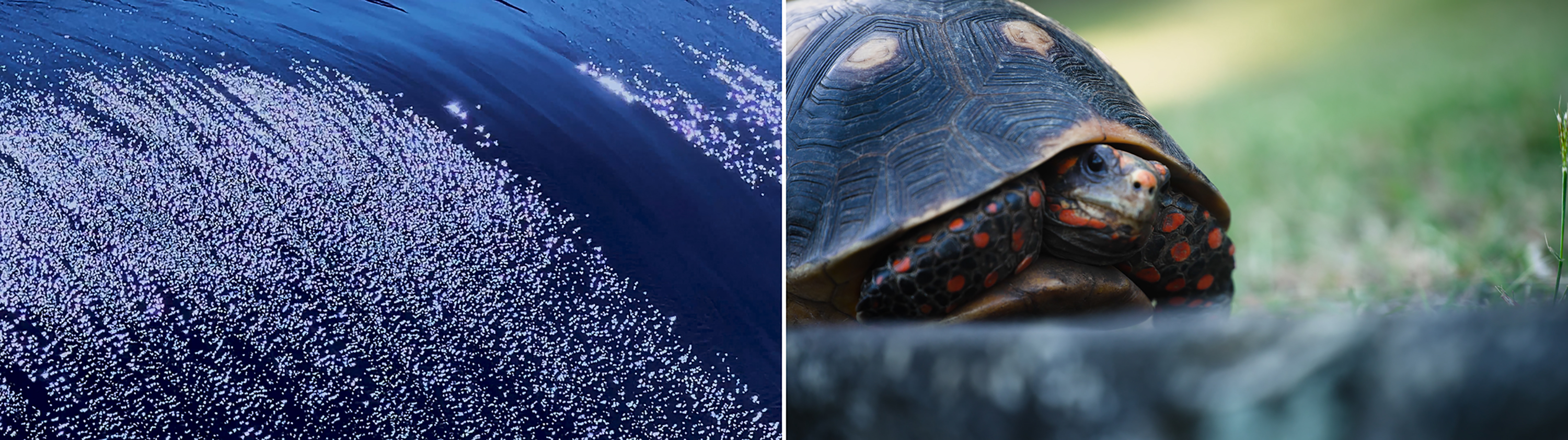 John Zieman, OTOH (On the One Hand): Waterfall Tortoise, aluminum panel, 60 x 16.83 inches. Courtesy of the artist and Leonovich Gallery.
On New Year’s Day 1984, Zieman aided Nam June Paik in orchestrating Good Morning, Mr. Orwell, a one-hour video program beamed simultaneously via satellite to New York, Paris, Cologne, and Tokyo. Highlighting radical performances by figures such as Salvador Dalí, John Cage, Merce Cunningham, Laurie Anderson, and Allen Ginsberg, the stunt literalized—and idealized—the modernist notion of an autonomous “art world,” set apart from bourgeois lifestyles and values. It was an enchanting dream. But by then, MTV had already been operating for nearly two and a half years, blithely dissolving the walls of the bohemian enclave. Today it would be hard to say whether their shared language of quick cuts, weird juxtapositions, and bizarre special effects constitutes music videos stealing from art or art stealing, more awkwardly, from music videos. Technology’s high-low mashup fundamentally, and almost instantly, altered the world’s visual vernacular—and will continue to evolve at high speed into the future, if we have one.
John Zieman’s Weaponized Beauty, was at Leonovich Gallery, 520 West 24th Street, New York, from February 19-March 7, 2026.

Richard Vine
Richard Vine is the former managing editor of Art in America and author of hundreds of critical articles, interviews, and reviews. His eight books include New China, New Art (2008) and Odd Nerdrum: Paintings, Sketches, and Drawings (2001), as well as the artworld crime novel SoHo Sins (2016). He has taught and lectured around the world, and curated exhibitions in Beijing, New Delhi, Hangzhou, Ho Chi Minh City and New York.
view all articles from this author