Whitehot Magazine
October 2026
"The Best Art In The World"
"The Best Art In The World"
October 2026
John Giorno: Please Hold For: a Poem
By CAMILLE MORENO April 17th, 2026
Curious that in 2026 we carry phones everywhere, yet we almost never dial them.
At Lake Geneva’s Bains des Pâquis—past sunbathers popping oysters and tourists taking down pots of fondue—there is an unassuming broom closet with a telephone inside. Pick it up and a voice greets you: “Dial… a poem.”
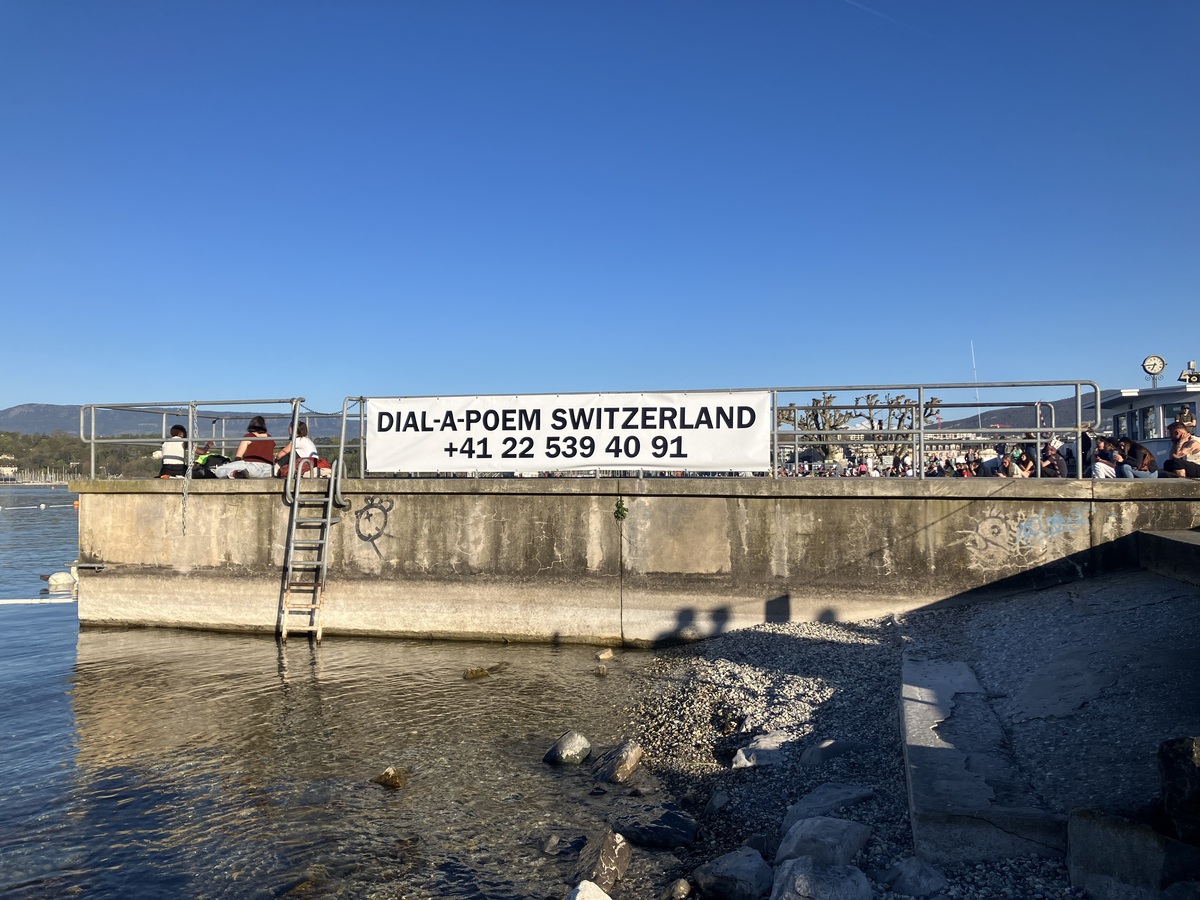
Dial-A-Poem Switzerland at Bains des Pâquis
The voice sounds male and vaguely like Jerry Saltz. He leans heavily into the verb, lingering as if tasting every letter—di-a-l—and stretching it into multiple syllables. Dial. Not tap, not swipe, not scroll. It almost feels like an explanation of the technology. A word from a more mechanical era, when communication entailed bygone rituals of tactile satisfaction.
The caller can press a button—any button—to hear a poem read aloud by its author. The recording plays until its conclusion, at which point you can either place the receiver back in its cradle or dial again. The interaction is simple, self-regulated, and a little addictive, like a public morphine drip except the medicine is poetry. How much do you need today?
The little poetry cabin, however, is only half the story. Anyone with a telephone connection, wired or otherwise, can also access the same poems remotely. Thirty Swiss artists contributed recordings, each reading their own work in their own voice. After all, poetry is meant to be heard.
So said John Giorno, the American poet and performance artist who first conceived Dial-A-Poem in New York in 1969. The current Swiss iteration, hosted by the Museum of Modern and Contemporary Art (MAMCO) Geneva and curated by Elisabeth Jobin with Charlotte Morel, revisits Giorno’s original idea and adapts it for a new audience, backdrop, and time period.
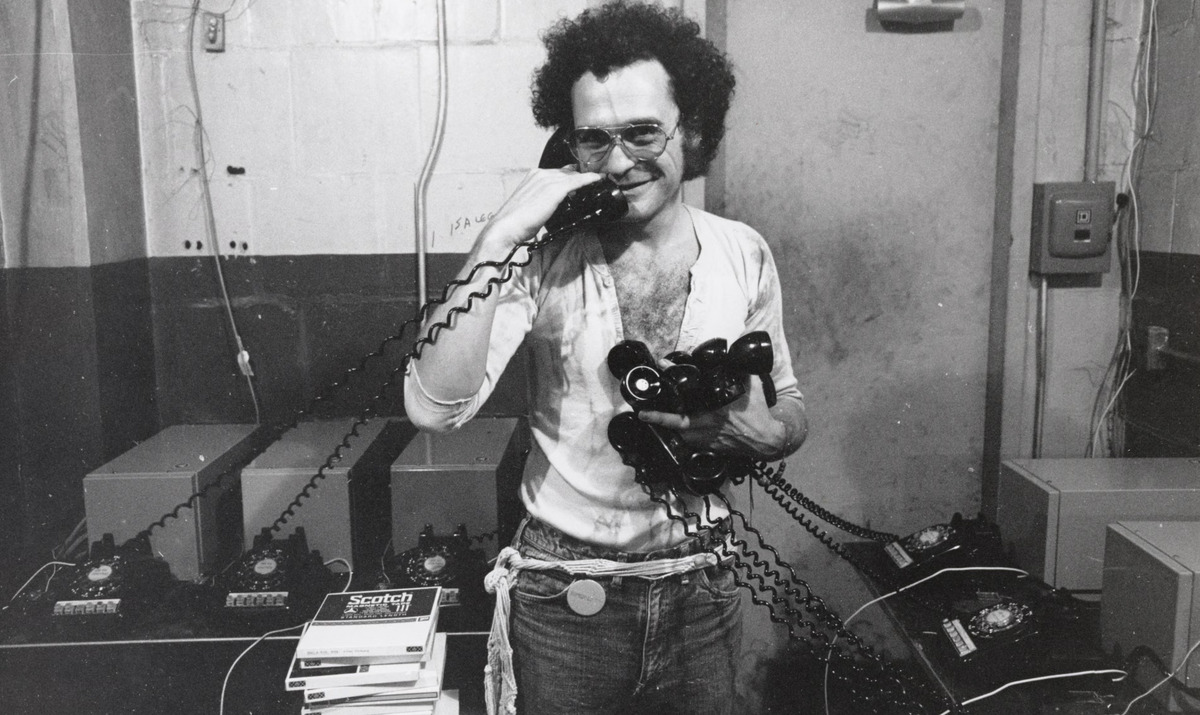
John Giorno's Dial-A-Poem in 1970, Courtesy The John Giorno Foundation, New York, NY
Giorno’s idea reportedly came to him while he was on the phone of all places. Hungover, he was listening to a friend talk at length, wishing that what he heard in his ear were a poem instead. In that way, Dial-A-Poem is like the postmodern precursor to a familiar contemporary complaint: this meeting could have been an email (and this email could have been a poem).
The project also emerged at a moment when artists around Giorno were transgressing the borders of their respective mediums. Contemporaries like Andy Warhol and Robert Rauschenberg were pushing past painting and into film, performance, and installation. Poetry, by contrast, still circulated largely through books and magazines.
Giorno’s proposal was logical and structural. If poetry needed a broader public, it could borrow the network already connecting millions of people: the telephone system. He wired together a bank of answering machines and opened a phone line attached to a telephone number, where callers could hear recordings by poets, musicians, and artists—including Patti Smith, Philip Glass, and Frank Zappa, to name a few.
After The New York Times printed the number, the floodgates opened. Calls poured in, and within a year, the project appeared in the exhibition Information at the Museum of Modern Art (MoMA). In its new museum setting, visitors listened through identical black rotary phones, their circular dials and coiled cords transforming the infrastructure of telecommunications into a sculptural interface. The device that distributed the poems had become part of the work itself, blurring the line between distribution platform and aesthetic object.
Dial-A-Poem Switzerland
The little booth in Geneva inherits this history but also reveals how Giorno’s original premise has aged. In the late 1960s, the telephone network was a tightly controlled infrastructure—centralised, regulated, and technically limited. Turning it into a poetic broadcasting system carried a faintly illicit edge; especially since some recordings were politically confrontational or sexually explicit, provoking complaints and even investigations by American authorities.
Today, the idea feels almost quaint—novel even. The internet now distributes language with such relentless “efficiency” that dialing a poem could seem unnecessarily elaborate. Where Giorno’s gesture once expanded the circulation of poetry, contemporary platforms have pushed the logic of distribution to its extreme. With the advent of social media, the logic of circulation has shifted from expansion to compression. The novelty now lies in subtraction: poems arrive stripped of the interface economy that would usually frame them. There are no metrics, no comment sections, no algorithm quietly predicting what you might want to hear next. There is not even a way to signal approval. Did you like it? The system does not ask.
In the end, this regression is nothing less than liberating, and that logic extends to the museum hosting the project. With its main building closed for renovation, MAMCO has temporarily stripped itself of its own institutional interface. Removed from the architecture that normally frames it, the museum now engages a counter-public—an audience assembled not through exhibition design but through curiosity or even by accident. In doing so, the museum briefly disappears into the city while becoming more visible as a social function. The institution dissolves into its surroundings, reactivating the social imagination of what a museum can be.
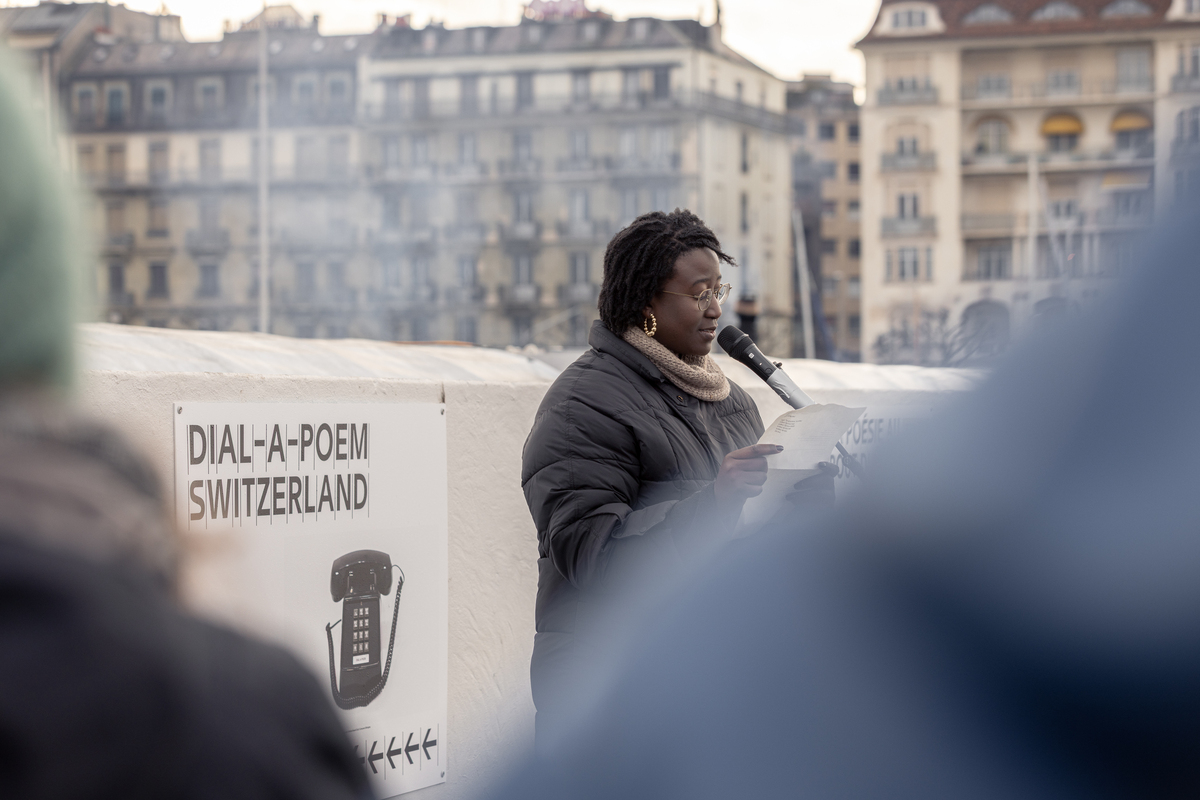
Davide-Christelle Sanvee, Photo ©Antoni Aeby, Courtesy of MAMCO
On opening night, contributors read poems aloud on the pier. In Ces êtres, artist Davide-Christelle Sanvee transforms language into a looping command structure. The poem repeats and mutates a series of imperatives—arrêtez (stop); stop disturbing the strangers; stop arranging them—until administrative language begins to collapse. The rhythm is incantatory, exposing how bureaucratic vocabulary can quietly discipline bodies. At one point, she herself stops saying words altogether and resorts to making sounds: arrêtez simply becomes arrrrrrrrrrrr. Then she breaks into laughter. It is difficult to tell where the word ends and the laugh begins, but it all feels like part of the poem. What even is a “word”, anyway?
Henri-Michel Yéré reads from his book Polo kouman Polo parle, written in French and Nouchi, the vernacular language of his native Abidjan in Côte d’Ivoire. His poems weave together past, present, and future, suggesting how poetry can interrupt the linearity of time and open other ways of seeing. The two languages move alongside one another, responding without dissolving their differences. Moments of existential uncertainty are answered by a steadier voice of composure; in dialogue, the poems gradually dissolve the sense of isolation they begin with.
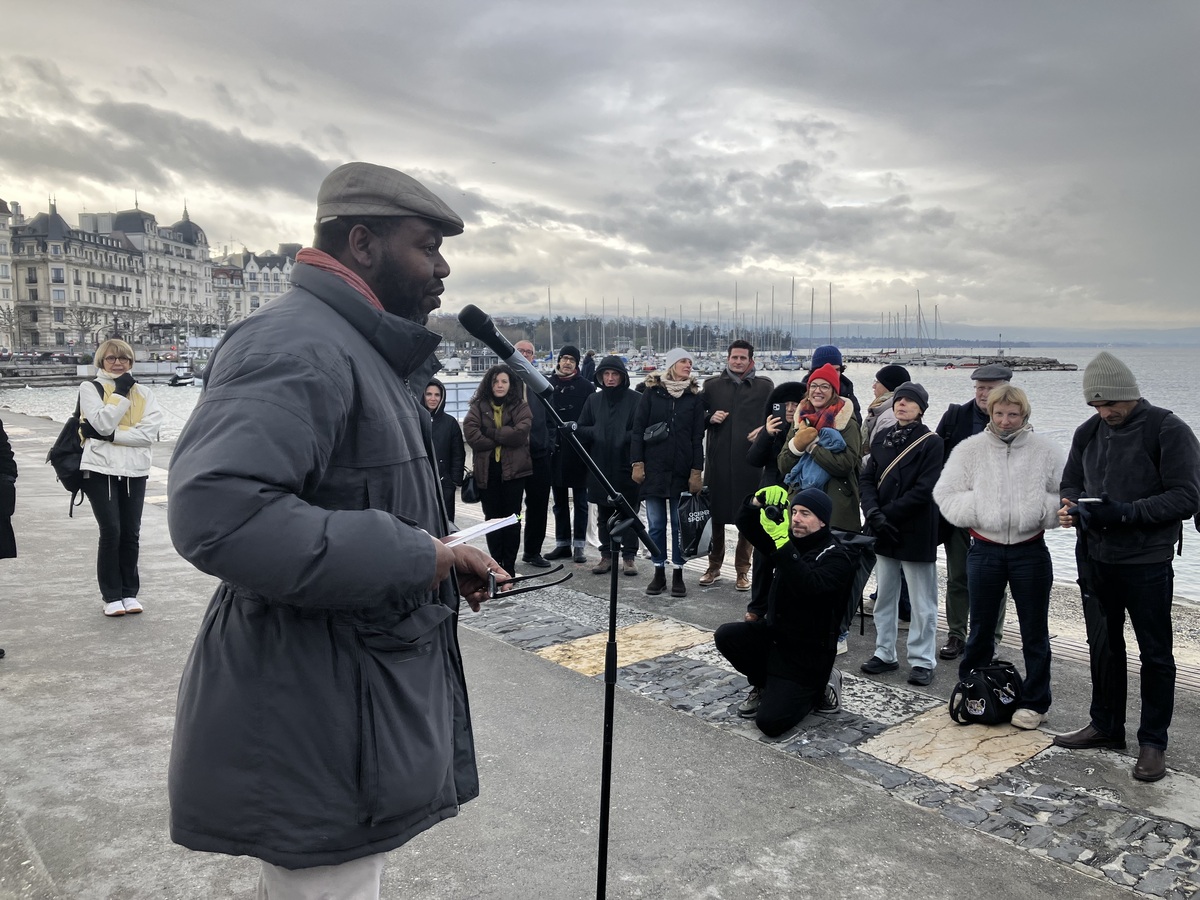
Henri-Michel Yéré, photo by Camille Moreno
For Jobin, the selection of voices was also an attempt to resist the familiar image of Switzerland as a monocultural landscape of mountains, chalets, and postcard stillness. Instead, the project presents a country shaped by movement—by migration, urbanisation, and awkwardly overlapping languages. The telephone line becomes a kind of discursive site, where Switzerland appears less as a fixed territory than as a network of voices temporarily converging. In this sense, the project mirrors a broader shift in how places are imagined today: not as stable identities tied to geography, but as spaces produced through social exchange, transit, and cultural encounters.
Giorno once remarked that Dial-A-Poem succeeded by creating a desire that could never quite be fulfilled. If a caller disliked the poem they heard, they could simply hang up and dial again. Each call promised another voice, another possibility. That logic persists today. The project has been revived in multiple countries—including Brazil, Mexico, and France—with 2026 editions in Thailand and Italy. Online, at dial-a-poem.org, hundreds of recordings from around the world now circulate together, playing in random order for anyone who calls or clicks.
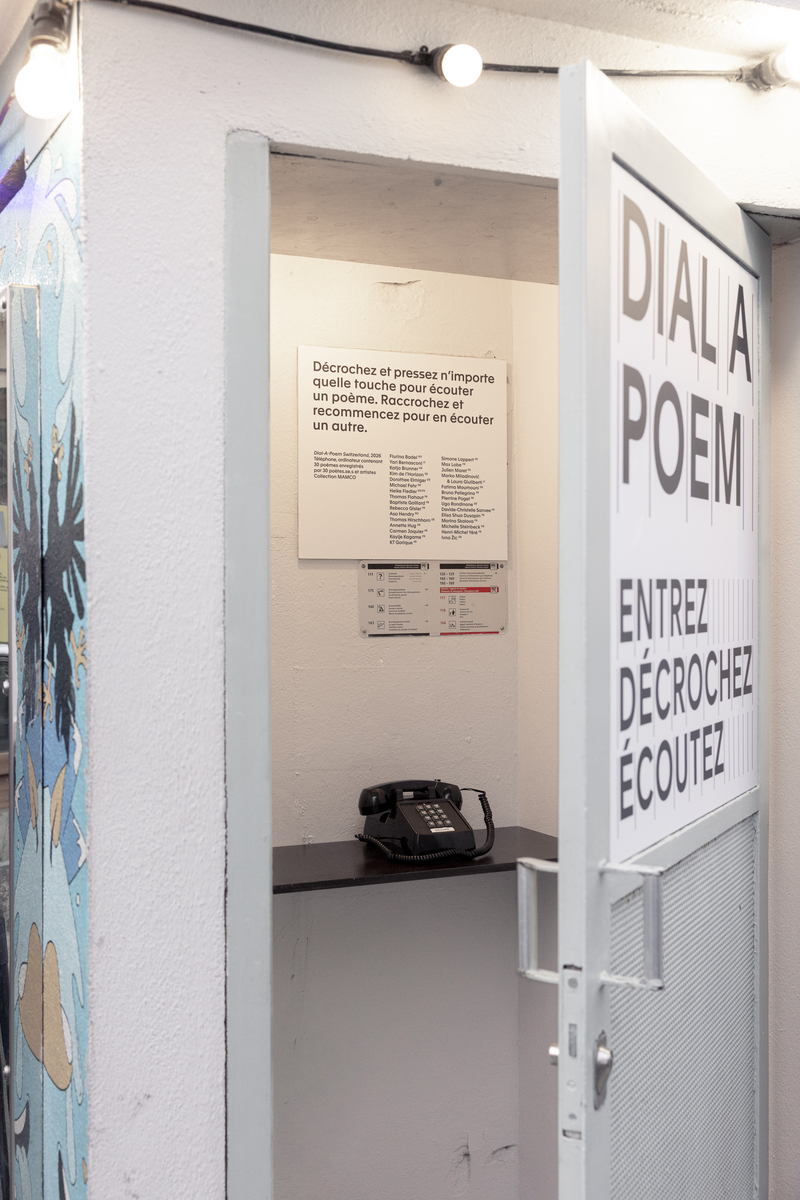
Photo ©Antoni Aeby, Courtesy of MAMCO
The phone line is open from 28.03.2026–10.05.2026
at Bains des Pâquis
Quai du Mont-Blanc 30, 1201 Genève, Switzerland
or by calling +41 22 539 40 91
Camille Moreno
Camille Moreno is a Costa Rican-American writer based in Berlin. Her writing investigates how art operates within social structures, foregrounding accessibility and the everyday as sites of critical and imaginative potential. She has written for cultural publications in Germany, the United States, and the United Kingdom.
view all articles from this author