Whitehot Magazine
August 2026
"The Best Art In The World"
"The Best Art In The World"
August 2026
A Grammar of Optimism: Joel Mesler's Internal Paradise
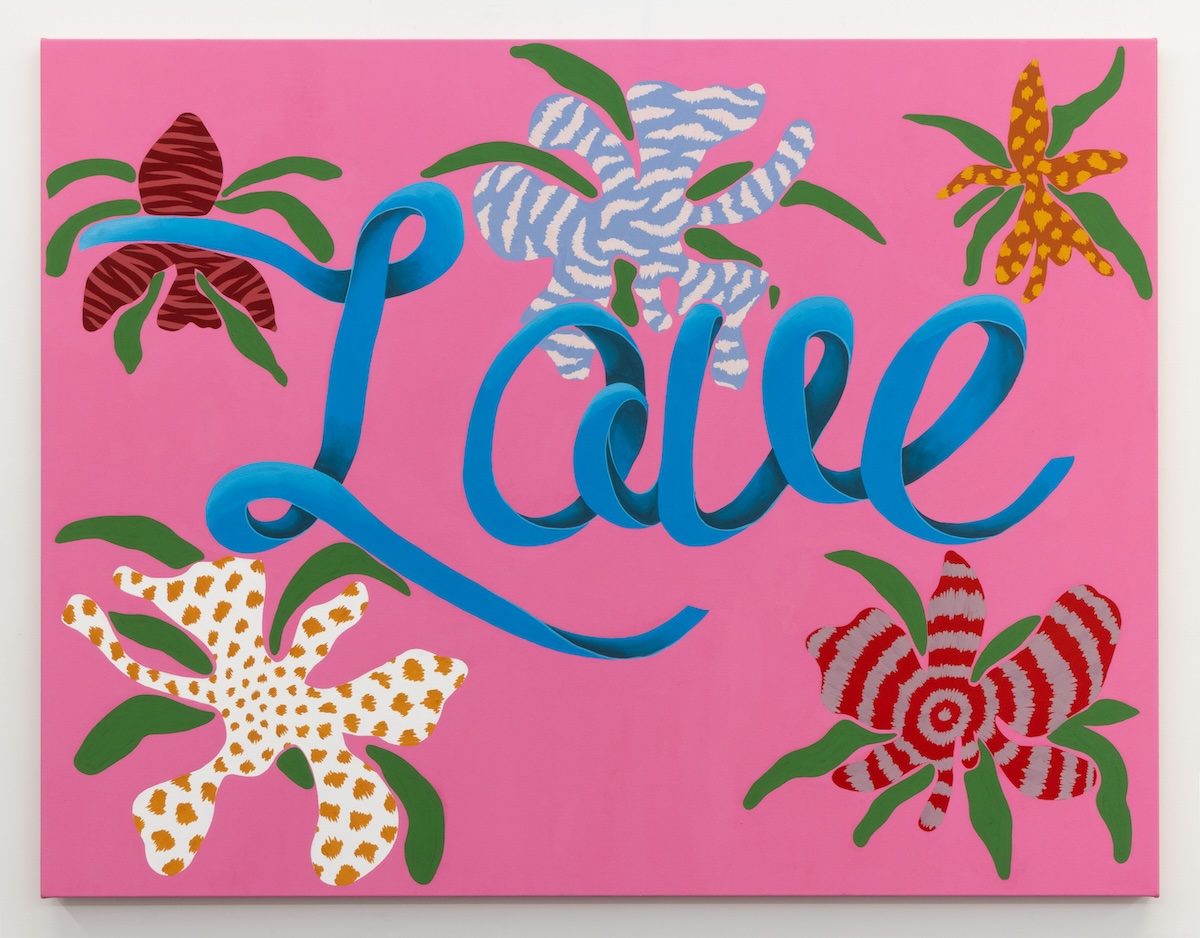
Joel Mesler, Love, 2025, Color on linen, 46 x 60 in. Courtesy of the Artist.
By EMANN ODUFU, Feburary 11th, 2026
Paradise Found, Joel Mesler’s first solo exhibition at the Paradise Art Space in Seoul, South Korea, presents an immersive journey through Earth, Water, and Sky. Across text, sculpture, and material play, the work navigates affirmation, anxiety, and personal memory. The exhibition’s elemental structure immediately resonated with me, echoing questions I’ve been exploring in my own recent curatorial and writing work around shared humanity and cultural exchange. As a writer, I’m particularly interested in the concept of art history as a never-ending conversation. Each artist, from the largest most renowned ones to even unknown artists are part of a larger tapestry. They bring their individual perspective, as a singular puzzle piece that shapes the many different ideas about how we perceive the world.
In Paradise Found, Mesler explores imagery of suburban Americana as aspirational symbols. Pool Parties are included as a marker of transcendence. The small joys of being at home and being able to appreciate a sunrise or a sunset or the wisdom of taking everything a day at a time showcase both vulnerability and self-examination--that there is meaning beneath the aspects of everyday life that we all take for granted. There is a natural balance between things that are universally human, love, passion, fear, regret, triumph, and each of our own individual subjective views on reality. Joel Mesler is an interesting artist to me because he works from within that gray area. He allows his work to hold contradictions and thumbs his nose at absolutism and self-righteousness without sacrificing meaning or intention. For Mesler, phrases of affirmation, anxiety, humor, and gratitude showcase the importance of everyday experience; the good, bad, ugly and everything in between.
In this conversation, Mesler reflects on paradise not as a destination, but as an internal state shaped over time. In my own journey, I relate to the idea that progress, and even small wins, compound over time, becoming a pathway not to absolute happiness but to feeling lighter and building greater capacity for happiness each day. In the troubling times we are living in, it's important to hear what other people have to say, listen, and take wisdom wherever it can be found. In my opinon, this can only be achieved by authentically engaging with one another rather than jumping to conclusions or preconceived notions.
Emann Odufu: Paradise Found unfolds across Earth, Water, and Sky. When did you realize that paradise, for you, was internal rather than external, and how did that realization shape the exhibition?
Joel Mesler: About halfway through making the show, I realized paradise comes from within, not outside the self. It is not a journey that ever really ends. It is one day at a time. Thank you for the reminder.
The elemental structure feels almost like a psychological map. How did Earth, Water, and Sky become a language for inner life, memory, and vulnerability?
It came organically while walking through the space at Paradise City. The architecture already held those elements, with or without me, so I simply named what was already there.
This is your first solo exhibition in Korea. What did it mean to present such a personal body of work in a new cultural context? Were there moments of unexpected resonance or translation?
The response exceeded my wildest expectations. I do not know if it was the interpreter or the work itself, but there was a real sense of mutual love and joy exchanged throughout the exhibition.

Joel Mesler, No Place Like Home, 2025, Color on linen, 60 × 70 in. Courtesy of the Artist.
Your texts often sit between reassurance and unease. Do you believe affirmation works best when it acknowledges anxiety rather than denying it?
What I put out is an honest reflection of my thoughts and experiences. At this point in my life, I have nothing to hide, the good, the bad, and everything in between.
In Paradise with Blossoms, the golden balloon lettering feels celebratory, while the materials suggest impermanence. How do you think about beauty as both exuberant and fleeting?
The balloons reflect memories from my childhood. Sometimes I cannot tell if they are inflating or deflating when I recall them. Memories hold different meanings for everyone, but we all have them, and that is worth celebrating.
Untitled (I Love You) appears buoyant and playful but is physically heavy. How important is that dissonance between appearance and reality in your work?
Nothing is ever what it seems to me. I like to reverse expectations, making soft things hard and inviting surfaces uneasy. That instinct likely comes from childhood trauma, which still informs the work, whether I want it to or not.
Humor runs throughout your practice. Do you see it as a way to disarm resistance and invite vulnerability?
“Vulnerability is the bridge to connection” is one of the truest things I have ever heard. And Mel Brooks is a hero of mine.
Many of your phrases feel addressed to both no one and everyone. How do you think about love or unity in the current moment?
I have learned that no one wants to be told anything. I have lived long and hard enough to have stories, and for those who want to hear them, I am willing to share, without instructing.
After Paradise Found, where does paradise live for you now? Has making this exhibition changed what you feel you owe yourself or others?
Paradise is still an internal destination. What I owe is not just to myself, but to the people around me: to stay focused on being the best version of myself I can be, as close to paradise as possible. Every day. One day at a time.
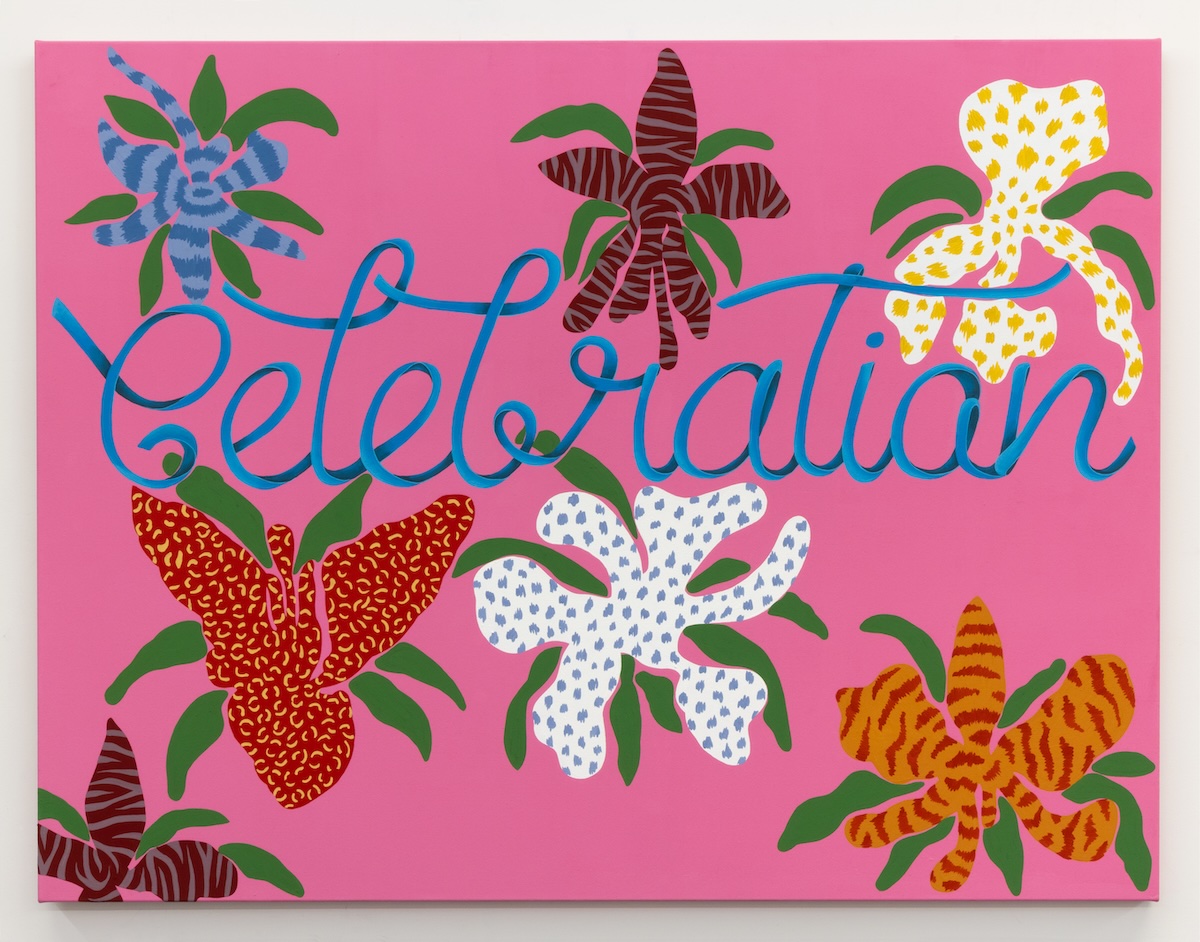
Joel Mesler, Celebration, 2025, Color on linen, 46 x 60 in. Courtesy of the Artist.

Emann Odufu
Emann Odufu is an independent art and culture critic, filmmaker, and curator from Newark, New Jersey, whose work explores contemporary art and Black visual culture through Afro-Futurism, narrative, and cultural memory. His writing and creative work has appeared and been featured in The New York Times, HuffPost, Paper Magazine, Office Magazine, and The Brooklyn Rail, and his curatorial practice includes exhibitions at the Liu Shiming Foundation, National Arts Club, MoCA Westport, Friedrichs Pontone Gallery, and Leila Heller Gallery. He has spoken at Harvard University, Yale University, the British Film Institute, and the National Academy of Design.
view all articles from this author