Whitehot Magazine
October 2026
"The Best Art In The World"
"The Best Art In The World"
October 2026
Jeff Koons at Gagosian
 The Golden Age, 2018–25, oil on canvas with aluminum leaf, 84 × 127 in. (213.4 × 322.6 cm), © Jeff Koons Photo: Tom Powel Imaging Courtesy Gagosian
By MATILDA LIN BERKE January 13th, 2026
In Jeff Koons’s return to Gagosian—and to the crucible of showing new work in New York—we are presented with a return to the mines of the artist’s own archives. The series title and underlying references serve as nods to his favored medium of the late 1980s, with these sculptures rendered in the material and finish (mirror-polished stainless steel) for which he has become notorious. As Koons remixes his storied negotiations with kitsch, he trains a rigorous, revitalized eye on the visual and commercial processes of derivation itself.
Though the notion behind the Celebration series was financially risky at the time of its proposal, turning a small contemporary kitschy object (balloon) into a perfect version of a large contemporary kitschy object (big metal balloon)—while easy to install as a parcel of value and reflective selfie-surface—doesn’t push the conceptual envelope as far as we saw it extended through the objects of Statuary (mid 1980s) or Antiquity (mid-to-late 2000s). Engaging with the fraught dispersion of images and motifs through history while adding a shiny tonal filter? Even if the works aren’t to your personal aesthetic taste, Koons is cooking with gas again.
 Kissing Lovers, 2016–25, mirror-polished stainless steel with transparent color coating, 88 × 77 × 55 in. (223.5 × 195.6 × 139.7 cm), edition of 3 + 1 AP, © Jeff Koons Photo: Tom Powel Imaging Courtesy Gagosian
Older forms transposed into his style become interesting precisely because of their inherent material contradictions. Still, certain experiments with the gradated color-membrane he introduces in this Porcelain Series bear more fruit than others. The blocking on Kissing Lovers (2016–25) is unsurprising. Smooth orange highlights interspersed with sketchy furlike strokes on Fox with Bird (2016-23) are well-executed but don’t do much for me. Darker, more irregular washes applied to Stag and Dog (2016-24) suggest the inevitable process of tarnishing, mirroring the evolution of its classical Greco-Roman subject—the ill-fated hunter Actaeon, transformed into a stag by Diana (2016-25), who stands buttressed by her nymphs in the next room—through marbles and Meissens into a more implacable medium that, while it resembles burnished silver or copper, is impervious to its flaws (which Koons creates in simulacra).
 Diana, 2016–25, mirror-polished stainless steel with transparent color coating, 108 × 77 3/8 × 70 3/16 in. (274.3 × 196.5 × 178.3 cm), edition of 3 + 1 AP, © Jeff Koons Photo: Tom Powel Imaging Courtesy Gagosian
(One imagines he could go even further down this road. Downstream of Ai Weiwei’s Coca-Cola Vase series, massive steel sculptures of preserved Chinese porcelain ware alongside later editions commissioned and collected by Ottoman emperors, complete with glazing quirks/subtleties and time-based erosion rendered in this new technique, would retain both visual appeal and historical interest—while establishing more resilient versions of these relatively vulnerable objects—as well as amped-up commercial viability in an evolving global market.)
 Nymph, Pluto, and Satyr, 2018–25, oil on canvas with aluminum leaf, 102 × 71 1/16 in. (259.1 × 180.5 cm), © Jeff Koons Photo: Tom Powel Imaging Courtesy Gagosian
The rouged knees of Aphrodite (2016-21) are equally fascinating. Even in illusion (translucent glaze here, makeup when the technique was popularized among flappers in the 1920s), blood flows under the skin: like the visible crinkles in Rabbit (1986), a present reminder that the “balloon” can be popped, the effect teases out provocative libidinal and existential compulsions. Despite the complexities of what it represents, a consistent and completely impermeable surface can only be so compelling. Active suggestions of vulnerability establish a necessary tension. So does Aphrodite’s babyish over-large head on her otherwise proportional body: a combination that evokes the dimensions of Michelangelo's David (designed to look normal from below). Perhaps Koons’s sculpture ought to tower over the viewer, but she’s installed at standard height. In any case, the decision complicates what would otherwise be a fairly simple figure. We see the artist poking his own head out of the trap of comfortable self-definition and into ambiguity.
The most ambitious and successful aspect of this show lies in its paintings, which display a welcome degree of expression coupled with formal invention and a startling attunement to the zeitgeist. They are curious hybrids caught between worlds and times, rendered in screensaver-esque images under fifteenth- and sixteenth-century designs stenciled in aluminum between gestural swathes of oils; they transcend trompe-l'œil, entirely evading questions of dimensionality; they do not fool the eye so much as baffle it. They slip in and out of legibility like surreal dreamscapes or artificially-generated content, though Koons painted them himself. They remind you of simulations of visual agnosia. They feel somewhat evil in their layered, pastiched, internally contradictory composition. They are also quite beautiful.
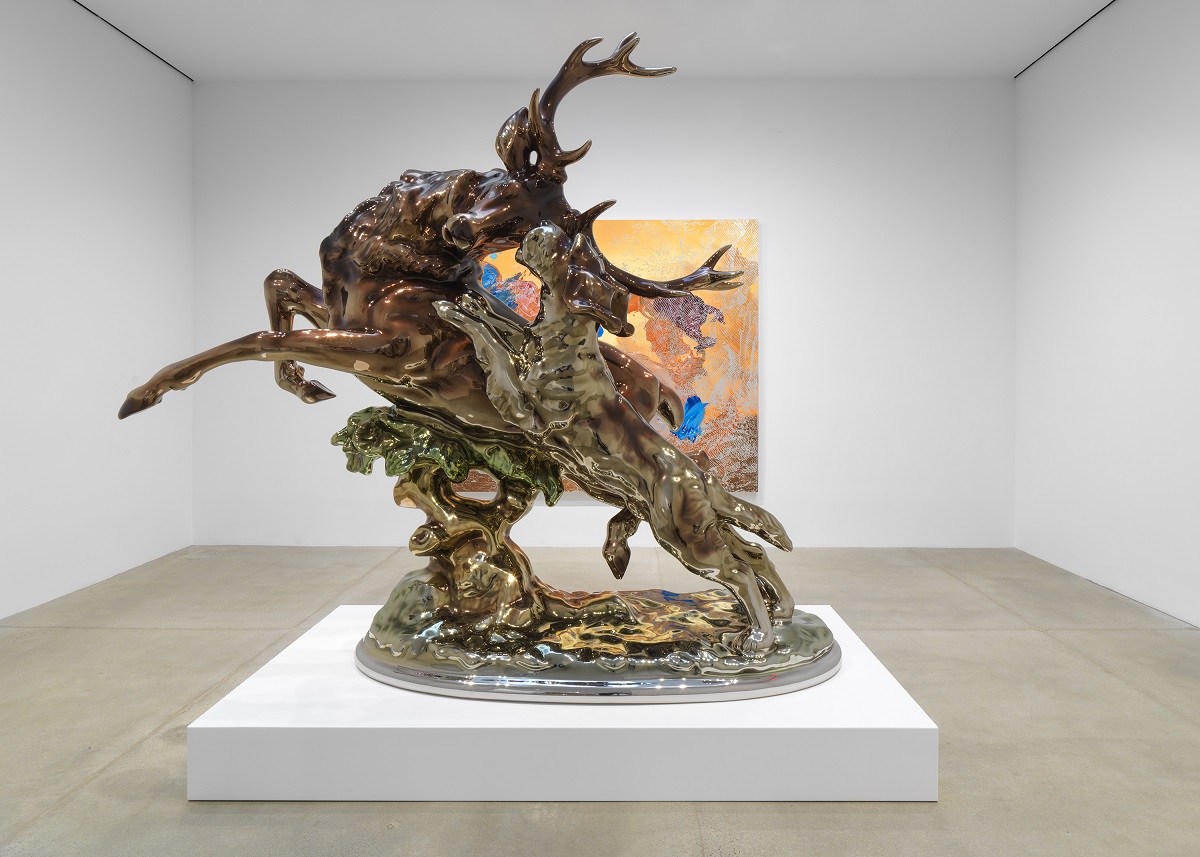 Stag and Dog, 2016–24, mirror-polished stainless steel with transparent color coating, 104 × 42 5/8 × 113 3/8 in. (264.2 × 108.3 × 288 cm), edition of 3 + 1 AP, © Jeff Koons Photo: Tom Powel Imaging Courtesy Gagosian
Like the references and myths that inform Koons’s sculptures, the aluminum stencils provide contextual scaffolding that alternately girds and embellishes the artist’s marks. They are like silvery skins or elastic nets; though they resemble the rigid outlines of engravings where the works are flat, they appear fluid or membranous where they fall over infrequent bunchings of paint. The most successful paintings emphasize these textural inconsistencies, which—at odds with the slicker aspects of their production—materialize puzzling tonal juxtapositions. The “high,” expressive, mostly abstract painted gestures confuse the “low” high-definition reproductions of background images as both swirl around the transferred forms of history. It’s like an aestheticized Neo-Pop version of the threatening, politically prescient “brainrot” meme webseries Skibidi Toilet. (Toilets are also made of porcelain.)
At the top of the heap, the sweeping Venus and Mercury (2018–25), The Judgement of Paris (2018–25), and Swiss Landscape (2018–25) are legitimately epic, if twisted. These aggressive compositions crash over you in waves of visual information just as recognizable figures emerge from the noise. Despite being deliberately derivative and dispersive—vague romantic ideas of “the classical” or “the natural” filtered through a contemporary lens and stacked on top of one another (it seems like no accident that the shapes of the canvases mimic the rough dimensions of a phone or laptop screen)—these are powerful, well-planned, effective paintings. Venus and Mercury is triangularly composed in negative: close-knit aluminum latticework flattens out its edges while an illusionistic combination of exposed background and applied oils draws the eye up toward a falling angel with its face obscured. As Koons elides and establishes forms between multiple planes, he obliquely confronts the optical technologies and conditions of our time. Imagine the art world auto-cannibalizing and vomiting itself back up.
Most culture has been mass culture at some point; as mass culture generates its own avant-garde critical structures, it sustains a perpetual feedback loop. It’s ultimately impossible to deny the relation between the two. There is some perverse circular beauty in the ouroboros, which Koons—at his best—makes explicit.
Matilda Lin Berke
Matilda Lin Berke is a New Yorker from Pasadena, California. She has written theory and criticism for publications including the Brooklyn Rail, Filmmaker, Spike, and The Whitney Review, with pieces forthcoming in Purple Fashion Magazine and Mutt Magazine. You can find more information (fiction, poetry, and other projects) on her website. She teaches at the Center for Fiction in Brooklyn.
view all articles from this author