Whitehot Magazine
October 2026
"The Best Art In The World"
"The Best Art In The World"
October 2026
SAVE/DIE/RETRY at A Space Gallery: Jagger van Vliet's Highlights
By JAGGER VAN VLIET, October 29, 2026.
Cyberattacks are no longer science fiction, folks. The era of digital collapse may be nigh at hand. For now, we’re stuck in a scene of transition; a limbo trance in Techland. Judging by the name alone, A Space Gallery’s latest exhibition, SAVE/DIE/RETRY promised to be just the thing I needed to make sense of the recent headlines.
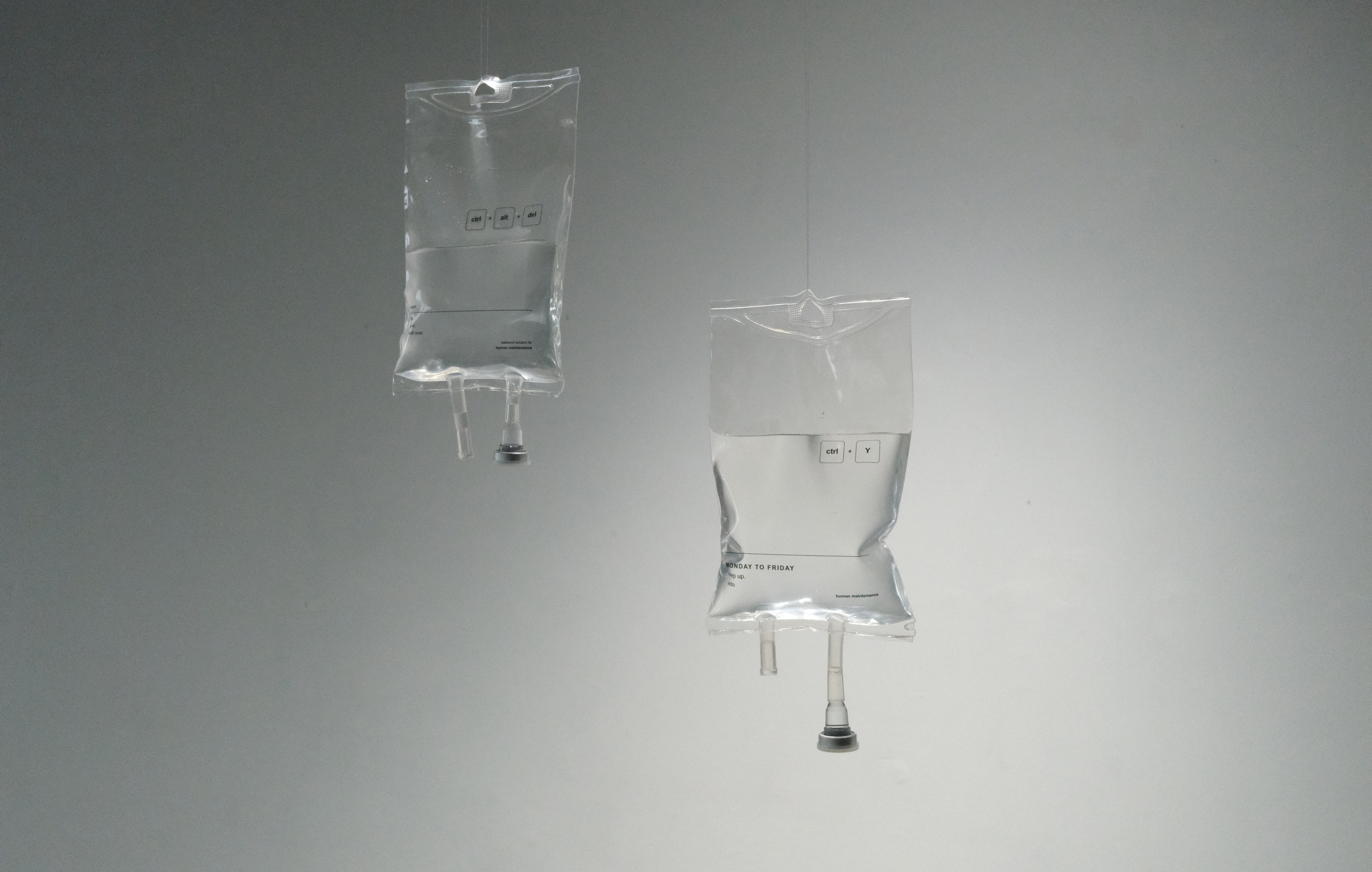 Raphaela Stella Leys, Ctrl + alt + del, and Ctrl Y, 2026. Custom label on IV bag.
“There’s this really interesting concept of dying in the digital world,” said Daniel Meng, the show's curator. He cut a shy figure, albeit rocking the hell out of a tan suit jacket.
Meng explains, “Essentially, when AI was not as advanced… its memory processing was not fully developed. So, when you started a new chat, had the old one died? Or, when you started a new chat, had the AI essentially been reborn? I wanted to start with this concept and develop it further.”
A Space Gallery’s 4th floor showroom was palpably sparse. There was an undercurrent of disappearance running throughout the whole gallery. Works of sculpture were frequently rendered transparent, two-dimensional, or otherwise they were redacted completely.
Meg Lewis’ piece Precious (A Soul Being Carried to Heaven), hung in the center of the room like an eerie apparition; a vision of the quintessential Bushwickian angel split apart along two clear flaps of acetate. You had the thousand-yard stare, the micro-bangs, and the clever sartorial pairing of cowboy boots and glitchy underwear. It was all there, only it wasn’t. Split. Fractured. Halfway there, like a pellucid diptych.
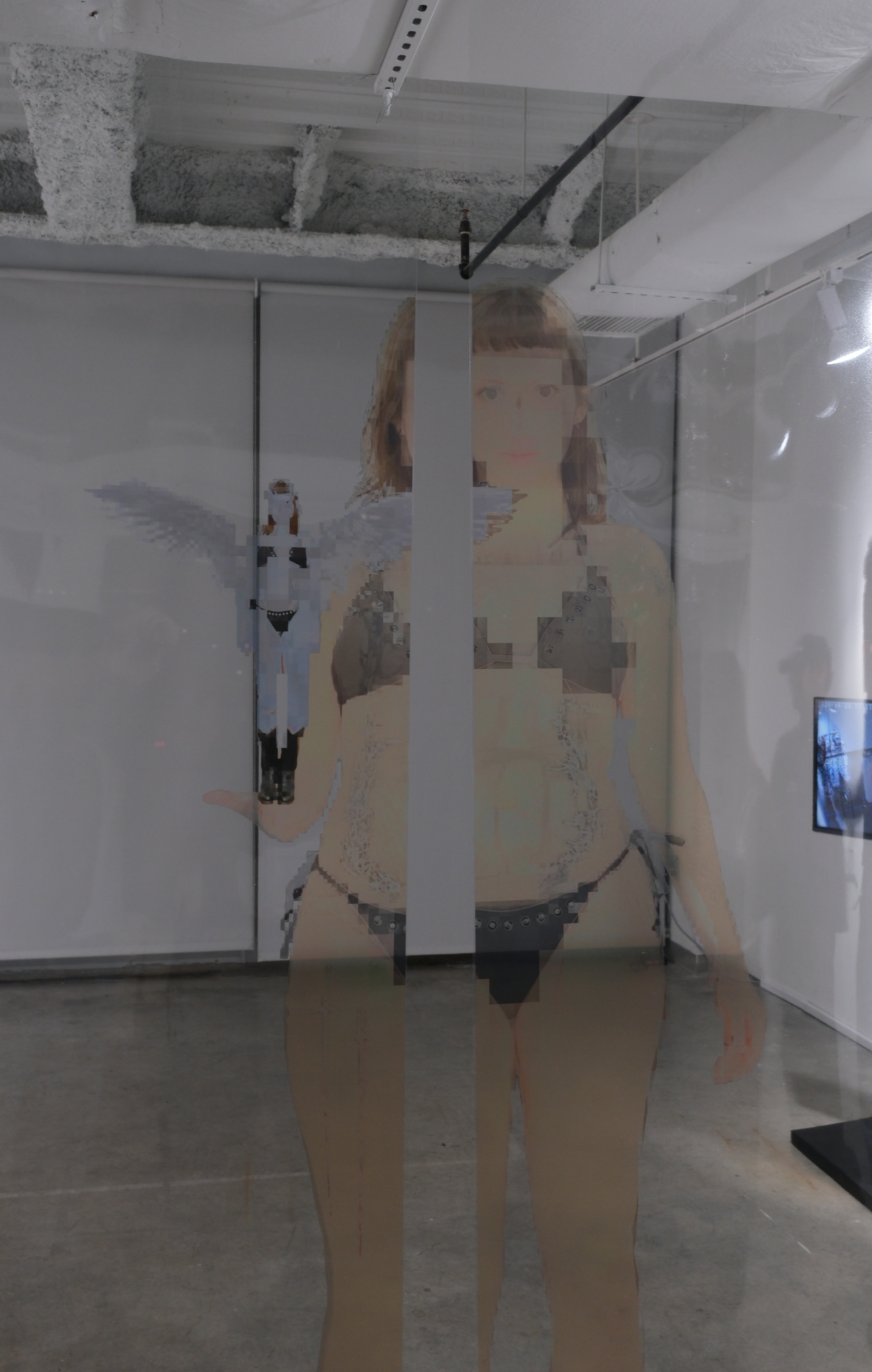 Meg Lewis, Precious (A Soul Being Carried to Heaven), 2026. Acetate Print.
Later, I came across a monitor, displaying a live feed of the very gallery in which I was standing. This livestream was almost definitely haunted. Instead of gallerygoers, blobs of pixels moved across the screen, like ghostly QR codes. This piece was titled, Blind Eye, by Polish artist, Natalia Kapitan.
“It’s a Python-based code, using the YOLO feature,” Kapitan explained, “When you set up the piece, the code takes a picture of the empty room. Any time the code doesn’t detect people, it takes the image and it kind of mish-mashes the body and the pixels and substitutes the actual person with the first initial image. It refreshes any time people aren’t in frame.”
In her last year at RISD, Kapitan took a computation class where she learned how to code these altered livestreams. Now, she shows the piece wherever she can, bringing her virtual wraiths to RISD, The Woods-Gerry Gallery, and now A Space. I admitted to Kapitan that her piece reminded me of Hito Steyerl’s digital performance, Ways To Disappear.
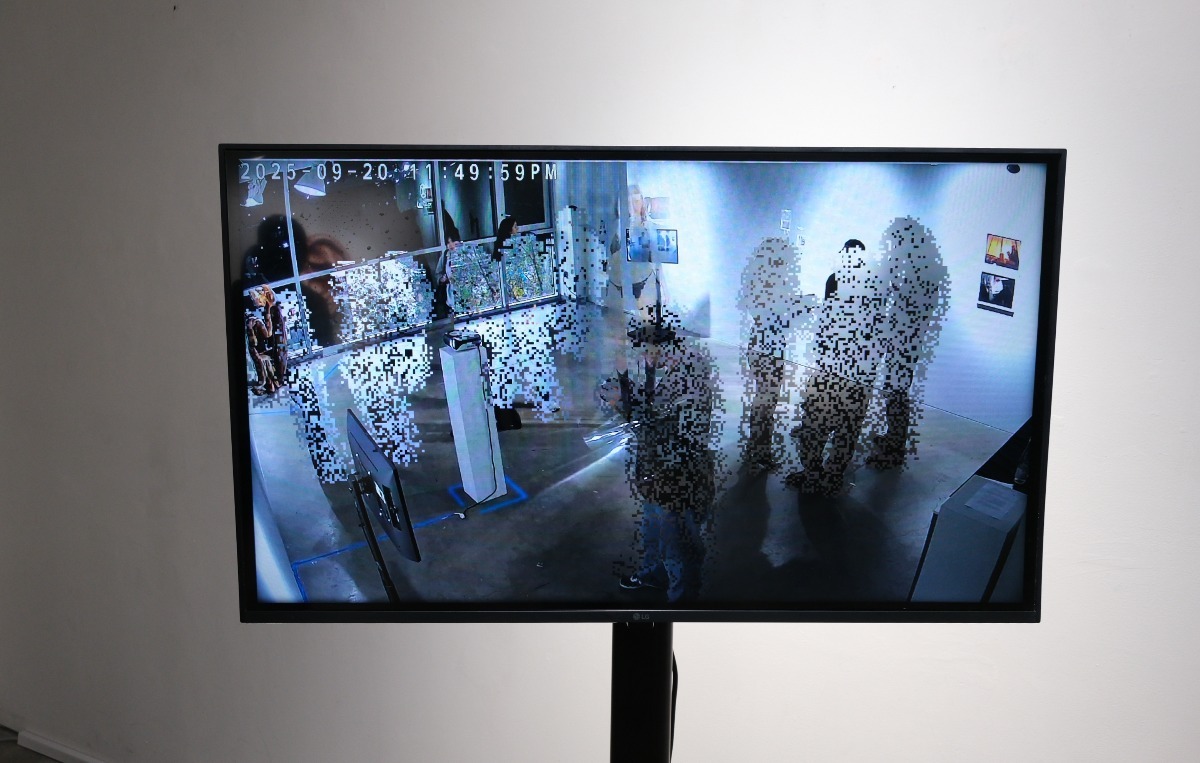
Natalia Kapitan, Blind Eye, 2026. Security camera, wireless router, laptop monitor, Python-based computer vision system.
“A lot of my work deals with disappearance and trying to make myself disappear through the systems that control you or surveil you,” Kapitan agreed, “I’m an immigrant here, and I was thinking a lot about surveillance, especially in my last year of college. There is this understanding of the body being detected constantly, but not necessarily legible fully.”
It was an acute diagnosis. In fact, it neatly synthesized SAVE/DIE/RETRY’s whole curatorial ethos. Whether it was Qu Chen’s computer-rendered short film, or Raphaela Stella Leys’ IV bags hanging from the ceiling, everything in A Space Gallery seemed to be eroding before your eyes; pinwheeling their pixels into the ether. Constantly fading into 1’s and 0’s.
Dust to digital dust, or however they say it. WM
Jagger van Vliet
Jagger van Vliet was born in Maine and currently resides in New York City. They are completing an MA in Writing and Publishing from Emerson College. Jagger is the author of a published novella, “TABU.” They have also worked as the Editorial Director for the award-winning Index Fashion Magazine. Additional work can be found in Trill Magazine and Rock N' Load. Jagger’s writing concerns the grotesque, the strange, or the ineluctably necessary (which are all the same thing).
view all articles from this author