Whitehot Magazine
October 2026
"The Best Art In The World"
"The Best Art In The World"
October 2026
Not That Deep Gallery's 1 Year Anniversary: Jagger van Vliet's Highlights
By JAGGER VAN VLIET, October 20th, 2026
It was a windy evening in Brooklyn, and I was at Not That Deep Gallery for their one-year anniversary exhibition aptly titled It’s Not That Deep. For this show-turned-celebration, curators Sadie Withers and Alina Hoai gathered every artist who had ever shown at Not That Deep into one gallery. The only caveat: they had to bring a work of art using cardboard.
Hoai told me the idea was loosely inspired by her and Withers’s visit to a Thomas Hirschhorn installation. I found it to be a unique and perfectly emblematic concept for Not That Deep’s anniversary show. What better way to pack 64 artists into one basement gallery than by handing them the quintessential DIY challenge?
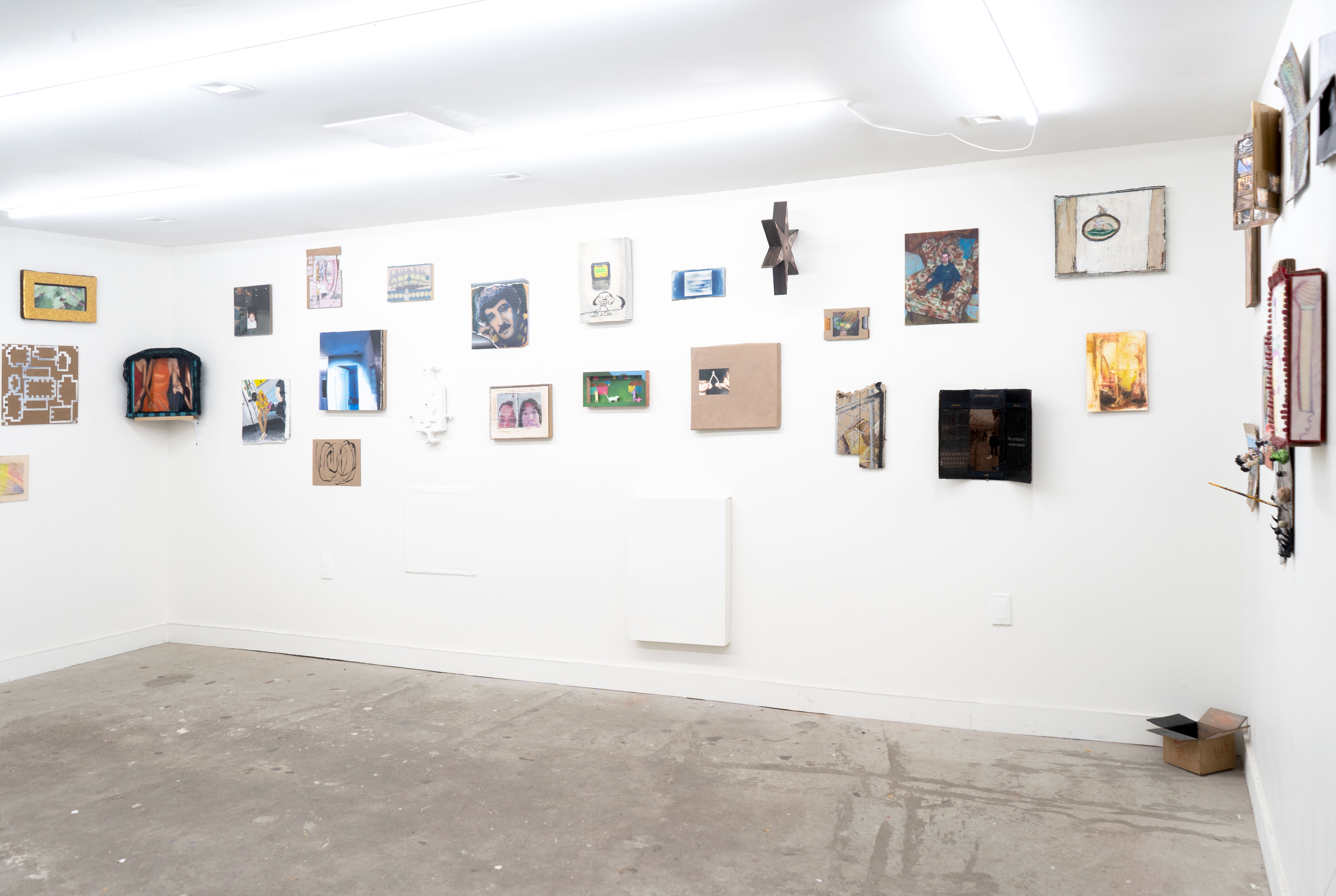
Installation view of It's Not That Deep, at Not That Deep Gallery (October 17 - November 27, 2026) Photo by Sadie Withers
The first piece that caught my eye was one of Roselynn Sadaghiani’s light boxes. This particular frame was, of course, made of cardboard and illuminated an overlapping image of the Ayatollah of Iran. This Ayatollah was recognizable by his face alone, the rest of his body replaced by—of all things—a cardboard cutout. Sadaghiani sourced the image from a viral Iranian meme.
“I’ve been thinking about how Iranian culture and its perception in the media is informed by repetition of images,” Sadaghiani explained. “Especially as someone who lives in the diaspora, I find myself having less and less to hold onto in understanding my culture.”
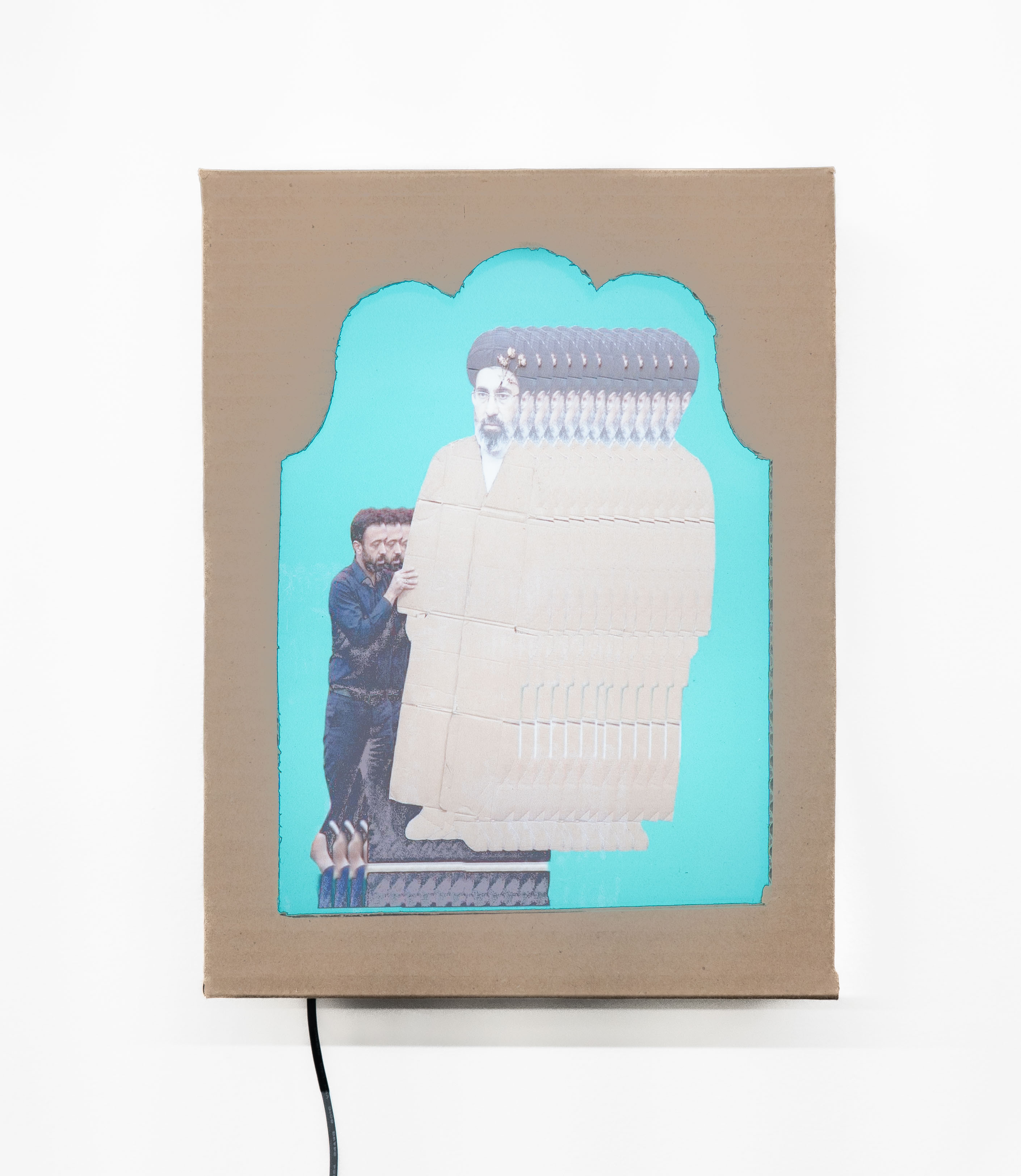
Roselynn Sadaghiani, Cardboard Ayatollahs, 2026, Cardboard, packing tape, backlit film on light box, 12 x 9 x 3 in.
Directly above Sadaghiani’s piece was a sculptural work by Wyatt Lux. It was an inverted peace symbol, layered and continually involuting. Lux painted the cardboard a shade of Statue of Liberty green, an instantly recognizable patina, albeit replicated onto a nonmetallic surface. Much like Lux, the piece sort of loomed over you, inverted and vaguely arcane.
“I was thinking a lot about symbols being representative of ideology,” Lux explained. “But also this specific material has its own ideology… It’s interesting how all that can be expressed with just a few lines.”
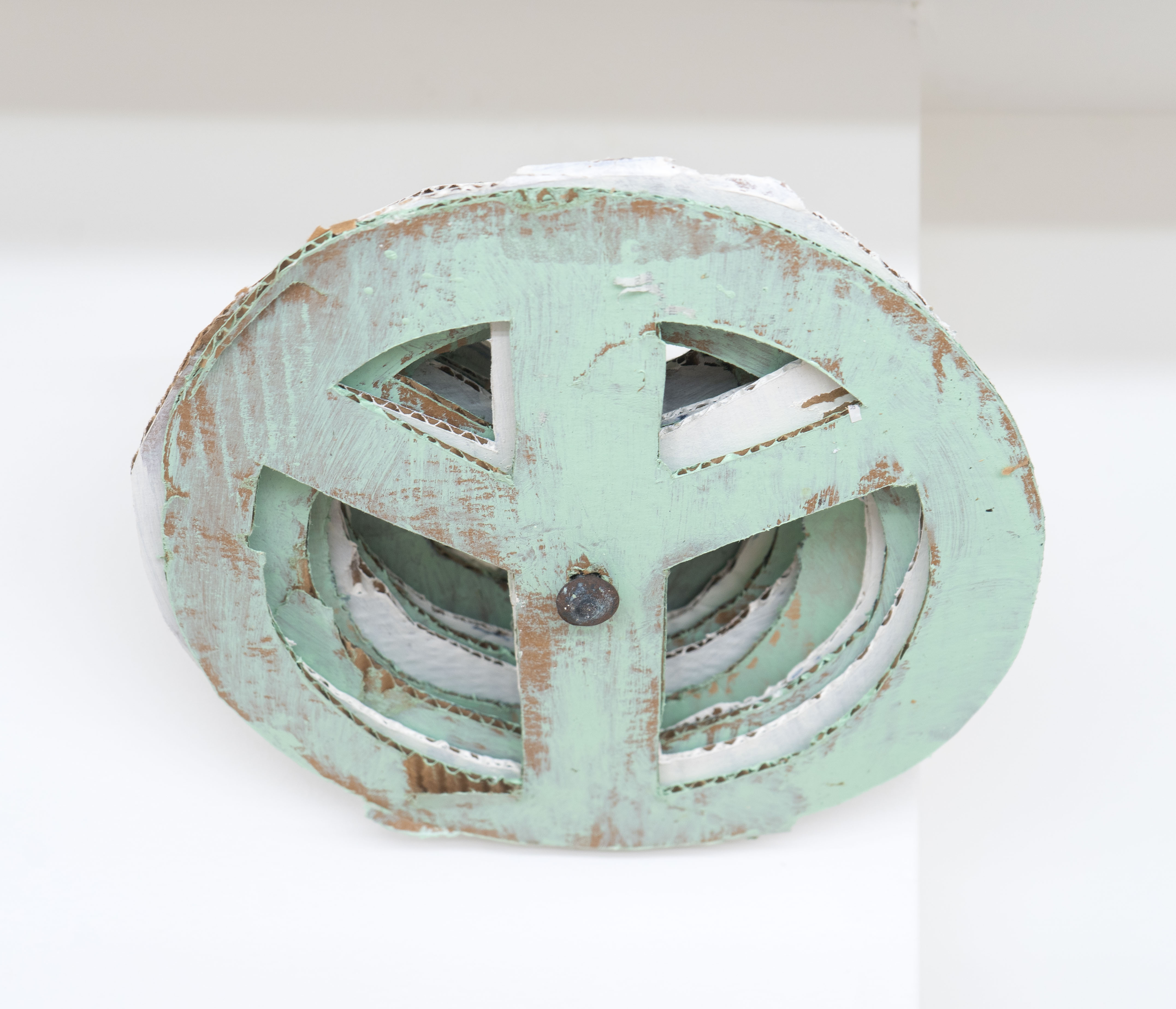
Wyatt Lux, Sublime object 2, 2026, Iron and oil paint on cardboard, 11.5 x 11.5 x 7 in.
Lauryn Casey's Breaking the Close was a classic Casey piece in that it was eerily familiar, a little wrong, and featured a chair as the subject. For this piece, Casey’s choice of canvas was a jagged scrap of dense cardboard. I could see the cardboard fluting, the interior breakage—all signs of what usually exists subdermally in Casey’s other work.
“I had never painted on cardboard before, and surface-wise, it’s just so dry,” Casey groaned. “Plus, it’s a light brown, so you had to consider how the colors would play.”
Casey’s personal style worked remarkably well under cardboard confines. Despite the asymmetry of the scrap, Casey refused to shift the overall perspective. Instead, parts of the wider scene were unavoidably omitted, ending, as things often do, abruptly and with no explanation.
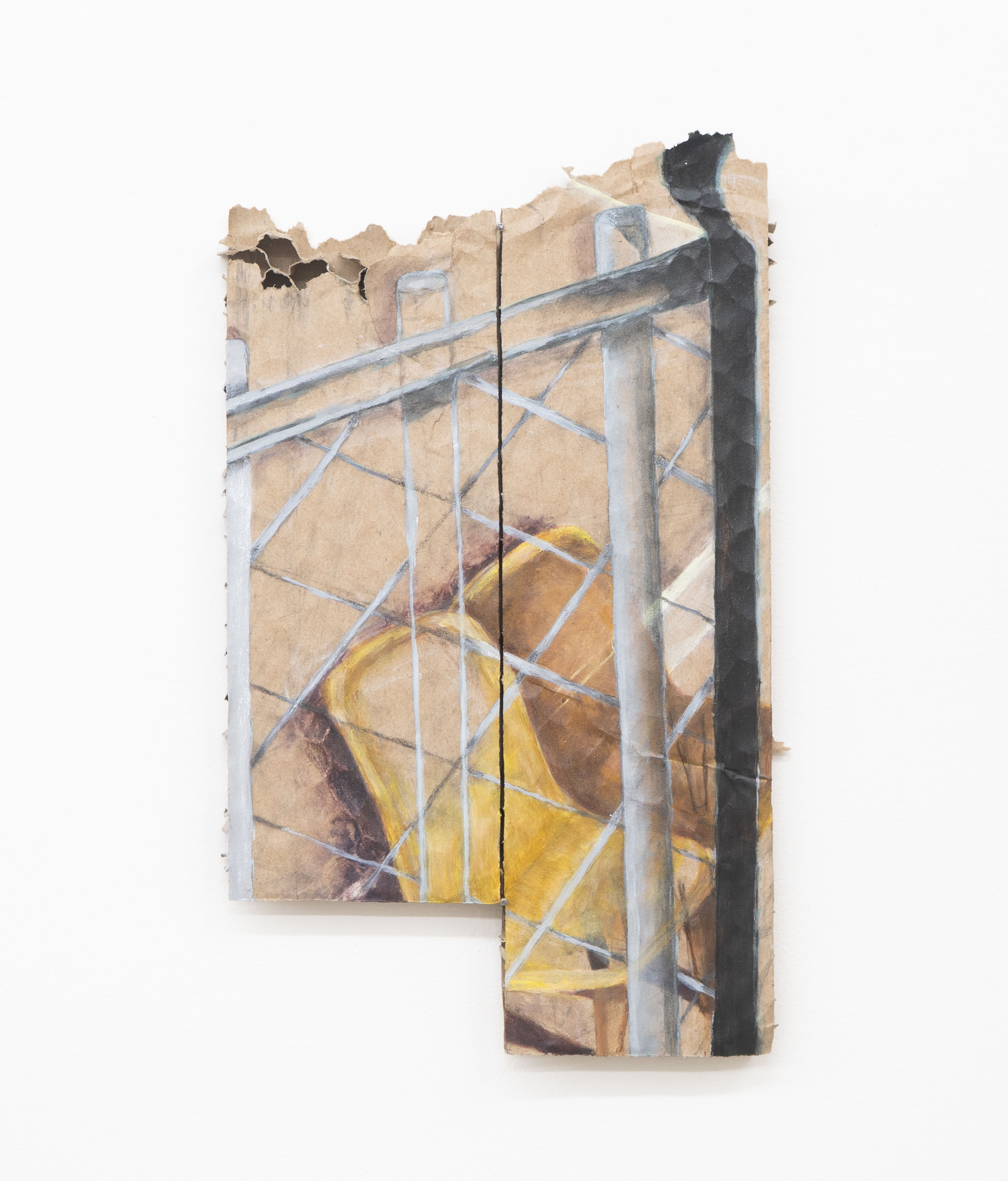
Lauryn Casey, Breaking the Close, 2026, Acrylic and graphite on cardboard, 8 x 13.5 inches
Finally, leave it to an artist to find and exploit an obvious loophole. Not That Deep required that artists make a work ‘with cardboard,’ so Jonathan Leib elected to instead paint a cardboard cutout onto a standard canvas. It was a solid take on the old La Trahison des images conceit. Could this piece still belong in the gallery even if it was only a simulacrum of the required material? Leib seemed to think so.
“Listen, it’s the cardboard show. I did have to do something really diva, so it had to be Madonna-shaped,” Leib said. “And also… I kind of wanted it to stick around. Cardboard tends to get thrown away. I like my paintings.”
Leib sourced the original image from online auction listings for cardboard cutouts. Beyond its subversion of the medium, the work also raised the question: whose silhouette is recognizable enough to stand on its own? It’s all too fitting that Leib turned the Queen of Pop into a study in recognition without ever once showing her face.
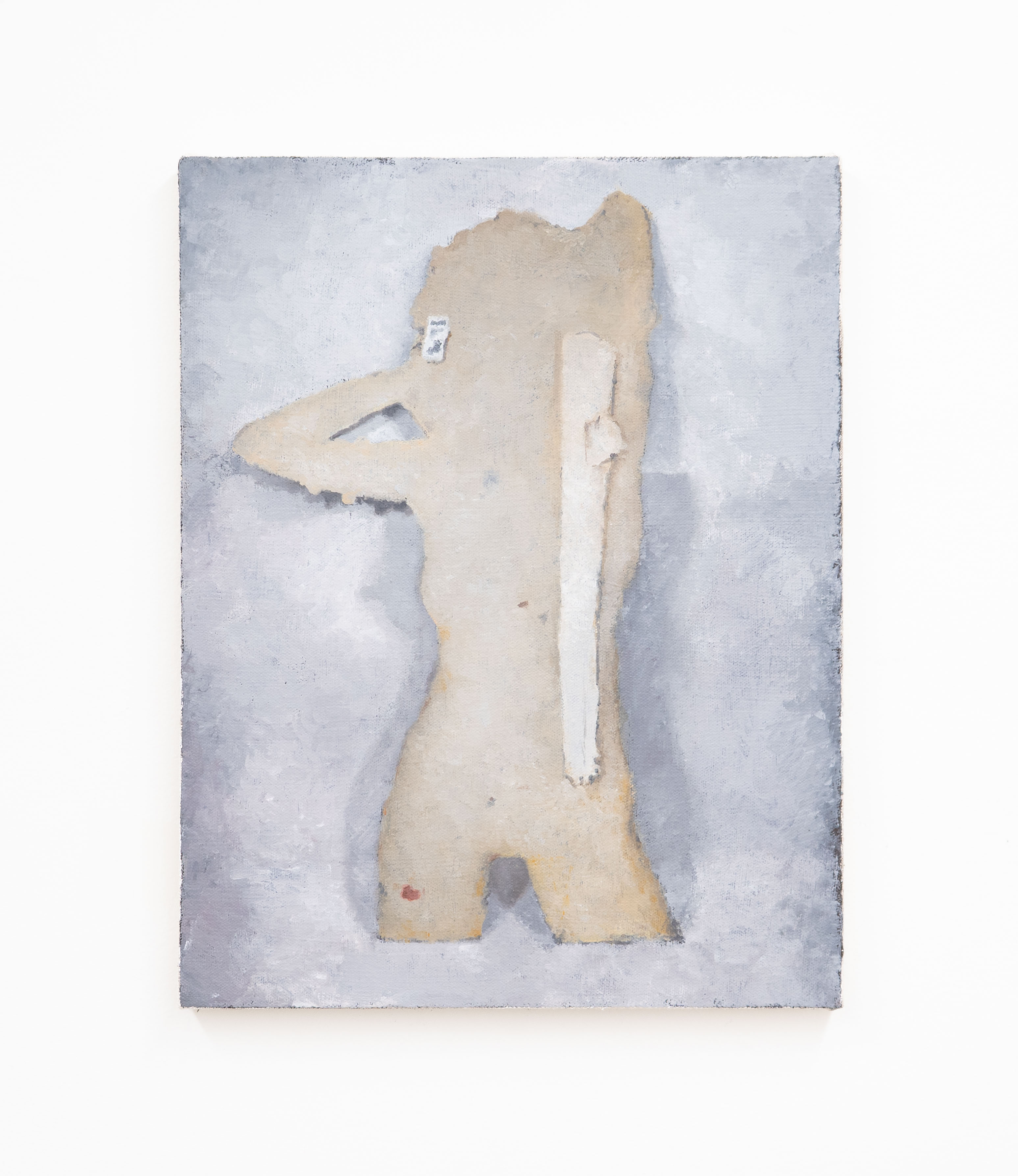
Jonathan Leib, Cutout Study, 2026, Oil on canvas, 14 x 11 in
After a jam-packed year, you’d think Withers and Hoai would be ready for a much-needed break. But when I caught up with them, it seemed nothing could be further from the truth. They were still just as fired up, distinctly proud of everything they’d accomplished. Above all else, they were immensely grateful to the community that has helped turn their basement gallery into a genuine hub for ultra-contemporary art. WM
Jagger van Vliet
Jagger van Vliet was born in Maine and currently resides in New York City. They are completing an MA in Writing and Publishing from Emerson College. Jagger is the author of a published novella, “TABU.” They have also worked as the Editorial Director for the award-winning Index Fashion Magazine. Additional work can be found in Trill Magazine and Rock N' Load. Jagger’s writing concerns the grotesque, the strange, or the ineluctably necessary (which are all the same thing).
view all articles from this author