Whitehot Magazine
September 2026
"The Best Art In The World"
"The Best Art In The World"
September 2026
Spring Break Art Fair NYC: Jagger van Vliet's Highlights
By JAGGER VAN VLIET September 28th, 2026 at 11:14am EST
Recently, SPRING/BREAK hosted its exhibition, Hide N Seek; a sprawling affair that packed 120 projects into the former offices of CBS News. It was noon in Manhattan when I attended the press preview and the quantity of art was truly staggering. Hide N Seek’s media brief promised “obfuscation, surreality, and political upheaval.” Talk dirty to me, why don’t you.
Over the course of a single afternoon I spoke to dozens of artists, collectors, vandals, and impresarios. It would have been downright impossible to make sense of it all, if not for the thick wad of keepsakes I stashed in my suit pocket. Throughout the day, the veritable haul of arthouse swag would serve as my roadmarks, each souvenir a reminder of where I’d been and who I’d met.
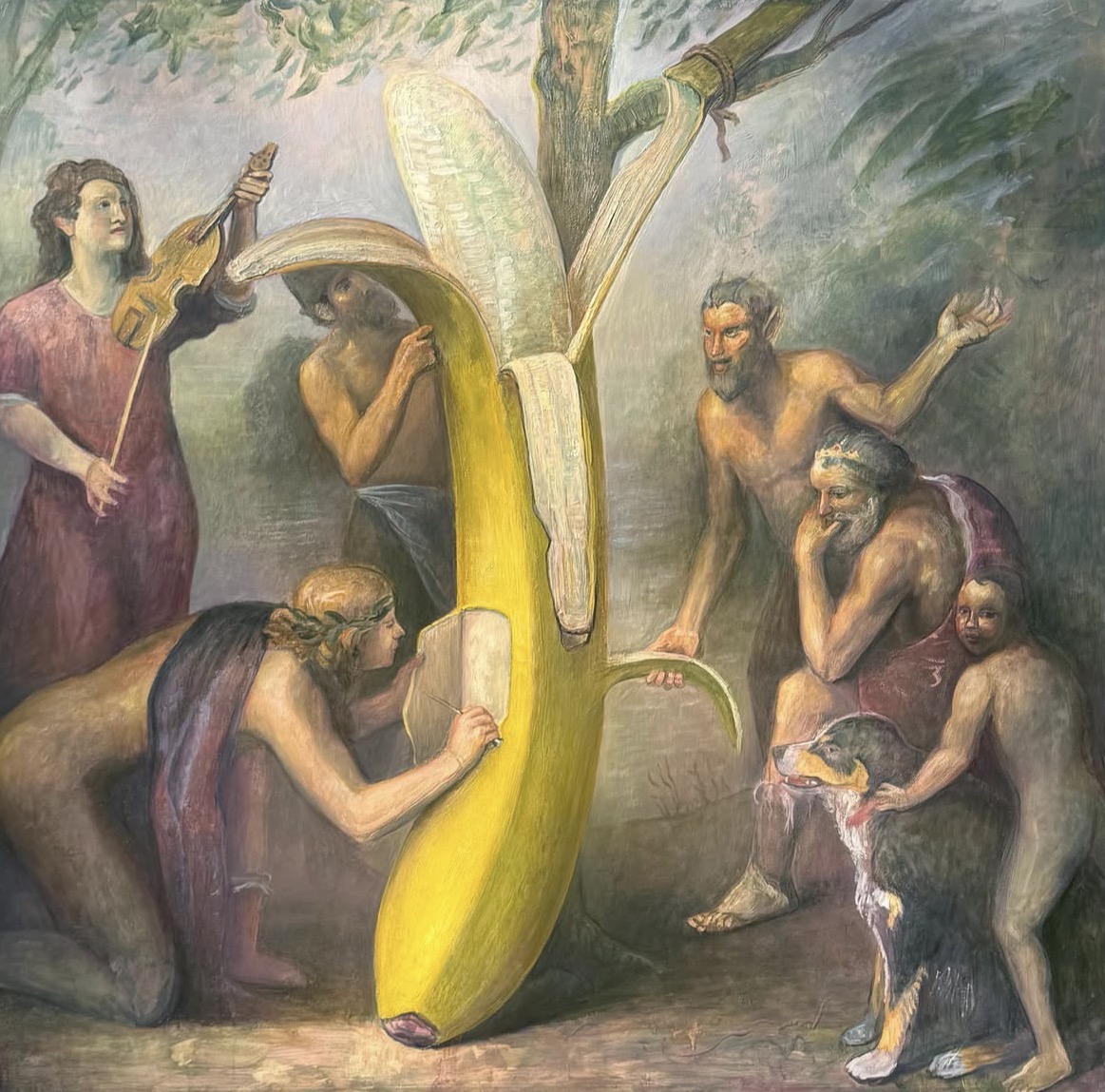 Come out and Flay” -David Molesky
David Molesky:
Almost immediately after stepping out of the elevator, I encountered a hallway full of ripe satire. Dozens of paintings with historic, artistic, or religious importance that had been rendered with a banana as the subject. It would have been a fun bit if it had just been one painting. It would have been a cheap gimmick if it were only a handful. But what floored me was the sheer amount of multivaried work.
I caught up with the artist, David Molesky, in front of a large parody of Titian’s Flaying of Marsyas. Instead of the gruesome torture scene, Molesky had cheekily replaced the doomed Marsyas with a banana, mid-peel.
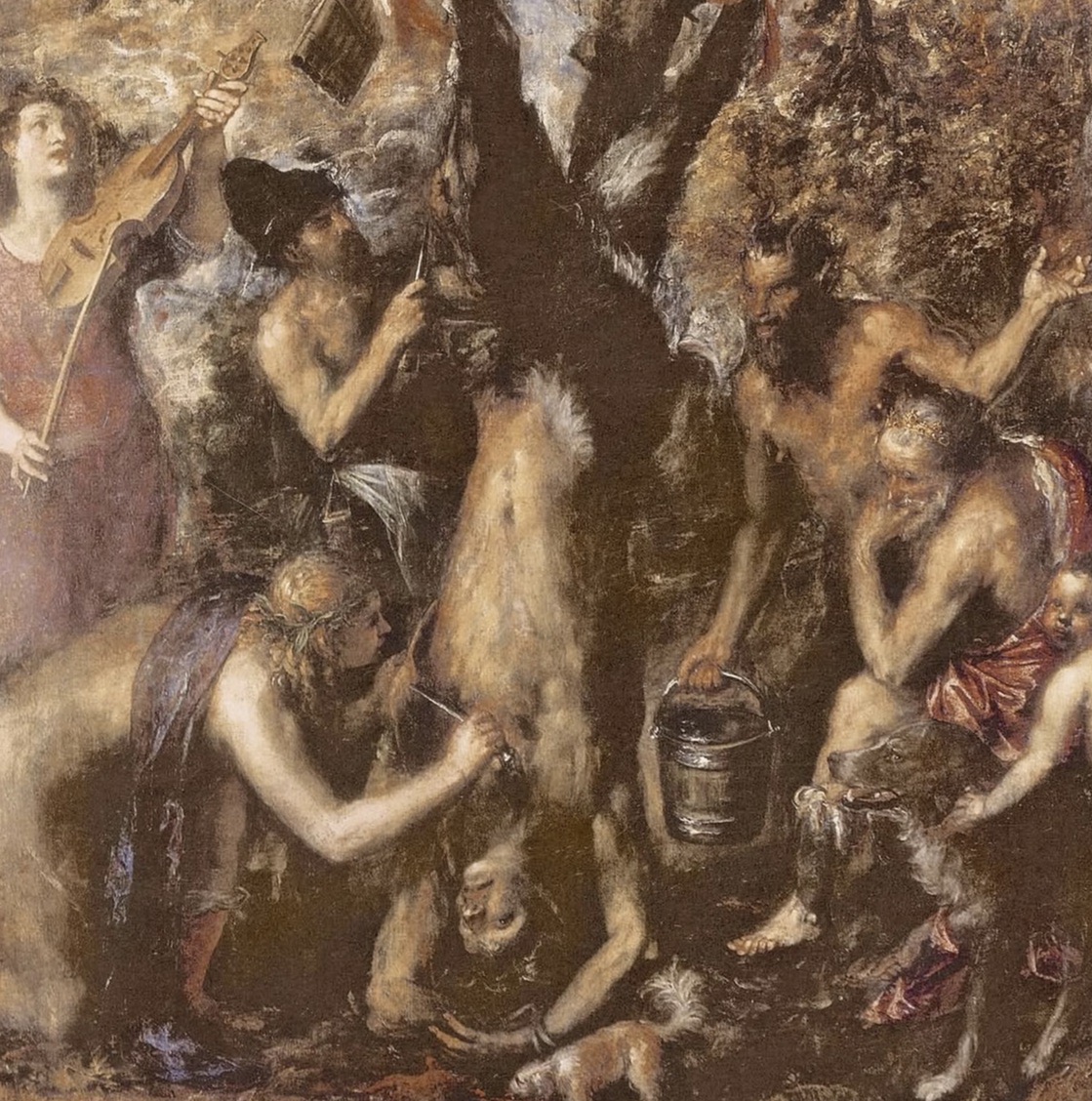 Titian’s Flaying of Marsyas
“As a main subject, I find bananas approachable and relatable,” the soft-spoken Molesky told me, “You can position the banana to create a lot of empathy in the same way you could a figure… But because the subject isn’t a person, it doesn’t have any specific identity in this case.”
Throughout the series, Molesky experimented with anthropomorphizing the banana; imbuing it with increasing life, and eventually, levity. A banana-ified Death of Marat contained a number of clever Easter eggs such as fruit flies and a poem penned by the recently expired fruit.
I came away from my talk with Molesky holding a copy of his book “Prone to Bruise.” It’s a well-curated sampling of his work and I have to admit, he’d convinced me. There was something undoubtedly masculine, obviously phallic, and distantly nihilistic about the banana; an understanding you only come to when an artist like Molesky takes the time.
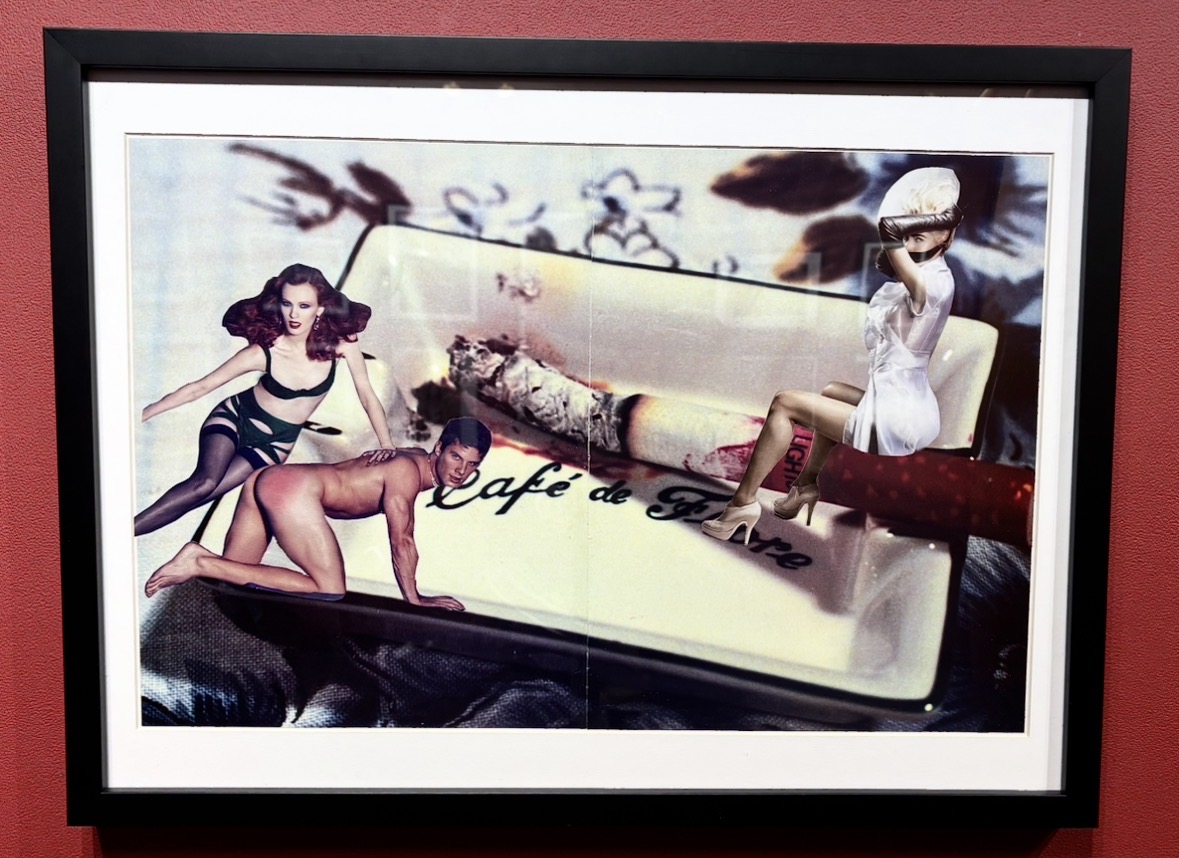 “Dirty French Novel” -Shawn-Holly Cookson
Hugh Lippe and Shawn-Holly Cookson
My first pocketed roadmark was a smutty black-and-white postcard, obscured by hand-drawn Smurfs. I had snagged this after hitting up Hugh Lippe’s booth.
Lippe, was an earnest, tattooed talent, with a penchant for warping American iconography. Another New York artist, JJ Hammond, had curated Lippe’s booth and both seemed happy that someone understood the deeper vibe. An over-critical eye might have disregarded the Looney Tunes cels overlaid on Life magazine covers as a bit on-the-nose; possibly a step away from Adrien Brody art. But I could tell there was more to Lippe.
He was undeniably good at selecting subject matter. The immediate standouts from Lippe’s collected work were three oil paintings, depicting stacks of colorful, vintage novels. Their spines were cracked, their authors all long dead. Yet, these are the kinds of paintings that made a down-and-out journalist wish they had collector money.
“I photograph the books on my dining room table,” Lippe explained, “They’re very time-consuming… I do the entire stack together because each one is supposed to be its own little criticism.”
On another wall, Lippe constructed a collage of disembodied images which he titled Culture Shock. It portrayed loose detritus from a former squatter, only the full picture had been fractured, shotgunned, blown-apart and reassembled into 26 unevenly-spaced frames. The entire piece felt accurate to how all media is consumed these days: in a fugue state that’s one part religious psychosis, two parts beer commercial, and dimly horrifying no matter how you cut it.
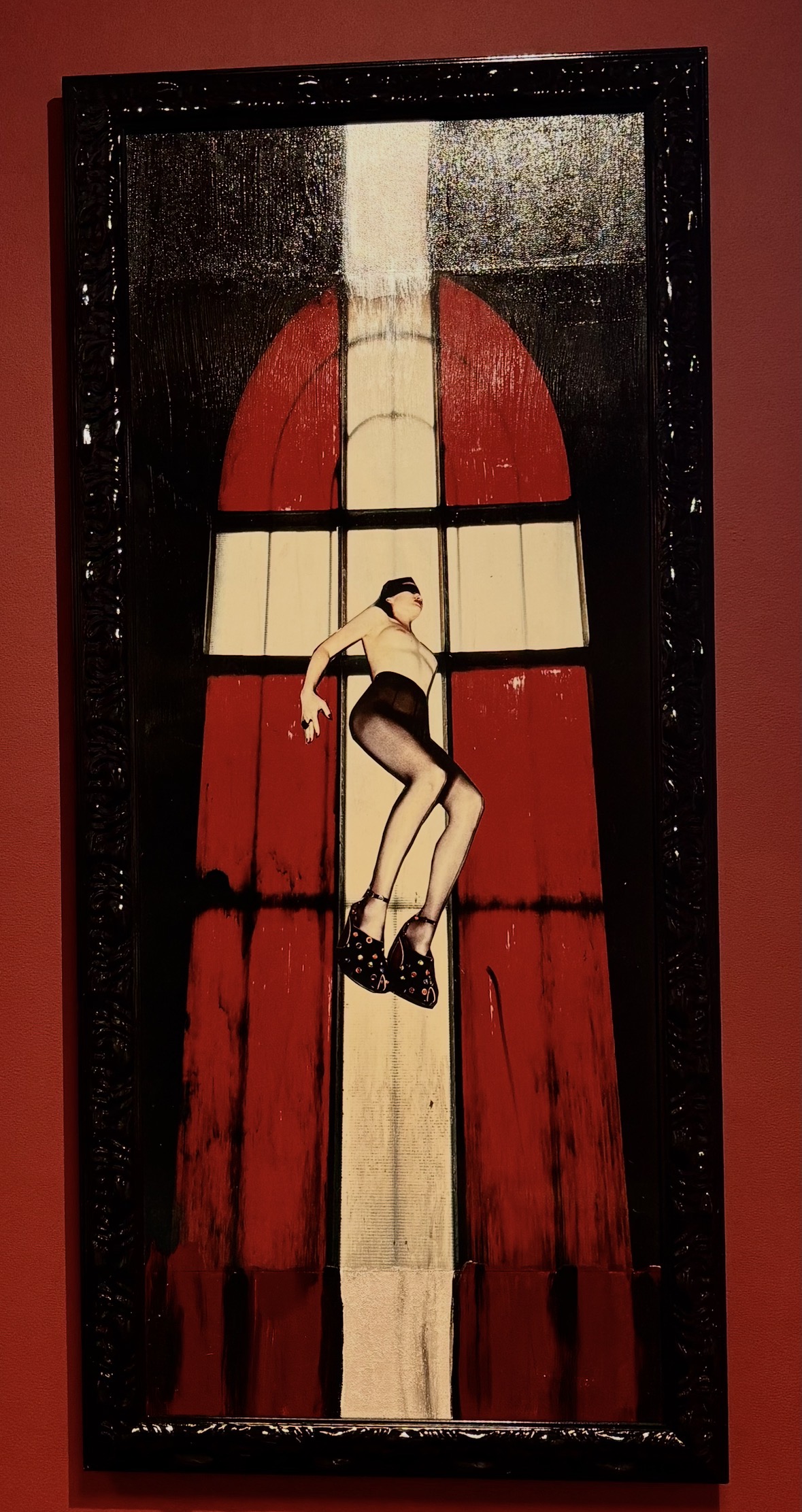 Tales from the Jesus Cafe -Shawn-Holly Cookson
Next door to Lippe’s room, I discovered the collage-work of a two-time Emmy-nominated costume designer. Her name was Shawn-Holly Cookson and she was my favorite interview of the day. Cookson had a perennially youthful Stevie Nicks energy that left no doubt that she was a Cali girl through and through.
Leave it to a costume designer to put together a good collage. Across the installation, there was a free-flowing, innate sense of image and proportion. A scantily clad Playgirl straddled a lipstick-stained cigarette. A perfectly posed model glanced over at Yemeni women wearing traditional madhalla hats.
Cookson and I agreed on a lot of things, not the least of which being that Beggar’s Banquet is one of the finest Rolling Stones records. But we also shared a writerly sensibility. Cookson told me that these collages come to her in intense bursts of creative mania, like automatic writing, or free association.
“Each one of these pieces is so personal and so profoundly intense. When all of these left my house, the energetic hole that was left was palpable. Each one of them has a frequency.”
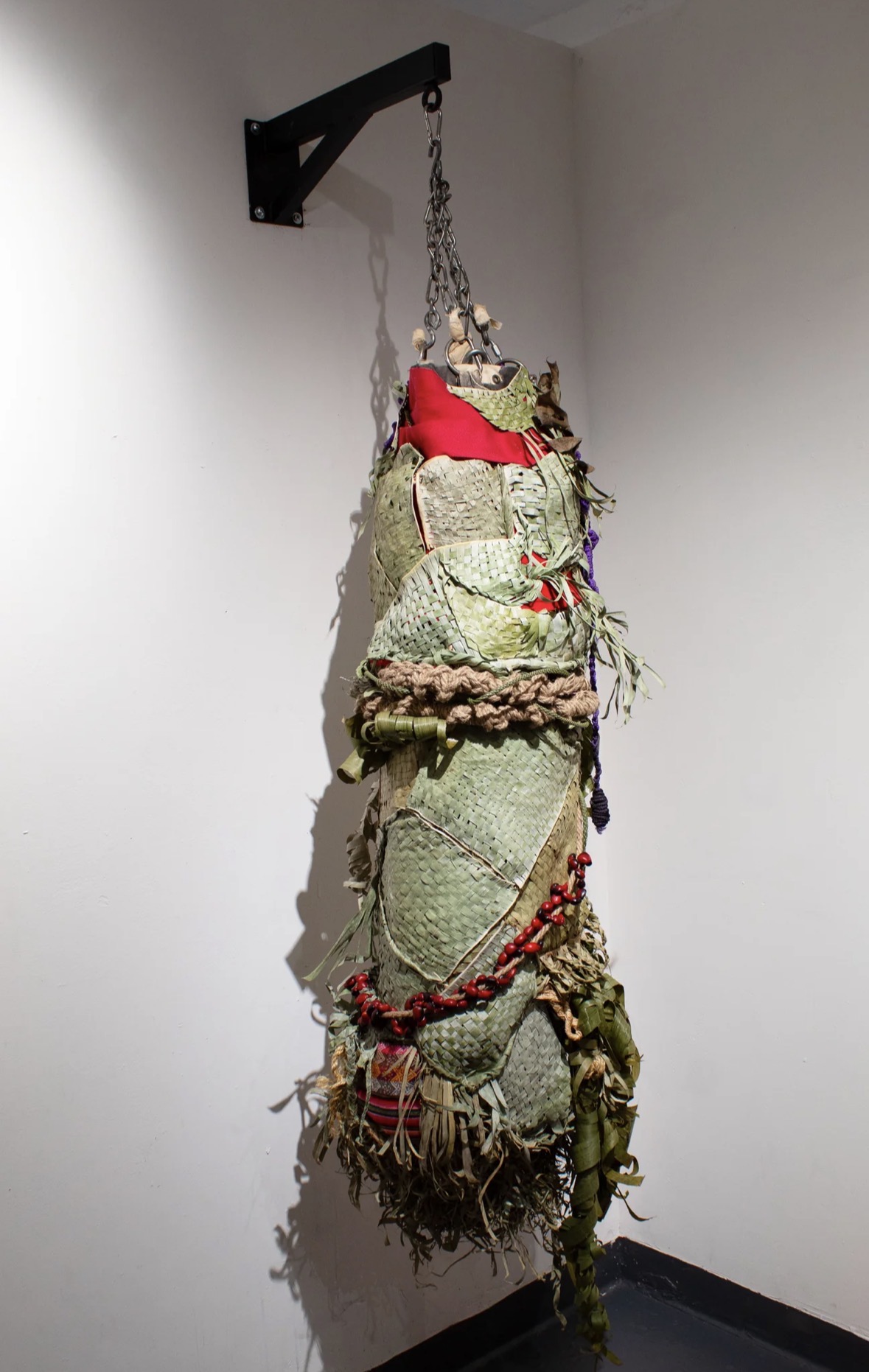 Relating Across Differences - Lindaluz Carrillo
Lindaluz Carrillo and Christopher Chan
Another one of my keepsakes was a dreamy print from Christopher Chan’s booth. His airbrush work captured harsher-than-harsh angles and the whispers of a Frutiger Aero future we never got to live. He also shared a room with the ever-talented Lindaluz Carrillo; an unlikely but effective pairing.
Carrillo’s work was sculptural, dense, and coincidentally also banana-themed. The Brooklyn-based artist presented boxing paraphernalia: a boot, a glove, and of course, a punching bag, all covered in lattices of handwoven banana leaves. They were deeply textured works, braided, overlapping, and wrapped in traditional huayruro beads.
Both Carrillo’s grandfather and father were professional boxers, and she felt being paired with Chan was fitting.
“Our childhoods have been coming out in different ways,” Carrillo said, "Recently, I’ve been slowing down and considering the weight of objects. Touch has its own significance and when I was working on the leaves, it became a meditative state… It takes a lot of concentration… Understanding craft has been a very important part of this.”
Once again, I was shocked at how deep you could get with just a banana. Carrillo highlighted the healing properties of the leaves, contrasting that with the innate violence of boxing. There was a larger conversation about protection and the use of one’s hands. The average person imagines boxing to be all slugs and jabs, but Carrillo’s work embodied the reality of the matter: The whole thing is cerebral, familial, and distinctly human.
Shelter Serra:
Somewhere along the line I came into possession of a lone business card with the name Shelter Serra written in plain, unassuming type. The starkness was pretty on-brand when I think back to our conversation.
Serra’s work was confined to a small windowless cubicle that had likely been used as a CBS broom closet before it was converted for use in SPRING/BREAK. Consequently, Serra’s choice of subject matter was rendered all the more grim and dreary.
On one wall hung four hand-painted images of drone strikes. On the next were four separate paintings of differing exit signs. And on the remaining two walls were quartets of breaking news bulletins.
Serra was an introspective guy, distinctly aware that what he was doing was essentially documenting the undocumentable. I couldn’t tell you with any degree of accuracy where the depicted drone strikes had been carried out, but in truth, neither could Serra.
I pointed out that if you decided to walk around the exhibit in a circle it would closely mirror the modern condition: Breaking news, drone strikes, exit, exit, exit, exit. Breaking news, drone strikes…
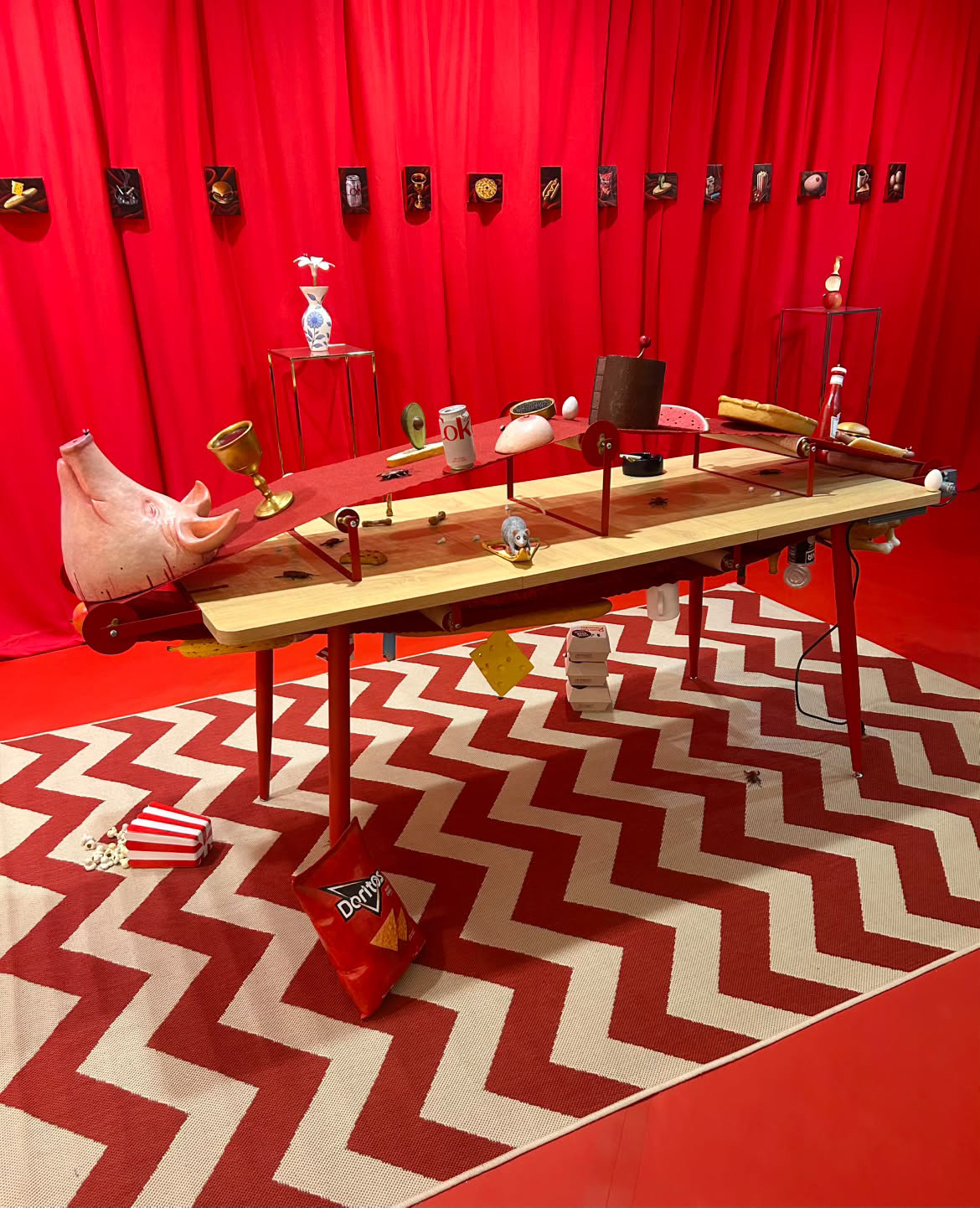 Everything is On and Under the Table -Stuart Lantry
Stuart Lantry
Finally, I picked up two business cards, each depicting hand-sculpted fast food. I grabbed these at Stuart Lantry’s exhibit, “Everything is On and Under the Table.”
His piece was a genuinely elaborate, moving sculpture that played off the various ways Americans “consume.” On a rotating conveyor belt, Lantry placed hyper-realistic foam models of American food staples: apple pie, hot dogs, a burger. As the conveyor belt moved, I spotted some less-than-conventional viands: caviar, a pig’s head, a silicone breast and, yes—because I know you’ve been waiting— a third banana. (Comedy really does come in threes.)
“This is meant to be like the last American supper,” Lantry explained, “It’s looking at all the latent meanings embedded into the food.”
I found myself thinking about the rise of Ozempic, disordered eating, and a slew of recent recalls.
“No matter if you’re a line cook, a harvester, or one of the animals themselves…someone is getting exploited in this process,” Lantry said.
HIDE N SEEK:
This was hardly an exhaustive review. If anything, it merely highlighted the pieces that I liked, the artists I found most engaging, and the scraps that followed me home. I’ve got all this art-show loot laid out in front of me, and I can’t help smiling. It’s all personal to me now.
Jagger van Vliet
Jagger van Vliet was born in Maine and currently resides in New York City. They are completing an MA in Writing and Publishing from Emerson College. Jagger is the author of a published novella, “TABU.” They have also worked as the Editorial Director for the award-winning Index Fashion Magazine. Additional work can be found in Trill Magazine and Rock N' Load. Jagger’s writing concerns the grotesque, the strange, or the ineluctably necessary (which are all the same thing).
view all articles from this author