Whitehot Magazine
October 2026
"The Best Art In The World"
"The Best Art In The World"
October 2026
Jack Penny: Welcome to the Jungle
By JOSH NILAND May 23rd, 2026
Jack Penny and his energetic canvases—brute depictions satirising the chaos of life inside an urban jungle—have an uncanny way of undressing benign anxieties that reside at the core of human relations. Ambivalent in intention and yet barbaric in their artistic delivery, these pieces offer a bare-knuckle take on the human experience: their manic brushstrokes sending quarrelsome subjects pinwheeling as though members of a jazz ensemble in order to satisfy a conflicting set of preconditions he admits he has improvised and finds hard put to define.
Penny is a ventriloquist at heart whose droll wit and anti-style animate characters he typically situates inside haute bourgeoisie dens of vice and sin that exude the pathos of an upper crust careening headlong into a state of violent debauchery. The real-life former professional yacht pilot’s hectic gambling parlours and harried dining rooms are seen by many as pits of escape but of exposure; spaces where the urbanity once held together by ritual, alcohol, and good tailoring is overturned to uncover the sordid impulses hidden underneath the social apparatus, chef smocks, sunglasses, and topcoats lurching forth frantically in an awful menagerie.
Eschewing rigid definitions of painting to deliver on a promise of unsettling “roller coaster energy”, the Chichester-born millennial, whose only formal training includes a one-year stint in an illustration course, claims to revel in a view of his work as intentionally low-brow and epigrammatic. “A bit like Marmite,” he says, equating British divisiveness on the vegetable spread’s taste with his own viewer's appetites. Like it, he admits, perceptions of his artwork differ widely, characterised by an all-or-nothing likability and impolite refrain.
Earlier this winter, while he unpacked from a debut appearance at NADA Miami, Penny and I talked about the key to his painting’s acerbic tendencies. His thoughts on chaos and control were predictably unsparing, clarifying his process on the heels of a new ski chalet series begun prior to a relocation to the French Alps in May.
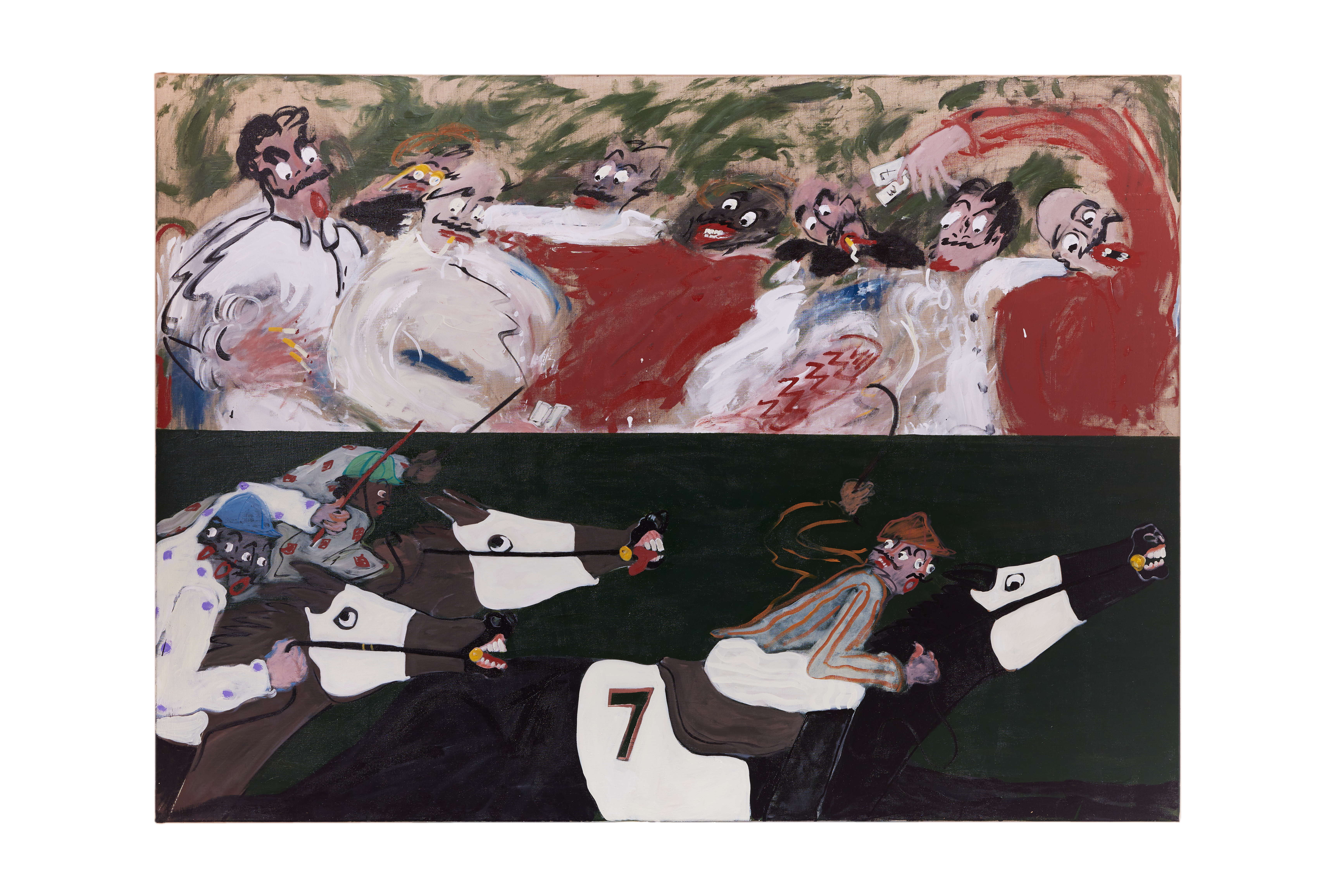
Even When I Win I Lose | 2025 | Acrylic on canvas
53 1/8 x 72 7/8 inches (135 x 185 cm)
The classic question is how you got to painting in the first place.
I really started understanding art when I first started skateboarding. The art of skateboarding, the music, the culture, the artists within skateboarding, was some of the earliest creative art that I was exposed to. So I’d say I was exposed to quite a lot of creativity at a young age. After that I moved to London, diluted and completely unaware of the art world and how it ran. I used to knock on gallery doors and show them my drawings. That was a learning curve. Then, I met an artist who I would skate with and we shared a studio for three years. That was my university. It was an amazing space for us to learn and draw from each other. Our whole body of work wound up being very similar, coming from that little room we were in for years together. His brother was Billie Childish. So he was also in the background every now and then, and I kind of idolized him and his ethos about painting and how he was an outsider.
What are the kinds of things you notice when you show at art fairs?
In general they serve a purpose, and the purpose is for you to be discovered as an artist. It’s a fantastic way of having a massive number of eyes on your work in a short period of time. But, on the whole, it’s probably the worst way to see art. Because you’re just so desensitized from being in there for just five minutes. Every wall is something else, an artist is trying to do or express something while you’re looking at another artist's work in the periphery, and they have nothing to do with each other. It’s just a sensory overload, and I found that in Miami, which was my first fair. I do tend to get excited about them, though. It’s a fascinating environment to witness. It’s funny that the work begins in such a humane, real place of the artist in their studio and it ends up in the exact opposite at the end of its life when it’s changing hands on the secondary market. There’s an innocence and vulnerability that you see going away the second they’re sold.
 Work on paper
Why intuit a painting versus preparing the work and then executing based on that plan or sketch?
There is a difference between experimentation and undeveloped thinking. Painting freely with no direction often generates a series of works that I will repeat and more often than not they become tighter and more refined, narratively driven works. On one hand, pre-staged, tighter paintings, where I can see a direction are meditative. But even in those works there is always space for the painting itself to have its movements and for me not to be in control. It is an important part of my practice not to know the complete end result. There are moments where I throw caution into the wind and I just start painting. The painting reveals opportunities for me to be conscious in them then unconscious again.
Would you say that this fits with a certain style or mode of painting that equivocates structure with ingenuity and unpredictability with a deliberateness in the artist’s will?
Absolutely. I am heavily influenced by Expressionism, mostly German Expressionism and why artists of this Time took paintings in this direction. My work leans towards Action Painting. The unpredictable elements with deliberate intent leave space for something to happen that I could not foresee. It navigates between absurdity and empathy. It gives its soul to the painting. The animal in us gets to dance whilst the Artist has his little bit of control. Something we all are desperate to hang onto.
What’s so important about costuming in your work? Why has it become a focal point of your art?
The reasons are many and some still unveil themselves as my practice develops. Costumes, here as uniforms, serve a purpose in the works, which enable anonymity. Stripping the individuals’ identity away allows them to represent something larger than themselves. With the individuality taken away, the viewer can decide how to relate. I also believe that once one wears their uniform, they become less accountable. Waiters, chefs, soldiers, nurses, police officers, etc. become a symbol. Either separating themselves from their surroundings or by contrast trying to blend in. Then there are the stereotypes which we associate with this familiar imagery. The viewer “knows” what they are looking at immediately, which in turn enables me to manipulate the label attached to the uniform and make it more ambiguous. To question the stereotype even. To change the expectation on preconceived ideas that a certain type of ‘costume’ speaks out loud of one’s current circumstances.
I occasionally enjoy taking these individuals out of their environment, such as in Almost Home, which was exhibited last December at NADA Miami. Two chefs fighting through the jungle, chefs are literally the top of the food chain, yet taking them in the setting of the jungle highlights the vulnerability of those labels once taken out of their environment. This specific painting was inspired by Percy Fawcett, an archeologist that disappeared in 1925. My paintings are often the results of many different resources of interest.
Another example is Through the trees, shown in March 2024. Through the trees is a play on safety. That painting shows that there are wolves waiting beneath the tree line. They could be any number of threats that exist. I am not interested in painting wolves but they are again a stereotype, a costume. And whilst people are joyfully waiting for the chef to congratulate him on their meal, he has, unbeknown to them, become a meal himself.
 Portrait of the artist
If I’ve worked out a philosophical theory, it’s based on the thought that in every new relationship you are first confronted with the harm the other person could potentially cause you — by their latent structural capacity for injury. And you then have the ability to reconcile and understand that, which is essential for survival. That’s the kind of dint that your subjects are performing, right?
Sometimes, the human emotion which drives forward happens of its own accord. It was born within the creation of the painting itself. And sometimes, it’s driven by me, probably in relation to something I might be feeling at the time. As to your theory, I feel first meetings are simply ‘happenings’. Like when the artist meets its painting and then, the painting meets its viewer. First and foremost they meet. Then the social game demands that we suss out our ‘opponents’ but that we read the harm they might cause or the curiosity they might arouse is up to both party’s inner beliefs and stands on living I guess. My paintings do however depict the pathos within those interactions, not just in terms of survival but also more simply in terms of unmasked human emotions.
What other aspects of human nature are being addressed through the devices seen in the table paintings?
You will find a lot of symbolism in my work. My scenes are really microclimates of humans’ animalistic behaviours or intrusive thoughts, humanising everyone. As we all eat, setting these around a diner table is the ideal stage to fill the painting with many different types of human behaviours. I like to play on human emotions through my work: happiness, greed, fear. But these symbols are part of a greater play to convey them in a way which allows the viewer to read the painting. I use slapstick and comical representations, almost the end of the peer humour in the works which hopefully allows them to relieve the pressure of the scenes. The underdog often prevails. I like the idea of a painting that reveals itself over time living with it. Used in a repetitive manner, my end goal is to be able to create an imagery base language where I could simplify a painting to a single image and the symbol would still hold through its narrative and be recognised and interpreted by the viewer.
And you said you’re averse to “singing from the same sheet” where it relates to other young contemporary artists. What does this mean?
We are living in a really interesting time in painting, due to its diversity but also due to what art feels like to people. This is one of the reasons I have injected a comical, slapstick approach in my work. It allows me to not make ‘tasteful’ works but rather ones full of dread and reverence. Trying to not take my work and myself too seriously gives me more freedom to revisit subject matters that have been explored time and time again with some sort of authenticity—I hope! I am not interested in being part of a trend. I am quite contrary to it, actually, and I think it comes down to my sensibility as a person. I work in the countryside, far away from the art world. What I want most for my work is for it to feel vital and be timeless. Only time will tell.
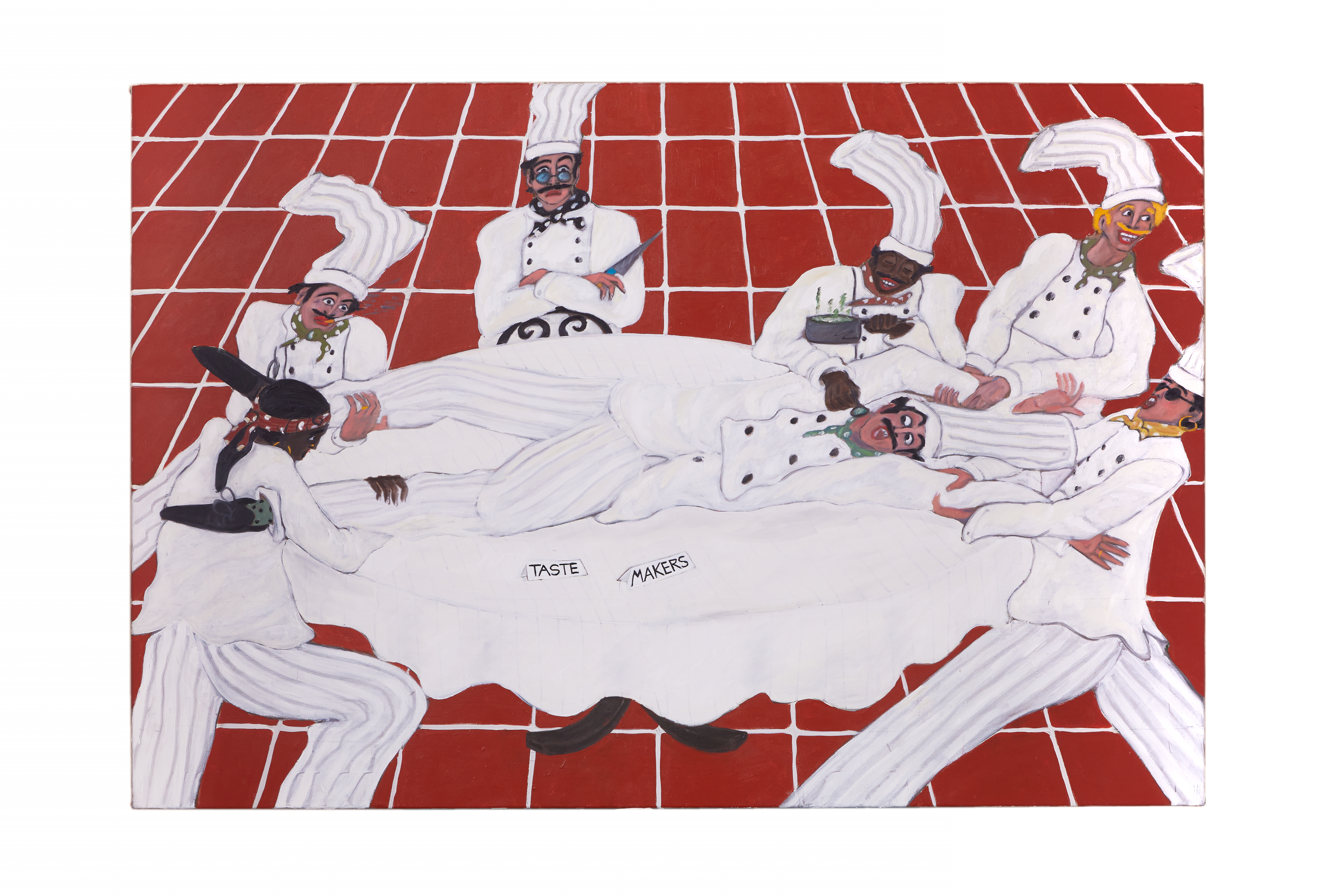 Taste Makers | 2025 | Oil & acrylic on canvas
49 1/4 x 72 7/8 inches (125 x 185 cm)
What perspective on the new people and the social dynamics of the city have you gained by moving away from it? I’ve had a similar experience and for the most part now find the lifestyle of gentrifcation broadly appalling.
I started painting about the city when I moved out of London. I explored a series called Commuters which is quite self-explanatory. It was about the morning travel rush to work. People packed into tubes like sardines trying not to make eye contact or encroach in anyone’s personal space, if there was any at all. It was part of the reason I moved back down south. Moving away had an impact because the distance from the subject matter allowed me to approach it. Once I had space from the city, the series came to me.
I think it comes from a need to challenge well rehearsed social scenarios within a somehow institutionalised world. Noah Becker himself talks about how art ‘used to feel like a way to understand existence’. I think this is what I try to achieve here. Once the uncomfortable becomes the center play of the social scenario—the arguments, the stabbing, the angst in the work—then the protagonists are stripped to their raw selves and the conversation can begin. Yet, from personal encounters, I also believe that there are still people out there who wear their authentic selves. Not everyone needs to be undressed.
That’s what I like about it. Like Flaubert said: "Be settled in your life and as ordinary as the bourgeois, in order to be violent and original in your work."
To try and figure out what is happening in the world around, as well as inside, one has to learn to push the questions and feelings into something creative. I sometimes believe that if it was to sit inside of me it might well end up killing me. I personally think that living an ordinary life, as per Flaubert's quote, probably does not come that easy to most artists, who naturally question everything. I am not sure that it's the countryside life or the ordinary part of my life which allows for the necessary space in my work to be emotionally charged, though. I think that has always been part of who I am and my practice. What I had to learn was the ordinary part. Sometimes, the human emotion which drives forward happens of its own accord. And sometimes, it’s driven by me, probably in relation to something I might be feeling at the time.
What painters do you like?
Philip Guston, Rose Wylie, Jake McCord, Danny Fox, Taylor Anton White, Winslow Homer, Matías Sánchez, Ernst Ludwig Kirchner, Joan Miró, Calvin Marcus, Iryna Maksymova, Ray Materson, Robert Colescott. You showed me Neo Rauch, and now I like him, too.
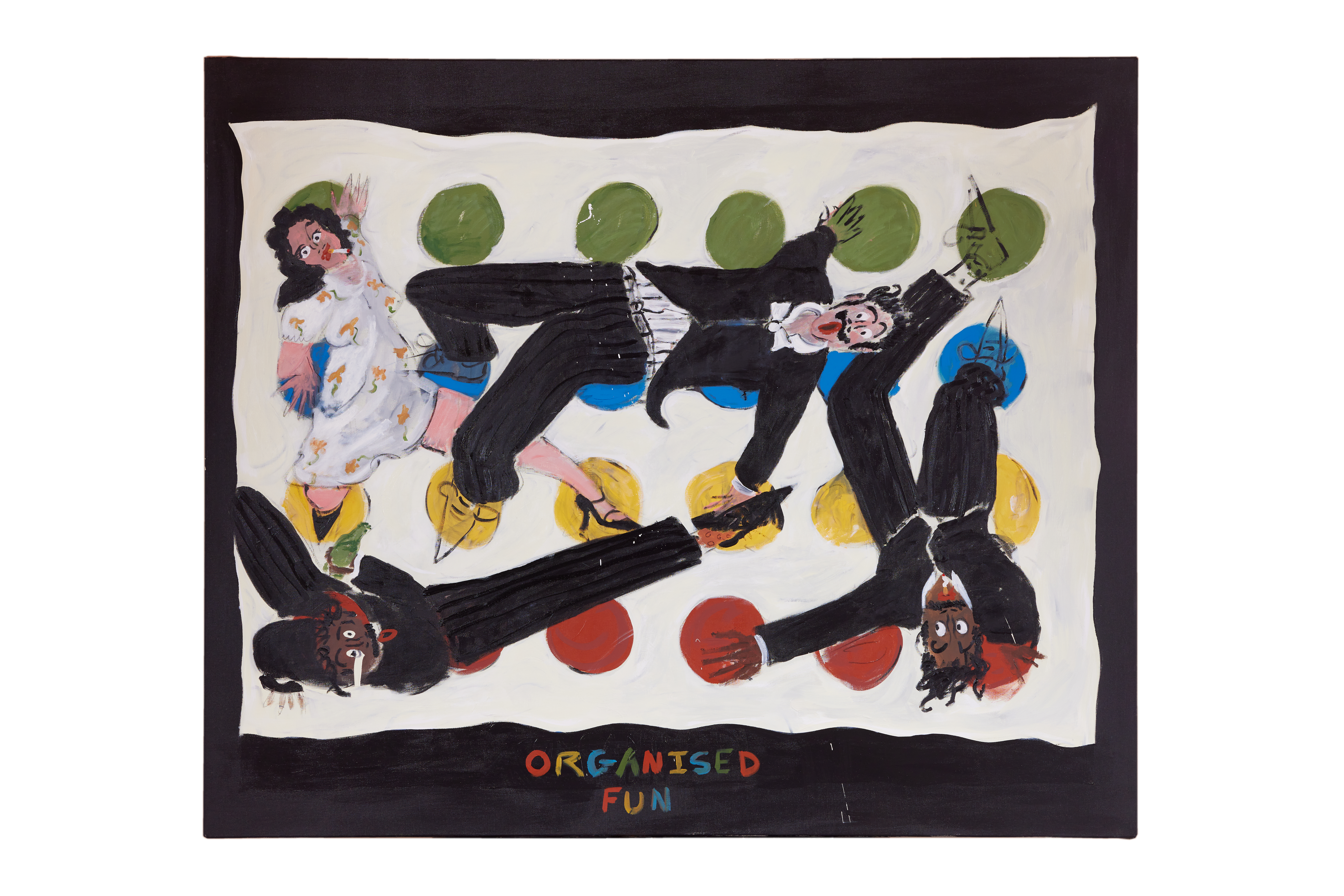 Organised Fun II | 2025 | Oil & acrylic on canvas
61 x 72 7/8 inches (155 x 185 cm)
You mentioned that you have dyslexia. Do you think it lends—paradoxically—a kind of legibility to your paintings?
I do think the narratively driven part of my painting practice might be a result of this. Maybe that’s some sort of relief from not being so eloquent in writing. I’m able to create narratives and stories and moments through paintings. I guess it scratches an itch. I remember as a child writing epic stories, but then came the time to read them back and I couldn’t make the words myself and neither could my parents. I also like to think of my paintings as stills from movies, I want them to feel like we’ve captured a moment in a vast story. What happened before and what’s happening next.
There’s something so uncanny about the dinner setting that makes the work ripe for collectors. Why is that?
Table Paintings is just one of the series I work on. It does seem to be popular, and I believe it’s because breaking bread with people is enjoyed throughout all cultures, all around the world. Eating together is ceremonious and we can all relate. We all look forward to sitting down with friends or family so I believe people lean towards these paintings for what they represent. It’s a multi-lead concept which brings fun into the room that it’s occupying as its final resting place. This being said, I am a deep lover of the action of painting and resolving issues in painting, the application, the speed. All things encompassed with the materials of painting. The subject matter is something which will never become forefront to this love. It is a by-product of my exploration of paint and freedom. It’s on that edge of what people can take, but I couldn't give a shit about food.

Josh Niland
is currently the featured staff writer at Archinect in Los Angeles and has contributed to Hyperallergic, Artnet, Architectural Digest, the Boston Phoenix, and other outlets with a focus on artists’ narratives and the psychological underpinnings of the art-making process. He holds a BA in Philosophy from Boston University and is presently looking for publishers for his new book proposal, a work of metafiction depicting post-Covid life in New York City through the lens of thirteen new architectural projects.
view all articles from this author