Whitehot Magazine
October 2026
"The Best Art In The World"
"The Best Art In The World"
October 2026
Interview: Getting Lost in the Light of Iván Navarro at Templon
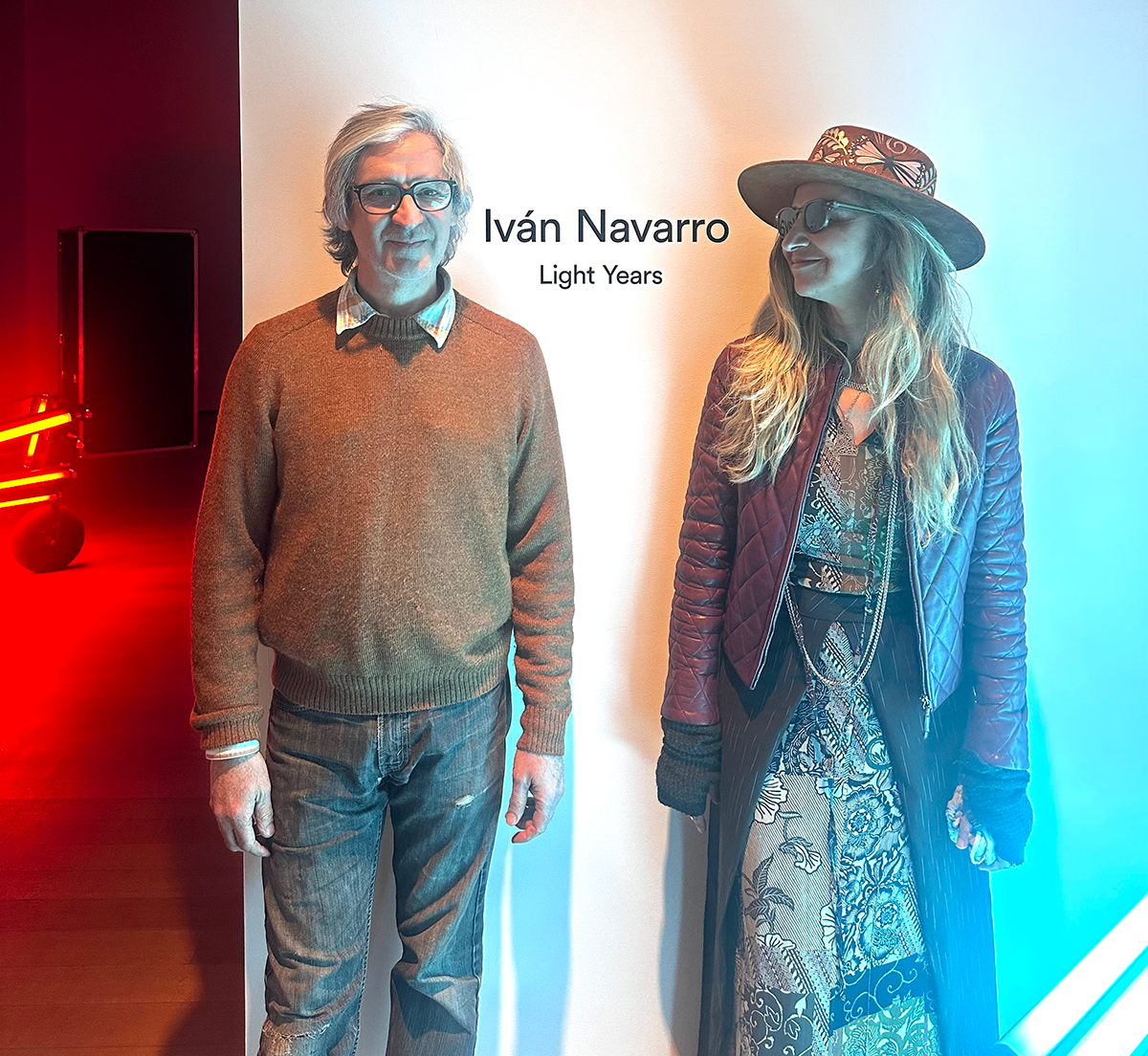
Artist Ivàn Navarro (left) with the author at Light Year, Templon, New York, NY
By AYSE SARIOGLU March 21st, 2026
Light is not always innocent.
Sometimes it is a streetlamp.
Sometimes it is an interrogation room.
Sometimes it is an eye that never closes.
Iván Navarro’s works are placed precisely on this threshold: the fine line between the magic of light and the shadow of power. The glow of neon tubes initially promises a dizzying aesthetic. Mirrors open up the space to infinity—depth, distance, vibration.
But upon a closer look, light does not only illuminate; it exposes.
For a child growing up under Chile’s military dictatorship, electricity was not a comfort. Power cuts, homes left in darkness, cities under control… Electricity was not a convenience that came at the flick of a switch, but a method of governance. This is why in Navarro’s practice, light is always double-edged: both hope and oppression, visibility and threat.
The exhibition Light Years at Templon New York is not merely a retrospective; it is a tension line. A map of an invisible current running through more than twenty years of production. Here, light is not an aesthetic surface, but a political pulse.
In Landess Land, light becomes a condition of survival. It is necessary not to illuminate, but to exist. Here hope is not a romantic glow, but fragile energy conservation. Blue Electric Chair transforms the symbol of state violence into a glowing form, confronting the viewer with an unsettling beauty. Light is not purification; it is a means of confrontation.
Resistance in Navarro’s works is not abstract. In Resistance, electricity is produced by the body. It requires energy. It requires friction. Resistance is not only an ideological stance, but a physical tension.
And mirrors…
Navarro’s infinities are both mesmerizing and unsettling. The viewer looks at themselves but cannot find themselves. To see is simultaneous with being seen.
Perhaps the point is this:
Light does not eliminate darkness.
It only changes its shape.
Because sometimes resistance is not a sentence.
It is a frequency.
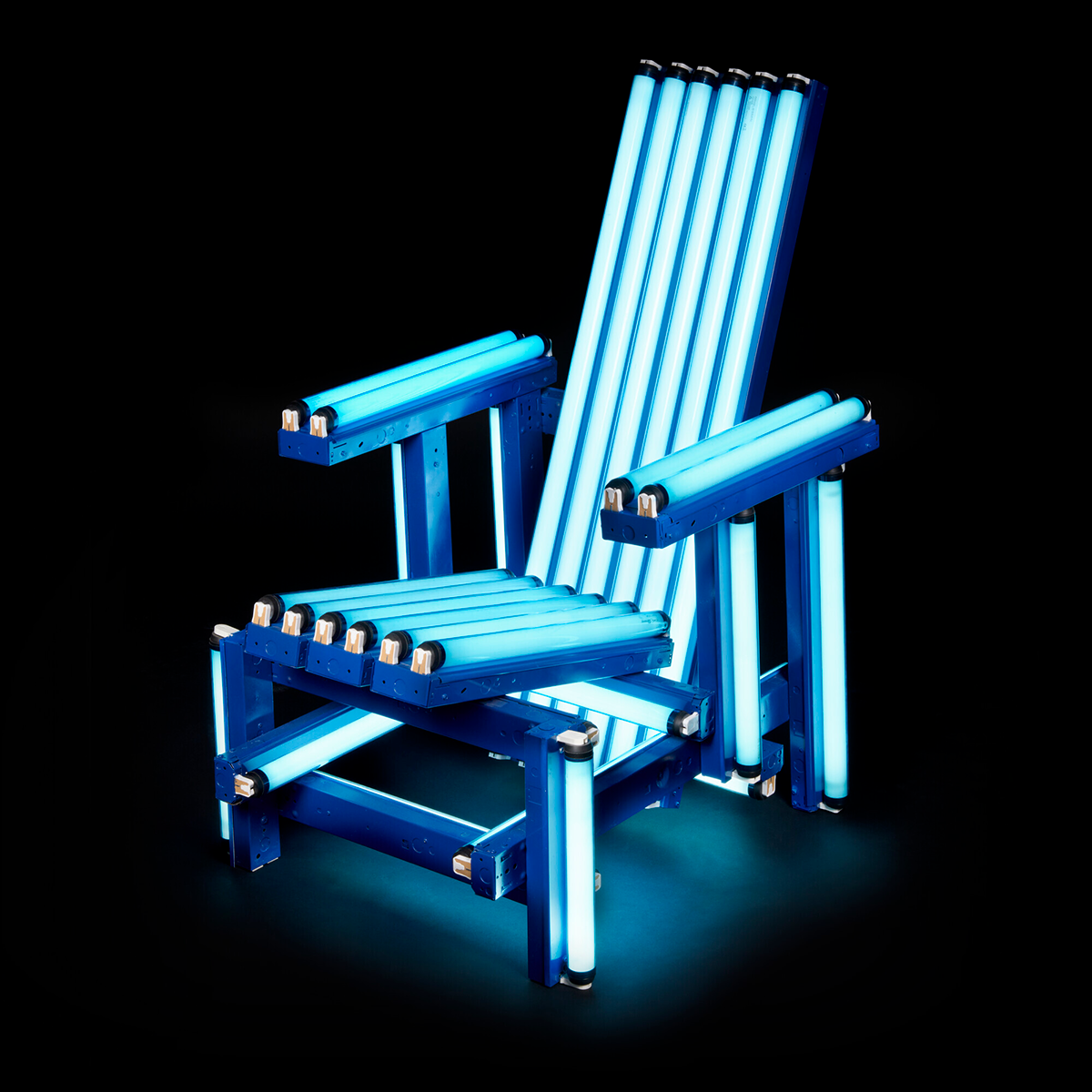
Blue Electric Chair, Executed in 2004, courtesy of the artist and Templon
When you grew up in a regime where electricity was used as a tool of control, do you now see electricity as a political energy rather than an aesthetic material? Is it power, memory, or the materialization of trauma for you?
I would say trauma. But we are also in a new era. Electricity is now connected to renewable sources, presented in a more “ecological” framework. But there are still significant economic interests—such as lithium for batteries and its political effects in South America. In the 70s, electricity was a much more direct tool of control—a form of violence applied to the body. Today, control is more indirect, more “virtual.” Yet we are still under a form of electrical control. Electricity has a dual nature: it is presented as a good thing, but it is still connected to control and violence. For example, the electric chair was initially introduced as a more “humane” method.
In Blue Electric Chair, you transform the symbol of state violence into a design object. How do you define the line between aestheticizing violence and exposing it?
If the works appear beautiful, that is not my goal. The materials I use come from industrial design and the history of minimalism, so aesthetics are already present. My aim is not to seduce, but to create historical connections. I want different viewers to find different entry points: fashion, design, or art history. The work must be multi-layered.
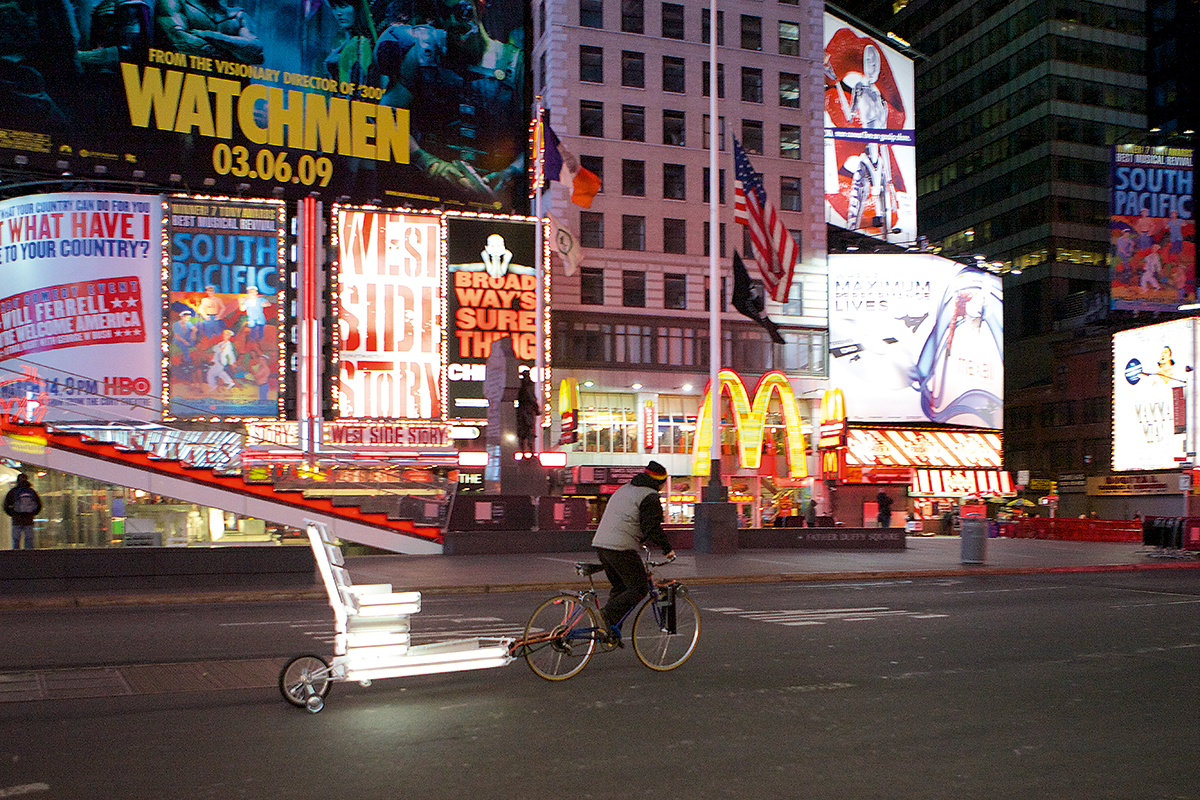
Resistance(2022), courtesy of the artist and Templon
In your 2009 Venice Biennale work representing Chile, Resistance, electricity is produced through physical effort, literally turning resistance into “friction.” Do you think real resistance produces energy, or does it consume energy?
Actually both. But my intention with this work was to show the opposite in a place like Times Square, where we constantly consume energy. A person producing energy… it is a metaphor. Instead of constant consumption, we generate thought, create our own energy.
In an era of increased global surveillance technologies, is using electricity now more political?
Yes, because electricity is everywhere. It can be produced in different ways. For example, in one exhibition, artists even produced electricity from potatoes. This reminds us that electricity does not belong only to large systems—it exists everywhere, even within our own bodies.
The title I’m Not From Here, I’m Not From There describes a state of being rather than a sentence. Do you see exile now as a geographic or psychological category?
Psychological, I think. You can feel alienated even while living in your own country. Living in another country allows you to make comparisons. Exile is a state of mind, not only related to migration but to thought.
As a Chilean artist living in Brooklyn, do you see your identity as a root or as a flow?
Completely fluid. My family is very multicultural. My children speak different languages. I am now considering living in Brazil—to experience a different Latin culture.
When addressing themes of displacement, do you deliberately avoid nostalgia?
Nostalgia is always there. But it must be transformed rather than directly reflected. If I create purely nostalgic work, it only belongs to me. My goal is to create something others can connect with.
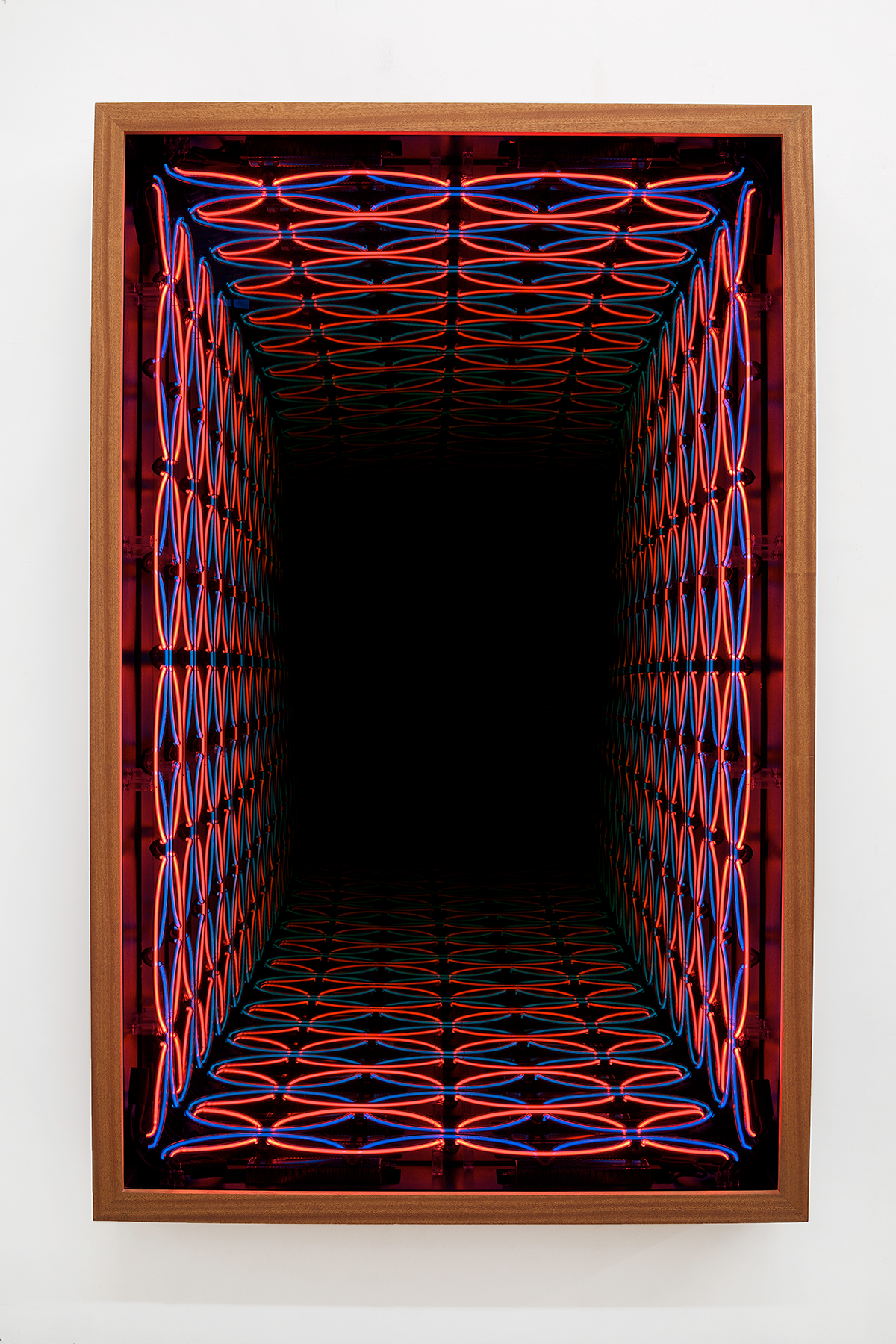
Polka (2022), courtesy of the artist and Templon
Your infinity mirror installations are both dizzying and unsettling. Do you want the viewer to lose themselves or gain awareness?
The goal is awareness. When people cannot see themselves in the mirror, they become part of the work. This makes the experience stronger. When they see themselves, there is a kind of relief: “Okay, never mind.” But when they do not see themselves, they engage and begin exploring.
You borrow one-way mirrors from police interrogation rooms. Is the viewer the observer, or the observed?
I think both happen. You observe the work because you are looking at an art piece. But if the work poses a question to you, you are drawn in. People begin to consider what the person in the image experiences. They start questioning themselves.
Today, social media and digital screens also act as “infinite mirrors.” How does the infinity you create in physical space differ from digital infinity?
Perhaps because I see them as sculpture. Three-dimensional. Considering the combination of emptiness and real space. Digital infinity is more like television: three-dimensionality is absent, only the image exists.
The music accompanying your works, and projects like Drums, introduce unexpected lyricism. Can political art be poetic?
Yes, absolutely. Political art can have both psychological and physical impact. An activist can also be a poet; even in short-term struggle, rhythm and lyricism can emerge. Activism is short-term, whereas art creates a long-term psychological effect. I do not want to be an activist; I just want to make art.
What does the “sound of silence” mean to you? Oppression, or potential?
If there is silence, something has created it. You have been silenced. In meditation, silence is chosen; here, it is not a choice. The other side of the coin.
Is music a tool of protest, or a healing force?
A healing force. It elevates people’s pain and experiences to another level.
Your strategy of transforming functional objects into political tools—critique, respect, or tension between the two?
Tension between the two. You critique something while simultaneously existing within it. This is both a political response and a means of livelihood. Duality is important to me.
Modernist design is generally based on the idea of progress. Do your illuminated objects promise progress, or reveal cracks in the system?
Progress is a political idea. Power says, “this is for your good.” But progress for whom? Different classes always think of themselves. Those in power present it as being for society’s good, but actually different classes and communities pursue their own interests. The poor cannot see this; lack of education and resources becomes a method of silencing. My illuminated objects reveal cracks; instead of fake progress, they provoke questions.
You mentioned a childhood fear of being kidnapped. How does the sense of infinity connect to the fear of being lost?
Standing before these mirrors, not knowing how they work, creates anxiety. That anxiety connects to fears I felt as a child.
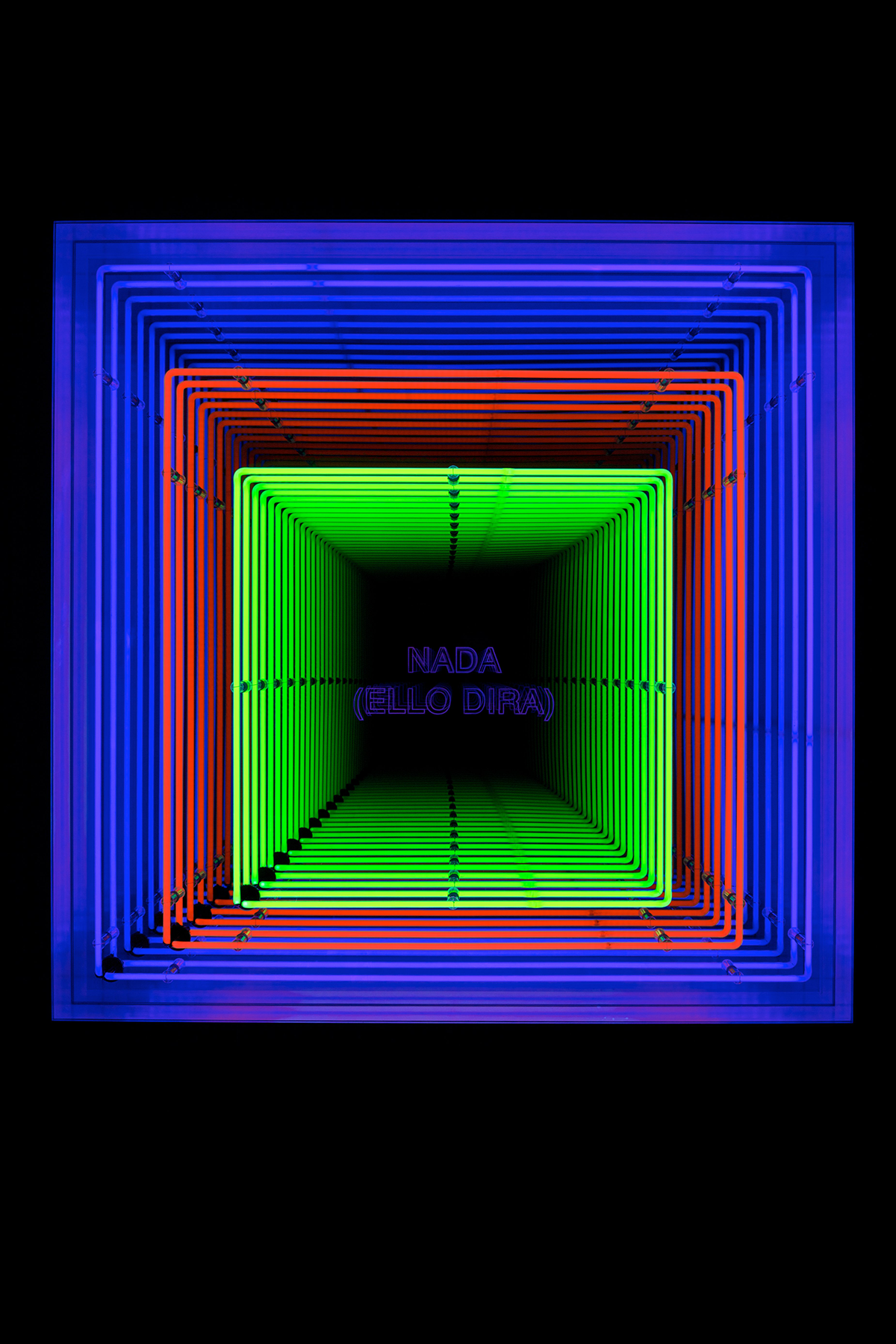
NADA( Ello Dira) (2013), courtesy of the artist and Templon
Do you want to create fear, or a space to confront fear?
To confront. I do not aim to scare people. But mystery and uncertainty encourage reflection. They ask themselves questions like, “How deep is the space behind the wall?”
If you had been a young artist during the Pinochet era, would you still have worked with light?
Maybe, maybe not. But my inspirations for working with light were artists of that time. The idea of a “waiting room” was very important; people constantly awaited something that never happened. Light thus became a critical language.
What is the greatest risk for political art today? Becoming aestheticized, instrumentalized, or desensitized?
Desensitization. Once something becomes a tool, it is dead. It is no longer political; it becomes propaganda. I think that is the worst. Aestheticization and instrumentalization are also risks, but if the audience loses interest, the work loses impact.
Your works with light convey both hope and threat. When looking to the future, which do they represent?
Both at the same time. You cannot be too explicit in a single meaning; ambiguity encourages reflection. Contrast and contradiction are the soul of the work.
How do you balance technical and aesthetic considerations?
You need to find the right tool. Thin neon expresses fragility, red neon urgency. Understanding what each material conveys is challenging. This is the hardest part.
How determinant are materials and production processes in conveying your message?
Very. Over the years, you learn the behaviors of materials. You produce with hands, mind, and materials. Even conceptually, material is a message.
Are there materials or techniques you want to experiment with in new projects?
I want to work more with sound. I make records, publish works by other artists. Sound is a very precise expressive tool.
What is the “next step” in your art practice and your personal dreams?
I want to move my studio to Rio de Janeiro. To engage with a different language, materials, and environment. To shake up my way of thinking, and increase inspiration.

Ayse Sarioglu
Ayse Sarioglu-Guest is a senior Turkish media executive, writer, and art critic based in Istanbul and New York. With over 25 years of executive experience in Turkey’s leading media organizations, including Sabah and ATV Group, she has held key leadership roles overseeing national newspapers, magazines, and television networks. Sarioglu-Guest was instrumental in the launch of MTV and Nickelodeon in Turkey and led the market introduction of Eurosport. She currently contributes to Vogue Turkey and Harper’s Bazaar Turkey, focusing on contemporary art, culture, and international creative industries.
view all articles from this author