Whitehot Magazine
September 2026
"The Best Art In The World"
"The Best Art In The World"
September 2026
What's the Deal with Pop Art? Did It Die After Warhol?
By PRISCA PAN September 19th, 2026 at 3:28pm PST
I keep hearing people talk about pop art like it’s something that happened once, in 1962, and then stayed there. Warhol, soup cans, done. But I don’t think the movement ever actually ended. I think we just stopped recognizing it, because it changed lens on us.
Pop Art’s whole trick was never really the soup can; it was taking whatever image the culture had decided was too cheap and everywhere to matter, and putting it into a museum. Warhol did it by removing the artist’s hand entirely: silkscreen, repetition, mechanical reproduction, a deliberate insult to Abstract Expressionism’s cult of the gesture. In 1962, the object was the soup can. The insult was flatness.
What’s changed isn’t the insult, it’s the unit. Pop art used to elevate a thing — an object sitting on a shelf whether or not anyone looked at it. Today’s version elevates an experience — the accessible, everyday, half-conscious act of consuming an image: snapping a photo, scrolling a feed, glancing at a screen, flipping through a manga volume. Nobody thinks of any of these as significant while they’re doing them. That’s exactly the point and it was always the point.
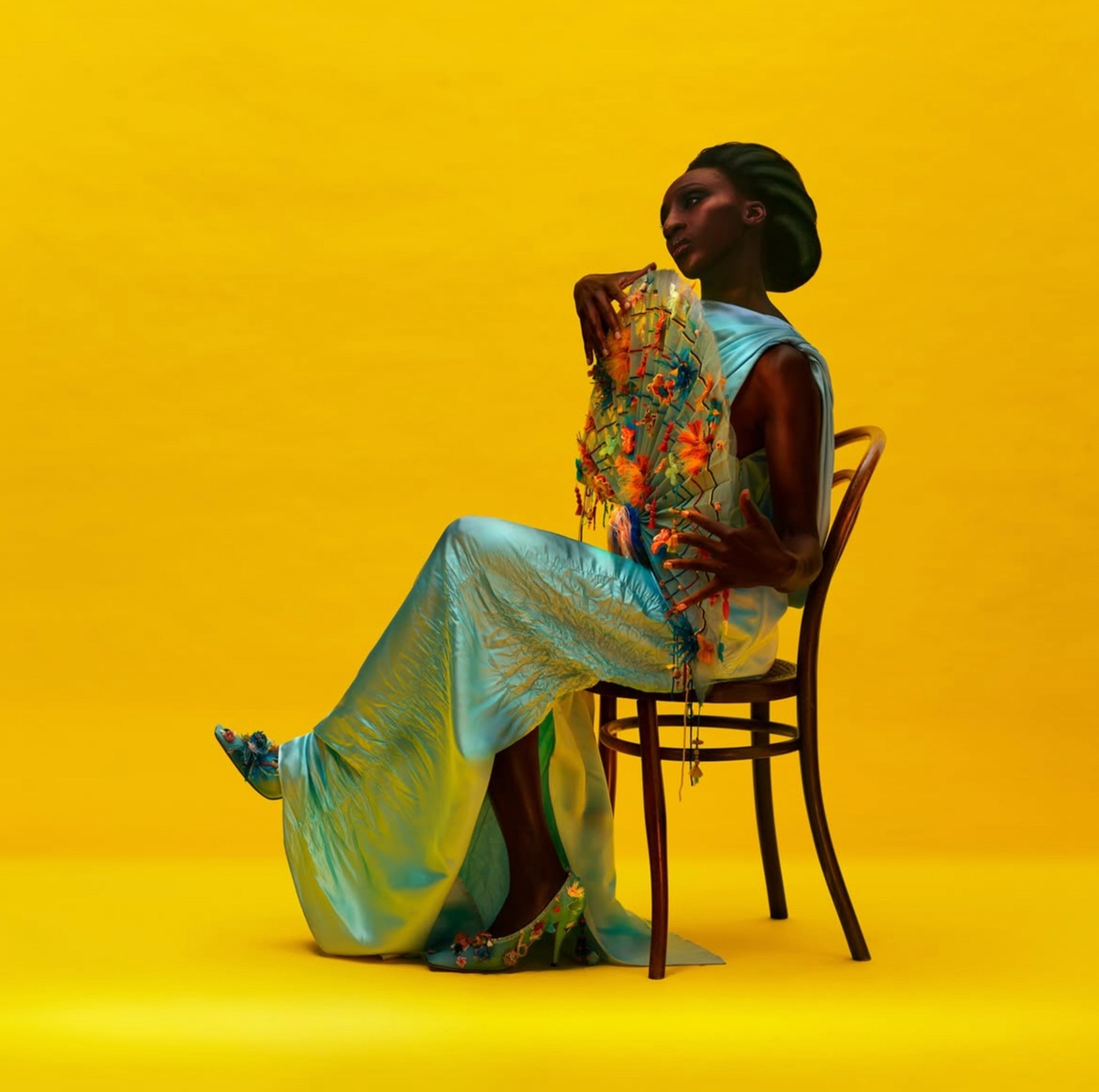 L’exception Couture issue from Prince Gyasi’s IG page
Prince Gyasi elevates the experience of seeing a photo. Is it a photograph or is it a painting? Not photography as a medium in the abstract: the specific, mundane, thumb-on-glass gesture that a billion people repeat without a second thought. What informs the technique is everything upstream of the click: he studied sculpture and woodwork so he could physically build his own sets before he ever raises the phone, and his color choices come out of a synesthetic system — hope is pink, victory is white — that nobody else has access to. In The Process, he poses ballerinas specifically for their discipline, staring one dancer straight into the lens to dare the viewer into the same leap he took choosing a tool “people didn’t really respect.” The everyday act of snapping a picture gets elevated by an entire practice of set design and color theory that most people who own an iPhone will never build.
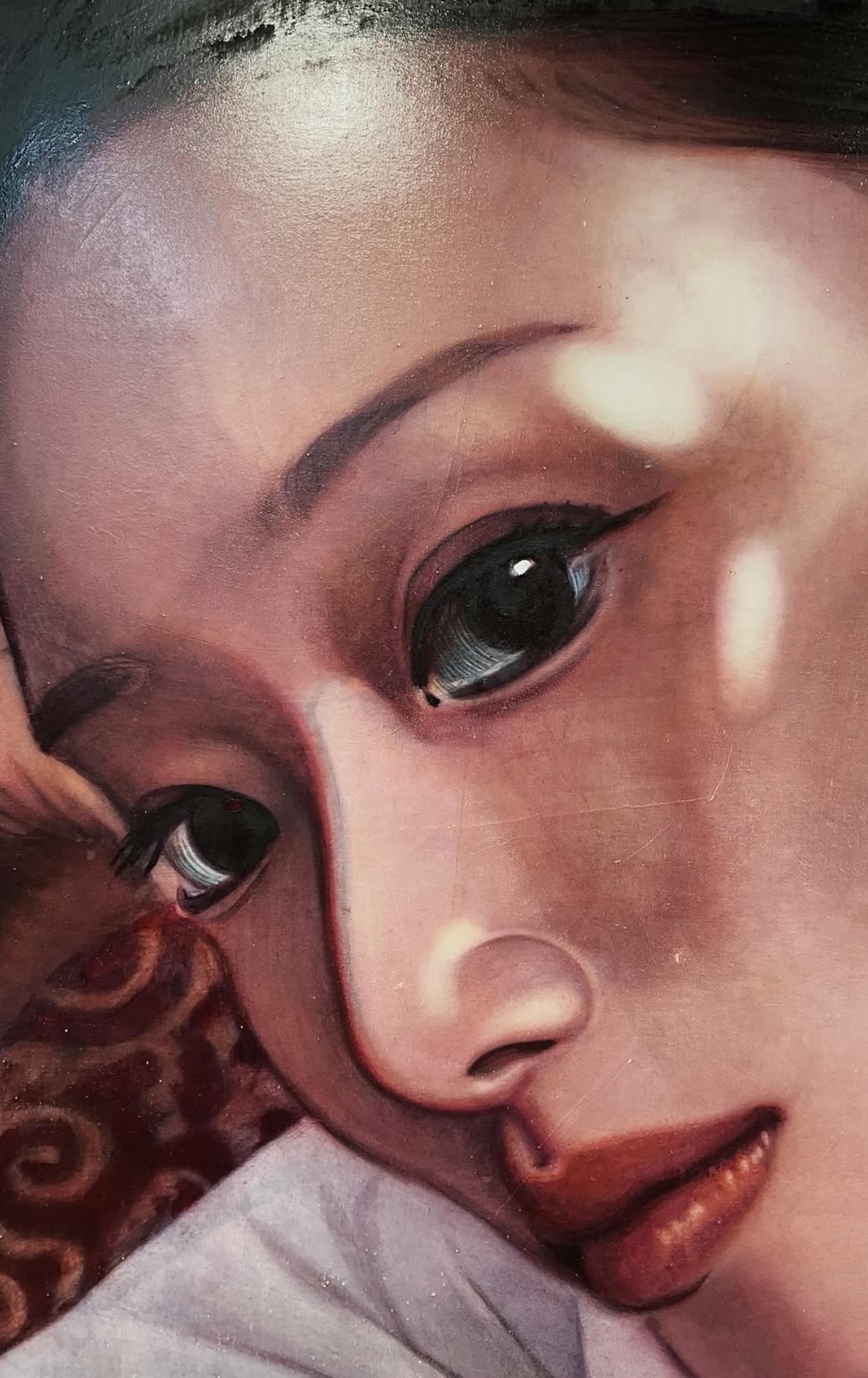 (detail) innuendo 03 (composition), 2026, oil on cotton. Courtesy of Moka Lee’s Instagram page
Moka Lee elevates the experience of scrolling. Not the photo itself — the specific, absent-minded act of pausing on a stranger’s face in an infinite feed, something everyone does and nobody remembers doing an hour later. What info the technique is the opposite of what you’d expect from a flat, printed-looking source image: thin, translucent layers of oil that physically diffuse light, so the canvas glows in a way the screen she painted from never could. She’s not elevating the photograph. She’s elevating the three seconds of looking that produced it.
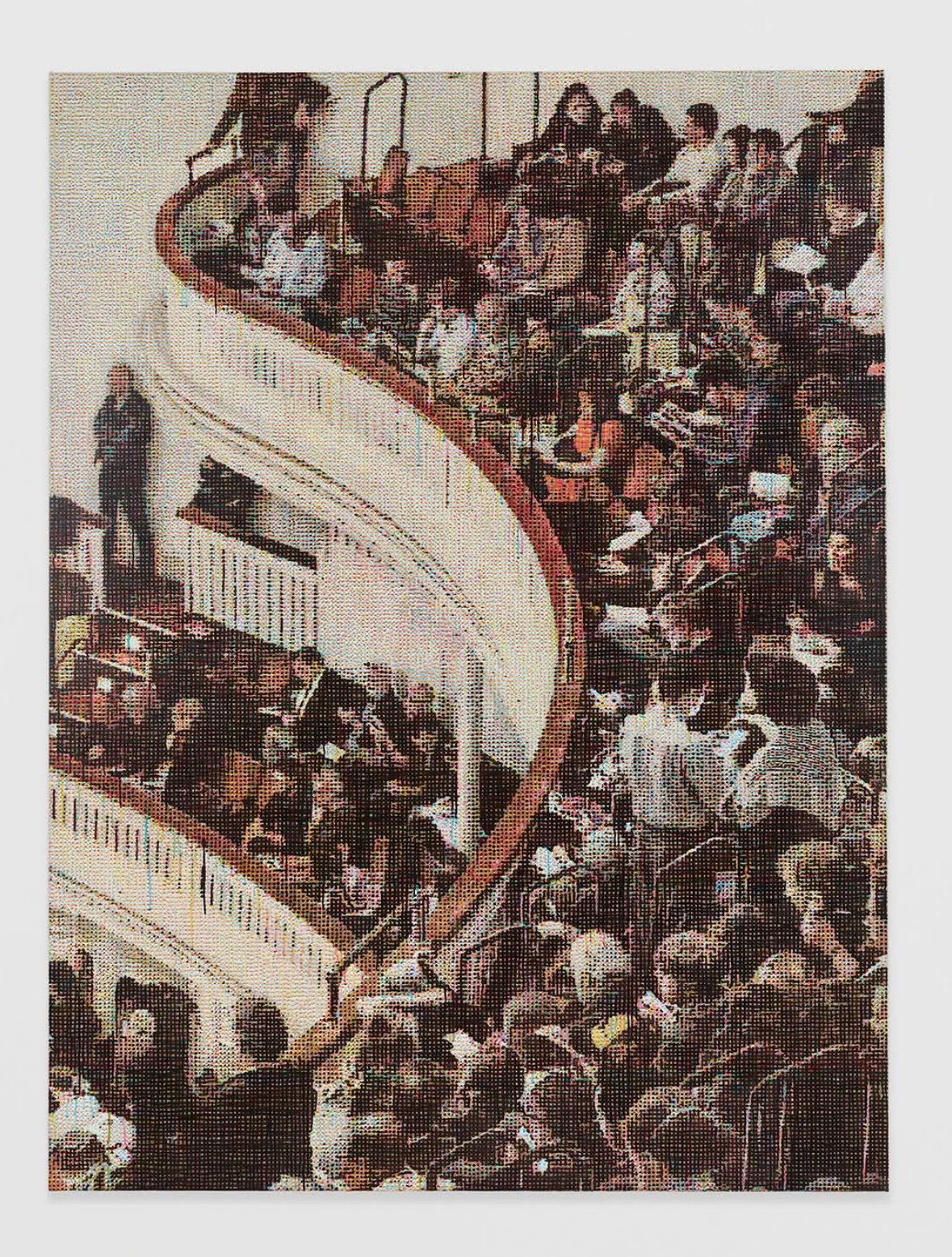 From Asher Liftin's new show with 125 Newbury & Pace
Asher Liftin elevates the experience of looking at a screen and having the image degrade — the glare on a phone, a reflection in a mirror, the particular way a photo warps through glass. That’s a moment everyone has had and nobody has looked at twice. What imports the technique is an almost algorithmic, Seurat-descended dot-matrix method: from across the room you see the ordinary screen-glance; up close, the image dissolves into individual, hand-placed color decisions. He’s elevating the visual noise of digital viewing, not the image underneath it.
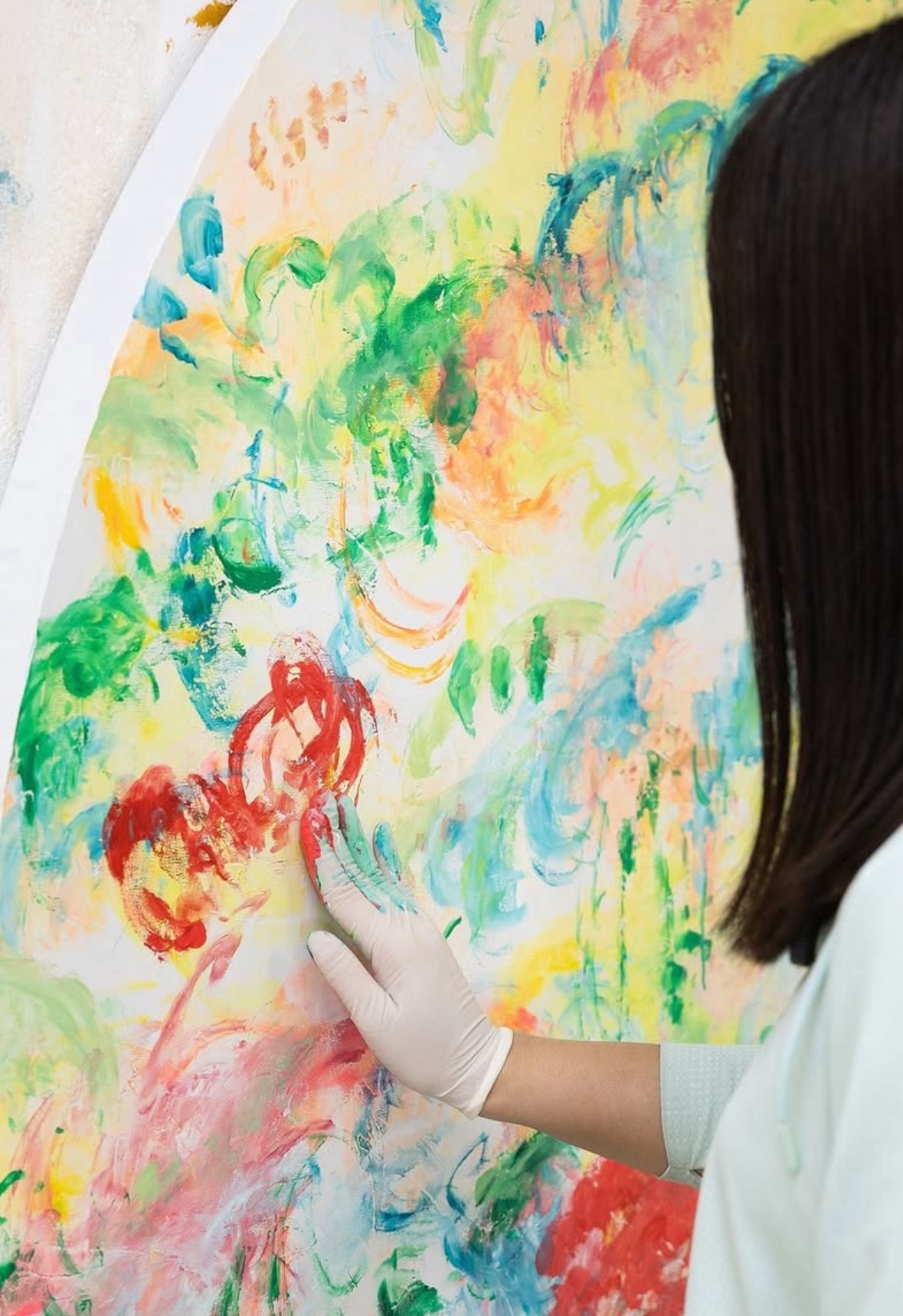
Ayako Rokkaku elevates the experience of reading manga — not the imagery, the flatness itself. Manga is defined by cheap paper and mass-produced, depthless ink; reading it is one of the most disposable, low-friction image experiences there is, and it has been since long before phones existed. Where Gyasi, Lee, and Liftin all reach forward for a new-generation technique to match a new-generation experience, Rokkaku reaches backward: she paints with her bare hands, no brushes, no sketches, and names Pollock and Twombly, the artists Pop Art was invented to reject, as the influences that unlocked her work. She isn’t updating manga’s flatness. She’s importing the one thing flatness has never had, from decades before flatness was even pop art’s subject.
That’s the throughline, and it runs in both directions at once. Elevating an everyday image-experience doesn’t require a new tool matched to a new decade — Gyasi, Lee, and Liftin prove that reaching forward works, and Rokkaku proves reaching backward works just as well. What none of them need, and what none of them use, is the one thing that made Warhol’s soup can radical in 1962: mechanical distance. In an image economy where a phone already produces perfect, flat, mechanical reproduction for free, a thousand times a day, the hand isn’t pop art’s enemy anymore. It’s the only thing left that still counts as a transgression.
__________________________________________________________________________________________________________
If any of this makes you want to look at real work in a room instead of on a screen, that’s the whole point. and t’s exactly what these three events are for:
Armory Show Insider Tour — NYC, Javits Center, Saturday, Sept 26 — a guided walk-through with morning coffee, 10 spots only.
SF Tech Week Salon I — Bernal Heights, Thursday, Oct 8, 6:30–8:30pm — featuring Tunji Adeniyi-Jones, hosted at his SF collectors’ home.
SF Tech Week Salon II — Palo Alto Hills, Saturday, Oct 10 — an evening with Tunji’s most significant works, in Dr. Cabaccan’s blue-chip collection.
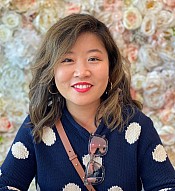
Prisca Pan
Prisca runs Unfram_d, an art advisory working at the intersection of culture and capital, helping a new generation of collectors build thoughtful, investment-grade art collections. She writes about cultural permanence, art as infrastructure, and what wealth looks like beyond liquidity at The Uncommon Angle.
view all articles from this author