Whitehot Magazine
October 2026
"The Best Art In The World"
"The Best Art In The World"
October 2026
The Bride Intervention is coming to New York City
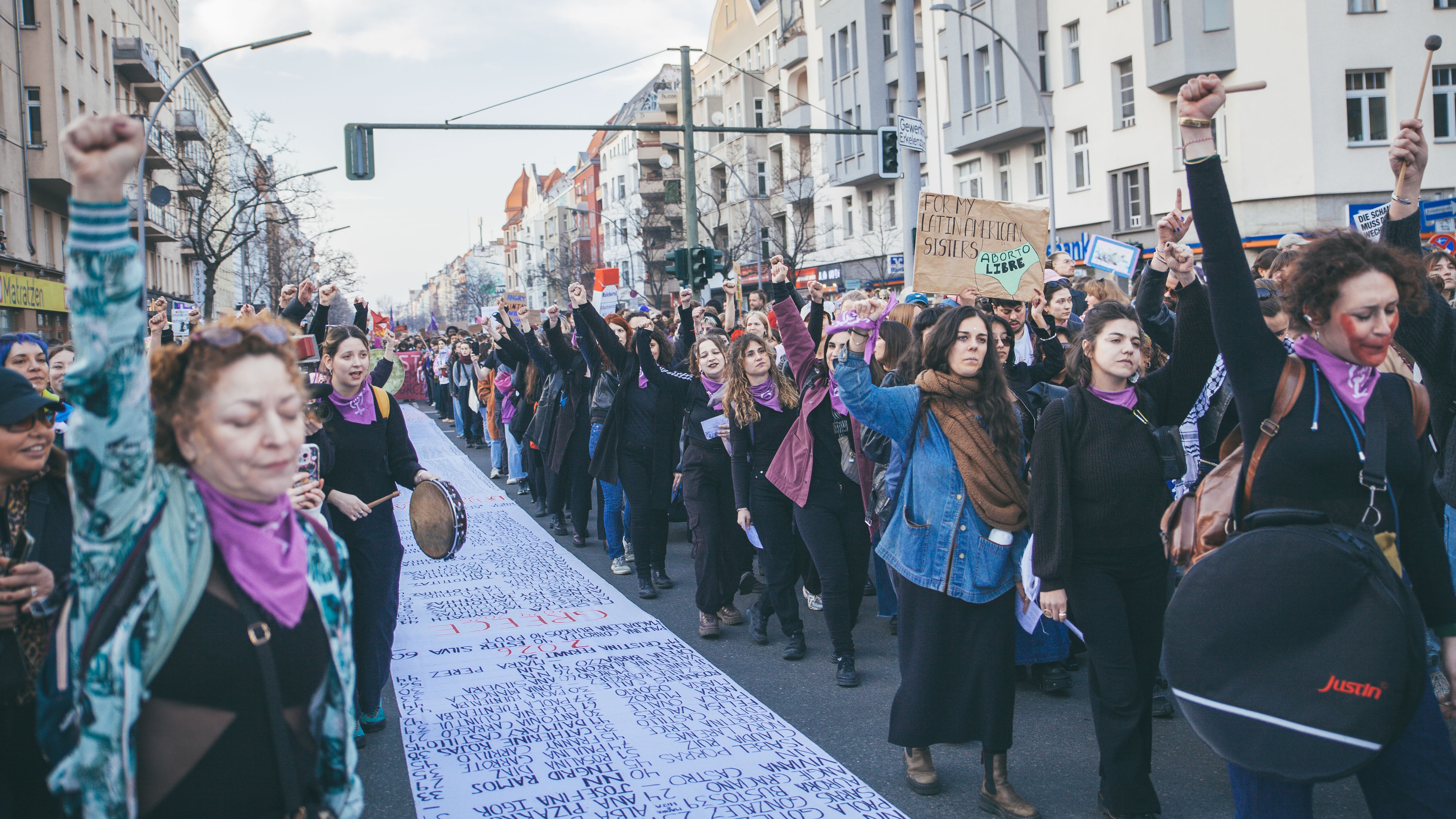
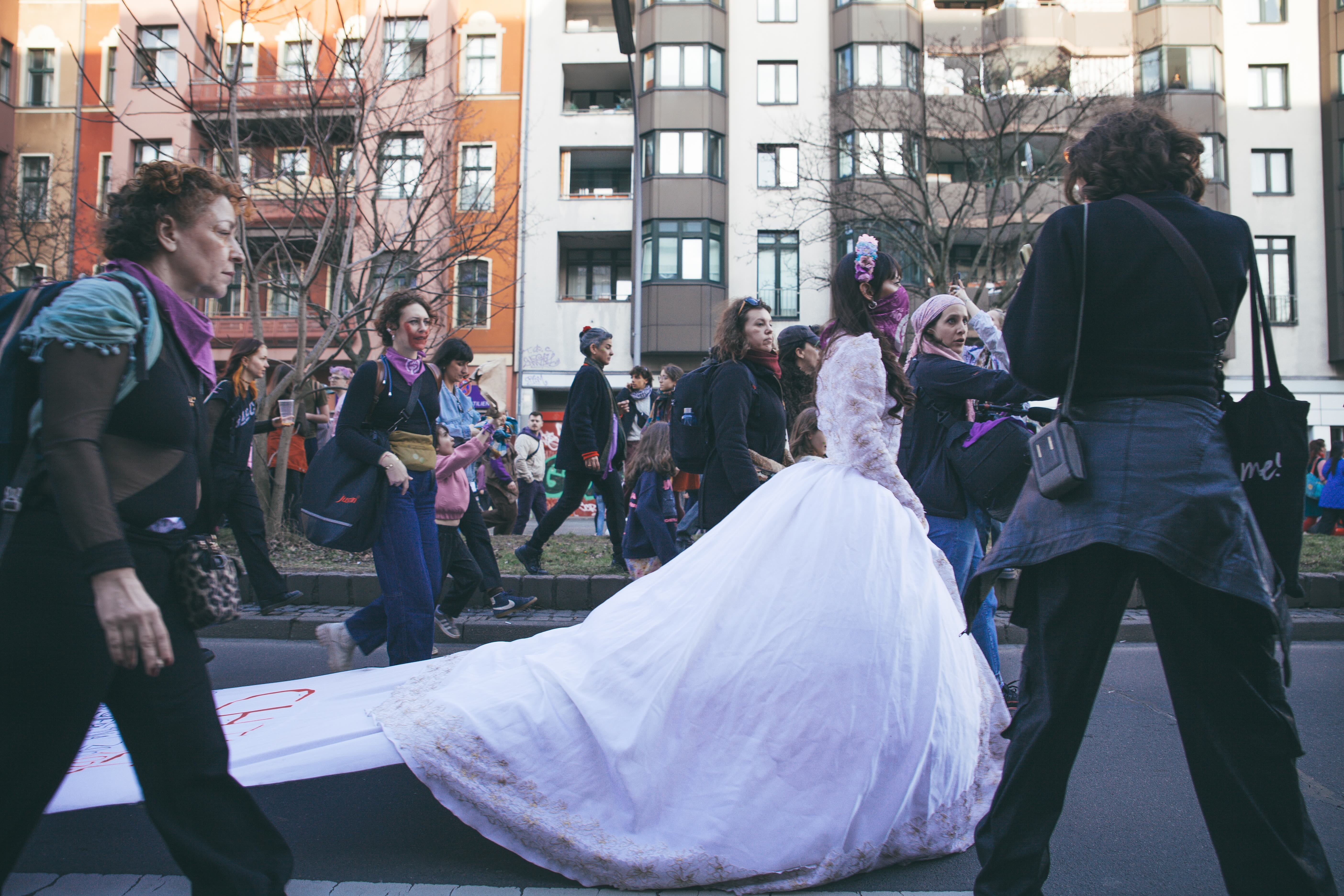
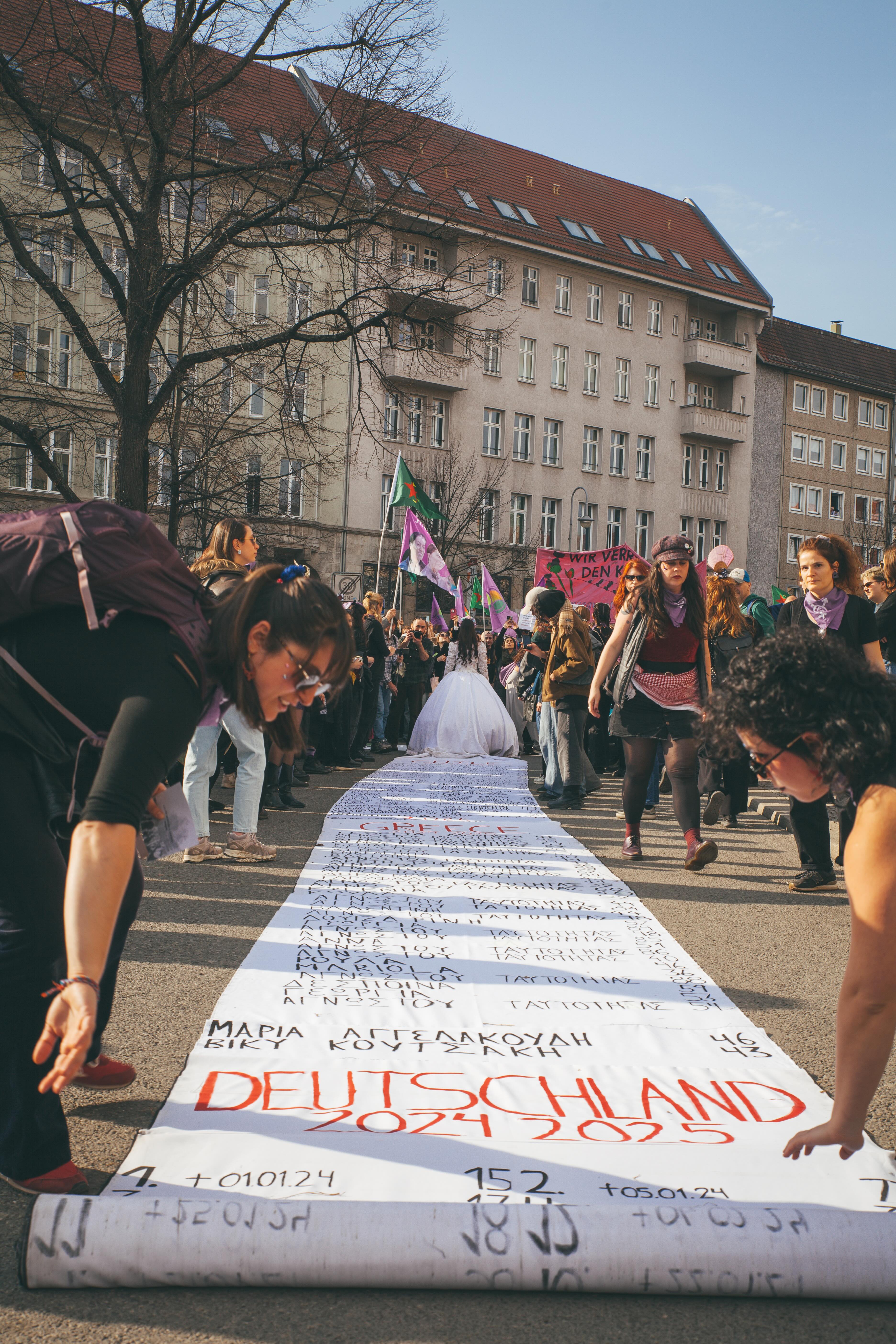
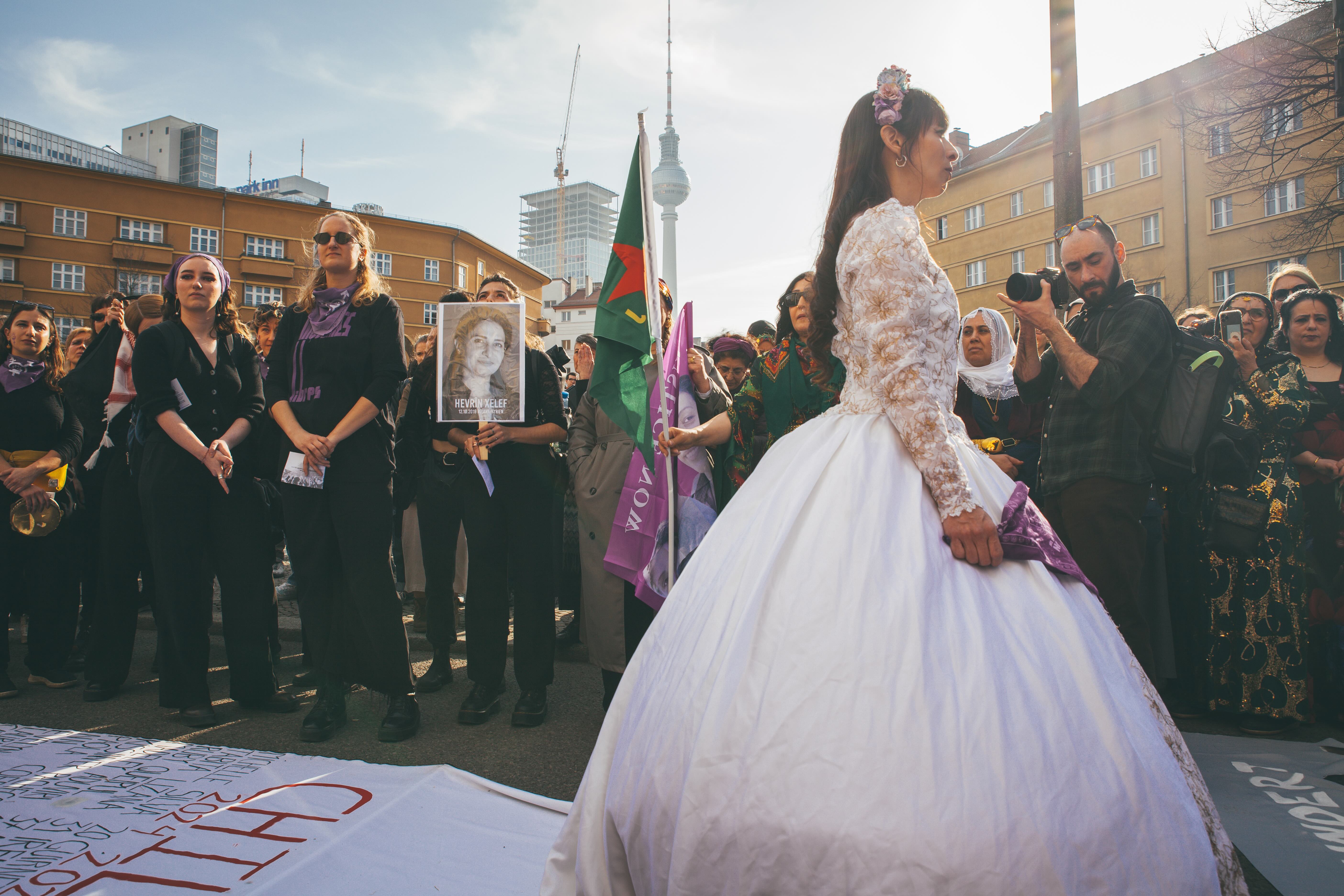
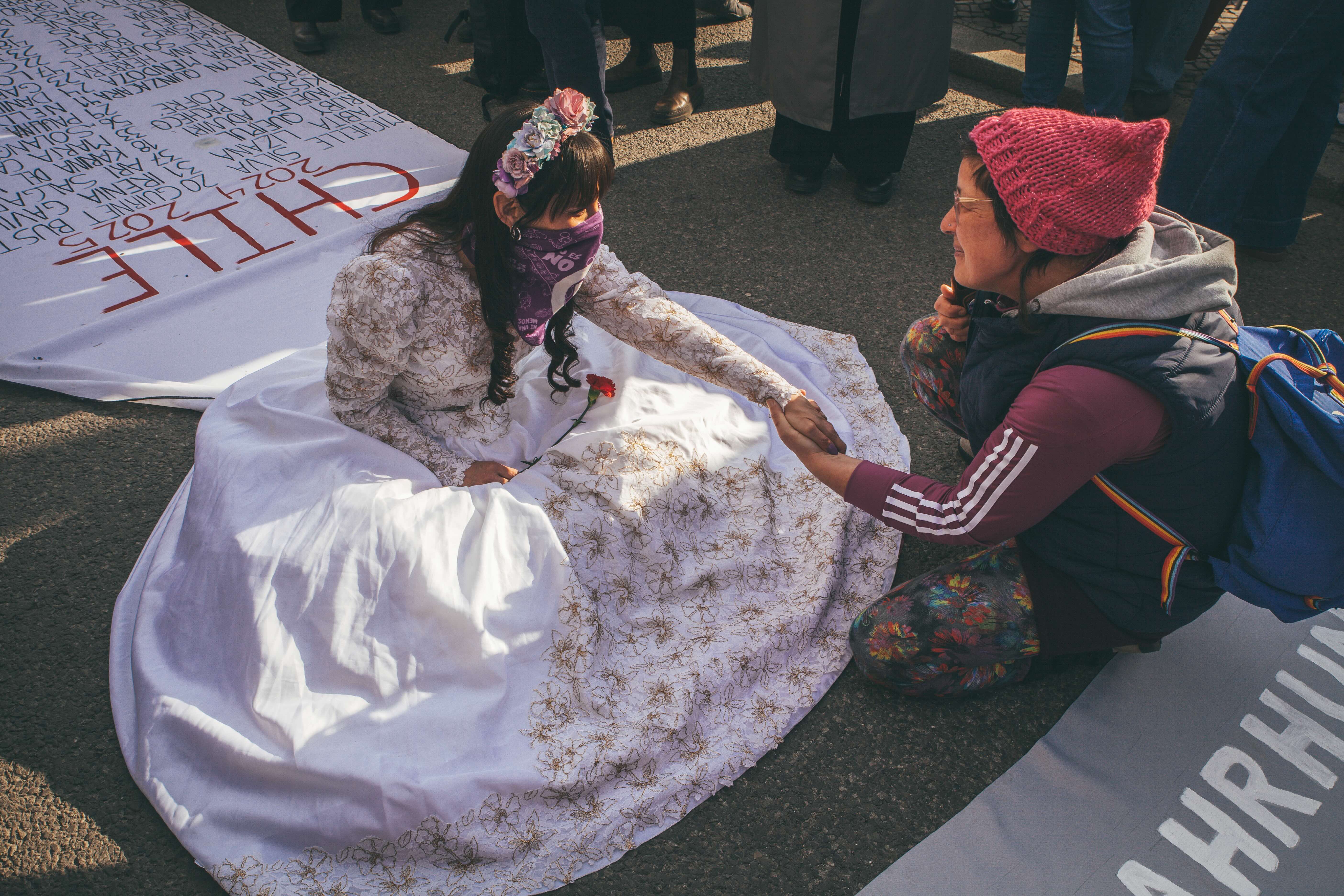
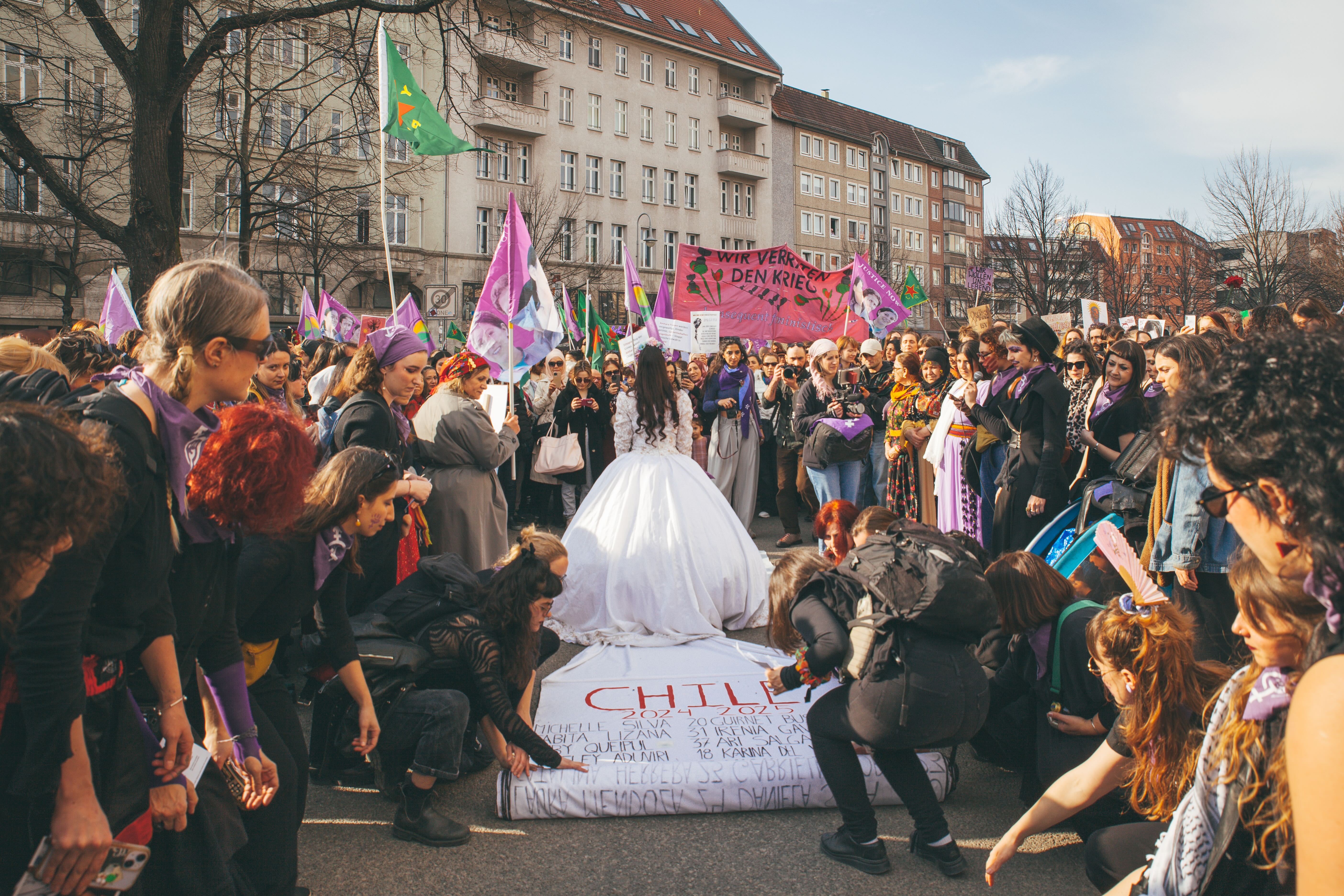 All pictures are from this year's staging of The Bride Intervention in Berlin, Germany with the collective Lilith Unveiled (Polyphonic choir) Instagram account @lilith_unveiled and the pictures are from Aser Magdy, instagram account: @aser.magdy. All photos are provided courtesy of the artist.
By EMMA CIESLIK, October 28th, 2026
In the fallout following news about the “Cornell 7,” seven Cornell University students who drugged and raped a fellow student for seven hours, a performance art piece titled The Bride Intervention has gone viral. People might have seen a woman dressed in a long white bridal gown, a purple handkerchief obscuring the bottom half of her face and a long train covered in the names of women. The Bride Intervention is a feminist political performance that addresses gender-based violence, especially femicide in Latin America, created by Chilean artist and feminist activist Claudia Bell Rifo.
During this performance piece, which she has held in Chile, Greece, and Germany, Bell or another woman dresses as a bride and walks through the city wearing a train with the names of femicide victims from each territory. It's a visually compelling and deeply tragic performance that recognizes how violence against women and gender minorities has been normalized. After learning about this performance piece online in the aftermath of the “Cornell 7” and the news that Bell is set to bring The Bride Intervention to New York City this upcoming March 8th, I sat down with the artist to learn more about the intention and impact of this work.
Emma Cieslik: Would you mind please introducing yourself however you feel comfortable?
Claudia Bell Rifo: My name is Claudia Bell Rifo. I am a Chilean artist and feminist activist. I have a background in theatre and dance. My work brings together art and social issues, especially violence against women. When I see injustice, I feel the need to do something. I don't want to just talk about these problems. I want to take action through my art. Through my work, I want to raise awareness, give a voice to women, and encourage people to think about these issues. For me, art is a way to speak out, create change, and stand up against injustice.
Cieslik: What, in your own words, is The Bride Intervention?
Bell: The Bride Intervention is a feminist political performance that addresses gender-based violence, specifically femicide. I created this intervention because this issue deeply affects me, both as an artist and as a woman from Latin America. Femicide is the ultimate expression of gender-based violence. It exposes the failures of our legal and social systems to protect women and prevent these crimes. This is not only a Latin American reality; it is a global problem.
That is why The Bride Intervention was born. Through this performance, I wanted to bring the voices of silenced women into the streets and create a moving memorial for those who are no longer here. It is a way of making visible a reality we cannot continue to ignore. Every day, women are killed by their partners, family members, or strangers simply because they are women. I believe this reality must be made visible. We cannot remain silent or look away. Through art, I want to create a space for remembrance, protest, and awareness, reminding people that behind every statistic, there is a woman, a life, and a story that deserves to be remembered.
Cieslik: Why choose the image of the bride? What does the bride represent?
Bell: I chose the wedding dress because, since I was a little girl, I have never fully understood the meaning behind the traditional marriage ritual. I was always struck by the idea of a father giving his daughter away to another man. To me, this gesture represents a deeply rooted patriarchal tradition in which a woman seems to pass from one man's hands to another, as if she were a possession rather than an independent person with her own desires, decisions, and freedom.
For me, the wedding dress carries a much deeper meaning than a symbol of love or celebration. It represents many of the expectations society has historically placed on women: purity, obedience, submission, modesty, sacrifice, and the idea that a woman's value is connected to her ability to be a good wife, to please others, and to fulfill a predetermined role. It is a symbol shaped by traditions that have taught women how they should behave, how they should look, whom they should love, and what their lives should be about.
I wanted to take this symbol, which is so deeply connected to the social construction of femininity, and transform its meaning. I wanted to reclaim the wedding dress and turn it into something that challenges these traditions rather than reproduces them. Instead of representing submission, purity, or the beginning of a life defined by marriage, I wanted it to become a symbol of resistance, struggle, and protest.
This is how The Bride Intervention was born. I transformed the wedding dress into a political statement and a moving memorial for women who have been victims of femicide. The bride, traditionally associated with romance, beauty, and the promise of a happy ending, becomes a figure who confronts society with a much darker reality: the violence that women experience, often at the hands of men they know, love, or trust.
By bringing this figure into public spaces, I wanted to disrupt the familiar image of the bride and create a powerful contrast between what society expects women to be and the violence that so many women endure. The white dress, traditionally associated with purity and celebration, becomes a space of remembrance and protest. It carries the weight of lives taken, voices silenced, and stories that must not be forgotten.
For me, this intervention is also a way of reclaiming a symbol that has historically been used to define women's roles and giving it a new political meaning. The bride is no longer being given away. She is no longer a passive figure in a ritual designed by tradition. She becomes a voice, a body of resistance, and a witness to a reality that society too often chooses not to see.
I wanted to take something so familiar and transform it into something impossible to ignore. By bringing this image into the streets, I turn the wedding dress into a moving memorial that carries the memory of women who are no longer here and demands that we look at the violence that continues to take their lives.
Ultimately, The Bride Intervention is about reclaiming the meaning of a symbol, but it is also about reclaiming women's voices, bodies, and freedom. It is a protest against the structures that continue to place women at risk, and a reminder that no woman should have to die because of her gender. Through this performance, I want to transform mourning into resistance and art into a public act of remembrance, awareness, and political action.
Cieslik: Do you always depict the bride or does anyone else take on this role?
Bell: When I first started The Bride Intervention, I was the only one performing as the bride, throughout 2023 and 2024. Later, 2025, I traveled to Germany, and the intervention took place simultaneously in both Chile and Germany. Another performer took on the role of the bride in Chile, and she is the one who will continue representing the intervention in the streets there.
Now, as I plan to bring the intervention to other countries, my vision is to have it take place simultaneously in Chile, Germany, and wherever I am in the world.
For me, this is an important step because I want the bride to become more than just one person. I want her to become a collective symbol of resistance, one that can exist in different places at the same time. The woman wearing the dress may change, but the message remains the same. Each woman who takes on this role becomes part of a shared act of protest against gender-based violence and femicide.
Cieslik: Whose names/what words are featured on the train of the dress?
Bell: In Chile, the dress carries the names of femicide victims from 2022 to 2026. In Germany, the intervention expanded to include three territories: Chile, Germany, and Greece, with the names of victims from 2024 to 2026. Chile remains at the heart of the intervention because it is my home country. Germany is included because the performance took place in Berlin, and Greece has a special place in this project because I worked with a wonderful community of Greek women.
Including these three territories reflects the intention behind the intervention: to connect different communities through a shared struggle against femicide. Although each country has its own context and reality, gender-based violence is a global problem. The train of the dress becomes a moving memorial that brings these women's names into public spaces, allowing their stories to travel across borders and reminding us that no victim should be forgotten.
Cieslik: Do you collaborate with any other organizations as part of your protest, and if so, which ones?
Bell: I work with communities of women artists, activists, and women who simply want to be part of the project. I don't work with formal organizations in every country, but I always collaborate with local communities who help bring the intervention to life. Every woman contributes in her own way, and this allows the intervention to reflect the culture of each territory.
In Chile, actress Natalia González performs as the bride, and dancer Nancy Ascencio has been collaborating with me since the very beginning, helping develop the mechanism that allows the train of the dress to move through the streets. We also have dancers and actresses performing around the bride. In Germany, we have a polyphonic choir directed by Greek artist Dimitra Kandia, as well as an audiovisual work created by Greek artist Alkistis Kafetsi. I believe these collaborations are essential because The Bride Intervention is not something I create alone. It is a collective project that grows through the women who come together to make it happen.
Cieslik: What do you hope this protest communicates to members of the public and political leaders who can pass legislation protecting women and their rights?
Bell: I hope this protest makes people understand that femicide is not an isolated event. It is the final expression of a much deeper problem: gender-based violence that, in many cases, begins long before a woman is killed. I want the public to understand that behind every name on the train of the dress, there is a woman, a life, a family, and a story that deserves to be remembered. These women should not become just statistics. We need to stop treating their deaths as something normal or inevitable.
For political leaders, I hope this intervention serves as a reminder that remembering victims is not enough. We need laws that protect women, institutions that take their experiences seriously, and real action to prevent violence before it becomes fatal. Women's safety and rights should not depend on where they live or whether someone believes their stories. We need effective laws, institutions that protect victims and survivors, access to justice, prevention, education, and real accountability when institutions fail.
As an artist, I cannot make laws, but I can use my work to make these realities visible, to challenge people's indifference, and to create spaces for collective reflection.
Cieslik: Your resistance action has found an audience in the United States after the news of the “Cornell 7.” What do you hope ahead of bringing The Bride Intervention to the United States?
Bell: When I learned about the Cornell case, I felt the need to speak out and show my support for Jane Doe. I couldn't just stand by and watch. I wanted to use my voice as an artist and put the images of The Bride Intervention at the service of this cause. I never imagined the video would have the impact it has had or reach so many people in the United States. Seeing how people have connected with these images has been deeply moving. It has shown me how art can cross borders and create connections between people who may be thousands of miles apart but share a desire for justice.
My plan has always been to take The Bride Intervention to as many countries and territories as possible, and to collaborate with local communities, feminist organizations, and women who want to be part of this action. I believe every intervention should connect with the realities of the place where it takes place and with the people who live there.
Bringing the intervention to the United States would be a meaningful step in this journey. I would love to build collaborations there and create an action that brings people together in solidarity with Jane Doe and with all those who have experienced gender-based violence.
For me, this is about more than the reach of a video. It's about what we can do when we put our voices, our work, and our creativity at the service of something that matters. I hope this response can become the beginning of new collaborations and allow The Bride Intervention to continue growing internationally
Cieslik: Is there anything else that I didn't ask you that you would like me to add?
Bell: Yes. There is something very important about The Bride Intervention that I would like people to understand: the performance itself is only one part of the project. For me, the creative process is just as important as the action that takes place in public space.
Something beautiful happens when women come together to create this intervention. We form circles of women, share experiences, listen to one another, and build connections that often continue long after the performance is over. These encounters create spaces of care, trust, and solidarity, and sometimes lead to lasting support networks. For me, this is one of the most meaningful aspects of the project. It is not only about making gender-based violence visible to the public; it is also about creating spaces where women can connect, support one another, and feel that they are not alone. I believe these relationships are part of the resistance itself.
I have developed and financed much of this project independently, including the travel required to bring the intervention to different places. It has been a very personal commitment, driven by my belief in the importance of this work. However, if I want to take The Bride Intervention to more countries and make it accessible to more communities, I need support, resources, and people who believe in this project and want to help it grow. I am currently looking for financial support and partnerships that would allow me to travel, collaborate with local communities, and continue developing these interventions in new territories.
My hope is to build an international network of women who can come together through art, create spaces of care and collective resistance, and carry this work forward. Because for me, the impact of The Bride Intervention is not measured only by what happens during the performance, but also by the connections we create and everything that continues to grow afterward.

Emma Cieslik
Emma Cieslik (she/her) is a queer, disabled and neurodivergent museum professional and writer based in Washington, DC. She is also a queer religious scholar interested in the intersections of religion, gender, sexuality, and material culture, especially focused on queer religious identity and accessible histories. Her previous writing has appeared in The Art Newspaper, ArtUK, Archer Magazine, Religion & Politics, The Revealer, Nursing Clio, Killing the Buddha, Museum Next, Religion Dispatches, and Teen Vogue
view all articles from this author