Whitehot Magazine
October 2026
"The Best Art In The World"
"The Best Art In The World"
October 2026
Breanna Gordon’s ‘Introspect’ at Tache Gallery, London
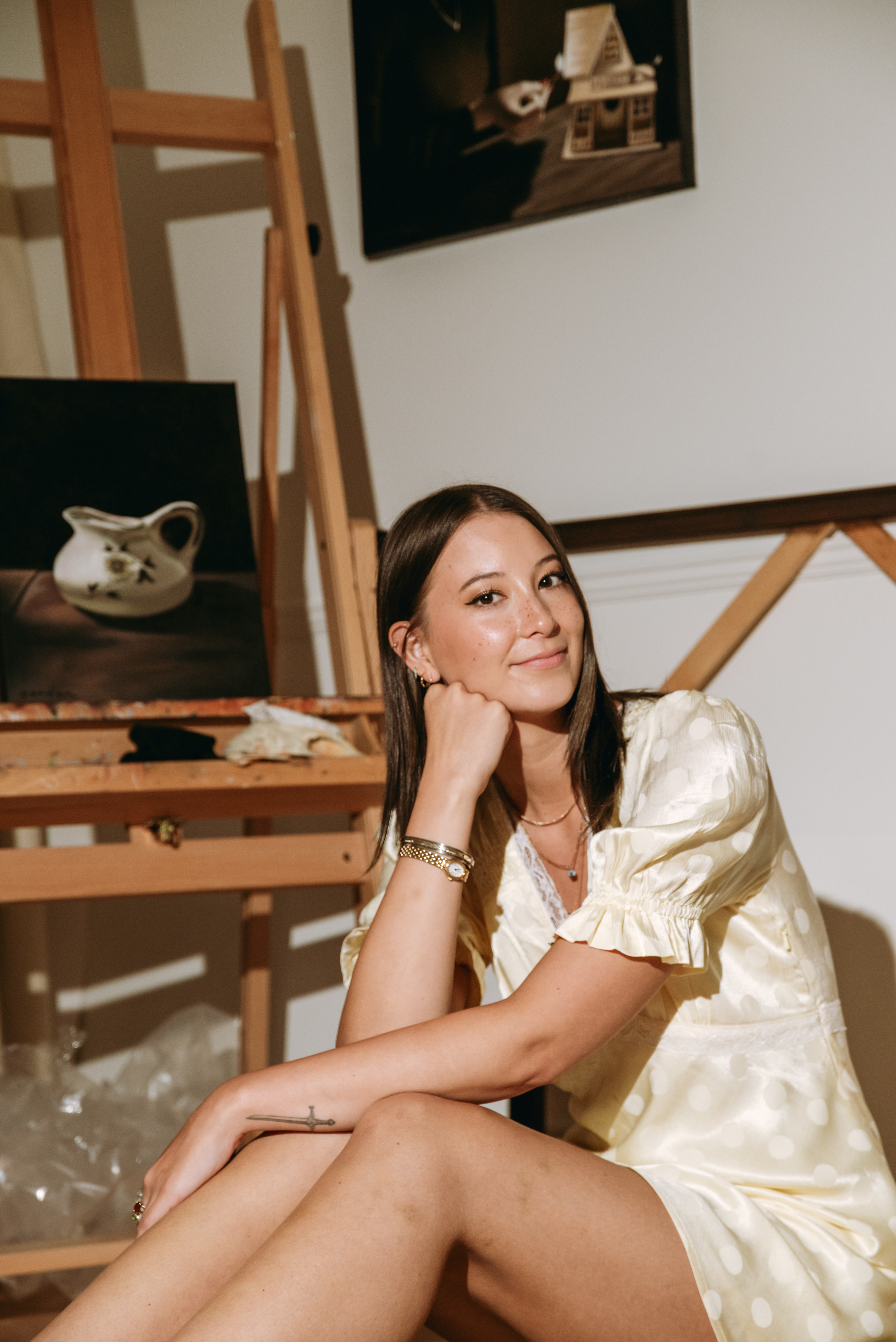 Breanna Gordon portrait, Paige Thompson Photography. Courtesy Tache Gallery.
By GRACE PALMER March 21, 2026
“Being forced to look inwards and address things about the self.” This process is the bedrock of Breanna Gordon’s solo show ‘Introspect’ at Tache Gallery, London. Having graduated with her Master’s degree from the University of Arts, London (UAL) in 2023, Gordon has participated in both the London and Chianciano Biennale. ‘Introspect’ at Tache marks her debut in the London gallery circuit – a masterful one that showcases her painterly, meditative, and unique talent. Incorporating works from both her ‘Patterned’ and ‘Darker’ series, Gordon’s exhibition demonstrates her multifarious approach to arts and craft, alongside her personal reflection on mental health. I spoke with Gordon about her engagement with the disruptive and uncomfortable, the myriad of art historical influences she draws upon and the transformational potential she uncovers through her art.
Introspection is a process. It is a deep, continued re-engagement with the self. It is uncomfortable, challenging and often easy to dismiss. For Gordon, introspection is also what encompasses her entire practice: “It comes from a place of necessity.” Language becomes an important conversational tool between her and the work, often using her journal entries as the foundation for her paintings. Sometimes, the journalistic language, out of context, takes on these painterly expressions. Other times, she “makes the painting first, then I look at my journal to understand why I had to make that.” This continued back-and-forth is evident in the intimacy on display at Tache. Although monumental, Gordon’s work hangs in quiet contemplation within the gallery space. The quasi-conclave of the second room provides respite, a momentary meditation amongst Gordon’s challenging yet poignant subjects.
 Installation views by Sergey Novikov (2026). Courtesy of Tache Gallery.
Drawing from Gordon’s experience of depersonalisation and derealisation a few years ago, many of her paintings explore the turbulent nature of mental health anxiety. While this unrestrained emotional expression destigmatises, it functions equally as a healing and ritualistic process for the artist herself: “It is about trying to make sense of this thing that happened to me. Once I’d processed it, made all the art, done all the introspection, that’s when it shifted.” Deep Chaos Within stands out amongst Gordon’s exhibited works. Set against a rich red floral background, three female figures twist and bend in anguished poses. With their faces turned away and bodies exposed, these women (representative perhaps of one) reveal a painful intimacy rather than an erotics. It is hard not to see correlations between Gordon’s figurative depiction and her description of depersonalisation: “it feels like you’re disconnected from your body. Things around you don’t feel real, like you’re dreaming.” Within this floral dreamscape, these figures squirm and take shape before us. Gordon is unconcerned with shocking or disturbing her audience; instead, these representations aim to “make people feel less uncomfortable about things like this.”
Discussing the installation process, Gordon revealed how building community was a prescient determinant behind the exhibition. Tucked in the corner of the second room, Gordon’s desire “to find connections” reaches out with two hands. Encouraging visitors to write a message on a ribbon that hangs across two projecting palms, the exhibition shifts from a singular emotional venture into a shared lived experience. Introspection may be a continued re-engagement with the self, but it is not a process that has to be undertaken alone.
 Breanna Gordon, Perpetual Inbetweenness (2023), 72.8 x 78.7 in, oil on canvas. Courtesy of Tache Gallery.
Figure and background are in constant interplay throughout Gordon’s ‘Patterned’ series. In these densely layered oil compositions, figures intermingle with intricate patterns, capturing the intangible force of anxiety. When facing the blank canvas, Gordon admits that her starting point is tethered to her current emotional capacity. She often begins with the pattern when she needs to ground herself: “just to do something that I have control over.” By contrast, her ‘Darker’ series embraces ambiguous liminal spaces; vacant backgrounds that illuminate her subjects. This dichotomy is central to her oeuvre; a natural juxtaposition. It is that “need to express that, yes, there is this feeling of chaos and overwhelming, but there is also this strange feeling of things not being real, something being off.” We all exist in the interstitial state between chaos and emptiness, and it is this space that Gordon seeks to explore in her future works: “to merge both pattern and dark.”
Titles like We’re Rebuilding, Out of Sorts, and Lucky Girl adopt a tongue-in-cheek irony coupled with their content. Much like Gordon applies the language of her journals to the painting’s themes, her titles often derive from daily life – text messages, conversations with friends, common phrases. Applied to certain images, the titles create a whole new world of meaning. “It attempts to give other people an entry point,” Gordon expressed, “to pull people into this conversation about mental health anxiety, without making it jarring or unapproachable.” Works like Ears are Burning, despite referencing Vermeer’s Girl with a Pearl Earring, are not predicated on pre-existing art historical knowledge. Her use of the turn-of-phrase ‘ears burning’ shifts the work from an isolated iconographic in-joke to a more universalising expression.
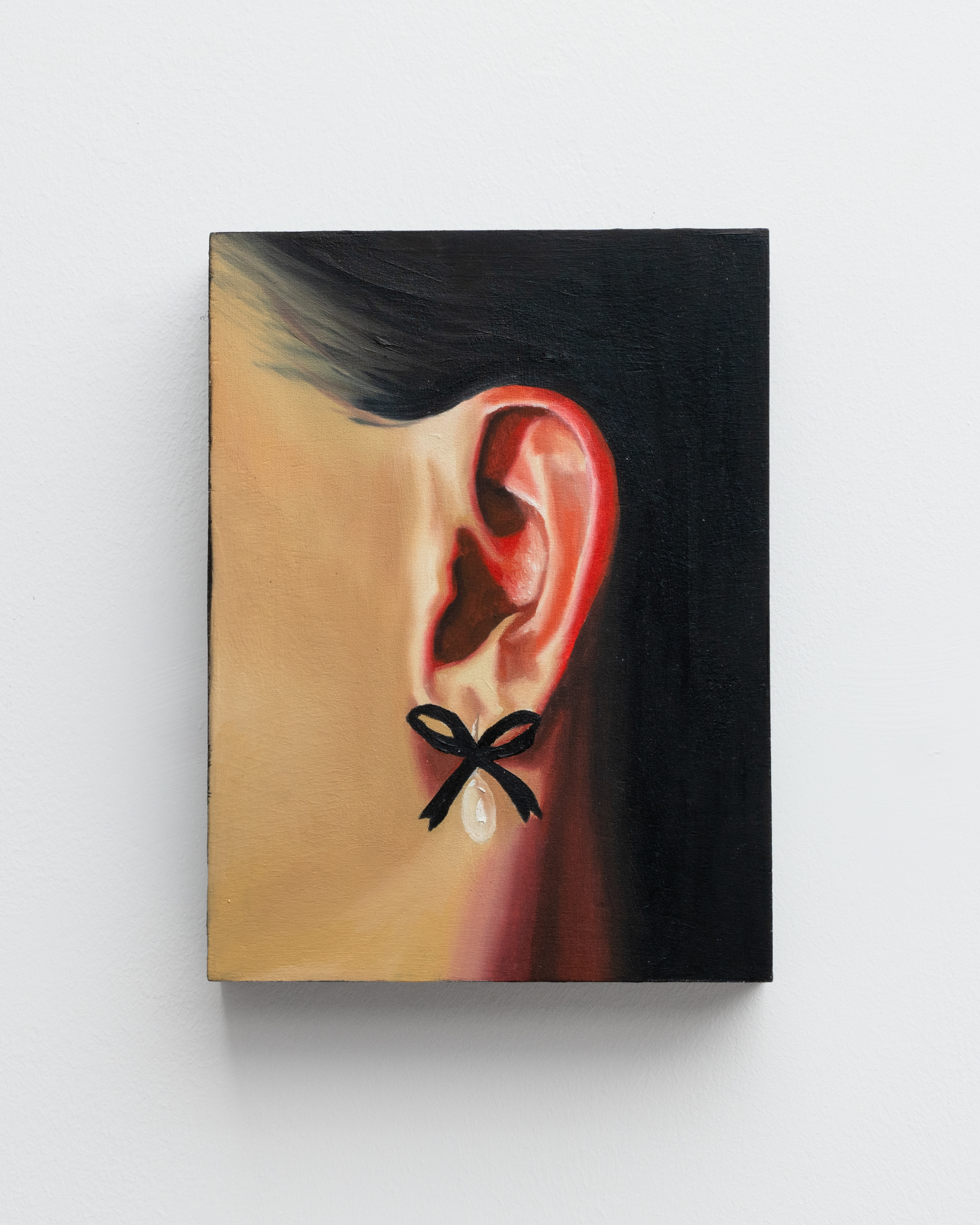 Breanna Gordon, Ears are Burning (2025), 6 x 8 in, oil on canvas. Photography by Sergey Novikov. Courtesy of Tache Gallery.
“When you look at this ideology, about the practice of work and creating things, it brings fulfilment.” Speaking on the prevalence of the Arts & Crafts Movement in her work, Gordon noted how, much like William Morris, art-making has become a craft. Morris made his philosophy clear: “The true secret of happiness lies in taking a genuine interest in all the details of daily life.” His intricate tapestry designs, with their entanglement of surface depth and emphasis on the decorative, evidenced an approach embedded in the beautiful quotidian minutiae. Gordon’s Perpetual Inbetweenness, hanging in the alcove of Tache’s second room, shows the hallmarks of a Morrisian influence. As Gordon’s transparent protagonist falls through the canvas, her body interweaves with the floral motifs – figure and background becoming one. Amidst chaos, Gordon uncovers a momentary calmness; a reconciliation with nature. Heading to the canvas for Gordon is as much about producing as it is stimulating herself to create joy and security through her work. Like Morris, Gordon’s work manifests a reciprocal relationship – one that nurtures her as she offers to it.
Alongside Morris, Gordon cites poetry as a continued inspiration for her practice. Her appreciation for poetry developed through her engagement with the Pre-Raphaelites, who themselves drew narrative influence from the writings of William Shakespeare. For Gordon, Hamlet’s Ophelia became a figure of fascination: “She is this character who fell into this dark spiral and had no way out. I related to that story on that level.” In works like Ghost Image, echoes of these Shakespearean female tragedies are evident, reverberating in the solemn expressions of Gordon’s double portrait. Poetry in her work transcends mere subject matter. Rather, it is prescriptive, “something for people to find when they really need it. That’s how I feel about art as well.”
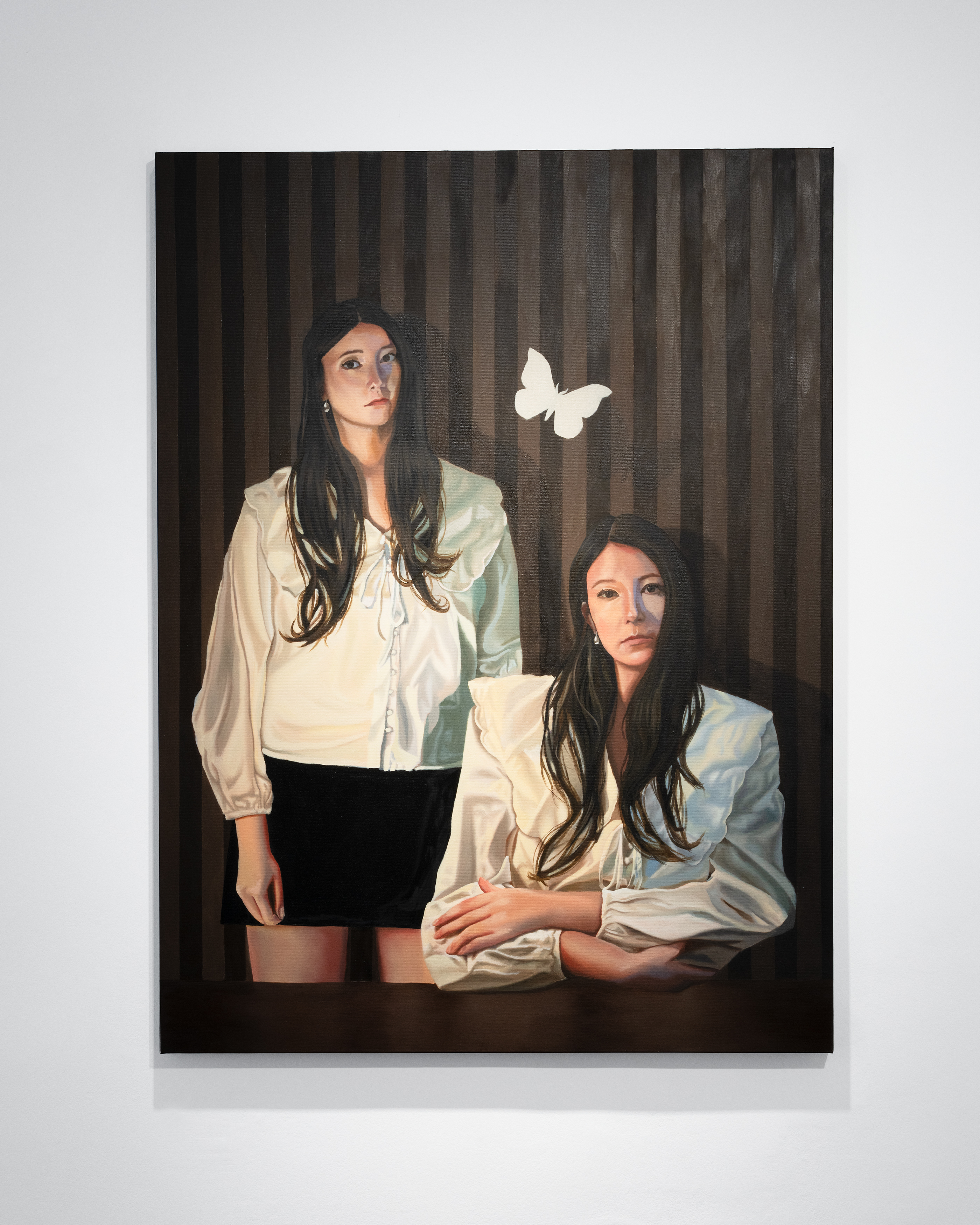 Installation views by Sergey Novikov (2026). Courtesy of Tache Gallery.
Despite Tache being Gordon’s solo debut, she has participated in numerous group shows across her career, including ‘To the Lighthouse’ at Studio 18, London (2023) and ‘BREACH: Moments in Flux’ at Toronto’s Red Head Gallery (2024). As such, Gordon finds that she approaches each work individually: “they have no relevance to each other in that moment, because I’m just making something I have to make there and then.” It is through this experience of organising for a solo show that Gordon has begun to consider her works in conversation, particularly around the topic of mental health and selfhood. As she stated in our discussion, “It’s extremely exciting for me to be given this opportunity by Tache because my paintings are so large, you rarely get to see them side by side in the studio.” Curating this exhibition, Gordon has woven together a gradual transition and timestamp of her experiences, creating a show that feels deeply intimate. Topics that often feel uncomfortable and challenging are revealed with care and beauty; in a way only an artist of notable skill and discernment can.
“You’ve done the introspection, you’ve had these experiences, what comes next?” Gordon ends our discussion on a poignant note – what comes after ‘Introspect’. On a practical level, she restates her interest in merging her ‘Patterned’ and ‘Darker’ series. Touching on her painting Burn Cycle (not on display at Tache), Gordon expressed how this coalition of pattern and dark felt like breaking free, “coming out from those spaces previous to my experiences. So I’m interested in exploring more of these figures, in more dynamic situations.” Perhaps after ‘Introspect’ there is clarity. Perhaps there is freedom. Perhaps more foliage will emerge. Regardless, her debut at Tache marks an exciting starting point for Breanna Gordon, once again proving that supporting emerging artists is an invaluable endeavour.
My considerable thanks go to Breanna Gordon for taking the time to talk with me about her process, and both the team at Tache and Pelham Communications for facilitating this interview.
'Breanna Gordon: Introspect’ runs between March 6 and April 9, 2026, at Tache Gallery, London.

Grace Palmer
Grace Palmer, an art historian and writer, specializes in the history of contemporary art and 1960s New York performance art. She contributes to Whitehot Magazine and is currently located in London, England.
view all articles from this author