Whitehot Magazine
July 2026
"The Best Art In The World"
"The Best Art In The World"
July 2026
Philip Guston Outside the Hood: Intimacy and Iconography at Hauser & Wirth
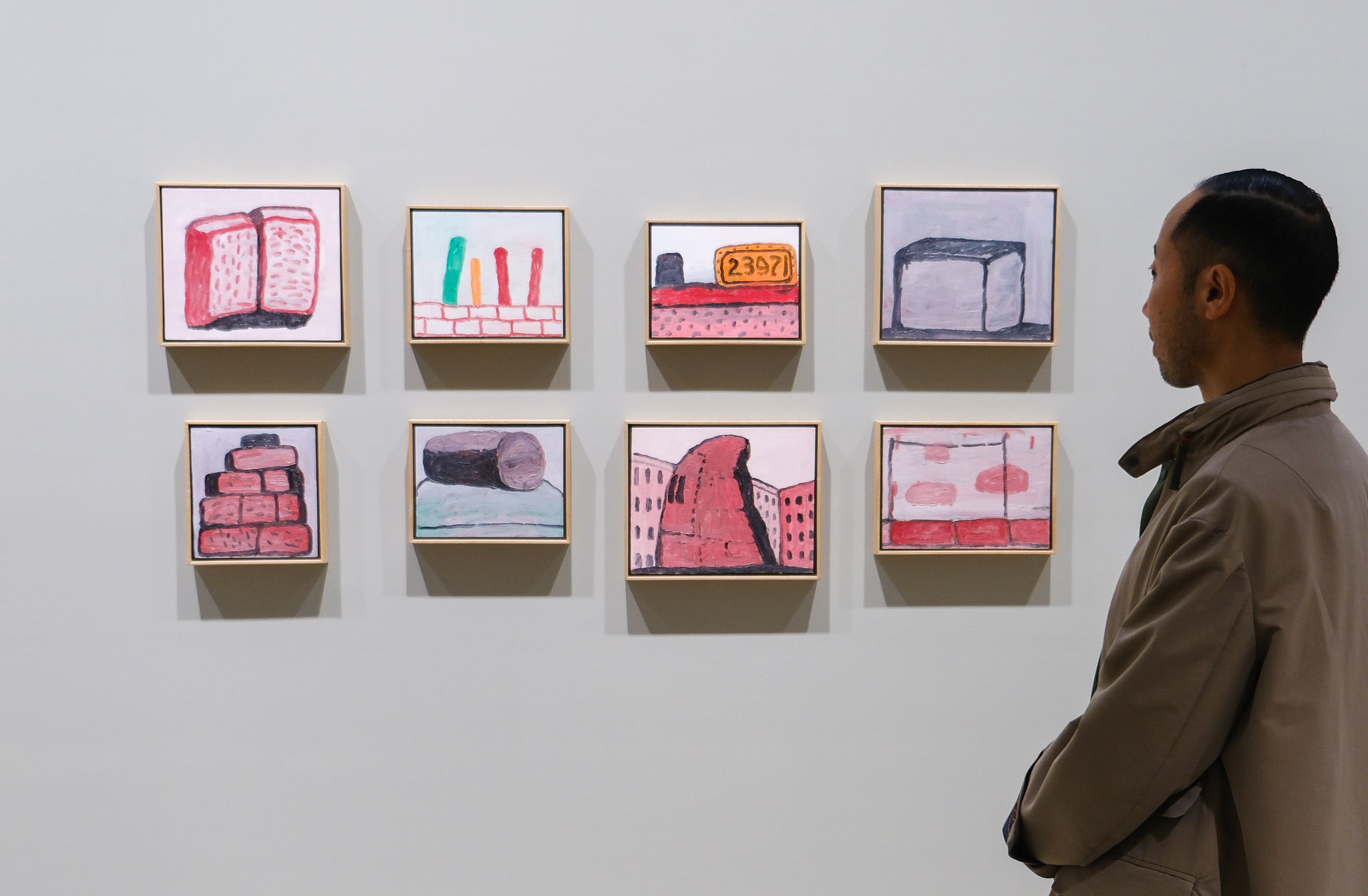 A viewer examines a wall of Guston's works, including an untitled 1969 painting depicting a Klansman, at Hauser & Wirth. Photo by Jamie Lubetkin
BY J. SCOTT ORR April 23rd, 2026
Two forms, one red one black, sag toward each other on a raw, scumbled ground—pierced by arrows, exhausted, barely holding their shape. In Two Hearts (1978), Philip Guston reduces love to something physical and strained, two organs that look less enraptured than spent. Nearby, in Untitled (1976), a head with a dense, looping crown of hair tilts upward, eyes wide, almost vacant. The paint is thick, the line blunt. Nothing is idealized. Everything is close.
That intimacy—domestic, inward, stripped of public theater—anchors Life with P., the current exhibition at Hauser & Wirth. The show builds a portrait of Guston during the period he spent with his wife, poet Musa McKim, in Woodstock after fleeing Manhattan’s Lower East Side in 1967. McKim’s journals, published for the first time in a Hauser & Wirth publication also called Life with P and edited by their daughter, Musa Mayer, track the same terrain. Mayer was on hand at the show’s press opening to discuss her father’s work and read from her mother’s journals.
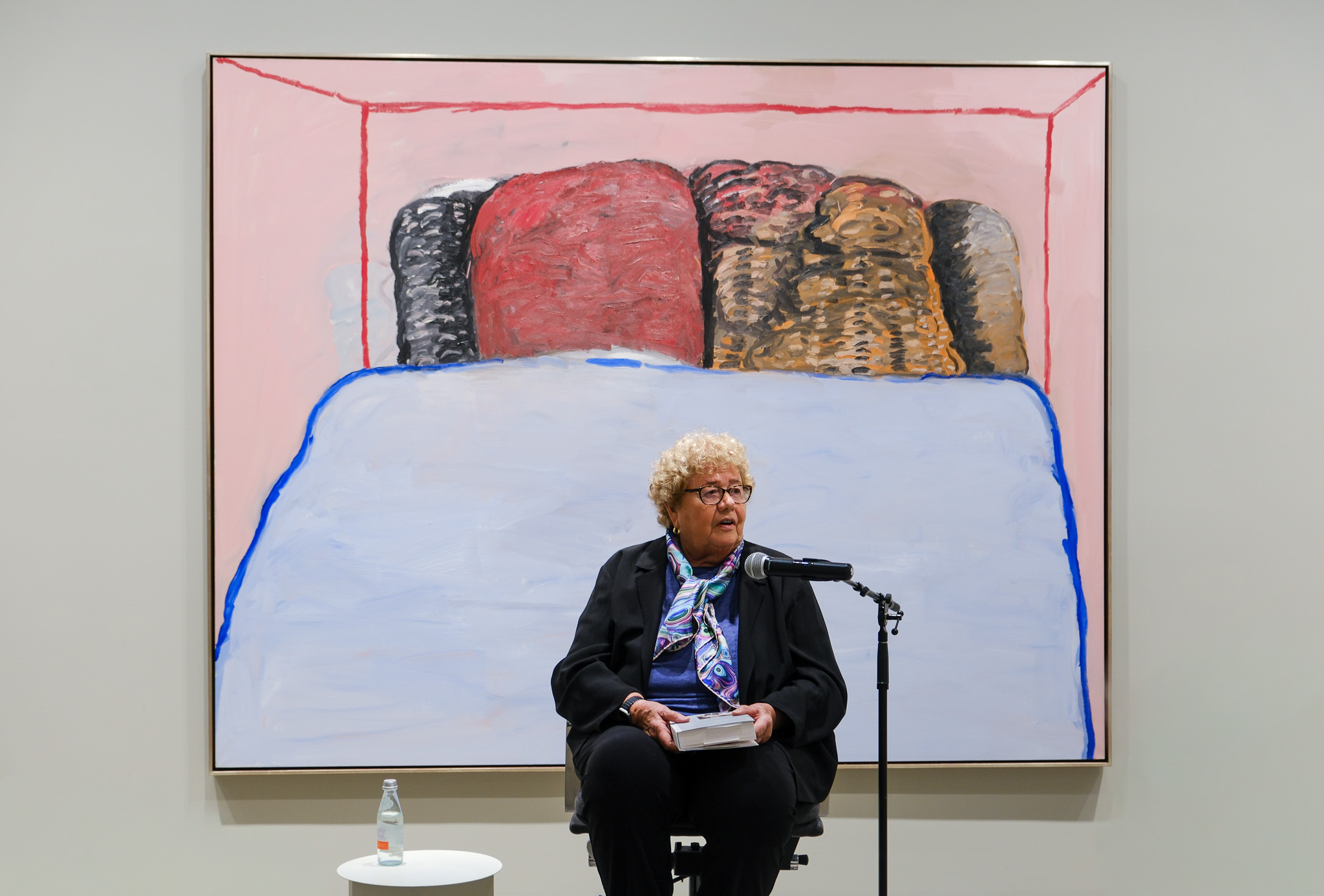 Musa Mayer, the daughter of Philip Guston and Musa McKim, sits below a painting of her parents in bed as she discusses their work at Hauser & Wirth. Photo by Jamie Lubetkin
Life with P is a show that sidesteps the images that have come to dominate his late reputation—the hooded figures—and instead returns to the quieter system of signs he constructed out of books, beds, limbs, cigarettes, and the small rituals of daily life. The effect is less a correction than a rebalancing: Guston before and beyond the controversy, and more important, Guston as an artist whose late work was never only about one set of images.
In 2020, a traveling retrospective of Guston’s work was postponed after concerns that his Ku Klux Klan paintings might be misinterpreted amid a moment of heightened institutional sensitivity. The hesitation exposed a familiar tension: whether images meant as critique could be flattened into endorsement when stripped of context. Guston’s hooded figures—often depicted smoking, driving, painting—were never heroic. They were banal, indictable portraits of ignorance and hate. But in a climate primed for reaction, the nuance was lost on some.
A single hooded figure is included in the Hauser & Wirth show, but it seems anodyne when placed in the context of the other works. This helps to clarify something that the 2020 debate risked obscuring: that the Klan works are but a fraction of a larger, deeply autobiographical project.
By the mid-1960s, Guston had stepped away from abstraction—after decades as a central figure in the New York School—and began rebuilding his imagery from the ground up. He had been there at the beginning: included in the legendary Ninth Street Show, a founding moment for postwar American painting, and present in the pages of the avant-garde journal It Is, where artists argued out the terms of New York’s emergence as the new center of gravity for modern art. By 1970, when he unveiled his crude, cartoonish figures at Marlborough Gallery, he wasn’t an outsider breaking in. He was a known quantity breaking rank.
The paintings and drawings in Life with P.—many of them part of what Guston called his “pure drawings” of the late 1960s—make that break legible. Lines thin out. Objects sit alone on the page. A shoe, a book, a hand. After he moved to Woodstock, Guston’s vocabulary became basic, then it turned domestic. The studio and the house collapse into each other.
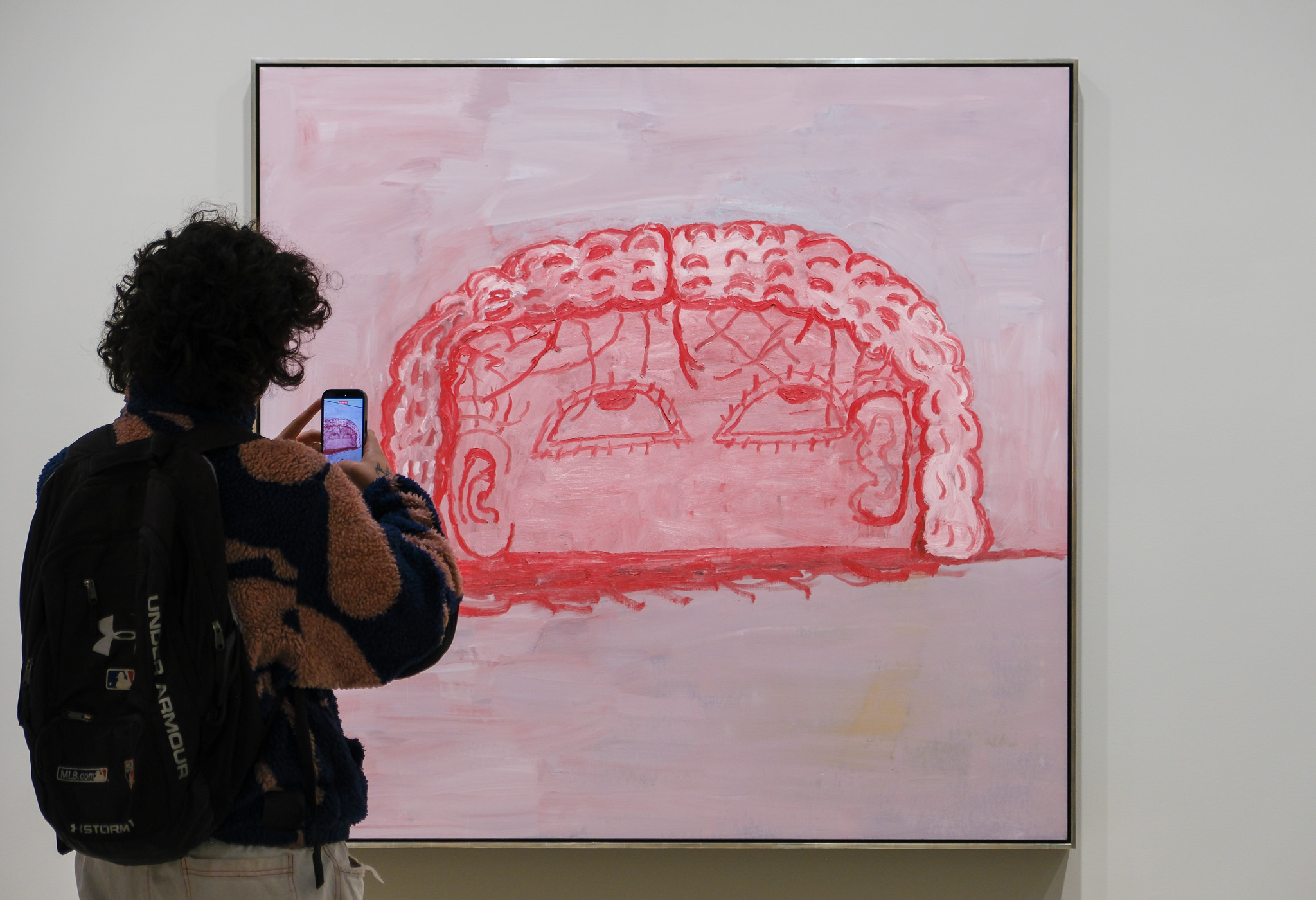 Philip Guston, Untitled, 1976. Photo by Jamie Lubetkin
Untitled (1976) exemplifies Guston’s latter day figuration. The exaggerated hair—rendered as a dense, looping mass—becomes a kind of emblem, a stand-in for McKim. The eyes tilt upward, not toward anything visible but toward thought, or the absence of it. The body is not there because what matters is the head and the act of looking, or not looking. It’s a painting about proximity without contact, about the strange distance that can exist inside a shared space.
Two Hearts, by contrast, suggests the most intimate of physical contact, but denied of emotional toil or sentimentality. The forms are not symmetrical and, like lovers, they are of a piece, but individuals. They lean, buckle, and come close to surrender. Guston paints them with the same material weight he gives to his bricks and shoes. Love, here, is not elevated, it is a struggle, and there are wounds and scars.
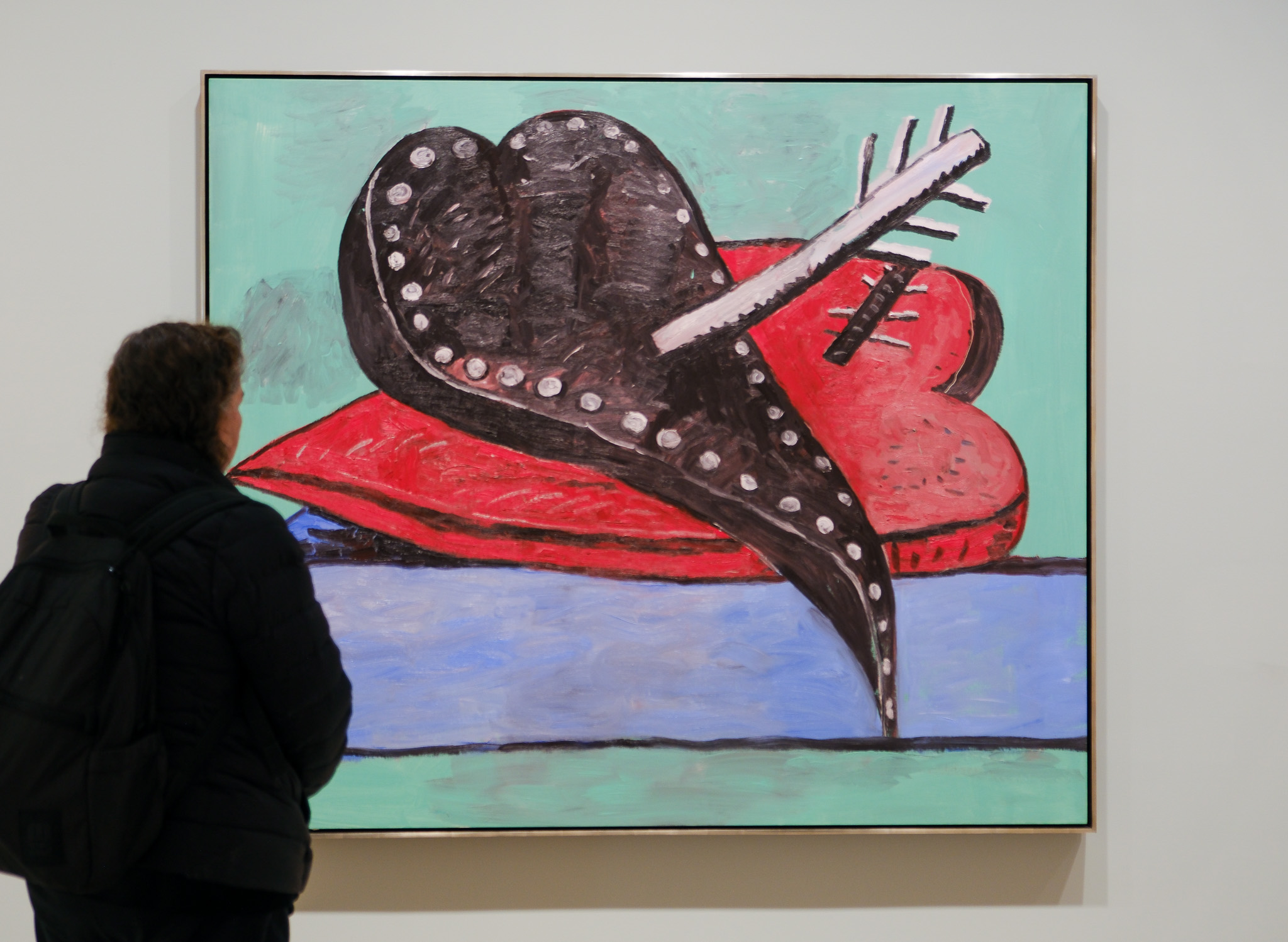 A woman considers Guston’s 1978 work Two Hearts. Photo by Jamie Lubetkin
Underlining the biographical texture of Life with P. was the presence at the press opening of Mayer, who discussed the period that yielded her father’s assembled works and her mother’s journal entries.
“These are very personal works for the most part,” she said, seated before Blue Cover, a 1977 monumental representation of her mother and father lying side-by-side in a bed covered by a blue blanket. “To me, this is one of the most coherent exhibitions that we've done of my father's work because it is so inward looking,” she said.
“What I'm hoping to bring to the Guston legacy, of both Musa and Philip, both of my parents, is an intimate picture of what it was like to live and work alongside Philip Guston, and it was not always easy,” she said, adding that her mother’s newly published journals cover a period during which the couple separated because of Guston’s relationship with another woman. “It was a particularly difficult time for my mother, as you can imagine, since her whole life was really life with P. And she struggled,” she said.
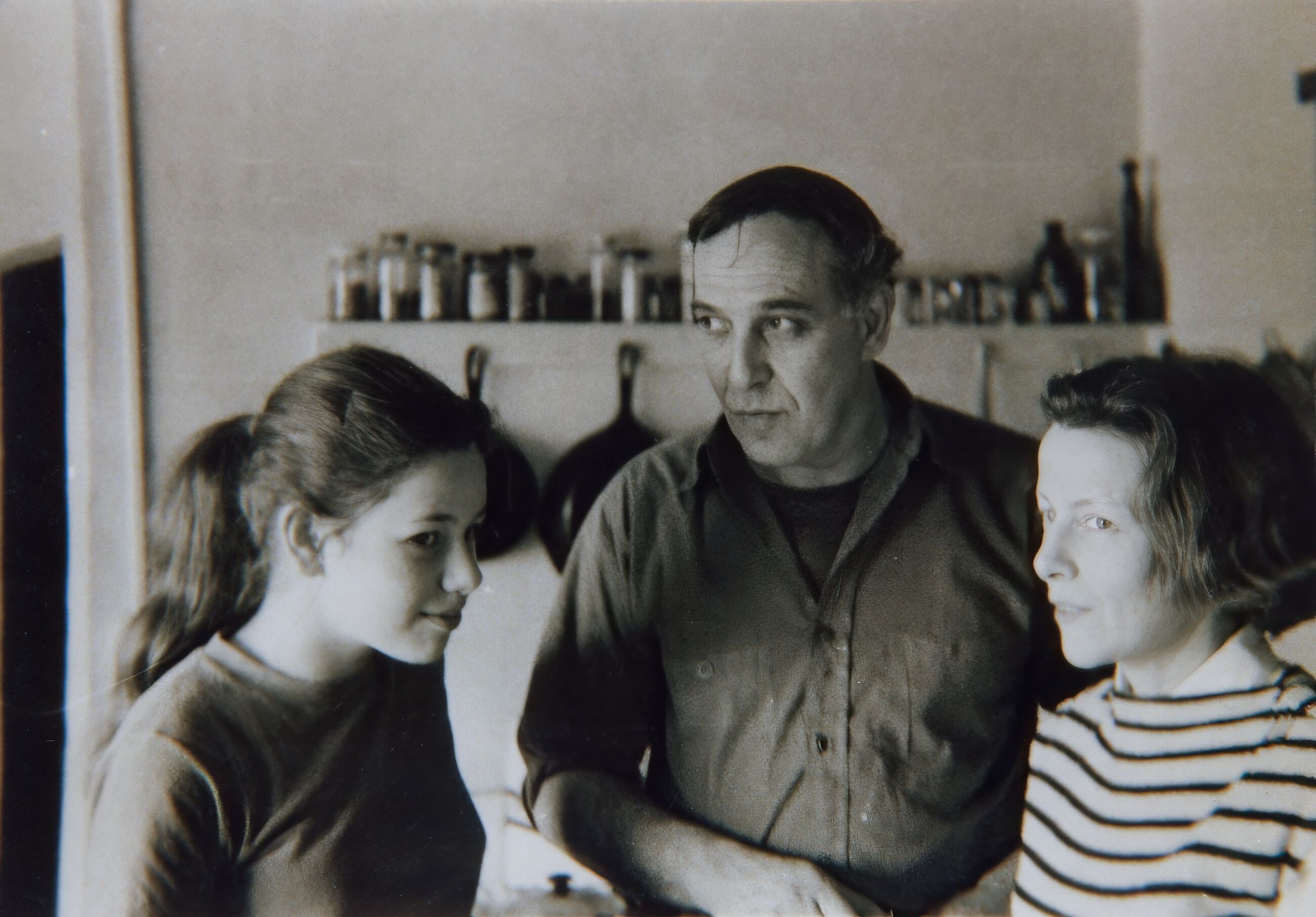 The Gustons in the kitchen, Woodstock, 1956. Courtesy of The Estate of Philip Guston Archives Photo by Sam Hunter
The risk with Guston has always been reduction: first to abstraction, then to figuration, then to the Klan paintings. Each phase gets treated as a rupture that cancels the others. This exhibition quietly suggests continuity, rather than consistency. The same artist who helped establish New York as the center of the postwar art world—through the New York School, the Ninth Street Show, the early debates that defined abstraction—also spent the last decade of his life finding inspiration in his own kitchen, his own bed, his own fears.
The Klan paintings don’t disappear in this context. They recede just enough to be seen as one part of a larger system: figures of power rendered ridiculous, yet uncomfortably familiar. If the hooded figures are about public violence and historical guilt, the hearts, heads, and beds are about what remains when the door closes.
Guston once wrote that there was nothing left to do but paint his life—his “dreams, surroundings, predicament, desperation, Musa—love, need.” This sounds like a man who had already helped redraw the map of modern art, turning back to the objects within arm’s reach, and finding that they were enough.
Life with P runs through July 10 at Hauser and Wirth, 443 W 18th St., New York.

Scott Orr
Scott Orr is a career writer, editor and a recovering political journalist. He is publisher of the East Village art magazine B Scene Zine. He can be reached via @bscenezine, bscenezine.com, or bscenezine@gmail.com.
view all articles from this author