Whitehot Magazine
October 2026
"The Best Art In The World"
"The Best Art In The World"
October 2026
Pots and Paintings: An Interview with Jake Clark
By SARA CEMIN April 24th, 2026
In light of his upcoming show at Adam Cohen’s A Hug From the Art World in Chelsea, I had the chance to meet Jake Clark in his Brooklyn studio. Jake moved to New York City four years ago, after working between LA and his native Australia. Like totems, relics from iconic destinations — the Brasserie Lipp, the Ritz, or Raoul’s — I was welcomed by his large pots, popping with color, lined up along the walls. One corner was dedicated to a menagerie of delightful creatures of varying sizes, holding balloons and other whimsical accessories. They seemed to cheer any newcomer in. Even more intriguing, however, were the two-dimensional characters figuring in a room separate from all the ceramics: the series of canvases he would be exhibiting for the first time this coming week…
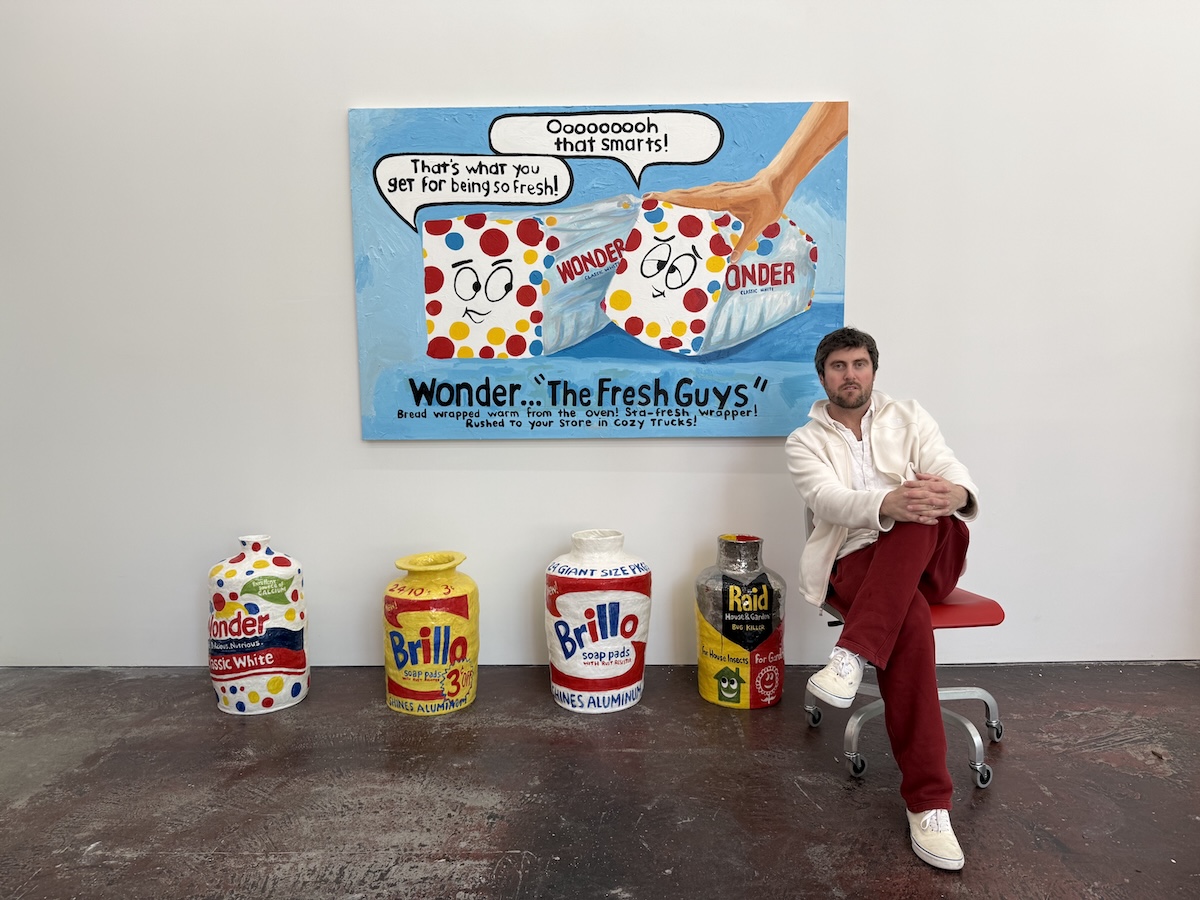 Portrait of Jake Clark, courtesy of A Hug From the Art World
Until now, you’ve been showing exclusively ceramic works and this is the first time you’re exhibiting large-scale paintings. Walk me through your process, what inspired you for this show?
Even though I’ve worked on ceramic, I call myself a painter more than a sculptor, because the majority of my work is actually painting. In this show, I wanted to go deeper and into more detail on the original idea that’s been inspiring my work. I'm really obsessed with American iconography: commercials, billboards, anything advertising-wise from the 50s and 60s. I remember going through many magazines and watching commercials from that time and wanting to make this the subject of my next show. For instance, I found these images of these Brillo soap pads, like [the character] Prudence Pots who’s feeding her cats and who kind of looks like a Flintstone character. I just found the iconography so playful and fascinating. I wanted to play around with those images and bring them back to life on a personal and much larger scale.
I see that each pot corresponds to a painting, referencing the same brand in question — is this deliberate?
Yes, each painting corresponds to a pot, they play off each other. I wanted to give the paintings as much texture as possible, so they could be in dialogue with the pots, which is why I used a combination of oil and acrylic, so I could get that thickness. I even added some sculptural elements to some of the paintings. I want them to look hand made; I don't want them to look like straight, flat images. It’s the same thing with my pots: you can see all my fingerprints — they're not exactly perfect, which I don't want them to be. I had people tell me they could get me factory-made pots but I'm like, no way, that's the whole thing about the actual work, is that they have my imprint in them. I like that you can see the brushstrokes and the little cracks and crevices. If it were sleek and perfect, it would dumb the whole thing down.
You call them pots rather than vases — is that an important distinction for you?
Well, I guess they’re vessels, but I call them pots. I never call them vases because I feel like a vase is something that you put flowers in and I don't really like that. The works aren't made for that. Some people do — I've got one lady in LA who sends me photos of spring flowers every month, but that's not really why I made them. They're sculptural and I like them on their own rather than have flowers come out of them.
So, it’s a bit the same way the ancient Greeks didn't put flowers in their vases.
That's how I thought about it originally. These works, and the works I've previously done, they’re kind of like that. At the time, the Greeks were painting on vessels to tell the story of that day and age, and I see my works as doing the same thing, as being our stamp of time. If you were to see these 100 years from now, people would see what we were up to in our day and age. The Greeks would tell a whole story in one vase but I spread that story out over ten pieces. That's how I like to envision it.
How do you work in the studio — do you have a set process or do you move between things?
I'm a bit ADD which is why I really like working with ceramics because it allows me to work with my hands and do various tasks. Once I’m done with making the shape, I can work on the painting, and once I’m done with that I can work on something else. I like to bounce around in the studio on different things at different stages, but I usually try to make the pots in one sitting. It's about how the clay flows that day. And I carry that forward with the painting, they're meant to look like how I paint my pots.
When you started making art, did you start painting on canvas or were you always working with ceramics?
I was always just painting and drawing from whenever I can remember. I didn't really like painting on canvas because it didn't excite me as much. I’ve always liked working with my hands. I took a ceramics class in high school and I remember it being very therapeutic. We would have the music on and I would go into my own little world. I never went to art school. After high school, I started my own landscaping business, but on the side I was always painting. Once I had people working for me, I would just go on and paint and make ceramics. I was friends with some artists in NYC and they told me they wanted to show my work in a group show. At the time, the pots were very small, the size of cups. It took off from there.
Since you work so much with recognizable brands, have you ever collaborated or wanted to collaborate with the companies themselves?
I haven't really. I have made pieces for some people's restaurants, but the pieces for this show are more of a take on the 1950s aesthetic in general. It’s not really something I would want to do — I feel like it's a bit too commercial. The point isn’t really the brand but the visual landscape that it refers to. America is like an endless pool of visual stimulation. There's just non-stop images wherever you look and if you dive deeper into where these images originated from, it’s just so clever and so much fun. There's also something really nostalgic about it that people can resonate with. Everybody recognizes these images and cartoon characters. I really love that nostalgia.
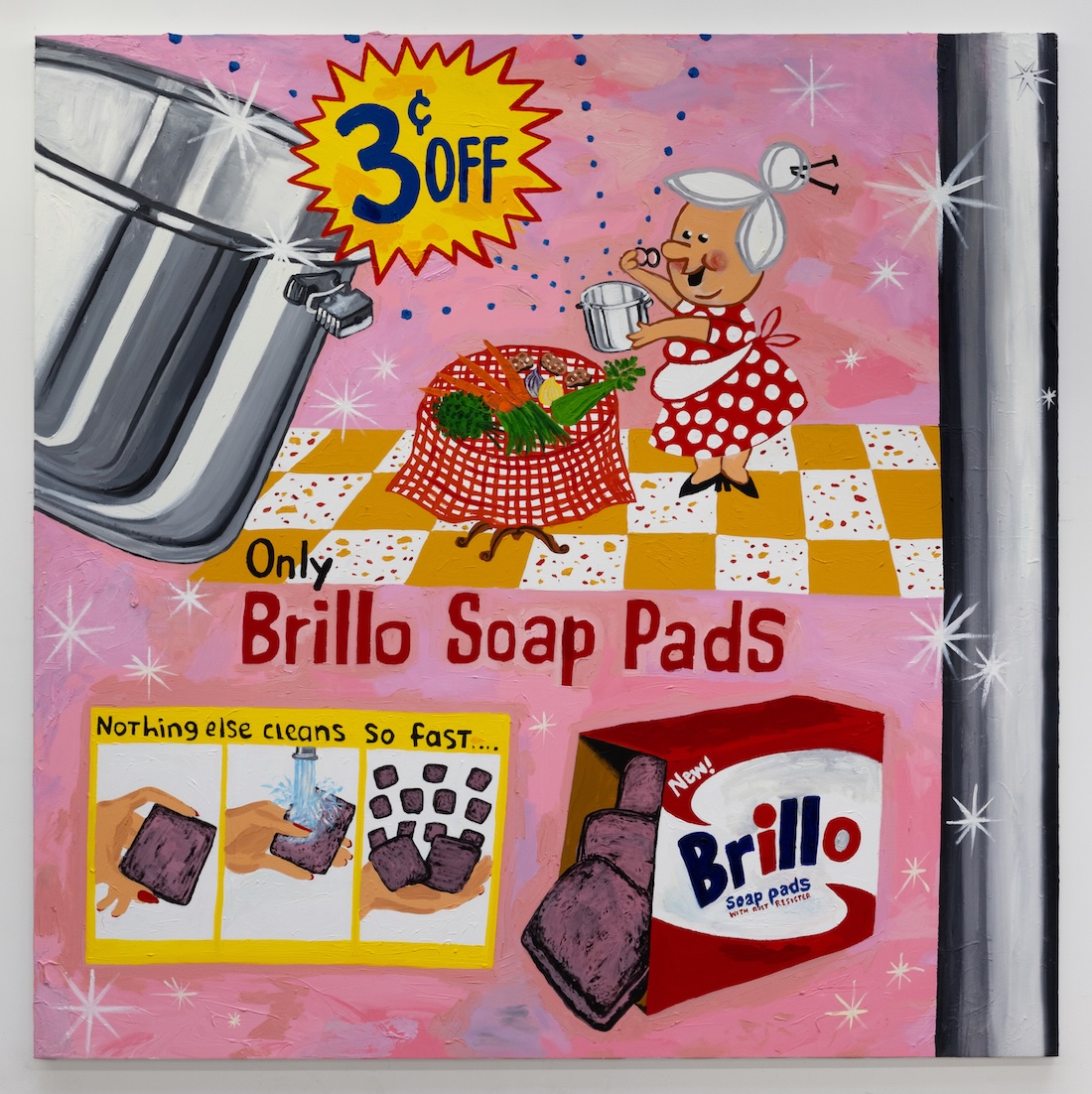
Prudence Pots, oil and acrylic on canvas, 2026 - 72x72 inches (courtesty of the artist)
This aesthetic from the Golden Age of Advertising, do you think it’s something we’ve lost in our cultural landscape, something that you’d like to bring back?
Yeah, it just doesn't exist anymore. The packaging is terrible compared to how it used to be. I wouldn't paint anything from this day and age. That era from the 50s and 60s, that was completely different, and it’s what I'm trying to capture. There are still some places like that C.O. Bigelow pharmacy on 6th Ave: when you go in there, it's like stepping into the past. I love places like that, where you can still get that vintage feel. Growing up in Australia, it was very bare with design. The colors, branding, cartoons — Australia never had that style. There are still some places here that have followed through with that aesthetic, but it’s still not really the same.
So you never felt inspired by Australia?
Never. In terms of branding, it’s just not the same. There's something about American advertising that captures the whole world, and if I were to do Australian pieces, no one would recognize it. There’s something really universal about American iconography, and that’s what I like to capture, the way it taps into our collective unconscious.
What was it like working on canvas rather than ceramics, is it something you’d like to keep doing?
I always feel the need to challenge myself and try something new. The canvas has been a nice break from making ceramics, but I did feel a difference. I work quite fast usually and oil has slowed me down a bit. It also challenged the way I perceive the work. On canvas the proportions look so different. The pots feel more forgiving, because if I mess it up, I can just rub it off. I also know when they are finished because once they’re glazed and in the kiln, they’re done. You can’t go back. With the paintings, it's hard to know when they’re finished because you can keep adding layers forever. It was a great experience to start painting on canvas, especially for the purpose of this show. Generally, though, I don’t see myself changing the subject of my work, like making portraits for example.
You say you wouldn't make portraits, but in a way you kind of are — just not of people, but of these characters, icons and this era.
Yeah, I see that. I think it’s more visible in the series I did previously with the Bemelmans’ characters for the Rockefeller Commission for the Art Production Fund. Even though there's no specific "brand" iconography in it, these characters are so iconic and people relate to them immediately. It brings it back to that nostalgia everyone can connect with. Basically, I’m paying homage to all these places and characters. I feel like they're worthy of being immortalized. It may mean something different to you depending on how old you are, but they are still unified as a concept in our minds, at least in a general sense.
Pots and Paintings runs April 23 - June 6, 2026 at A Hug From the Art World, 112 10th Ave, New York NY.

Sara Cemin
Sara Cemin is a writer based in New York. She holds an MA in English Literature and History from the University of Edinburgh, where she also directed several plays. After working in film production, she now manages the studio of sculptor Saint Clair Cemin and publishes a Substack newsletter which explores storytelling across film and literature and features some short fiction. Her work in literature, performance, and visual art informs a critical practice attentive to the intersections of aesthetics, history, and cultural context.
view all articles from this author