Whitehot Magazine
October 2026
"The Best Art In The World"
"The Best Art In The World"
October 2026
Interview with Artist Cooper Cox
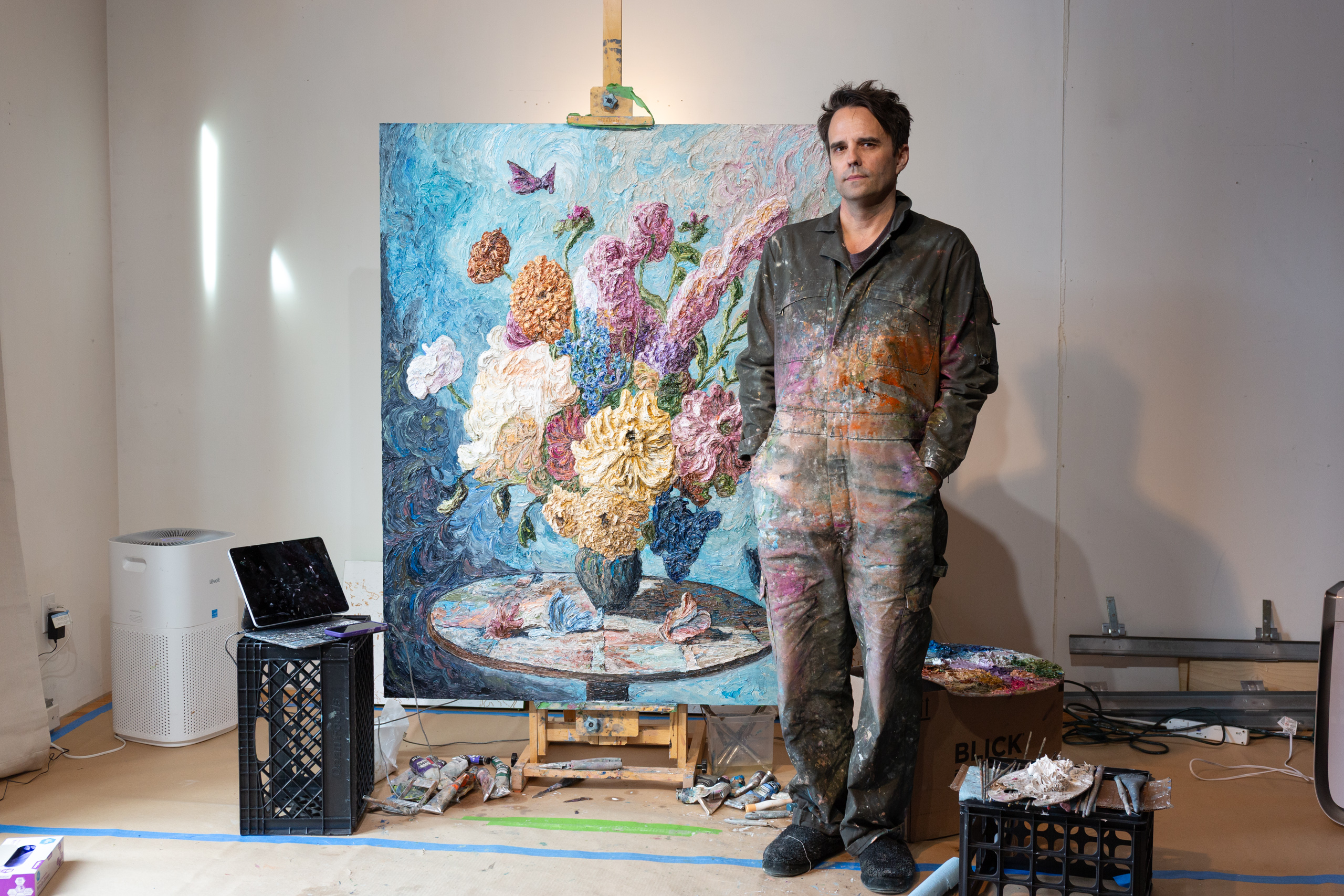 Cooper Cox upstairs in OCHI Idaho (2026). Image courtesy of the artist and OCHI. Photo by Callum Stearns.
By MARCARSON February 27th, 2026
Your work feels like it exists between control and chaos. Are you orchestrating the mess — or negotiating with it?
I start with a structure, but I don’t try to dominate what happens inside it. I set conditions where things can misbehave. So I’m not orchestrating the mess as much as listening to it and making decisions in response.
I think of it largely as building a container for uncertainty. I establish a framework, then allow instability to enter. The work happens in the exchange between intention and what the painting insists on becoming.
When a collector acquires one of your pieces, what are they really taking home: an image, a mood, or a psychological experiment disguised as art?
Hopefully they’re taking home a state of feeling more than a single image. The painting keeps changing depending on who’s looking at it and when. If there’s an experiment involved, it’s a quiet one about how perception, memory, and emotion keep rewriting the same surface.
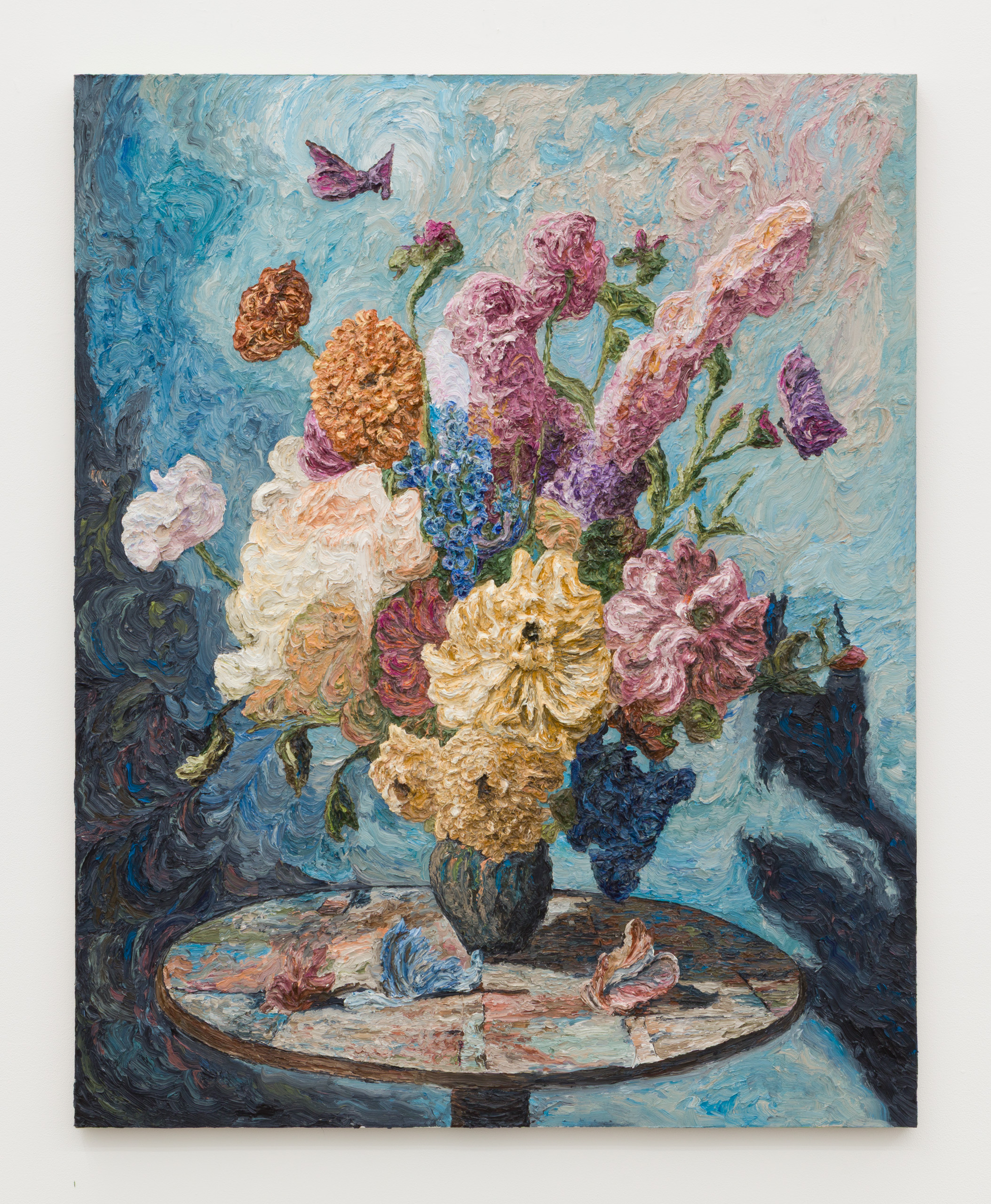 Cooper Cox, Threshold, 2026, 60 x 48in
Has your relationship to risk changed as your career has progressed? Are you more reckless now — or more strategic about where the explosions happen?
I’m less interested in being reckless for its own sake now. The risk hasn’t disappeared, it's just become more precise. I think more carefully about where I allow things to break open. In the landscapes from my latest body of work, for example, I kept structure and tighter brush strokes in the physical and geologic forms and allowed the skies and clouds to flow freely and morph in a manner that was both riskier and more reckless.
Do you think collectors are drawn more to the surface impact of your work, or to the slower burn that happens after living with it for months?
I think the surface and its sculptural elements are the invitation, but the slower burn is the reason people stay. Ideally, the work offers both an immediate charge and a long, unfolding relationship.
If one of your paintings could subtly alter the energy of a room, what would it do — calm it, destabilize it, or quietly dominate it?
I think the paintings offer a subtle power, perhaps a presence that doesn’t announce itself but gradually takes hold. Ideally, the painting becomes a kind of atmospheric center, quietly shaping how the room feels and how time moves inside it.
What’s the most uncomfortable reaction someone has had to your work — and did that feel like a success?
I’ve seen people tear up without quite knowing why. Not in a dramatic way, but in a private, contained way. That kind of vulnerability feels significant to me. If a painting opens something that wasn’t accessible before, I consider that a success.
There’s often tension in your compositions. Is that tension aesthetic, personal, or a reflection of the broader cultural moment?
I don’t separate those things very cleanly. The tension starts as personal, but it inevitably absorbs what’s happening culturally. Aesthetic tension is just how it becomes visible.
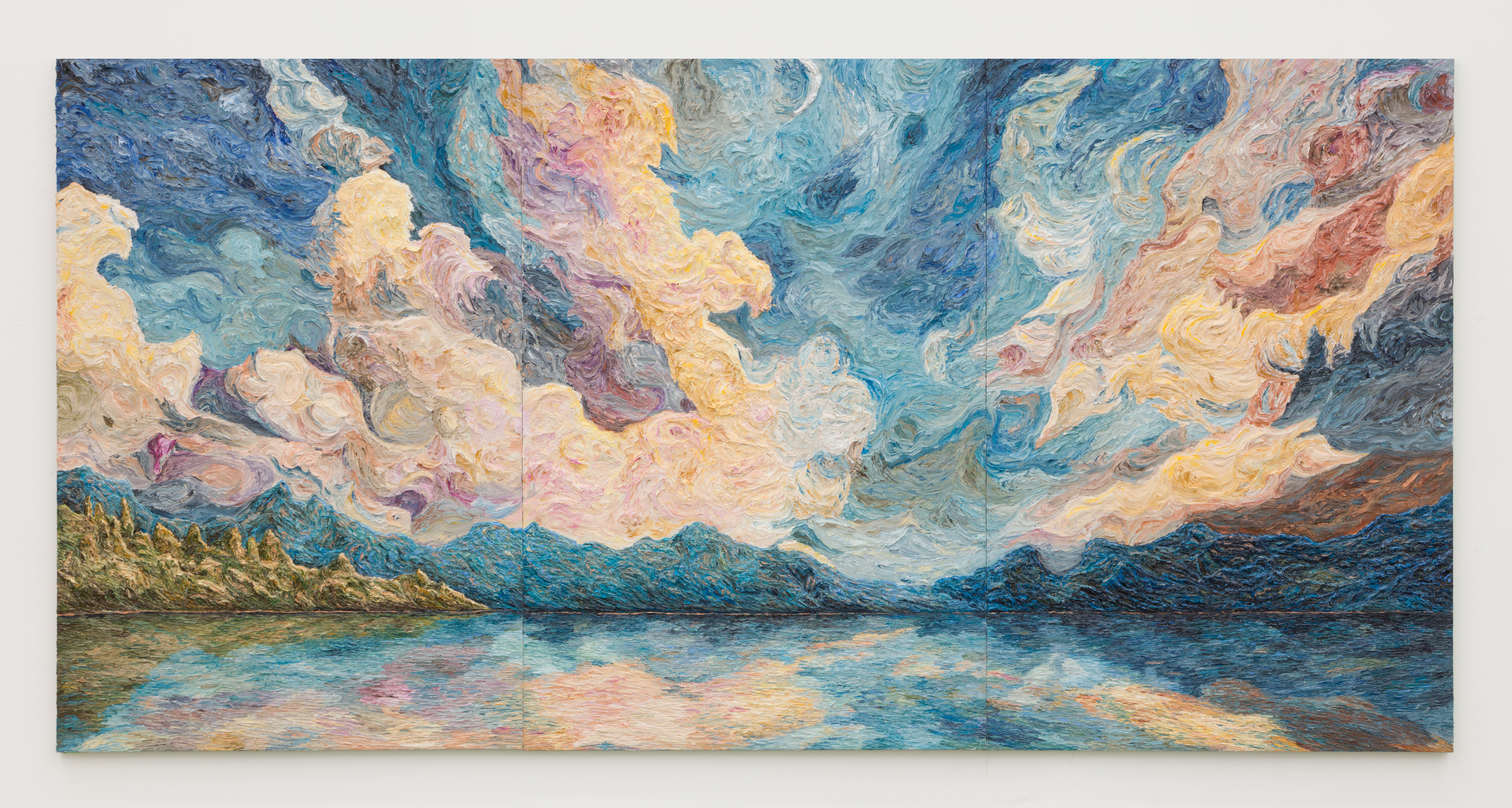 Cooper Cox, The View From Upstairs, Triptych, 2026, 72 x 144in
If you had to remove one element from your practice entirely — color, scale, subject, or texture — which loss would hurt the most?
Texture would be the hardest to give up. It’s how I begin my paintings, and it carries time, pressure, revision—all the evidence of decision-making. Without it, the work would feel mute to me.
For collectors thinking long-term, how do you see your work evolving over the next five years — refinement, expansion, or total mutation?
I’m committed to continuity, not repetition. The work will become more specific and distilled but also more ambitious. I will continue to retain my personal style, brushstroke, and likely also my preferred color palette. I don’t envision a total mutation so much as a continuous evolution.
When you imagine your ideal collector, is it someone who understands your references immediately — or someone who feels slightly unsettled and can’t quite explain why?
I’m more interested in the latter. I don’t mind if someone recognizes references, but I care much more about a visceral or emotional response than an immediate intellectual one. If the work creates a small sense of unease—something they can’t quite name but keep returning to—that feels like the right kind of connection.

Marcarson
Marcarson is the owner of NOT FOR THEM, an art house/concept gallery in New York City.
view all articles from this author