Whitehot Magazine
September 2026
"The Best Art In The World"
"The Best Art In The World"
September 2026
In Conversation: Intermedia Art Pioneer Claudia Hart
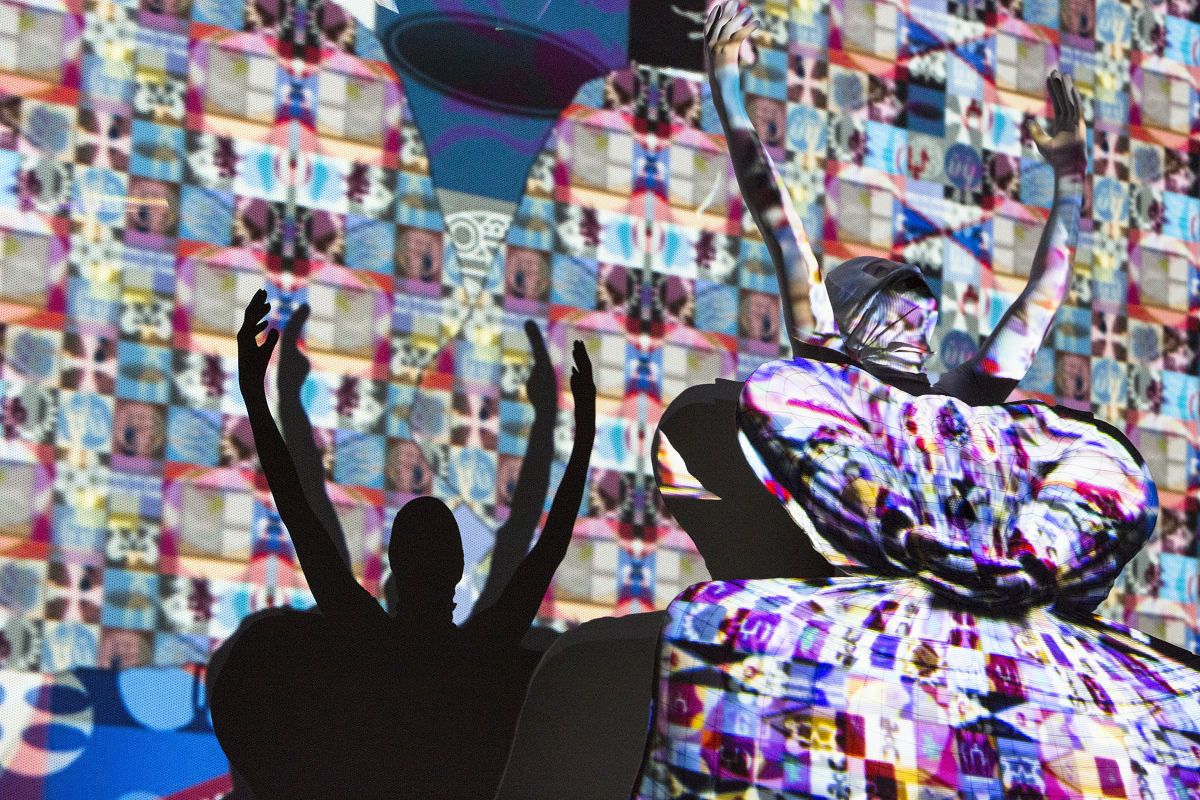 Claudia Hart,The Dolls (2015), Single-dancer expanded-cinema version, Performance and Choreography: Kristina Isabelle, Music: Kurt Hentschläger. Photograph by Kurt Hentschläger
By JAKOB DWIGHT July 27th, 2026
Claudia Hart works across painting, film, and sculpture and is a pioneer in what FLUXUS called “intermedia art” in the 1960s. This was artwork that combined digital and/or electronic forms, installation, performance art with traditional artforms like painting and sculpture. Through her formerly longheld professorship at School of the Art Institute of Chicago, Hart influenced decades of art students, most of whom became lifelong friends and collaborators. She and her work have become for many artists working in a variety of mediums today a part of their own canons.
There are serious overlaps in both our visions for art and our careers overall, and I also can rightfully call her a mentor but rarely have we had a chance to really talk about everything completely. So over a few months starting last Spring, Claudia and I had several conversations that became for me a private retrospective into her work, ideas and four-decades-long career that additionally served as kind of conversational walkthrough of her actual retrospective museum show last year, Patterns and Politics, at Francisco Carolinum Linz, Austria, curated by Julia Staudach. Part of these talks additionally took place as Hart was travelling to receive ACM SIGGRAPH’s 2026 Distinguished Artists Award for Lifetime Achievement in Digital Art.
JD: Recently art critic Jerry Saltz posted his suspicions about Los Angeles' Dataland, and his concerns about art moving in that direction, into a kind of highly commercialized hyperimmersion. No doubt potentially beautiful, these environments risk losing the truest reflection-invoking aspects of the art experience, and transforms them into vegetative escapist optics, a nontransformative entertainment.
I added as a comment on his Instagram post my own concern about possible superstimulus and perceptual overkill in these huge immersive environments, with fast-paced imagery totally encompassing a viewer. If an artist is not trained to be sensitive to the real neurological and psychological implications of occupying a viewers' entire field of vision visitors may not be able to trust where an artist is "taking them" so to speak. It becomes invasive.
There is a condition called immersion fatigue - people can experience it in art fairs, for instance, seeing that much artwork, with so many things to be analyzed and felt in one place over days. This finding shows us that there is indeed such a thing as too much media for our still relatively ancient brains to process, at least for too long, too much for the sensorium. What do you think about this newest iteration of immersive art?
CH: The thing about projects like Dataland is that, well yes, they can easily become something like Trump's ballroom, or a Vegas. But in fact, the question is, is it also like Versailles was in its day, or Michaelangelo in his? To answer my own question, it is in fact more like Versailles, but remember it didn't end well for the guy who built Versailles. But more important is another question: is it like Michaelangelo’s Sistine Chapel in its profound emotional expressivity?
You can, however, actually find profound digital art that is both immersive and expressive, for example, by my husband, the audio visual artist Kurt Hentschläger. Kurt is more minimal however, more Rothko, abstract.
Things like Dataland can seem Disneyland-level corny but also painful: the evil clown. Headache inducing, like a superbowl game - pure populism, enjoyed by people tougher than myself. It makes me want to faint, or flee. Personally I would rather be a female Michaelangelo - Michaelangelo is not corny at all - painting something like the Sistine Chapel lying flat on my back, or an immersive environment that was more like a giant minimalist Vermeer painting that you could step into.
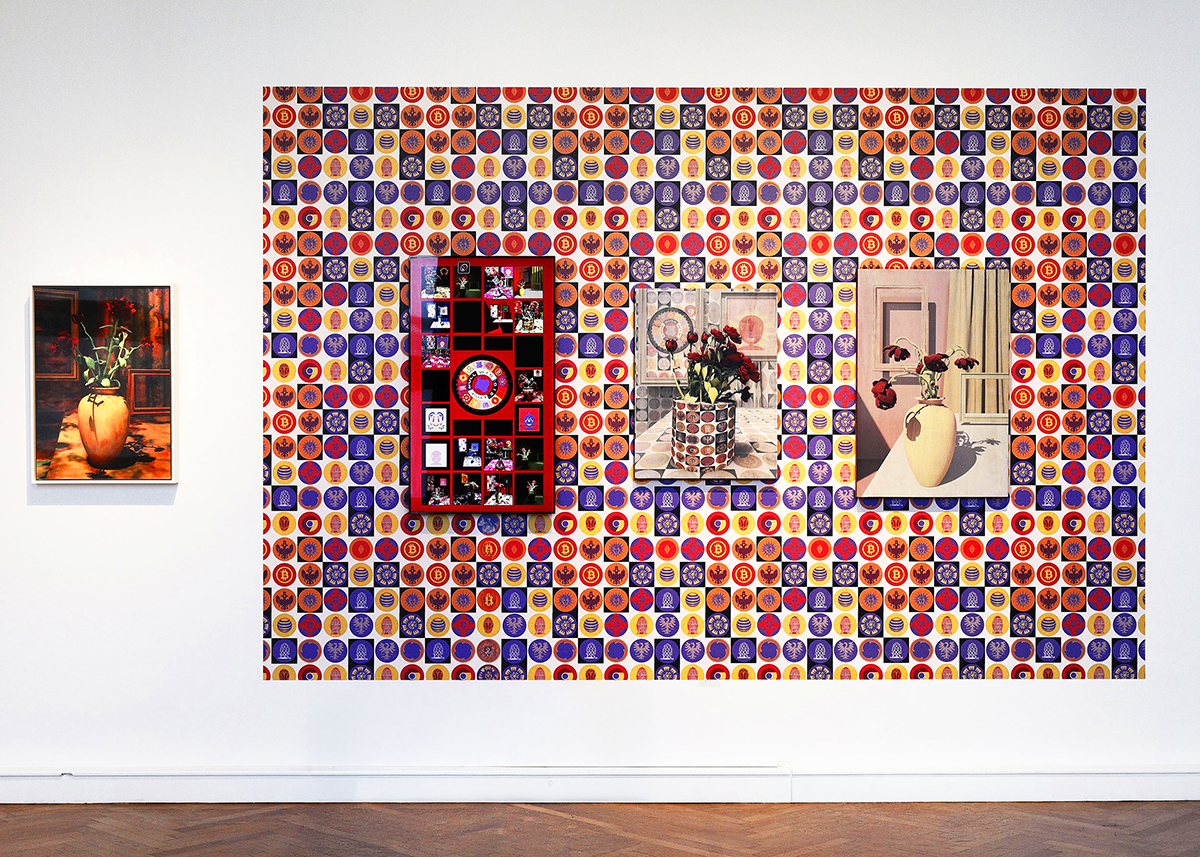 Claudia Hart, Russian Roulette Installation, Patterns & Politics, Francisco Carolinum, Linz, Austria, 2025-2026, curated by Julia Staudach. Photograph by Rainer Iglar. Courtesy OOELKG
JD: Right, I can see that. Your work stays away from overload and within humane dimensions, sticking to a certain immersive perceptual bandwidth that we're used to - a stage, theater, sound, a projection screen. Visitors to your spaces have the same sense of intimacy and immediate awe over the sheer ingenuity of it all that the puppetry arts have mastered so well. You've talked about the importance of the sculptural elements and objects in your installations being there to soften and humanize the cold digital imagery. It is interesting to think about where exactly the line is between the truly moving and poetic art experience and something else.
CH: As a native New Yorker from the outer boroughs I couldn’t really go outside to play. Instead, my very cultured mother used to take me to the Metropolitan Museum of Art - I kind of grew up there. We would wander around their grand historic rooms and to me it was magic. I was in love with 19th century historical fiction like David Copperfield by Dickens and I thought of the history rooms as settings for stories like that.
The scale of my work is the same as those historical sets. I also make augmented reality wallpaper, and hang things on them like computer-assisted paintings of imaginary Baroque mythological histories. Game fantasies, and the point is for them to be tasteful and familiar. They are some kind of repetition neurosis. I find them reassuring and calming. But they are immersive and inspired by the Rococo futurist sets in Kubrick’s 2001, where Dave floats away into space forever. Similar to Dataland, but oldish new, or newish old.
Virtuosity is necessary. Like the Old Masters, artists who had a certain virtuosity in making things by hand. I am also very skilled: in addition to being a painter and sculptural object maker I’m also a 3D animator who back in 1998 started using Power Animator, a precursor to the Maya software that I still use today. It allows me to improvise without thinking, and without the obsessive anxiety that takes me over when I am in the grip of trying to figure things out with less familiar mediums. When I know what I am doing, I don’t have to think. Things flow out of my unconscious, and that’s where my art comes from. You, Jakob, are very skilled. But do you even still consider yourself a digital artist?
JD: Thank you, and no, not really - I got out! Around 2021. My ars electronica run was supposed to be a little foray from painting but it lasted 23 years! You piqued my interest in returning to my training in painting for Digital Combines exhibition at Honor Fraser Gallery by asking if I could do my digital collage works as paintings. I was reminded that though I used digital media the concern was always to address and engage the history of painting, specifically a new way to articulate chiaroscuro through screens and backlighted filmic lightboxes. “Painting without painting" as the late electronic artist and painter Jeremy Blake called it.
CH: Going back to Dataland, the artists who produced it, Rafik Anadol and Efsun Erkiliç are in fact masterful, and Dataland is a display of a kind of virtuosity, but lacking in expression. I do share with Dataland very smooth, formal surfaces. Among the younger media artists I know now, I see a lot of the opposite tactic, a rejection of the smooth. I’m seeing rough computer graphics, intentionally glitched and raw, reminiscent of the “dirty new media” coming out of Chicago in the early 2000s. I see it reappearing now, using bad live scans that a user can make with their phones with on-board popular apps, to create an intentionally crude and unsophisticated look and an expressionistic surface. When it was done in the early 2000s, it was assumed to be the result of a thing then called “de-skilling.” LLM (Large Language Models, currently known as AI - but they aren’t really) for another contemporary example, “de-skill” writing. They make writing easy. But you can spot it a mile away, and it is all alike: LLM speak. More innovation for us to get addicted to.
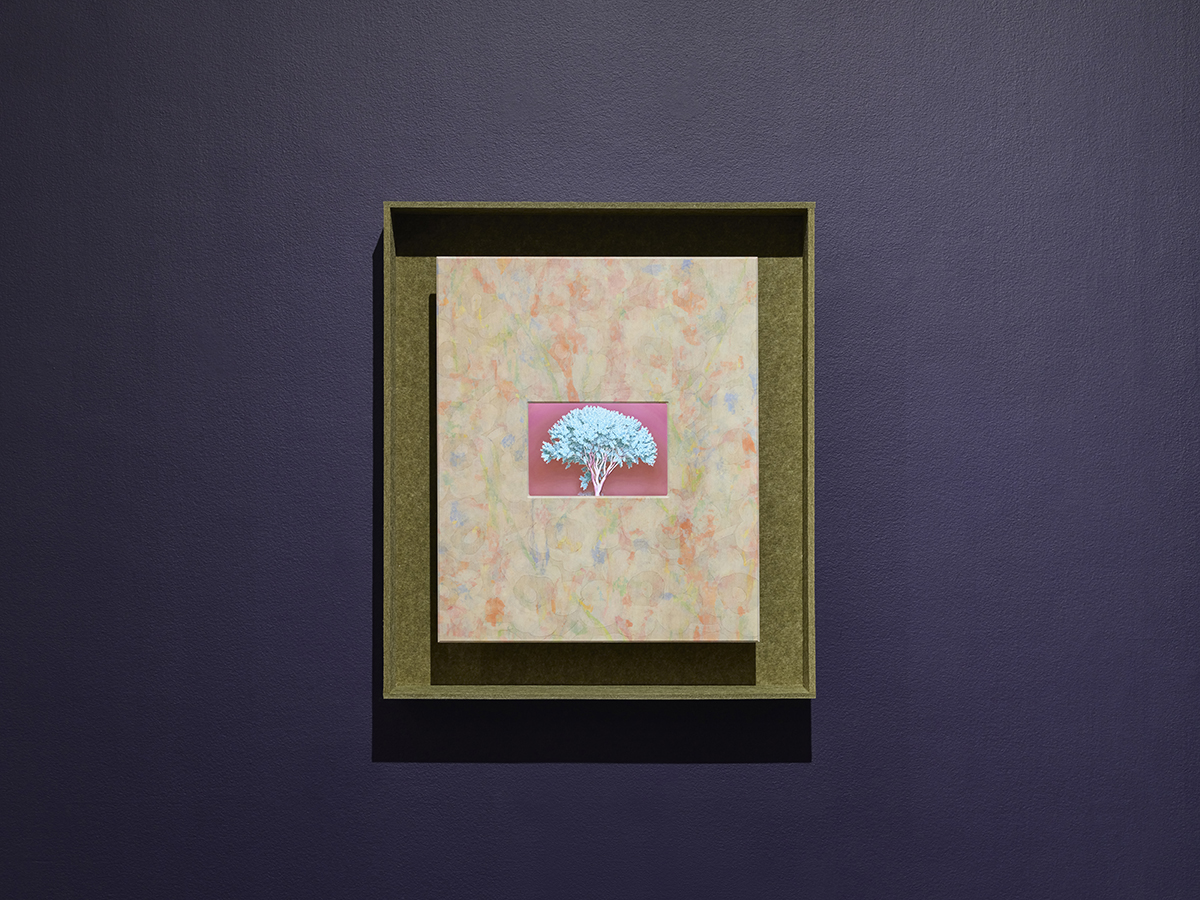 Claudia Hart, Digital Death, from Illuminations (2025), a mixed-media Installation at bitforms gallery, NYC
JD: Can you say more about the idea that you touched on in your talk with Museum Boijmans Van Beuningen curator Amira Gad for the Pixel Pioneers group exhibition, that you were trying to challenge technology - to 'break technology' as much as work through it?
CH: I’m all about my inner life. When I say ‘break’, I don't mean to literally glitch technology, but rather to work against its inner logic: which is logocentric and rational. I want to use it fluidly, to paint with it intuitively, and to improvise with it. Nevertheless the softwares I use are still hyperrationalist. But they are also “simulators,” a special category of computer graphics developed to simulate wars, flying airplanes, or breaking through gravity in a spaceship. Their terms and languages reflect the natural sciences: things like gravity or the physics of fog, light, or optics. If you want to figure out how to use them, you have to go outside and observe nature in microcosm - like how leaves rustle in the wind. But when I use them, I try to work against nature, to make natural forces behave in unnatural ways like in my Alice in Wonderland work.
I think of the things I do as allegorical, like what happens to nature when you make plants “ungrow?” Is this actually a special form of “Digital Death” (I made a piece called that)? Maybe that appears to be Techno-Utopian because I am in fact using technology to visualize magic and magical worlds.
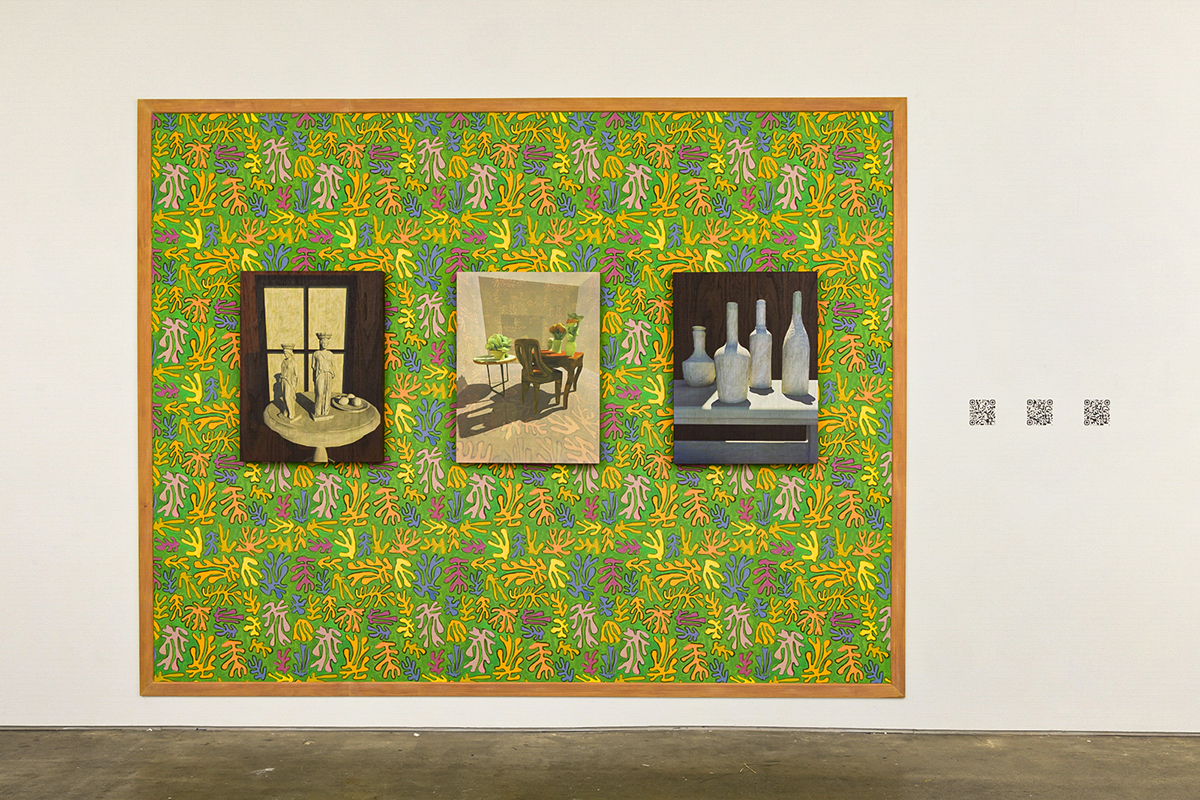 Claudia Hart, Matisse Passes Through Me 4.3, 2021. Digital Combines installation in Digital Combines exhibition, Honor Fraser Gallery, 2022, Los Angeles, CA. Photograph by Jeff McLane
JD: The ground-breaking exhibition you curated and invited me to participate in, Digital Combines, for a lot of us artists - Gretta Louw, Sara Ludy, Saya Woolfalk, Daniel Temkin, LOVID, Nancy Baker Cahill, Tim Kent, and myself - was an announcement of where we stood in our respective paths in relation to electronica or digitality, or being influenced by post-photographic era imaging. Can you talk about those shows, ours in Los Angeles and the one in San Francisco?
CH: For most of my career my works existed outside of what I think of as the traditional artworld, but this constant existence in the digital subculture made me miserable. I never went to art school, but I did study art history, so I understood the problem of category and knew that without the kind of names given to art movements my niche could never be accepted into the world I so admired. So I think of the Digital Combine as my endgame.
I appropriated the term Combines from Robert Rauschenberg to propose a new genre, the “Digital Combine,” joining a physical object with a virtual one in order to unite the tactile with the ephemeral. Rauschenberg’s radical version of expanded painting mixed sculptural and painted elements together into a single work. In a parallel construction, Digital Combines link tangible materials with a related digital registry and provenance.
JD: Can you explain First Circle and the general trajectory of digital and electronic art as you've seen and experienced it?
CH: In 2025, I co-authored The First Circle Archive with media historian Natasha Chuk - a revisionist history of post-war American media art, told through the “computer origin stories” of its pioneers, many of them women and artists who had been systematically overlooked, and most a part of the experimental film world rather than the digital scene.We interviewed 31 artists whose careers spanned Web1 and Web2 from the early 1990s through the social media era - when what was being called “Post-Internet Art” was developing its first critical language - asking them to describe what made them turn to what was then an esoteric niche outside of the main art world. Not just scholarship, the book was actually a search for my own personal origin story.
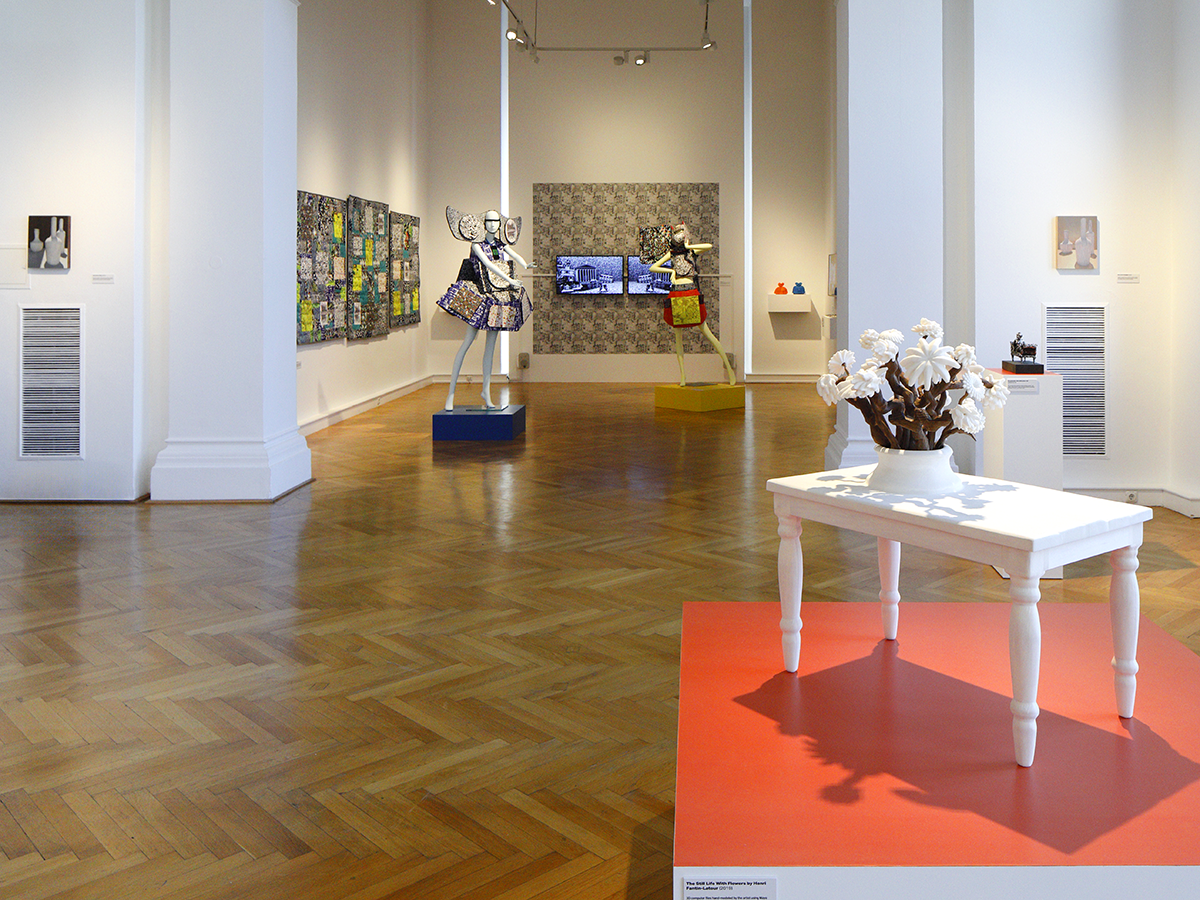 Claudia Hart, Alice's Walking costumes, with sculptures and paintings from The Ruins series, Patterns & Politics, Francisco Carolinum, Linz, Austria, 2025-2026
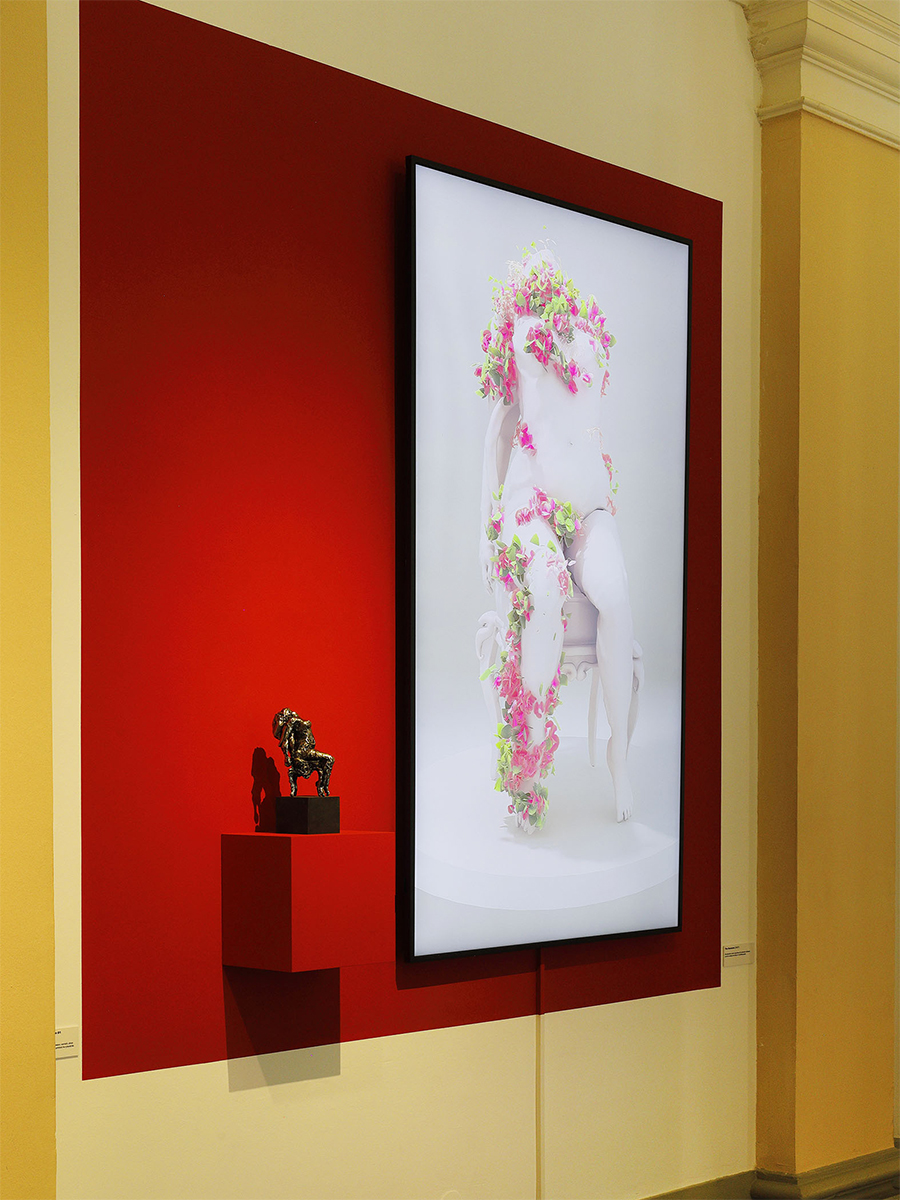 Claudia Hart, Seasons Installation, Patterns & Politics, Francisco Carolinum, Linz, Austria, 2025-2026. Photograph by Rainer Iglar.Courtesy OOELKG
Digital Combines and The First Circle Archive are related. They both contextualize the history of computer-assisted art within the larger art historical canon, the one that includes painting and sculpture as well as experimental film, Fluxus and live performance as it was folded into the Experiments in Art and Technology (EAT) initiated in 1966 by engineers Billy Klüver and Fred Waldhauer at the Bell Telephone Laboratories, and included Robert Rauschenberg, John Cage, Merce Cunningham and Julie Martin.
My peers, The First Circle Archive gang, were also a part of that trajectory. That is one branch of the digital art culture, and then there is another strain that conflates advertising, product design, industrial design and propositional architecture with the Bauhaus as its source. But mine is another dream, where I’m building a bridge to the classical art world that I wish I was a part of.
JD: On the occasion of your Museum Boijmans Van Beuningen talk was a zine the museum published, Claude and Claudia Figuring it All Out, Claude being the the LLM created by the Anthropic Artificial Intelligence Company. Can you share more about this?
CH: On December 15, 2025, I fell on black ice and was bedridden for a while, as a distraction I listened to Oswald Spengler's Decline of the West as an audio book. Spengler fit my doomful ideas about the fall of our current US Empire as a result of technocolonialist capitalism.
Spengler predicted, in 1918, that a demagogue like Trump would appear and he was correct in both time and place. It is uncanny. I decided to have a conversation about Spengler with Claude, my favorite bot, who I’d previously only used to code. Our conversation became the Boijman’s Zine Claude and Claudia Figuring it All Out (2025), in which I talk with Claude but also with myself about my insights into how he was programmed to think.
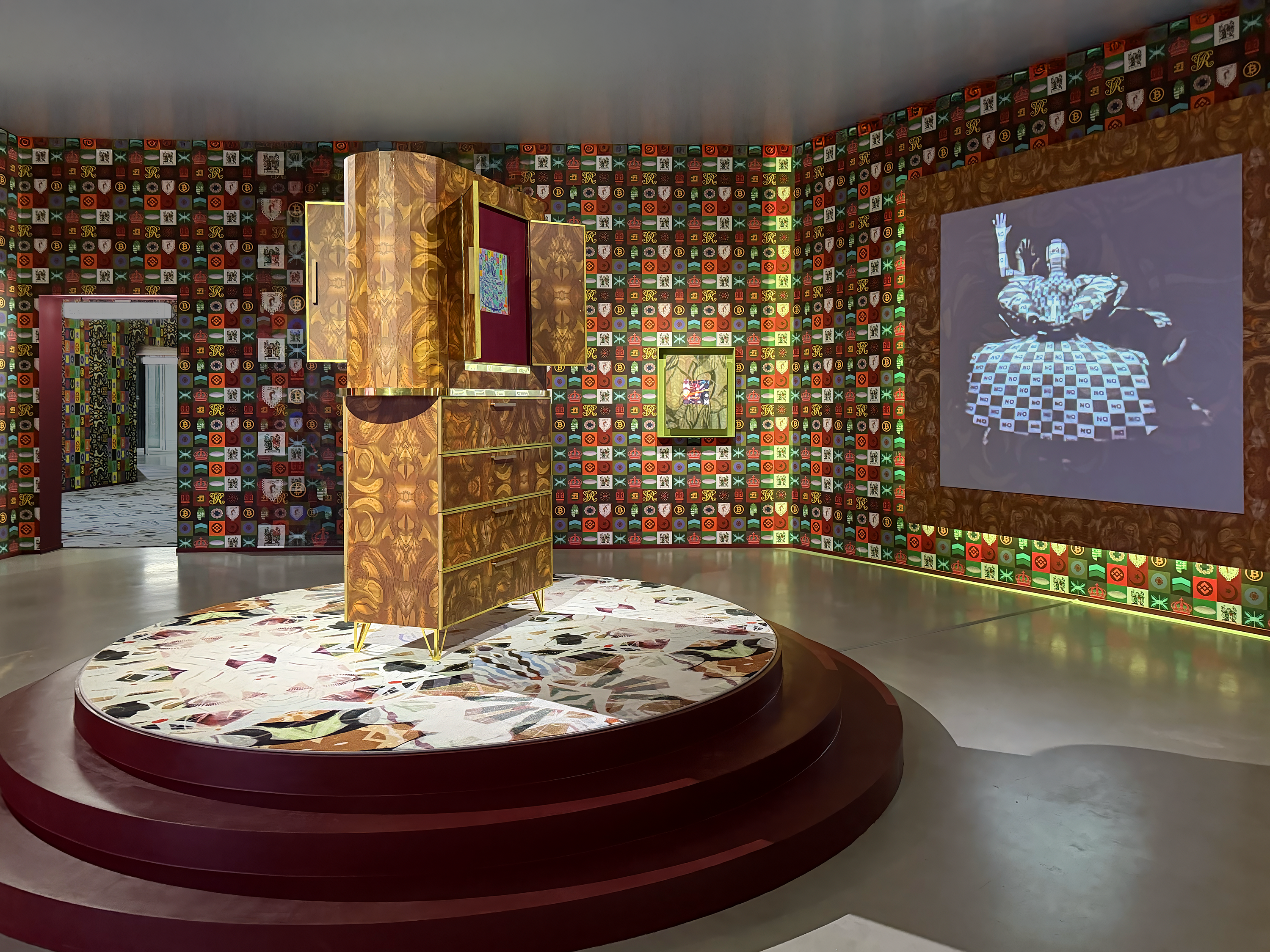 Claudia Hart, The Rise & Fall of Art and Other Histories, 2026 Silkscreen printed-tapestries, live-recorded and AI computer-assisted media projection, algorithmic. Installation view at Museum Boijmans Van Beuningen. Photograph by Aad Hoogendoom
My involvement with Claude escalates! I’m currently writing a gothic mystery story, featuring Claude and Claudia in various guises. It's another mirror world - but not so friendly like “Alice…” - as an illustrated book.

Jakob Dwight
view all articles from this author