Whitehot Magazine
October 2026
"The Best Art In The World"
"The Best Art In The World"
October 2026
Transparency Without Resolution: Zhou Zizheng's Inconceivable at Harvard CAMLab Cave
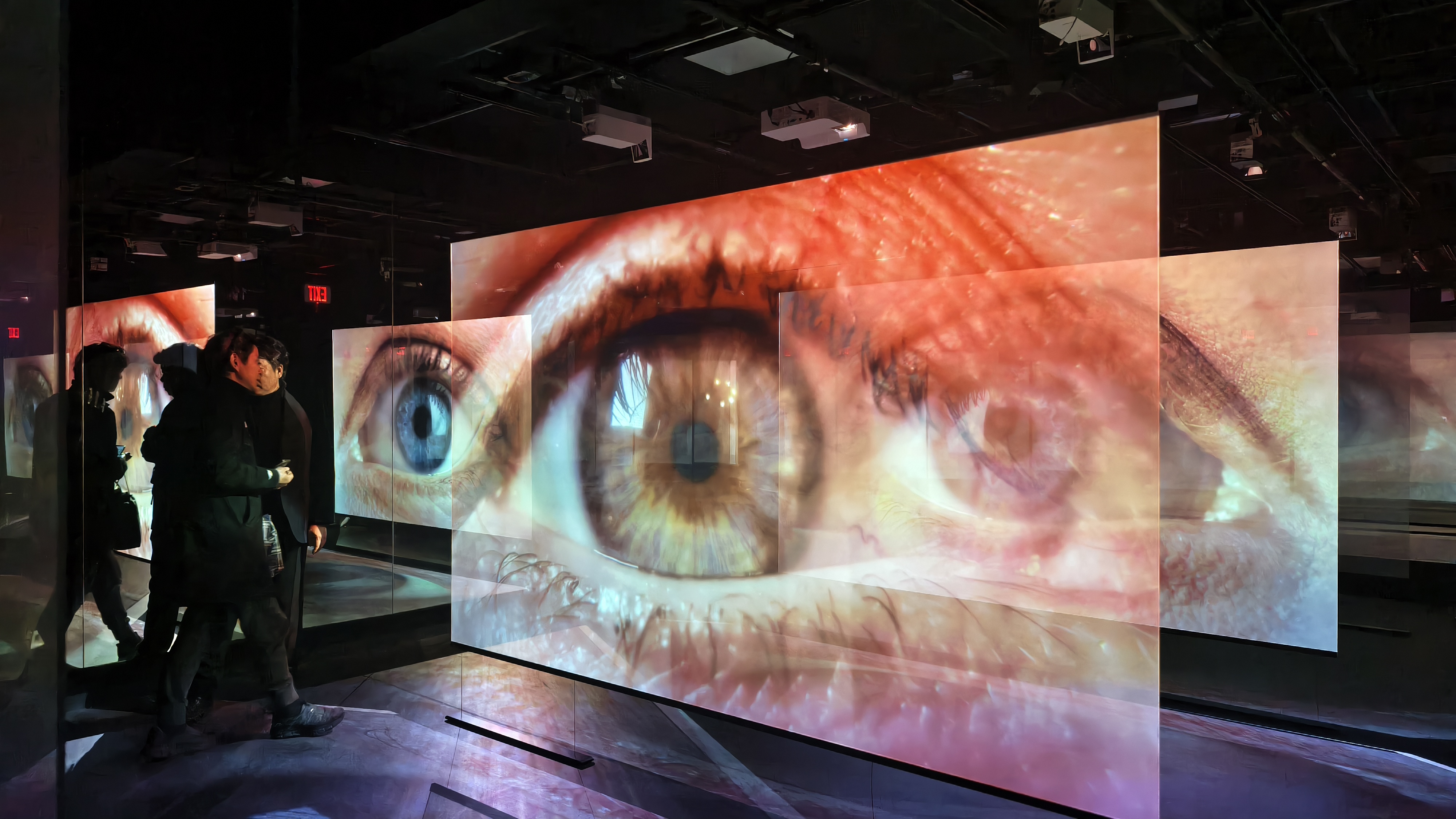 Installation view of Inconceivable. Courtesy of the artist.
By LUMAN JIANG May 2, 2026
A 3D scanner advances toward a glass bottle and returns with nothing usable. The surface transmits light instead of reflecting it back, and the device, designed to map solids, produces instead a spectral form that hovers between presence and dissolution. Zhou Zizheng's Inconceivable, presented as a two-part installation at Harvard's CAMLab Cave, begins here, at the point where machine vision encounters a material it cannot resolve. What follows is not a meditation on technological failure but an inquiry into transparency itself, and into the assumptions embedded in how we understand seeing.
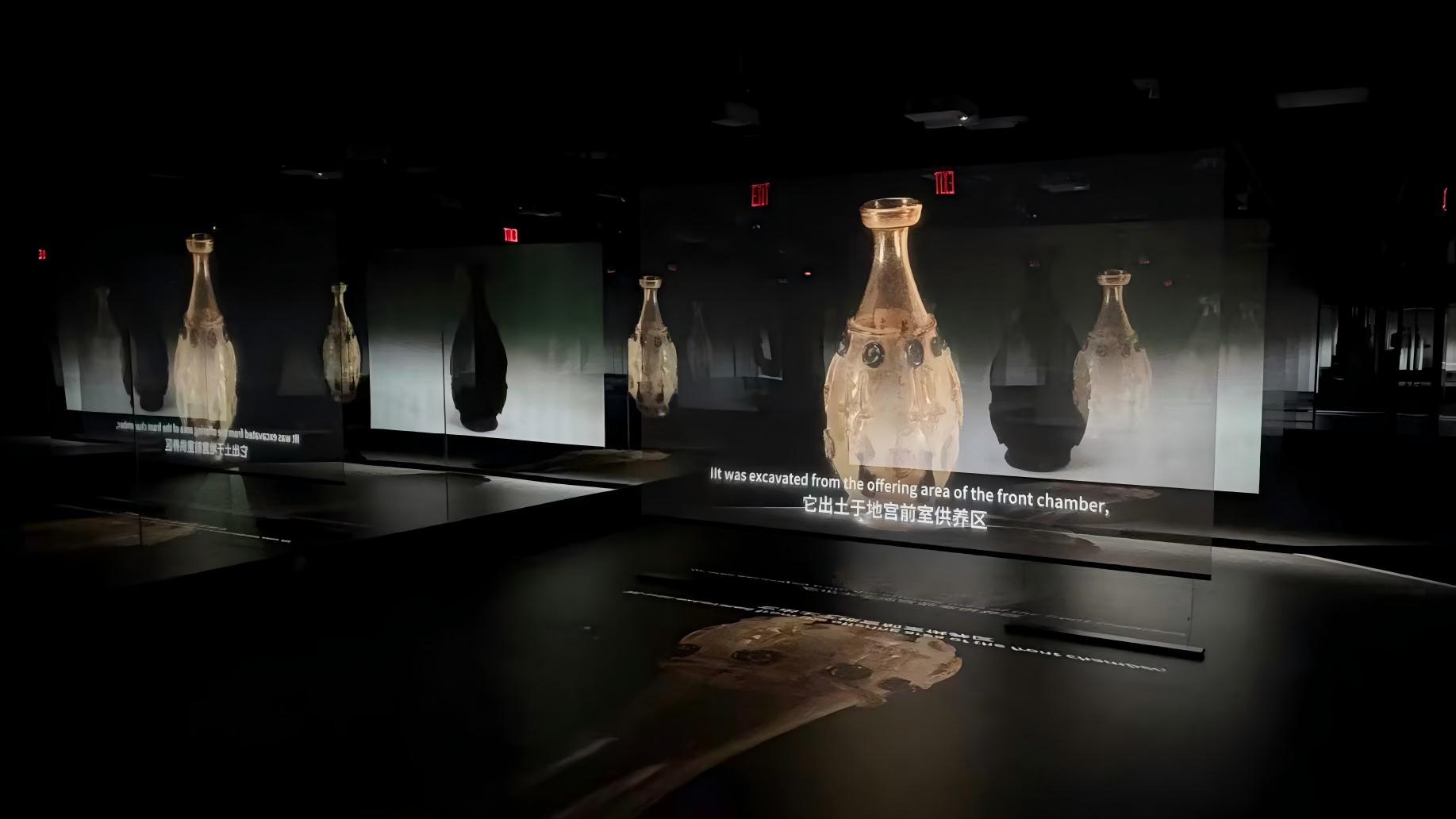
The scanned objects include a Tang dynasty pale yellow glass bottle and a mass-produced Coca-Cola bottle. The scanner treats both identically, which is to say it fails at both equally. Glass, by transmitting and refracting light rather than returning a stable surface, resists the logic of capture on which the device depends. The resulting forms are topographies of misread data in which distinctions of historical value and material origin collapse. A thousand-year-old vessel and a commodity become indistinguishable within the same order of error. Transparency here does not facilitate access. It interrupts the conditions under which vision is organized.
 Installation view of Inconceivable. Courtesy of the artist.
The four-channel video, displayed across transparent screens in the mirrored Infinity Room, extends this interruption into spatial experience. The screens do not establish a fixed image plane but produce a layered field in which the scanned forms and the surrounding space remain simultaneously visible. Reflection, transmission, and duplication destabilize any clear distinction between foreground and background. Colin Rowe and Robert Slutzky's 1963 distinction between "literal" and "phenomenal" transparency proves insufficient here. Both models assume that transparency serves vision, either by allowing sight to pass through material or by structuring spatial depth. Zhou's installation operates outside this framework entirely. The Buddhist Śūraṅgama Sūtra offers a more precise orientation: it compares liuli to placing glass bowls over both eyes. Something covers the eyes, but it does not obstruct. You see clearly, yet you cannot locate the act of seeing. The forms on screen behave accordingly. They are present and absent at once. Transparency suspends the distinction between seeing and not-seeing.
 Installation view of Inconceivable. Courtesy of the artist.
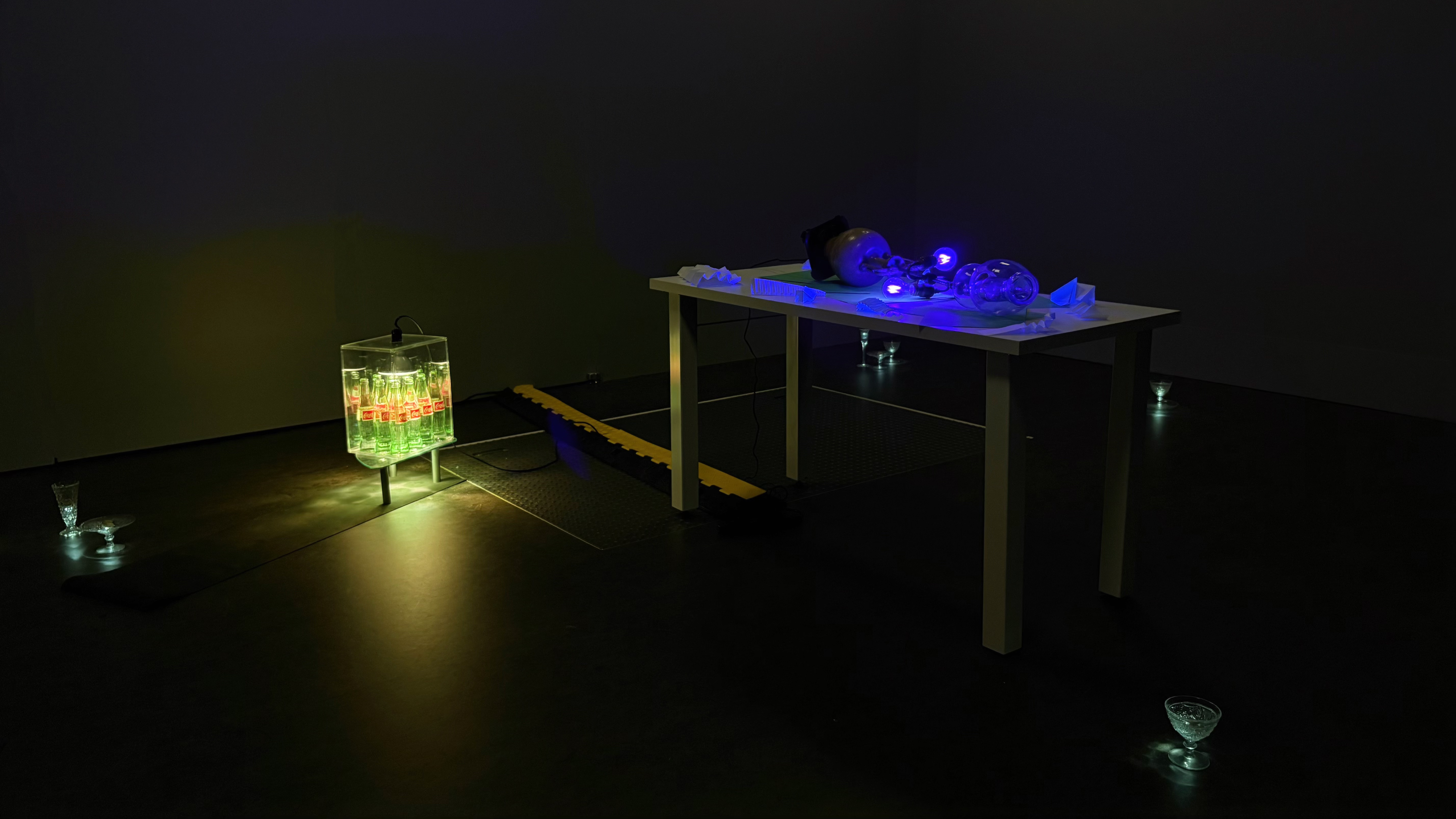
In the adjacent Immersive Theater, the companion installation The Gaze of Transparency shifts the problem from perception to atmosphere. A Tang Straw Glazed Amphora is placed alongside used Coca-Cola bottles and everyday glassware. Under uniform lighting, distinctions between the ancient and the domestic are flattened. Stripped of function, the vessels no longer operate as containers but as mediators of light. Transmission and refraction become shared behaviors, generating a diffuse luminosity that reorganizes the surrounding space. What matters is no longer whether an object can be seen through, but how it structures the field of visibility around it. A vessel from the Tang dynasty and a glass someone drank from last week produce the same atmospheric condition when freed from use and simply allowed to be present.
The two components establish a coherent arc. The video demonstrates the failure of machine vision to resolve transparent material. The installation reorients perception toward the atmospheric effects such material produces. The movement is from the limits of capture to the conditions of encounter. Transparency, in this framework, is neither literal nor phenomenal in the architectural sense, but ontological: a state in which form emerges, dissolves, and reconstitutes without stabilizing into fixed meaning.
The exhibition does not resolve this instability. It sustains it. Perception is displaced, and visibility no longer guarantees knowledge. What Inconceivable proposes is not a new image of transparency, but a redefinition of the conditions under which seeing takes place. WM
Inconceivable by Zhou Zizheng was on view April 3–5, 2026, at CAMLab Cave, 485 Broadway (Lower Level), Cambridge, MA.
Luman Jiang
Luman Jiang is an independent curator and writer based in New York. Her work engages contemporary art, curatorial practice, and cultural theory across Chinese and English.
view all articles from this author