Whitehot Magazine
October 2026
"The Best Art In The World"
"The Best Art In The World"
October 2026
Review: Biennale Gherdëina 10: (Future) Paradise Gardens
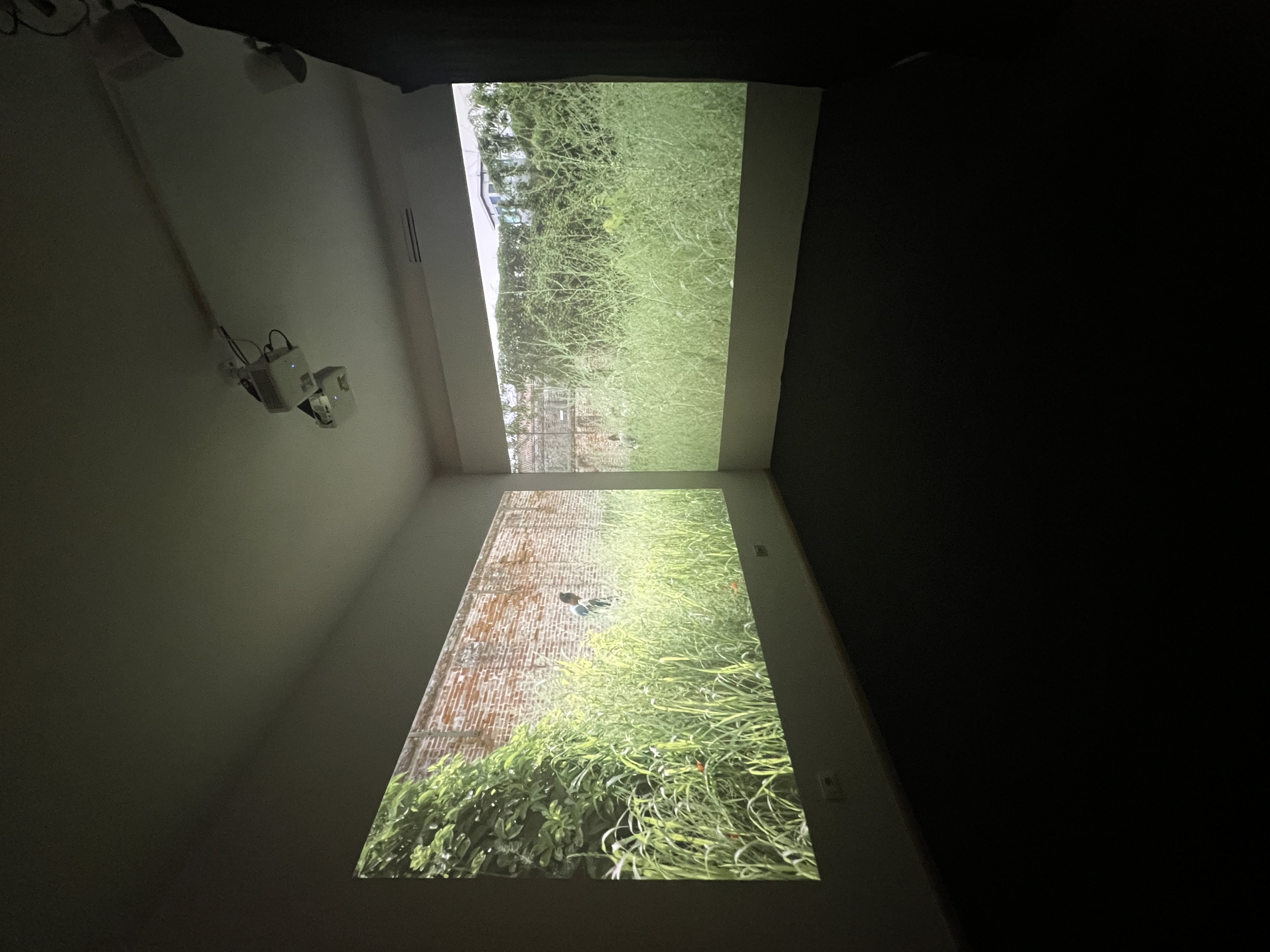 Walter Niedermayr & Marina Ballo Charmet. CASANZA, 2022. 2-channel video, 4K, with sound 35'11"
By HANTIAN ZHANG July 14th, 2026
To reach Pilat, the artist homestead and one of the three sites of Biennale Gherdëina 10: (Future) Paradise Gardens, is to leave the town center of St Ulrich/Ortisei by the river and follow a steep trail into the woods. A thunderstorm had passed through the valley the night before, and another was forecast within hours. Moisture hung in the air so densely that it felt like an extra layer of clothing. Several times I stopped, partly to rest, partly to wipe the fog from my glasses. By the time the forest opened onto the pasture of the homestead, I found myself wondering less about the artworks than about the conditions required to sustain them anywhere.
This concern turned out to recur throughout the biennale. Samuel Leuenberger’s curatorial statement begins with labor that echoes my hike’s: a garden in the mountains, he writes, “cannot merely be decorative,” nor can it “sustain the fantasy of full control.” It is cultivation itself, “a negotiation with circumstance,” that defines the garden carved out of the terrain of the Dolomites. His essay soon moves, though, toward the more aspirational claim that a garden might offer common ground for imagining more just and livable futures. The artworks, however, turn out to be less interested in that vision than in what it takes to sustain any garden at all. Spread across a mountain homestead, an abandoned hotel, a disused tunnel, former social housing, an unrented shop, and a neglected plot, they begin not with the future but with what is already there: buildings left behind, enclosed environments, and the labor of making do. In insisting on making art with whatever is on hand, the biennale reiterates how the actual gardens get made out of its terrain: the thin and fragile layers of soil, short growing season, and erratic, often harsh weather.
Leonardo Bürgi Tenorio’s Homescapes (2025), a series of Wardian-case terrariums, makes this logic visible from the start. Located at the darkened gallery of Sala Trenker, the main congregation of the biennale, these terrariums are filled with tropical vegetation and equipped with misters and iridescent grow lights. At first glance, each appears to be a self-contained miniature ecosystem: carefully arranged plants recreate the vertical layers of a rain forest, monstera leaves shading over ferns sprouting between trunks and rocks. What disrupts this appearance of spontaneous growth is what sits beneath each terrarium: a stack of cardboard shipping crates, the containers used to transport the contents, with postal labels and markings still intact. The boxes are coarse, veined, already used and opened; the stacks they form are rickety, provisional, and openly makeshift. That they bear the weight of glass and living matter is the work’s central statement: the thriving ecosystem above depends on disposable infrastructure below. But the same crates that expose this fragility are also evidence of how it might be mitigated: they are themselves the very materials of recycling and reuse, called to do the unglamorous work of holding something up.
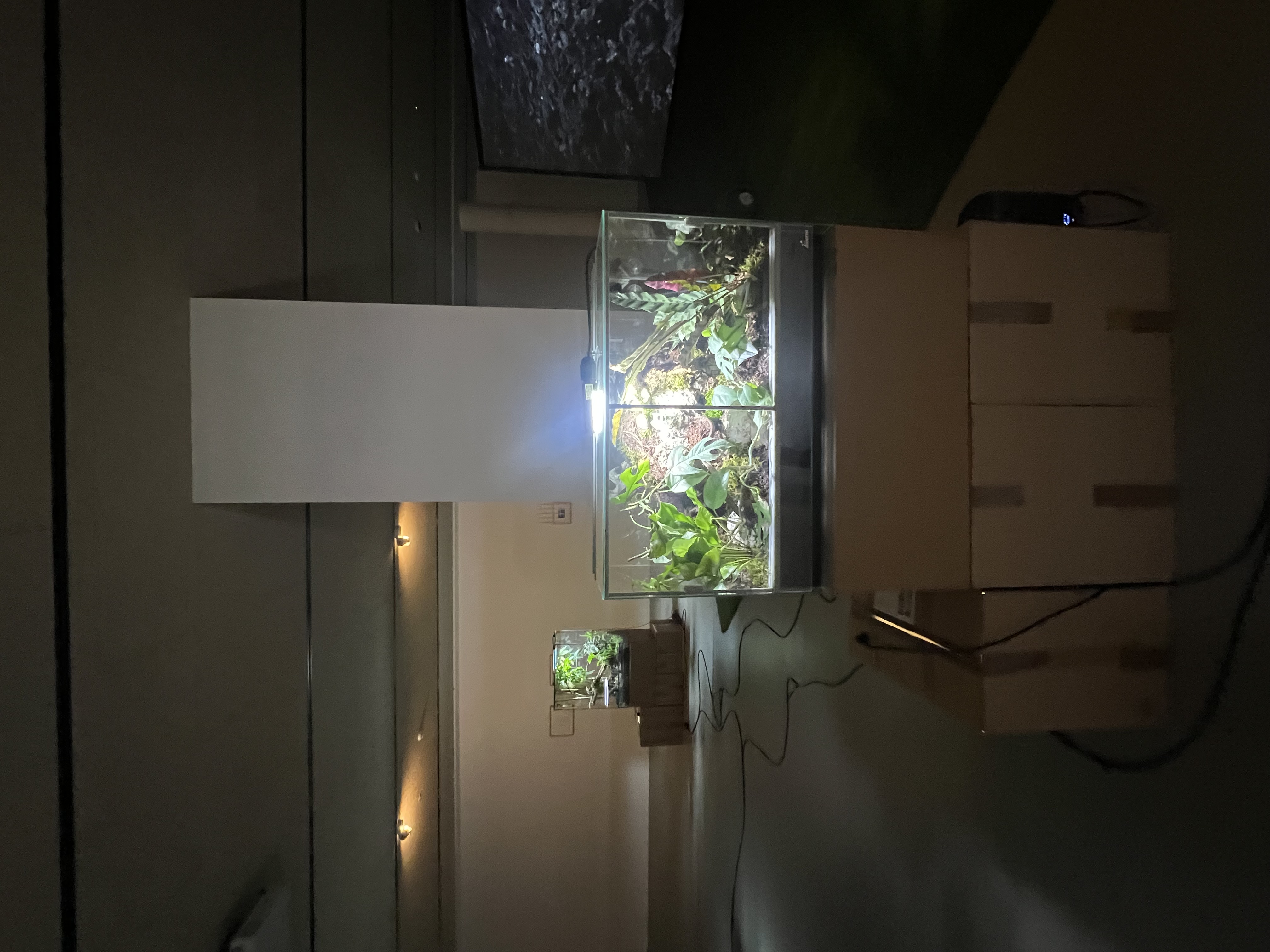 Leonardo Bürgi Tenorio. homescapes, 2025. Terrariums, cardboard boxes, photographs, plants, soil substrates, souvenir mountains, humidifiers, lightning systems, cement, light bulbs. Dimensions variable.
The make-do nature of cultivation is stressed again in the abandoned Hotel Ladina, vacant for more than two decades before being incorporated into the biennale. Father-daughter duo Gregor Prugger and Leonora Prugger respond directly to the building’s condition of decay in Adaptation as Form (2026), taking its deterioration as input. Gregor’s carved limewood sculptures are inserted into the openings and cavities of the former reception area, emerging from the mouth of an old furnace or bursting from the gaps of a radiator, their pale, carved surfaces spilling outward like fungal growth. The visual effects they create are not repair but new life adapted to conditions it didn’t choose, growing through the cracks without completely overturning the decay. Leonora’s interventions work differently: a painted green stem stretches across a blue surface behind the weathered grid of a key rack, its vivid color set against wood browned by decades of usage and exposure. Where Gregor’s carvings reshape the room’s surfaces, Leonora’s palette changes how it is seen. This is the first time father and daughter have shown work together, and the building gives that fact its own weight: two generations taking up the same rooms, small additions that update the old with new life while still growing out of it.
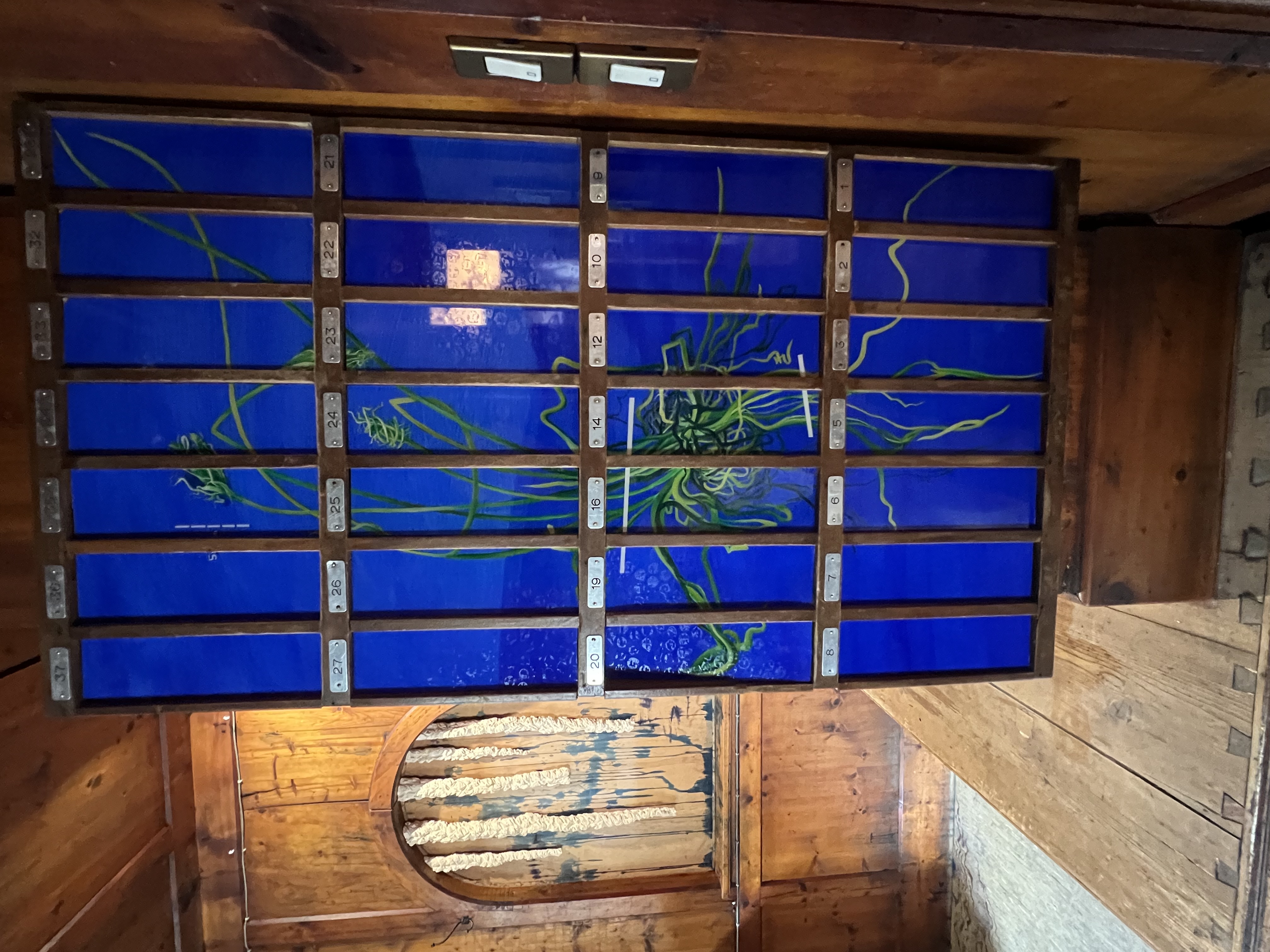 Gregor Prugger & Leonora Prugger. Adaptation as Form. 2026. Lime wood, oil colour on panel, acrylics, epoxy resin. Dimensions variable.
Kelly Tissot pursues a related logic in Girl (The Workshop I–XII) (2026), a series of black-and-white photographs installed within the former social housing apartments occupying a whole floor of a semi-abandoned building. The apartments are all one-room, emptied except for a kitchenette and a washing station in varying states of disrepair. Moving between them, one finds Tissot’s photographs hung over an empty space where a table or a bed once stood. Their subjects are local: wooden toys, sculptures, workshop tools, sized the way photographs in someone’s own home would be. The muted palette and the local focus make them feel less newly placed than left behind by the former occupants. The day I visited, there were no other visitors. The black-and-white photographs seemed to watch me move through the hushed rooms, the space caught between abandonment and habitation, neither fully one nor the other.
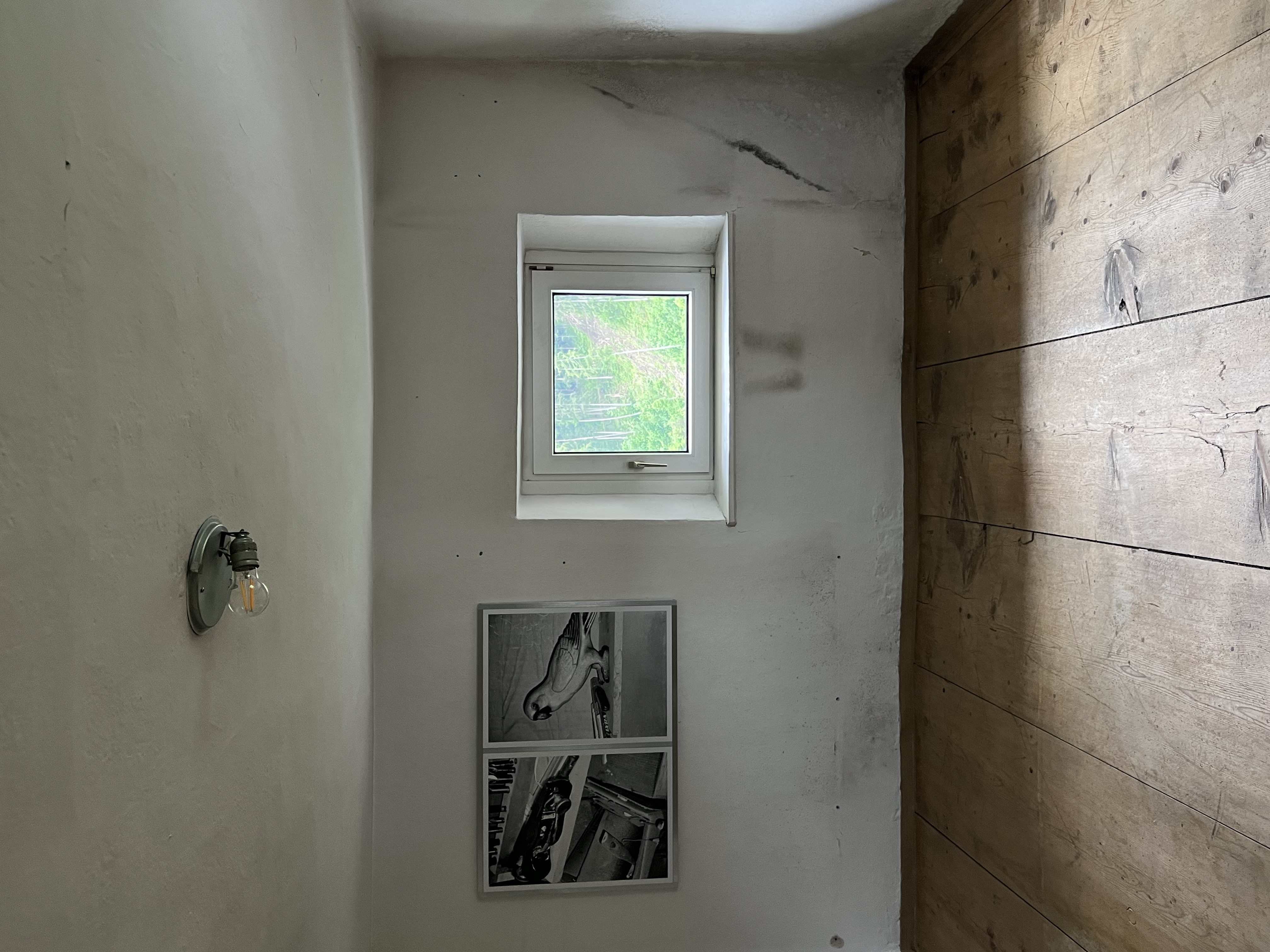 Kelly Tissot. Girl (The workshop I-XII). 2026. 12 photographs, all fine art prints on paper, PVC, aluminium. Various dimensions.
CASANZA (2022), a two-channel video installation by Walter Niedermayr and Marina Ballo Charmet filmed in the women’s prison on Giudecca Island in Venice, is the work throughout the biennale that most explicitly addresses the labor a garden requires. Projected across two adjoining walls in a provisional room in the Museum Gherdëina, the work immerses viewers in shades of green: dense tree canopies, tall grass, the glimmering surface of canal water. There is no voiceover, no added score; the camera patiently follows the inmates as they move through the space, raking, gathering. What you hear is only what they say to each other while they work, and sometimes what they sing. A brick wall runs through the shots, the literal border of what the inmates have to work with. It’s a plain reminder of the theme of make-do, except here the cultivation is collaborative, carried out together rather than alone. Leuenberger’s future paradise imagines care and reciprocity as conditions to be cultivated. CASANZA suggests they are already being cultivated, in places that complicate any easy optimism about what cultivation means or who performs it.
Overall, the biennale’s strongest works point to the same concern my hike raised: a garden is built from labor and making do, not grand, aspirational design. Leuenberger’s curatorial essay reaches the same place eventually, ending on a garden made of “stone, wood, memory, labour, and history,” something he calls “fragile and entirely real.” The crates holding up terrarium gardens, the footage of women laboring in confinement, the photos hung on the walls of an abandoned home: none of them needed the curator’s questions about justice and care to arrive there. The paradise, if there is one, is not ahead but already being made, by hand, out of what is already here.
Biennale Gherdëina 10: (Future) Paradise Gardens
Gröden/Val Gardena, the Dolomites, May 31—Sept 13, 2026
Hantian Zhang
Hantian Zhang is a San Francisco–based writer and curator. His criticism has appeared in Afterimage, Art Spiel, Roborant Review, and elsewhere
view all articles from this author