Whitehot Magazine
October 2026
"The Best Art In The World"
"The Best Art In The World"
October 2026
How Graffiti Artist GIZ Got From a Train Yard in Queens to a Gallery in Miami
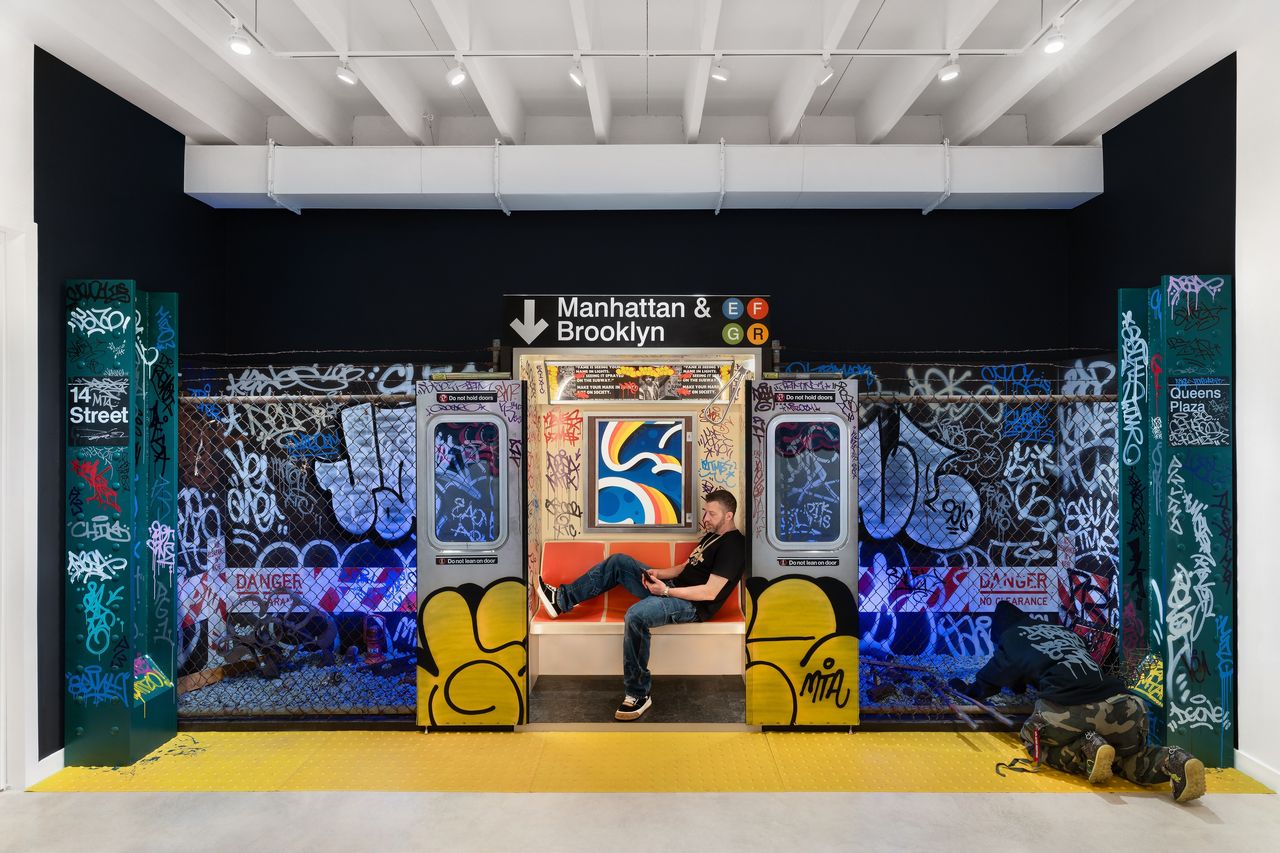 GIZ inside the subway mock-up at Goldman Global Arts. Photo: Zachary Balber
By J. SCOTT ORR| October 6, 2026
He was eight or nine years old, hanging with the big kids one night in the mid-1980s. It was a big moment for the youngster, his first time accompanying his cousin and a crew of teenage graffiti writers from Bushwick and Ridgewood on a late-night mission to the M Train subway yard in Queens. To avoid the NYPD’s vandal squad, the boys took a circuitous route to get into the yard that involved jumping from a catwalk to the roof of a bus depot next door, then down into the yard. That jump was fine for the older guys, but for him it was a leap too far. No problem, though; a couple of the older boys picked him up and threw him onto the depot roof.
That he was literally tossed into the world of graffiti is really almost too perfect. That single act more than 40 years ago was the beginning of the story of GIZ, the name that would later be provided by an older, veteran writer. The kid small enough to be thrown from a catwalk to a rooftop grew into a graffiti writer of some renown, his name plastered across the New York City subway system within a matter of a few years.
Today, his name is also on the walls of a Miami art gallery. NO CLEARANCE, GIZ’s first solo exhibition at Goldman Global Arts Gallery inside Wynwood Walls, opened October 1 and runs through November 16. The show pairs new carved-wood works with a full reconstruction of a New York City subway platform, one that bears little resemblance to the M Train yard where GIZ painted his very first train decades ago.
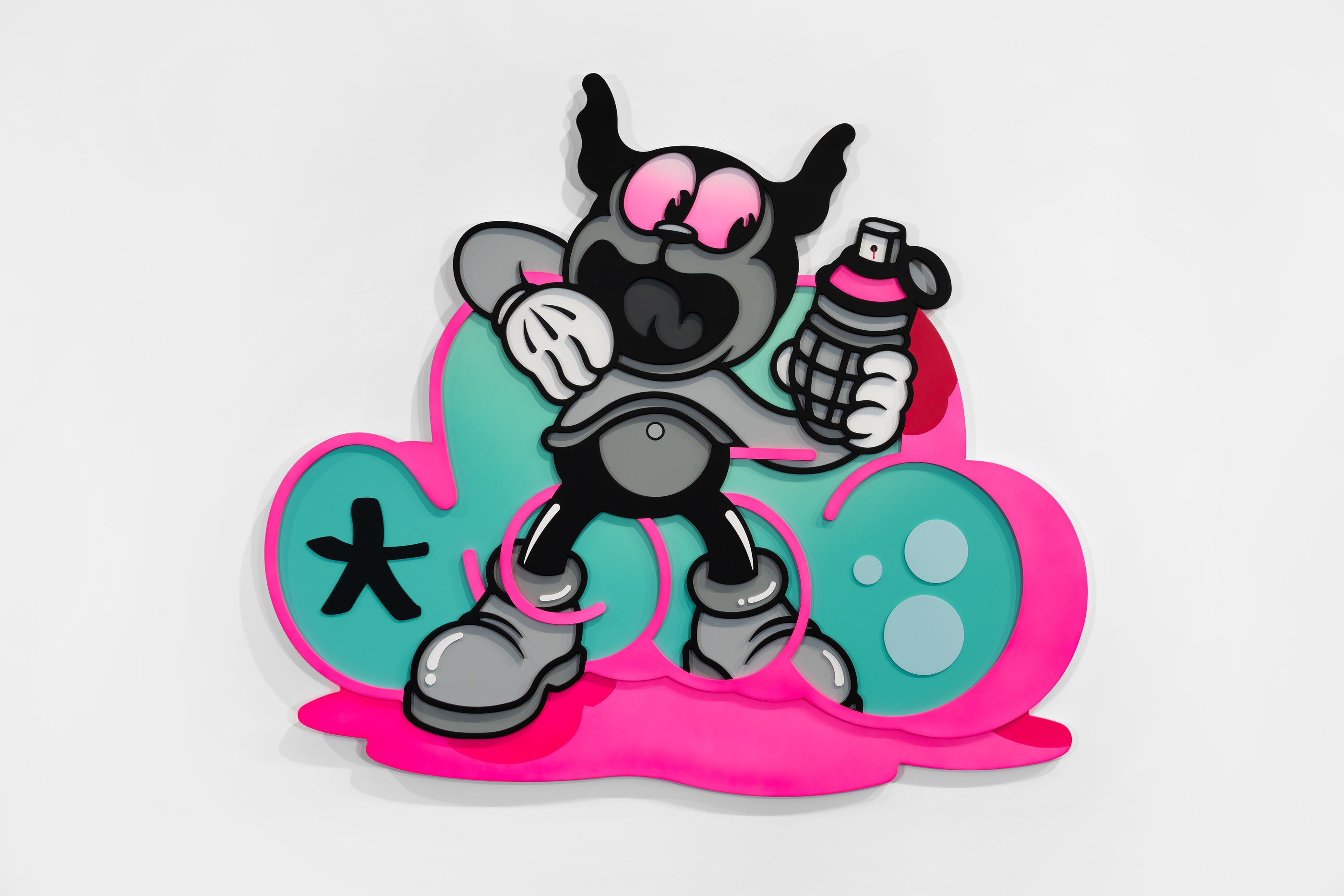 GIZ, Bubble Trouble, 2026, wood wall-mounted sculpture, Italian lacquer. Photo: Zachary Balber
That night in the yard turned out to be an initiation of sorts for the newbie graf writer. Once they entered the yard, the older writers scattered to the trains, leaving him alone. “They ran away from me, and the train yard looked pretty scary for an eight-year-old kid. It was dark. The trains were covered in graffiti. There were noises I wasn’t familiar with, like the brake release—which we called ‘train farts’—the sound of pressure releasing from the brakes,” GIZ told Whitehot.
“I remember I wrote PAC-MAN because it was a video game I liked, and I thought the C was cool. Afterwards, my cousin and the six or seven older guys I was with came around after they finished painting, joking with me,” he recalled.
Later, he went to someone’s house in Bushwick where he encountered a well-known writer and drug dealer named SHOW.
“When I got there, they asked me my graffiti name. I told them it was PAC-MAN, and they made fun of me. SHOW told me it was six letters long, and that if I was using that name, by the time I finished whatever I was doing, the police would be on top of me. He said I needed something shorter, and that he was going to think of something new for me,” he said.
“Then he called me a Gizmo. He said, ‘You know what? Your tag is—Gizmo. You write GIZ for short.’” Finally, GIZ felt like he belonged.
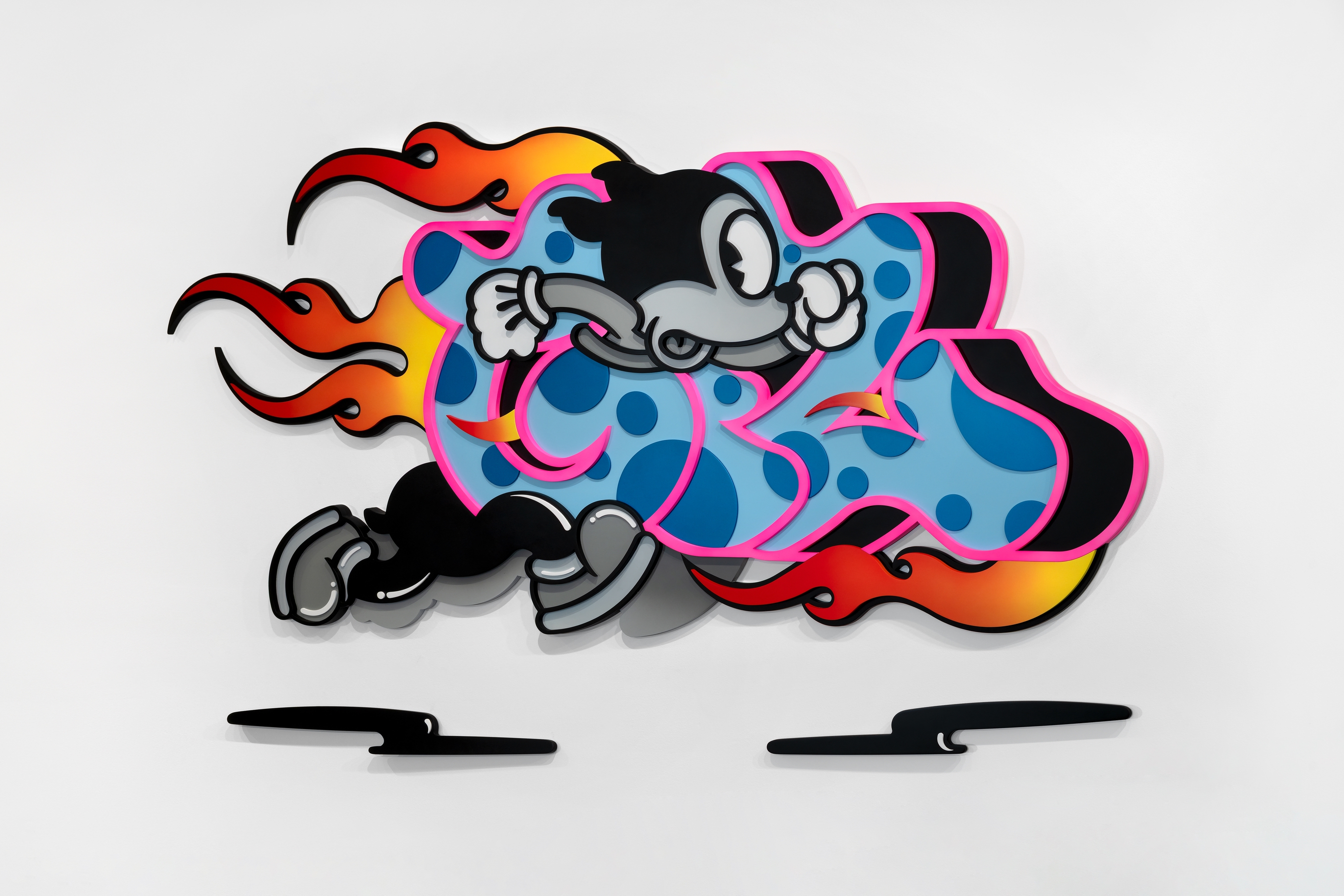 GIZ, Catch Me if You Can, 2026, wood wall-mounted sculpture, Italian lacquer. Photo: Zachary Balber
Over the years, that belonging carried a price that GIZ doesn't romanticize. The Miami show's title comes straight from the yards: "There are places where there is no clearance. That is where the title of my show comes from." His best friend VE was murdered while writing graffiti in Bushwick in 1997, a case still open. Another friend, Jason Wulf, was electrocuted by the third rail in 2014, two hours after GIZ dropped him at the train station. GIZ himself was jailed on Rikers Island in 1996.
For a long time, GIZ was hesitant to move his art from the streets to the galleries. The first time a gallery owner called, around 1998, he assumed it was an undercover cop and hung up. He eventually accepted an invitation, met writers like PHASE 2 and TRACY 168, and sold a jigsaw-cut wooden piece for $5,000. "It was pretty crazy to me that I had sold a piece of graffiti."
The woodwork comes from his father, who built a successful woodworking business from a handyman job. GIZ learned the craft at home. Until 2019, he worked with nothing but a jigsaw and sandpaper. He paints the wood not with acrylics but with high-end lacquer, often 30 or more colors apiece, blended and sanded to be flawless. He's made more than 100 3-D sculptures, every one with a little graffiti in it.
Today, it’s that woodwork that has become a critical part of GIZ’s oeuvre and that features prominently in NO CLEARANCE. The cut-outs, cast in hues of hot pink, acid green, electric blue, draw on two unlikely inspirations: the rubber-hose cartoon mascots of 1930s animation—white gloves, pie eyes, oversized shoes—and the bubble-letter throw-ups of vintage graffiti. In one, a black-and-gray character grips a spray can rendered like a grenade, planted squarely on a hot-pink-and-teal throwie. In another, a cat-like figure sprints across a polka-dotted blue field with flames licking off its heels.
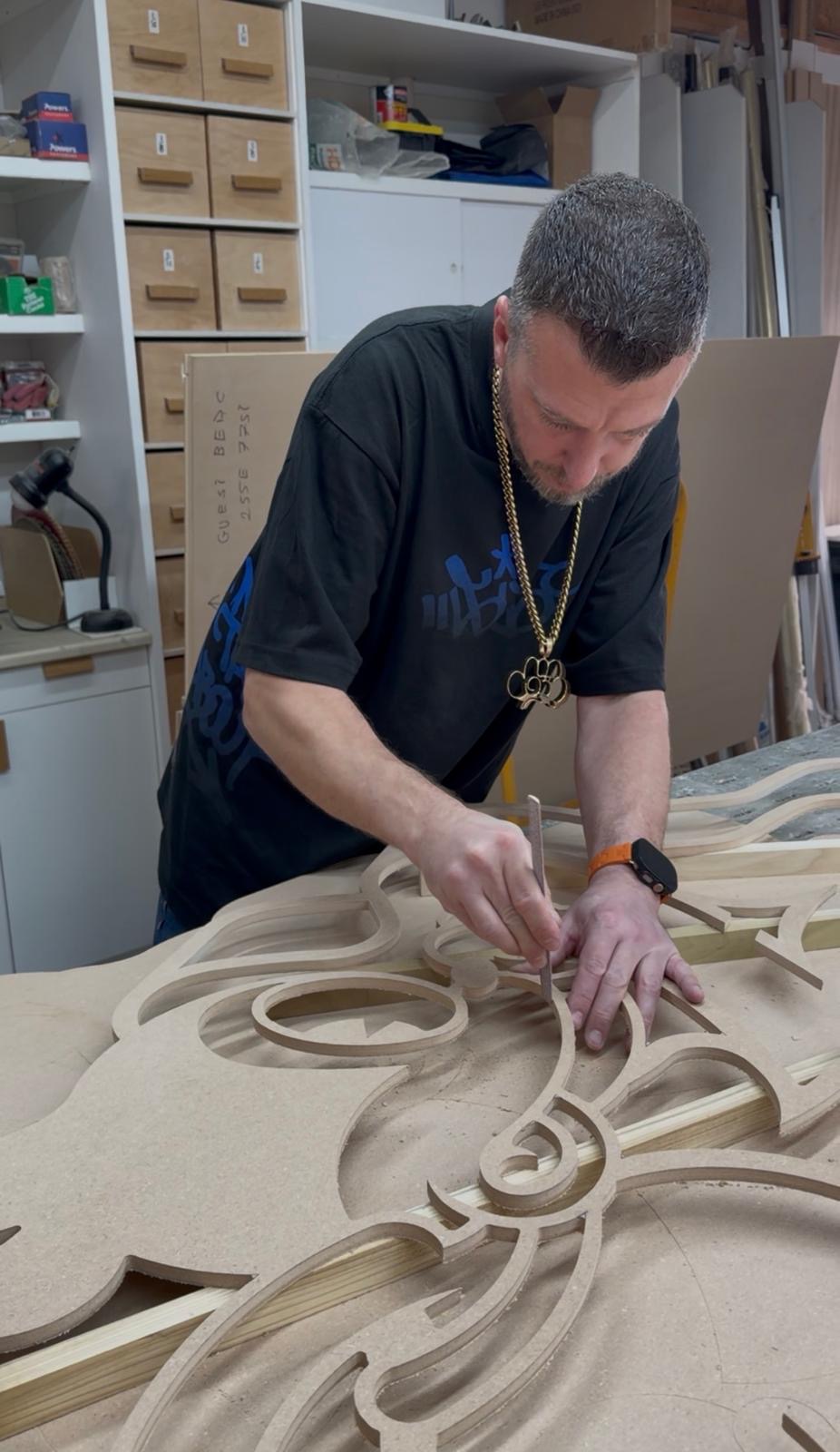 GIZ at work in his Queens studio. Photo: Zachary Balber
Up close, the colors of lacquer blend into a candy finish, and you can see the strata where one layer of cut wood sits hard by the next. It is a throw-up to be sure, but it is one you can walk around in a gallery, or hang on your wall at home. GIZ creates these pieces in his studio in Queens, not that far from the M yard, but, unlike his street work, this is built to last.
Jessica Goldman Srebnick, who founded Goldman Global Arts Gallery in 2015, says writers like GIZ who make the leap to the galleries are bridges between the worlds of graffiti and fine art.
“GIZ is fundamentally a New York graffiti writer, a fixture in New York City’s graffiti scene from a remarkably young age… He represents a tradition that will always play an important role in the art form's trajectory. In many ways, GIZ serves as a bridge. He comes from the graffiti culture yet has built a serious studio practice with gallery representation,” Goldman Srebnick said.
“Working in the studio requires a different set of skills,” she continued. “Artists who succeed are those who build a discipline independent of the street rather than just bringing the street indoors. GIZ does that through his craftsmanship, ranging from intricate woodcuts to significant large-scale installations. He incorporates his tag into each work. He stays true to his roots while evolving his craft,” she said.
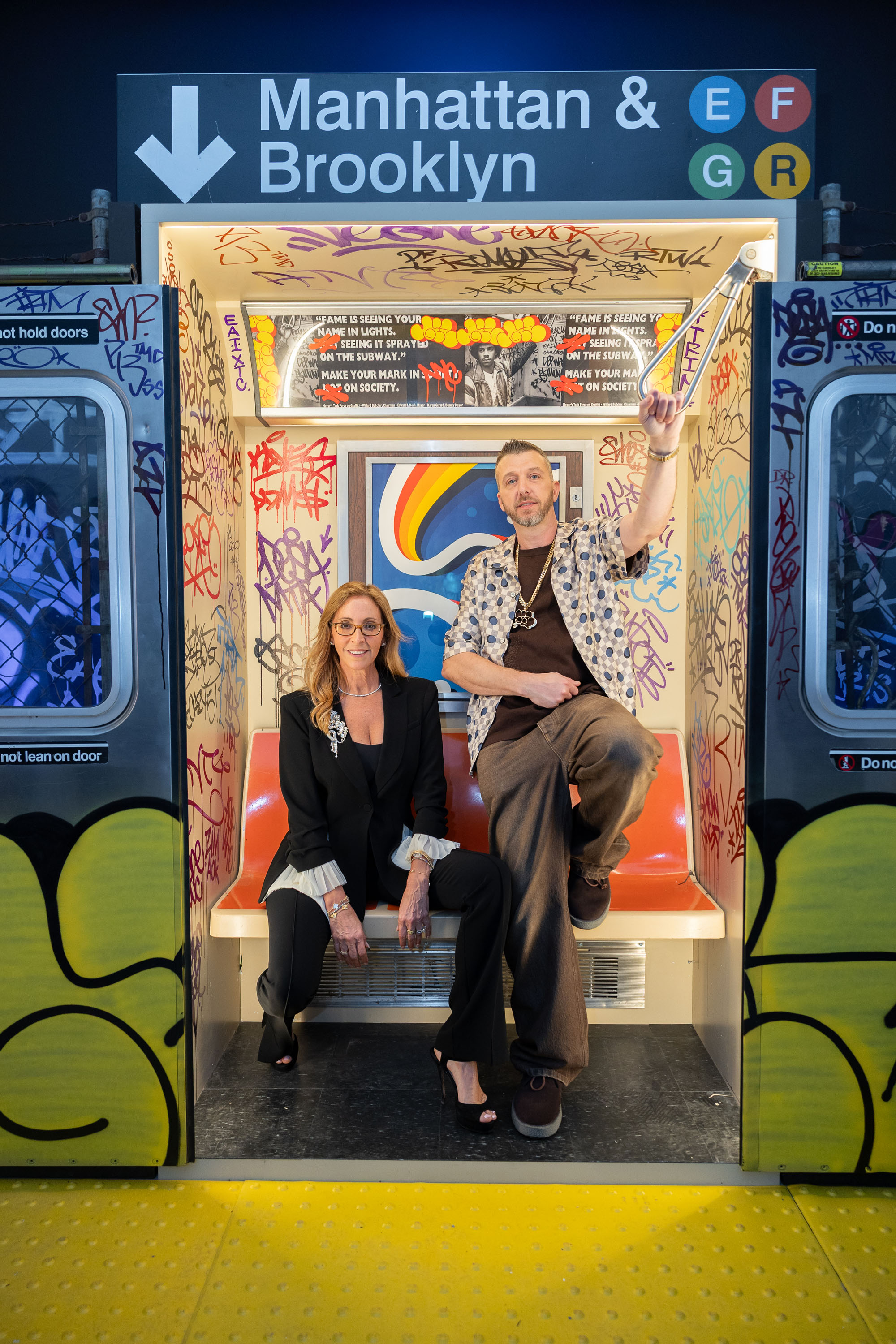 Jessica Goldman Srebnick, founder of Goldman Global Arts Gallery, and GIZ inside the subway mock-up at the Miami gallery. Photo courtesy of Goldman Global Arts Gallery.
While he mostly does sanctioned street art work today, GIZ sometimes misses the old days, "the rawness, the danger, the sense of community, and the real struggle it took to become known in the first place." Ask if he still paints unsanctioned walls, and his answer comes with a grin: "Both. But I'll let my lawyer take it from there."
Seeing GIZ’s work in the reconstructed subway platform in Wynwood captures his artistic journey from the streets. The platform is where it all started: the dark yard, the live rails, the thrown kid writing PAC-MAN because he liked the way the C looked. Everything that happened since helped deliver GIZ to this point: the name, the crew, the Rikers stint, the jigsaw, the lacquer, the hundred sculptures.
What would that kid in the train yard think of today’s GIZ? “I think the 10-year-old version of me would probably think I was a sellout, because that is how we thought back then. But things are very different now,” he said.

Scott Orr
Scott Orr is a career writer, editor and a recovering political journalist. He is publisher of the East Village art magazine B Scene Zine. He can be reached via @bscenezine, bscenezine.com, or bscenezine@gmail.com.
view all articles from this author