Whitehot Magazine
August 2026
"The Best Art In The World"
"The Best Art In The World"
August 2026
Novelty, Spectacle, and Pleasure in Public Art: The Musical Fountain
The Musical Fountain in Terminal B at LaGuardia Airport. Courtesy of the writer.
By BIANCA BOVA April 4th, 2026
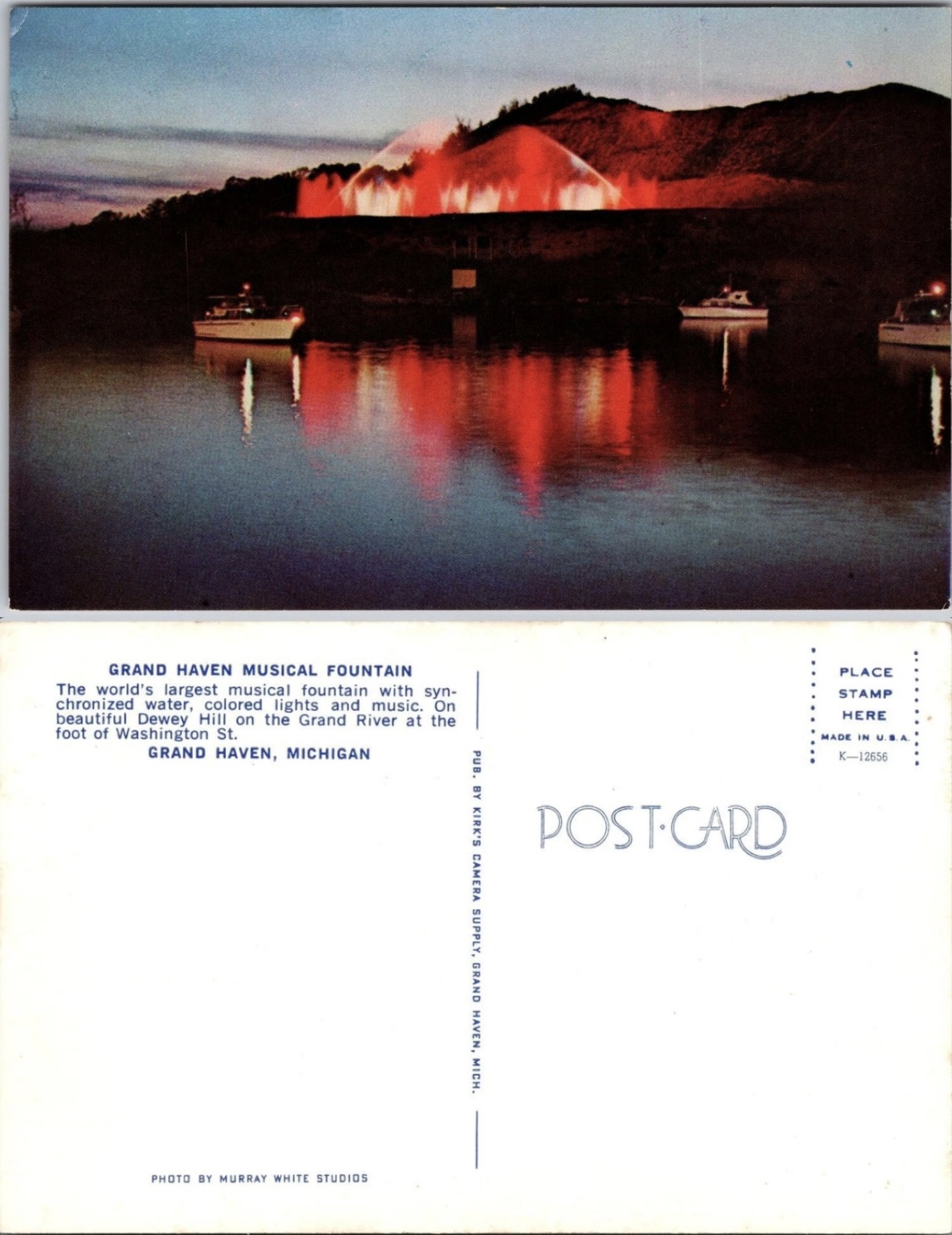
In the beachside town of Grand Haven, Michigan, at the foot of Dewy Hill, there is a musical fountain. For the uninitiated, it is precisely what it sounds like. By its own description, it is “an enchanting spectacle of water and lights creatively synchronized to a wide variety of well-known musical selections,” and has been for over a half-century.
The Grand Haven Musical Fountain (GHMF) made its public debut in the spring of 1963. It was the dream of the town’s former mayor and longtime resident Dr. Bill Creason, realized. During his time serving as a dentist for the US Navy during World War II, Dr. Creason had been taken with a musical fountain he saw in a Berlin nightclub. It was the work of Otto Przystawik, the father of musical fountains (though he preferred the term “self-standing water attractions”), who since the 1920’s had been making his living designing and installing small-scale versions for display in restaurants and stores.
Dr. Creason had a bolder vision for the GHMF. With the assistance of a local engineer, a bevy of volunteers, and $50,000 the fountain was built, and upon its inauguration was the largest musical fountain in the world. Since that May sixty-three years ago, the GHMF has hosted free nightly shows from Memorial Day weekend through Labor Day every year. Though the mechanics have undergone necessary, periodic upgrades, and the musical selections have attempted to keep pace with the popular culture, little has changed in the overall execution of the GHMF’s productions. It is still water, colored lights, synchronized music. The musical program is sometimes thematic and sometimes a “jukebox,” always opening with classical fanfare before moving onto a mix of benign pop songs and the occasional stirring, patriotic anthem. There is an indelible charm–a quaintness even–to the crowds that gather nightly in the dark along the waterfront to take in the spectacle of it.
There is also an unaccountable strangeness that is part of each evening’s proceedings: the Grand Haven Musical Fountain talks. It speaks in the first-person. It is part host, part semi-conscious, self-aware, otherworldly being. It knows it is a musical fountain, it claims ownership over its programs. It knows it has an audience; it expresses pride; it thanks you. And then it plays the theme from Gilligan’s Island.
Stranger still, the GHMF’s program is broadcast nightly on 92.1FM WGHN, Grand Haven’s local 50,000 watt radio station. A musical fountain without the fountain. This renders its music program (fine), but also its semi-sentient voice accessible to anyone with an FM radio within about fifty miles. Such is the enthusiasm of its devotees, that this sustains. And its devotees are many: its annual attendance is an estimated one hundred thousand visitors. Despite these figures, it was arguably back in 1978 that its cultural reach peaked, when a scale model of the GHMF was incorporated into Liberace’s live show at the Las Vegas Hilton.
 A vintage souvenir postcard depicting the Grand Haven Musical Fountain.
The tawdryness of playing backdrop to a rotating, gilded, and candelabra-sporting grand piano can be forgiven for its prescientness. Las Vegas in its deep unnaturalness is, in turn, the natural home for whatever the greatest spectacle is that the American culture can conjure in any given day and age. Consequently, the Grand Haven Musical Fountain held the title of the World’s Largest Musical Fountain until 1998, when it was eclipsed by The Fountains of Bellagio (FOB) at the Bellagio Resort Las Vegas.
The FOB “were destined to romance your senses.” They were and remain, by their own estimation, “the most ambitious, complex water feature ever conceived,” and an “unprecedented aquatic accomplishment.” One can pay a premium for a room at the Bellagio with a view of them; one can dine beside them. They are the resort’s “calling card.” Their 1,000+ water jets fire off every fifteen or so minutes well into the night, serenading onlookers with a variety of songs, though their signature work remains Celine Dion’s My Heart Will Go On, the love theme from 1997’s Titanic.
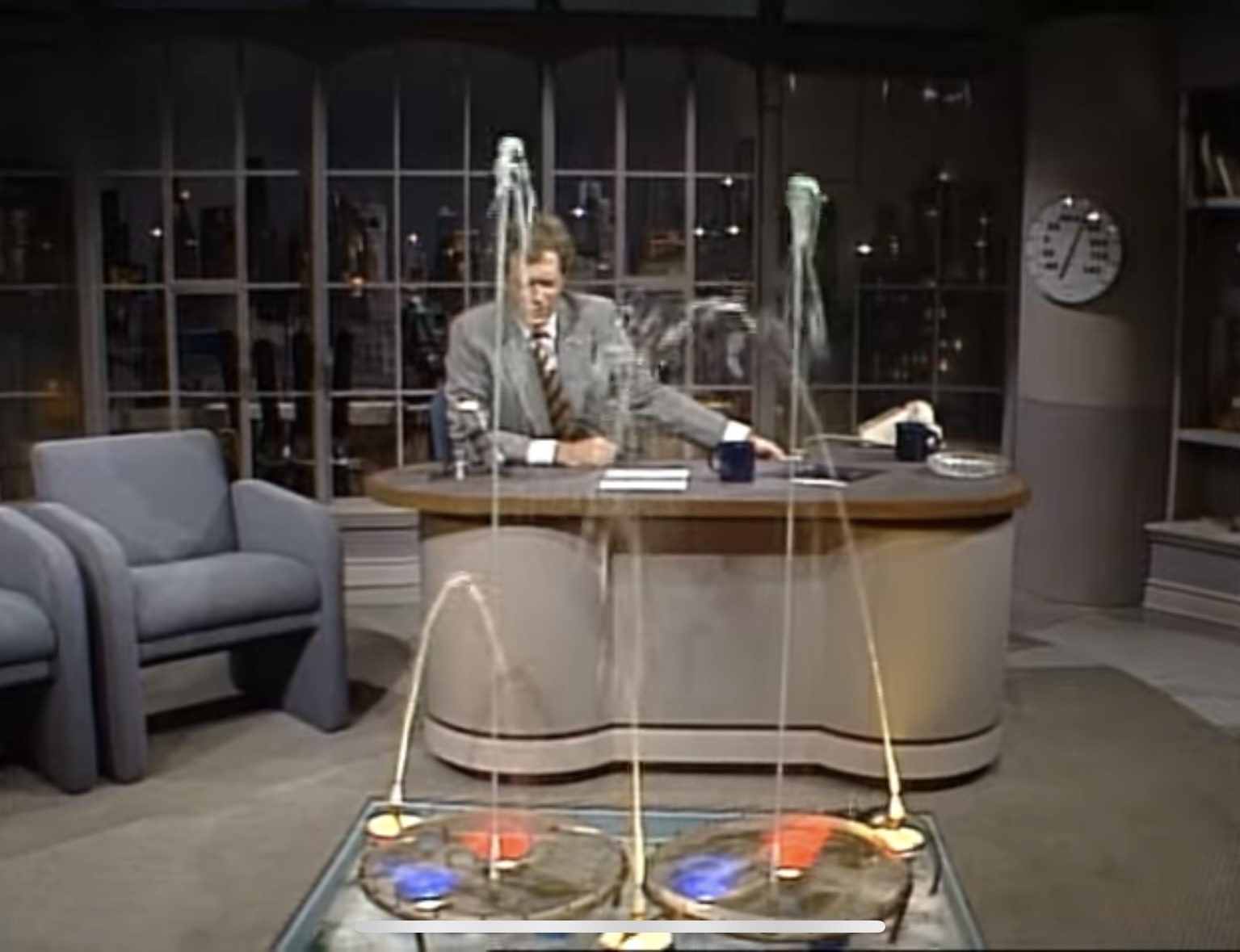
Not just a spectacle, musical fountains have long been a true novelty in America. If you didn’t pass through a resort town of one kind or another in the latter half of the twentieth century, you may only have encountered one, of all places, on late night television. This entree into the avant-pop culture came in 1987, when a small musical fountain was installed in front of the host’s desk on the set of Late Night with David Letterman. Initially referred to as the Dancing Waters, threats of a copyright infringement suit had it hastily renamed the Prancing Fluids. Its tenure was briefer than other accouterments added to the set over the years (a bubble machine, a set of confetti cannons that were in no way limited to being filled with confetti), but its impact more legible.
Letterman seemed giddy over it, declaring, on its debut, “I love this. In five years, this is my absolute favorite thing.” This is of particular note for its timing on two counts: the show, having long since hit its stride, had entered a period characterised by a kind of surrealist absurdity; meanwhile Letterman, having settled fully into place, shed the veneer of nervous politeness that had defined his early career, and became more self-possessed, but also more quick-tempered, and prone to minor outbursts that (as with the incorporation of the musical fountain) made it increasingly difficult to discern what, if anything, was intended to be funny.
The Prancing Fluids (née Dancing Waters) on the set of Late Night with David Letterman. Courtesy NBC/Worldwide Pants Inc.
Still the show’s writers and producers, for their part, worked the fountain in from time to time. It was drained and filled with Lavoris, for an added visual and olfactory effect; had live leeches turned loose in it by a zookeeper; and over the course of one program became run down and attracted ne'er-do-wells, before becoming the object of a fundraising campaign by school children, and finally being restored to its former glory.
Primarily, though, it served as a push-button distraction (accompanied, typically, by a half-hearted rendition of Debussy’s Clair de Lune performed by Paul Schaffer on the organ) that seemed to do little more than delight the host, baffle guests, and occasionally malfunction and drench the desk.
The circumstances of its departure from the show’s set a year or so after its arrival managed to outpace the strangeness of its presence in the first place. Letterman had made an appeal on behalf of a researcher on Late Night’s staff, Bridget Jackson, whose sister was in the running to be crowned homecoming queen of Comeaux High School in Lafayette, Louisiana. The initial offer was a cash bribe to the student body to secure her election, but given the legal and ethical concerns that raised, once things were said and done, Letterman proffered up the fountain instead.
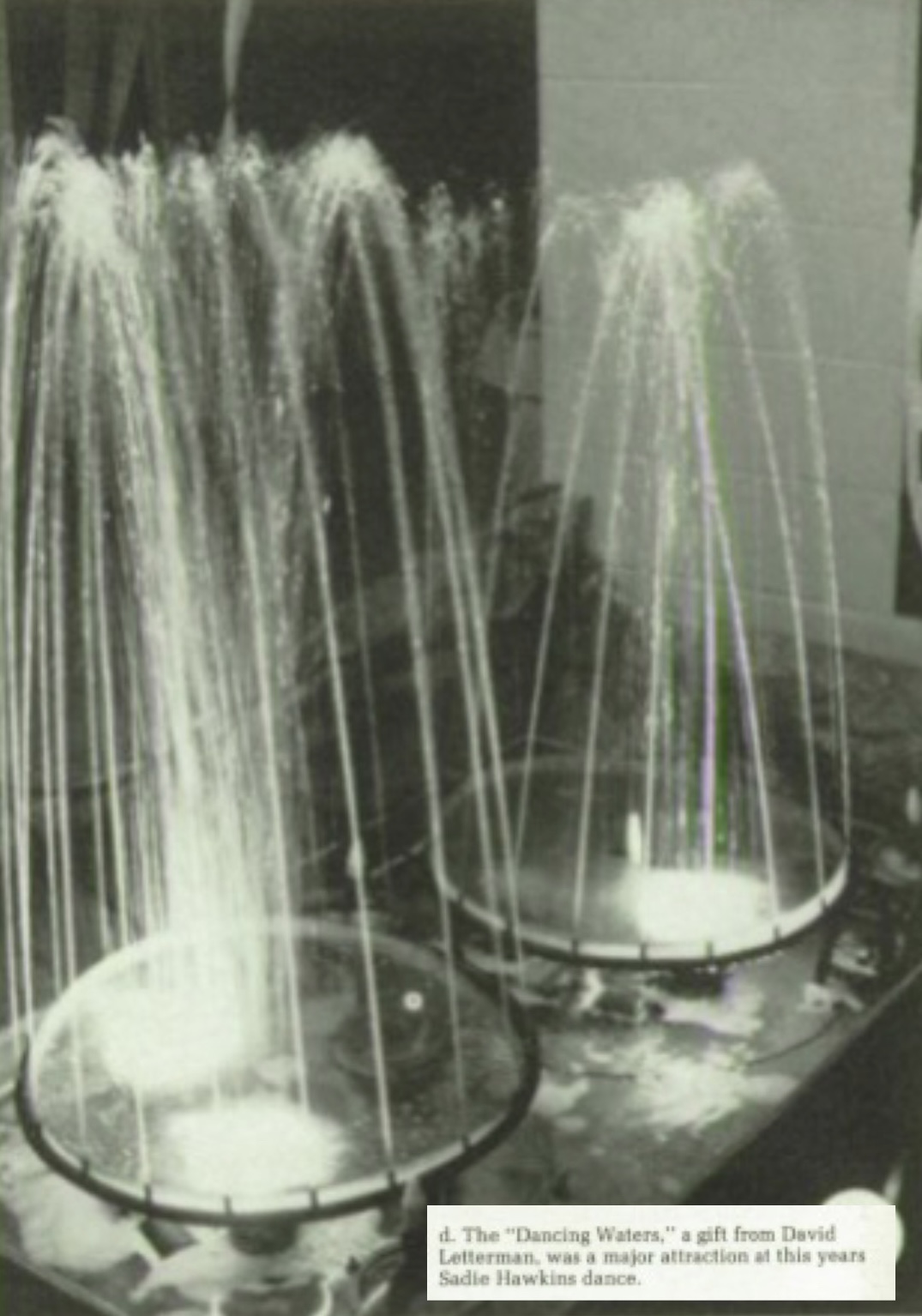
“The Prancing Fluids presented in lieu of cash to the Comeaux High School Class of 1988 by David Letterman in honor of Becky Jackson” reads the plaque that accompanied it. The fountain was deinstalled on the air one night, though, curiously, not before giving its own first-person farewell. All efforts made to contact administrators in the Comeaux School District to inquire about its installation and maintenance over the interceding years unfortunately have gone unanswered, but the school’s 1988 yearbook shows it was installed at least for a time (and was “a major attraction at the Sadie Hawkins Dance” that year). What became of it after that remains unknown, though an alumni message board from 2022 features a recollection that notes, “years later, they found the Prancing Waters [sic] in the back of an old supply closet in the main building at Comeaux High.”
 Courtesy of the 1988 Comeaux High School Yearbook.
While that may seem a less than illustrious end, it is a somewhat unsurprising one, given that the musical fountain as a form of entertainment hardly holds up to what’s on offer today. It’s curious then, that as part of its five billion dollar redevelopment of Terminal B, New York City’s LaGuardia Airport saw fit to incorporate one into its new and otherwise robust public art program (there are site-specific works by Sarah Sze, Sabine Hornig, and Laura Owens, among others, also in the terminal).
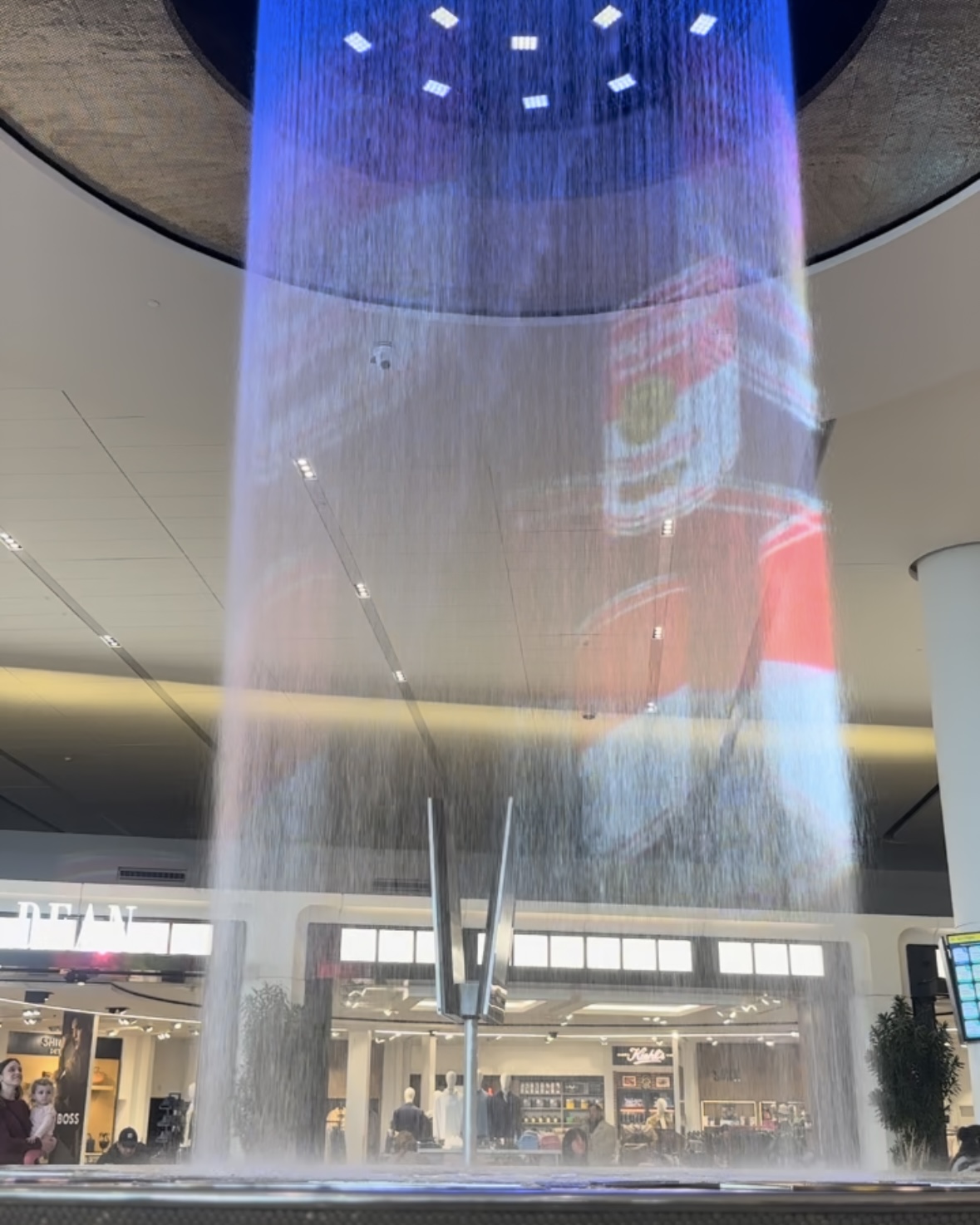
The LaGuardia Musical Fountain (LGAMF) is, strictly speaking, actually two “Aqua Graphic water curtains” and, per the company responsible for engineering it, the “only one in the world installed in an airport.”
It runs several roughly three-to-five minute long programs, each featuring water-cutting displays and projections, along with more standard fare, namely synchronized water jets, lights, and music. The first of these programs features a voiceover that, upon first listen, sounds if not like the late broadcaster Regis Philbin, then like someone doing a vague impression of him (nowhere could a credited announcer be verified). Accompanying the celebratory message welcoming visitors to New York City are projections of its famous attractions (Yellow Taxis, the Statue of Liberty, Broadway marquees) which become increasingly and hallucinatorily bizarre (a balletic array of Warhol soup cans, the Dow Jones Industrial Average on a good day).
The subsequent program opens with a metronomic beat, which gives rise to a pit of dread in one’s stomach at the recognition of the opening bars of a sleepy, almost dirge-like rendition of “New York, New York” sung by an artist by the name of Pam Millo. This is accompanied once again by an array of technicolor projections of the skyline, the subway, the Station Island Ferry, and on and on.
In between these programmed displays, the LGAMF reduces itself to a sort of pathetic ground display. To sit on one of the benches that ring the fountain’s base and take it in is a multisensory experience. It reeks, just as much as one might imagine, of commercial-grade chlorine—a distinct scent that conjures up visions of swimming pools at chain hotels or the wishing-coin fountains found in shopping malls in the 1990s. During the water-cuts, the LGAMF also splashes generously. Though not quite aggressive enough to actually get onlookers wet, it certainly introduces enough ambient moisture into the air to, say, ruin a blowout or perhaps a suede jacket, if one lingers long enough.
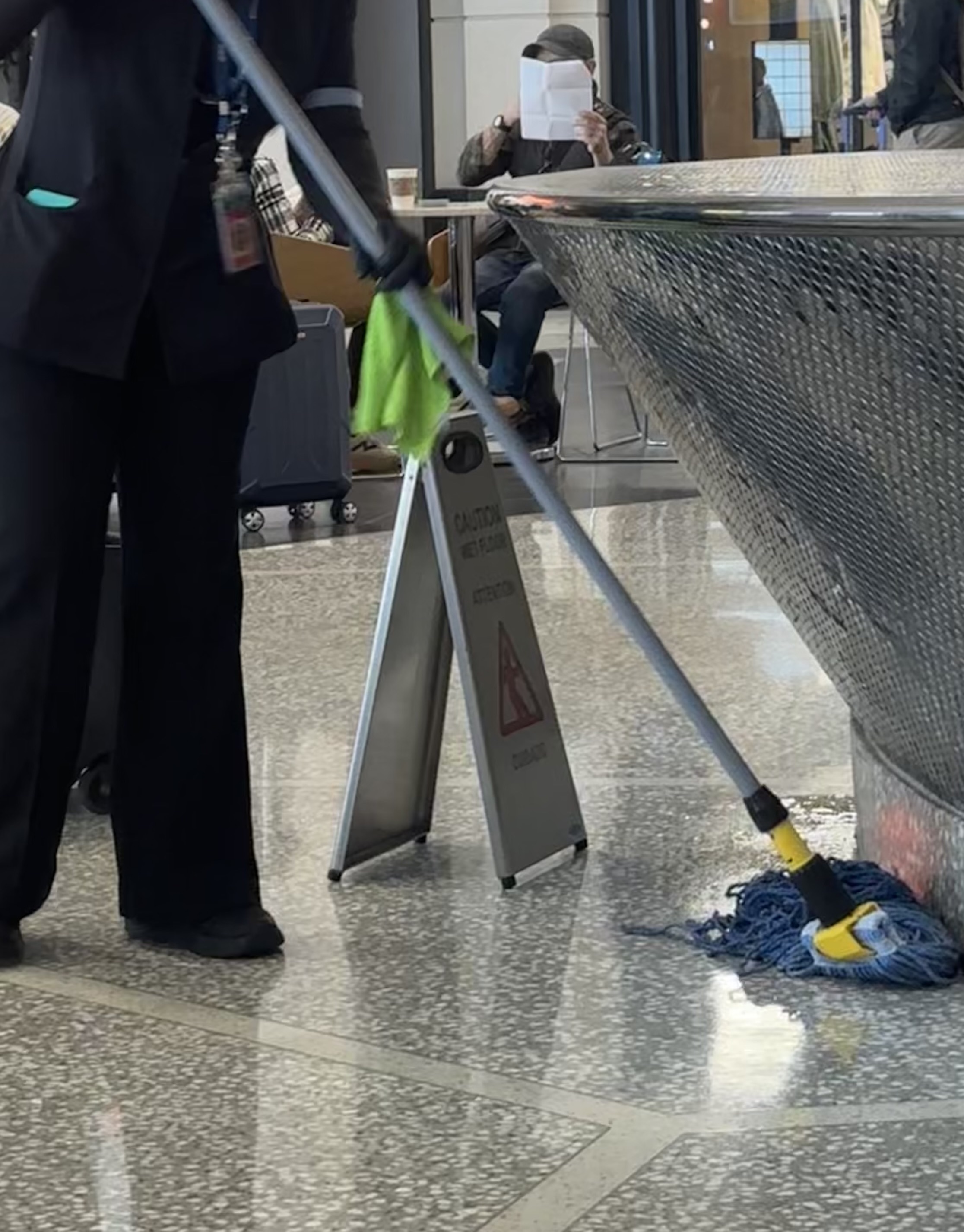 A worker mops up spillage from the LaGuardia Musical Fountain. Courtesy of the writer.
Linger they do. Despite or in spite of it being over-the-top—tacky, even—to the passing droves of travelers, it is also riveting.
“My team and I literally stopped in our tracks and were almost late for our flight because we were possessed by the water feature!” Timmesha Burgess, a flight attendant, is quoted on the fountain engineer’s website as saying.
Possessed! What higher praise could there ever be? Before the advent of the internet, before our cravings and demands called for spectacle on top of spectacle, before we could fathom a day when we could, anytime we pleased, conjure up spectacle on top of spectacle one had to, generally speaking, leave the house if they wanted to experience something novel. The musical fountain, for all its garishness and all its banality, has for roughly a hundred years going managed to satisfy those desires. While its origins place it squarely in the pantheon of good, clean twentieth-century pre-digital fun, it has somehow beat the odds and found its way forward. What could feel more dated, and what could prove to be more timeless? And what does it say that we, the public, are still hopelessly wide-eyed with enthusiasm in the face of it?

Bianca Bova
Bianca Bova is a Chicago-based curator and cultural critic. As director of her eponymous gallery, she exhibits the work of conceptual artists who utilize research and art historical content in their work.
view all articles from this author