Whitehot Magazine
October 2026
"The Best Art In The World"
"The Best Art In The World"
October 2026
Vertigo in Blue: The Unstable Gaze in Louis Jacquot’s Painting
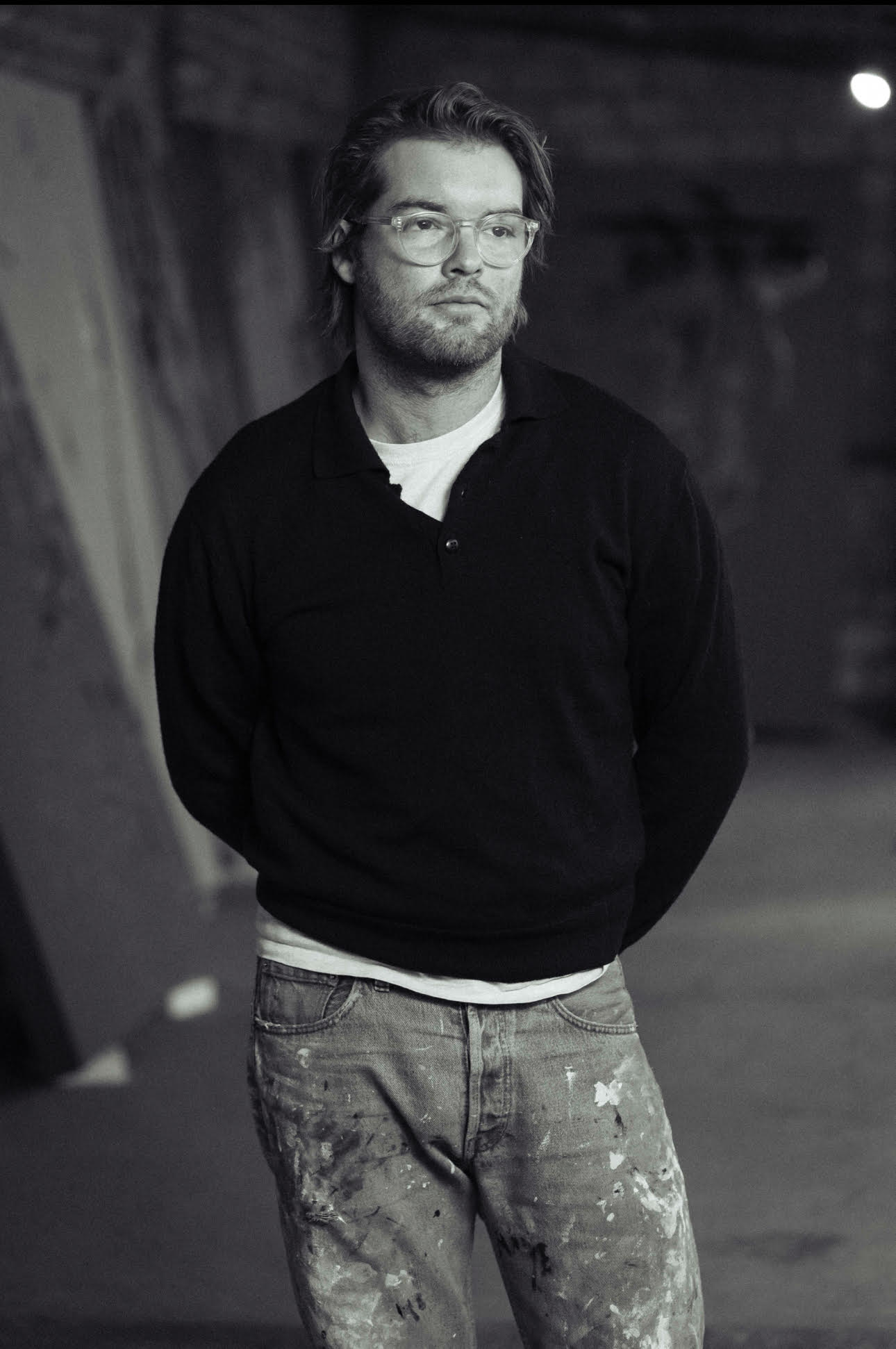 Portrait: © Louis Jacquot. Courtesy of the artist and Villa Magdalena. Portrait by: Luis Vázquez
By LARA PAN February 21st, 2026
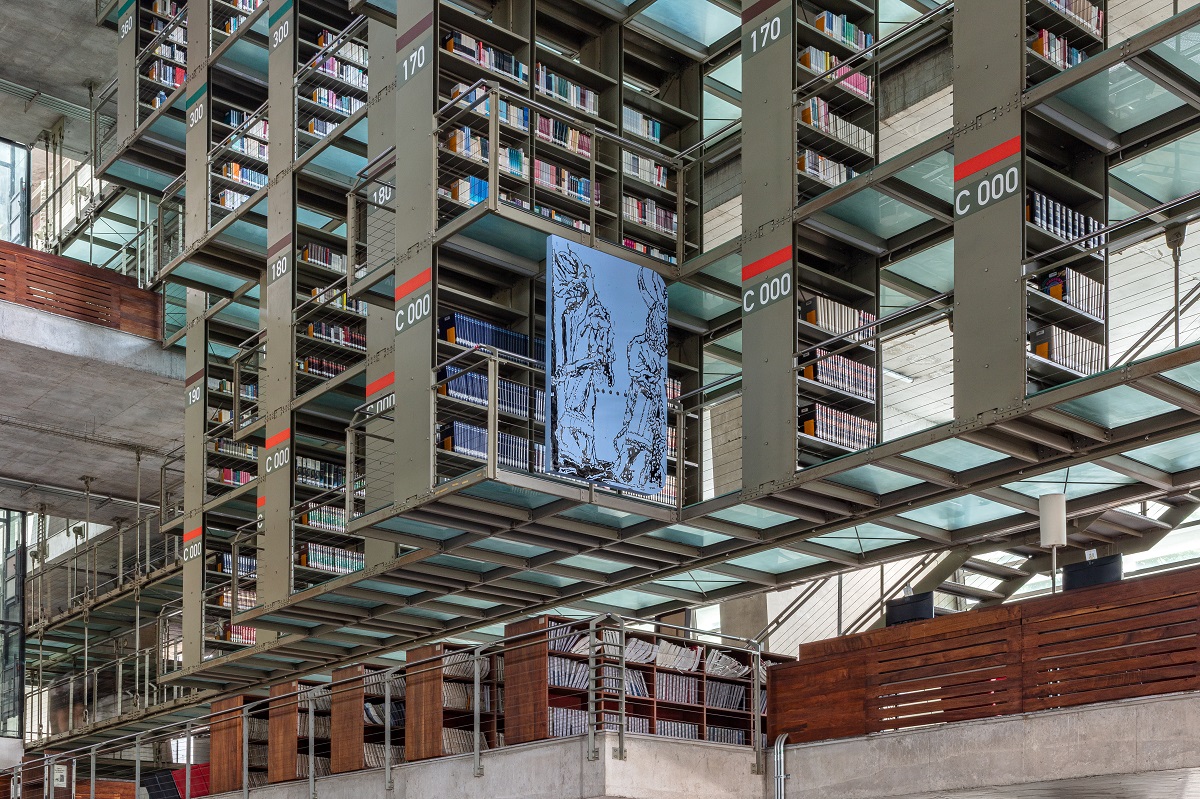
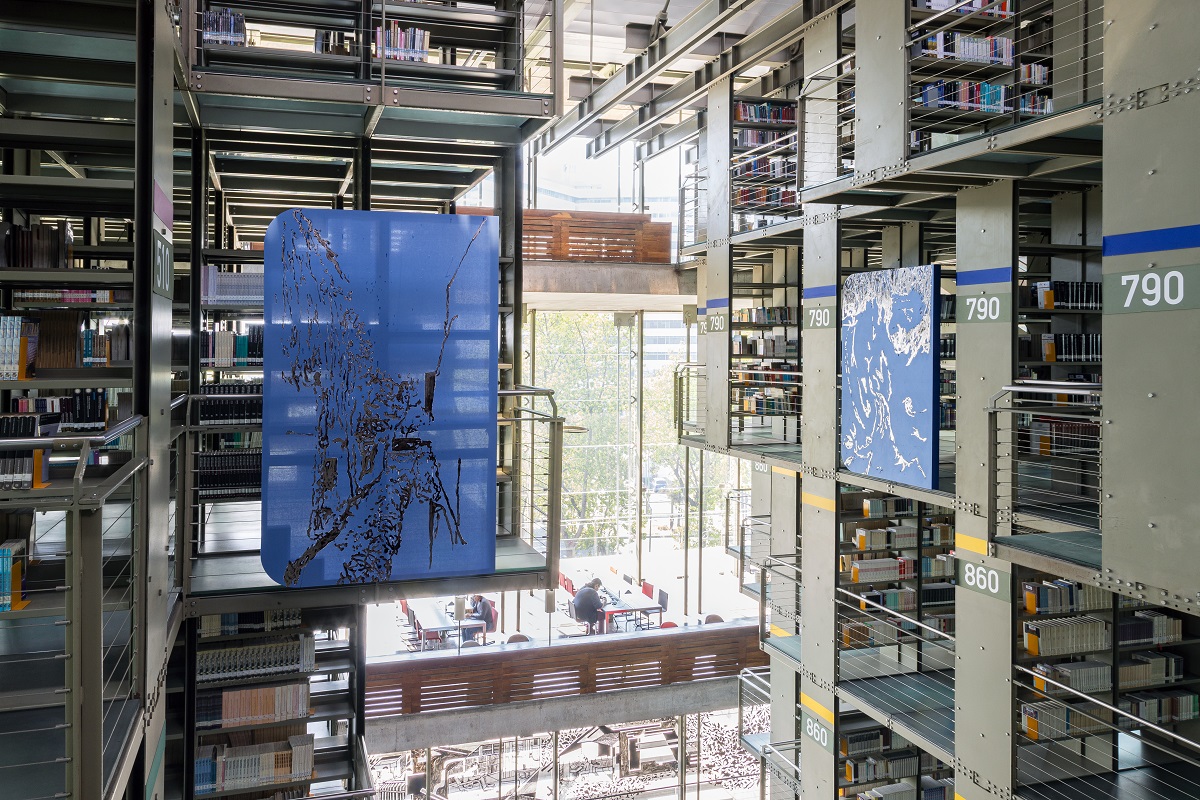
The exhibition Tantalo unfolds as a distinctive collaboration with Villa Magdalena, under the discerning direction of Cy Schnabel, within the remarkable architectural setting of the Bibliotheca Vasconcelos in the Buenavista neighborhood of Mexico City. In this monumental space, French artist Louis Jacquot presents an installation of paintings suspended in dialogue with the library’s vast structural framework.
Within this environment, Jacquot’s paintings appear to hover in space, resonating profoundly with the surrounding architecture. The title Tantalo draws from Greek mythology, evoking the tantalizing condition of desire reaching toward something that continually withdraws. His work exists precisely within this tension: between matter and its disappearance, between the promise of an image and the impossibility of fully fixing it in time or space.
 © Louis Jacquot. Courtesy of the artist and Villa Magdalena.
There is a sensation that the building has no clear beginning and no discernible end. Much of the Bibliotheca Vasconcelos unfolds across seven levels and three expansive halls, with natural light entering through vast openings on each side, reinforcing this perception of continuity and immersion. One does not encounter it as a conventional structure with a defined façade and clear boundaries; rather, one enters it as if descending into a suspended landscape of knowledge.
Designed by architect Alberto Kalach, this architectural masterpiece evokes the structure of an enlarged computer chip—an immense storage system containing human knowledge and memory for the future. It functions as a contemporary metaphor reminiscent of a tesseract: an infinite container, a multidimensional archive in which past, present, and future collapse into a single continuous field. The building becomes not merely a repository of books, but a spatial embodiment of infinity itself.
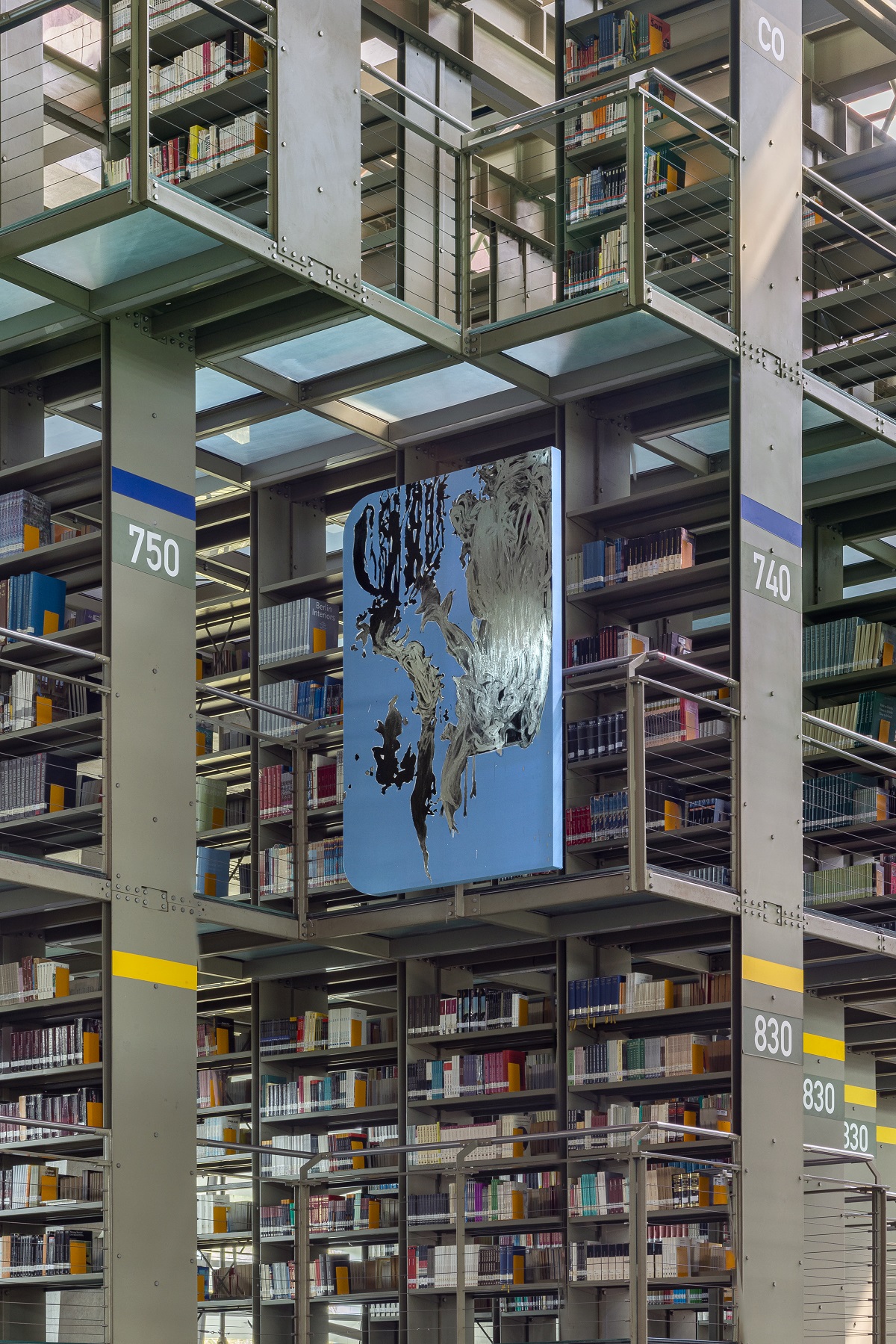
Within this setting, Jacquot’s paintings integrate into the architecture without imitating it, becoming almost ghostlike presences. They resist solidity and exist in an in-between state, neither fully anchored nor entirely ephemeral. In this sense, they mirror the architecture’s own logic of suspension and connectivity. If the library embodies an immense archive of accumulated knowledge, the works introduce uncertainty, subtle mimicry, and the shifting nature of perception.
 © Louis Jacquot. Courtesy of the artist and Villa Magdalena.
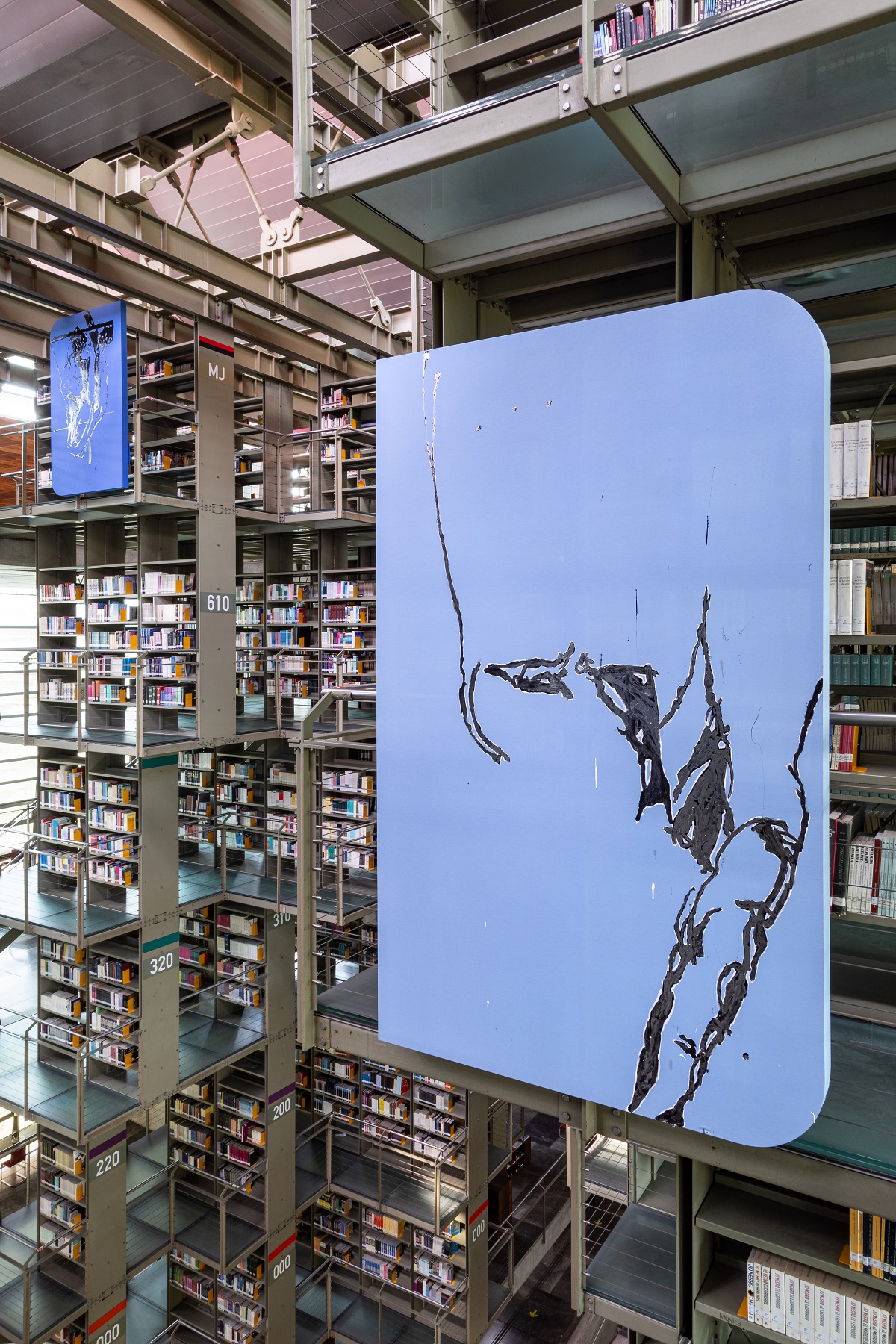
The paintings suggest both opposition and connection. They move above and within the architectural grid, inhabiting a threshold between past and future. In this suspended space, matter becomes memory, and memory becomes something spectral. Throughout the day, natural light interacts with the surfaces, activating reflections in the paint and revealing the transparency of the delicate blue cotton fabric. The works respond continuously to their environment, shifting in tone and presence as the light evolves.
The exhibition ultimately transforms the library into a living metaphor: a site where knowledge is stored, yet also where it hovers, never fully fixed, always in transition. Together, the architecture and the paintings form a single experiential field: a multidimensional environment in which gravity is questioned and containment expands into infinity. Within this field, Louis Jacquot’s art appears like a fleeting blue apparition inside a structure that seems to defy temporal and spatial limits.
Continuing this dialogue with the artist through the medium of an interview has been a rewarding experience, offering deeper insight into the subtle tensions and poetic structures that shape his practice.
 © Louis Jacquot. Courtesy of the artist and Villa Magdalena.
Interview
You developed this body of work in Mexico City, in direct dialogue with the extraordinary architecture of the Bibliotheca Vasconcelos. How did working within this monumental structure influence your process? And what is your personal relationship to this space,did it shape the way you think about painting?
I started working on this series before I knew about this place, and that is actually what ignited it. When I first visited the library two years ago, I quickly realized there was a connection between the proportions of these paintings directly inspired by those of my notebooks and the proportions Alberto Kalach chose to shape this space.
The decision to use only imagery from the library’s book collection, as well as views of the garden, as source material for the twenty paintings presented here led me to divide my time equally between my studio and the library. This made me more familiar with this place than with any other space in which I have shown my work, and I became very attached to it in a personal, almost domestic way.
Later, I realized that its unique structure and the ever-shifting natural light within the building would change the way I experience my own paintings. They entered the realm of autonomous, living objects.
I also try to make my work as open and accessible as possible, which aligns well with the ideology of José Vasconcelos, so fundamental to the conception of this place.
The title Tantalo evokes desire reaching toward something unattainable. Is painting for you an attempt to fix a fleeting perception, or is it precisely about preserving its instability?
Over time, I have realized that most of my works even outside this specific series deal with instability, disorientation, vertigo, and the act of tricking the viewer’s perception.
The only chair I sit on to look at my paintings in my studio is a rocking chair I designed precisely to place myself and visitors in that state when facing my work.
 © Louis Jacquot. Courtesy of the artist and Villa Magdalena.
Installed within the vast architectural grid of the Bibliotheca Vasconcelos, your works appear to hover rather than rest. How do you conceive the relationship between painting and architecture? Does the space complete the work, or does the painting resist its environment?
I think the way I installed my paintings here accentuates the feeling of weightlessness suggested by the building, despite its heavy metal and concrete foundations.
I see these works as if they were other visitors in this space. They enter it, choose their favorite view, rest their elbows on the railing, and look around. They come alive when visitors approach them, see their reflections in the chrome paint, move very close, sometimes gently touching them to make sure their perception is not still being tricked.
At other times, the paintings recede into the distance and return visually to their original notebook size, seeming to fit onto the library’s shelves, which is something new for me.
The titles of your paintings feel almost like parallel works in themselves. What role do all these surnames play? Is there a story behind them? It might be a slightly amusing question, but I am genuinely curious.
Most of my works are titled with names from various origins that I pick randomly from a first-name dictionary.
This allows me to suggest a backstory for each painting while keeping interpretation open and abstract, even though the images themselves come from reality. It gives them the same “anonymous” status as the visitors one sees moving through the exhibition.
It is also a way for me to avoid the title “Untitled,” which I find too easy.
 © Louis Jacquot. Courtesy of the artist and Villa Magdalena.
Could you describe how audiences engage with your paintings in this monumental space? Does the architecture influence their perception or emotional response, and have you observed any surprising reactions to the sense of suspension and scale in your work?
As I mentioned earlier, there are many interesting reactions to the paintings, and the way the library is designed makes it very easy for me to observe visitors.
The public truly engages and is drawn into a kind of treasure hunt that I invite them to take part in, and I enjoy following their paths, it often helps me discover new points of view.
The library is also a well-known dating spot in Mexico City, and I am quite proud to see couples hide behind my paintings to kiss. It reminds me of people dating in cinemas, and I feel it is not very common in exhibitions.
It makes me think museums should be more open, living spaces, less sacred. Do you remember Thomas Hirschhorn’s exhibition Flamme éternelle in Paris twelve years ago? Every exhibition should be like that.
My final question concerns the distinctive shade of blue that permeates your work. I would love to hear what draws you to this color, how it speaks to you, informs your artistic vision, and resonates within the world you create.
This very thin blue cotton fabric has been the first layer of clothing against my skin for as long as I can remember. Even now, I still wear it as underwear, pajamas, shirts, and bedsheets.
It relates to the ergonomic shape of my canvases and gives me a very pure, human, and comfortable surface on which to apply this kind of alchemical, almost poisonous paint.
I think the sky is perhaps the only thing the whole world has in common, and its shades might be the first colors a newborn perceives.
It is also a color with a deep place in art history, from Giotto’s blue to Ming porcelains, Maya murals, Tuareg indigo, and beyond.

Lara Pan
Lara Pan is an independent curator,writer and researcher based in New York. Her research focuses on the intersection between art, science, technology and paranormal phenomena.
view all articles from this author