Whitehot Magazine
October 2026
"The Best Art In The World"
"The Best Art In The World"
October 2026
IN-DIRECTISM: The Other Revolutionary Strategy
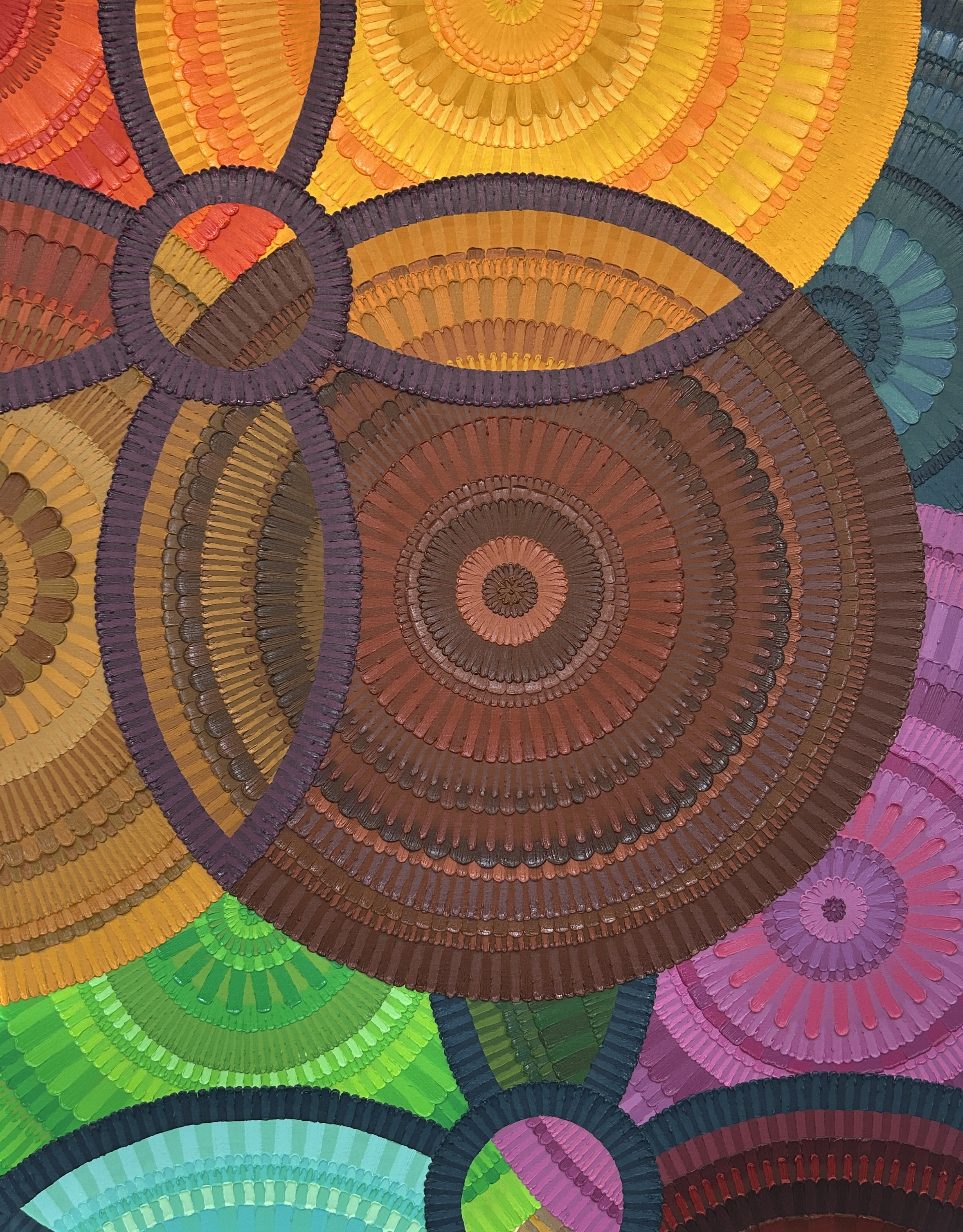 June Edmonds, Beloved Appearance (2025)
BY RICHARD ALLEN MAY III May 26th, 2026
If Directism answers invisibility with confrontation—"SEE ME CLEARLY"—then In-Directism comes back swinging with overwhelming complexity: "I'M TOO DENSE TO BE REDUCED." This strategy is epistemological resistance with attitude.
Charles Wright and the Watts 103rd Street Rhythm Band dropped “Express Yourself ” in 1970 with recursive wordplay that circles back on itself like a vinyl record stuck in a groove. Action and appearance tangle together until simple meaning dissolves into layered complexity demanding you work for comprehension. That circular structure? Pure In-Directism.
Jacques Derrida's différance provides theoretical backbone—meaning perpetually deferred, never pinned down like a butterfly in a collector's case. Where Directism compresses meaning into billboard-sized legibility, In-Directism multiplies signifiers until interpretation becomes marathon engagement rather than drive-by consumption. The work accumulates like sediment, layer upon layer.
Michel Foucault mapped how power operates through classification and archiving—making the invisible "knowable" by rendering it legible to institutional frameworks. In-Directism dodges this capture. Complexity becomes camouflage. Density becomes armor.
THE GENEALOGY RUNS DEEP
Alma Thomas—first Black woman to receive a solo exhibition at the Whitney Museum in 1972—pioneered this resistance through Color Field–inflected abstraction. Her mosaic-like paintings hold your eyes hostage: small, rhythmic brushstrokes arranged in dense patterns transform backyard observations into transcendent visual symphonies. Cherry red dances with lemonade yellow. Sweet potato orange vibrates against popsicle blue. You can't speed-read Thomas. Each painting demands time, revealing new chromatic conversations with every encounter like peeling the package off of a Hershey chocolate bar. Looking once isn't enough.
Norman Lewis walked impossible territory as the only African American among first-generation Abstract Expressionists. Too abstract for social realists demanding recognizable protest. Too Black for formalists championing pure paint. White institutions said no. Black cultural nationalists often said no. Lewis developed "floating signifiers"—marks carrying cultural weight without fixed referents, legible to insiders while remaining strategically opaque to institutions eager to classify and contain. His work spoke, but only to those with ears tuned to the right frequency.
Sam Gilliam took painting off the wall and let it breathe. His draped, unstretched canvases collapsed boundaries between painting, sculpture, and installation—refusing the rectangle, refusing the frame, refusing conventions about where paint belongs. In 1972, he became the first Black artist to represent the United States at the Venice Biennale. The work would not stay in its assigned place.
AFRICOBRA'S DOUBLE CONSCIOUSNESS
AFRICOBRA contains this paradox fully realized, embodying Du Bois's double consciousness in visual form. The same movement that gave us frontal images and billboard clarity also gave us horror vacui—surfaces jam-packed with pattern, color, and rhythm like a house music DJ layering tracks until the bassline becomes hypnotic.
Jeff Donaldson's “JamPact/JelliTite” (1988) pulses with both impulses simultaneously. Every square inch vibrates with Cool Ade Colors—that AFRICOBRA philosophy of brightness, intensity, harmony. You can't look away, but you also can't finish looking. The painting keeps certain meanings in reserve even while it appears to show everything.
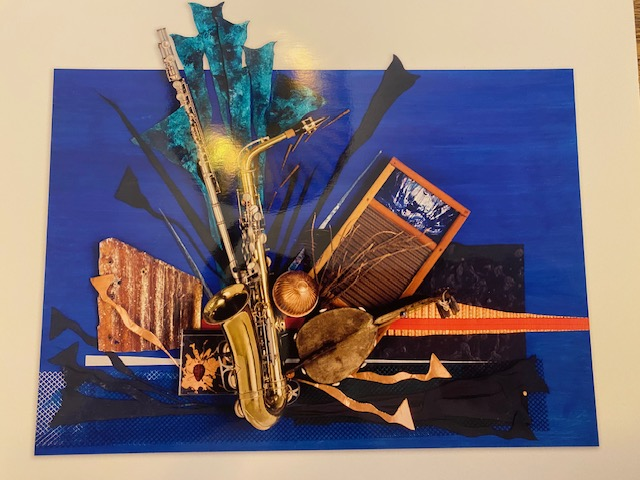 Dale Brockman Davis, Jazz Composition ( circa 2007)
LOS ANGELES ASSEMBLAGE AS MATERIAL THEORY
Noah Purifoy walked through Watts in August 1965 collecting what the Rebellion left behind—charred wood like burnt toast, melted neon signs twisted into caramel sculptures, shattered glass glittering like broken ice. With Judson Powell, he organized “66 Signs of Neon” (1966), assembling the exhibition in thirty days flat. Purifoy co-founded Watts Towers Arts Center and served as its first director, mentoring a generation in assemblage practices. His declaration—"I do not wish to be an artist. I only wish that art enables me to be"—refuses institutional categories the way a jazz musician refuses to stay inside the changes.
Brothers Dale Brockman Davis and Alonzo Davis extended this assemblage tradition while building institutional infrastructure. In 1967, in the wake of the Meredith March and the Watts Rebellion, they co‑founded Brockman Gallery in Leimert Park—the first major Black‑owned contemporary art gallery in Los Angeles. Dale created multimedia works from salvaged objects, discarded instruments reborn as sculpture. Alonzo Davis, who studied with Charles White at Otis in the early 1970s, later turned to his “Mental Space” collage series, layering drawing and paint over salvaged postcards, paper scraps and brown bags rerouted from everyday circulation. His “Blanket Series”, begun in the 1980s, weaves painted paper strips into wall-bound constructions that echo African American quilts and riff on Kente cloth. His “Eye on ’84” mural stretched across the Harbor Freeway, inserting Black abstraction into the city’s infrastructure.
Both brothers championed artists—Romare Bearden, Elizabeth Catlett, David Hammons, John Outterbridge—while maintaining rigorous studio practices. Not coincidentally, Brockman Gallery sat in the same Leimert Park neighborhood that nurtured the Watts 103rd Street Rhythm Band. Same post-Watts cultural explosion. Same determination to express themselves on their own terms.
John Outterbridge succeeded Purifoy as director of Watts Towers Arts Center, serving from the mid-1970s into the early 1990s. Like Purifoy, he collected debris—burnt wood, twisted metal—and transformed it into assemblages weaving personal narrative with public memory. Both artists enacted what Foucault called "subjugated knowledges"—forms of understanding excluded from official histories. Their works argue through accumulation rather than declaration.
David Hammons extended this practice into conceptual territory. His body prints, sculptures, and installations function as formal experiments and political interventions simultaneously. He won't hold still for taxonomy, constantly shifting strategies.
MARY LOVELACE O'NEAL'S THEORETICAL SOPHISTICATION
Mary Lovelace O'Neal's lampblack paintings from the late 1960s and early 1970s represent In-Directism at its most theoretically rigorous. When Black Arts Movement critics demanded narrative figuration and explicit social activism, O'Neal responded by creating monumental canvases using loose powdered black pigment rubbed into unstretched canvas with chalkboard erasers or her bare hands. She built velvety black surfaces—licorice dark, ebony deep—punctuated by spare white lines.
The work engages Minimalism's obsession with surface and flatness while maintaining striking depth. When challenged for not painting recognizable Black figures, O'Neal countered that these paintings were already "as black as they could be"—turning literal blackness into existential and political statement. Abstraction itself becomes social critique.
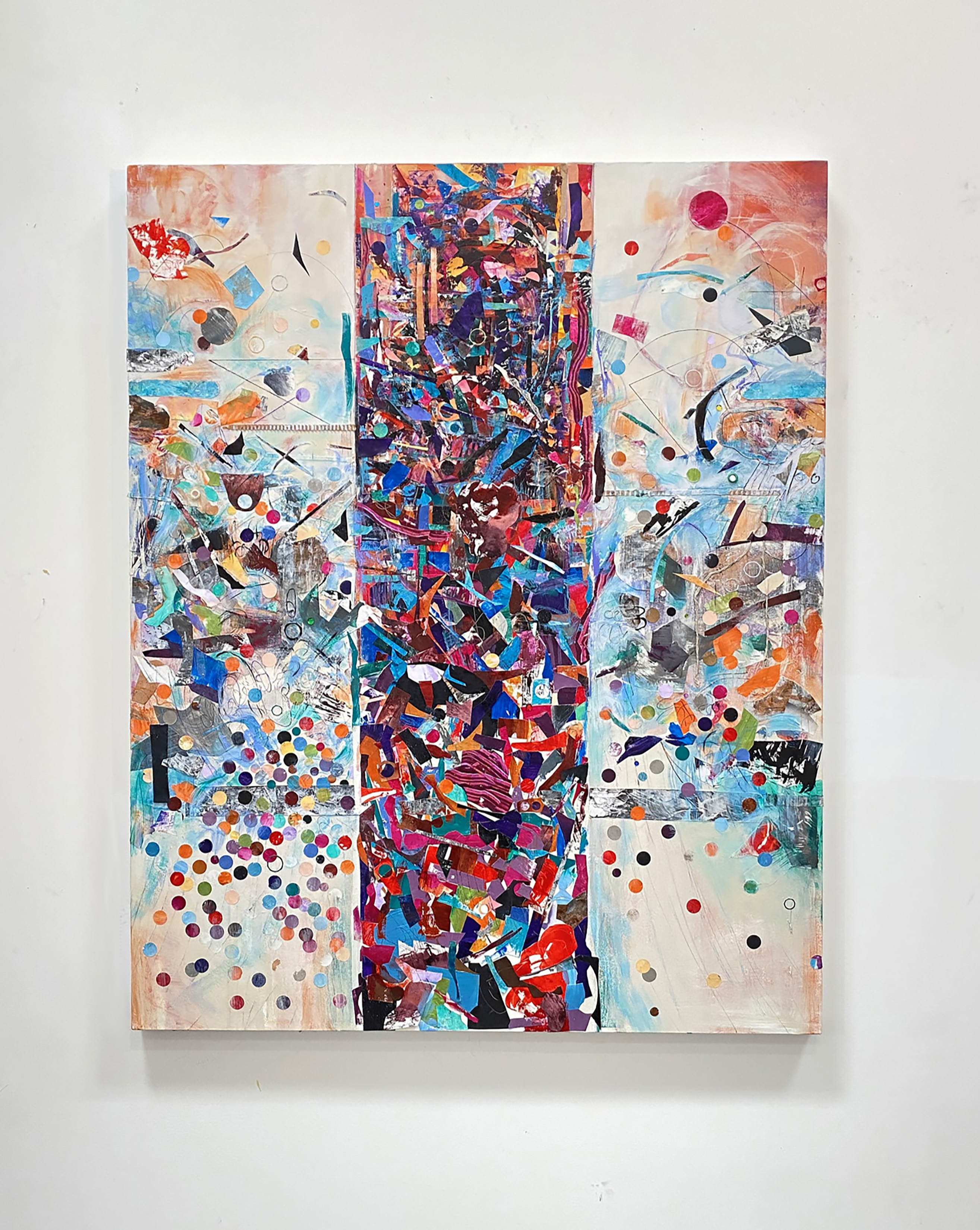 Sharon Barnes, She Stands Bigly (for Gwendolyn Brooks) (2022)
CONTEMPORARY CONTINUATIONS
June Edmonds creates thickly textured “Energy Wheel” paintings where repetitive color and pattern explore spiritual contemplation. Each brushstroke is distinct yet part of an overwhelming whole, like individual voices in a gospel chorus building to crescendo. Standing on the shoulders of Beauford Delaney, Norman Lewis, and Alma Thomas with unwavering intentionality, Edmonds demonstrates that Cool Ade Colors aren't just AFRICOBRA history—they're living practice.
Sharon Barnes works in what she calls "Social Abstraction"—mixed-media paintings drawing on Gwendolyn Brooks's poetry and narratives of Black fugitive migration. Her surfaces refuse quick reading, demanding that viewers bring cultural literacy to the encounter. Text fragments, painted gestures, and collaged materials accumulate into histories that cannot be summarized in a museum caption or Instagram post.
Lisa Diane Wedgeworth's large-scale black abstract paintings interpret psychological energies through gestural mark-making. Beyond making objects, she founded "Conversations About Abstraction" to amplify historically excluded voices, recognizing that institutional silence is structural rather than accidental. She expresses herself by making space—literally and institutionally—for others to speak.
Marcus Guillory demonstrates both impulses on the same surface. His text-based works deploy Directism's confrontational typography while building up distressed, layered grounds of revision and erasure so that legibility itself becomes contested terrain. The work visually code-switches, speaking different languages to different audiences within a single frame.
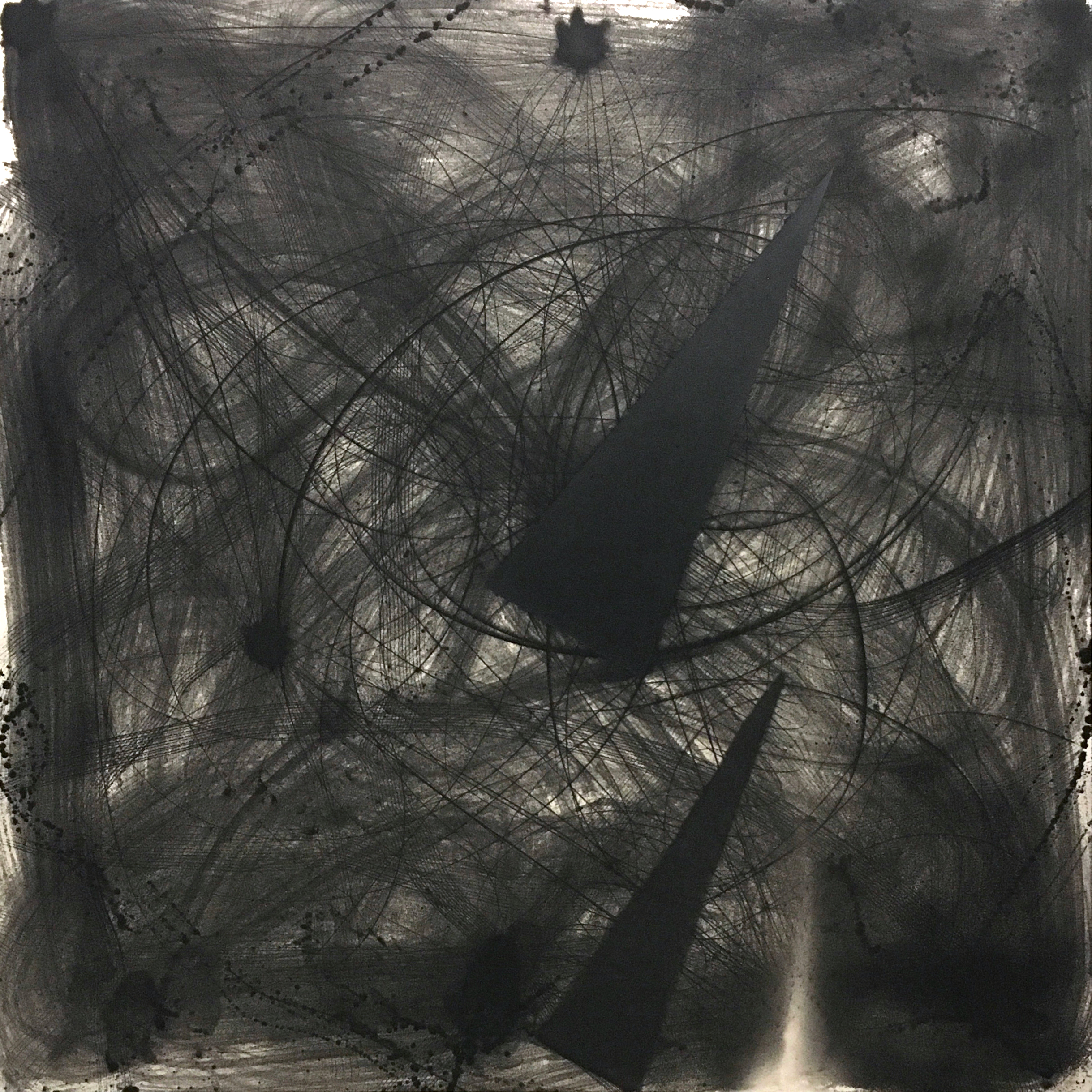 Lisa Diane Wedgeworth, Embracing (Self Portrait As a Levitating Triangle), 2020
THE SPECTRUM OF REFUSAL
Where Directism reduces mediation, In-Directism multiplies meanings until meaning itself becomes plural, unstable, resistant to institutional capture. Direct strategies demand immediate recognition—billboards, protest signs, declarative statements. Indirect strategies demand prolonged engagement, cultural literacy, and repeated viewing.
One strategy insists you cannot look away. The other ensures you cannot be finished with what you see in a single encounter. Together they articulate a crucial frequency range of Black aesthetic strategies: direct statement and recursive complexity, frontal imagery and abstraction, Barbara Kruger's bold text and Abstract Expressionism's gestural mysteries.
This isn't an either/or choice. It's both/and consciousness, the kind of doubled vision Du Bois described, a complexity that resists being flattened into a single story or marketable style. In volatile times, In-Directism offers more than aesthetic pleasure. It models epistemological resistance: how to exist in ways institutions cannot fully categorize, how to maintain cultural specificity while operating inside dominant spaces, how to be simultaneously visible and illegible.
Charles Wright understood something about this in 1970, recording a song in post-rebellion Los Angeles about expression that itself requires effort to understand. His circular logic operates as liberation strategy, multiplying rather than resolving meaning.
In-Directism takes up that strategy across visual art, making work that demands we look again, stay longer than we planned, and accept that some of what matters most will remain productively hard to pin down. Express yourself. But make them work for it. Make them look deeper. Make them come back tomorrow and the day after because one viewing will never be enough to reach bottom.
Richard Allen May III
Richard Allen May III is a 2025 Andy Warhol Foundation Arts Writers Grant recipient, independent curator, and educator at CSU Fullerton, CSU San Bernardino, ArtCenter College of Design, and Bowie State University, where he teaches art history. He has been a contributing writer for Artillery for over eight years and wrote the foreword to AFRICOBRA: Experimental Art Toward a School of Thought (Duke University Press, 2020).
A project supported by the Andy Warhol Foundation Arts Writers Grant.
view all articles from this author