Whitehot Magazine
May 2026
"The Best Art In The World"
"The Best Art In The World"
May 2026
Sivan Lavie in conversation with Brian Belott
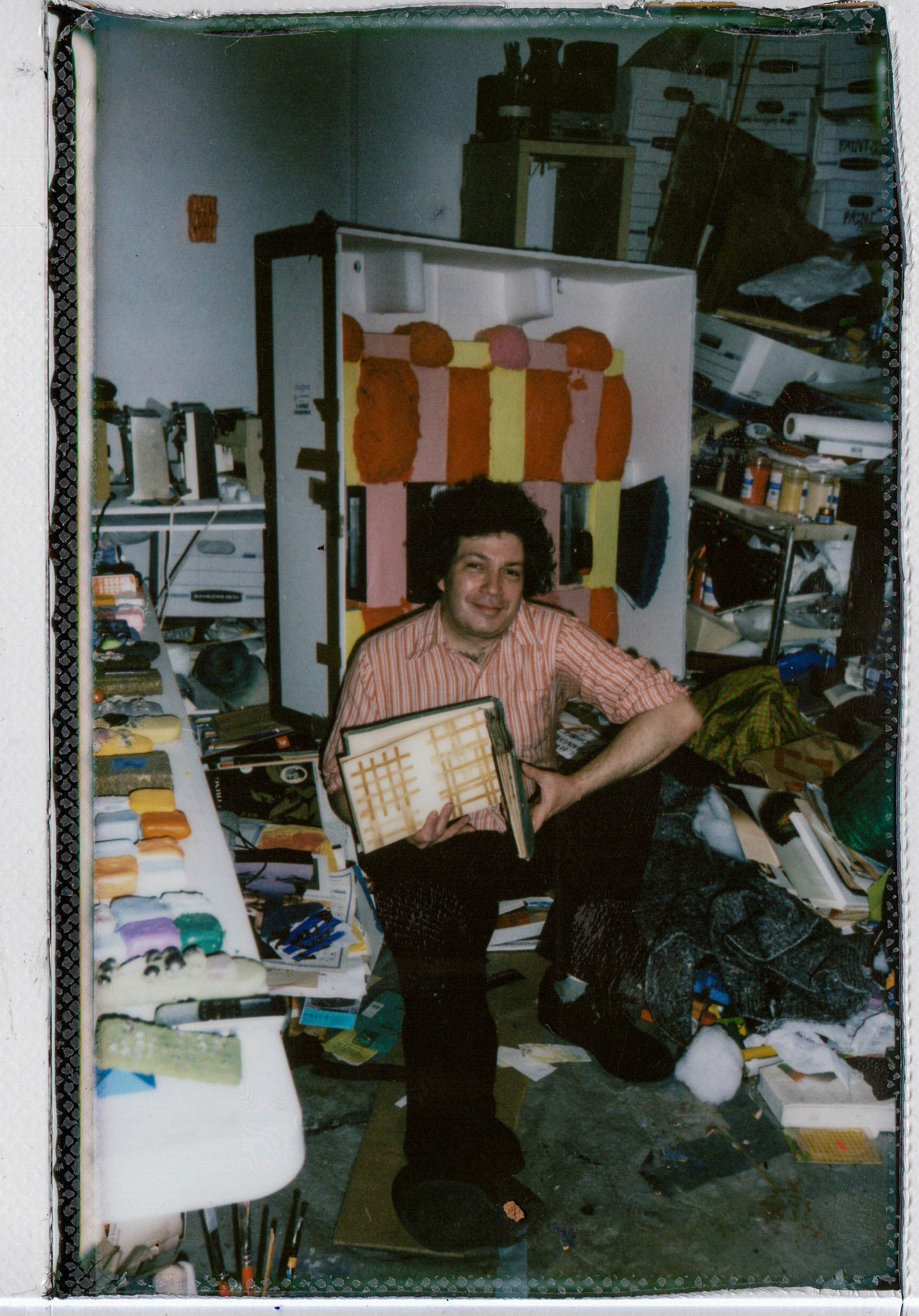
Brian Belott in his studio, 2026. Photo by Levi Japhet.
By Sivan Lavie May 23, 2026
With a figurative knife and fork, I was lucky enough to delve head first into Brian Belott’s generously color-filled studio in Brooklyn. I ate up the extragalactic, texturally innovative, childlike, chaotic universe I found there, which Brian so kindly walked me through. Brian Belott and I talked about color, texture, materials and innovation, children’s work and Rhoda Kellogg.
Sivan Lavie:
Talk to me about texture.
Brian Belott:
Texture equals some type of rhythm. For me, music is the ultimate, right? Alot of me would like to figure out how to sell sound, 'cause I think it's this very powerful thing, but it's also invisible. All of us can do it. It's a type of drawing, you know. So the equivalent of music would be textures and colors and stuff like that.
Sivan Lavie (SL):
Well, that sounds like synesthesia.
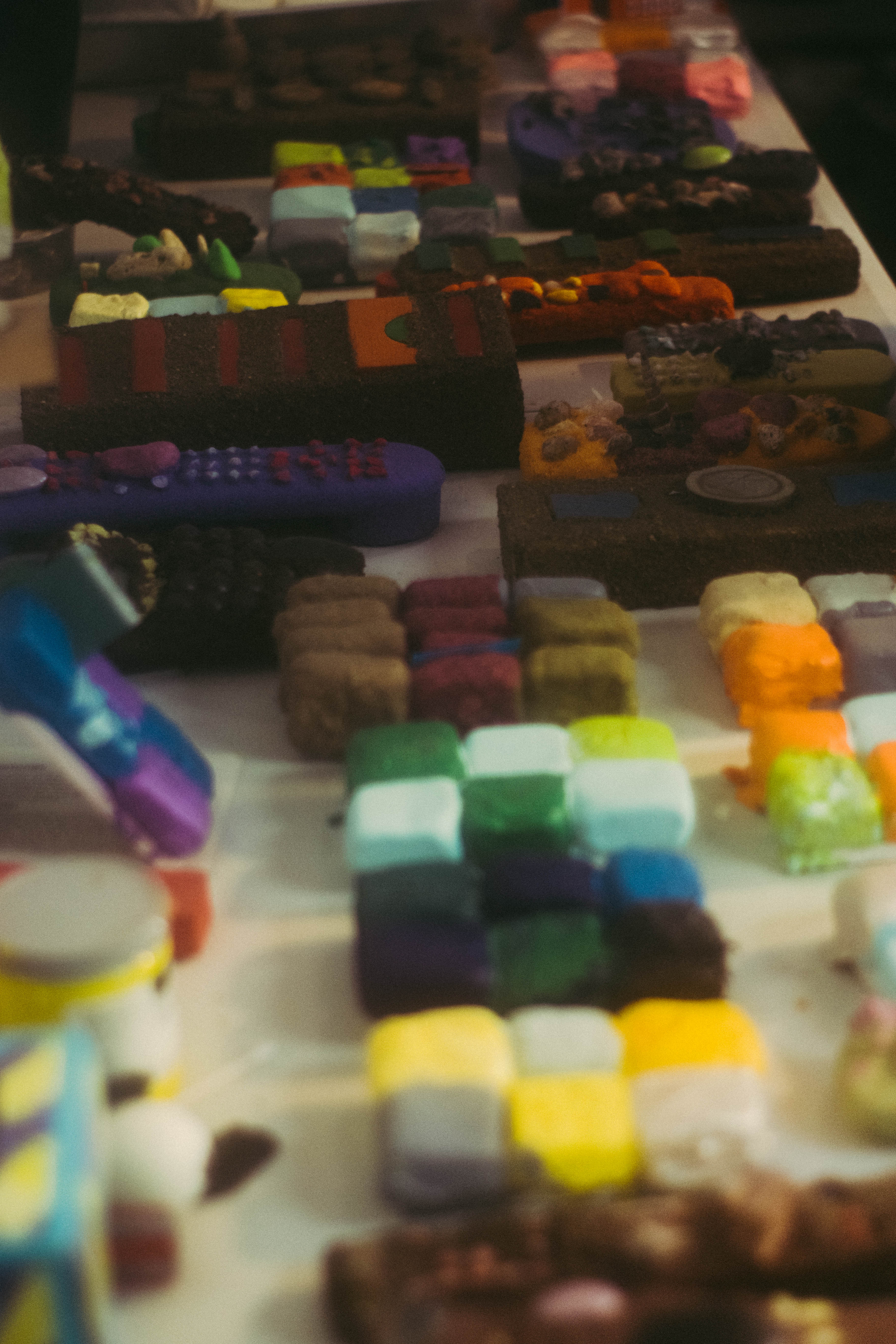
Brian Belott's Marshmallow Paintings and Remote Control pieces, 2026. Photo by Levi Japhet.
Brian Belott (BB):
Yeah. One of my teachers was Jack Whitten at SVA, and he said something along the lines that painting is like reconstituting a skin. And I was like, "Okay, let me think about that for a while." And so more or less, I think about, you know, you need to come up with your own monster skin. And so what's funny is when Jack Whitten was teaching me, I had no idea that he was, like, this incredible Arte Povera artist. So I didn't really ask him all the questions I had, nor was I really developed, nor did I even know what Arte Povera was.
Um, I was very aware of what art brut was, and had been collecting children's drawings since I was, like, more or less a kid.
SL:
Where'd you find them?
BB:
My two moms were elementary school teachers.
SL:
Oh, that explains a lot.
BB:
And my father was a crazy commercial photographer. And so a lot of my children's drawings, my parents kept. And then, but at the end of every school year, I would go to my mom's school and clear out that classroom of its contents, the work that had been abandoned and was going to be thrown out. So by the time I got to Cooper Union, I already had, like, piles and piles of children's art. And, you know, in a certain way, art brut and Arte Povera are similar or are fused at the hips, because they both deal with unconventional materials. You know, like someone grabbing a door and drawing on it, someone grabbing a napkin, someone grabbing an onion and drawing on it, someone grabbing a slice of ham and drawing on it.
SL:
Do you think of your stuff as Arte Povera? Because I guess when I think of Arte Povera I think how it uses really, like, dull colors often, or that's at least my kind of memory of it.
BB:
I mean, like, color is a big subject. Color be good. Texture good.
SL:
Why color be good?
BB:
I don't know. It's just I tend to think that if you mix your colors right, you could almost just throw it on the floor and it'll be something invigorating.
SL:
I agree with that.
BB:
But colors are very personal, you know?
SL:
Huh, why are they personal?
BB:
Well, 'cause they're linked to memory. Because you link certain colors to, I don't know. I think about my grandparents' place. I think of the colors in the kitchen, the colors in the bathroom, the difference between the colors of the '80s and the '90s, and colors of ice cream. Colors of cars.
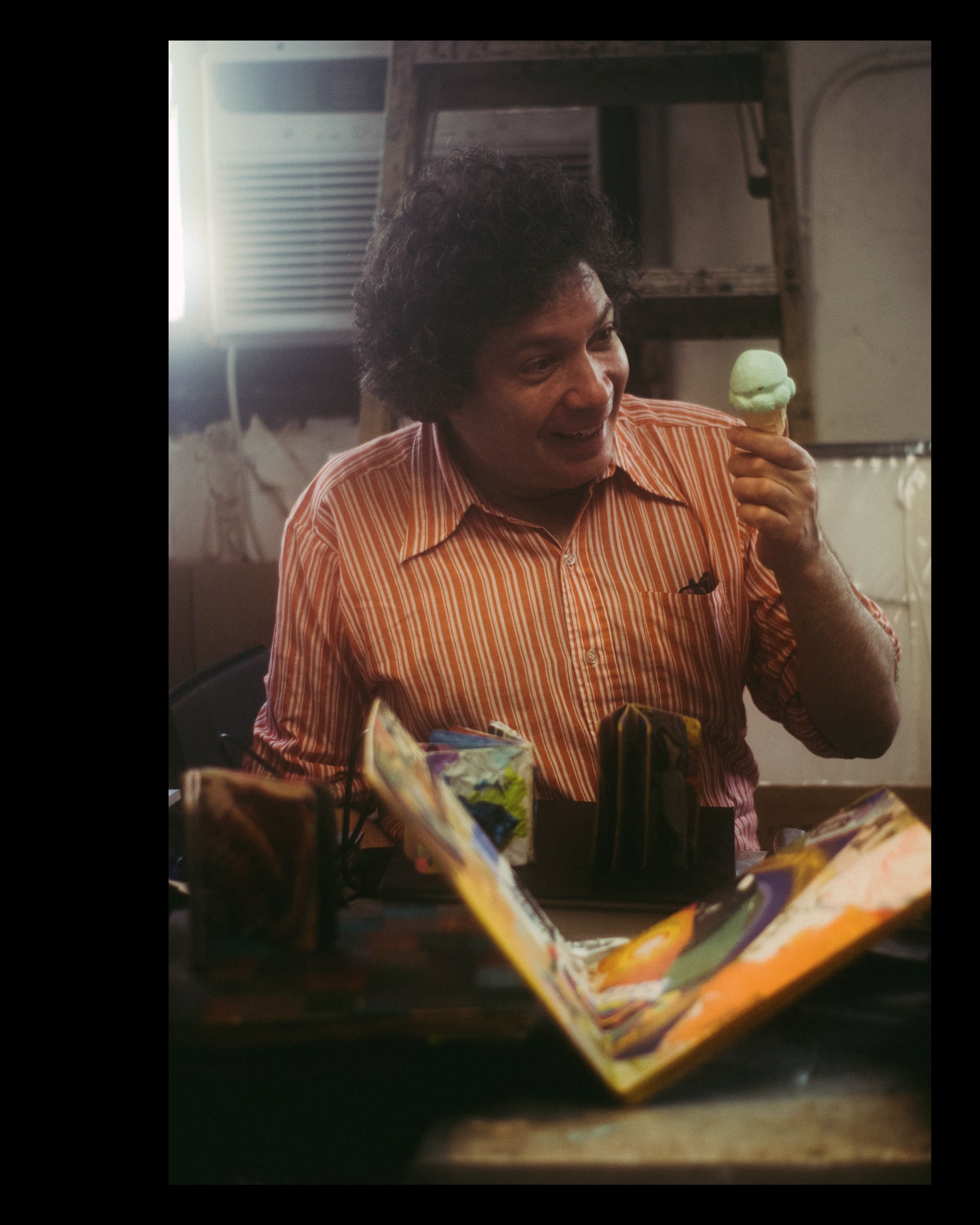
Brian Belott in his studio, 2026. Photo by Levi Japhet.
SL:
What kind of colors was your grandparents' place?
BB:
Uh, turquoise, emerald green, purple.
SL:
Can you go back to the stuff you were saying about Whitten and skin?
BB:
Well, you know, Jack Whitten was filled with poetic riddles. You know, half the time I had no idea what he was talking about. I was more interested in asking him about, you know, how it was when he saw John Coltrane play. Um, but one thing that for whatever reason I remembered, thecomment he said, which is, "Painting is reconstituting a skin." this skin is marshmallows. [points to Marshmallow painting] You know, this skin is, [points to remote control] you know, colored sand and rocks. And so, you know, whether you're-
SL:
Oh, that's really smart.
BB:
…Painting like Renoir or Van Gogh, you have to come up with a certain facture, a way that you're moving the medium and material that winds up becoming something that you're exhilarated by, and then winds up being a signature of sort. Well, you know, the thing is, I've always liked, Van Gogh, he was a major influence. You can't redo Van Gogh. Or can you? Howard Hodgkins, Yevegenia Barras. I love their facture, you know, the textures. I really love the textures of things. So yeah, maybe there is a way to recreate Van Gogh, but not really. So, you know, I've come up with different approximations, you know-
SL:
Of what?
BB:
Well, it's just, you know, it's kind of an abstract notion of, um, what textures go together well. I tend to believe in opposites, in bringing opposites together, but there's varying levels of that.
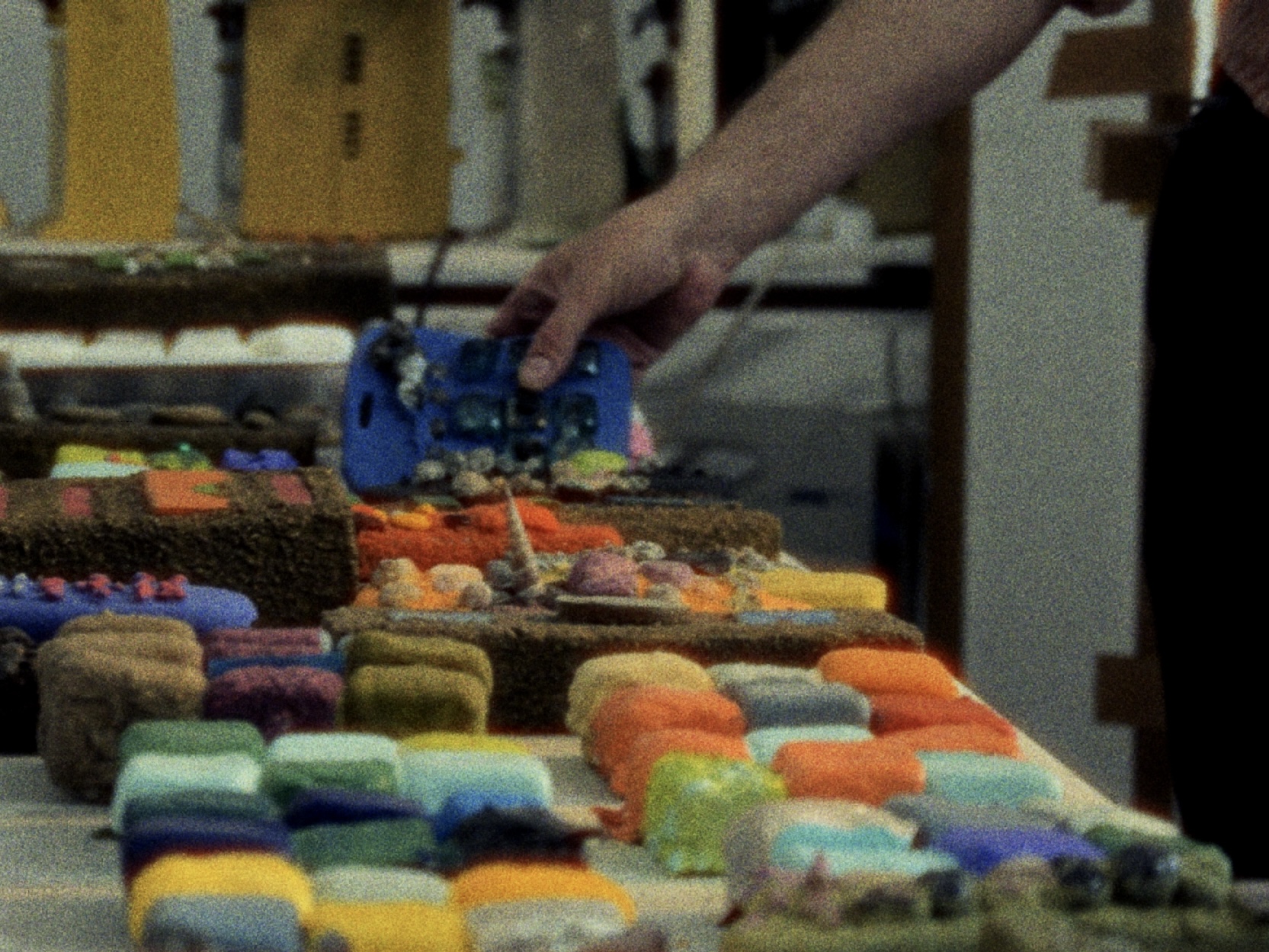
Brian Belott's calculators and remote control works, 2026. Photo by Levi Japhet.
SL:
[pointing to one of Brian’s Marshmallow paintings]
What's this made of?
BB:
These are marshmallow.
SL:
Oh, I didn't know it's an actual marshmallow.
BB:
Oh, yeah.
SL:
It's an actual marshmallow.
BB:
Mm-hmm.
SL :
How do you want, like, someone looking at the work to approach the texture? I mean, I guess you don't want them to touch it.
BB:
No, I absolutely do want them to touch it.
SL:
You do want them to touch it?
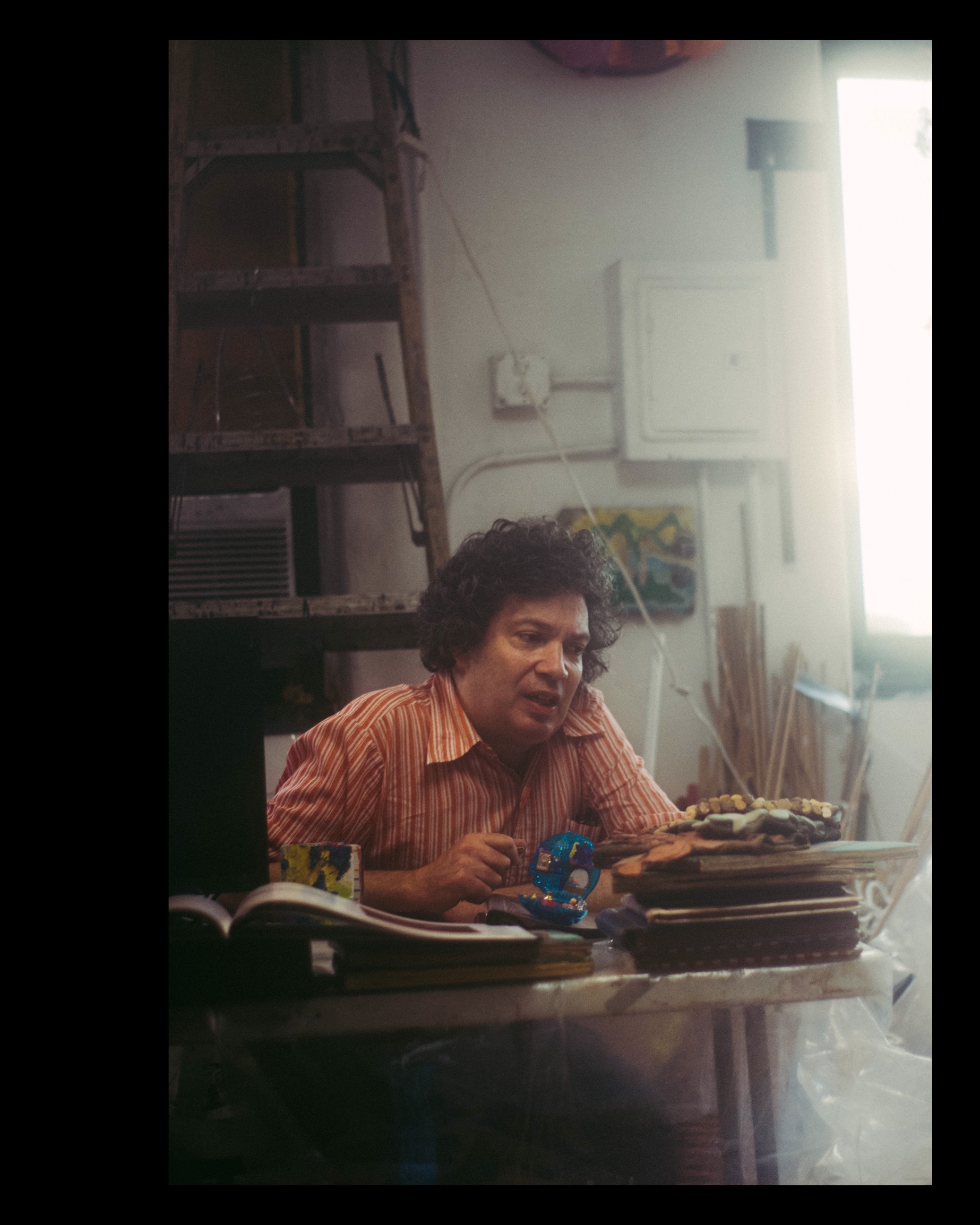
Brian Belott in his studio, 2026. Photo by Levi Japhet.
BB:
Oh, yeah, and it's caused problems. First of all, I love paperwork. I love the notion of paper. I love the notion of drawing, because it is this, like, you know, it's where the sparks fly.It's back to the drawing board, the place where there is no wrong, and, you know, you can make mistakes. So I hated that paper work had to be framed. That's been a big issue for me. As small as it is, it's a big issue. So I made the collage books. The collage books were a way for what I wanted was for the gallery viewer to pick up the drawings in their hand. They're confronted with the library of these collage books, and they pick them up and hold them, hold the drawings. You know? But despite telling the my gallerist and people that work there that they can pick them up, I would get reports that people would come by and then all of a sudden get yelled at for picking up the work. You know, this is the same thing. [points at remove contol works] A lot of these operate as table sculpture.
So like Polly Pocket-
... they're scaled, um, and they function in this way that you hold them in your hand. So you, like a child plays with dolls or little figurines or action figures, they jump into the world.
SL:
Mm-hmm, mm-hmm.
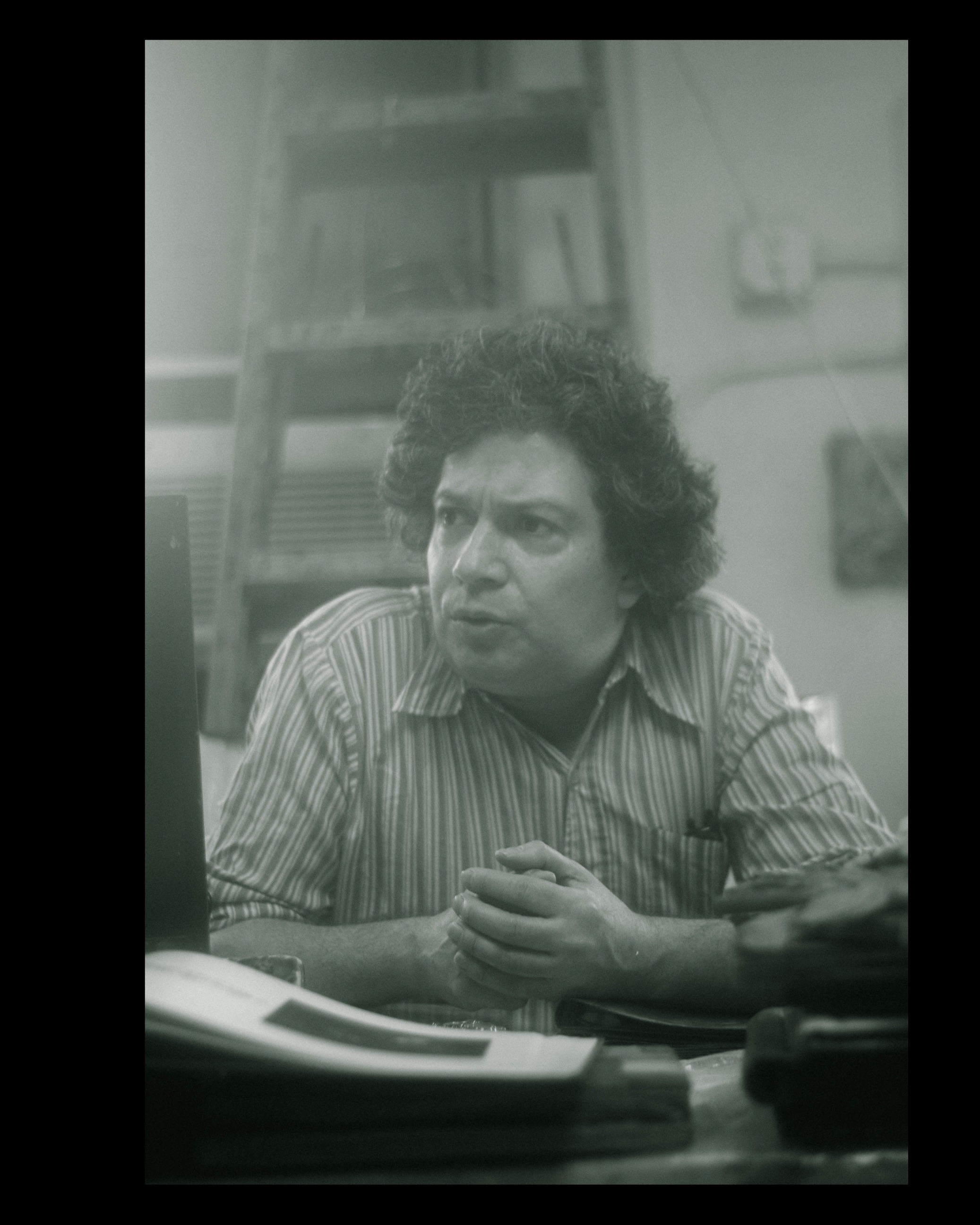
Portrait of Brian Belott in his studio, 2026. Photo by Levi Japhet.
BB:
It isn't like, for instance, Katherine Bernhardt's incredible show where these things are as big as a movie screen.
SL:
Yeah, that's true. These do invite more, like, intimacy or- ... like you said, entering, entering of a, a different landscape and skin.
BB:
Well, that's the thing about the idea of making a masterpiece or a big large work, and that's also why I like Katherine's paintings, they are 10 feet large, they look like they're made very casually. I can't make things that large casually in this studio currently. But I can make a table of marshmallow paintings relatively quick. Something I like about drawing and about making smaller low stakes art is that you can cook up 12 of them at the same time.
And then just like library books, your friends could come, fall in love with different ones, and you can give them away easier. You can't, you know, give away a 10-foot painting. You can't give away a six-foot painting. You can't give away a three-foot painting. You know? So there's something I like about being able to give away work, though it counterintuits the idea of scarcity and worth in the art world.
SL :
It's very cool that you do that.
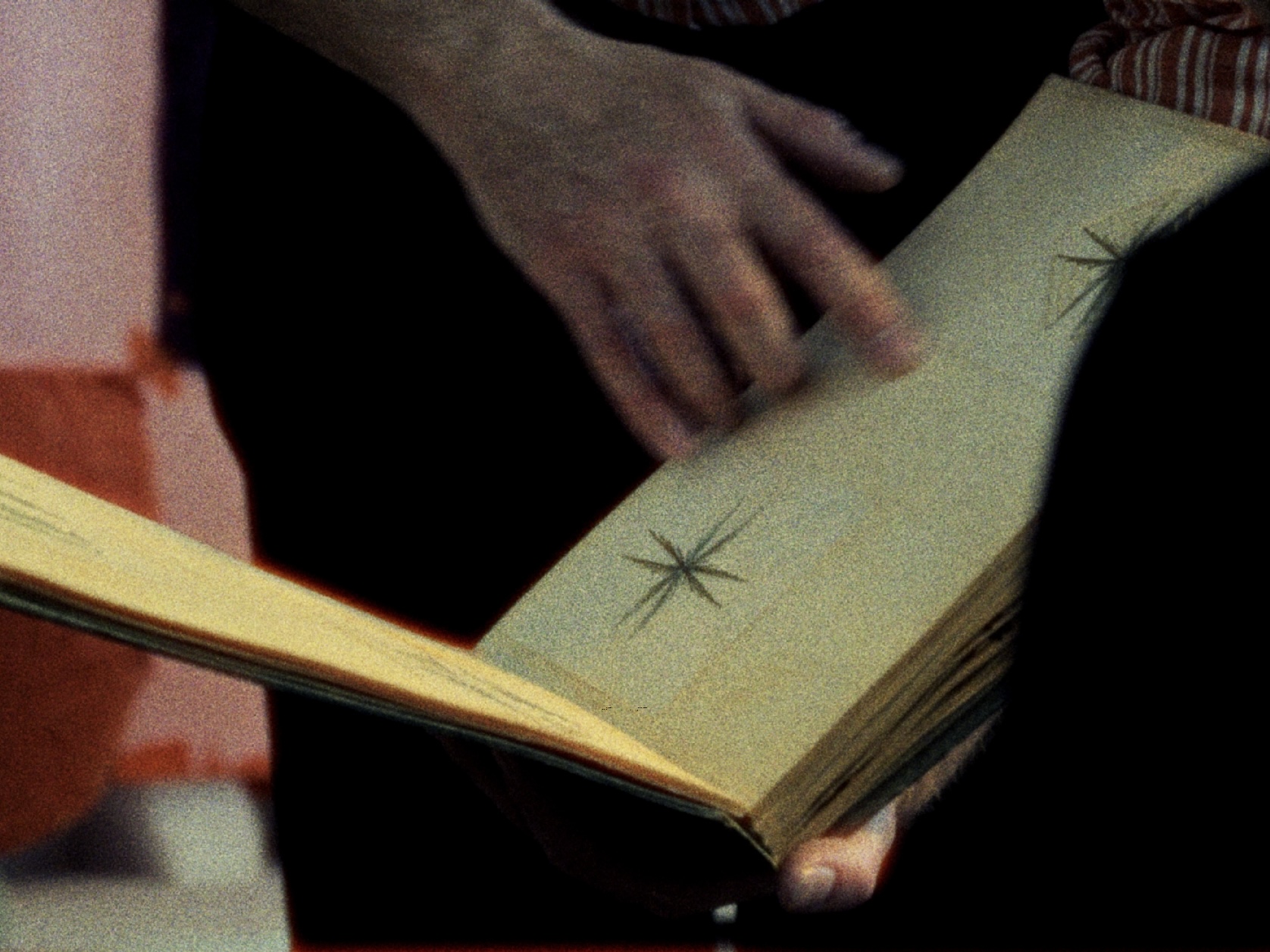
Brian Belott with a notebook in his studio, 2026. Photo by Levi Japhet.
BB:
A lot of these works are about basic building blocks. Like this [holds in his hand a little notebook filled with hand-sewn geometric patterns] is a book actually of very early techniques that Friedrich Froebel would teach. This is when sewing was more prevalent. This is from, like, the teens. But, like, yeah, so a lot of these things, like my remote controls, it actually all started in the dollar store.
Where I just picked up, um, calculators, and I glue rocks to them. And then after a while I felt that that was, like, too dada or too raw, and I wanted to aestheticize it more. So I started covering the calculators' bodies with colored sand, dirt, even crushed up Doritos.
SL:
Oh, wow.
BB:
And, and then you know, um, changing up the rocks and dipping them... And so what started as kind of dada-ish gesture turned into a Méret Oppenheim kind of, like, fur-lined teacup.
SL:
So there's, like, children's craft materials, dollar store stuff. Are any of the rocks crystals, or are they all just kind of, like, dollar store rocks?
BB:
I mean, some are abalone. You know, where I work at, at Donald Baechelor’s studio is right next to the floral district. And so in, there are so many of those stores in the floral district- ... that have every bead and bauble and bangle that you could imagine. So I go there and get different types of shine, stones, and pebbles, and-
SL:
Like, for the bottom of the vase and, like, for the garden you mean?
BB:
Exactly. Exactly. And, and there's aquarium rocks and shells. And some of them I've picked out of rivers or, or the sea myself, or some of them are bought at these craft stores or stuff like that. Some of those wooden things that you were talking about, the buttons, are from Montessori. You know, you teach at kindergarten. Or do you do pre-K?
SL:
Yeah, pre-K. And where I teach, it's Reggio inspired, so that's pretty similar to Montessori and equally Italian.
BB:
Reggio Emilia.
SL:
Yes, exactly.
BB:
Cool.
SL: I was thinking also now just about how, like, remotes and calculators are intimate. You use them in your hand. There's also, like, a kinesthetic memory of the button, how a button feels.
BB:
Yeah. Yeah. And the other thing is, is that I really love the grid. I love the grid because it's something that it can be relied upon, that then you can mess up, like building a tower and then knocking it down and building it again. I use the grid a lot in what I do to counteract the more wacky moves.
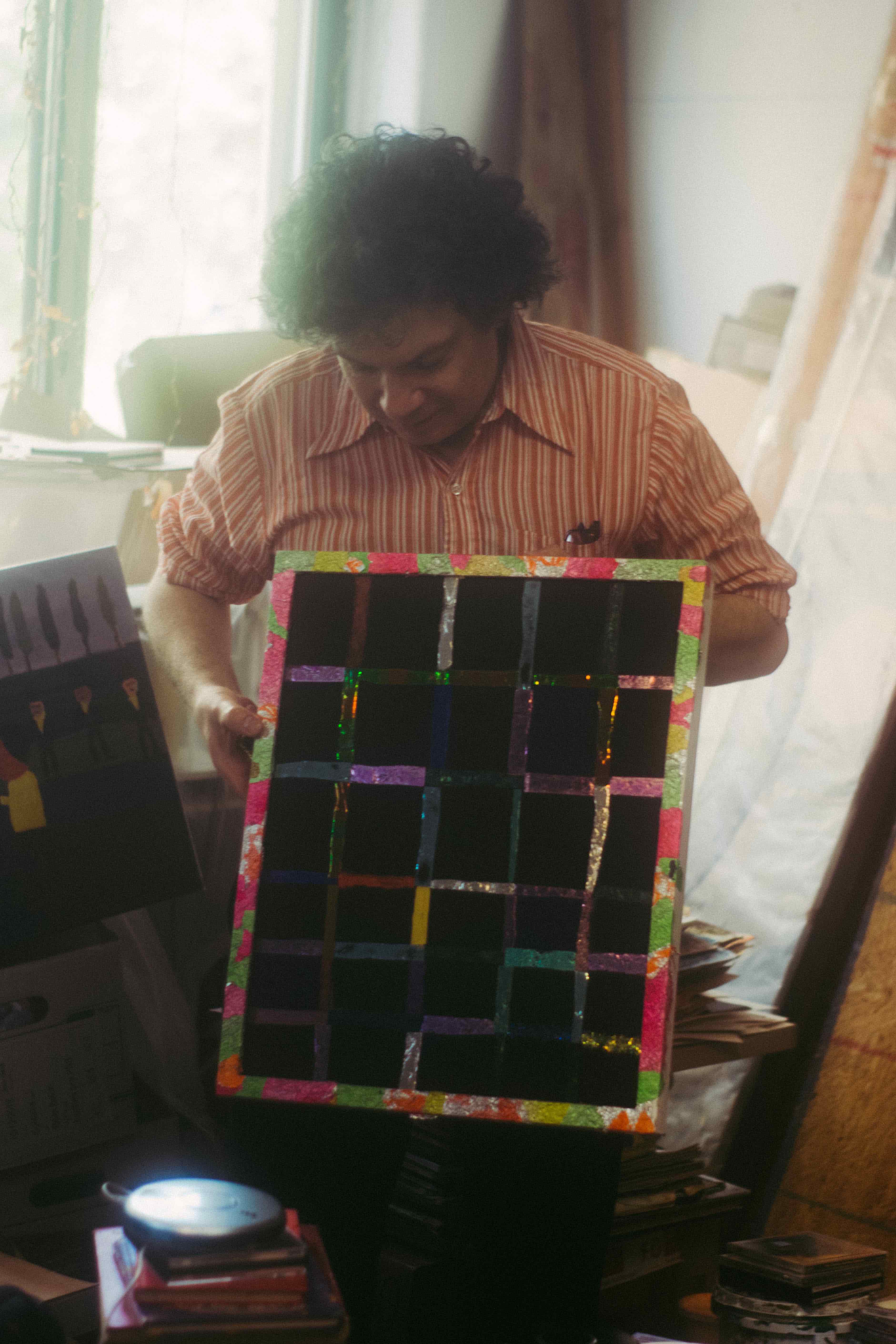
Brian Belott in his studio with a revese glass technique painting, 2026. Photo by Levi Japhet.
SL:
To give you like a structure to go against?
BB:
Yeah, exactly. So a form of rhythm, but it's a form of counting, a form of block play, all, all these kind of primary counting, you know. And then people project on them in the sense that it kind of is like ancient future or something along those lines. And, uh, you know, sooner or later, buttons will be phased out and the computer will be bastardly, you know, we'll be moving the mouse with our eyeballs. I'm sure that that's already happening.
SL:
Mm-hmm. That makes sense.
BB:
So people project on them in that way, but really it's more formal to me, and it has more to do with like, boop, beep, bop, boop, ba, boop. You know, it's like way more about making a very primary push button thing. Like, just being, holding this and pressing it. A lot of times the things do crumble, and then I have to come back and fix them for people.
[We look at a child’s drawing of a smiling cat lying lazily on its back. This one must be drawn by a child who’s around 8 years old.]
Those are just drawings of stuff.
SL:
Very zappy. Like, you know, lightning zaps.
BB:
Yeah. Yeah. I went through a period where I was doing things that were fuzzy or zappy. Uh, ... or wobbly. You know, like I really see the kind of wobbly line, the wave signal line as being, um, more or less how we all operate.
[We look at an album filled with 6x8 photographs]
BB:
These are found photography. I love amateur photography, just like children's art is amateur in a certain way. It's something that obsesses me, the idea of what is an amateur. A lot of times I find amateur work more compelling than professional work. You know, um, I tend to believe if I hear someone got a doctorate or an MFA, I just wanna walk away from them, because I think they've, they've been processed too much. Um, but so yeah, I used to live in Green Point, and there was a place called The Thing, and it was a fountain of found material. For five years I would go there and just scoop up some of the most amazing stuff. So these are all from different places and then collaged together.
SL:
They're also super textural, like the actual pictures. Like this woman’s veil, this pebbled pavement.
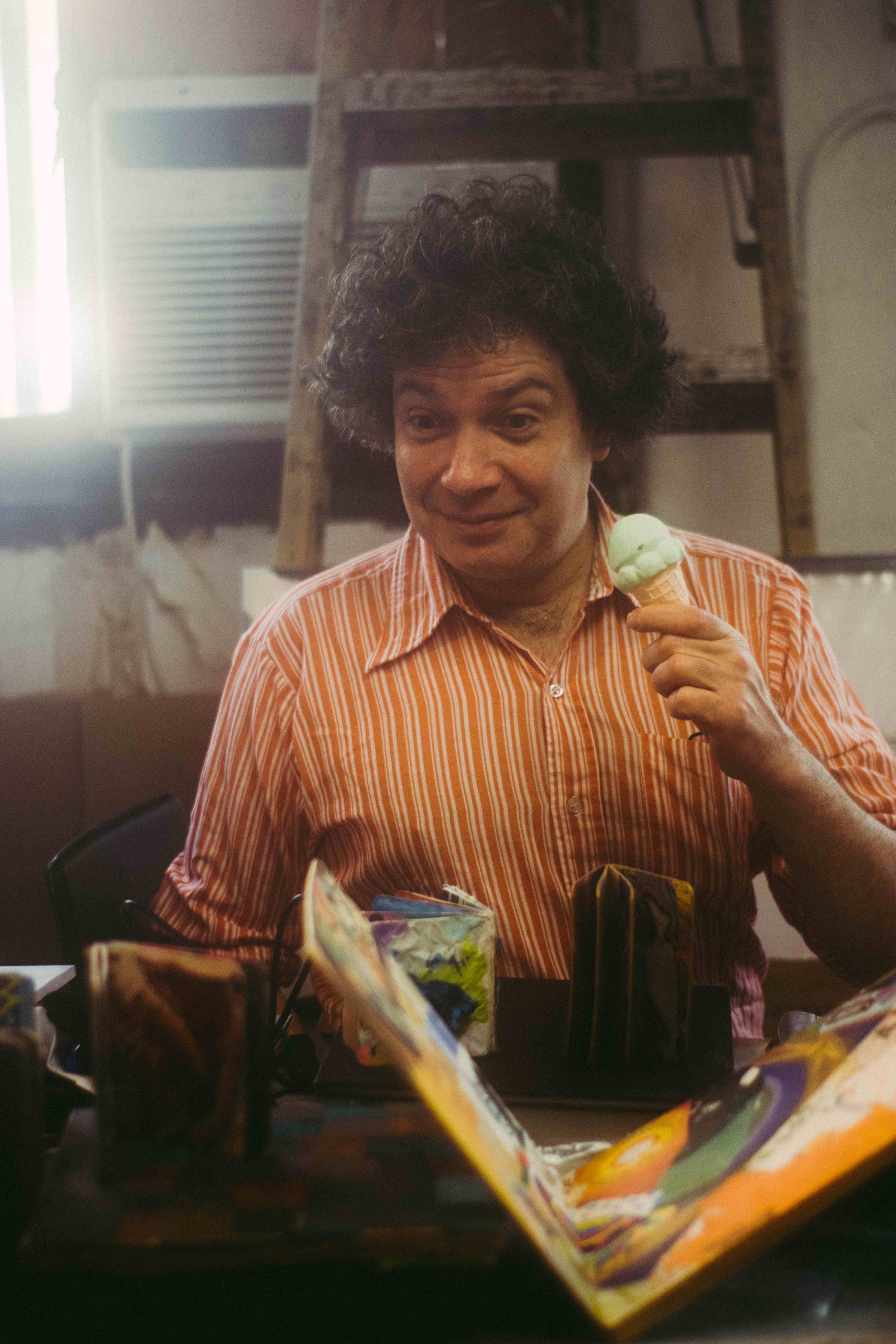
Photo of Brian Belott in his studio, 2026. Photo by Levi Japhet.
BB:
This is a collection of mistake photos. I really love the idea of mistakes, the old analog mistakes. Strap gets in the way, um, blurred camera, opening the back of the camera and exposing the roll.
Um, so this collection also has asound, um, version. I collected found sound and got a lot of it on WFMU. I was friends with someone named Michael Pool who ran the Audio Kitchen. So I would go around the states collecting answering machine cassettes and reel-to-reels and Recordios and digitizing that. Something in the future that, you know, I wanna get back into is tofigure out a way to bring sound into the gallery, which is always very difficult. How do you bring sound in without it being lost? But, you know, I had the equivalent of all these found domestic photos. I have conversations between kids and grandpas and grandmothers and, and drunk uncles and excited, crumbling relationships all documented, uh, uh, you know, digitized.
Cassettes, reel-to-reels, Recordios, acetates, every format going back to the '30s. I get them on eBay, all over the place.
SL:
Oh, wow. Yeah, I mean, sound in the gallery space, it's another sense to bring in, you know? There's touch, and maybe smell, like the marshmallows I guess. Like your ears would be very pleased as a viewer.
BB:
Michael Mahalchick did a great performance called It, and, um, it was a performance where he put his show together in the dark, took about two hours, and he did something along the lines of where he kind of referenced, um, Smell-O-Vision. You know, that John Waters film that came out with a card, and you're supposed to scratch it during different parts of the film. Mahalchick did this performance where there were eight scents. So he went in there, there was incense he lit. At another point, he was peeling an orange. Some of the time he was brewing coffee. It was an interesting thing, bringing scents in, you know.
Back to thinking about the auditory, I did this project a couple years ago where I was making songs kind of under the guise of Instagram songs and leaving them on people's phone messages, you know?
I did it, like Zwirner had me in their shop, and so, we decided to activate this project, which is this idea that I do sound scribbles. If people call me up, I call them back, and I leave a sound script. Then Jamian Juliano Villani, like, reposted it. All these people called me.
SL:
Uh-huh.
BB:
Annie Armstrong actually called me, amongst a lot of people, and I would go back and just leave these improvised songs, you know? And the only thing is that I would love to figure out how... I wish people saw them, that they were monetized, like, after the fact. I wish that my gallery would go and then buy all of them from the people I left, and then these things would have a currency. You know, I thought that, like, NFTs, if there was anything that was interesting about it or interesting to me, it was nothing visual. I thought some of the visual work was tremendously corny and crap. What I was interested in is the idea that poets and dancers, performance artists and musicians could monetize these scraps of performance. That's what I thought was interesting, you know?
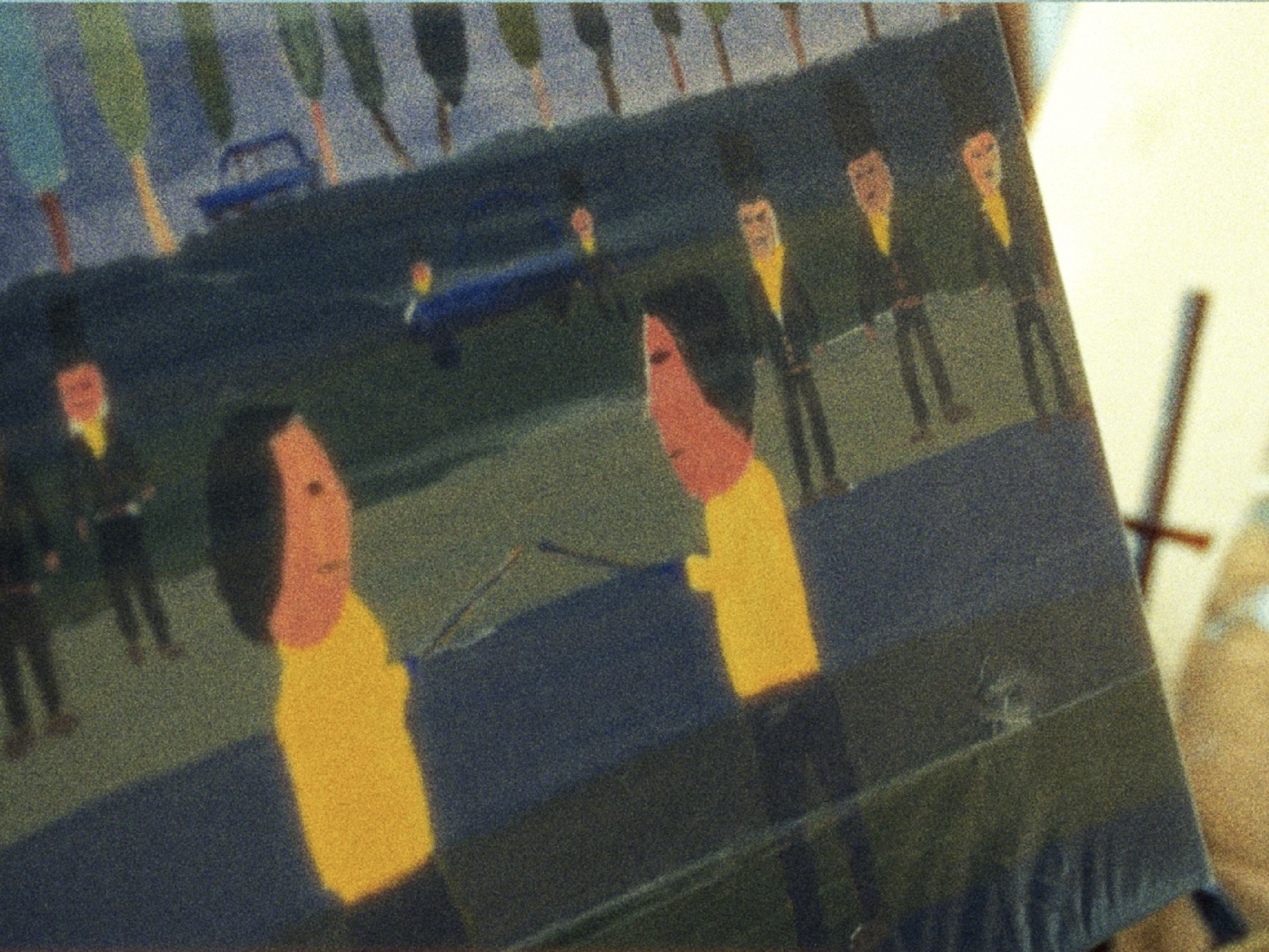
Brian Belott, painting inspired by children's art from the Rhoda Kelogg collection. 2026. Photo by Levi Japhet.
SL:
[This whole time, in the studio in real time, muzak plays softly out of a CD player]
I notice you’re playing muzak.
BB:
Yeah. I love, um, clip art music. You know? Like, kind of a personality-less or elevator music, wallpaper music.
SL:
Yeah. What's over here?
BB:
Um, these are some paper collages. This one's wallpaper.
SL:
Mm-hmm. Like, is that found texture?
BB:
For me, half of collage is color. Just like painting, there's color. Um, you know, you are as good as what you collage. I think if you collage garbage, then you're gonna come up with garbage. So I go through, um, the garbage, and I look for things that are from the '70s, '60s, '70s, '80s, you know, uh, because of the way they were printed, the way that the ink sits on the surface of the paper. It's very painterly to me. Um, this earlier stuff, it's saturated color versus, you know. More digital forms of printing I think feel pretty much dead.
SL:
Yeah, they do look alive. Is that a leaf?
BB:
Yeah, that's a birch tree and some stuff.
SL:
Oh neat, that's unexpected and fun.
BB:
I like to make art to have fun. It wasn't to make all my colleagues in New York's jaws drop. You know? And there's something about the unpretentiousness of a practical joke that I'm interested in, and I think that that's the kind of world kids live in. They don't have the adult stakes resting on their shoulders. So sometimes I believe maybe artists are making the best art when they don't know it, and when they're making art, they're not making it. So that's just, like, a little inversion that's based on the idea that children's art is free because it isn't encumbered by the stresses, the pressure cooker of history, of professional ambition.
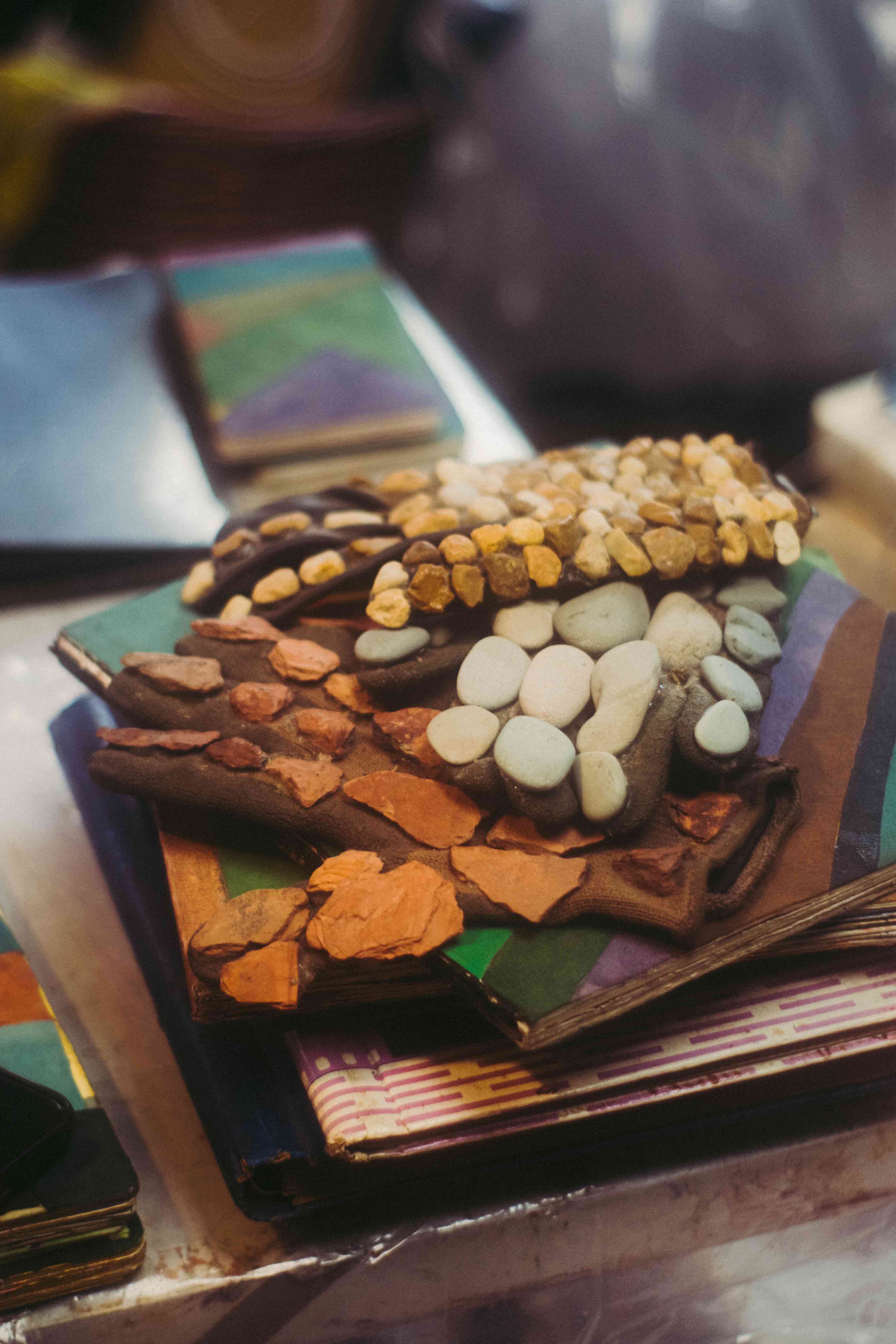
Brian Belott, Glove pieces in his studio, 2026. Photo by Levi Japhet.
SL:
Being a professional artist, is it easy for you to step into that carefree practical joke mindset?
BB:
Well, late night and early in the morning.
… and in the shower.
When I was a kid, I was so jittery. I was so wound tight. Like, my feet couldn't stop in bed. You know, or I was constantly getting in trouble all throughout elementary school and high school, and then finally by Cooper Union they threw me out, and it all had to do with this tightly wound hyperactivity, you know? And so that is my happy place. Alot of times, when I'm talking as a visiting artist, Italk about the idea that I like to make art from a place of... Like, think about when, when you go on vacation, and when you're at the airport, and now you're just like, you know you have about 11 days of fun. And your whole attitude has changed, and you're way more open to creatively thinking, even with mistakes, you know? I think that when you lose that bandwidth, and that a lot of times happens in crunches, you lose a whole spectrum of options in, in neuroplasticity.
SL:
Yeah. I feel like that's where your work exists, in that bandwidth, in that frequency of hyper-association and openness.
BB:
Yeah. You know, I'd rather not make any sense, and that's what, if anything, when I get freaked out about, like, presentations or interviews, is I don't wanna give the right answer. I'd rather not give answers. But I feel as though, uh, in a certain way, we've been programmed to do that. You know?
SL:
Programmed to giving answers?
BB:
Yeah, because, like, it feels as though if everything's free and everything's possible, you somehow have to give a legitimate thread of how you arrived there. Or people wanna know that. Why this abstraction? Why this color? Why are you rolling on the floor? Why are you making this noise?
SL:
Yeah, or why, you know, like, "Why paint like a child? If my child could do this, why, why are you doing it?" Right?
BB:
Yeah, that sort of thing.
SL:
Do you like to play? Do you play? Is that what you do? Is it your adult form of play, making art? Do you feel like that when you're doing it? Are you like, "woohoo!"?
BB:
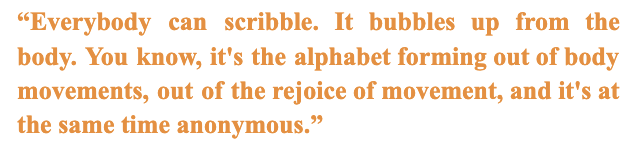
Yeah. And at the same time, I think a lot of the art that I'm interested in, including the scribble, I remember when I was living in Greenpoint and I was doing a lot of mushrooms and I would just do these collage sessions. And really, I would just start laughing, saying, "I'm nothing. I am nothing." And I'd feel like I’d broken into everything. You know what I mean? Like, the scribble is like that. It's anonymous by its very character. It erases memory. Everybody can scribble. It bubbles up from the body. You know, it's the alphabet forming out of body movements, out of the rejoice of movement, and it's at the same time anonymous. The children's art, the found photography, all this great art, most of it is not considered art. I'm interested in bringing that into the fold. At the same time, I love the hardened brands, you know, I don't have a problem with that.

SL:
Wow. That's really good.
A choir of one.
BB:
Yeah. And at the same time, I think a lot of the art that I'm interested in, including the scribble, I remember when I was living in Greenpoint and I was doing a lot of mushrooms and, and I would just do these collage sessions. And really, I would just start laughing, saying, "I'm nothing. I am nothing." And I'd feel like I’d broken into everything. You know what I mean? Like, the scribble is like that. It's anonymous by its very character. It erases memory. Everybody can scribble. It bubbles up from the body. You know, it's the alphabet forming out of body movements, out of the rejoice of movement, and it's at the same time anonymous. The children's art, the found photography, all this great art, most of it is not considered art. I'm interested in bringing that into the fold. At the same time, I love the hardened brands, you know, I don't have a problem with that.
SL:
It's always nice when people bring other things into the art, like other worlds. You still have your freezer?
BB:
Oh, yeah. That's next door.
SL:
Let's go.
[we arrive at studio room numer two, a few doors down the hall]
Oh wow, it’s like Brian Belott takes over the world, huh? Or at least Flatbush.
[Brian walks across the room, puts on a pair of gardening gloves and opens a meat freezer. He kneels and takes out an ice painting.]
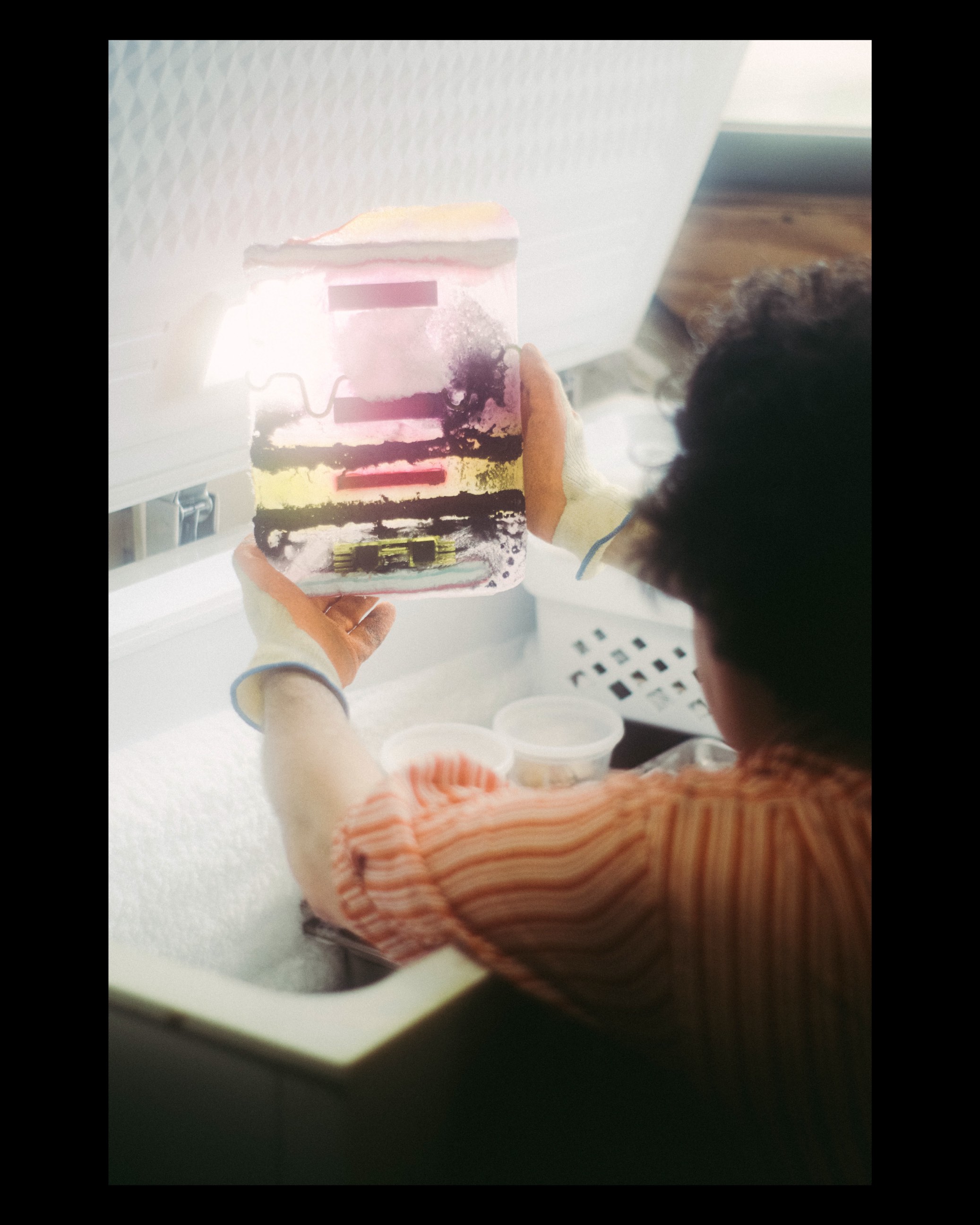 Brian Belott at his studio freezer with an Ice Painting, 2026. Photo by Levi Japhet.
SL:
Oh, man. Yeah, this is genius. You're truly an innovator of the art form.
BB:
Thanks.
SL:
This really, really blows my mind. I couldn't believe it when I saw images of the show at Gavin Brown with all the freezers and-
BB:
Thanks.
[he picks up another ice painting. Embedded into the ice is a piece of printer with a colorful scribble in colored pencil.]
SL:
Oh my God, is that a children's drawing inside ice?
BB:
Yeah, yeah, exactly.
SL:
Oh my God. I can't believe that it works like that.
[Brian picks up another piece hat’s lumpy and yellow.]
BB:
This is actually from the Whitney Biennial. It's, uh, made of mustard.
SL:
That's so disgusting.
BB:
So this is a work that was, um, at the Whitney Biennial, and it's made of mustard. Um, this is a sand pull from making the remotes. This is unopened clay.
Yeah, and-
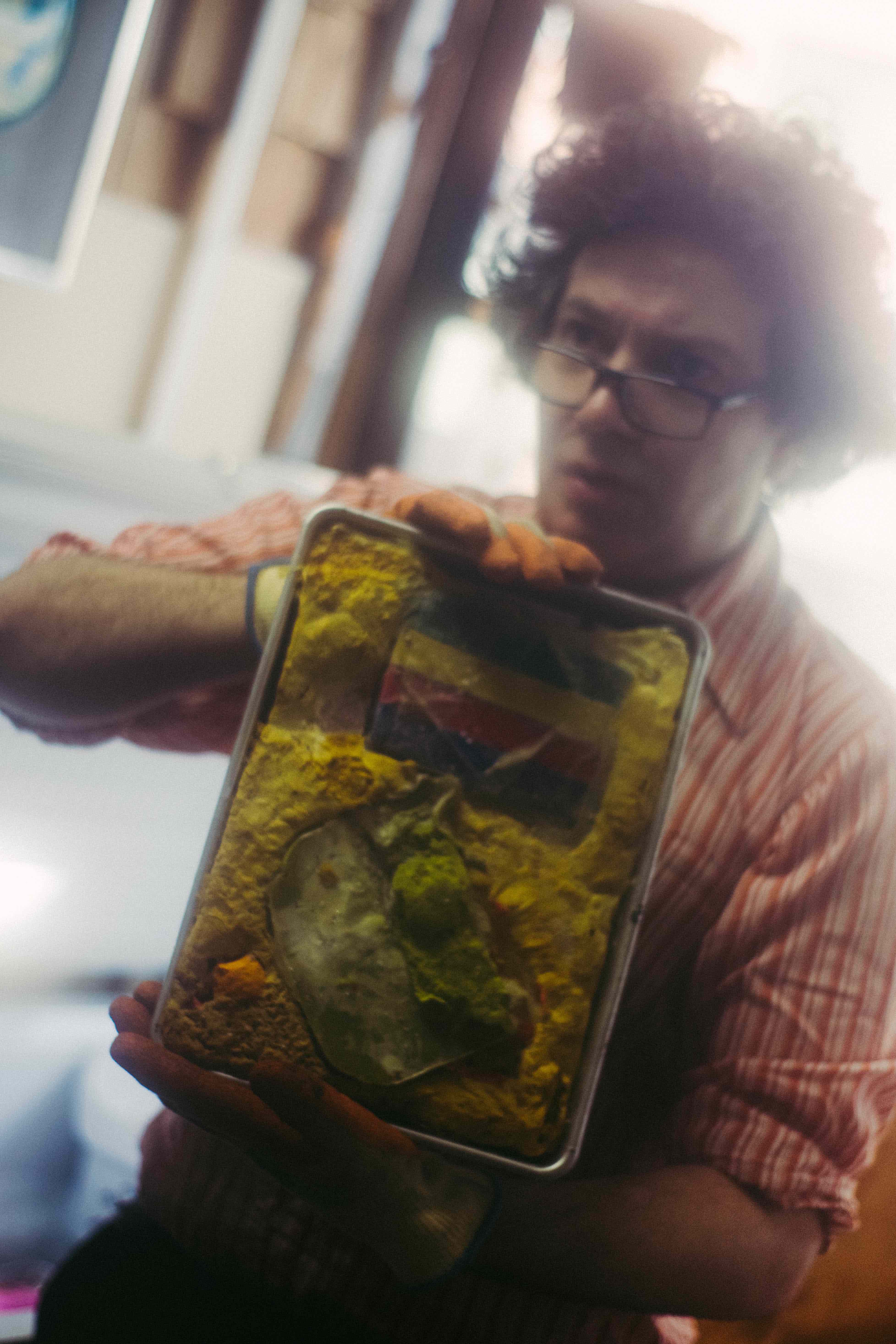
Brian with Ice Painting, 2026. Photo by Levi Japhet.
[He picks up another.]
BB:
Yeah, and-
... that, that is made from, um, kids' toys, blocks, uh, puzzle pieces, Aquafresh, um, also, uh, black toothpaste and hair gel.
SL:
Oh, black toothpaste. Like, um- Activating charcoal. It's insanity.
BB:
So this, the work you're looking at is about three years old. And it was never rejuvenated. When, when the works were at the Whitney, they had a team that was more or less keeping them alive. Because what happens is, is, since they're not a closed system, they start to evaporate.
SL:
Oh.
BB:
This is a cotton ball dip. And the notion really just came from playing around at just thinking about what happens if you change the, um, glue? Like, what binds stuff? Well, why don't you just use ice, you know? But then, then I started to think, "Well, you don't need to just use ice. You could use hair gel."
SL:
Mm.
BB:
You know? And I like this idea that, that it's kind of like luminescent, like, stained glass. But then I started to add really disgusting things, like cat food and food products. And it's funny, 'cause I would leave the room and put on gloves and say, "Hey, I just need to show you this," and pull it out. It'd be a steaming piece of like, you know, stained glass made with cat food and hair gel.
And people are like, "What the..." You, you know, it almost was a performance-
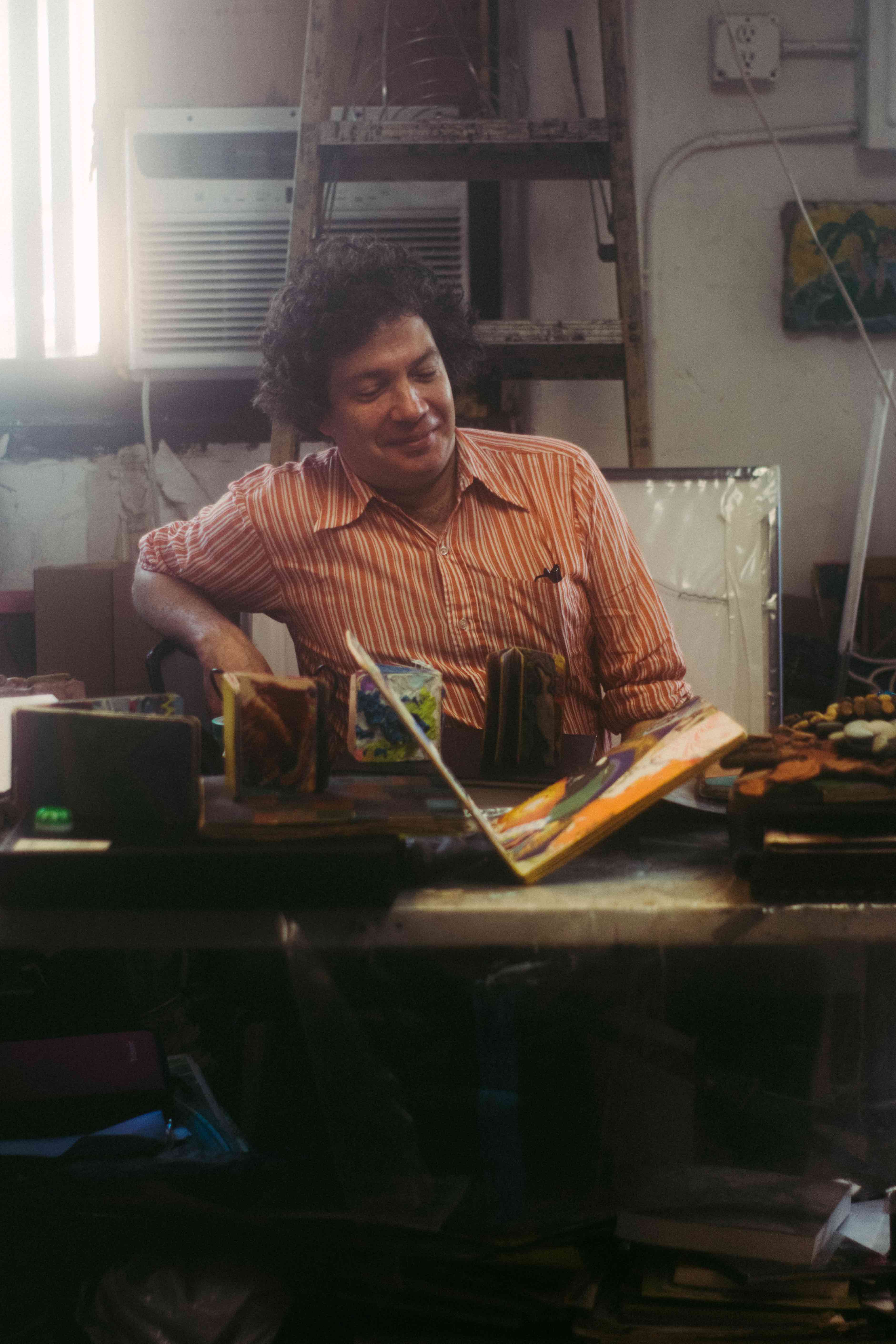
Portrait of Brian Belott in his studio, 2026. Photo by Levi Japhet.
SL:
Yeah.
It's food and anti-food also.
BB:
... it's turned into, like, its own terrarium or aquarium-... of frozen crystals. But, um, you know , just over the weekend, I was just at alecture. Josh Klein, and he was talking about his history and, you know, supposedly his parents were both, scientists. And so at a very young age, his father gave him test tubes, and he filled them with Coke and different materials. You know, where I grew up is East Orange and it was very influenced by Thomas Edison, like his laboratory and this notion of this guy who had brought in the modern world, blah, blah, blah, blah. Um, so from a very young age, I was always playing chemist and pouring stuff around. So again, the idea of, like you're saying, cooking. This is like kind of wackadoo version of that, you know?
SL:
See, but you're not really talking much about cooking, yet so much of this is kitchen related. You've got mustard, you've got marshmallows, you got a freezer. You know, maybe next you're gonna bake it, like-
BB:
If I knew more about cooking or chemistry–-which I really think of as the same thing–-it would probably really inform the work. But a lot of times I like the idea of going into something that I have no business being in at all. It’s like the audacity of children going into things they have nothing to do with. I don’t really like professionals or the idea of being a professional. I’m immediately suspicious of someone who’s an expert at something, you know?
This is an early painting from high school. I took a photograph of this painting of Mozart and reproduced it. Then I fed it porridge.
SL:
Oh, wow that’s whack. That's what the stain is. You were already doing goofy shit in high shcool, huh. Well, you said you, like, we're troublemaker.
[We turn to examine some of Rhoda Kellogg’s collection of children’s works, stored in Belott’s studio.]
[Next, we turn to examining some of Rhoda Kellogg’s collection of children’s works, stored in Belott’s studio. Piles and piles of children’s drawings and paintings sit on tables filling the room.]
BB:
The children's art thing [working for the Kellogg Foundation] that kind of flopped in my lap that I've been working on for the past ten years has transformed my life, and it's probably the happiest thing that’s happened to me. It makes me so happy, you know, because I get to peer into the infinite through the collection, you know? And, uh, and becausechildren's art is worthless, it's the most valuable. Again, the union of the opposites in a certain way. Uh, so, you know, here's a picture of Rhoda watching a finger painter.
[We begin to leaf through a giant pile of children’s drawings. We pause at one. It depicts a closed closet. At the top of the doors, a few hangers are hung over the doors. From each hanger hangs a stuffed animal wearing swim suits]
SL:
Oh, that's so good.
BB:
Isn't that wild?
SL:
I don't even know what they are exactly.
BB:
I don't, either.
SL: People hanging on hangers.
BB:
I wonder if it's, like, dolls or teddy bears or something. Yeah, it's very, you know, surreal and-
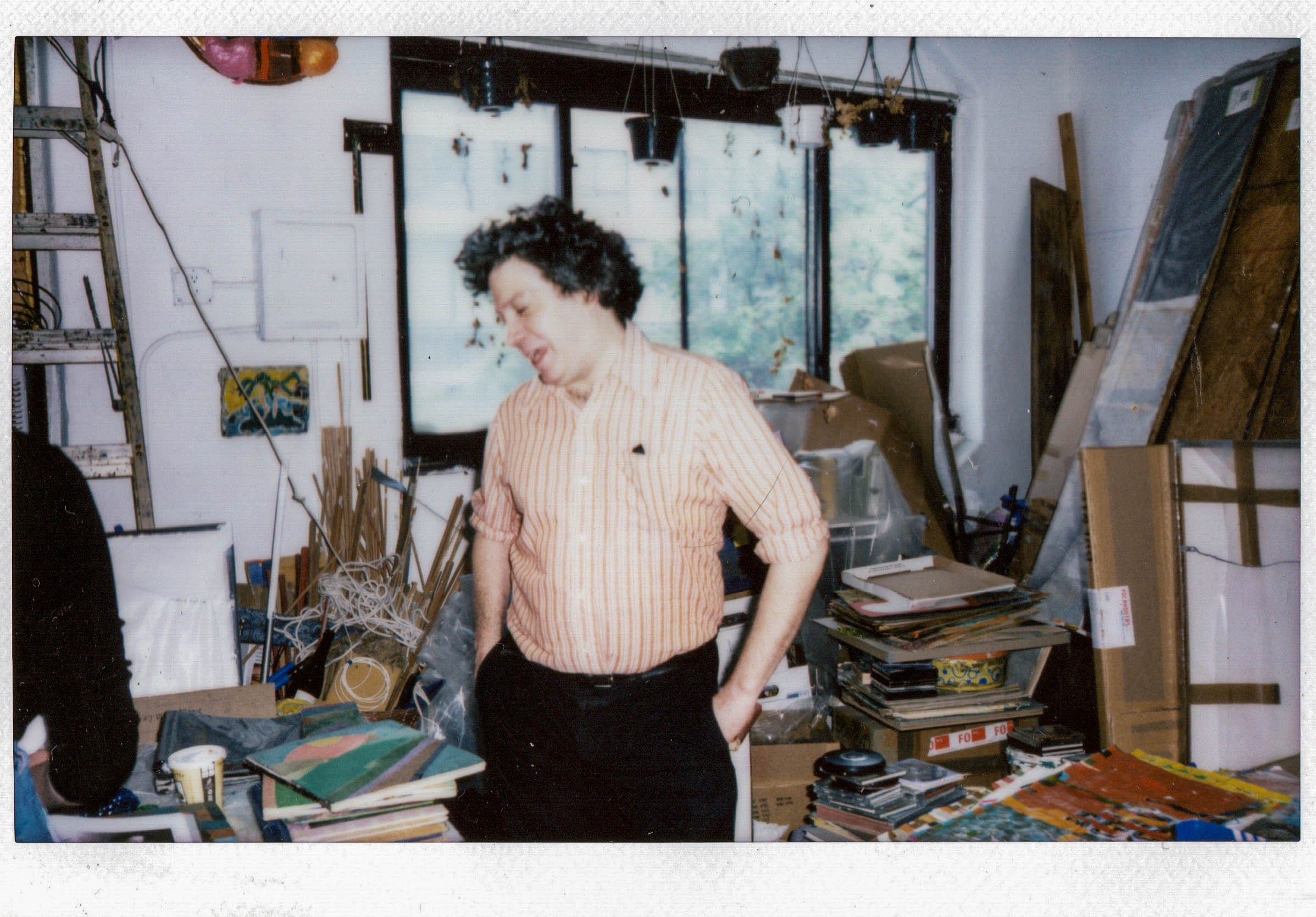
Brian Belott in his second studio, with piles of the Rhoda Kelogg collection, 2026. Photo by Levi Japhet.
SL:
Yeah, the fun thing about when you actually work with kids, and then they, like, explain it to you, those are always really good, when they're like, "Oh, yeah, I was drawing my closet, and these are my family." You know? Like, sometimes they're unexpected. "We're going swimming, and we needed to dry off." You know? You never know what they're gonna say.
BB:
I also love the in-between world of not knowing the story. To a certain extent, I think this work should remain invisible to adult questioning.
When Rhoda Kellogg published her books, she did a couple world tours, and so then collected children's art from around the globe, you know. So, like, this is from Iceland here. Look at this one. Look at the pattern in that one. Whoa.
SL:
The colors are so good.
BB:
Whoa. Shit. Look at this. It's like a jungle gym, and then a twisting vine around it, and then the twisting vine of this tree and all the birds.
It's such texturally dense designs, but to then activate it all in the mind's ear with birds flying… You know?
SL:
The mind's ear! That's good.
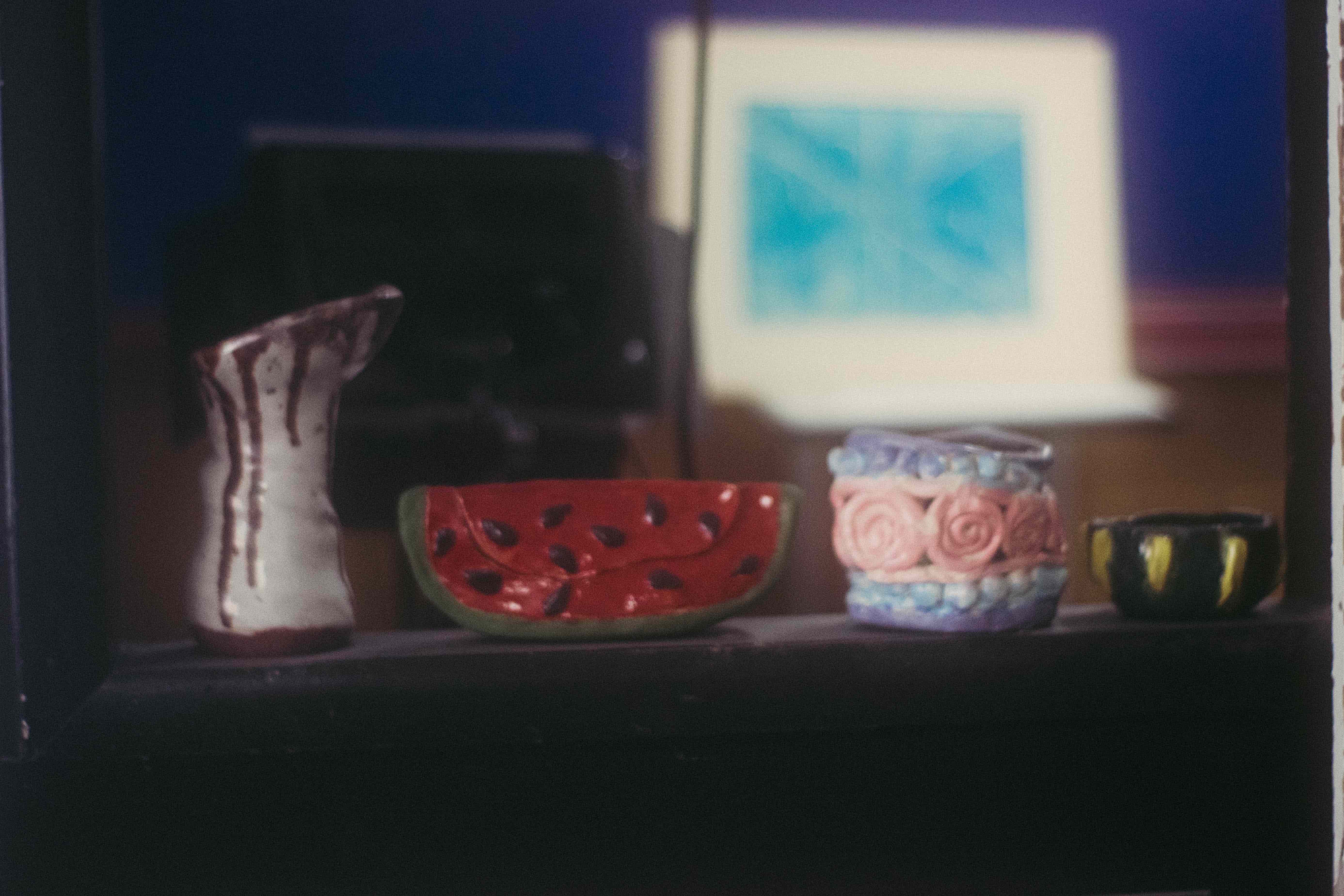
Ceramic objects in Brian Belott's studio, 2026. Photo by Levi Japhet.
BB:
This one's from India. Look, look how Paul Klee-like that is.
SL:
Totally.
BB:
Isn't that wild?
[proudly holds up a child’s drawing. It’s of a singular crayon scribble, the rough shape of an oval, carefully lasooing into itself. It’s clear it’s a drawing by a child who is around 2, maybe 3 years old]
SL:
Wow, Kellogg was so, um, careful, huh? She, like, cut the scribbles out, put them on cardstock, then on another cardstock.
BB:
Oh, yeah. She had the utmost respect for children and their art, and in many ways she apologizes to children. But, um, like, she's someone that needs a statue in San Francisco, you know, 'cause she's this, you know, the patron saint of scribbles.
SL:
True.
BB:
And, and what is scribble but this abstract play, the gurgling up of all designs and everything, you know? But adults want to get their cattle prods and hurry the child through the hoops, the adult hoops, and the notions of advancement too quickly. Anyhow here's a scribble where then she cut out the sample, and the reason that it's this kind of stone shape was a way to spotlight what she called the implied overall shape. And then she would slip this thing underneath it to kind of match the color or to beef up the color, so it's kind of like a spotlight of the actor. So all this is really for adults, and to teach adults to respect something as simple as the first closed shape. And so, you know, in scribbling, a lot of it begins as a textural thing. My arm is moving this way. My arm is moving diagonally. My arm is making a lot of dots. And eventually, all of this kind of motor-eye-hand coordination play, um, finally you arrive at the single closed shape. So it's a, it's a big advancement for the child, and she's, like, spotlighting it. But what is this? I mean, it looks like a Richard Tuttle to me.

You know? I think it's, like, such a gorgeous piece. It really kind of reminds me of high modernism. And when I think of it as Rhoda Kellogg, of, I think of her along the lines of someone like John Cage, who jumped into the void of silence and came out with profound notions. In the same way, Rhoda jumped into the well of nonsensical scribbles, and then tweezes out all these profound notions of why we should let the tiny professors, a.k.a. the kids, teach us.
[we look at a child’s drawing of a cat. This one must be drawn by a child who’s around 8 years old]
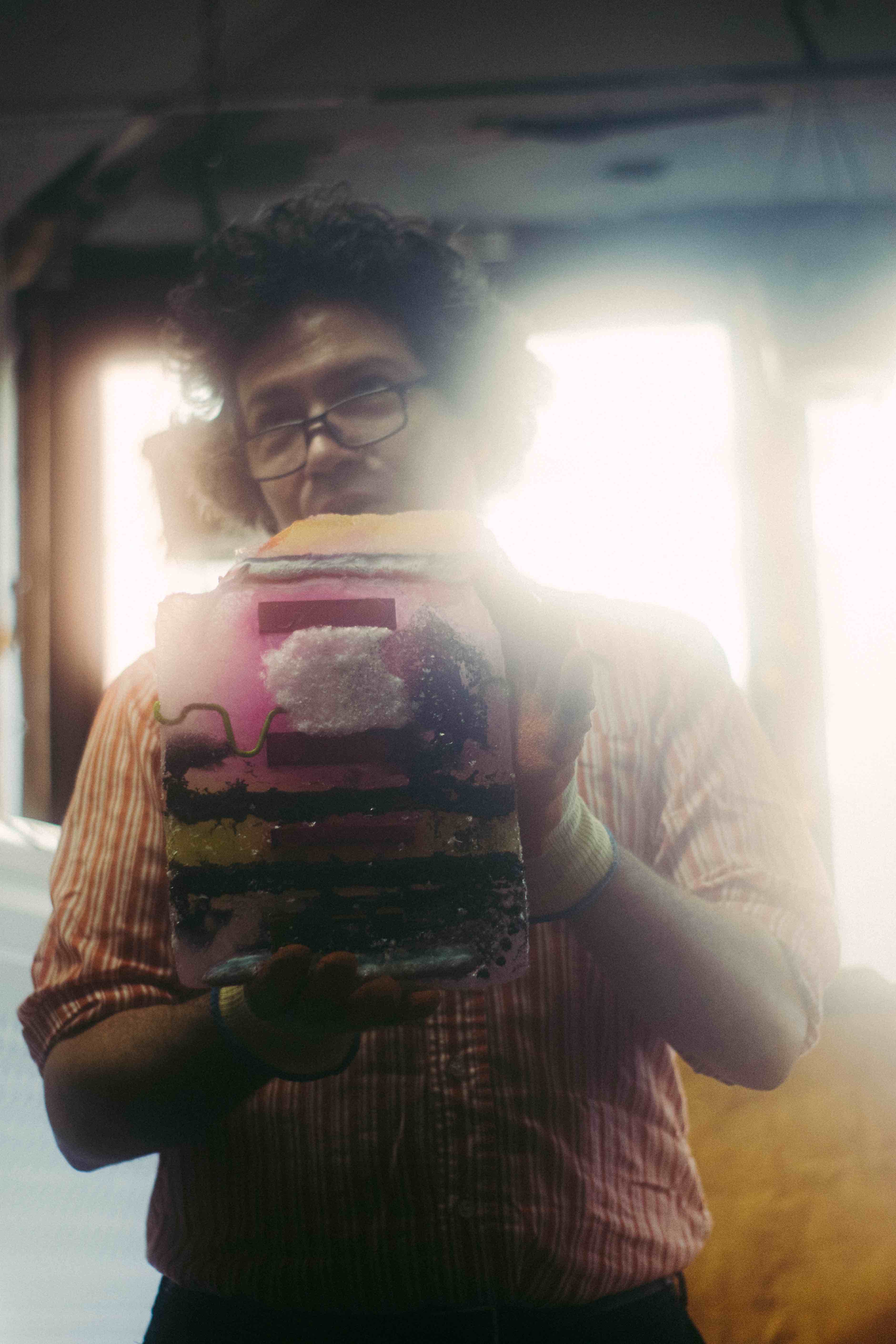
Portrait of Brian Belott with Ice Painting, 2026. Photo by Levi Japhet.
BB:
Oh, I love this one. So good. The toes.
SL:
Yeah, very goofy fingers.
Happy cat.
BB: Yeah, that's a cat that's loving life.
[The next image is of a cow. Also drawn by someone a similar age, maybe 6 or 7 at a guess.]
SL: That's so good. Wow. Weird cow. It's totally a cow, right? It feels like, um, you can see it from every angle as one flat image. It's like the flat earther, but the flat cow-er.
BB:
Yeah, we didn't need Picasso. Look, right?
SL: Yeah, the udders and that. That's really good.
Well, that’s all for now, folks, that sums up my time at Brian Belott’s studio. We could have kept talking til the cows came home, but I folded myself away and left the marvellous scribble universe of Brian Belott for the time being, until next time. We take a bow and begin to digest all the wonderful froot loop milkshakes of things we’ve seen and learned, having starry vision dreams of colors. Can't wait to smell whatever Brian will have bubbling on the stove next.
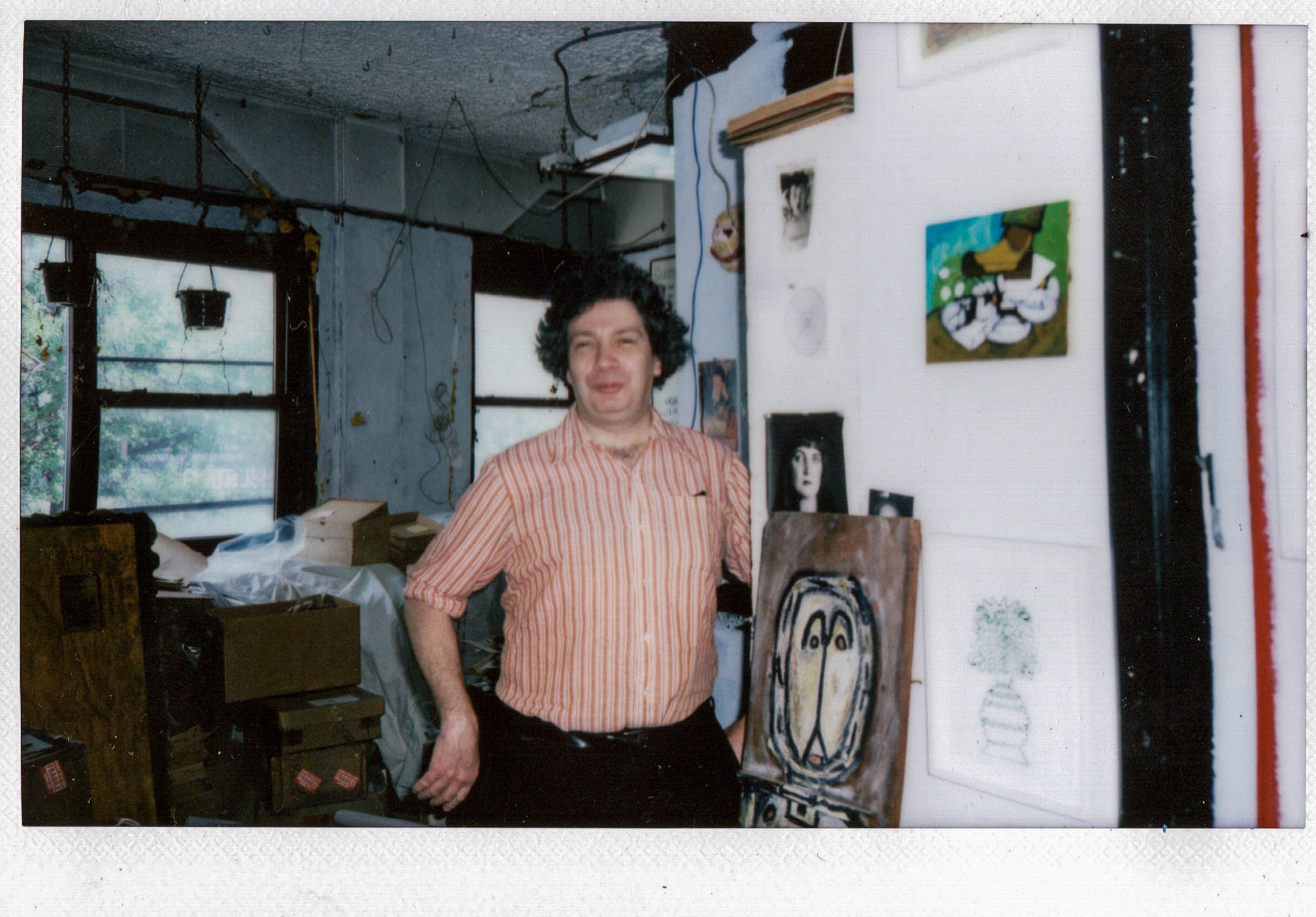
Brian Belott in his second studio, 2026. Photo by Levi Japhet.
Brian Belott (b. 1973, East Orange, NJ) lives and works in Brooklyn, NY. He received a BFA in 1995 from the School of Visual Arts, NY. His work has shown at The Journal, Brooklyn, NY; LOYAL, Malmö, Sweden; CANADA, New York, NY; and Galerie Zurcher, Paris, France. Notable exhibitions include: Call and Response, Gavin Brown’s Enterprise, New York, NY (2015); Jeunes Créateurs à New York, Musée d’Art Moderne de Saint-Etienne, Saint-Etienne, France (2014); and Draw Gym, 247365, Brooklyn, NY (2013). Belott’s work is included in the permanent collection of the Museum of Modern Art, New York, and The Whitney Museum of American Art, New York. @brianbelotti
Sivan Lavie (b. 1992) is an artist and poet based in New York City. Drawing from the realms of fine art and children’s craft, she incorporates materials that emphasize sensory experience, inviting viewers into a colorful, abstracted, playful world. Sivan’s works have been exhibited in The Water Mill Center (NY), Magasin III Jaffa, Beit Hatfutzot Museum, HIT Gallery, Satellite Gallery, Gapäckausgabe, Öff, Angus-Hughes Gallery, Barbur Gallery, Rothschild Foundation and Kupferman Foundation. Sivan published chapbooks with Inkfish Studio and Earthbound Press, and her poems and short stories appear in Hobart Pulp, SPECTRA Poets, SUDS Zine, KEITH LLC, The Burning Palace, Happy Apple Press, Care Where? Zine and Beepy Bella’s Fairy Book. @s.i.v.a.n.w.o.r.l.d
The photographer, Levi Japhet (b. 2000) is painter and filmmaker based in New York City. @levijaphet
Sivan Lavie
Sivan Lavie is a poet, arts writer and visual artist based in New York City. Sivan published chapbooks with Inkfish Studio and Earthbound Press, and her criticisms, poems and short stories appear in Art Spiel, Hobart Pulp, SPECTRA Poets, SUDS Zine, KEITH LLC, Happy Apples Press, Kids of Dada and Avenir Magazine. @s.i.v.a.n.w.o.r.l.d
view all articles from this author