Whitehot Magazine
October 2026
"The Best Art In The World"
"The Best Art In The World"
October 2026
Staging The In-Between with Sarah Ringrave
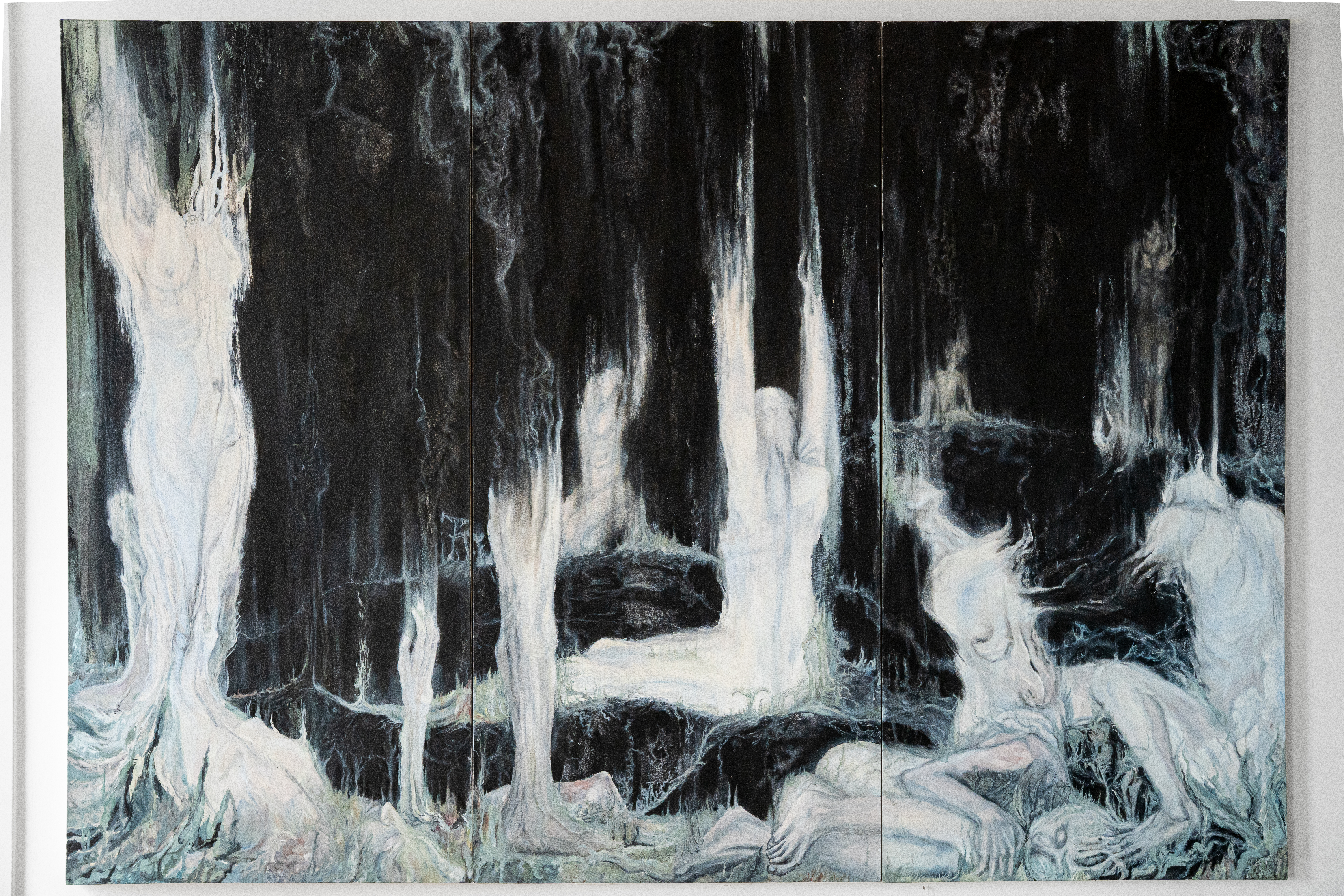
Sarah Ringrave, Continuum, 2026
By: MYLES FUCCI April 28th, 2026
Myles Fucci: During our visit of your show Vessels Between at Fugue Gallery, you mentioned how a lot of your work involves elements of transformation, both physically and spiritually. I see a similar effect with different materials you use such as oxidized gold leaf and solidified wax in pieces like amulet or reliquae. How important is it that your materials embody the same processes you’re exploring conceptually?
Sarah Ringrave: That’s an interesting observation, and why I appreciated our convo. I believe transformation is essential to the process but it’s not necessarily a conscious decision I’m making. Transformation is like change or death, it’s completely inevitable, and for better or worse, unavoidable. It’s very important to me that the materials carry the same sense of transformation as the work itself. Most of my work comes from a stream of subconsciousness, images that come through meditative states. They can stay with me for months before I understand how to translate them. There’s a kind of digestion happening, something I process over time before it becomes material. In the paintings, bodies are often dissolving into the ground, or emerging from it, or evaporating somewhere else. I need the materials to reflect that physically. Wax, for example, works well because it’s unstable, fragile, almost flesh-like, it can shift, melt, solidify. With the gold leaf pieces, I use chemical reactions that keep evolving on their own. I guide them, but I don’t fully control them. The material kind of finds its form, and I follow that. I think of the body as a container, like something that transforms what passes through it. That idea carries into how I work with materials, they’re not fixed, they’re in process.
MF: You referenced the Egyptian Book of the Dead, which explores the afterlife less as a fixed destination and more as a process of moving through thresholds. I see your work operating in a similar “in-between” space, where bodies are never fully resolved. Do you see your practice as inhabiting this state of “in-betweenness” through an avoidance of finality, or is finality something you actively consider when creating your work?
SR: I think a lot of this “in-between” space comes from a very specific experience I had. I once broke my neck diving, and for a moment underwater I lost all my senses. There was no gravity, no clear orientation, just this dense, almost unreal blue surrounding me. It felt like being suspended somewhere undefined, neither here nor elsewhere. Then I suddenly came back to my body, still underwater, and had to swim back. That moment stayed with me. It was probably the first time I experienced that kind of dislocation, that fluidity between states. Since then, I’ve developed ways of re-entering or approaching that space. It comes back in how I work, the process stays quite open, not fully planned. The materials can shift, the forms aren’t fixed from the beginning, and even with performers I’m looking for those unstable moments, where the body slips out of definition. But there is always a point where I decide to stop. The work becomes fixed, almost like a trace, a kind of residue of that experience.
MF: In this current body of work, the doors seem to suggest that the figures have yet to pass through, have already passed through, or are in the process of passing—without any of these states indicating a sense of finality in their purpose or placement. What do you imagine is happening in the alchemical process with the presence of these doors in your work? And how do you see this process differing from the way the bodies themselves function within your work?
SR:The doors have become very present in this body of work. I see the bodies as containers, almost like alchemical ovens or sarcophagi, where transformations happen. The doors are something else. They’re not a destination, but a point of passage. Nothing is ever fully resolved. Something is always about to happen, or just happened, or still happening. The doors don’t mark an end, they remain thresholds, portals. If the body is where transformation takes place, the door is what allows movement. It creates a link between our world and something more invisible or divine.
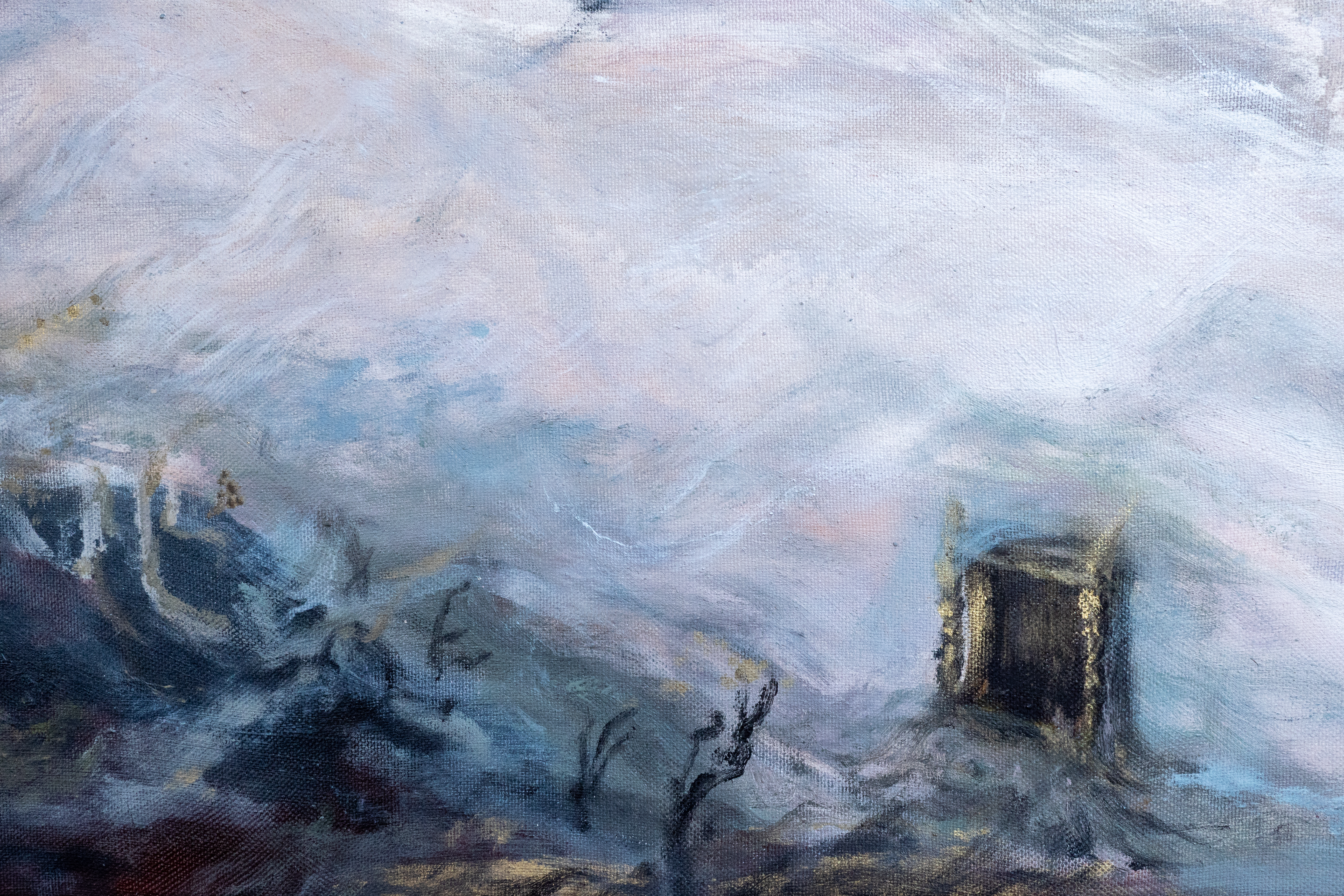
Sarah Ringrave, Failles Passantes (detail), 2026
MF: With the inclusion of scent by Lindsay West and the somewhat ominous track by Princess Jalpari playing on repeat in the space, I felt like the work began to take on a ritualistic quality in the way it engaged my body. Were you thinking about creating a kind of ritual experience for the viewer, and if so, is that meant to ground them or further disorient them within the in-between?
SR: Yes, I wanted the space to feel immersive, almost like something you enter physically, not just visually. When I go into altered states, I usually rely on small anchors, sound, frequency, sometimes scent, to move through them. I remember a moment where I went too far into something I couldn’t really process, almost like a fractal space, and what brought me back was sound, and even smell. It helped me reconnect to my body. I thought about these elements in a similar way here. They act like subtle guides for the viewer. They can ground you, by bringing you back to your senses, but also shift your perception. I’ve been going to churches a lot recently, and I was struck by how sound and scent create a shared atmosphere, something almost tangible but hard to define. I wanted to bring that into the work. The architecture of the space at Fugue Gallery also plays into this, the triangular structure, the way light moves through it at certain hours, almost activating the gold surfaces and turning the space itself into a kind of passage. The sound follows a kind of progression, like phases of a passage, and the scent was developed alongside the main sculpture. The piece feels like an opening body, and the scent works like a trace, something that lingers, like a presence that hasn’t completely left.
MF: We talked about your spiritual practice as something that runs deeply through your work, alongside the ways religious influence surfaces without being directly named. As your practice continues to unfold, what aspects of your spiritual or religious life feel most urgent for you to return to or deepen?
SR:I feel the need to spend more time in places that carry a strong energy, temples, not only churches, and to encounter more relics. They’re very activating for me, almost like catalysts. At the same time, I’m moving away from structured religion, while getting closer to its symbolic and ritual dimensions. I’ve also been very influenced by the people around me, through my parents I’ve had the chance to meet different practitioners, and through being self-taught I’ve worked closely with artists and mentors who have really shaped how I see and make things.
Alongside that, there’s a more personal practice that continues to unfold, both exploratory and therapeutic, which informs how I experience these states and how they enter the work.

Myles Fucci
Myles Fucci is a curator, writer, and model based in Brooklyn, New York. His interdisciplinary practice explores discontinuous Black diasporic narratives and the ways memory, kinship, and archives shape our understanding of the past and possibilities for the future. While grounded in an interest in Black diasporic life and cultural production, his work remains attentive to broader questions of history, relation, belonging, and symbolism.
view all articles from this author