Whitehot Magazine
October 2026
"The Best Art In The World"
"The Best Art In The World"
October 2026
Seeking Randomness in Art at Future Fair - NYC Art Fair Highlight
By NATSUMI GOLDFISH May 17th, 2026
When many major international art events are stagnant or fixated on politics, we might finally find something different at smaller art fairs. At Future Fair, artist duo exonemo from NowHere Gallery (Booth R13) presented a self-destroying installation work called Hatch/et.
Hatch/et is a generative installation built around randomness. The installation destroys itself when the computers succeed in guessing randomly generated passcodes. A hatchet installed within the work is released and destroys the computer - the heart of the installation - immediately once the code is solved. The installation then permanently loses its ability to operate.
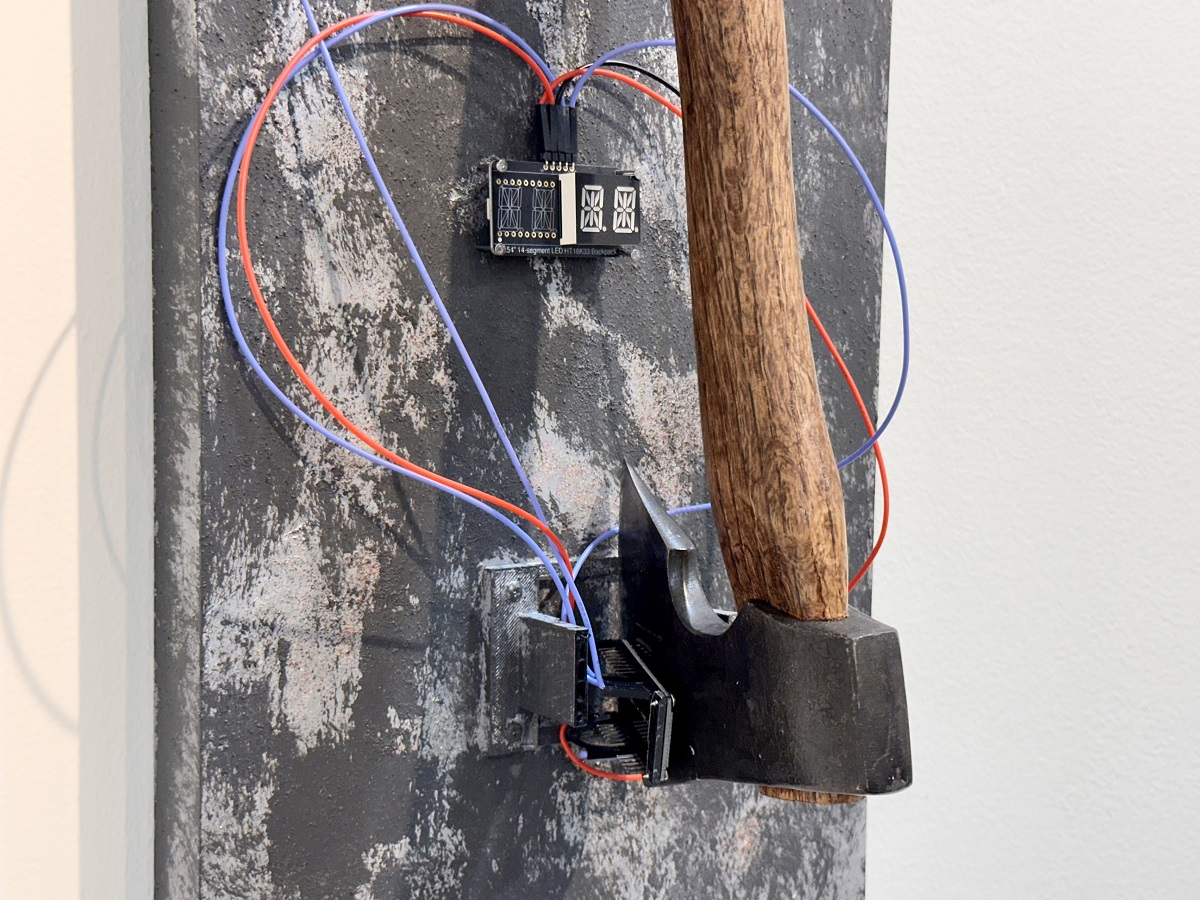 Hatch/et by exonemo
This kind of installation places the idea itself in the foreground. Although it challenges randomness, the artists still maintain control by selecting the initial number sequence, which greatly influences the computer’s chance of solving the code. Randomness has long been a major theme in fine art, explored through movements such as Dada, Surrealism, and Abstract Expressionism, yet there still seems to be room to explore the idea of “complete randomness” within physical art.
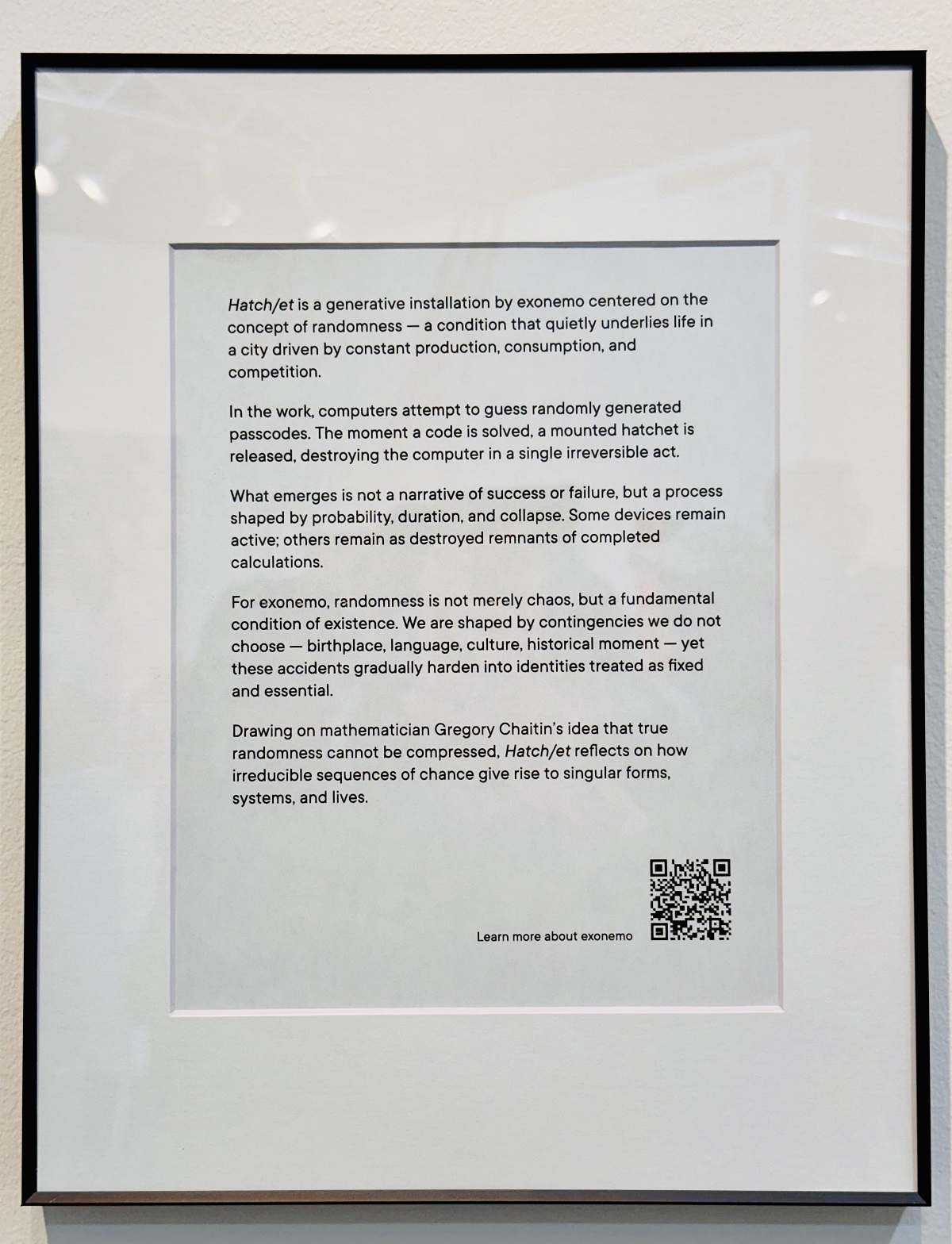
The installation forces viewers to actively question what they are seeing, while also creating a sense of fear that, at any moment, the hatchet could suddenly fall as we observe it closely. Collapse is embedded into the work itself and becomes part of the arrangement. The computer cannot avoid destruction as long as it continues running. It feels as though we are watching the world move toward a single inevitable destination, regardless of individual will.
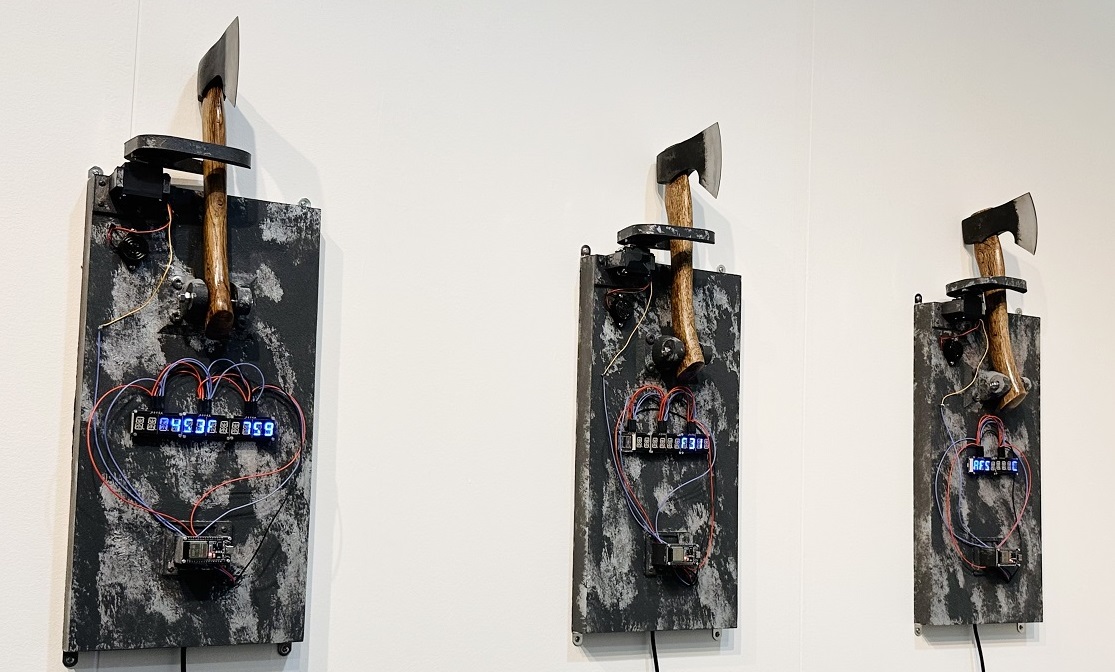 At Future Fair, artist duo exonemo from NowHere Gallery (Booth R13) presented a self-destroying installation work called Hatch/et.
On one hand, we might interpret the computer destroying itself as the end of a life. On the other hand, the computer’s sole purpose is simply to solve randomly generated codes. It produces nothing during its “lifetime” and does not help, affect, or communicate with our lives. This raises the question of whether it is even reasonable to view a computer as a life form, because it moves and mimics a life cycle with a beginning and an end.
Viewers are left free to decide whether the installation becomes a complete statement - after solving the random code, or whether it is complete throughout every stage of the attempt itself - from operation to destruction.
Natsumi Goldfish
Natsumi Goldfish is a visual artist and writer based in New York City. Since 2014, she has been writing about the world around art and artists, mainly from an artist's perspective. She has a deep interest in the question “What makes us human?”, and it is her passion to keep examining and discussing people and society through the lense of art.
view all articles from this author