Whitehot Magazine
October 2026
"The Best Art In The World"
"The Best Art In The World"
October 2026
STATISTICAL ICONOCLAST: When Presence Becomes Revolutionary
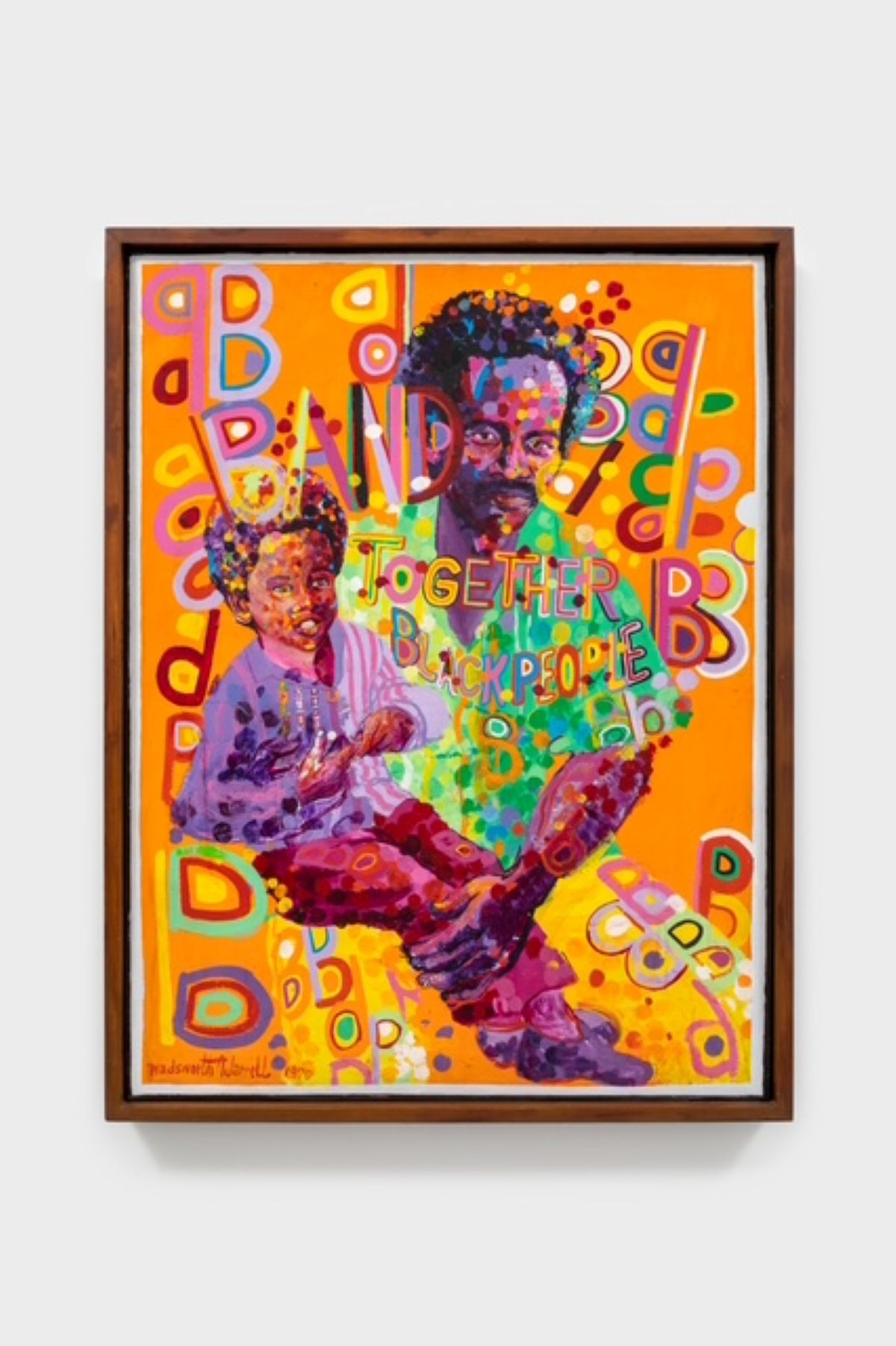 Wadsworth Jarrell, Boss Couple, 1970, acrylic on canvas, 30 x 40 inches, courtesy of the artist
BY RICHARD ALLEN MAY III June 20th, 2026
Some children know their fathers. Some grow up watched, truly seen, held in the gaze of a man who decides, day after day, to be there. That kind of presence settles in the bones like an inheritance you do not have to fight to keep.
Many children do not. They learn absence in its different registers—the father who leaves, the father who stays but never reaches out, the father sealed inside his own wound. That story cuts across race, class, and geography; it is not unique to Black families, and it is not new. As Barry Gaither, longtime director of the National Center of Afro-American Artists, has observed, in Western art the mother-and-child theme is common, while the father-and-child—particularly around tenderness—appears far less often. That same absence runs through the visual, published record of African American painting, sculpture, drawing, and fiber arts from the late nineteenth century through the 1970s. Images of tender Black fathers appear only sporadically in the canonical accounts, even as countless lives outside the frame tell a more layered story. Other works have appeared since the 1970s, and the record is still unfolding, but the period up to that decade already shows how slowly images of tender Black fathers entered the published canon.
Fathers are not wholly absent from this history. A father reaches toward his child in Vincent van Gogh’s First Steps, after Millet (1890); William H. Johnson’s Going to Church (ca. 1940–41), Folk Family (ca. 1944), and Homesteaders (1942), Charles Alston’s The Family (1955), Gerald Williams’s Black Family (1968), Jae Jarrell’s Ebony Family (1968) and Wadsworth Jarrell’s Black Family (1968) all fold fathers into larger scenes of family life, where the father belongs to the group portrait but never holds the frame alone.
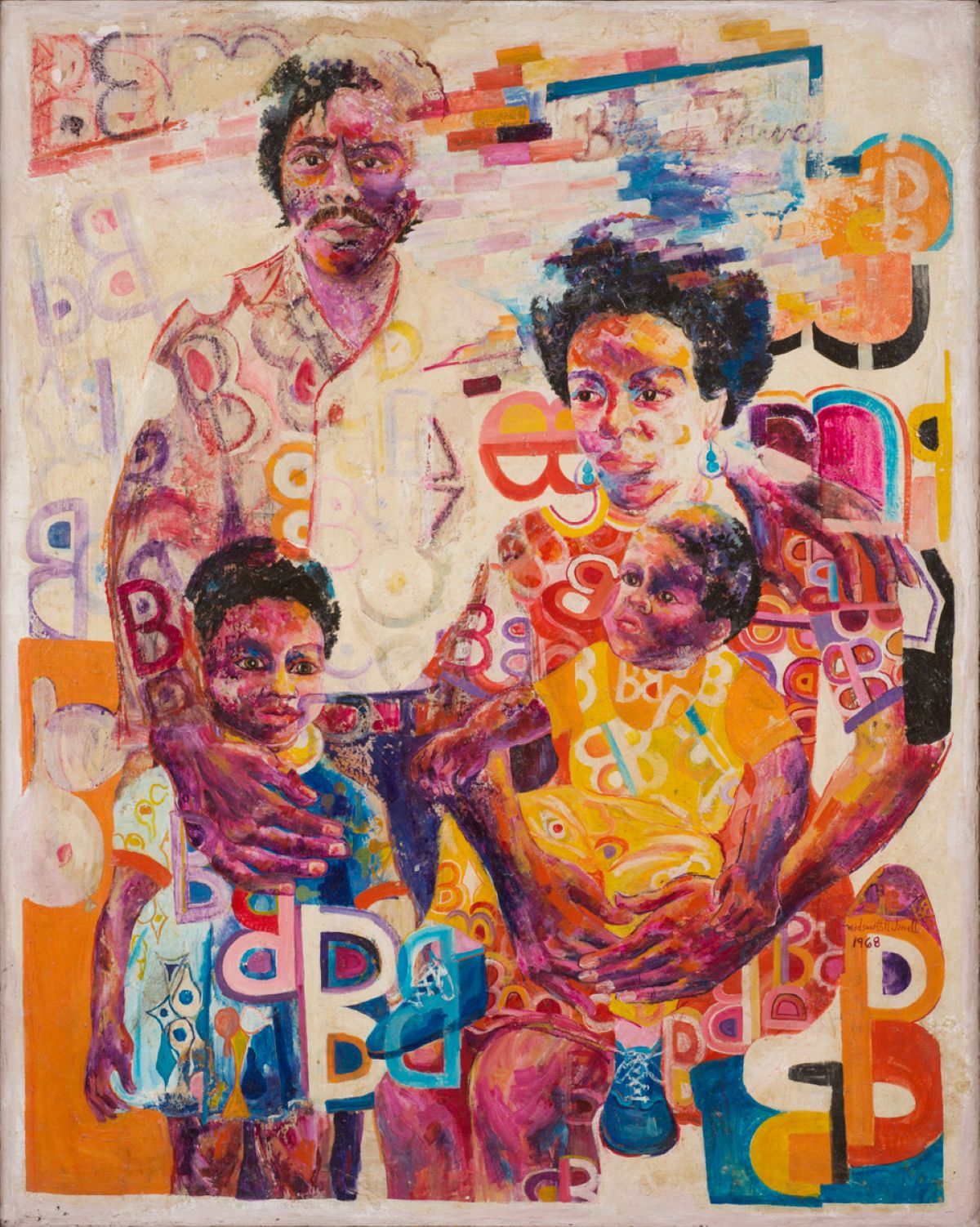 Wadsworth Jarrell, Black Family, 1968, acrylic on canvas, with pastel and hot wax, 46 x 36 inches, courtesy of the artist
What remains comparatively rare in the recorded canon is the father-and-child image where the two appear alone together, with no one else to mediate the exchange. A handful of works turn that relationship into the whole subject: Henry Ossawa Tanner’s The Banjo Lesson (1893); William H. Johnson’s composition often titled Deep South or Father and Son (ca. 1942–1944); John Wilson’s Father and Child works culminating in Father and Child Reading; and Wadsworth Jarrell’s Boss Couple (1970). Each of these works builds its entire image around the charged space between a father and a child.
Tanner’s The Banjo Lesson is one of the earliest and still one of the most affecting of these images: an older African American man bent toward a young boy, guiding his hands over the banjo’s strings. Tanner’s painting opened the subject for those who came after. Johnson’s related composition, often titled Deep South or Father and Son, extends that intimacy forward in time, placing a Black father and child in close physical relation and insisting, with characteristic economy, that tenderness belongs within the field of African American modernism too.
Two artists, however, refused to leave the subject in the margins: John Wilson and Wadsworth Jarrell. Working in the later decades of the twentieth century, they make visible what had so often gone underrepresented in canonical accounts of American art—Black fathers who are present and attentive, strong without ever raising their voices.
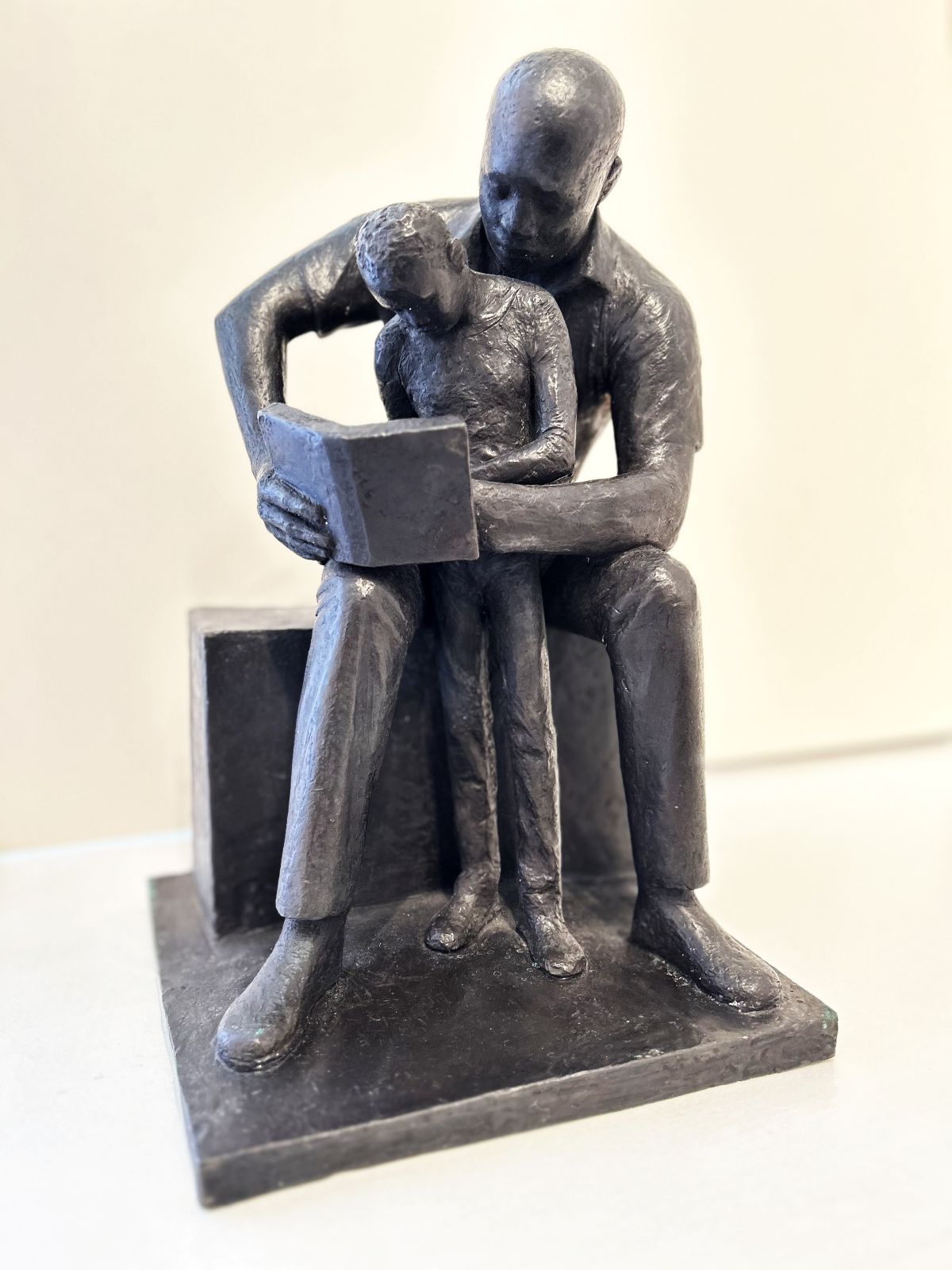 John Wilson, Maquette for "Father and Child Reading," 1985, Bronze, Height: 14-1/2 inches © Estate of John Wilson, courtesy of Martha Richardson Fine Art, Boston
Wilson did not arrive at Father and Child Reading all at once. The subject appears earlier in Father and Child (1964), a lithograph measuring 12-1/2 x 14-1/2 inches that distills paternal closeness into a compact image, and again in Father and Child (1976), a bronze only 4-1/4 inches high, where the idea is still intimate enough to feel held in the hand. By the late 1970s, Wilson had already established the father-and-child motif as a sustained inquiry; the later Maquette for "Father and Child Reading" (1985), a bronze 14-1/2 inches high, and the over-life-sized bronze unveiled at Roxbury Community College in 1990 simply make public and monumental an idea that was already fully present in the earlier works.
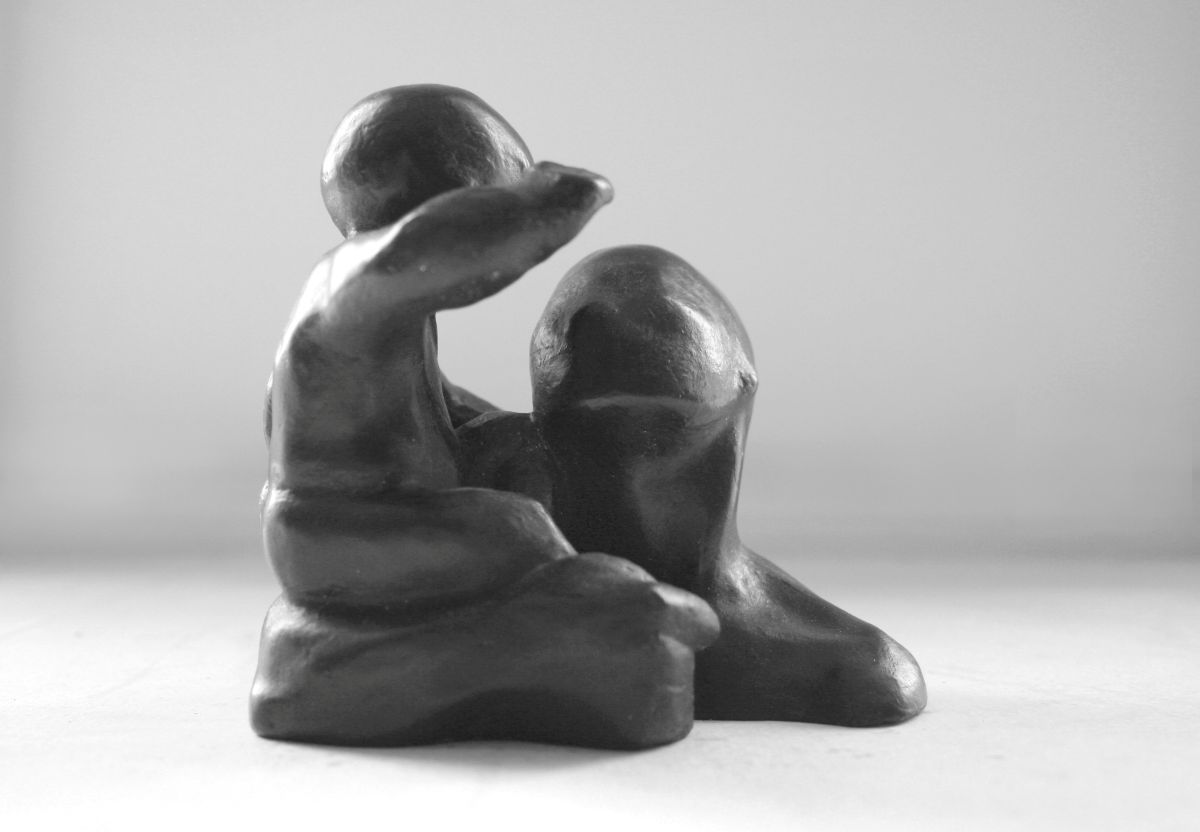
John Wilson, Father and Child, 1976, Bronze, Height:4-1/4 inches © Estate of John Wilson, courtesy of Martha Richardson Fine Art, Boston
Their bodies tilt toward the same book, foreheads almost aligned, as if the text were a third participant in the conversation. Wilson avoids the theatrical gesture and the heroic raised arm; the drama here lives in nearness, in the gravity of two bodies in quiet agreement.
The closeness of the figures—the father’s torso slightly sheltering the child, the boy’s body settling into that curve—reads as argument as much as arrangement. Wilson stages one version of what it can look like when a man allows himself to be physically and emotionally near a child. Bronze deepens the claim. It carries a history of monuments and permanence. By drawing on that lineage, Wilson frames this kind of quiet, literate, everyday fatherhood as worthy of the same enduring respect typically reserved for generals on horseback.
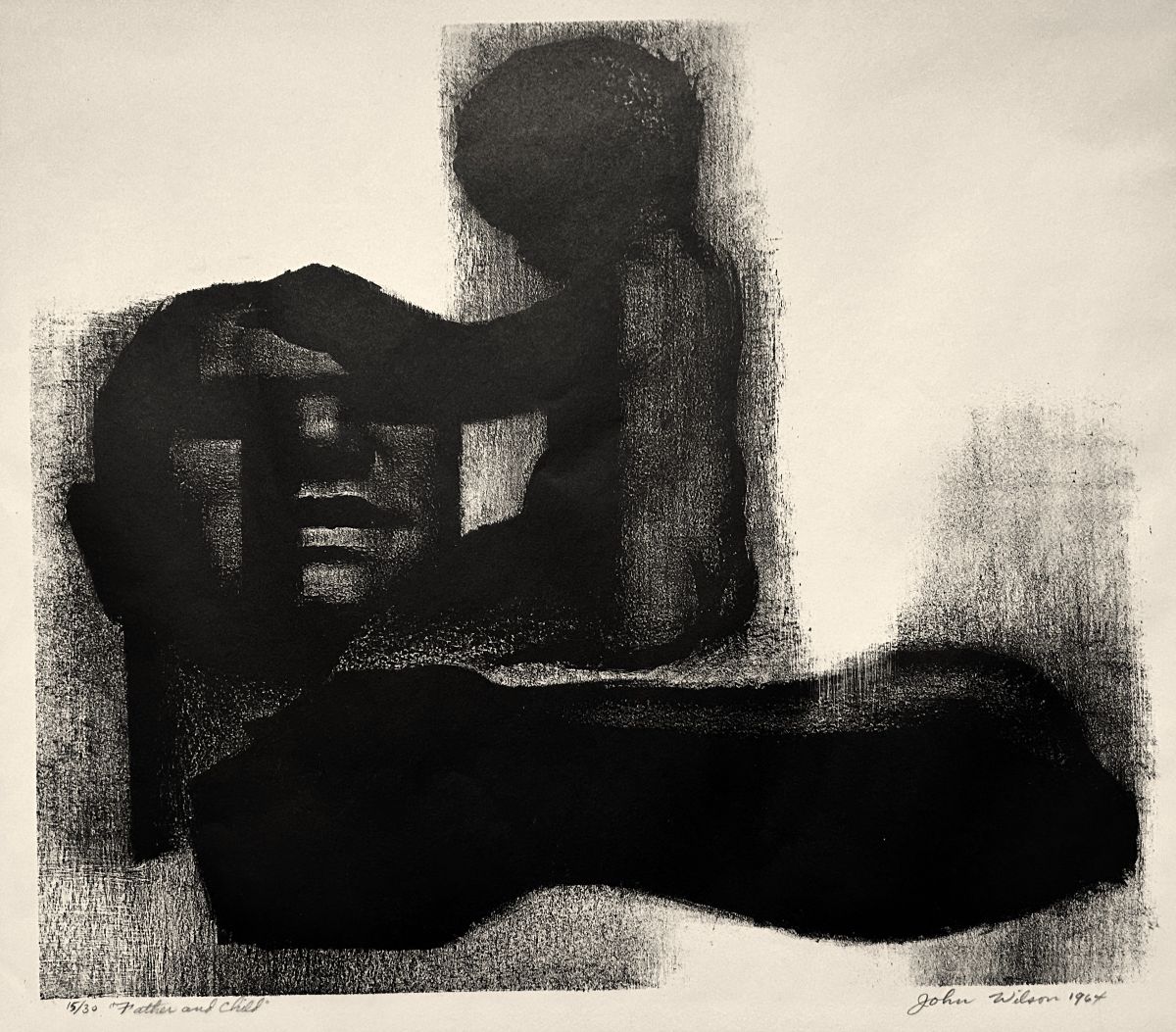 John Wilson, Father and Child, 1964, Lithograph, 12-1/2 x 14-1/2 inches © Estate of John Wilson, courtesy of Martha Richardson Fine Art, Boston
If Wilson’s sculpture pulls you into a circle of intimacy, Wadsworth Jarrell’s Boss Couple (1970) meets you at the surface and refuses to step back. The canvas shows a Black father seated with his young son on his lap, both looking directly at the viewer. They face you full-on, the way people do when they have decided not to vanish to make others comfortable. That directness, drawing on the strength and dignity of African sculpture and the aesthetics of AFRICOBRA, makes the painting a face-to-face encounter—father and son have arrived, and they are not asking permission.
Jarrell’s COOL-ADE COLORS—sweet‑potato oranges, hot pinks, saturated collard greens, and blues—refuse the flattened tones that often framed Black life in mid-century mass media. Within AFRICOBRA’s visual language, the chroma broadcasts that joy is a deliberate stance against erasure—serious optimism in saturated hues. Jarrell includes text directly on the picture plane—“Band Together Black People.” The repeated letter B is a symbol for “Black is Beautiful.” The father’s posture and the child’s ease produce a picture of Black fatherhood that is unembarrassed about affection and tenderness
Both Wilson and Jarrell invite what therapist Mitchell Rosen has called the intangible “dad piece”—that sense that someone is there, steady and attentive, offering a particular form of care. In Wilson’s bronze, it lives in the tilt of two bodies toward a shared book; in Jarrell’s canvas, it radiates from the father’s composed gaze and the child’s easy weight on his lap. When that presence is absent or inconsistent, the resulting wound can, as writers and therapists have suggested, emerge as a belief that tenderness from a man is either dangerous or impossible.
Writer Jason Wilson, in Cry Like a Man (2019), names a related condition he calls “emotional incarceration”: men sealed inside scripts that forbid softness, touch, or vulnerability. Poet Romaine Washington’s Authentic (2001) answers in another register, celebrating a Black masculinity figured as “the original fabric”—linguistically inventive, spiritually grounded, and capable of both public strength and everyday care while Peter J. Harris’s The Black Man of Happiness (2014; American Book Award, 2015) traces what can happen when Black men claim joy as a serious, sustained practice. Read together, these writers help clarify what is at stake in Wilson’s and Jarrell’s pictures: they show how deeply it matters whether a father’s presence—emotional as much as physical—can be trusted.
Placed in this company, Wilson’s and Jarrell’s images mark where the pattern breaks—a father bending toward a child with a book; a father and son sitting in chromatic glory, looking back at the world together. Jeffrey Osborne’s 1978 lyric with L.T.D.—“we both deserve each other’s love”—carries the same logic: not a one‑way rescue, but an exchange in which both lives register as necessary.
In 2025, John Wilson’s work began to receive significantly more institutional attention, with major exhibitions at the Museum of Fine Arts, Boston, and the Metropolitan Museum of Art in New York making decades of his drawing, sculpture, and printmaking newly visible to broader audiences. In February of that same year, Martha Richardson Fine Art opened the complementary exhibition John Wilson: Self Portraits & Spot Drawings.
For many viewers, these works can speak to a quiet hunger that often goes underrepresented in the published history of fine art: the desire to have been seen by a father, or to become the kind of father who sees. Any father, any child of a father, can recognize the ache to be held in that kind of gaze.
What Wilson’s bronze and Jarrell’s canvas insist on is simpler than that: tenderness from a father is not a miracle or an accident. It is a decision, made deliberately and repeated over time—which means it can be made again. Ultimately, these works are portraits and invitations at once—models for how Black fatherhood might be seen and practiced, and for how any father might come to count gentleness among his strengths.
Richard Allen May III
Richard Allen May III is a 2025 Andy Warhol Foundation Arts Writers Grant recipient, independent curator, and educator at CSU Fullerton, CSU San Bernardino, ArtCenter College of Design, and Bowie State University, where he teaches art history. He has been a contributing writer for Artillery for over eight years and wrote the foreword to AFRICOBRA: Experimental Art Toward a School of Thought (Duke University Press, 2020).
A project supported by the Andy Warhol Foundation Arts Writers Grant.
view all articles from this author