Whitehot Magazine
September 2026
"The Best Art In The World"
"The Best Art In The World"
September 2026
Barnes Stayed Home: Curtis Barnes Sr.: Dayton Icon, at the Dayton Art Institute
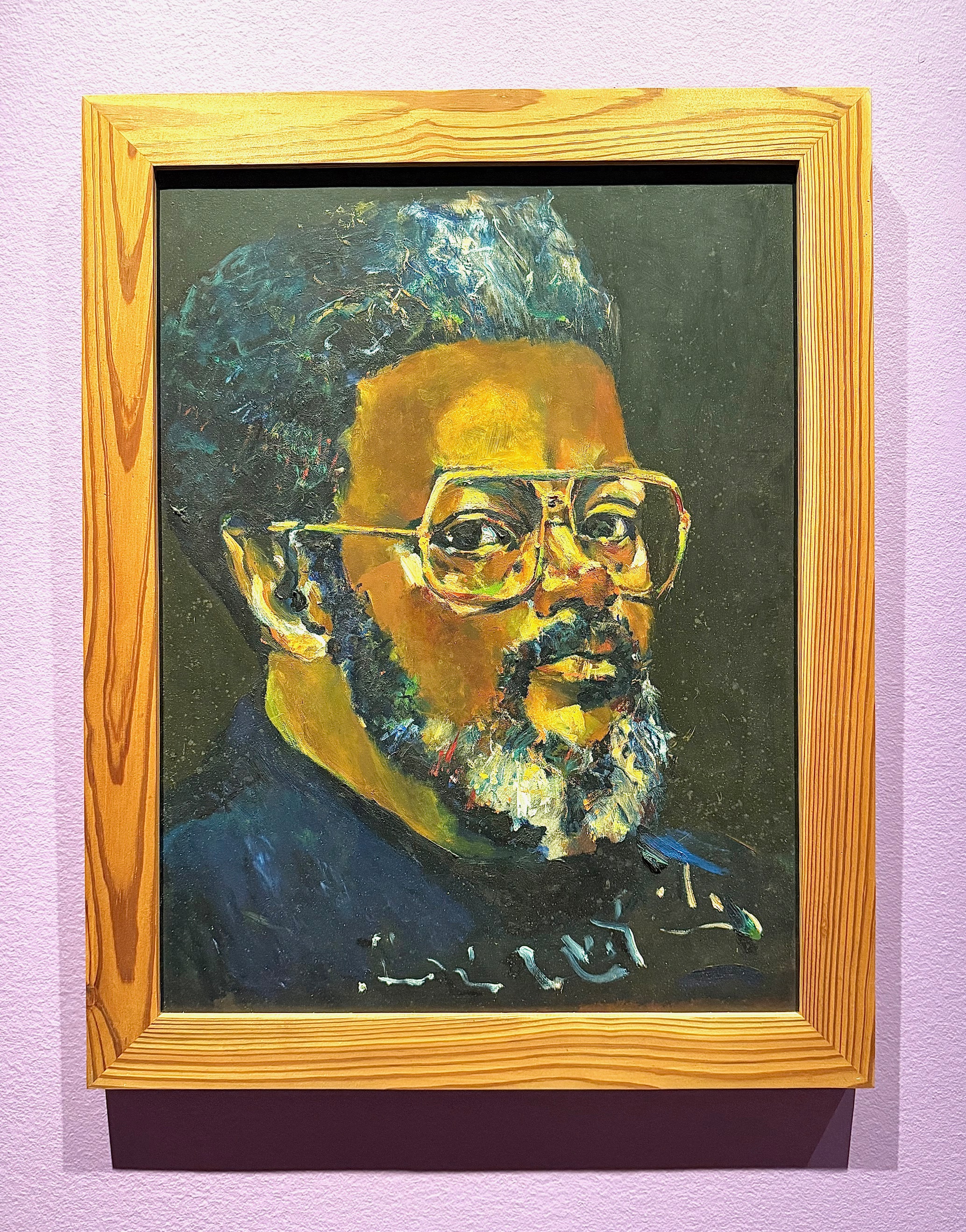 "Self-Portrait with Glasses”, 1986, oil on canvas; “Curtis Barnes: Dayton Icon"
By JOHN DRURY September 22, 2025
There is something to be said for the artist who stays at “home”, to celebrate in practice their creativity on home turf; that in simply place, family and friends. Curtis Barnes, is one such maker, and like his friend and fellow Daytonian, downtown superstar Willis “Bing” Davis, each artist produced/produce works of such a high caliber – that it is certainly plausible … definitely arguable ... that each has done so, at the cost of a greater career. Both makers, might have decided to chase the ever-elusive limelight, that is offered by the big city blues of New York City, or Los Angeles, but chose instead to establish for themselves a vocation from their smaller, perhaps manageable home territories.
And so, Curtis Barnes chose to remain in Dayton, Ohio - and to forge an occupation in the visual arts based there; of support, if less than may have been possible otherwise, and somewhere else – a practice reflective of what it is to be homegrown. Barnes’s contribution to the arts is currently commemorated at the Dayton Art Institute, with an exhibition of more than one-hundred painted canvases executed by the prolific painter, as spanning his long career. Barnes died in 2019, at the age of 84. For nearly 50 years, the productive Barnes painted most every day. A bank of some 30 portraits, capture but a modest portion of the friends and family, that Curtis depicted in paint and held close to his heart, including an early portrayal of his dear friend - the aforementioned “Bing” Davis, with whom he founded the African-American Visual Arts Guild, in 1992.
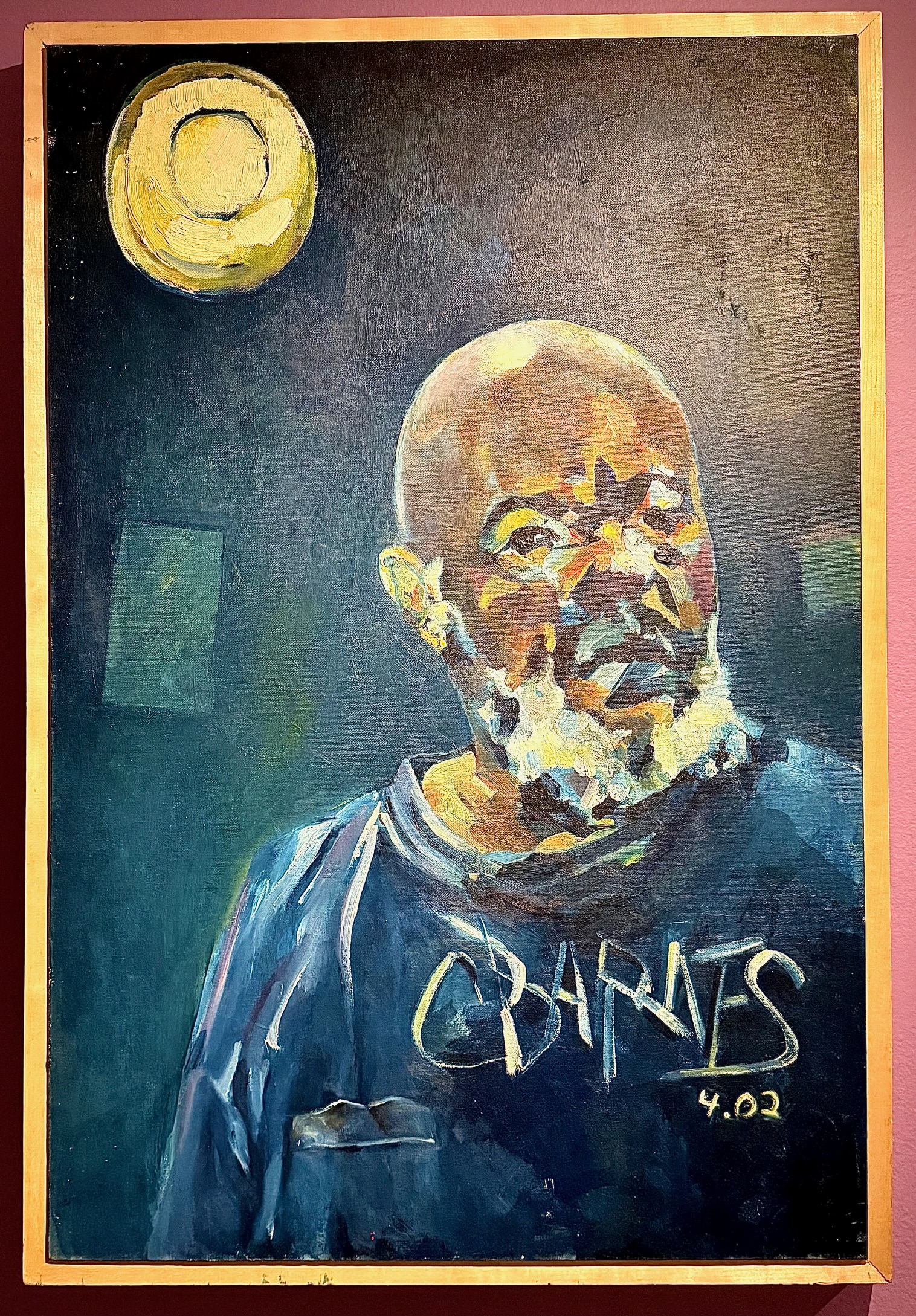 “Self”, 2002, oil on canvas; “Curtis Barnes: Dayton Icon"
Barnes’s work is included in many collections throughout the US, and in Dayton specifically, at the Sinclair Community College, the University of Dayton, and the Dayton Public Libraries in addition to the Dayton Art Institute. Appointed Professor Emeritus at Sinclair in 1995, he had served as a beloved painting instructor there, from 1977 until 1994. It was in 1978, that I had the opportunity to study painting, with Mr. Barnes, at Sinclair. As reflected also, in the seemingly tireless efforts of Davis, Curtis Barnes’s contribution too, to the young people in Dayton is immeasurable.
There are the abstract revelries of paint, on view at the DAI, but a great number of works by Barnes, are his self-portraits – time spent alone in the studio, finding of course, self, a most convenient model. And it is here that we see the studied hand of a master, in self-contemplation. We are allowed in curator Jerry N. Smith’s effort, to see the artist age, as recorded in pigment on canvas, as his painting talents grow with time and experience. As the artist “greys”, we witness a growing exploration of color, and see his adept handling of the material, bloom. Afro, a work realized in 1970, captures not the image of the younger artist alone, but records the popular hairstyle of the time. It is a clear record, of its day. A minimalistic background of simplistic and tumbling geometric shapes, is a reflection the previous decades art movement. Embodiment now breaks hard-edged formality with the soft flesh and hair of figuration. The proud and bearded artist meets our probing gaze head-on, the clear emergence the black man’s confidence, post-Civil Rights Movement, celebrated. Dayton remains a severely segregated city, and it is the creator who stands tall, and in a position of power … that in steadfast exploration of self and place – that, even in possible discomfort, who gains in hard-won successes … potentiality, for promised equity. WM

John Drury
John Drury is a multi-media artist, published author, independent curator and instructor. Drury holds a Bachelor of Fine Art degree from the Columbus College of Art and Design and a Master of Fine Art degree in sculpture (1985; including a minor in painting), from Ohio State University. John is the father of two young adults, and is living in NYC since 1989. He has received the prestigious Louis Comfort Tiffany Foundation Award. John is a contributing editor of Glass Magazine, with published texts appearing in Raw Vision, Neus Glass and Maggot Brain magazines, in addition those appearing online, at ArtNet and Whitehot. He has written texts for artist monographs published by Black Dog, Damiani and the Museum of Glass.
John Drury is on Instagram, at johndrury.studio and can be contacted, at simplefolktoo@hotmail.com
view all articles from this author