Whitehot Magazine
October 2026
"The Best Art In The World"
"The Best Art In The World"
October 2026
Ways of Being: Róza El-Hassan and Réka Lőrincz - ICA-Dunaújváros, Hungary
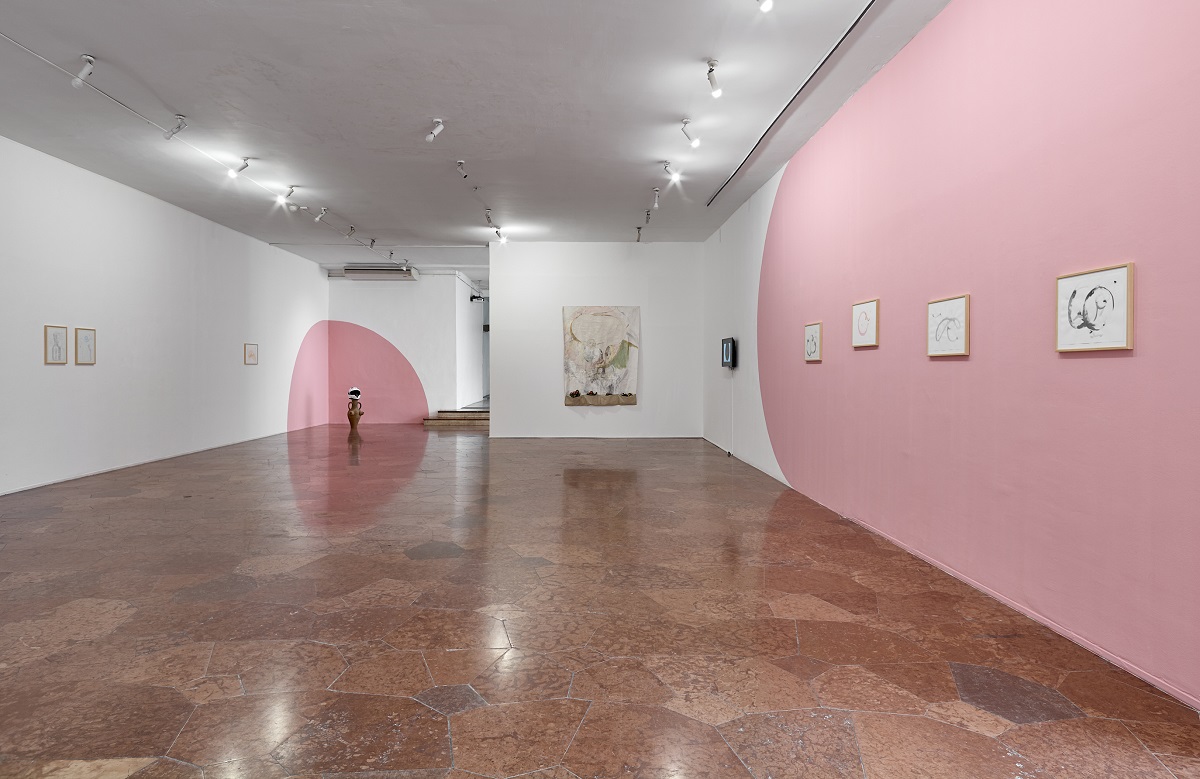 Ways of Being, installation at ICA-Dunaújváros. Photo credit: Áron Weber / The artists, ICA-Dunaújváros, Longtermhandstand
By CHRIS CLARKE May 6th, 2026
It can start small, with a minor gesture of resistance or a refusal to engage. When confronted with a culture of incessant information and insatiable consumption, withdrawal becomes a radical, even revolutionary, act. It’s a turning away, or rather towards, other, more consequential experiences. A pronounced focus on the body, its pulsations, postures, tensions, and tremors. An inhalation of fresh air, the shiver of a breeze, and the pressure of one’s weight against the ground. Or simply sitting, encased in a plastic shopping bag, and nonchalantly “smoking” a flower.
In Réka Lőrincz’s video Camping Peace, 2024, the artist’s performance reflects a mode of determined attentiveness: shielded from the distractions of society, she attunes herself to the wavelengths of the atmosphere, the flow of energy between an individual consciousness and the surrounding environment. Interoceptivity expands outwards, and the effect is reciprocated, as external elements are absorbed and integrated in turn. This connectivity reverberates between Lőrincz and Róza El-Hassan in their two-person exhibition Ways of Being, curated by Sonja Teszler at ICA-Dunaújváros. The artists share not only an affinity for the improvisational and intuitive, for natural materials and re-purposed objects, but have a personal and professional relationship; in her parallel practice as an energetic healer, Lőrincz has worked with El-Hassan. The phrase “Camping Peace” even recurs in the exhibition’s single collaborative work, as a vast text written in Hungarian - Kemping Béke, 2026 - and painted in bright pink across the breadth of the gallery’s central, window-facing wall.
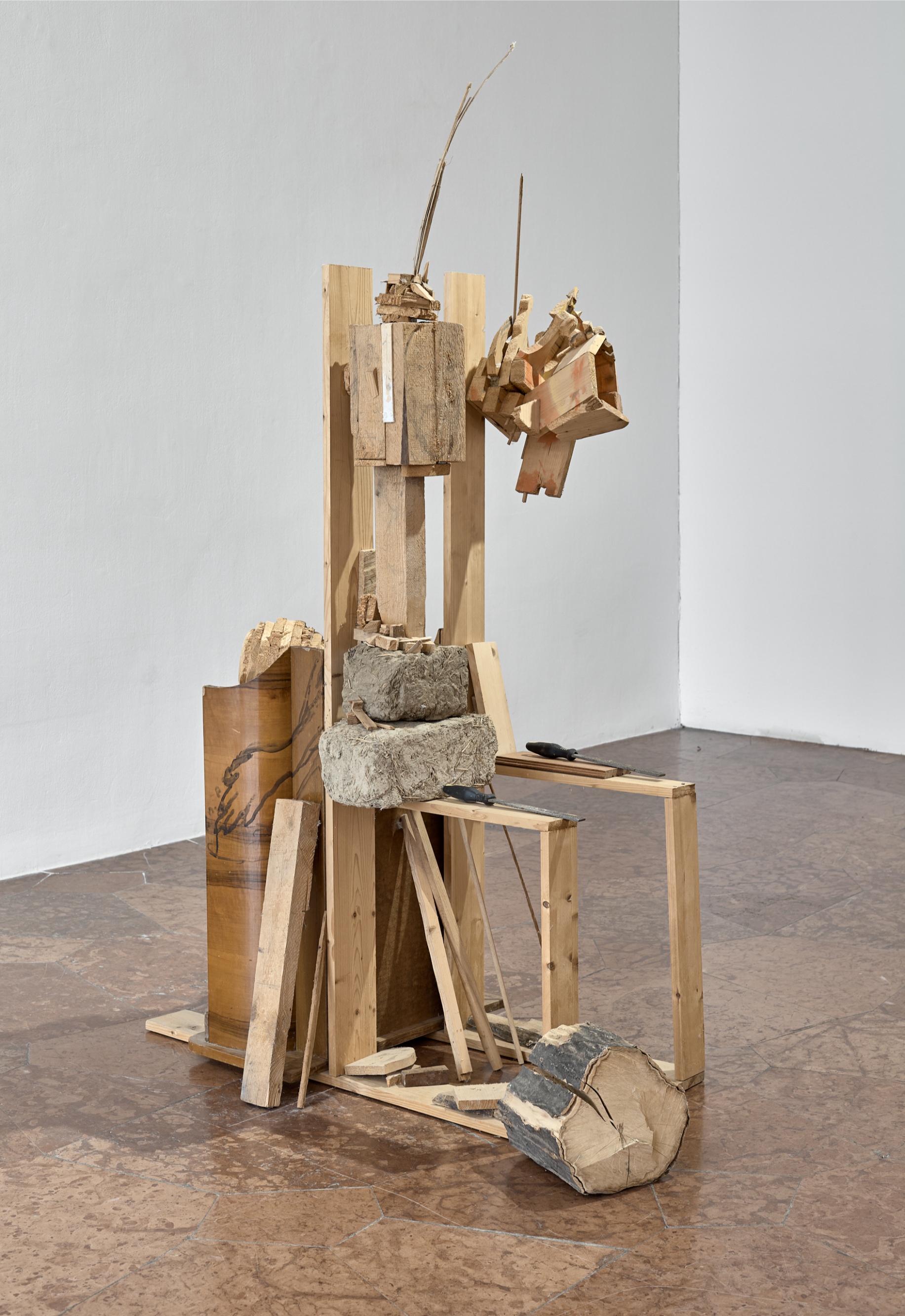 Róza El-Hassan, Couple, 2020-23. photo credit: Áron Weber / the artists, ICA-Dunaújváros, and Longtermhandstand, Budapest
While their practices are wholly distinct, there are multiple overlaps; formally, materially, and conceptually. A series of Lőrincz’s Energy Scores, 2021, circular swathes of graphite, ink and watercolour on paper that capture the after-effects of her healing sessions, are partnered with an early computer animation by El-Hassan, which juxtaposes flickering low-fi graphics, pixelated voids, and glitchy static with recurring footage of a Syrian woman as she hand-throws dough. The elongated disc spins, repeats and reappears again, in perpetual motion. In Lőrincz’s Healing Breasts, 2026, the titular forms are fluidly drawn, dispersed across the canvas in pink and yellow pastel, while two upturned plastic buckets, with apricot stones for nipples, protrude from the upper corner: the natural and the manufactured, femininity and materialism, intermingled together. El-Hassan’s Couple, 2020-23, portrays a more stolid embodiment of its subjects. A construction of vertical wooden planks evokes a rudimentary man and woman standing side-by-side, their facial expressions conveying inscrutable placidity and tortured anguish. Bodies are built up from sun-dried bricks of earth and hay, lengths of dowel, and a pair of steel rasps, laid flat on braces used to support the figures. The sculpture appears open-ended, unfinished, and, in the absence of defined features, interchangeable. In Spring Forgetfulness, 2008, and Autumn Forgetfulness, 2024, El-Hassan’s titles suggest a state of mindfulness, of existing in the present, that corresponds to this provisional quality. The seasons are, fittingly, transitional with the works themselves sharing this fugitive quality. Her canvases are pinned directly to the wall, scuffed with gouache and graphite, and buckling from both the accrued material and the weight of fresh flowers, hemmed into pockets sewn along the lower section. Clusters of whorls, crescents and sunbursts populate the scenes, while an empty speech balloon is appliquéd over a ghostly figure. Words are just out of reach, on the tip of the tongue.
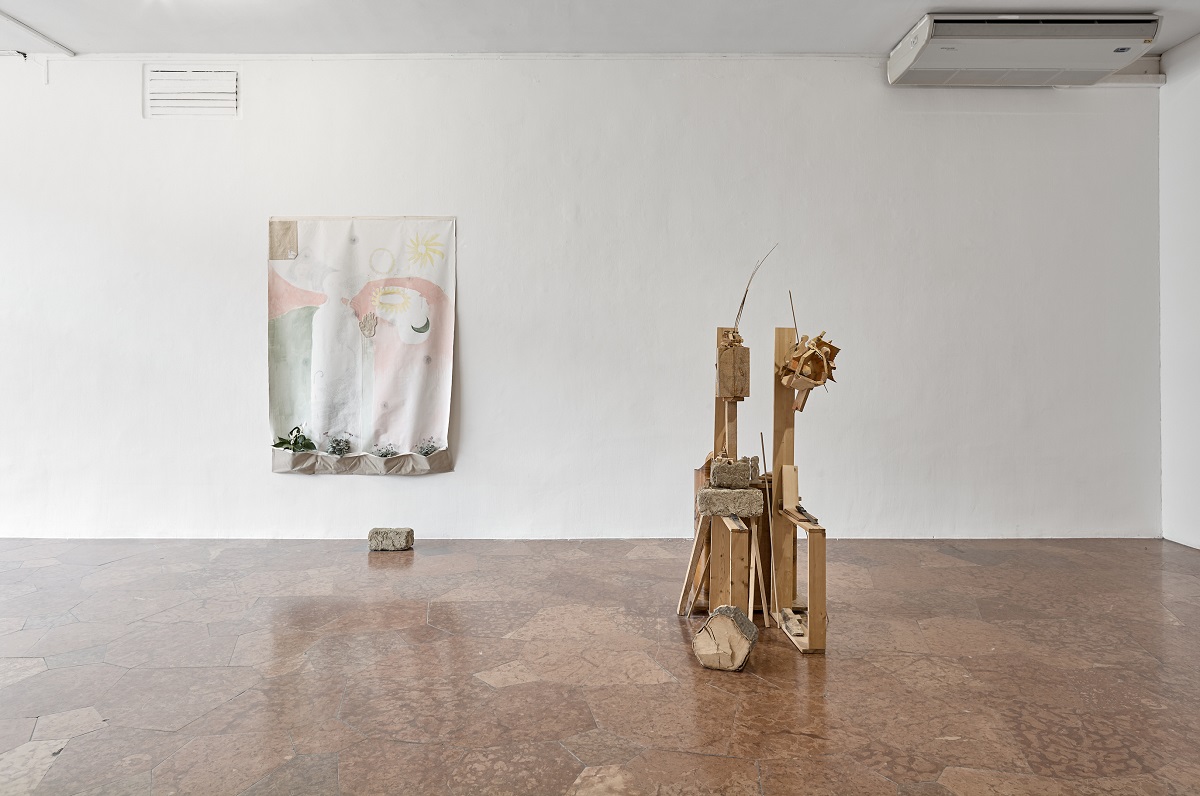 Róza El-Hassan, Autumn Forgetfulness, 2024, Couple, 2020-2023. photo credit: Áron Weber / the artists, ICA-Dunaújváros, and Longtermhandstand, Budapest
In Lőrincz’s Practical Peace, 2026, a mute, mysterious totem stands sentinel. A terracotta vase, its two handles held akimbo, is adorned with breasts woven from corn husks, while a motorcycle helmet is perched atop its rim, the visor raised to reveal a basket of hexagonal quartz prisms. Rock crystals are known for their restorative properties and their capacity to clear negative energy and, in Lőrincz’s sculpture, seem to infer an inner calm hidden beneath the accoutrements of modern life. However, such talismans have also been commodified, marketed as part of a burgeoning “wellness” industry. The artist often collects materials from within her vicinity - second-hand objects, mass-produced goods, bric-a-brac - and the crystals are no exception (a cursory glance on Amazon reveals thousands of offers). Yet, there is little cynicism evident here but, rather, a sort of pragmatism: in a world suffused with products, “practical peace” might just entail accepting and adapting to one’s circumstances.
It makes an intriguing counterpart to El-Hassan’s Protest Sign (Electromagnetic Signal Transmission in the Living World), 2022, in which off-cuts of roughly-hewn timber have been assembled into a makeshift placard. Miniature creatures are chiseled out of wood, positioned on an adjoining tray, while pegs and screws poke out haphazardly. Fragments of text (“ennyire nem szerencsétlenek,” a colloquial Hungarian phrase meaning “they are not that unfortunate,” suggesting a basic level of competence) are papered onto its reverse side, with a single, tattered paperback book, on electromagnetic communication between animals, casually placed on the base. While the target of El-Hassan’s protest is never directly specified, the sum of its parts offers a holistic worldview, of interspecies communication and interdependency. It registers on an invisible, underlying frequency, a spectrum only perceivable by the flora and fauna it represents. They aren’t simply the passive subjects of human civilization but equal, autonomous partners, caught up in forces beyond their control.
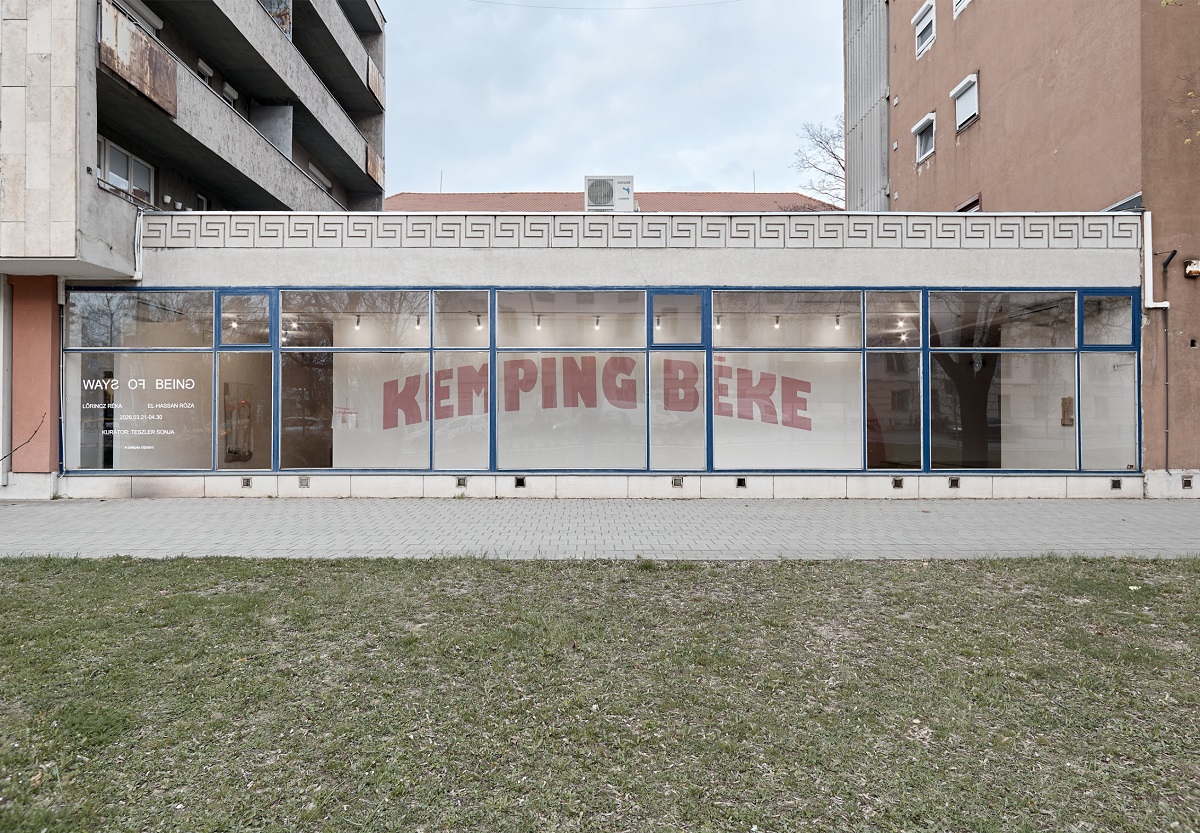 Réka Lőrincz, Camping Peace, 2024, Róza El-Hassan, Protest Sign (Electromagnetic Signal Transmission in the Living World), 2022. photo credit: Áron Weber / the artists, ICA-Dunaújváros, and Longtermhandstand, Budapest
The personal is always political. As I visited the exhibition on the day after the Hungarian election, when Viktor Orbán and his rightwing Fidesz party were finally ousted after 16 years in power, there was an almost incredulous sense of release, of slowly awakening from the stifling, suffocating era of his proclaimed “illiberal democracy.” Ways of Being is fortuitously timed, then. Both El-Hassan and Lőrincz - as women, Hungarians, and artists - have been compelled to navigate this inhospitable terrain, to find the means to retain their creative freedom in the face of autocracy and ethnocentrism. Having carved out their own individual, exploratory pockets of resistance, they offer an alternative to the prevailing, conformist culture. And while it remains to be seen what course the incoming, admittedly centre-right, government will follow, there is, at least, a newfound receptivity to such experimental approaches, to different mindsets. After all, you have to start somewhere.
Ways of Being: Róza El-Hassan and Réka Lőrincz
ICA-Dunaújváros, Hungary
21 March - 30 April, 2026
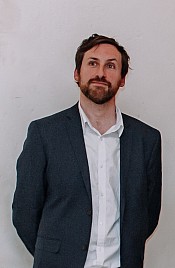
Chris Clarke
Chris Clarke is a Newfoundland-born critic based in Vienna. He has been a curator with Innsbruck International since 2018 and was previously senior curator at the Glucksman, Cork, Ireland from 2009-2016 and visual arts education and publications officer at Cornerhouse, Manchester, UK from 2006-2008. He has previously written for Art Monthly, Circa, Photography & Culture, Source, Spike Art Magazine, and VAN.
view all articles from this author