Whitehot Magazine
October 2026
"The Best Art In The World"
"The Best Art In The World"
October 2026
Curators Allison Lacher and Jeff Robinson discuss Phantom Frame, a site-responsive exhibition at NON STNDRD that explores fragments and how context informs meaning.
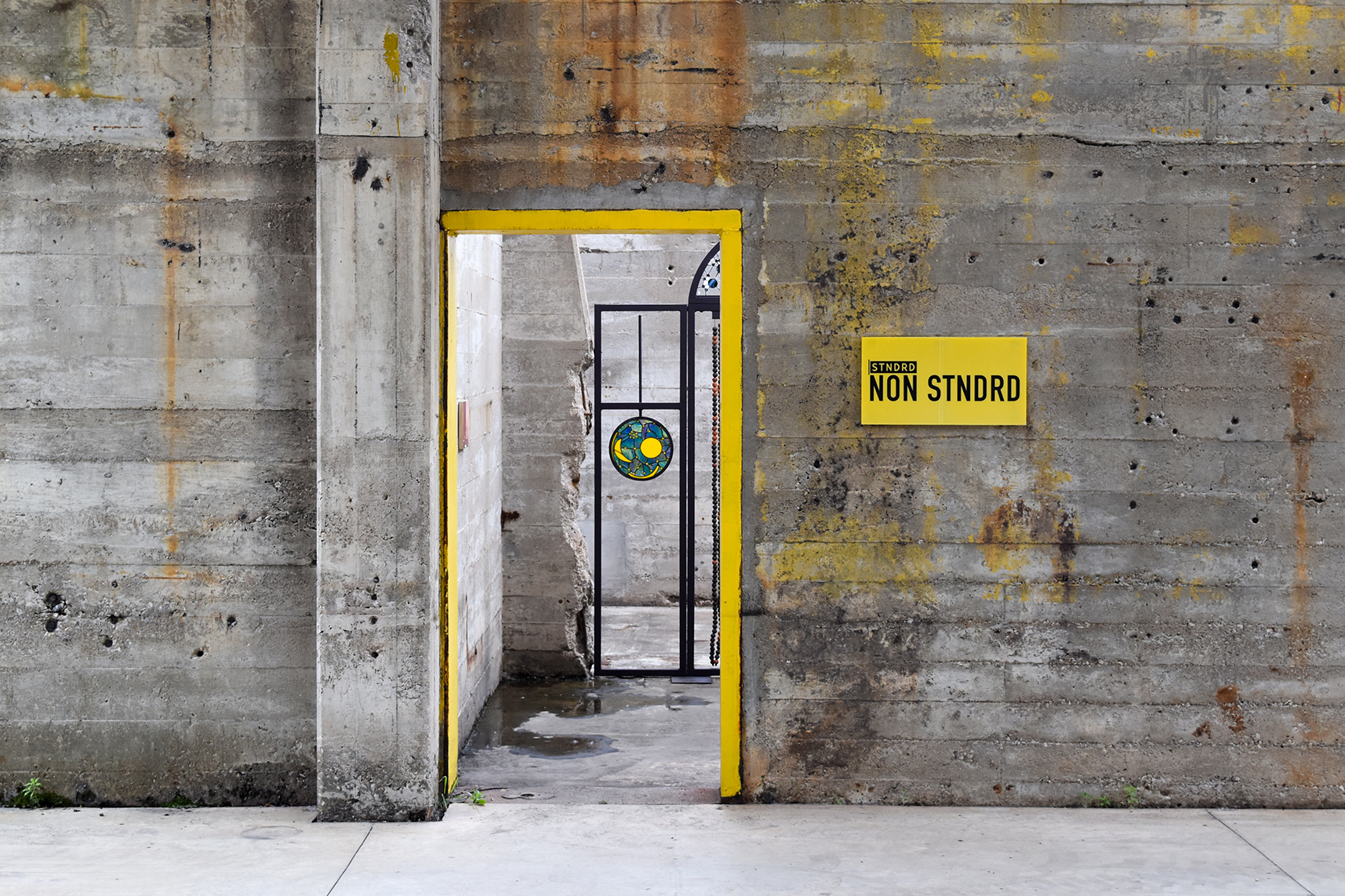 Installation view, 2026, Phantom Frame
By NOAH BECKER July 15th, 2026
Noah Becker: How did Phantom Frame begin, and what drew you to the National Building Arts Center as its setting?
Allison Lacher: Phantom Frame began through opening to curate an exhibition at NON STNDRD, one of the exhibition platforms of STNDRD Exhibitions, where I serve as co-director alongside Sage Dawson and Bruce Burton. It also gave me the opportunity to invite my longtime collaborator, Jeff Robinson, to co-curate a project at the site. NON STNDRD is a contemporary art program located on the campus of the National Building Arts Center in Sauget, Illinois. Exhibitions are presented in two adjacent open-air concrete bunkers that were originally built for industrial use. They're raw architectural spaces where the artwork has to contend with weather and the physical realities of the site.
The National Building Arts Center is an institution dedicated to preserving architectural artifacts and material culture from the built environment. It occupies a twelve-acre campus that was once home to the Sterling Steel Casting Company. Architectural fragments, salvaged facades, terra cotta ornament, bricks, industrial artifacts, and countless other building elements are stored throughout the campus. Much of the collection is visible; it comes into view as you pull into the parking lot, approach NON STNDRD, and move through the campus. It is everywhere.
Sauget remains an active industrial community and was once associated with Monsanto, a chemical manufacturer notorious for its environmental legacy. Looking more broadly at the region, the Cahokia Mounds are nearby, and although the site is in Sauget, the St. Louis Arch is visible on the horizon. There is a lot here for artists to consider. We understood that each artist would find a different point of entry and, from there, develop the work they wanted to make for the exhibition. Artists found points of departure in the NBAC collection, the architecture of the site, the industrial landscape, and the histories embedded in the region.
The exhibition centers on fragments. What can a fragment reveal that a complete structure cannot?
Jeff Robinson: A complete object might feel resolved and offer a stable purpose and meaning, but a fragment is inherently open-ended. A fragment asks something of us as viewers. Once it's removed from its intended context, it invites speculation. We begin to imagine what it supported, who made it, or what it might become next. In that sense, a fragment generates new meaning.
At the National Building Arts Center, the collection exists largely in fragments. Those fragments can certainly reveal something about the time in which they were produced, but they can also reveal something about us; how we respond to a fragment says something about our relationship to history, to the object itself, and to ourselves. We became interested in the possibilities that incompleteness creates, and this exhibition invited artists to consider what fragments can become. That generative potential became a conceptual core of this exhibition. The exhibition asks what new forms of understanding become possible precisely because something remains in part.
Robert Chase Heishman's work speaks to that idea. He began with the NBAC's collection of brick and his own family history. Both his father and grandfather were bricklayers, and he constructed an image that explores that lineage. Construction is both the subject and the method. He builds the photograph the way a mason builds a wall. Memory, family history, and images are assembled together. It reflects a core idea of the exhibition, that fragments are the materials from which new meaning continues to be built.
How did the history and industrial landscape of the National Building Arts Center shape your curatorial choices?
Allison Lacher: We were interested in asking what kinds of questions the site itself could generate. The campus an architectural archive, a former industrial facility, an active landscape of preservation, and part of the American Bottom. It is a place where multiple histories overlap. We knew the site would give the artists a lot to consider.
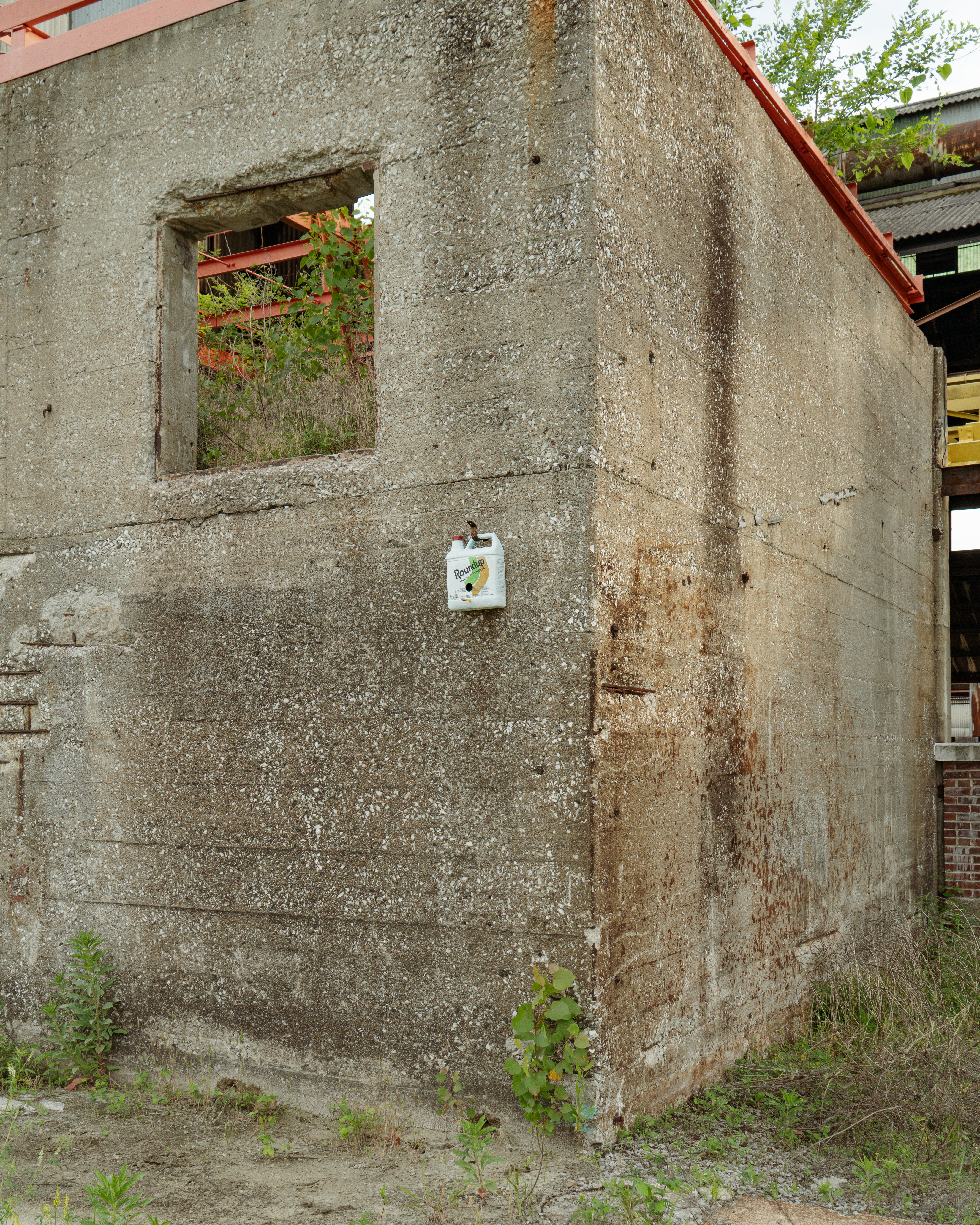
Conrad Bakker's work is a good example of how artists responded to different aspects of the site. Conrad looked to the industrial landscape surrounding the site, particularly Sauget's long association with Monsanto's environmental legacy. His work looks to the landscape itself as an archive of industrial history. The land preserves the material traces of industry, and we can think of those traces as another kind of fragment.
The artists work across different media. What connects their practices within Phantom Frame?
Jeff Robinson: Each artist approaches meaning as something that emerges through context. They're interested in how an object or subject changes when it's relocated or placed in relationship with something else. The artists work across very different media, but they're often asking similar questions. Loooking at Alberto Aguilar and Marina Peng illustrates this particularly well.
Alberto assembled salvaged architectural fragments, industrial sewer pipe, "end-of-day" clay forms, Mexican blankets, and living corn into new column-like structures. Those elements were never intended to exist together, but they reveal relationships between architecture, labor, and agriculture. His work could only have emerged through direct engagement with the NBAC and shows how the site itself became an active collaborator in the exhibition. Context transforms meaning and new relationships can emerge from materials that once belonged to entirely different histories.
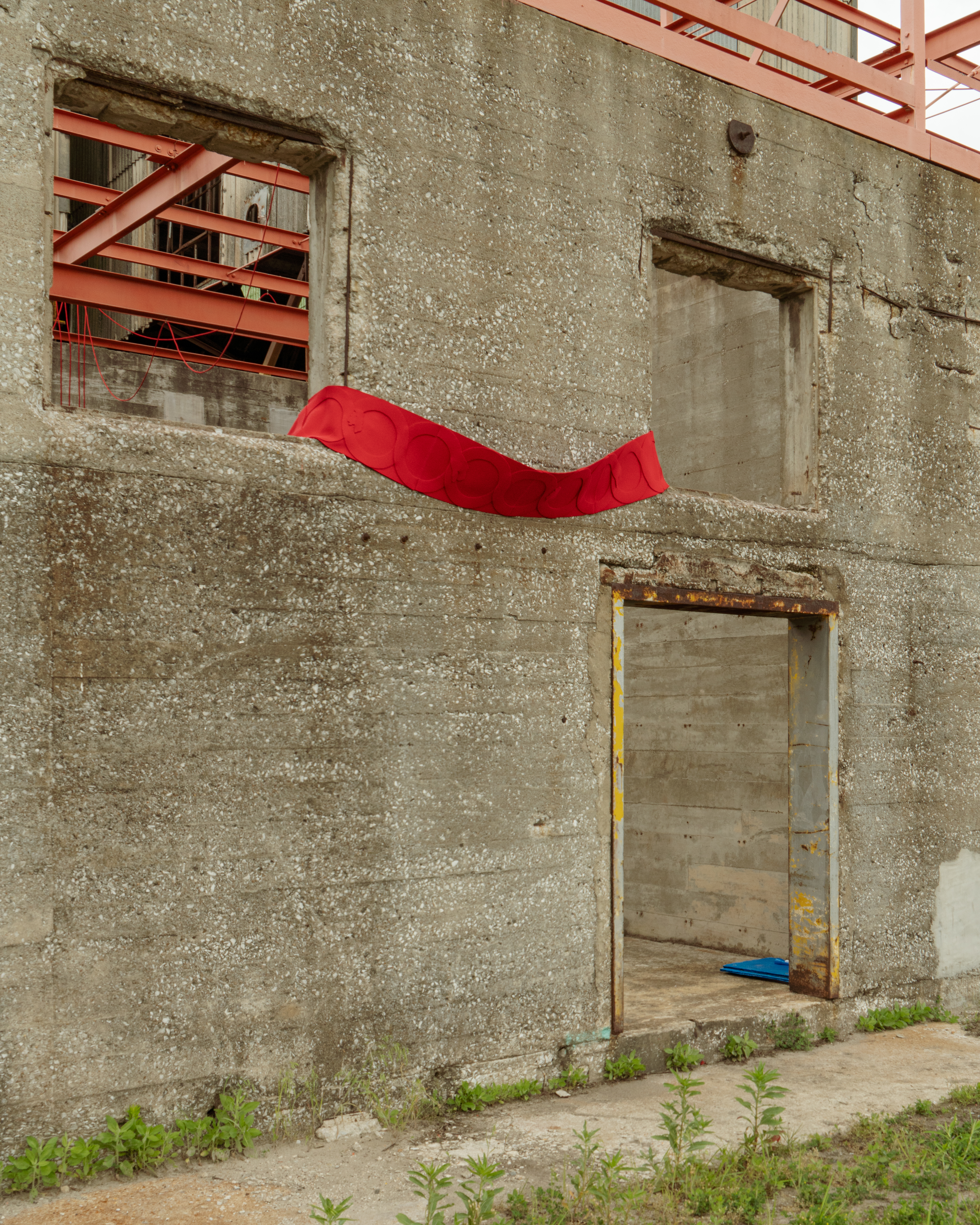
Marina's work launches from a single decorative motif taken from an ornamental brick in the NBAC collection. She incorporated that design into a large textile installation that wraps through the two window openings of a bunker as a Möbius strip. Even though her materials and approach are completely different, she arrives at similar questions. How does context shape meaning? How do patterns persist across time? What happens when a fragment becomes the foundation for something entirely new?
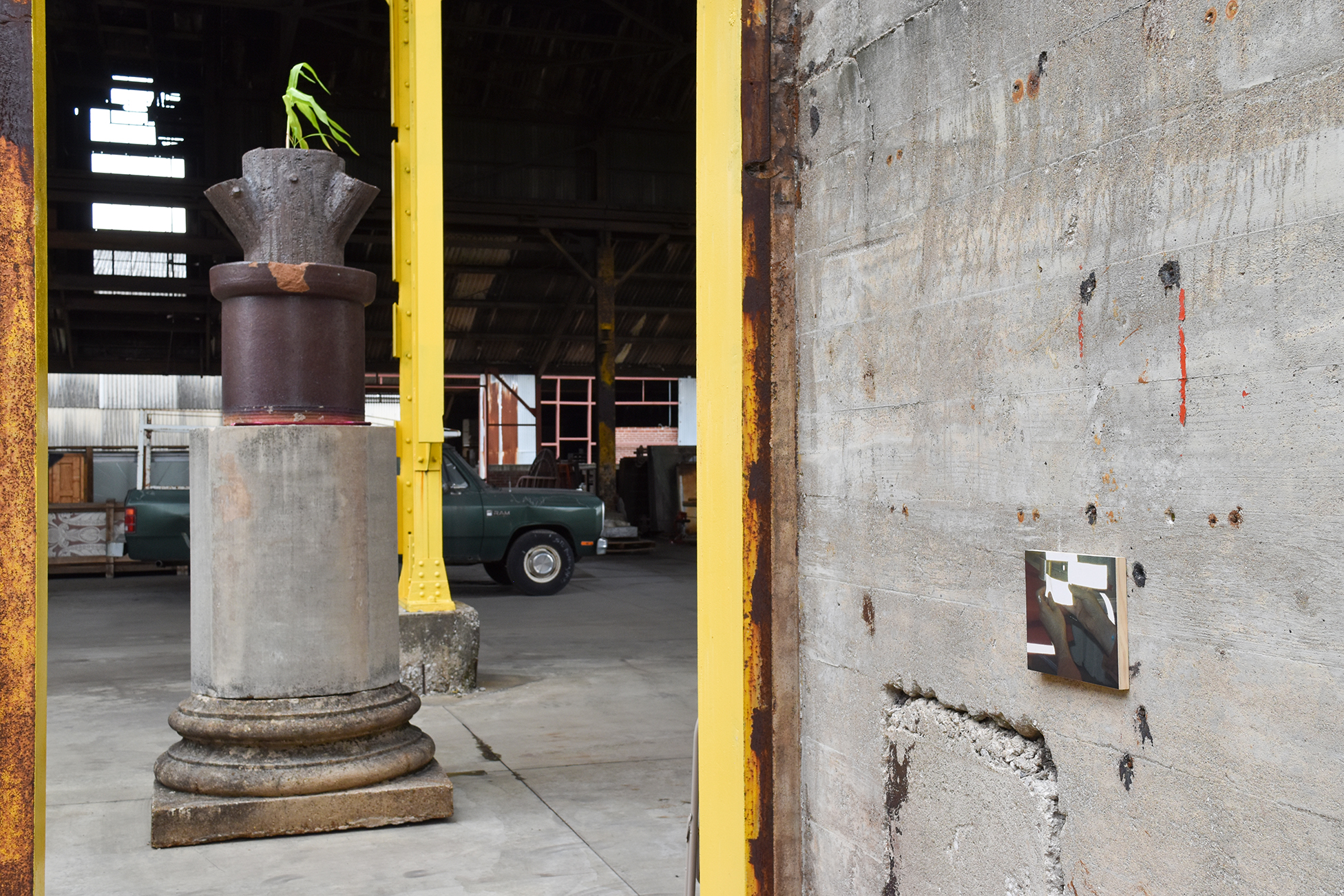 Installation view, 2026, Phantom Frame
The exhibition suggests incompleteness can be productive. Why is that idea relevant today?
Allison Lacher: It can be easy to associate completeness with success because it suggests stability and certainty. But that's rarely how we actually experience the world. Most of us live among things that are unfinished or constantly changing. That's where possibility arises. Once something is no longer final, it becomes open to interpretation. That doesn't mean we celebrate loss or erasure; it means recognizing that change can produce new forms of meaning. A fragment, a building, or a landscape can continue to evolve.
That's what interested us about the architectural remnants at the NBAC. We don't see them as static historical artifacts. They carry the traces of their original lives, but they're also open to new interpretations. That's the relevance of incompleteness today. We often think of fragments as evidence of what has been lost, but they can also be evidence of what remains possible.
Did any projects change significantly in response to the site?
Jeff Robinson: Every project changed in response to the site because none of the artists exhibited existing or predetermined work. Phantom Frame was site-responsive from the beginning. We invited the artists to spend time with the site, whether in person or through research, because we wanted the exhibition to develop from those encounters. This project emerged through experimentation, observation, and dialogue. The site became a collaborator rather than a backdrop.
Danny Bracken responded directly to the architecture of the bunker. He attached sound transducers to the overhead steel frame, essentially turning the overhead structure of the bunker into an instrument. The sound resonates through the steel itself. Because of the open nature of the site, the installation exists in constant dialogue with its surroundings. The sounds of passing trains, wind, birds, and industry move in and out of the work make it impossible at times to separate the sound installation from the place that produces it. It's an excellent example of what we hoped this exhibition could do: the site becomes an active collaborator.
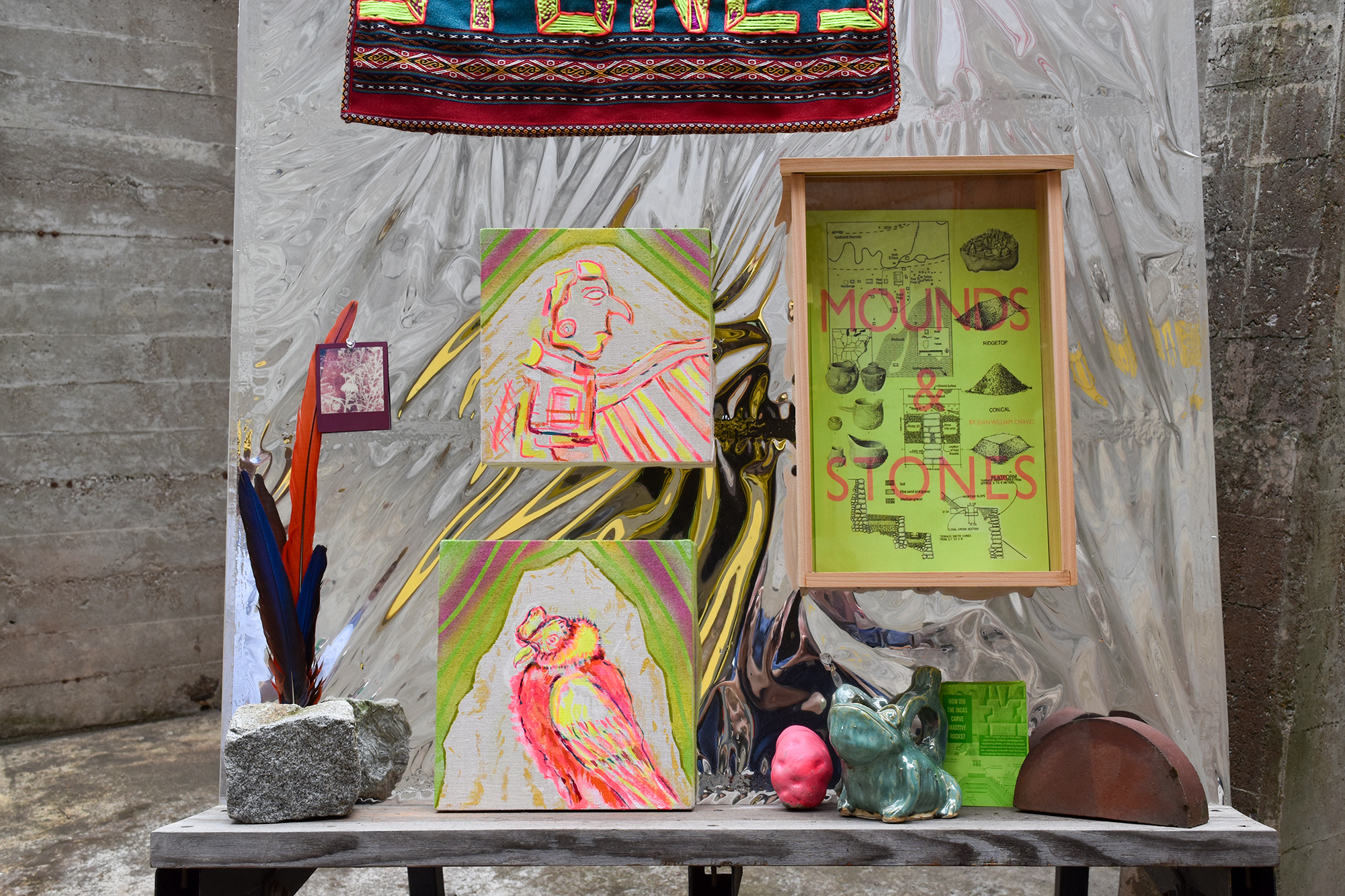 Installation view, 2026, Phantom Frame
Architectural remnants hold physical and cultural memory. How does Phantom Frame rethink preservation, history, and change?
Allison Lacher: We think about preservation as something active rather than static. Collections like the one at the National Building Arts Center certainly protect material history, but we also think they can generate new knowledge. When artists engage preserved objects, those objects begin to take on new meanings without losing the histories they already hold. We might think of preservation and change as opposites, but they're actually connected.
Juan William Chávez's work offers another way of thinking about preservation. He brings the NBAC's collection into conversation with Indigenous knowledge, agriculture, and the ancient mound-building traditions of the Mississippi River floodplain. His work centers much longer histories of building and material knowledge. Preservation is also about our relationship to land, ecology, and cultural memory. That includes asking what histories are preserved, whose knowledge is remembered, and what it means to carry those histories into the present.
 Installation view, 2026, Phantom Frame
The exhibition brings together architecture, landscape, memory, and contemporary art. How do you hope visitors navigate these ideas?
Jeff Robinson: To get to NON STNDRD, visitors first walk through the National Building Arts Center campus. Along the way, they pass collection items of every scale. That walk establishes a context that informs everything that follows.
The exhibition isn't intended to deliver a single interpretation or a linear narrative. It offers multiple points of entry. We hope visitors leave thinking about how meaning emerges through relationships between the site, the artwork, and the viewer.
Sarah and Joseph Belknap's work illustrates this. You begin with the architecture of the bunker and suddenly find yourself thinking about meteorites or communication with outer space. Their work moves fluidly between architecture, science, speculation, and the open sky above. That kind of movement is really what we hope visitors experience throughout the exhibition. It's less about following a single narrative and more about making connections across different places, histories, and ways of understanding the world.
 Installation view, 2026, Phantom Frame
NON STNDRD often challenges exhibition formats. How does Phantom Frame extend that approach?
Allison Lacher: STNDRD Exhibitions operates two sites: STNDRD and NON STNDRD. Across both, we develop projects that respond to the physical, social, and historical conditions of each site. Weather, landscape, architecture, infrastructure, and public space become participants.
At NON STNDRD, the boundary between exhibition space and context can be blurry. The collection, the landscape, and the architecture become part of the exhibition. This is not a site that recedes. STNDRD Exhibitions creates conditions where the artwork and the context of the site become difficult to separate. When that happens, both are transformed. The site becomes newly legible through the artwork. It's not just a gesture to place contemporary art in unusual locations. It's about creating opportunities for artists and sites to radically inform one another.
After visiting Phantom Frame, what do you hope stays with audiences?
Jeff Robinson: The National Building Arts Center does important preservation work, but it also gives these structures and objects an afterlife. They're no longer serving their original purpose, but they continue to generate new questions, relationships, and meanings. WM

Noah Becker
Noah Becker is an artist and the publisher and founding editor of Whitehot Magazine. He shows his paintings internationally at museums and galleries. Becker also plays jazz saxophone. Becker's writing has appeared in The Guardian, VICE, Garage, Art in America, Interview Magazine, Canadian Art and the Huffington Post. He has written texts for major artist monographs published by Rizzoli and Hatje Cantz. Becker directed the New York art documentary New York is Now (2010). Becker's new album of original music "Mode For Noah" was released in 2023.
Becker's 386 page hardcover book "20 Years of Noah Becker's Whitehot Magazine of Contemporary Art" drops Aug 8, 2025 globally on Anthem Press.
Noah Becker on Instagram / Noah Becker Paintings / Noah Becker Music / Email: noah@whitehotmagazine.com
view all articles from this author