Whitehot Magazine
November 2026
"The Best Art In The World"
"The Best Art In The World"
November 2026
The Hermeneutic Apparatus of Roberto Rizzo
By RAPHY SARKISSIAN | November 11, 2026
In Frank Stella’s Avicenna (1960), held in the Menil Collection in Houston, a hole cut through the center of the canvas reveals nothing but the wall. Curator Michael Auping called it “a very new thing for painting to have a hole in the center of your painting.” The act is also very old: around 1415 Brunelleschi drilled a hole through the vanishing point of his painted panel depicting the Florentine Baptistery, the point Alberti would later call the punto centrico. Through this aperture, no larger than a lentil, a single eye could view the panel’s reflection in a mirror, testing perspective against the real world it claimed to reproduce. Stella’s opening remains such a point, whereas in Roberto Rizzo’s ostensibly abstract painting De pictura XXII the point has become a line.¹
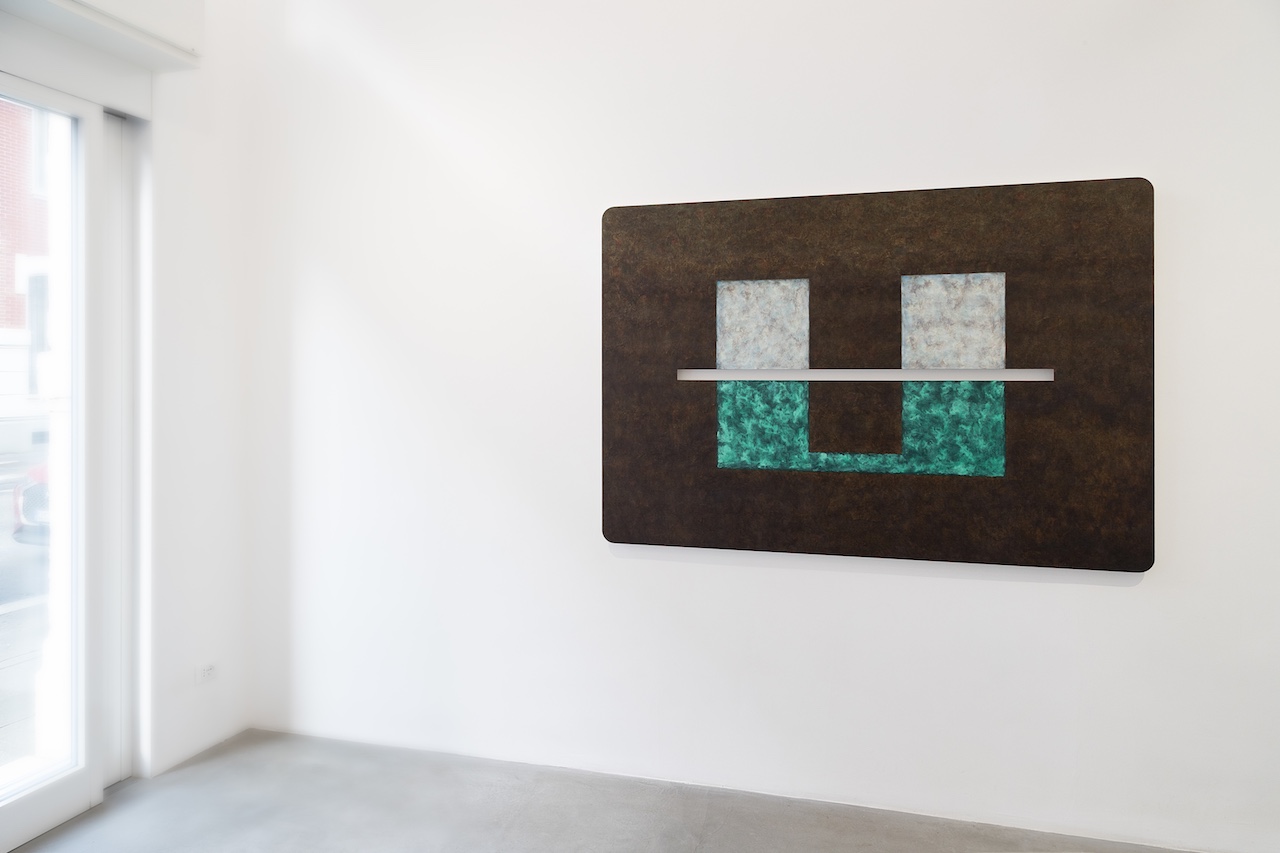 Roberto Rizzo, De pictura XXVI, 2026, oil on wood panel, 130 by 190 cm. © Roberto Rizzo. Photo: Alberto Messina. Courtesy the artist and Galleria Arrivada, Milan.
In De pictura XXII, shades of chalky blue cover a wooden panel with rounded corners, its surface suggesting the ground of a fresco after seven centuries of weathering. A narrow vertical slit opens through its center onto the gallery wall. On either side, two rectangles seem to reach toward one another: clouded white over blue on the left, sea green veiled in white on the right. Each extends a narrow foot along its lower edge, and the two appear to meet across the opening, in the exposed space beyond the panel. These feet recall the conduits of Peter Halley’s diagrammatic, Baudrillardian paintings, where synthetic channels link cells across a closed electronic circuit. Rizzo’s channels, however, lead off the surface altogether, emptying into the physical space of the gallery wall.
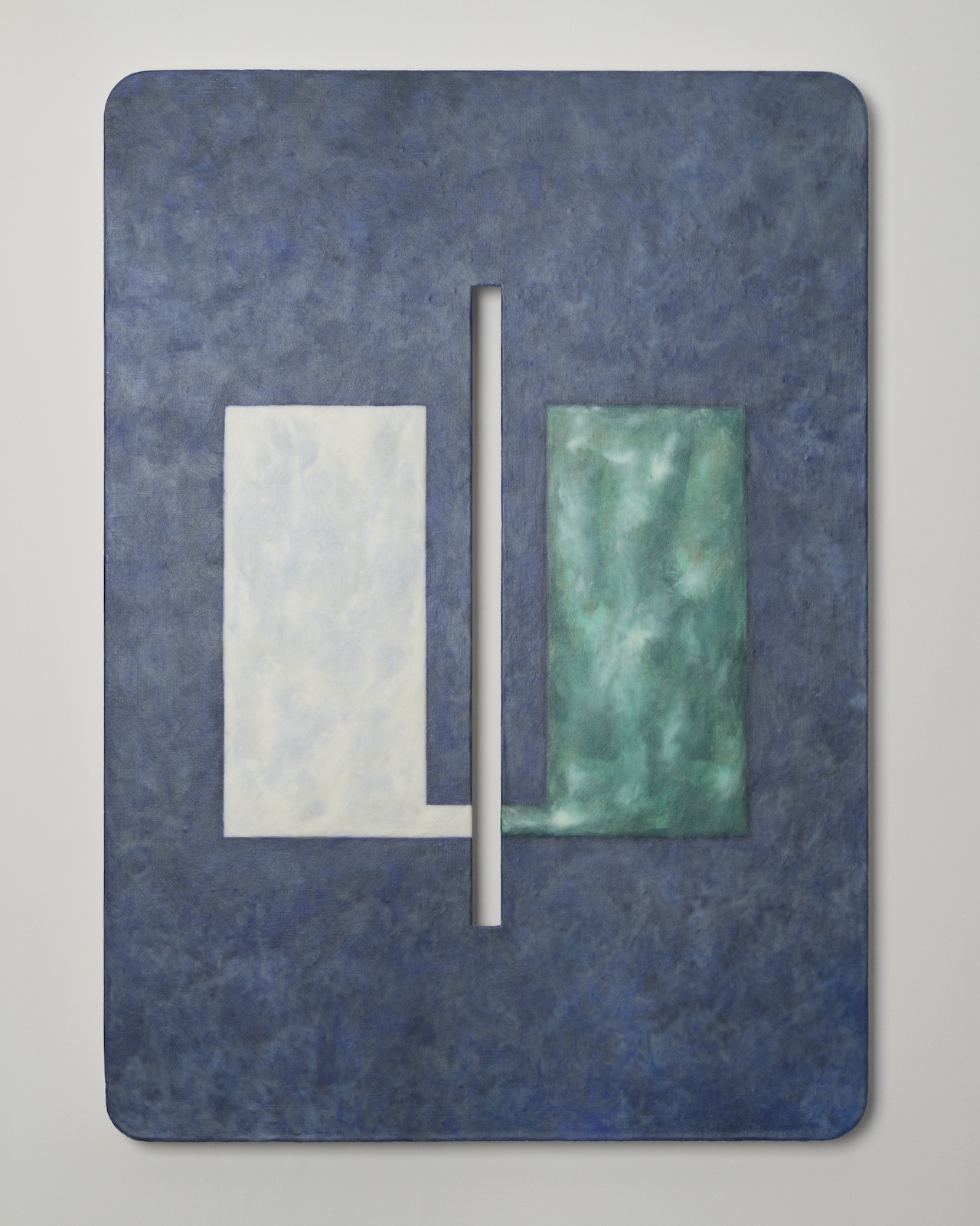 Roberto Rizzo, De pictura XXII, 2026, oil on wood panel, 70 by 50 cm. © Roberto Rizzo. Photo: Alberto Messina. Courtesy the artist and Galleria Arrivada, Milan.
In De pictura XXIII, similar geometric forms are arranged above and below a horizontal slit: two clouded white squares rest upon the central slit while a bordeaux, roughly U-shaped form hangs beneath it. Where the vertical stance of XXII evokes the posture of a waking body, the horizontal alignment of XXIII suggests the body at rest during sleep, as though each state of consciousness had been granted a painting of its own. If the two paintings were superimposed, their slits would form a cross whose center falls where Stella cut his hole and Brunelleschi drilled his peephole, each opening the picture to what lay beyond it. Both works belong to the De pictura series, shown in Il quadro come dispositivo, or “the painting as apparatus,” Rizzo’s current project at Galleria Arrivada in Milan. Curated by Angela Madesani, the exhibition is as historically charged as it is formally incisive.
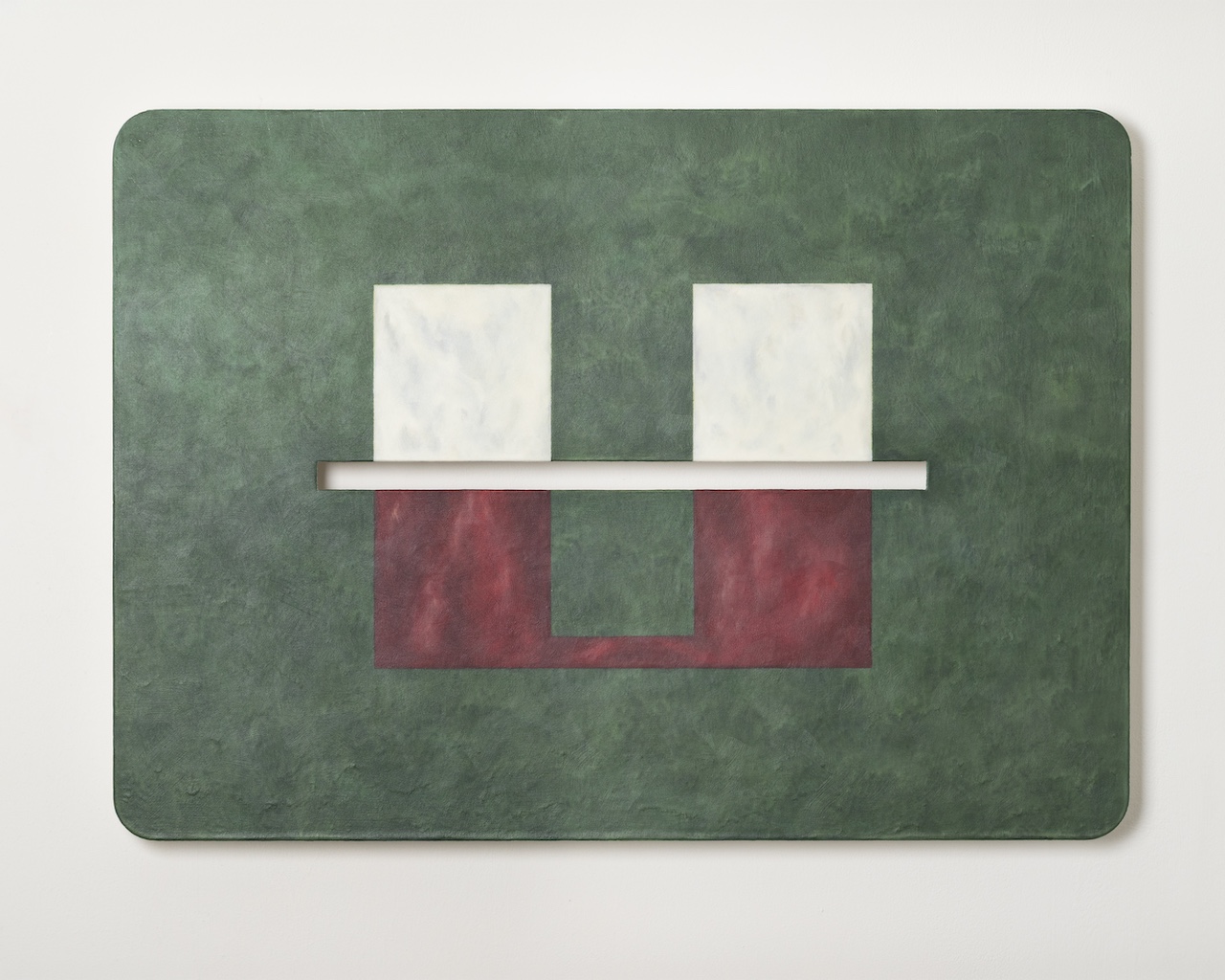 Roberto Rizzo, De pictura XXIII, 2026, oil on wood panel, 50 by 70 cm. © Roberto Rizzo. Photo: Alberto Messina. Courtesy the artist and Galleria Arrivada, Milan.
In 2005, Barry Schwabsky located the force of Rizzo’s diptychs in “the vacant central axis” between their two panels,² a gap that ran from edge to edge and so continued beyond the picture like a line. In De pictura that axis has been closed at both ends within a single panel, and the line has become a negative bar that discloses the architectural support. Brunelleschi had painted the Baptistery and left its sky to burnished silver, allowing real clouds above the painted architecture to appear in reflections. Rizzo gives up the image altogether and keeps only the peephole, the one element of the experiment that was never an illusion, now expanded into a baffling aperture, as if intended to probe painting’s ontology and its relation to the world.
Madesani, a critic who has known Rizzo since their high-school years in Milan, recalls the 1980s, when he began to paint, as a period “of irony for its own sake.”³ Against this backdrop, Rizzo looked back to Pittura Analitica and Conceptual Art, the movements to which his teachers belonged. Carmengloria Morales, whom Madesani counts among the most interesting painters to have worked in Italy since the 1960s, taught him at the Liceo di Brera and later took him on as her assistant. At the Accademia di Brera, where he enrolled in scenography in 1985, he met Rodolfo Aricò, known for his custom-shaped canvases. Behind them both stands Lucio Fontana, whose cut Madesani sees in Rizzo’s slits as involving “not only a breaking through but also the exterior space entering the painting,” an exchange of physical surface for the reality of space. Madesani reminds us that the portable painting itself, which acquired a new prominence in the fifteenth century, had by the 1970s become taboo, “almost the symbol of the commodification of art.”
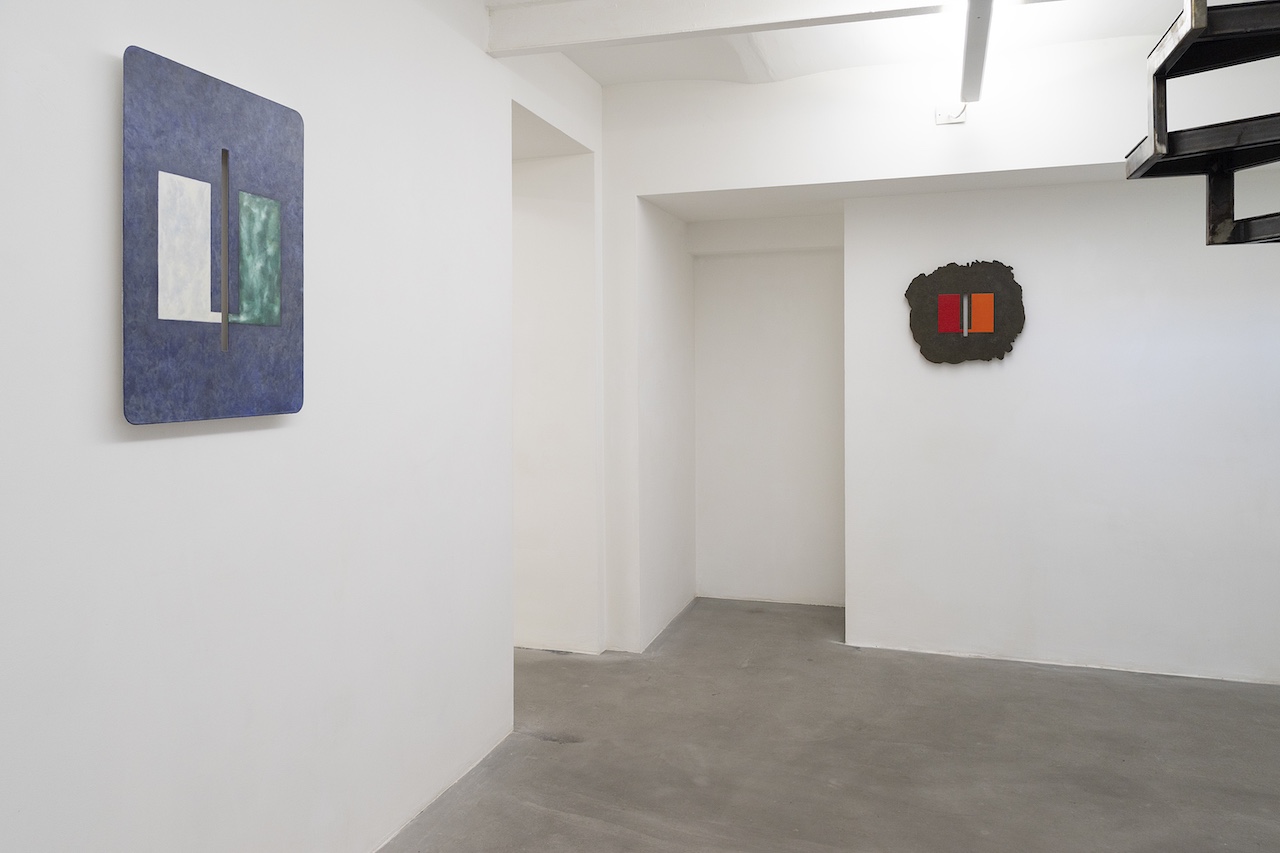 Left to right: Roberto Rizzo, De pictura XXII, 2026, oil on wood panel, 70 by 50 cm. Sinopia 2, 2026, oil on cement, 46 by 50 cm. © Roberto Rizzo. Photo: Alberto Messina. Courtesy the artist and Galleria Arrivada, Milan.
Midway between the Italian scene and the American one stands Imi Knoebel, who in 1968 began Raum 19, named for his studio Room 19 at the Düsseldorf Academy. Now presented at Dia Beacon in New York, its panels, stretchers, and blocks are stacked and leaned against the walls, like the disassembled parts of a space put into storage, leaving only a sum of unpainted supports. In New York City, Ralph Humphrey went the other way, keeping the rectangle and thickening its surface until the frame and the field it held became a single built object. Rizzo’s own question, as Madesani records it, is “What comes after the end of painting?” His answer has been to re-enter not only painting but the quadro, literally the “square.” Painting becomes an object, reassembled from what Knoebel had dismantled. Yet the object Rizzo constructs is not closed: it is an interiority that is at once an exteriority, opening along a single line onto the wall.
The two works titled Sinopia take their name from the underdrawing of fresco painting. During the initial phase, medieval and early Renaissance painters often sketched the full-scale composition in charcoal on a rough layer of plaster (arriccio), developing it with a brush dipped in reddish-brown earth pigment (sinopia). They then covered this drawing with the smooth final layer of plaster (intonaco) upon which the fresco itself was painted. Madesani is careful to say that Rizzo’s works are not sinopie in the strict sense but draw on the preparatory phase in which the pictorial plan is laid out. What they keep is the drawing’s own function: to set the foundational composition of a picture before its final execution. In Sinopia 2, the support is no longer a panel but a slab of cement whose shapeless outline only approximates an oval, as if a piece of wall had been broken off and returned to the wall. The slit passes primarily through the bare cement, an opening left when the slab was cast rather than cut into it afterward, as Fontana cut into his canvases. On either side of it stand two flat fields, an intense red and an intense orange, distinct in hue yet close in value, each separated from the opening by a margin of cement and reaching toward it only with a narrow foot along its lower edge. Across the aperture, simultaneous contrast intensifies the red and orange so that the two colors reverberate without ever meeting.
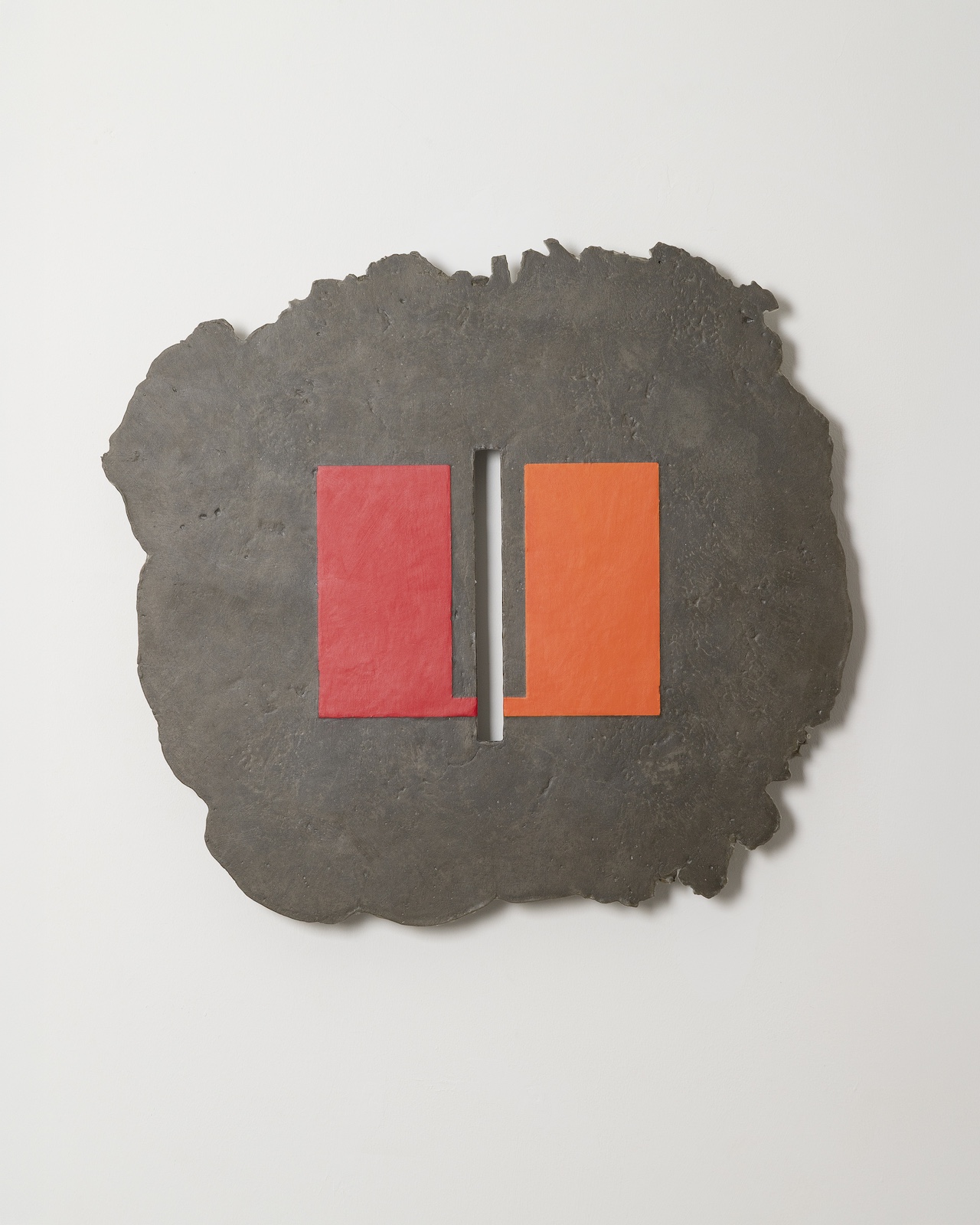 Roberto Rizzo, Sinopia 2, 2026, oil on cement, 46 by 50 cm. © Roberto Rizzo. Photo: Alberto Messina. Courtesy the artist and Galleria Arrivada, Milan.
In Sinopia 2, abstraction tempts the eye toward figuration: the near-oval outline, the axis of the slit, and the paired fields on either side of it are enough for the Gestalt principle of Prägnanz to organize them into a face, with the slit falling where a nose would be. However strongly we resist the anthropomorphic reading, we cannot help performing it. The slit then undoes the face that the eye has just assembled, dividing it down the middle. It is at once the center of a geometric arrangement, the nose, and an opening onto the actual wall. The eye moves back and forth among the three, and what it holds is less a face than an abstracted mask, its coherence forming and dissolving with every pulse. In Hegel’s terms, the face assembled and the face undone might be expected to undergo an Aufhebung, the movement that at once cancels, preserves, and lifts up, but Sinopia 2 stops short of the lifting. In declining sublation, Rizzo’s painting aligns more closely with Adorno’s negative dialectics, which refuses to reconcile what remains contradictory, for the mask and its undoing go on alternating without ever resolving into a single image.
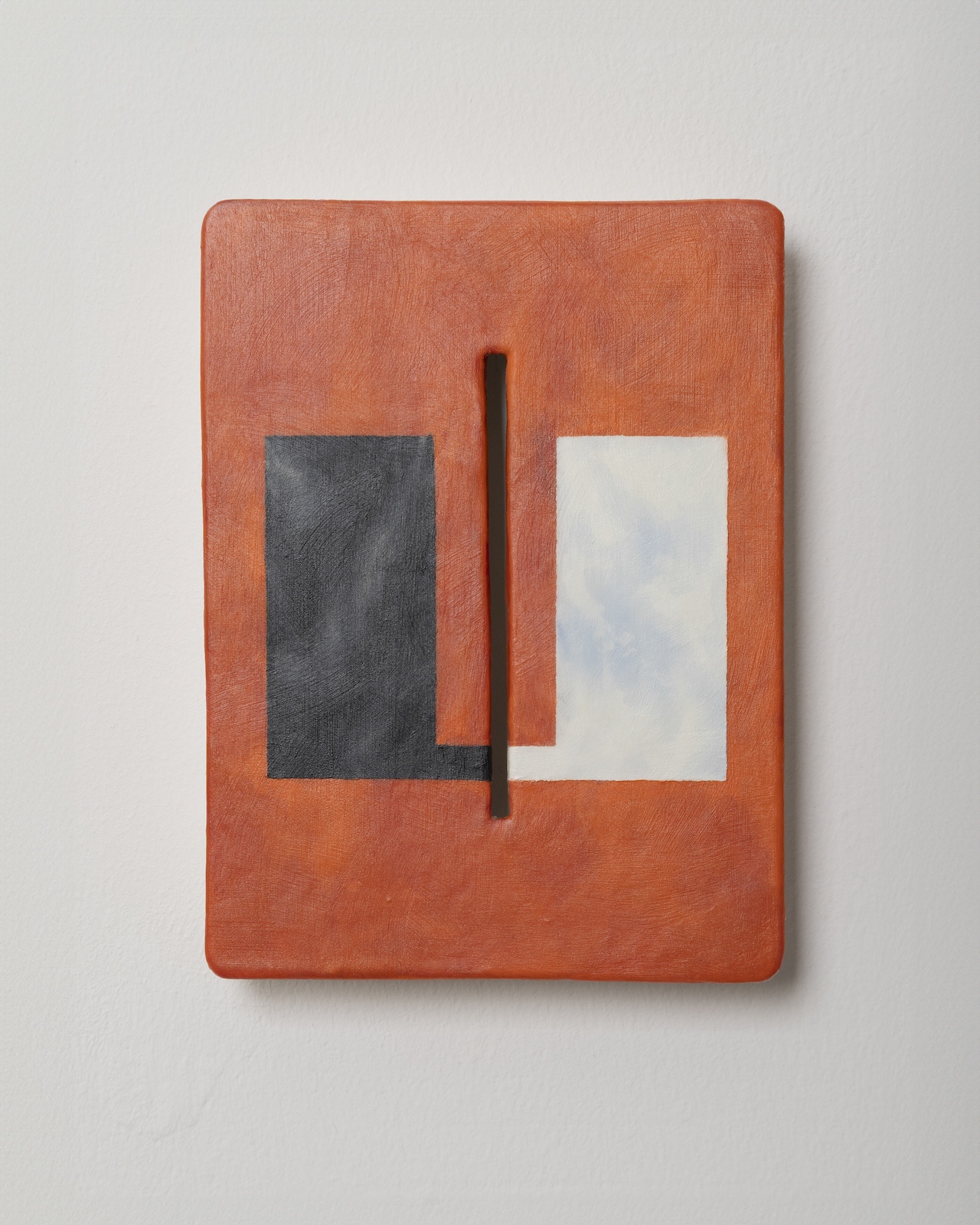 Roberto Rizzo, De pictura XXVIII, 2026, oil on wood panel, 16 by 12 cm. © Roberto Rizzo. Photo: Alberto Messina. Courtesy the artist and Galleria Arrivada, Milan.
The word in the exhibition’s title sounds more forbidding in English than in Italian. In Michel Foucault’s hands, its French counterpart, dispositif, came to designate the network of institutions, buildings, laws, and statements through which power shapes what we do, as in the panopticon, whose central watchtower could observe every cell. Gilles Deleuze, rereading him in 1988, drew from such examples the idea of the dispositif as, above all, a machine for making visible, with its own regime of light that decides what appears and what remains in shadow.⁴ Rizzo himself, in an unpublished text of 2019, sets the philosophical debate aside and uses the word for the painting “as a mechanism or process before an object.”⁵ In everyday Italian a dispositivo is simply a device, the word one uses for a phone or a tablet. De pictura XXVIII, a small panel with softened edges, shares something of their format but nothing of their function. Its truer ancestor may be Brunelleschi’s lost panel, a painting small enough to be held in the hand while the eye looked through its sighting hole.⁶ In Rizzo’s hands, Brunelleschi’s perspectival apparatus becomes the subject, and the work a discourse on how painting once persuaded us that its surface was a window.
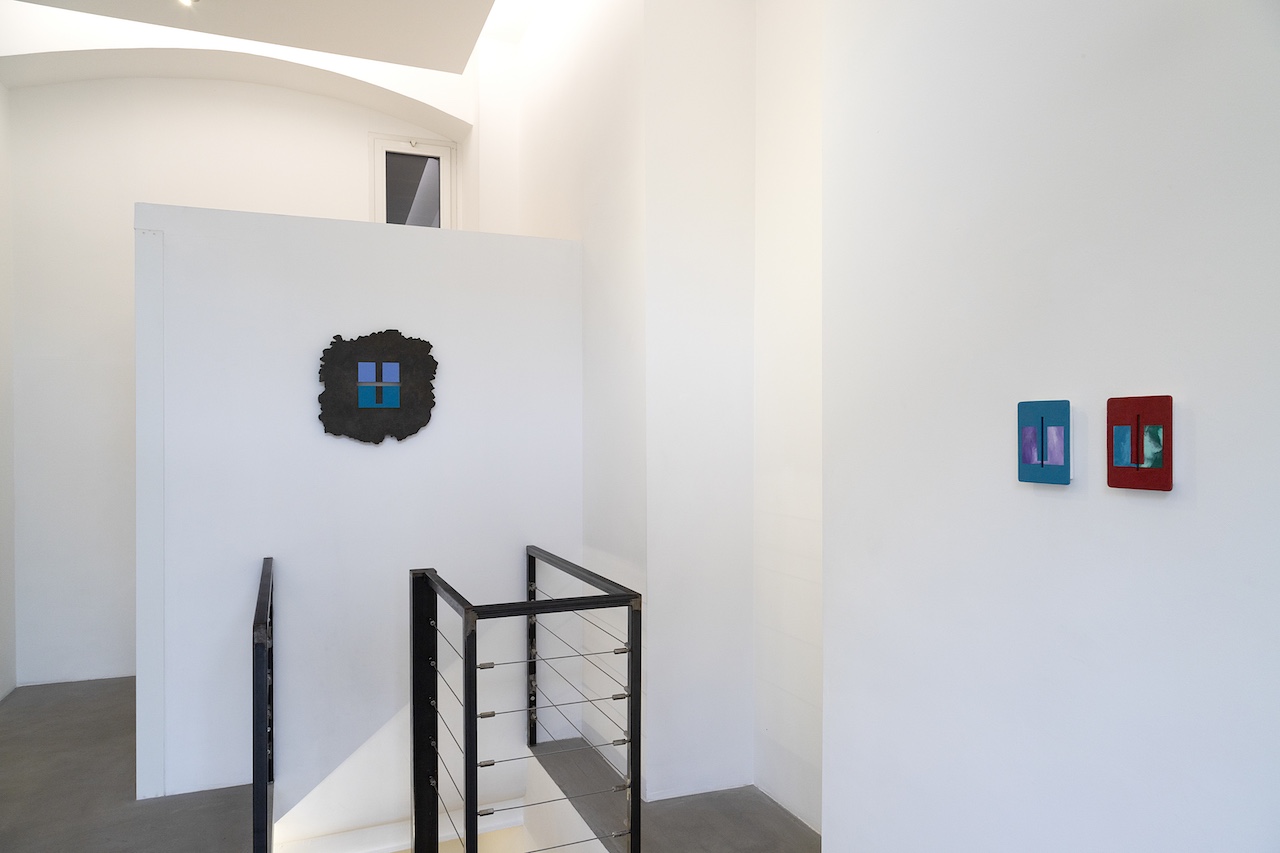 Left to right: Roberto Rizzo, Sinopia 1, 2026, oil on cement, 51 by 53 cm. De pictura XX, 2025, oil on wood panel, 16 by 12 cm. De pictura XIX, 2025, oil on wood panel, 16 by 12 cm. © Roberto Rizzo. Photo: Alberto Messina. Courtesy the artist and Galleria Arrivada, Milan.
At Galleria Arrivada, architecture and painting meet tête-à-tête, with Sinopia 1 mounted on a white block that doubles as a partition. Below, framed by a black steel railing, the stairwell opens a rectangular void in the floor through which one looks down as if into one of Rizzo’s slits. Vast galleries let a series of works speak to one another across long distances, but a space of this scale and ingenuity, rarer than it should be, draws them into close quarters with the architecture itself. The encounter between architecture and painting recalls that linear perspective, in Brunelleschi’s hands, was an architect’s invention. Yet the paintings themselves ask us to look beyond Brunelleschi’s constructed projections and reconsider our relation to painting’s historiography within the epistemological framework of our time.⁷
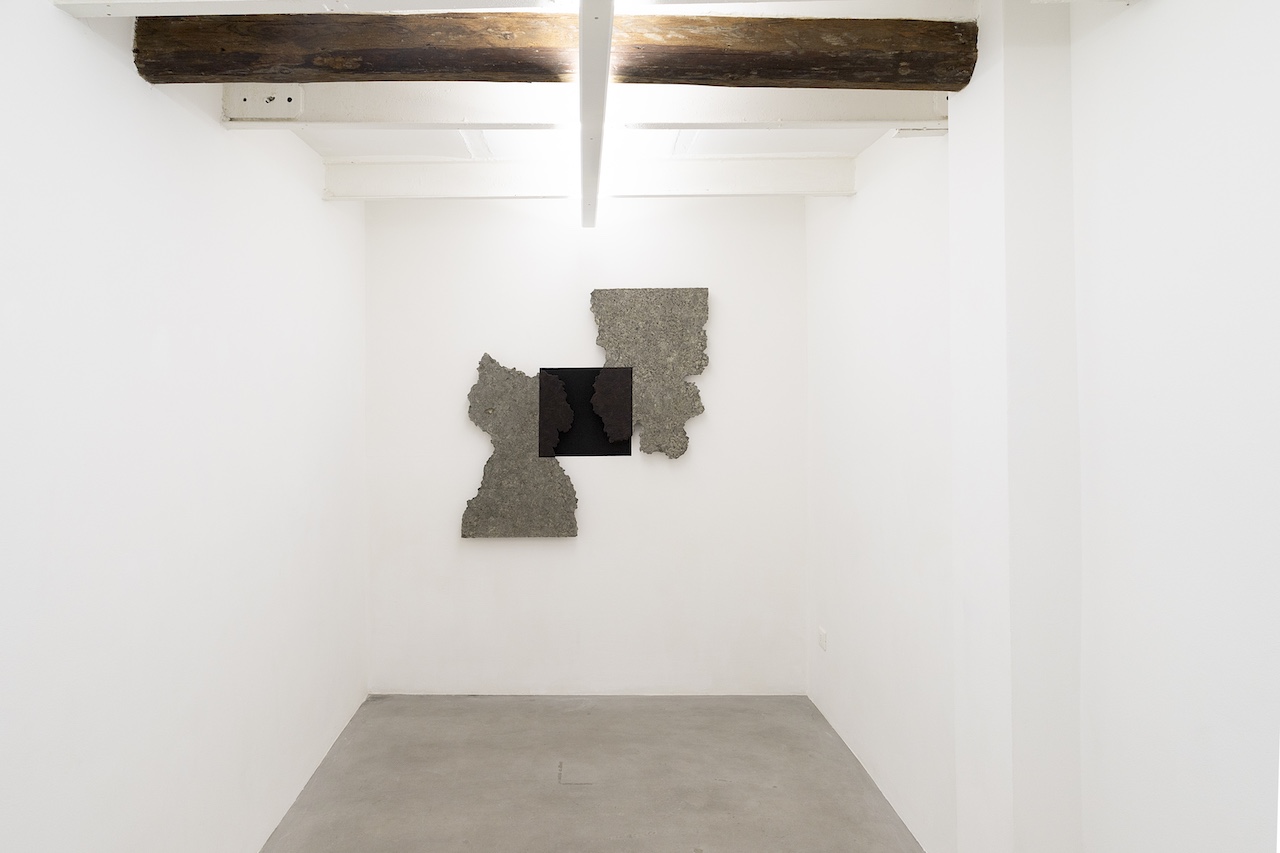 Roberto Rizzo, Geometrie dell’esperienza IV, 2021, oil on paper-cement, tempera on wall, site-specific dimensions (125 by 125 cm). © Roberto Rizzo. Photo: Alberto Messina. Courtesy the artist and Galleria Arrivada, Milan.
In a small white room beneath an old timber beam hangs Geometrie dell’esperienza IV, the earliest work on view and the one that goes furthest. Two nonfigurative formations of paper-cement, undulating and grey like sections of raw plaster, are hung apart. Their humble materials recall Arte Povera, though Rizzo’s allegiance lies with the analytic line Filiberto Menna traced in the 1970s rather than with the movement Germano Celant named.8 A black square, painted in tempera directly on the wall, lies beneath both formations. Its form continues onto the cement with Van Dyke brown oil paint, flat and matte on the plaster, but conforming to the irregular relief of the surface. A single figure thus exists on two supports and in two mediums. Since it must be repainted wherever it is installed, its date of 2021 records its conception and initial realization rather than the square now on this wall, a process before an object, exactly as Rizzo defines the painting.
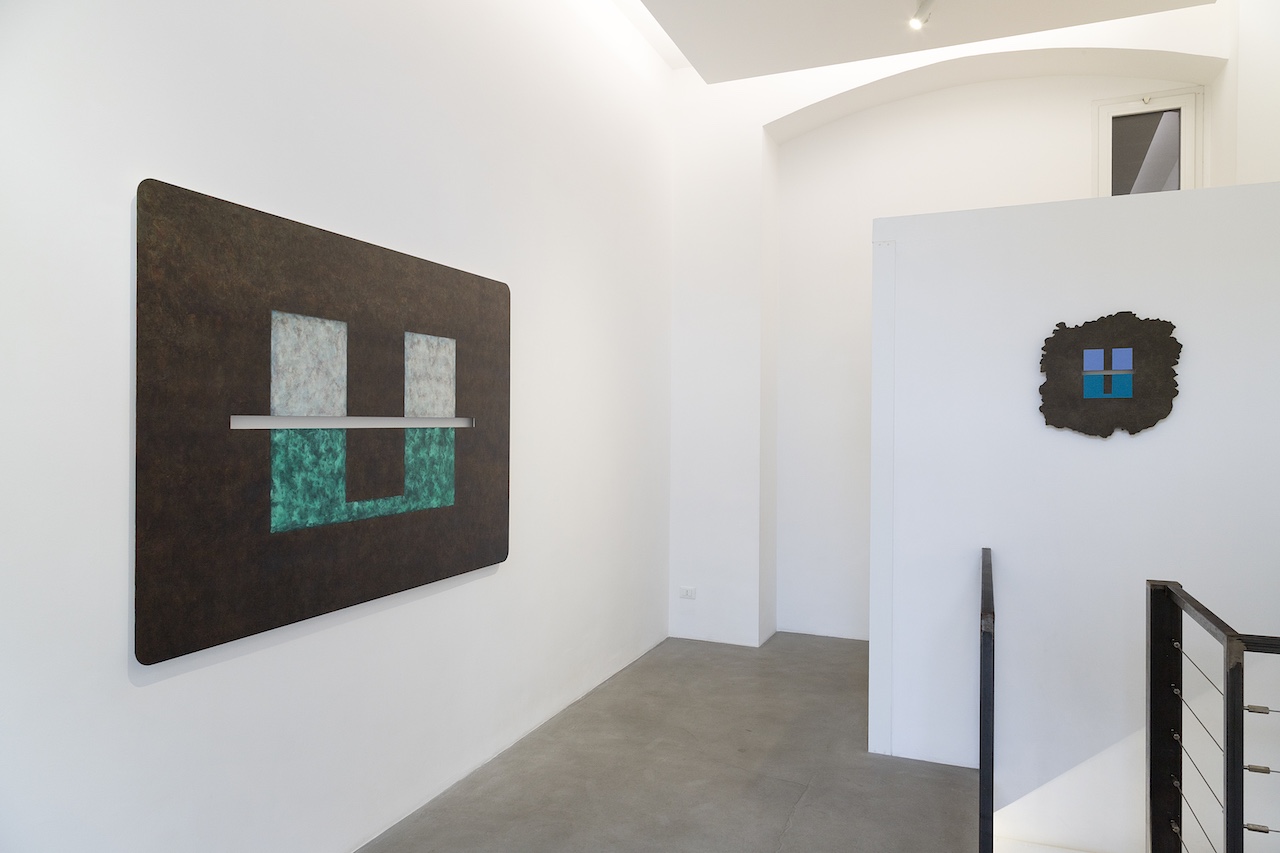 Left to right: Roberto Rizzo, De pictura XXVI, 2026, oil on wood panel, 130 by 190 cm. Sinopia 1, 2026, oil on cement, 51 by 53 cm. © Roberto Rizzo. Photo: Alberto Messina. Courtesy the artist and Galleria Arrivada, Milan.
Madesani describes Geometrie dell’esperienza IV as the work “of variable dimensions that closes the exhibition,” adding that “the experience is precisely the adaptability of the work.” Exhibited in isolation, the quasi-fresco binds geometric order to formless materiality. One may read the black square as Rizzo’s aperture translated into a painted surface, or, conversely, as a quadro in the literal sense, marking the outer limits of the painting while the space the aperture once held open disperses into the formless fragments on either side. Between the two readings, Geometrie remains suspended, as if holding sublation in abeyance. On the way out of the gallery, one may reexamine De pictura XXVI, hung beside a glass door opening onto the street. Having observed these narrow openings that expose the wall, the visitor may begin to see the windows of the city as extensions of Rizzo’s apertures, which insist that we carry them back into the world from which they originated. WM
Roberto Rizzo: Il quadro come dispositivo
Curated by Angela Madesani
Galleria Arrivada, Via Pier Candido Decembrio 26, Milan
October 1 through December 20, 2026
Notes
1. Italian distinguishes the quadro, the painting as a bounded object, from pittura, the art of painting, a word that descends from the Latin pictura of Leon Battista Alberti’s treatise De pictura (1435), from which Rizzo’s series takes its title and whose Italian version of 1436 he dedicated to Brunelleschi. Since English uses the same word for both, “painting” is used here for quadro, which is left in Italian where the distinction must be maintained. Similarly, dispositivo and its French counterpart dispositif are everyday words for a device, whereas in English “dispositive” survives mainly in legal usage, where a dispositive motion is one that decides a case, and translators of Foucault and Agamben have preferred “apparatus” or “deployment.”
2. Barry Schwabsky, “Painting the Present,” in Roberto Rizzo: Painting the Present, exh. cat. (London: Barbara Behan Contemporary Art; Milan: Grossetti Annunciata Arte Contemporanea, 2005), 6.
3. Angela Madesani, “Il quadro come dispositivo,” in Roberto Rizzo: Il quadro come dispositivo, exh. cat. (Milan: Galleria Arrivada, 2026), forthcoming. All quotations from Madesani, and Rizzo’s remarks to her, are from this essay.
4. Gilles Deleuze, “What Is a Dispositif?” (1988), in Two Regimes of Madness: Texts and Interviews 1975–1995, ed. David Lapoujade, trans. Ames Hodges and Michael Taormina (New York: Semiotext(e), 2006).
5. Roberto Rizzo, “Il quadro come dispositivo (prima che come oggetto),” unpublished text, 2019.
6. Antonio di Tuccio Manetti, The Life of Brunelleschi (c. 1480s), ed. Howard Saalman, trans. Catherine Enggass (University Park: Pennsylvania State University Press, 1970). On the experiment and its consequences, see Hubert Damisch, The Origin of Perspective (1987), trans. John Goodman (Cambridge, MA: MIT Press, 1994), and A Theory of /Cloud/: Toward a History of Painting (1972), trans. Janet Lloyd (Stanford: Stanford University Press, 2002).
7. Brunelleschi’s experiment is approached here through Hubert Damisch’s semiological reading of it (see note 6). “The epistemological framework of our time” refers to a way of seeing shaped by canonical modernism, from Mondrian to Pollock, and by currents that carried painting into sculpture and architecture, and into photography and text, from El Lissitzky to Eva Hesse. This way of seeing actuates, even provokes, the visitor’s own projections.
8. In the 2019 text Rizzo writes that the debate in Italy turned on “two distinct positions: that of Germano Celant, which proved victorious, and that of Filiberto Menna, concentrated on the specific language of painting and today rather forgotten.” Roberto Rizzo, “Il quadro come dispositivo (prima che come oggetto),” unpublished text, 2019. See Filiberto Menna, La linea analitica dell’arte moderna: Le figure e le icone (Turin: Einaudi, 1975).

Raphy Sarkissian
Raphy Sarkissian received his masters in studio arts from New York University and is currently affiliated with the School of Visual Arts in New York. His recent writings on art include essays for exhibition catalogues, monographs and reviews. He has written on Rachel Lee Hovnanian, Anish Kapoor, KAWS, David Novros, Sean Scully, Liliane Tomasko, Dan Walsh and Jonas Wood. He can be reached through his website www.raphysarkissian.com.
view all articles from this author