Whitehot Magazine
October 2026
"The Best Art In The World"
"The Best Art In The World"
October 2026
Arlene Shechet on her new exhibition at PACE gallery in New York, her sculptures - and the art of not knowing
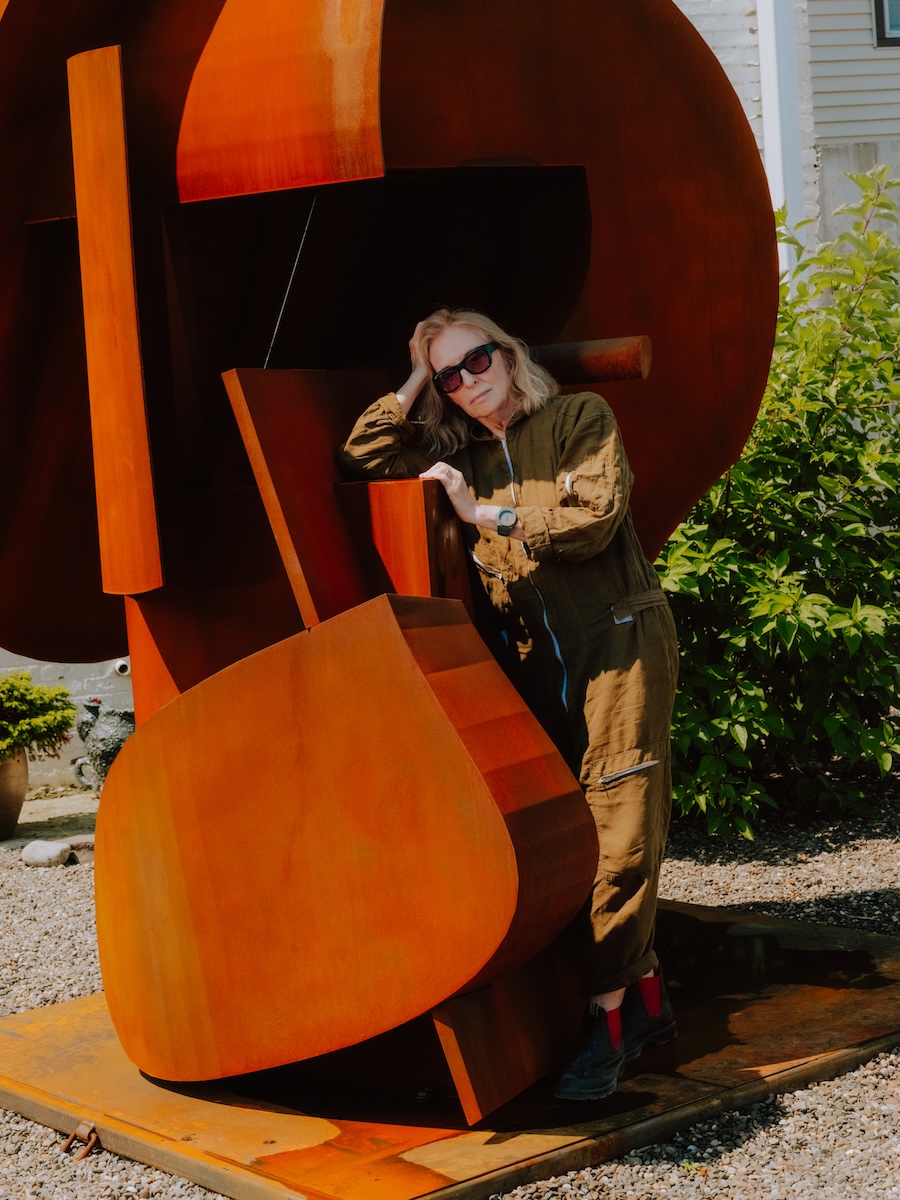 Arlene Shechet with one of her sculptures.
By AYSE SARIOGLU October 2, 2026 at 5:39 p.m. EST
There is something almost recursive about the title She Said, She Said. Before encountering the sculptures, we encounter a voice—then another voice repeating it, altering it, turning it into an echo. In Arlene Shechet’s new exhibition at PACE gallery in New York City, repetition is never repetition in the strict sense. Forms mirror one another without becoming identical; materials carry gestures from one body of work into another; color destabilizes the authority traditionally associated with monumental sculpture.
Shechet’s sculptures resist arriving at a single meaning. They are made to be walked around, looked through, approached and left behind. Heavy materials become unexpectedly light. Industrial steel acquires humor. Clay becomes drawing. Ancient techniques become contemporary gestures. The hand remains visible rather than being concealed.
At the center of this practice is a form of attention: to material, to process, to space, and perhaps most importantly, to what remains unknown.
Sarioglu: I wanted to begin with the title, She Said, She Said. Before we even encounter the sculptures, the title introduces a voice. Its repetition suggests an echo between two voices, but an echo is never identical to what came before it. Who is the “she” in the title?
Shechet: I don't know at all. The “she” isn't what's important. What's important is the mirror. I like the word because it also suggests an echo.
A lot of my work is made of two parts that are conversational with one another. Sometimes there are more than two, but often the work breaks down into mirroring or echoing. If I wanted to name who “she” was, I would have named her.
So “she” is an inclusive idea. It's a little bit spiritual.
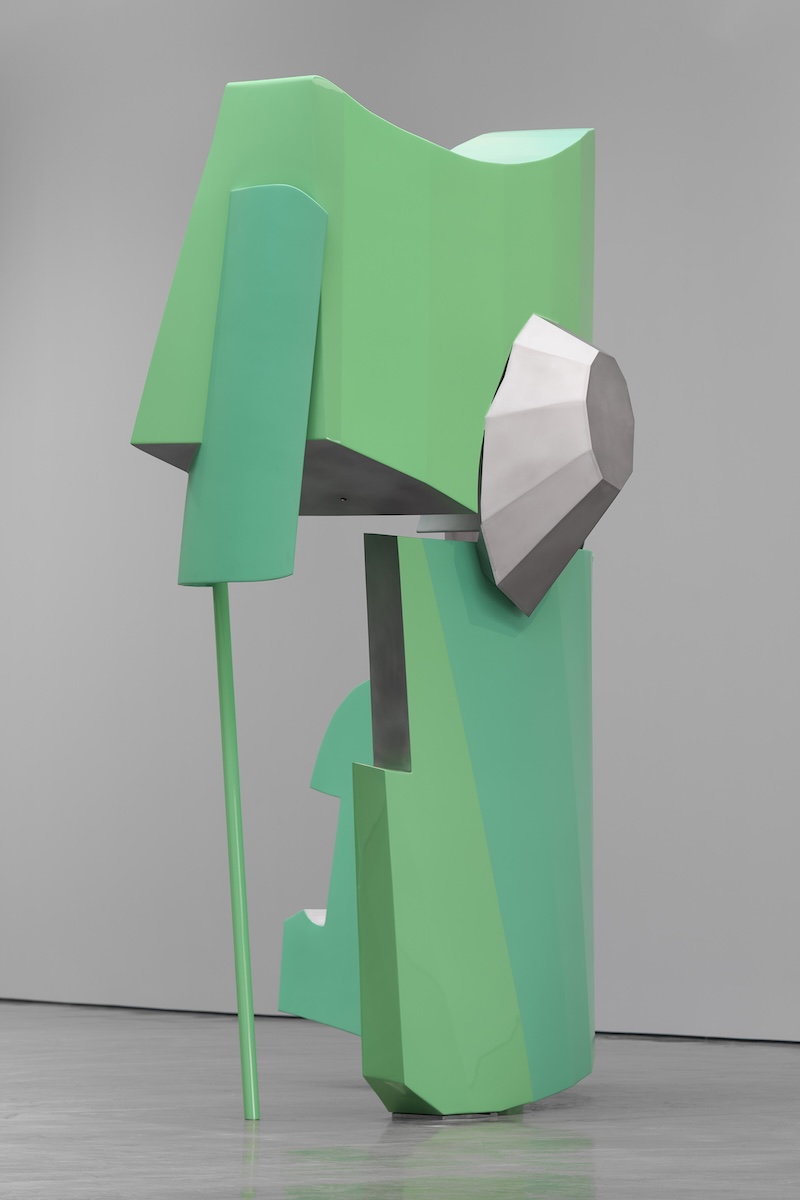 Arlene Shechet, Jewel, 2026
Sarioglu: That idea of mirroring seems to extend into the way you think about drawing. In these works, drawing doesn't remain on a surface. A line can become structure, space, volume. It can even choreograph the movement of the viewer. You have described your practice as “drawing through sculpture.” What happens to drawing when the line enters space?
Shechet: Line is simply one of the ways I make sculpture. I'm interested in all kinds of methods because line also creates space.
The negative space around something that is drawn or sculpted is just as essential as the thing itself. That's one of the beautiful things about art: you're not only looking at substance, you're looking at space.
So a line can absolutely be part of sculpture. It's another method, another way of making an image.
Clay is particularly important to me in this exhibition because it holds the impression of the hand. It's very direct, almost like a pencil or charcoal. It becomes a three-dimensional drawing tool.
Sarioglu: That brings me to material. Looking at these works, I had the feeling that the materials aren't simply being used—they're participating. Clay resists. Metal carries weight. Surfaces crack or absorb. Structures require support. At what point does the material begin to influence the decision?
Shechet: I'm always listening to the art. Not just the materials—the whole thing.
The entire process is about listening. It's a kind of call and response between the thing you're making and the artist. The job of the artist is to pay close attention to what the thing is trying to become.
I'm not following the material. I'm following the process.
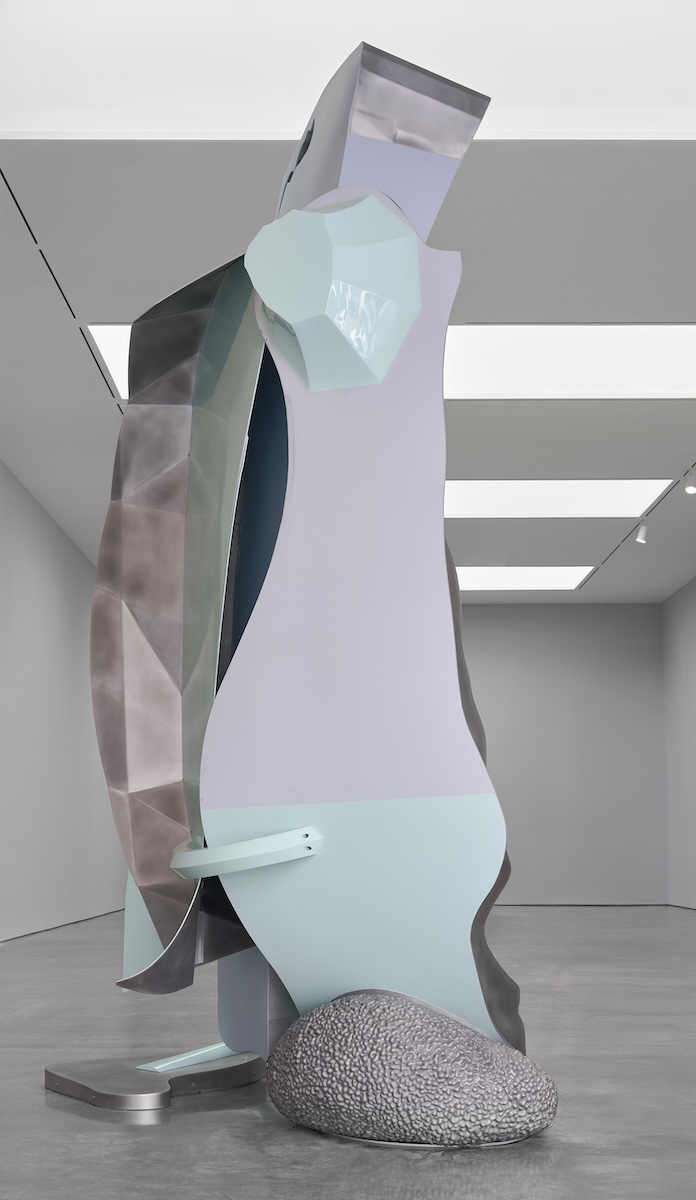 Arlene Shechet, Eve, 2026
Sarioglu: So the authority of the artist becomes less about imposing an idea and more about paying attention.
Shechet: Exactly.
Sarioglu: That sense of attention also seems important in Eve. The scale immediately places the sculpture within the history of monumentality, while the openness of the aluminum works against that sense of mass. And then there is the name, which carries an ancient and specifically feminine history. What interests you about giving an abstract monumental sculpture a name like Eve?
Shechet: My titles are always trying to be more than one thing.
I like the idea of time, of a word having more than one meaning. A title can give you a pause. You begin with one meaning, and then another meaning enters.
The large sculptures in this exhibition are also, in a certain way, a continuation of my exhibition at Storm King in 2024. Those sculptures had names that referred to time and women's names. So there is a continuity there.
Sarioglu: Monumentality is traditionally associated with weight, permanence and authority. Corten steel, in particular, carries a history of industrial power and a very masculine sculptural language. Yet your steel sculptures don't seem interested in intimidating the viewer. They can feel vulnerable, even humorous. How do you think about weight and authority?
Shechet: I like the fact that the sculpture can be heavy without making you feel its heaviness.
I had almost forgotten that it was heavy.
I like humor in sculpture. It changes the way people engage with something.
When you think about very large sculpture, and especially Corten steel, you often think about men and about scale creating awe. I'm not interested only in impressing people or creating awe. I'm interested in giving people an entry into the work.
I want viewing to feel like an invitation.
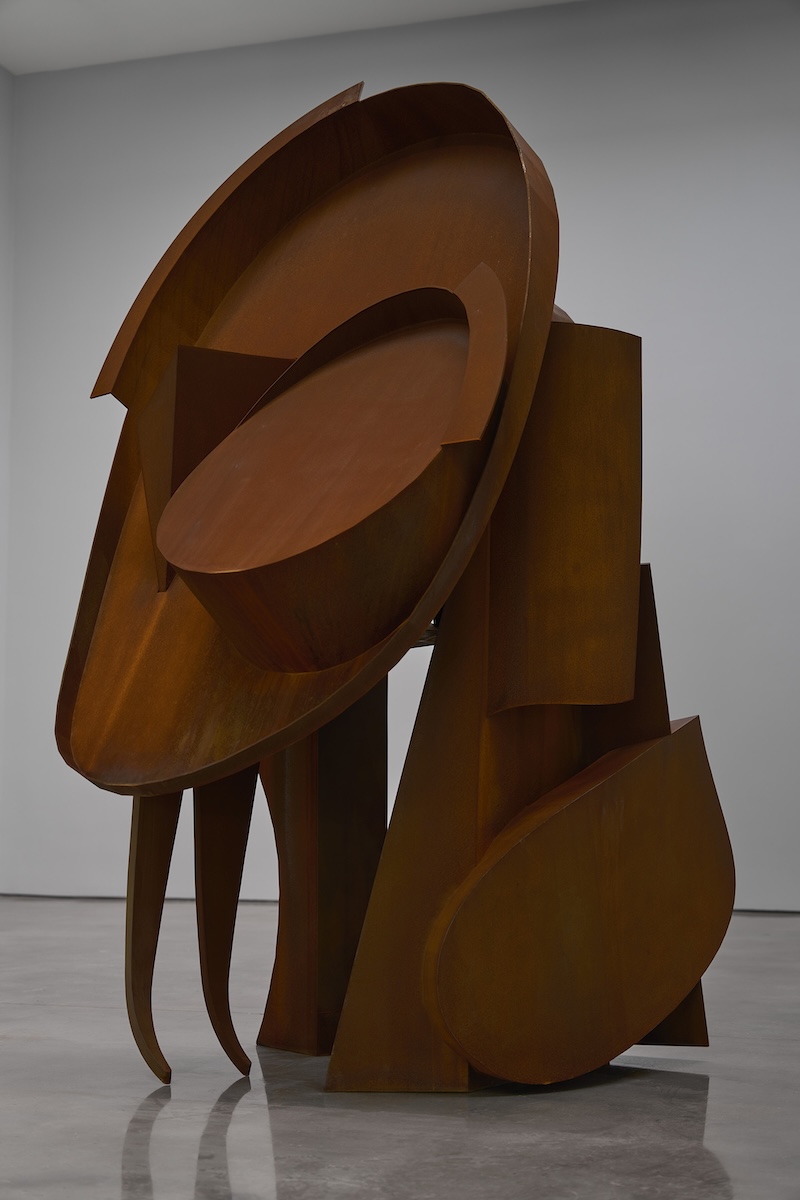 Arlene Shechet, Flo, 2026, images courtesy of PACE, New York, NY
Sarioglu: So rather than using monumentality to establish distance, you use it to create access.
Shechet: Yes. And I'm trying to make a new kind of monumental sculpture.
Sarioglu: Color seems central to that transformation. These aren't the colors we traditionally associate with monumental sculpture. They feel almost unexpected within that language.
Shechet: The colors are all hand-mixed. They're very much connected to my interests in both painting and sculpture, and to thinking about how something exists in the landscape.
Color has a lot of nuance. It's not simply red or black. It's everything in between.
And the surfaces matter, too. Some are glossy, some are matte. That changes the color and changes how you experience the sculpture.
Color is part of the sculpture.
Sarioglu: So color isn't applied to the sculpture. It belongs to its structure.
Shechet: Absolutely.
Sarioglu: There is something similarly important about the visibility of process. In the metal works, cuts, folds, welds and joints remain visible. They don't disappear into a perfected surface. They tell us that the sculpture has been made, altered, perhaps taken apart and made again. Do you think of these cuts as gestures?
Shechet: Yes. I think they're beautiful.
I've always been interested in seeing how things are made and sharing that evidence. The way something is made is part of the work.
I'm doing the same thing in the clay. The process remains visible.
Sarioglu: So the evidence of making becomes part of the sculpture's identity.
Shechet: Yes. It creates another entry point for people. You can experience the work through how it was made.
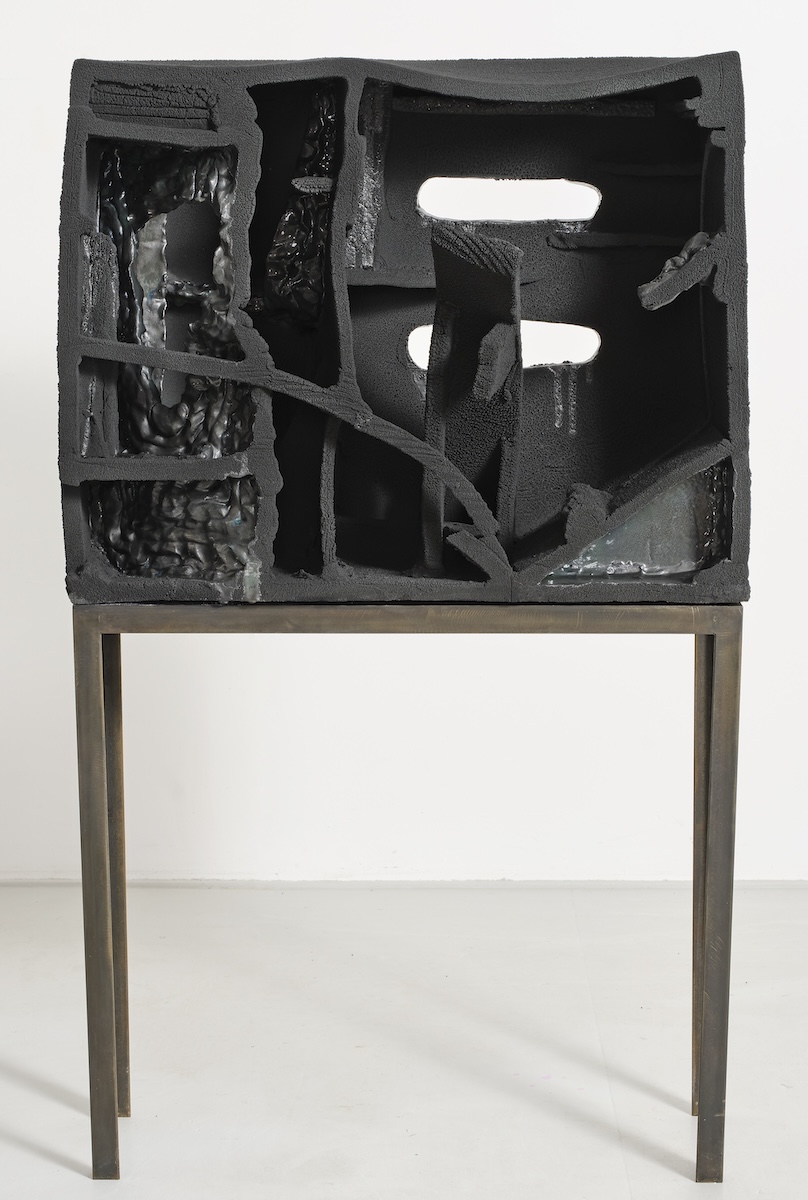 Arlene Shechet, Touching Ground: Amphora Story, 2026
Sarioglu: The ceramic works introduce another kind of time. You're using terra sigillata, an ancient technique associated with Greek and Roman ceramics, but you're using it in a very contemporary way. What were you looking for in that technique?
Shechet: I wanted a material that would behave differently from some of the other materials I use. Terra sigillata is extremely thin. I make it in the studio based on ancient Greek and Roman formulas, and it can soak into the clay while the work is being made.
When I was making these ceramic pieces, I realized that if I put anything heavy on the surface, it would conceal things. It would hide my hand.
I wanted the hand to remain present.
Sarioglu: That idea of absorption makes me think of Agnes Martin, whose paintings seem to contain an almost imperceptible physical process—the paint entering the canvas rather than simply sitting on it.
Shechet: I love Agnes Martin. I once watched something showing her painting in her studio, and the way the paint soaked into the canvas was mesmerizing.
That became an important piece of information for me. I wanted to access that kind of soaking in my own work.
Sarioglu: You seem very open about learning from other artists, but the references never feel illustrative. They become part of your own language.
Shechet: Exactly.
Sarioglu: Touching Ground: Silhouettes also looks back toward Greek and Roman vessels, where figures are reduced to shapes rather than specific identities. The silhouette suggests presence through absence. But in your work, even the outline seems unstable. It doesn't necessarily tell us what is inside.
Shechet: The Silhouettes come from those Greek and Roman vases and from the way figures move across them. You don't necessarily see a specific identity. You see a shape.
I'm interested in sharing that sense of Greek and Roman time through the vases and the paintings on them. But it doesn't mean the reference is specific.
I've paid attention to Greek and Roman sculpture since I was a child. There's a lot there for us to learn from.
Sarioglu: You once again turn history into something that isn't about quotation but about continuing a conversation.
That brings me to Touching Ground for Fontana. Lucio Fontana enters the exhibition through the language of cuts and incisions, but also through his relationship to material. What does it mean for another artist to enter your work? Is it influence, inheritance, conversation?
Shechet: Fontana is much more than incisions and cuts. He made a lot of ceramics.
What I find inspiring is the way he deeply engaged with his materials and allowed his hand to remain in the work. He had references, but the works were also fully abstract.
I wanted to reference some of my heroes without turning the exhibition into a list of influences.
With Fontana, I was also thinking about the Balzac figure by Rodin—not so much Balzac himself, but the leaning figure, the movement of the body in one direction.
It's nice, every time you have a show, to point out certain things. But I don't want to list hundreds of artists. The references become something else in the work.
Sarioglu: Because they pass through your own way of seeing.
Shechet: Exactly.
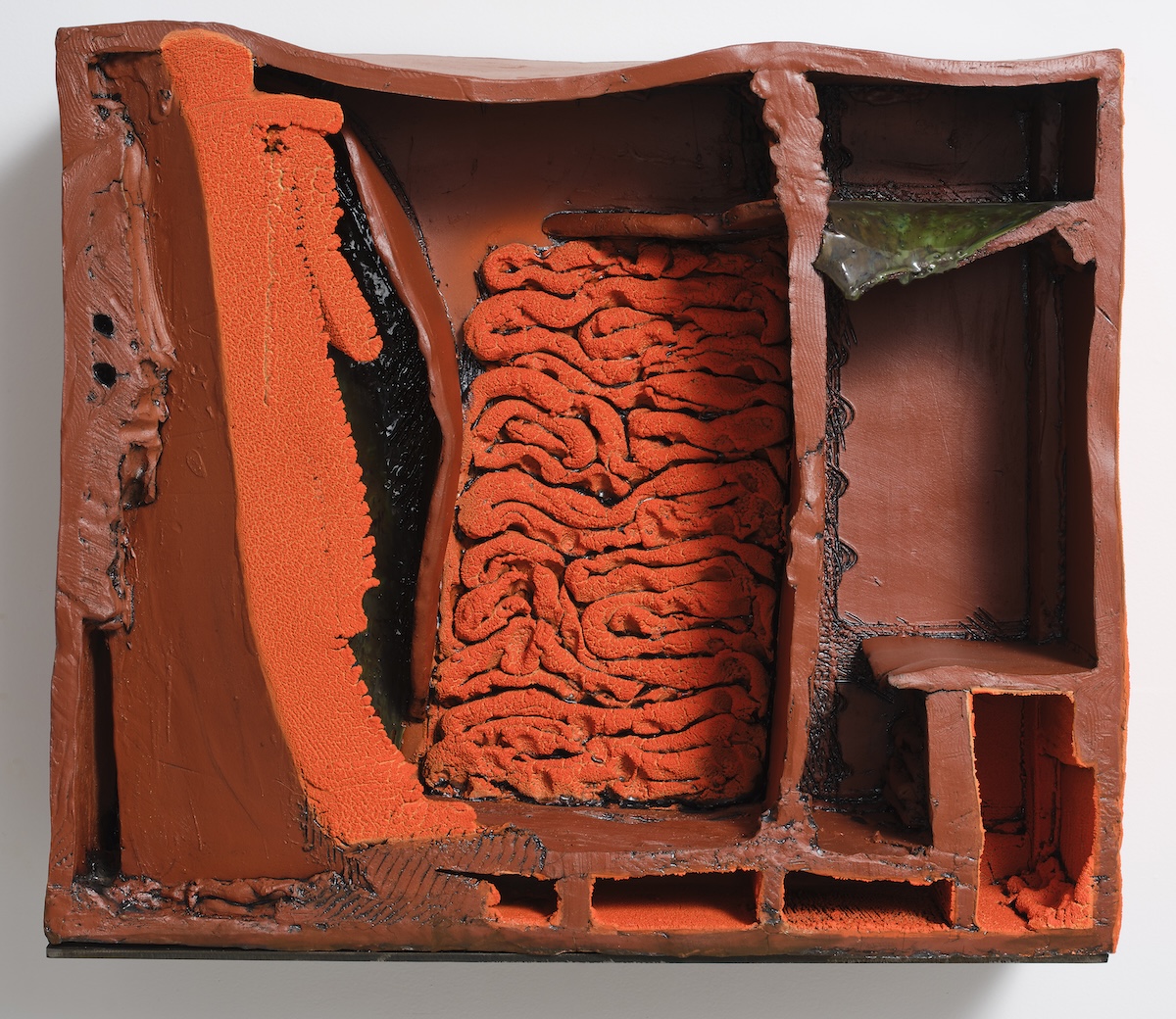 Arlene Shechet, Touching Ground: Like A Book, 2026
Sarioglu: Looking across the exhibition, the metal and ceramic works don't feel like separate conversations. Gestures—cuts, folds, seams, openings—seem to travel between materials. Are you moving between materials, or are you searching for one language that can speak through different materials?
Shechet: A single language that speaks through different materials.
The material isn't the most important thing.
I also wanted the exhibition itself to have its own identity. When I make a show, I want surprise, discovery and excitement. I want to undermine a single reading of who I am as an artist.
I want the work to be counterintuitive.
Unexpected.
Sarioglu: You love the unexpected.
Shechet: I love the unexpected.
The works give different kinds of energy back and forth to one another. There are conflicts between them.
Sarioglu: Those conflicts must be deliberate.
Shechet: Very deliberate.
I want to burst things open.
I want the exhibition to be questions. I don't want one fixed identity as an artist.
Sarioglu: That refusal of a fixed identity is also physical in the exhibition. There is no single position from which the sculptures resolve themselves. You move around them, look through openings, change your height, approach and retreat. Your body becomes part of the act of seeing.
At what point does the viewer stop being someone looking at the sculpture and become part of the conditions through which the sculpture is seen?
Shechet: Movement is central to my sculpture and central to the way I make things. Each artwork has multiple points of view.
It's a dance between the viewer and the artwork.
That's one of the beautiful things about sculpture. It's physically a dance—moving through and around things.
I've worked with dancers and performers many times because I wanted to make that relationship clear.
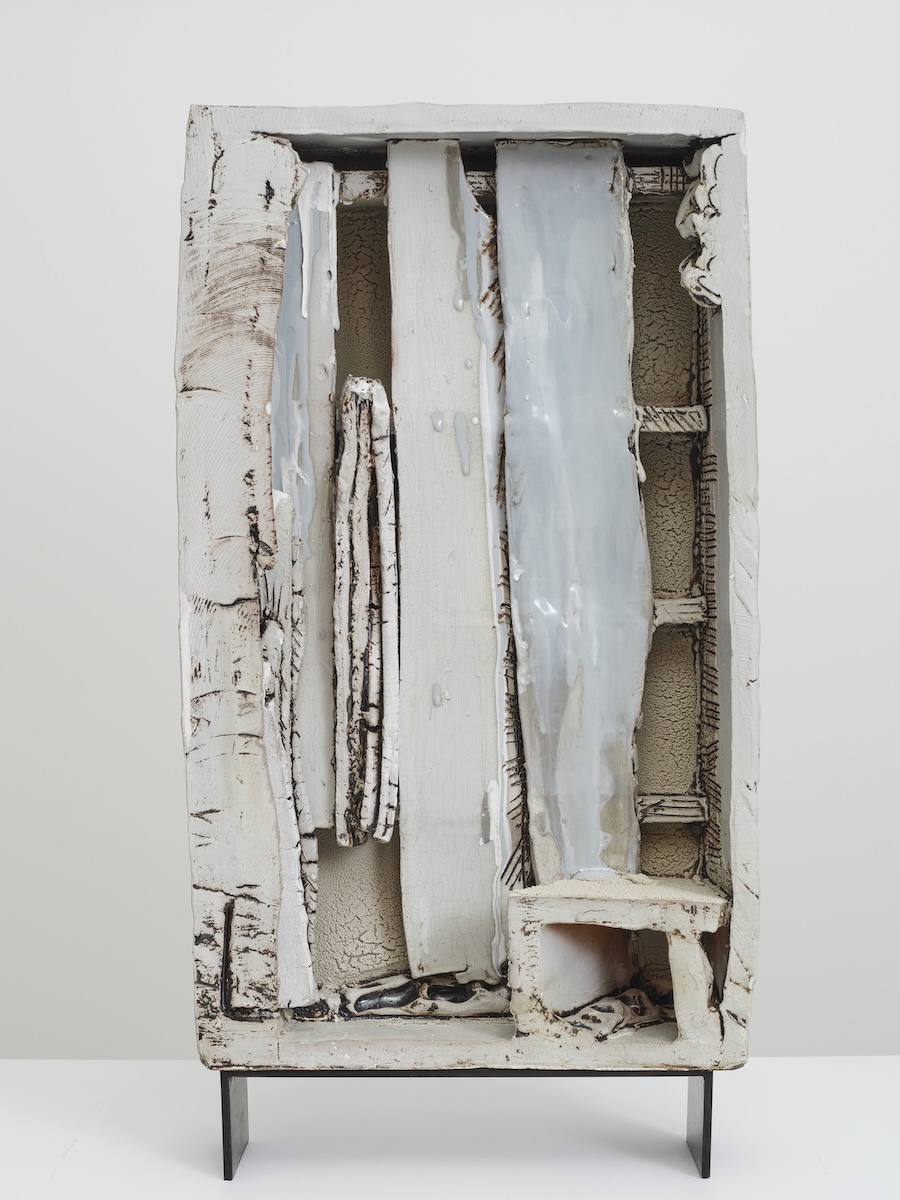 Arlene Shechet, Touching Ground: Tree Line, 2026
Sarioglu: So the sculptures themselves become choreographers.
Shechet: Exactly. The sculptures are the choreographers, and they make the viewers dance around them.
I don't have a performance scheduled for this exhibition, but I think the dance is already there.
Sarioglu: We're already dancing.
Shechet: We're already dancing.
Sarioglu: Which brings us back to color, space and weight. Nothing quite stays where we expect it to stay.
Shechet: That's what I hope.
Sarioglu: I also wanted to ask about mastery. After decades of making sculpture, technique can become almost second nature. But does knowing how to make something work risk making surprise more difficult? Can mastery become another kind of constraint?
Shechet: That's a real danger.
That's why I try to stay alive and present with what I'm doing and keep pushing it. It's up to the artist not to become a victim of mastery.
Once you know how to do something, it's important to stop showing off.
What matters is not only what you end up showing. What's important is what your life is like in the studio.
In the studio, it's just you and the thing. You have to have discovery, excitement and new information.
I'm happy that I can access whatever information I need to make something well. But I don't want to be victimized by that knowledge.
Sarioglu: Perhaps that is also why the sculptures never seem to close themselves down. They don't resolve the questions they create. Weight remains unstable, lines continue beyond surfaces, and objects never quite settle. After all these years, is there a question you are still asking that sculpture has not yet answered?
Shechet: That's too big.
I don't know.
The idea is not to know.
The idea is not to be able to answer that question.
Sarioglu: So not knowing isn't a failure.
Shechet: No. Everything is committed to imagination.
I don't want to instruct. I don't like to give instructions, and I don't like to receive them.
I like things to be found and opened up. I like questions to continue existing.
We don't need art to answer questions. The job of art isn't to answer questions. The job of the artist is to create questions.
To open the mind. To fly and imagine things.
And to create joy.
To create mirrors—to be a mirror to our existence.
To create empathy.
Sarioglu: Did you ever think about introducing music or sound into the exhibition?
Shechet: No. The sculptures already make sound.
Not literally, necessarily. Each viewer is hearing something different, related to what they're feeling and seeing.
It's not the sound of broadcasting. It's the sound of seeing and experiencing things.
Sarioglu: And finally, I wanted to return to the question of the unknown. Not necessarily what you will make next, but what remains genuinely unknowable to you.
You've spent decades allowing sculpture to surprise you. What can still surprise you?
Shechet: I'm not going to answer that.
Because I don't know.
Sarioglu: You don't know?
Shechet: I don't know.
Sarioglu: Maybe that's the answer.
Shechet: Maybe.
Sarioglu: Thank you.
Shechet: Thank you.
Sarioglu: Is there anything you want to add?
Shechet: No. I think you asked great questions.
Sarioglu: I was feeling it too.
Shechet: You are very sweet.
Sarioglu: Thank you.
Shechet: Thank you.
In the end, the answer is an echo of the question: “I don’t know.” Perhaps that is precisely where Shechet wants us to remain—not looking for resolution, but moving around it, finding another angle, another opening, another way to see.
My sincere thanks to PACE gallery in New York for their valuable support in facilitating this interview.

Ayse Sarioglu
Ayse Sarioglu-Guest is a senior Turkish media executive, writer, and art critic based in Istanbul and New York. With over 25 years of executive experience in Turkey’s leading media organizations, including Sabah and ATV Group, she has held key leadership roles overseeing national newspapers, magazines, and television networks. Sarioglu-Guest was instrumental in the launch of MTV and Nickelodeon in Turkey and led the market introduction of Eurosport. She currently contributes to Vogue Turkey and Harper’s Bazaar Turkey, focusing on contemporary art, culture, and international creative industries.
view all articles from this author