Whitehot Magazine
October 2026
"The Best Art In The World"
"The Best Art In The World"
October 2026
Future is Ruin: Henri Alexander Levy in Seoul
MIKE MAIZELS October 12th, 2026
"Only as a picture, which flashes its final farewell in the moment of its recognizability, is the past to be held fast… it means to take control of a memory, as it flashes in a moment of danger.” Walter Benjamin, 1940.
On view now at Shinsegae Gallery Cheongdam, a contemporary art space fittingly housed within an upscale department store of the same name, one can find designer Henri Alexander Levy’s first solo art exhibition. Primarily known as the creative director behind streetwear/fashion label enfants riches déprimés (“depressed rich kids”), Levy’s sprawling show Final Achievement is Ruin is something to behold—no less because of its presence at a deluxe retail outlet in the fashionable Gangnam district of Seoul. I first became aware of HAL’s distinctively downtempo décollage through his design of Future’s Save Me album cover of 2019. The two share a spirit of narcotic-infused heaviness and luxuriating melancholy, with life slowing down to a near velvet nature morte. The kind ideal for fashionably anguished languishing, dangling expensive champagne and prescription pills.
HAL’s artworks—paintings, photo collages, sculptures and zines—are strongly indebted to Virgil Abloh’s (dis)affected erudition—also expressed in a line of luxury streetwear—but Abloh’s work is more energetic and imaginative. Like early to mid Kanye, with whom Abloh was closely associated, one never knew what one was going to find on the other end of a sonic or conceptual hook. But for HAL (and I might add, Future, who remains one of my favorite vocalists of all time), you know what’s coming for you. Molly, Percocet, Civilization, Discontent.
Like his overall oeuvre, Final Achievement draws heavily on stylistic precedents from advanced European art surrounding the Second World War, a kind of post-whatever-degree revisitation of Informel, Brut and German Dada. The following analysis focuses on Levy’s works in the show, but does not limit itself thereto.
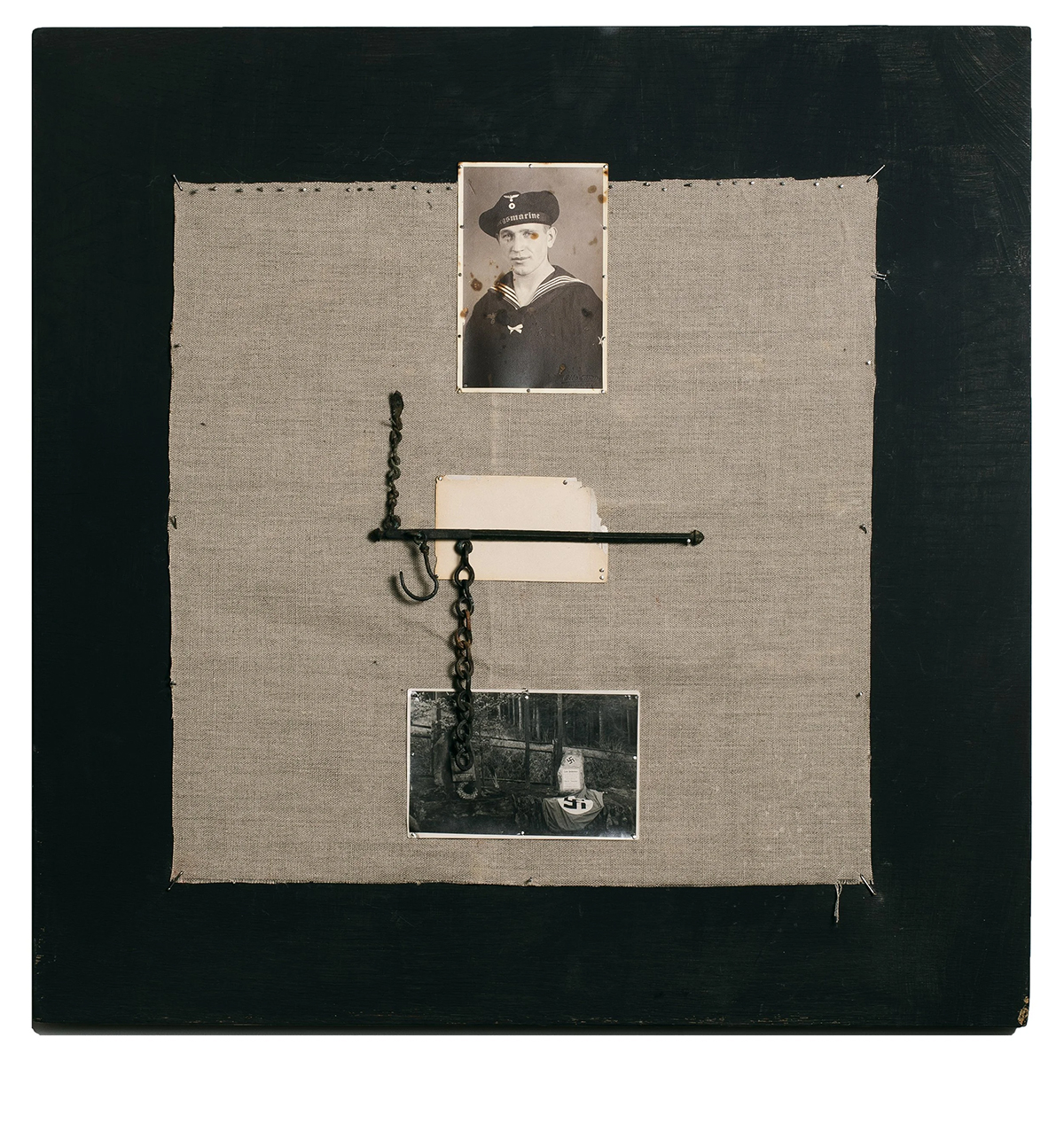
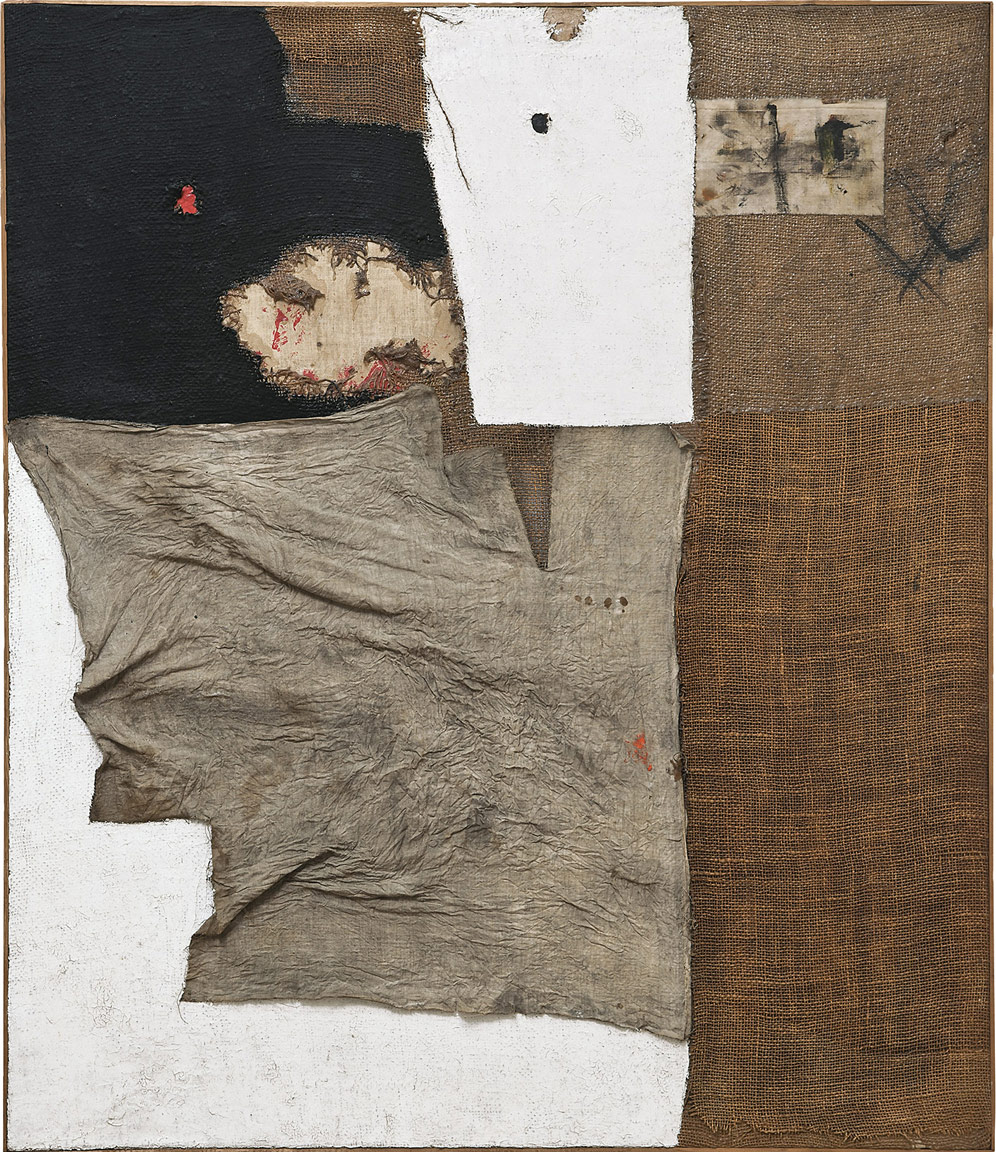
(top) Henri Alexander Levy, Untitled (No Date). (bottom) Alberto Burri, Grande sacco (1952)
As one obvious example, Levy picks up the barely sewn-together idiom of Informel-ist Alberto Burri, who famously stitched together his canvases out of burlap discarded from food aid sacks. A memento to the still-smoldering ruins of continental cataclysm. Several decades removed, HAL’s stitchings and assemblages are, if anything, more overt in their imagery of war and holocaust. There are certainly more visible swastikas.
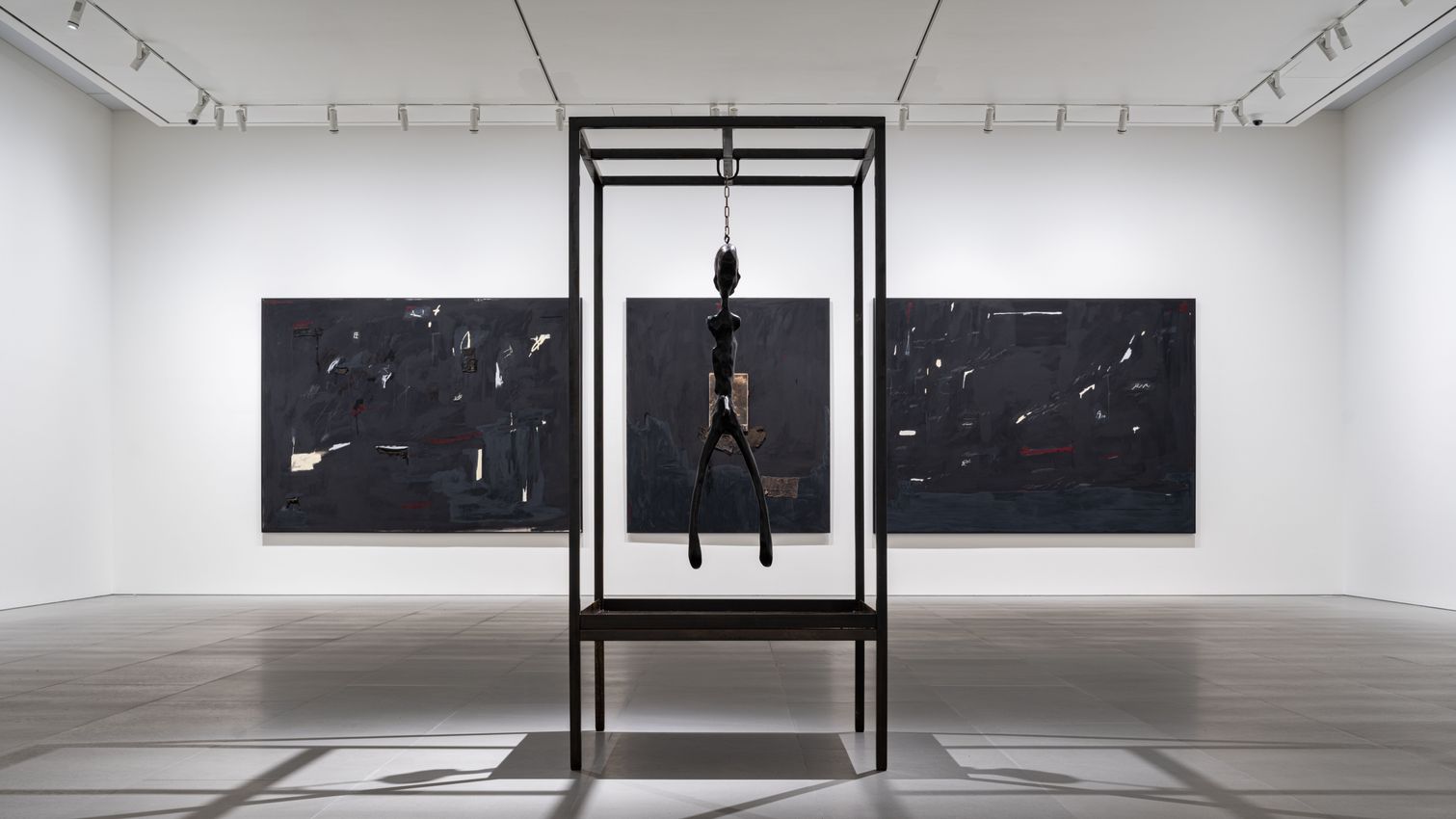
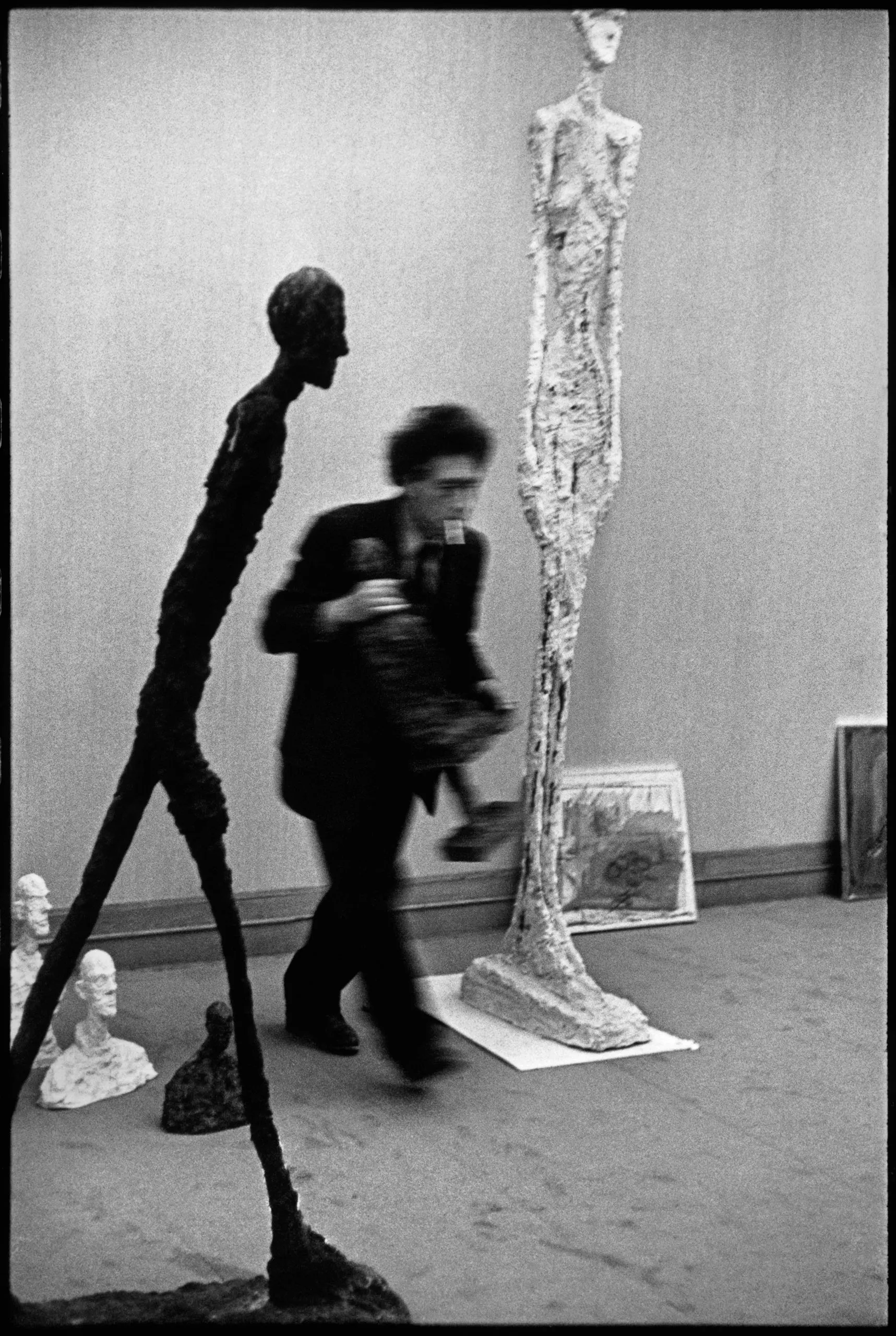
(top) Installation View, Future is Ruin: Henri Alexander Levy (2026) (bottom) Installation View, Alberto Giacometti Studio (1961)
This is not the friendly conceptualism of Abloh’s attorney Duchamp, but rather the knife-edge discord of John Heartfield or the rotten corporealism of Giacometti. A visual language of picked-over ruin that has been barely darned into psychic coherence.
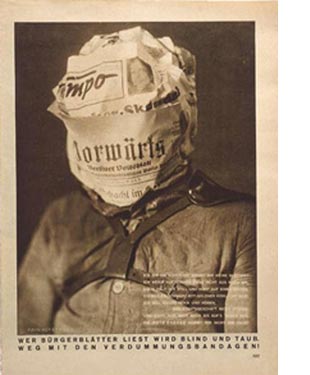
John Heartfield, Blind and Deaf (1939)
The cages, though, are something else entirely. If the stitched assemblages look back toward the physical wreckage of twentieth-century Europe, works such as Synthesizer Prison Unit transpose ruin into a more contemporary register. The object recalls the prison forms and surveillance structures that so fascinated the post-1968 generation of Nauman, Serra and Beuys, but stripped of their overt political program. Here enclosure is psychological rather than civic, and therefore distinctly Nauman-esque. The synthesizer, locked behind steel bars, appears as a machine for producing interiority, a melancholy instrument quarantined from the world that once gave it purpose. Much more fashionable than Ol’ Cowboy Bruce could have ever pulled off.

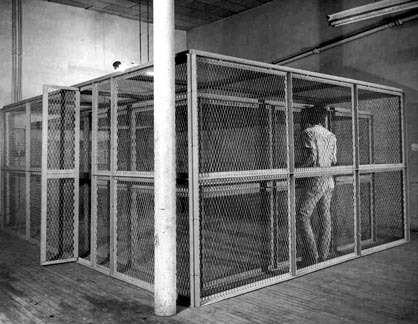
(top) Henri Alexander Levy, Synthesizer Prison Unit (No Date) (bottom) Bruce Nauman, Double Steel Cage (1974)
Like Nauman’s, it can be difficult to know what to make of HAL’s monumentality. Shinsegae describes Levy's practice as one that gathers the cast-off materials of criminality, erasure, and neglect, re-presenting them through a deliberately unsentimental lens. Beyond the carceral enclosures and out to the sweep of his oeuvre, the comparison that comes most readily to my mind with Levy is the frequently self-flagellative, but always self-attentive, Anselm Kiefer. Blood, soil, and monumental installation. Always with Riesling at the opening.
Yet where Kiefer's scorched landscapes purport to remain accountable to history, Levy's ruins are thoroughly untethered from any particular disaster. What remains is a floating signifier of trauma, collective horror distilled into style. The exhibition functions as what Levy calls an "autoclave," sealing and compressing emotion under pressure. One leaves impressed by the intensity of the affect, yet uncertain of its object. It is a politics of concern without commitment, a melancholy that cannot quite decide whether it wishes to mourn or merely pose. Most unsettling of all is Levy's own comparison of this condition to an "unresponsive infant.”
In theorizing what he regarded as a regressive turn in postwar European art, a relapse into myth, monumentality, and historical quotation, the art historian Benjamin Buchloh famously posed a question that remains difficult to dismiss. Writing in his 1981 essay "Figures of Authority, Ciphers of Regression," he argued that the renewed attraction of these visual languages could not be separated from the broader political atmosphere from which they emerged. The return of historical forms, he suggested, was never merely aesthetic. Buchloh's comments were directed at an earlier generation, but the same disquiet hovers uneasily over Levy's project as well:
"The question for us now is to what extent the rediscovery and recapitulation of these modes of figurative representation in present-day European painting… displace the ideological impact of growing authoritarianism, or to what extent they simply indulge and reap the benefits of it... or, worse yet, to what extent they cynically generate a cultural climate of authoritarianism to familiarize us with the political realities to come."
The political circumstances of the early 1980s are not those of the present. Yet the conditions that gave Buchloh's question its force have hardly disappeared. Across Europe, North America, and Asia, democratic institutions appear increasingly fragile, while narratives of decline, crisis, and civilizational exhaustion enjoy renewed cultural prestige. Levy's work is hardly political in any programmatic sense. Indeed, its defining characteristic may be precisely its refusal of political specificity. But this refusal does not place it outside history. Rather, it raises the possibility that the aesthetics of catastrophe can become detached from disaster itself, circulating as a mood, a style, or a luxury commodity.
Seen from Seoul, the question acquires an additional charge. South Korea remains marked both by the memory of authoritarian rule and by the ongoing presence of an existential neighboring state founded upon its perpetuation. At Shinsegae, tucked inside one of the world's most sophisticated consumer environments, Final Achievement is Ruin stages a theatre of permanent emergency whose sources remain deliberately obscure. The result is compelling, often beautiful, and when thought about closely, profoundly troubling.
Levy may ultimately be less interested in history than in the emotional residue the past leaves behind itself. But if so, one leaves the exhibition wondering whether such residues can sustain themselves indefinitely once severed from their causes. What remains is a pervasive sense that something has gone wrong, accompanied by few resources for imagining what might be done about it. We have seen this movie before. The scenery changes; the feeling does not. If there is consolation here, it arrives in the form of the narcotic haze that permeates Levy's work: not a cure, but a temporary anesthetic against the gathering weight of the future.
Henri Alexander Levy: Future is Ruin is on view at Shinsegae Gallery through October 17.

Mike Maizels
Michael Maizels, PhD is an historian and theorist whose work brings the visual arts into productive collision with a broad range of disciplinary histories and potential futures. He is the author of four books, the most recent of which analyzes the history of postwar American art through the lens of business model evolution. He has also published widely on topics ranging from musicology and tax law to the philosophy of mathematics.
view all articles from this author