Whitehot Magazine
October 2026
"The Best Art In The World"
"The Best Art In The World"
October 2026
Haroun Hayward and the Return to Landscape Painting
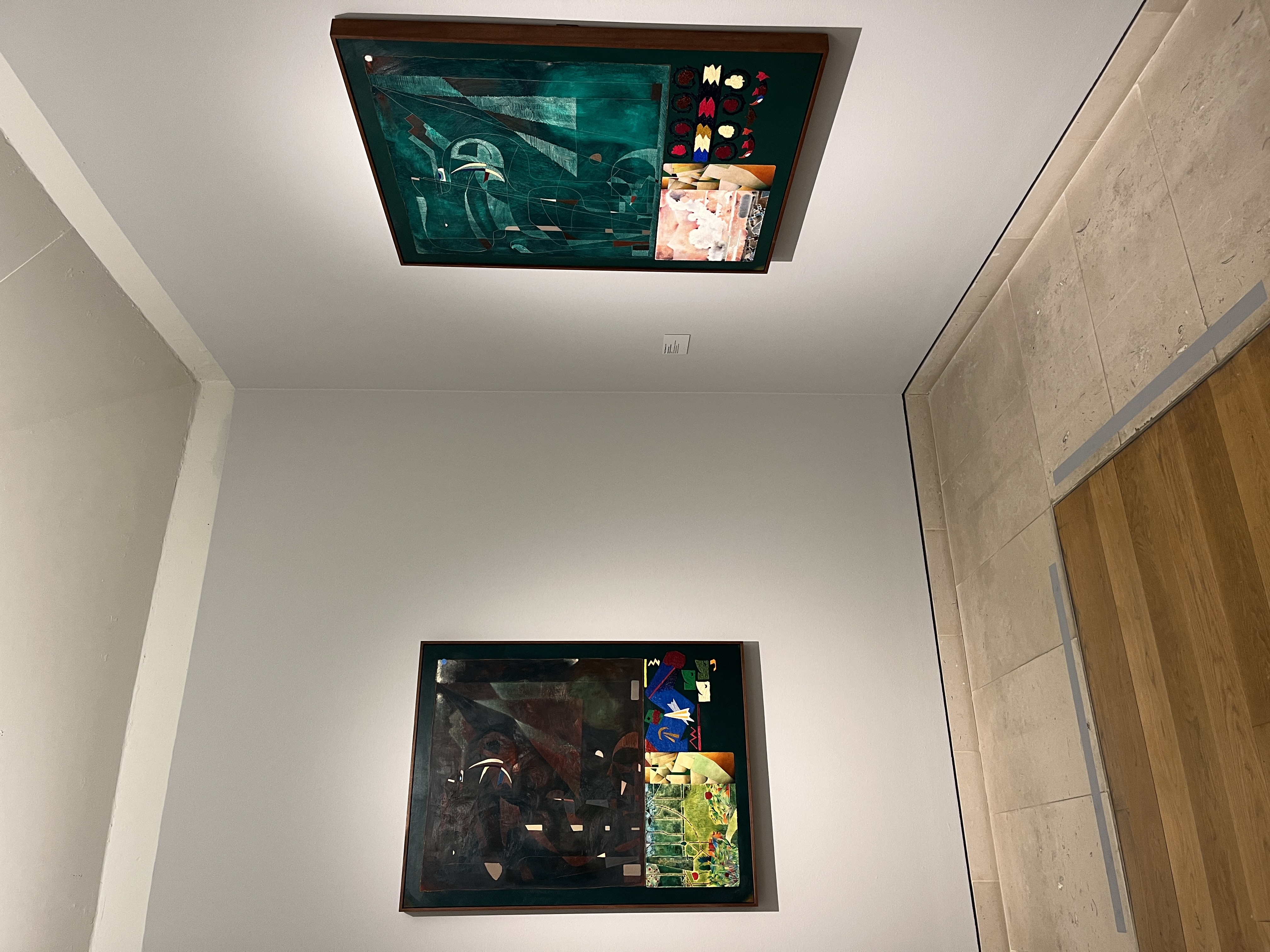
Installation view of Path Through Trees, Pallant House Gallery, 2026
By MARGARET RAND June 3rd, 2026
Only an hour-and-a-half train from London, in the picturesque town of Chichester, sits one of the most esteemed public collections of Modern British art. Housed in a red-brick Queen Anne townhouse with a shiny new contemporary wing, Pallant House Gallery has long championed the work of Modern masters like Paul Nash and Barbara Hepworth. This summer, the museum turns its attention towards a fresh perspective. Path Through Trees, the first institutional solo exhibition for London-based artist Haroun Hayward, presents a new body of work created during a month-long residency in the lush countryside of Sussex.
Raised in North London in the 1990s, Hayward grew up immersed in skateboarding, punk rock, graffiti, and the final wave of Britain's infamous rave scene. These days, the 43-year-old painter is more likely to be found listening to Bach in his Shoreditch studio than moving between underground parties, though the long hours persist. More often than not, a long day spent in the studio is achieved through brief naps on a twin-sized air mattress tucked in the corner beside his canvases. While the counterculture scenes that shaped his youth are no longer central to his life, the curiosity and creative freedom he found there continues to shape his work.
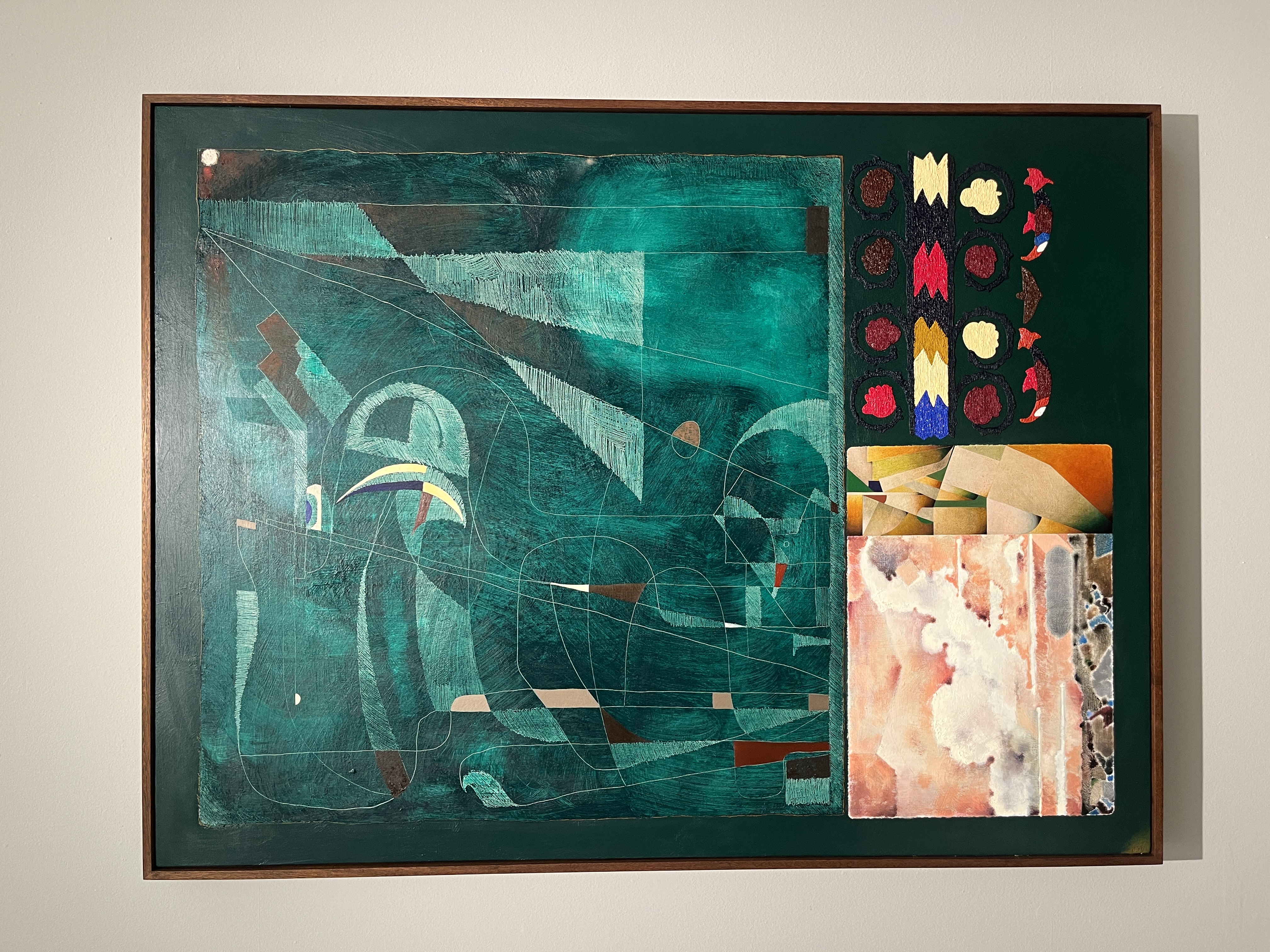
Path Through Trees (Emotion Electric), 2026
Each of Hayward's paintings is carefully structured into sections reserved for different strands of influence, a sophisticated color-by-numbers system of sorts. A central square often serves as the compositional anchor, drawing on the rhythms of Acid House and techno music. Beneath it are neatly separated regions depicting hazy skies and rolling hills, inspired by the atmospheric landscapes of his Modern British predecessors. The final elements in his compositions are floral and geometric designs rendered in thick oil sticks, creating impasto surfaces. Their textures and bright colors take inspiration from South Asian and West African textiles collected by his mother. Rather than blending these elements together, Hayward distinguishes each visual language, creating highly ordered compositions. The resulting painting feels less like a collision of influences than a carefully orchestrated conversation.
The balance of that conversation begins to shift during his residency at West Dean College in Sussex. A longtime admirer of artists like Paul Nash, Graham Sutherland and Wilhelmina Barns-Graham, Hayward immersed himself in the landscape that had shaped many of their own artistic journeys. The connection was particularly resonant in the case of Barns-Graham, whose estate is also represented by Hales Gallery (New York and London). After studying at Edinburgh College of Art, she relocated to St Ives in 1940, where the Cornish coastline became a lifelong source of inspiration. Like many postwar British artists, the landscape was a metaphor for grappling with national identity, memory and renewal in a society emerging from upheaval. Nash and Sutherland took this a step further, imbuing the countryside with a psychological charge, transforming hills, coastlines, and rock formations into abstract and surrealist terrains with a mystical quality.
Hayward’s own strolls through West Dean's arboretum prompted a similar experience for the artist. While deeply connected to the musical rhythms and urban counterculture that have long defined his practice, this new series possesses a quieter, more contemplative quality. The distinct visual registers that once separated different strands of influence have softened, inhabiting the same pictorial space.
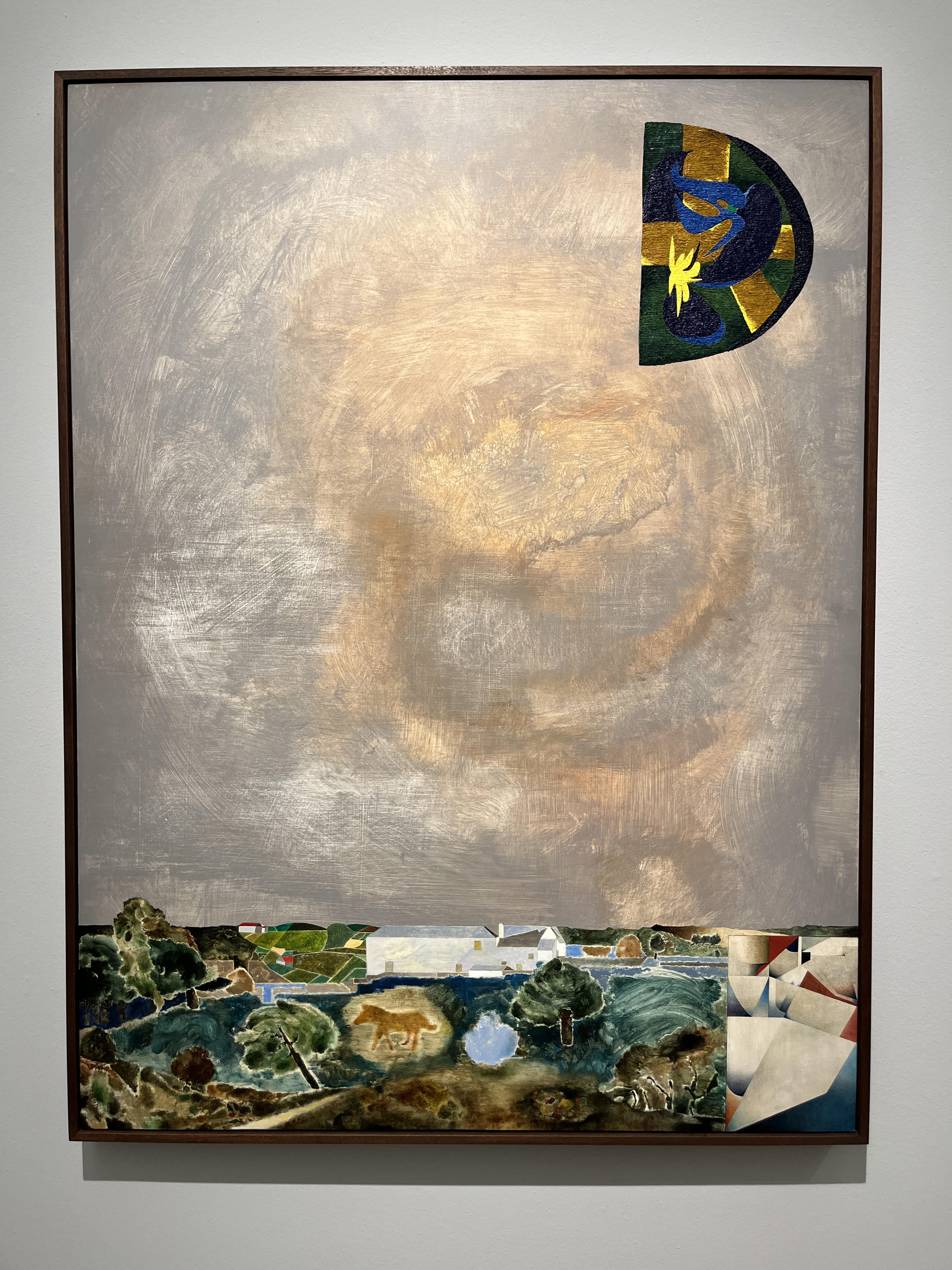 Birch Craig (Acid Tracks), 2026
In Birch Craig (Acid Tracks) (2026), the central square filled with abstract forms that typically grounded Hayward's compositions has evolved into a misty expanse that reads as atmosphere or sky. Beneath it unfolds a distinctly Nash-like landscape, populated with lush fields, a winding pathway, and a solitary horse moving through the countryside. Where Hayward’s paintings once maintained a distinct line between atmospheric watercolour passages indebted to Nash and the flattened geometric forms associated with Barns-Graham, these influences now converge: hazy washes of muddied greens and browns in the foreground represent the same landscape as the expanses of flattened yellow and green terrain in the background. Finally, the thick oil-stick motifs that previously held their own territory likewise migrate into the landscape itself. Here, the bright blue and yellow abstract motifs are painted in a semicircle near the top of the composition, reminiscent of a sun or moon in the sky.
This subconscious return to the landscape, and the softening of previously rigid pictorial boundaries, feels particularly resonant today. In the decades following WWII, the artists associated with the Modern British landscape tradition turned to the countryside as a source of continuity and renewal amid social upheaval, meditating on memory, identity, and belonging. At a moment when much of the world is once again marked by uncertainty and conflict, Hayward's renewed engagement with the landscape tradition suggests a similar human impulse to look to the natural world as a stable point of reference.

Margaret Rand
Margaret Rand is a New York–born art advisor, researcher, and writer currently based in East London. She moved to the UK in 2023 to pursue a Master’s degree at the Courtauld Institute of Art after earning a BA in Art History and Journalism from Georgetown University. Her academic research focused on the materiality of postwar and contemporary painting, with particular attention to the practices of artists such as Carla Accardi, Julie Mehretu, Cecily Brown, and Firelei Báez. Today, she continues to explore the material practices of emerging artists across the London and New York art scenes, while working as a researcher for an art advisory firm.
view all articles from this author