Whitehot Magazine
October 2026
"The Best Art In The World"
"The Best Art In The World"
October 2026
You Think That’s Funny? at The Hammond Museum and Japanese Stroll Garden
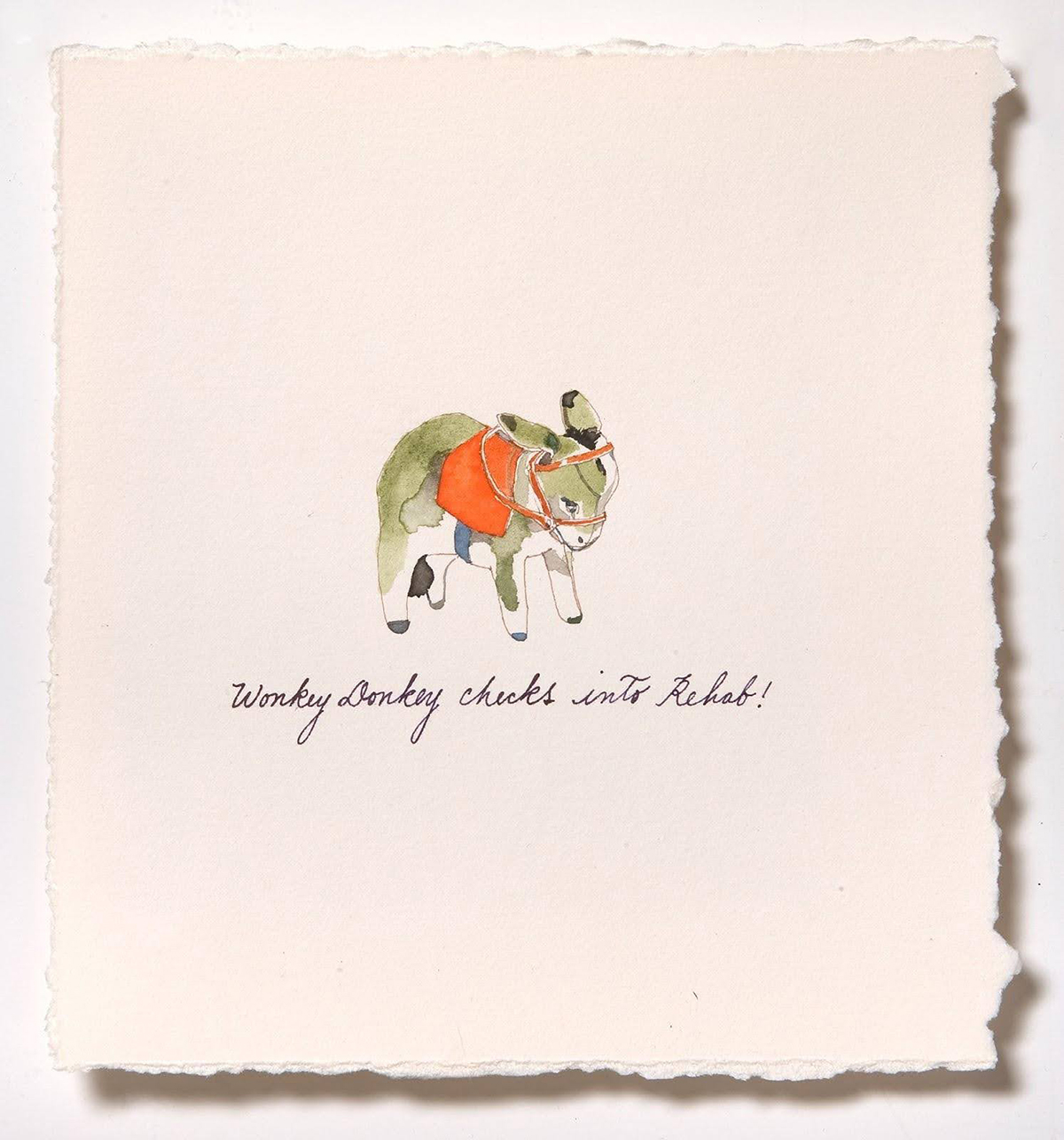 Peregrine Honig. Wonky Donkey, 2006. Pen, ink, Gum Arabic, pigment on Strathmore. 10.5 x 10.5 x 1.4 in. Photo courtesy of the curator.
BY CLARE GEMIMA November 6, 2025
You Think That’s Funny?
September 6 - November 16, 2025
Curated by D. Dominick Lombardi
Todd Colby, Peregrine Honig, Rita Valley, Norm Magnusson, Judy Haberl, Bret DePalma, Susan Meyer, Jeff Starr, Jim Kempner, Cary Leibowitz, Mike Cockrill, Mary Bailey, Cathy Wysocki, D. Dominick Lombardi
Hammond Museum and Japanese Stroll Garden
North Salem, New York
You Think That’s Funny? treats humor as a critical device but never quite settles on what kind. It’s hard to tell whether it wants to be funny ha-ha or funny peculiar, and that tension turns out to be its sharpest point. Some jokes collapse under their own weight, ironies fold back on themselves, and laughter—when it finally arrives—feels off-tempo, like a nervous reflex. The result is a show that exposes how unstable humor can be in art, where the punchline lands somewhere between sincerity and cringey unease.
Across painting, sculpture, textiles, and video, the exhibition dismantles the idea that humor is frivolous. Here, laughter becomes a tool for endurance, a way to reveal vulnerability and probe the limits of taste. Lombardi’s curatorial through-line is steady: wit is not an escape from seriousness, nor is sarcasm one of its lowest forms, rather, its is one of critiscim's most cunning disguises.
In Caught, Wonky Donkey, and Mr. Piggles, Worst Dressed (all 2006), Peregrine Honig stages a private theater of anxieties in pen, ink, and gum arabic. Her small, haunted figures—part fairy tale, part fashion sketch—teeter between charm and unease. Their beauty is brittle and their absurdity fragile. Honig’s humor resides in that charged threshold between innocence and desire, a space as uncomfortable as the awkward passage into adulthood itself. Her drawings invite a child-friendly affection, then quietly, and elegantly dismantles it.
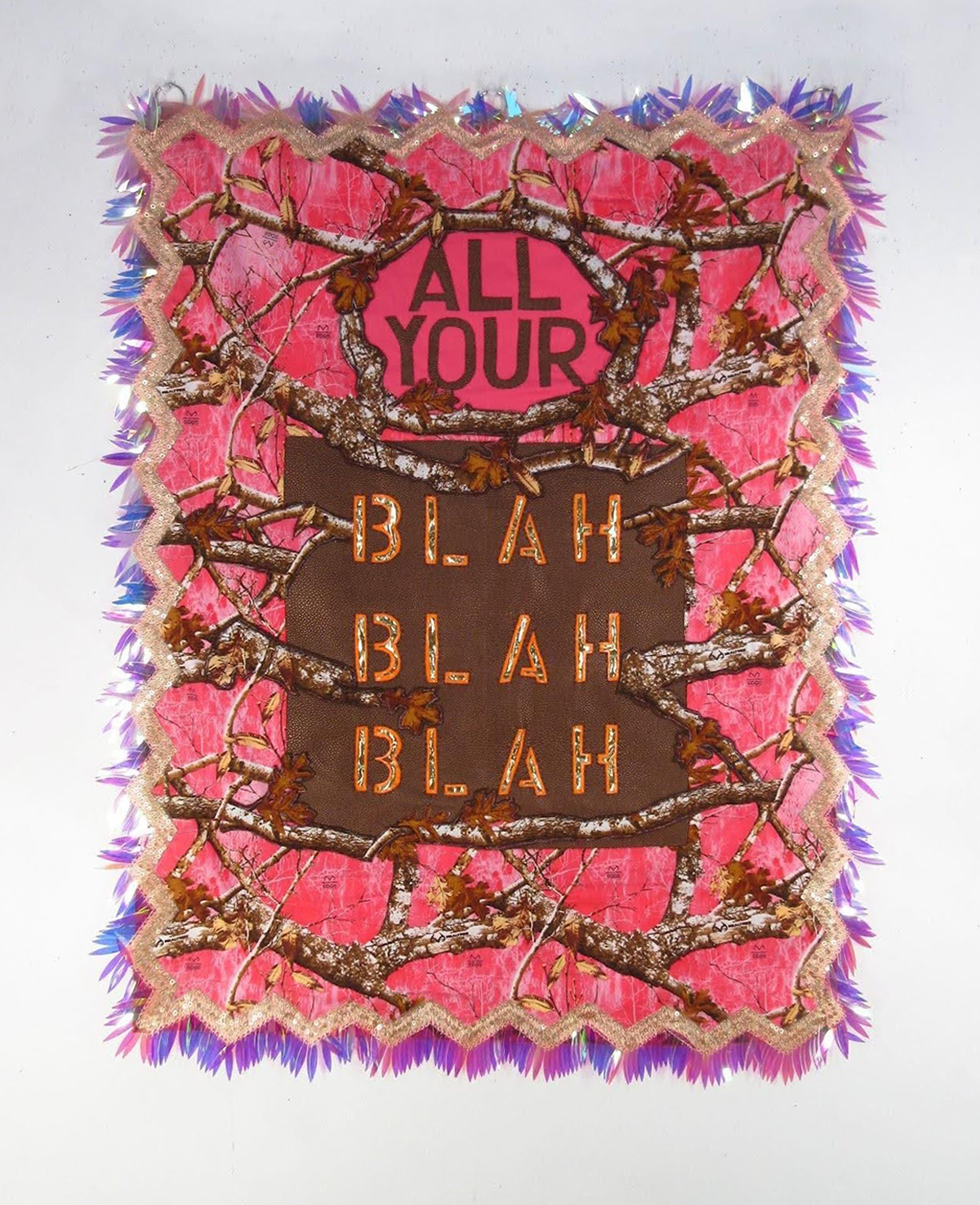 Rita Valley. For Greta, 2020. Cotton, textured pleather, felt, vinyl, iridescent commercial edging. 41 x 32 in. Photo courtesy of the curator
Rita Valley transforms the language of craft into a vehicle for satire. In WTF (2019), As If, and For Greta (both 2020), embroidered brocade, pleather, and fringe burst with theatrical color. The exuberance of her materials becomes its own punchline—what once read as “feminine” now performs as subversive critique. In For Greta, Valley's stitches ironically echo Mel Bochner’s text-based works where phrases oscillate between sincerity and sarcasm. Like Bochner’s verbal paintings, her works toy with language’s instability, and transform ornament into argument. Valley’s humor is capacious and political: she sews protest into embellishment, and decorative labor into dissent.
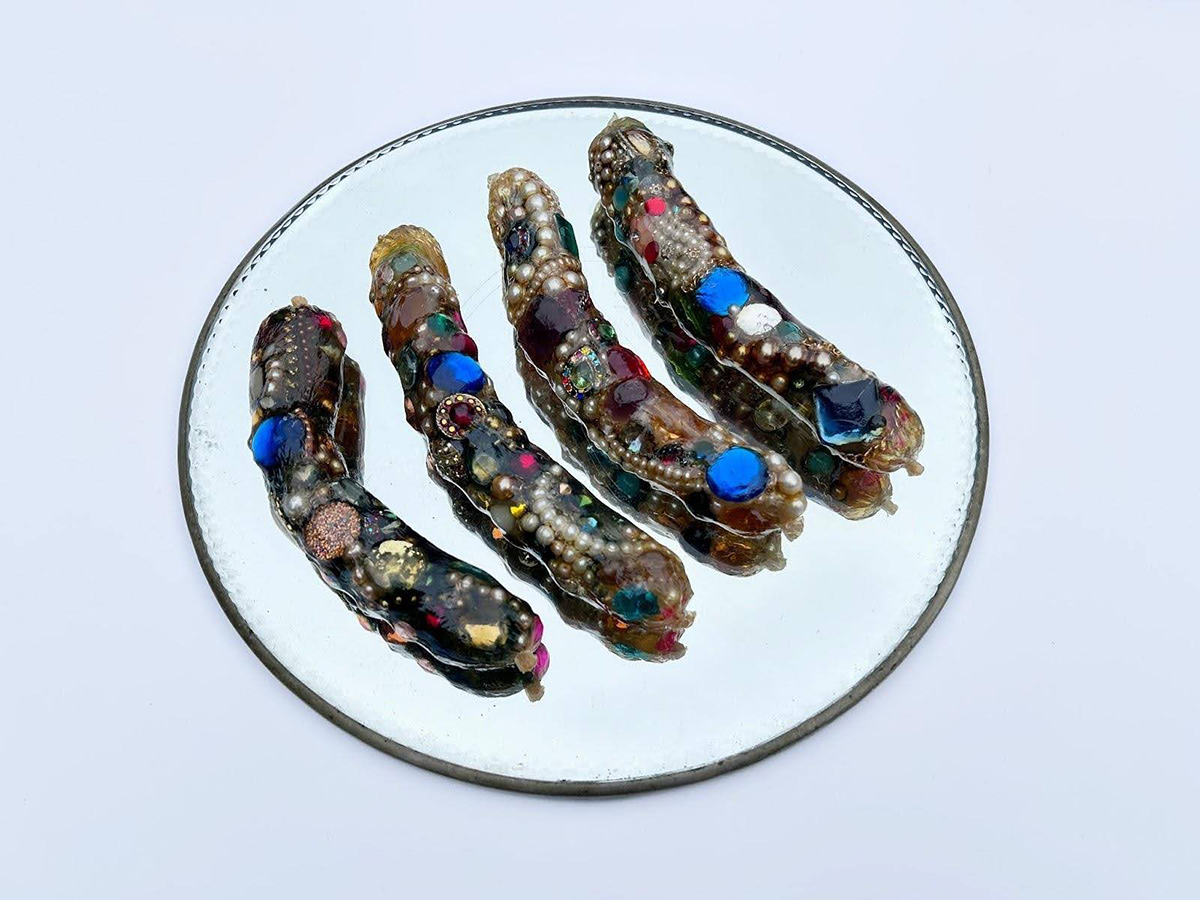 Judy Haberl. Sausages, 2020-25. Jewelry, pearls, sausage casings, acrylic medium, vintage decorative metal platter. Sizes variable. Photo courtesy of the curator
Judy Haberl’s sculptural hybrids—Sausages (2020–25) and Baby Cakes (2023)—blur the sensual with the grotesque. Strings of pearls nestle in sausage casings; plaster and jewelry cohabit with queasy elegance. Haberl turns appetite into aesthetic inquiry, suggesting that beauty and revulsion are often the same sensation seen from different angles. Her fascination with consumption and experimentation traces back to her childhood: her father, a chef for astronauts, spent years engineering foods that could survive the solar system. Growing up as his willing test subject, Haberl absorbed an early curiosity about the body’s thresholds—taste, texture, preservation—which now manifest in her uncanny, edible-seeming forms. The result is a practice at once domestic and cosmic, where nourishment and desire orbit one another with playful charm.
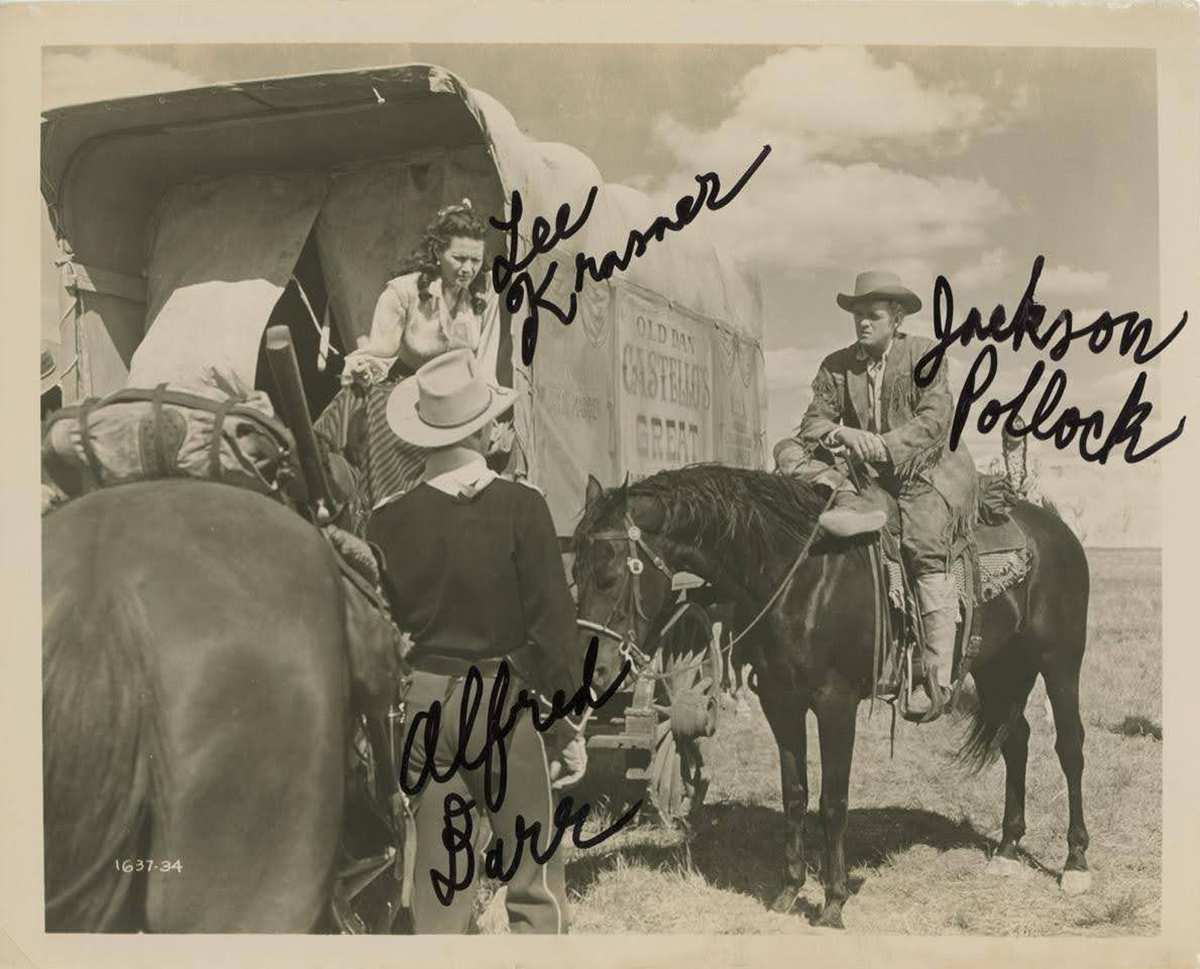 Cary Leibowitz. Lee Krasner, Alfred Barr, Jackson Pollock, 1998. Marker on found photograph. 8 x 10 in. (Framed 9.125 x 11.125 x 1.25 in.). Photo courtesy of the curator
Cary Leibowitz—known affectionately as Candy Ass—uses language as both confession and camouflage. His text-based works, Painting is Not Dead? Painting is Dead? (1998) and Everyone I Know Went to the Candyass Carnival and All I Got Was This Lousy T-Shirt (1991), fold self-deprecation into critique. In the photograph included here, the names Lee Krasner, Jackson Pollock, and Alfred Barr appear inscribed like a spectral lineage of art-world authority, their presence both invoked and deflated. Leibowitz’s humor operates like an offscreen meme—personal, reflexive, and knowingly absurd. Scrawled across found photographs and plush toys, his wit disarms through vulnerability; the joke becomes a shield barely concealing desire. His camp sensibility carries the melancholic wit of the queer archive, where failure and self-exposure persist as enduring modes of resistance.
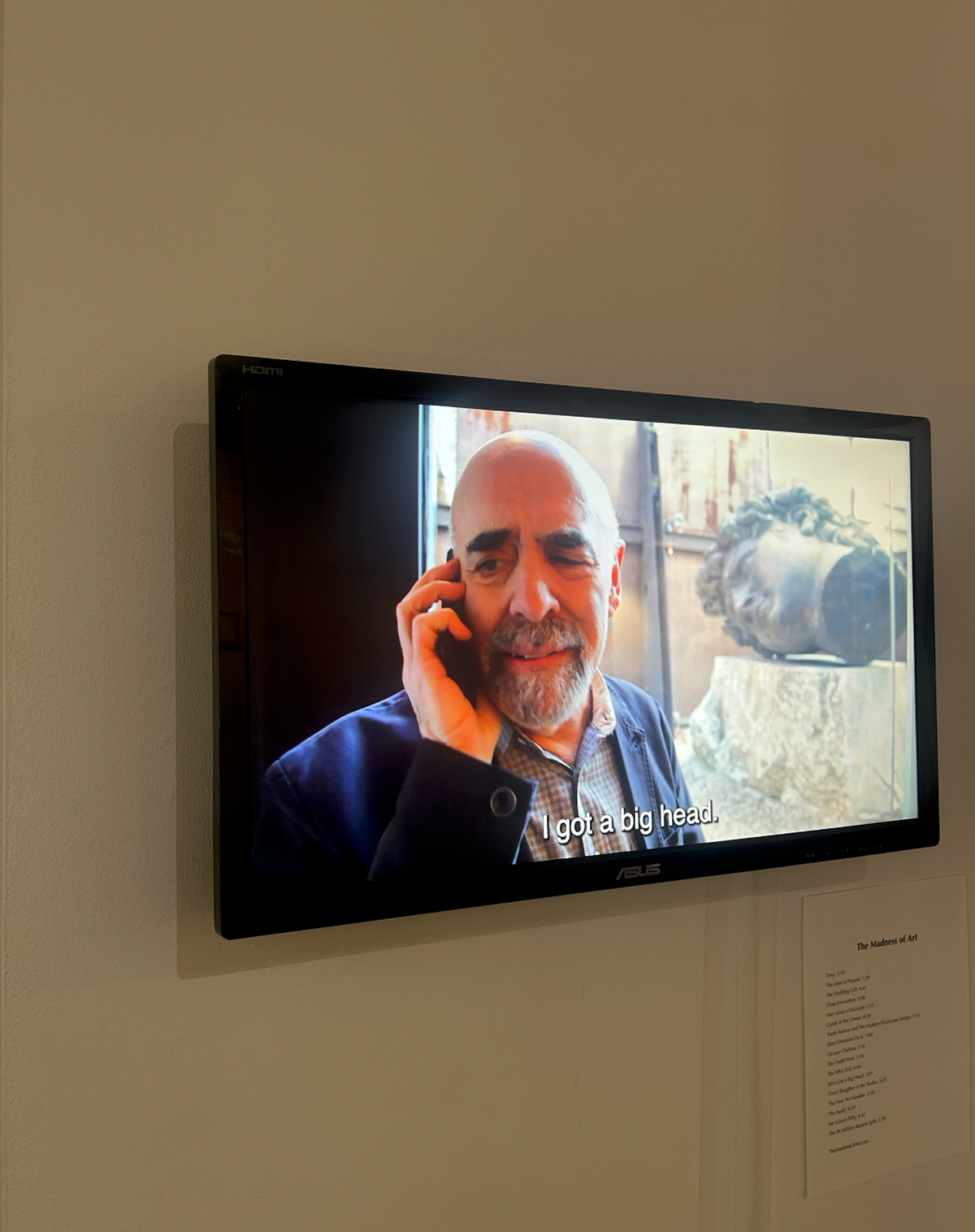 Jim Kempner. The Madeness of Art, 2025. Video sequence. Photo courtesy of the author.
Jim Kempner’s ongoing video series The Madness of Art skewers art-world spectacle through the grammar of sitcom. A gallerist by trade, Kempner stages the absurdities of value and validation with firsthand intimacy. Sequencing short excerpts from 17 episodes (selected from over 60 filmed since 2001), the work unfolds through sharp and self-aware clips that lampoon the industry’s performative chaos. His performance is knowing but never cruel; irony becomes both mirror and confession. In Lombardi’s context, the piece reads as a meta-gesture—an art of humor about the humor of art. Whether you fall for the joke, the artwork, or the man himself, Kempner not only turns his punchlines into heartbreak but also guarantees to leave you in tears.
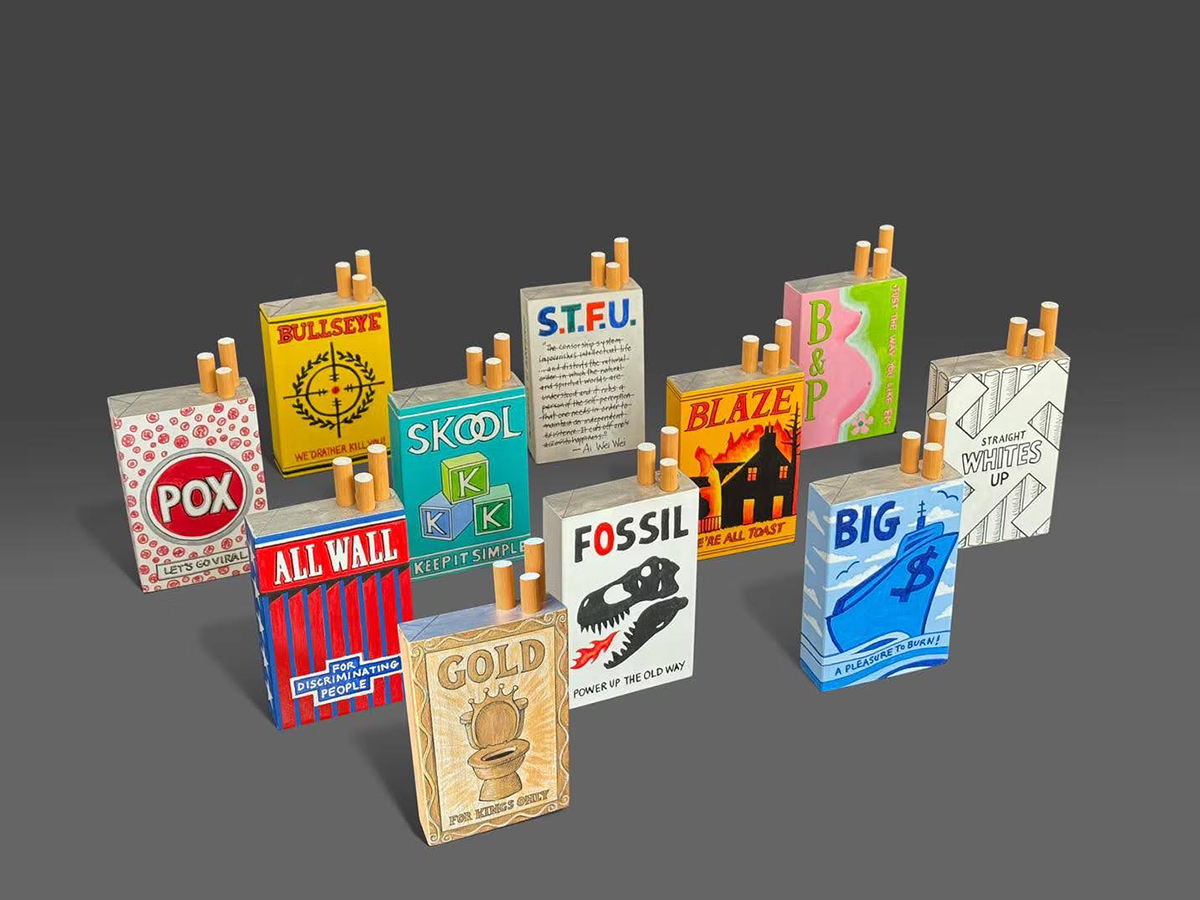
Mary Bailey. POX – Let’s Go Viral, BULLSEYE – We’d Rather Kill You, S.T.F.U., B & P – Just The Way You Like ‘Em, SKOOL – Keep It Simple, Blaze – We’re All Toast, WHITES – Straight Up, ALL WALL – For Discriminating People, FOSSIL – Power Up the Old Way, BIG $ – A Pleasure to Burn, GOLD –For Kings Only, all 2025. Wood, acrylic paint. 5 x 2 ½ x ⅞ in. each. Photo courtesy of the curator
With Mary Bailey, irony tightens into precision. Her wall-mounted series—POX – Let’s Go Viral, BIG $ – A Pleasure to Burn, and WHITES – Straight Up (all 2025)—compress consumer language into sculptural fragments. Each painted block operates like a corporate slogan turned blade, a minimalist quip about capital and complicity. Seen beside her early Cornucopia (1992), the new works feel distilled, and more refined into emblem. Bailey’s humor cuts more than it amuses; it is less laughter than incision.
Threaded through these practices is Lombardi’s conviction that humor, at its most potent, edges toward revelation. You Think That’s Funny? thrives in the porous space between the comic and the tragic—the place where laughter catches in the throat. In bringing together artists who risk absurdity, sincerity, and the chance to embarrass themselves immensely, Lombardi reframes wit as a form of moral attention. At a time oversaturated with irony and exhaustion, the exhibition restores to humor its original gravity: not as escape, but as inquiry. In You Think That’s Funny? laughter doesn’t offer relief so much as recognition—the uneasy acknowledgment that we are all, in one way or another, the butt of the joke.

Clare Gemima
view all articles from this author