Whitehot Magazine
September 2026
"The Best Art In The World"
"The Best Art In The World"
September 2026
Dae Hak Oh’s Gravity of Flux
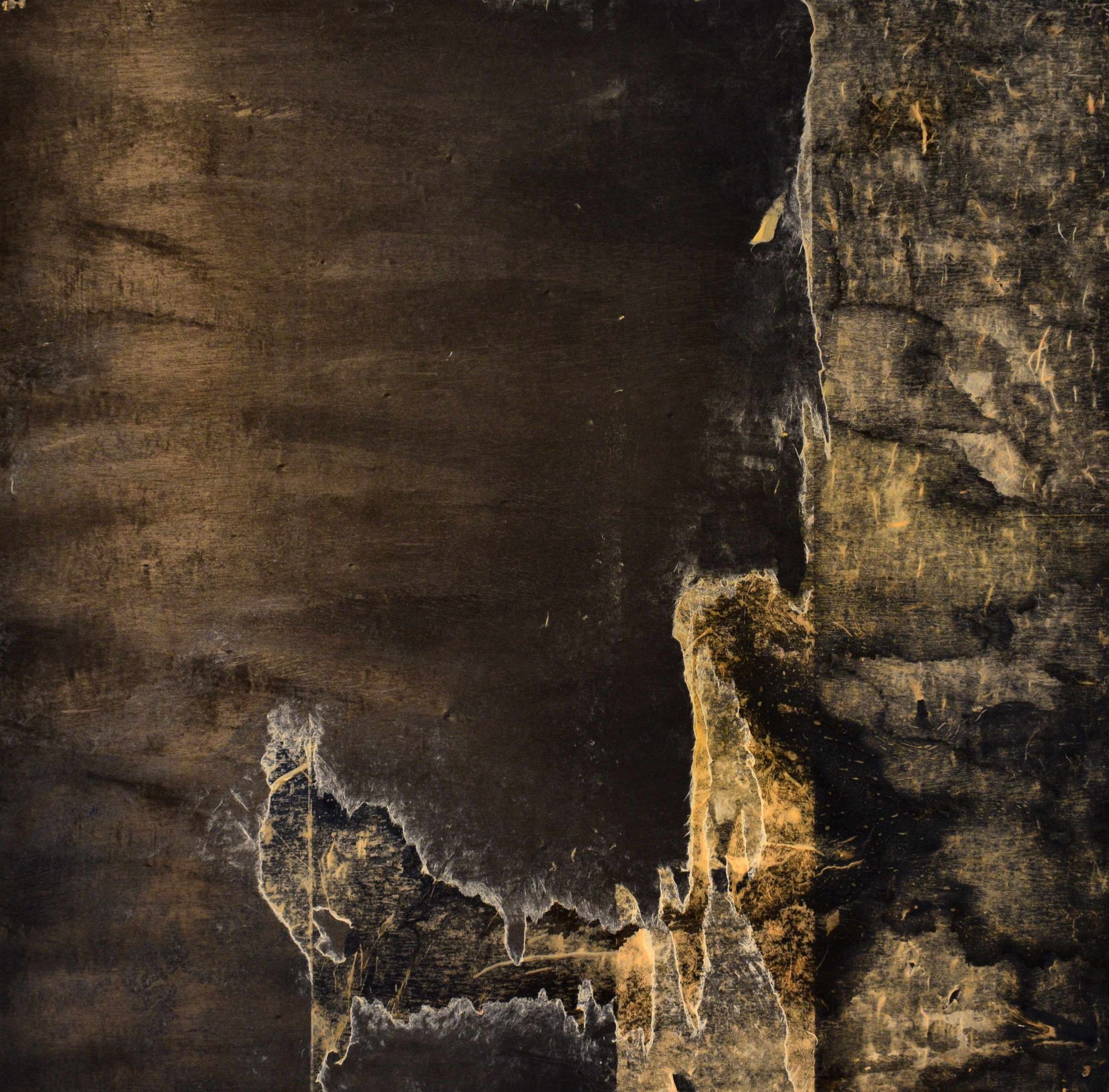
Dae Hak Oh, What Remains, 2026, Hanji, hand ground ink, shellac on wood panel, 48 × 48 inches
By THALIA VRACHOPOULOS September 17th, 2026
The centuries-old heritage of quietude, physical repetition, and spiritual introspection forms the conceptual bedrock for The Practice of Becoming, Dae Hak Oh’s solo exhibition at the Asian & American Art Foundation in Chelsea, New York. Oh’s austere minimalism and uncompromising execution were mesmerizing. The heavy materiality of a few sparse works - caked in pulverized dark pigments and marked by a corporeal weight - hung in electric tension against the ethereal white expanse of the gallery space. Rather than surrendering to the clinical silence of the white cube, Oh’s grounded objects commanded their own gravity.
In the early twentieth century, Kandinsky framed abstract painting as a mystical medium for inner awakening. A few decades later, Abstract Expressionists the likes of Lee Krasner channeled emotion in their works through repeated gestural motifs inspired by Hopi rituals and translated Kandinsky’s spiritual philosophy into a somatic practice. This impulse reached its quiet zenith in Agnes Martin, who - deeply influenced by Taoism and D. T. Suzuki’s Zen lectures - approached her grids as an ascetic discipline to strip away the ego.
The intersection of visual art and spiritual discipline is nothing new in East Asia where painting serves as a direct medium for self-cultivation and mental transcendence. Grounded in Buddhist and Taoist philosophy, Chinese recluse painters like Huang Gongwang, during the Yuan period, found freedom in retreating to mountain peaks. Here free and unfettered by royal protocol, they practiced ink painting as a form of meditation. Parallel to this tradition is Korean Seoseono (or the Way of the Brush) requiring the daily practice of executing a single and uninhibited brushstroke in one breath to express emptiness and non-attachment, where the gesture itself is an act of meditation.
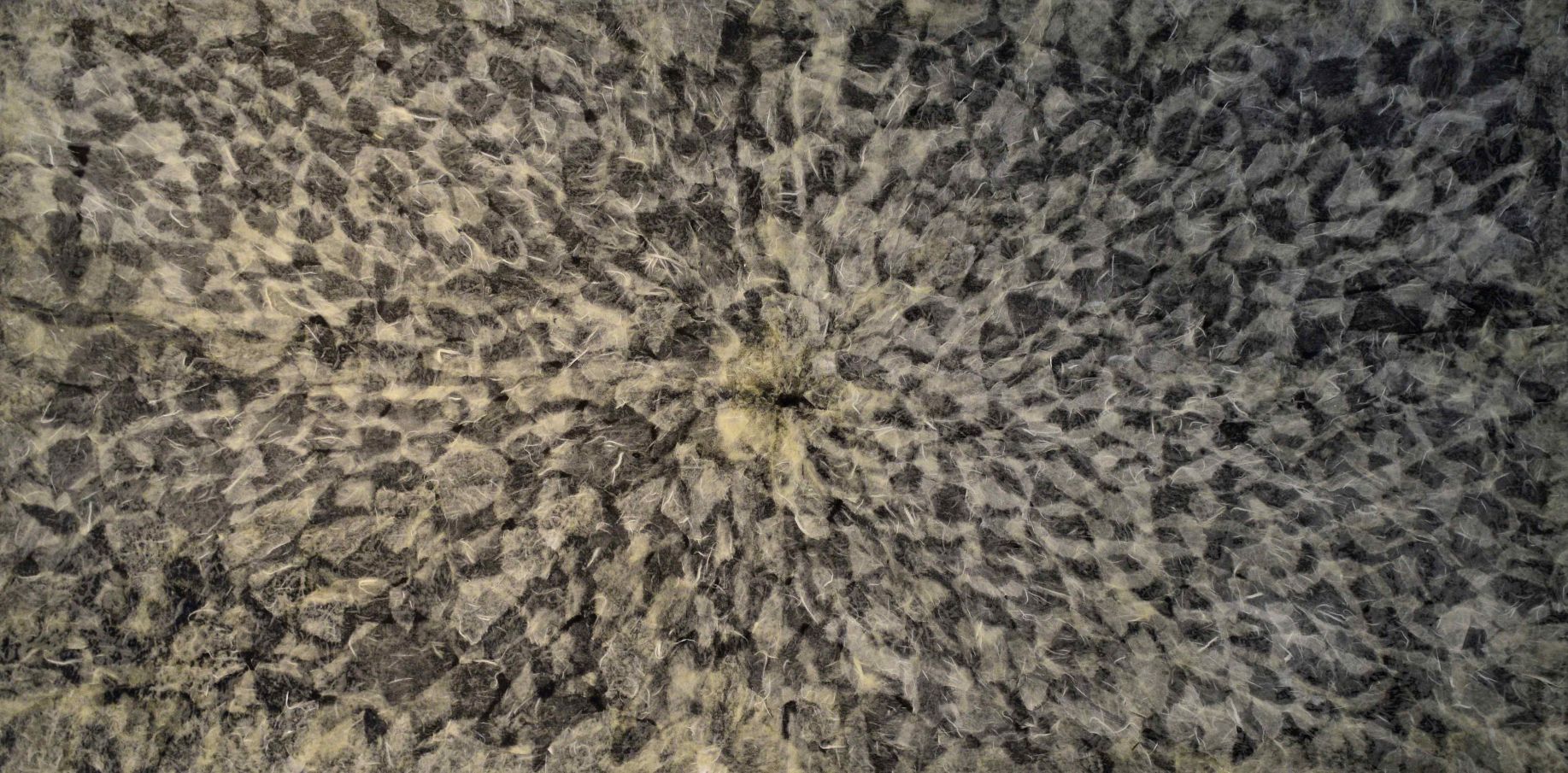
Dae Hak Oh, What Gathers, 2026, Hanji, hand ground ink, shellac on wood panel, 30 × 60 inches
According to Oh’s statement, the repeated hand motion of grinding ink, layering Hanji paper, applying shellac, and repeatedly scraping back the surface are ways of processing feelings of displacement. Rather than capturing literal landscapes or calligraphic symbols, Oh refracts the meditative focus of Seoseono into a tactile dialectic. His spatial and object-oriented framework converts traditional Korean media into coarse, earthbound topographies, pulverizing ink blocks across stone to yield a saturated dark substrate, incrementally constructing his planes with unrefined coats of mulberry paper, shellac, and timber armatures. With recurrent and physically demanding gestures of accretion, effacement, and removal, the final works surpass the conventions of static canvas, manifesting as a stark and sculptural environment of material vestiges of becoming.
But why has this age-old axiom become so obscured today, at a time when we are engulfed by an endless flux of digital media, streaming data, and hyperreal images? While our hyper-connected networks mirror the outward appearance of relational becoming, the Korean writer Byung-Chul Han reminds us that this digital acceleration produces only a frictionless hyperreality; a realm of instant and disconnected commodities that flattens temporal depth and closes off authentic becoming. Oh counters this weightless saturation through the unyielding friction of his own labor. As dark pigments saturate the timber matrix and upper layers are painstakingly scraped away, the deliberate drag of his process recovers what Han terms the scent of time, that is, a depth born of material decay. Here, emptiness ceases to be a cold and theoretical nothing to become a generative ground. By pitting the stubborn materiality of removal against the hyperreal instantaneity of the modern age, Oh reclaims the canvas as an active site of impermanence, demonstrating that what remains and what vanishes are not opposing forces, but co-dependent rhythms of a continuum that restores space for sustained contemplation.
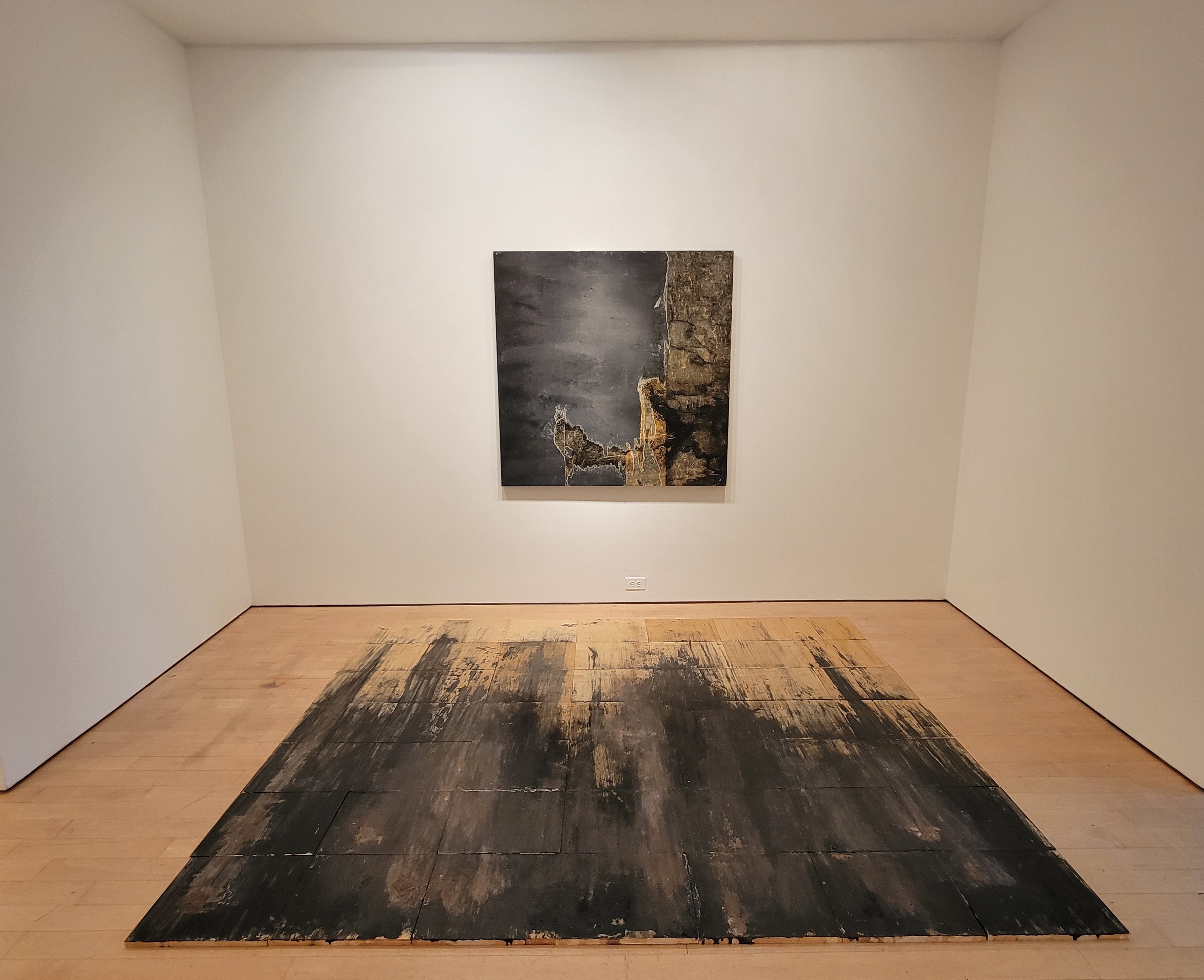
Dae Hak Oh, What Remains & 49 Days, Installation View
What Remains is a work in which Oh transforms emptiness and negative space through a spatial mirroring between wall and floor. Bifurcated into a horizontal wall-mounted panel and a collapsed floor installation, the work projects the floor element as a physical shadow. A material mark of emptiness cast into a three-dimensional space. Recalling Harold Rosenberg’s definition of the canvas as an arena in which to act, Oh’s brutal physical abstraction is born from a relentless body struggle with his materials, converting the picture plane into a site of pure exertion, friction, and kinetic residue. Through this physical endurance, Oh captures the act of becoming as a violent push-pull between self and shadow, exposing this continuous state of flux as nothingness itself: an unyielding void where raw matter and absent space bleed into one another.
In dialogue with this spatial discordance, his work, What Gathers, anchors the exhibition space by exerting a gravitational pull akin to a cosmic singularity; a black hole drawing matter and existence into a state of dense and concentrated tension. Suspended on the wall, the large-scale panel solidifies flux into a concrete and undulating ocean of compressed fragments that radiate inward. Yet, despite this formidable density, it is the minute central aperture that pulls the vast surface into cohesion, proving that absolute fullness is ultimately organized by the zero-point of space.
Understanding the full weight of Oh’s material brutalism becomes far clearer when read alongside Torkwase Dyson’s current exhibition Seeing in Blue at Pace Gallery, whose pigment-saturated canvases deploy a strikingly similar vocabulary of surface excavation and arduous toil. Mirroring Mark Bradford’s method of tearing, soaking, and gouging layered paper, Dyson builds her substrates using dense applications of ink, paper pulp, and process residue, subjecting the plane to an abrasive physicality. Dyson’s work operates akin to programmatic music, structured to evoke the atmospheric vibes and liminal states of the deep sea. Oh, by contrast, resists all programmatic narrative. His practice functions as absolute music, rejecting the canvas as a surrogate or vessel for outside phenomena.
Oh ultimately succeeds in reclaiming art as a point of contemplation and introspection, not as a product, but as the slow result of meditation. His works do not illustrate, simulate, or mimic a world beyond their own physical boundaries; they exist as autonomous, self-generating entities betwixt and between, as the anthropologist Victor Turner would say.
Oh’s practice functions as an urgent intervention, shifting the gesture from a market-driven product into a meaning-driven process by physically carving, layering, and scraping the timber substrate, refusing to let the artist's gritty mark be swallowed by a hyper-accelerated art market that flattens material depth.

Thalia Vrachopoulos
view all articles from this author