Whitehot Magazine
October 2026
"The Best Art In The World"
"The Best Art In The World"
October 2026
Zhen Guo: Between the Swamp and the Ideal
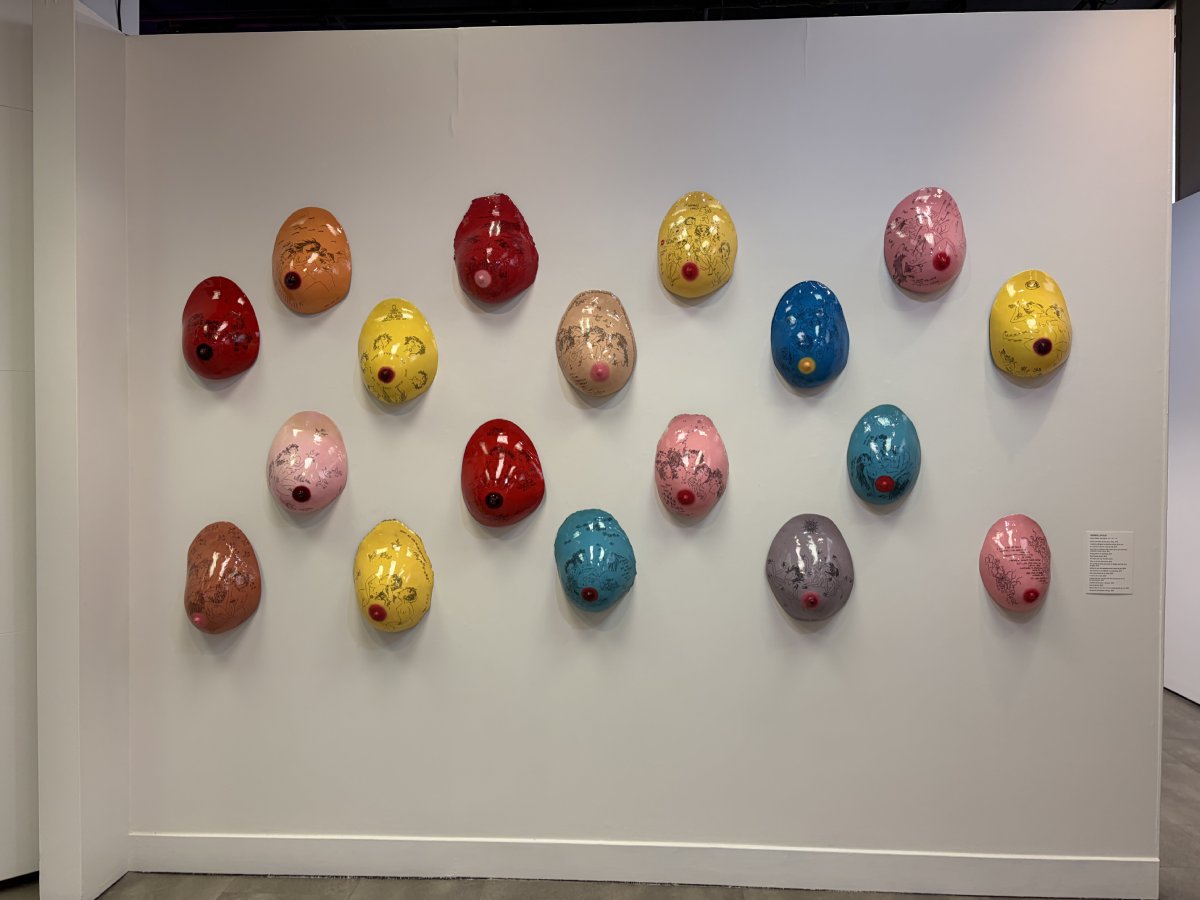 Women, 2010-25, papier-mâché, each approx. 15 x 12 x 6 inches.
By RICHARD VINE June 8th, 2026
Curated by the revered critic and art history professor Gail Levin, Changing Cultures: Zhen Guo, A Retrospective at the Mishkin Gallery, Baruch College, New York, lived up to the triple implications of its title. The show traced not only Zhen Guo’s émigré shift from China to the United States, but also her artistic response to deep social changes within both countries and her determination to foster even greater feminist progress in the future.
Guo was born in Shandong Province on the eastern edge of China in 1955, just six years after the Communist Party’s civil war triumph and Mao Zedong’s assumption of supreme autocratic power. She grew up with three younger siblings, a father who served as a local propaganda official, a mother who—as was the prerevolutionary norm—lacked a public education, and a grandmother whose feet had been bound. The earliest item in the exhibition was a handkerchief imprinted with a portrait of Mao, surrounded by halo-like radiating lines, to which an 11-year-old Guo added embroidery—an exercise fusing dexterity and indoctrination, performed in 1966, at the beginning of the massive 10-year purge known as the Cultural Revolution.
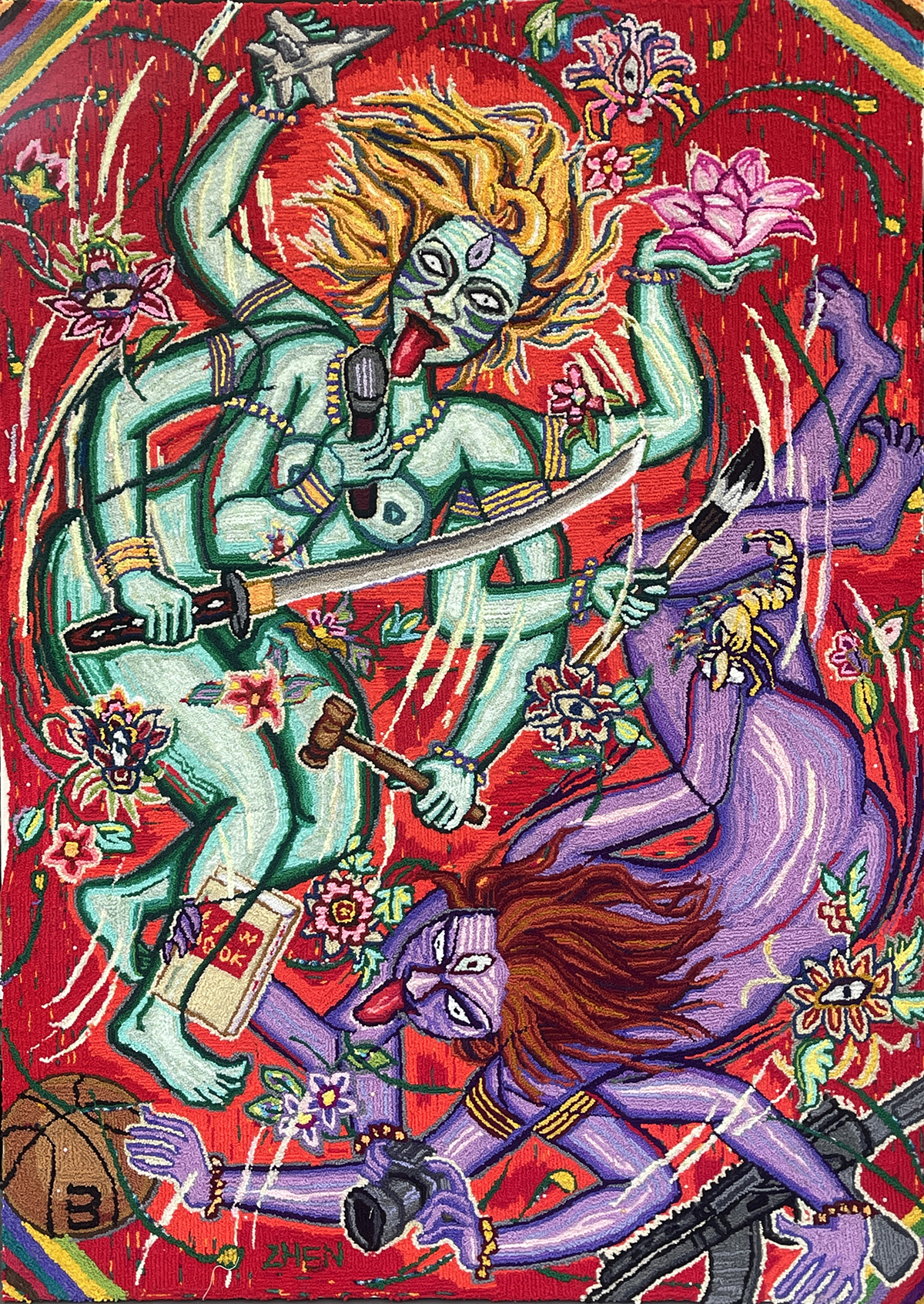 Khali Among Us, 2025, tufted yarn, fabric, pearls, 72 x 51 1/2 inches.
When Guo’s father was found insufficiently “correct” in his sociopolitical thinking, the entire family was sent to the countryside. At 14, Guo was apprenticed to a seamstress; at 16, the government assigned he to a clothing factory; at 18, defying her father’s fear that cultural work was politically unsafe, she ran away to take the national entrance exam for art. Succeeding, she spent three and a half years at the Shandong Art School and worked for one year, making propaganda posters and assisting with exhibitions, at the local Linyi Art Museum. In 1978, thanks to the new “reform and opening-up” policy of Mao’s successor, Deng Xiaoping, Guo entered the Zhejiang Academy of Art in Hangzhou, as one of only two women in a class of 14.
Guo’s student work explored the expected motifs of the time: traditional Chinese landscapes, imaginary portraits of ancient beautiful ladies in full array, sketches of contemporary friends, including one of a male student posed as a grinning, fully armed soldier. While generally praised by her teachers, Guo nevertheless had a brush with authority when one of her watercolors, Mother’s Love (1980), was suspected of criticizing the nation’s newly instituted One Child Policy. The scene features two young women, smiling together and each baring a breast to feed her infant. All good, one might think—except that the hen and six chicks at the girls’ feet could be read (by one male professor, at least) as implying that women should have multiple offspring.
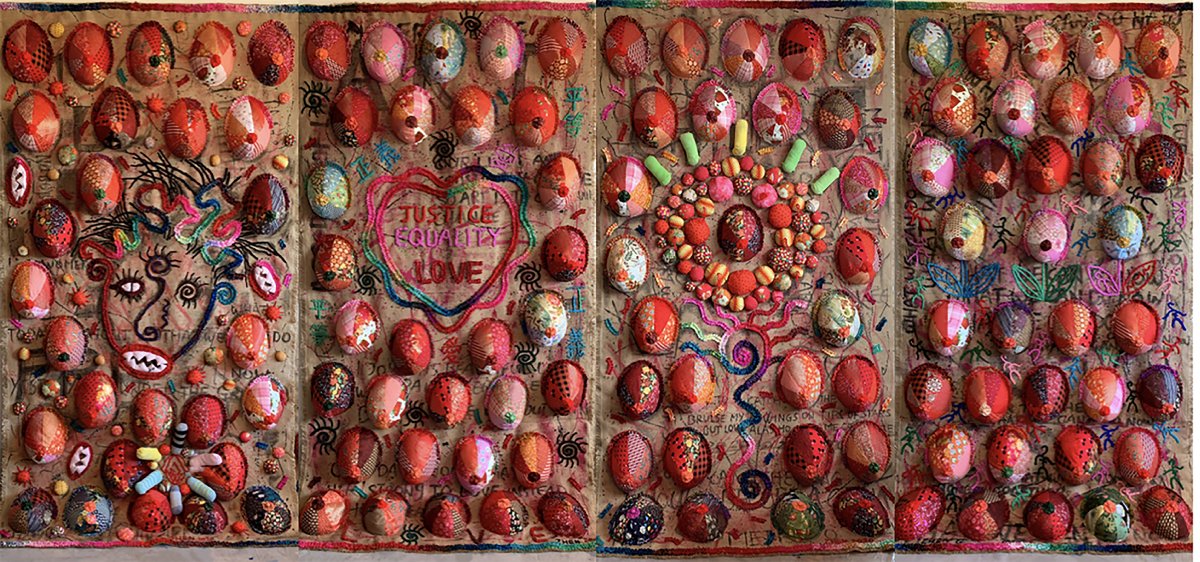 Love, Passion, Kindness, Desire, 2020, fabric and mixed mediums, 98 1/2 x 236 x 10 inches.
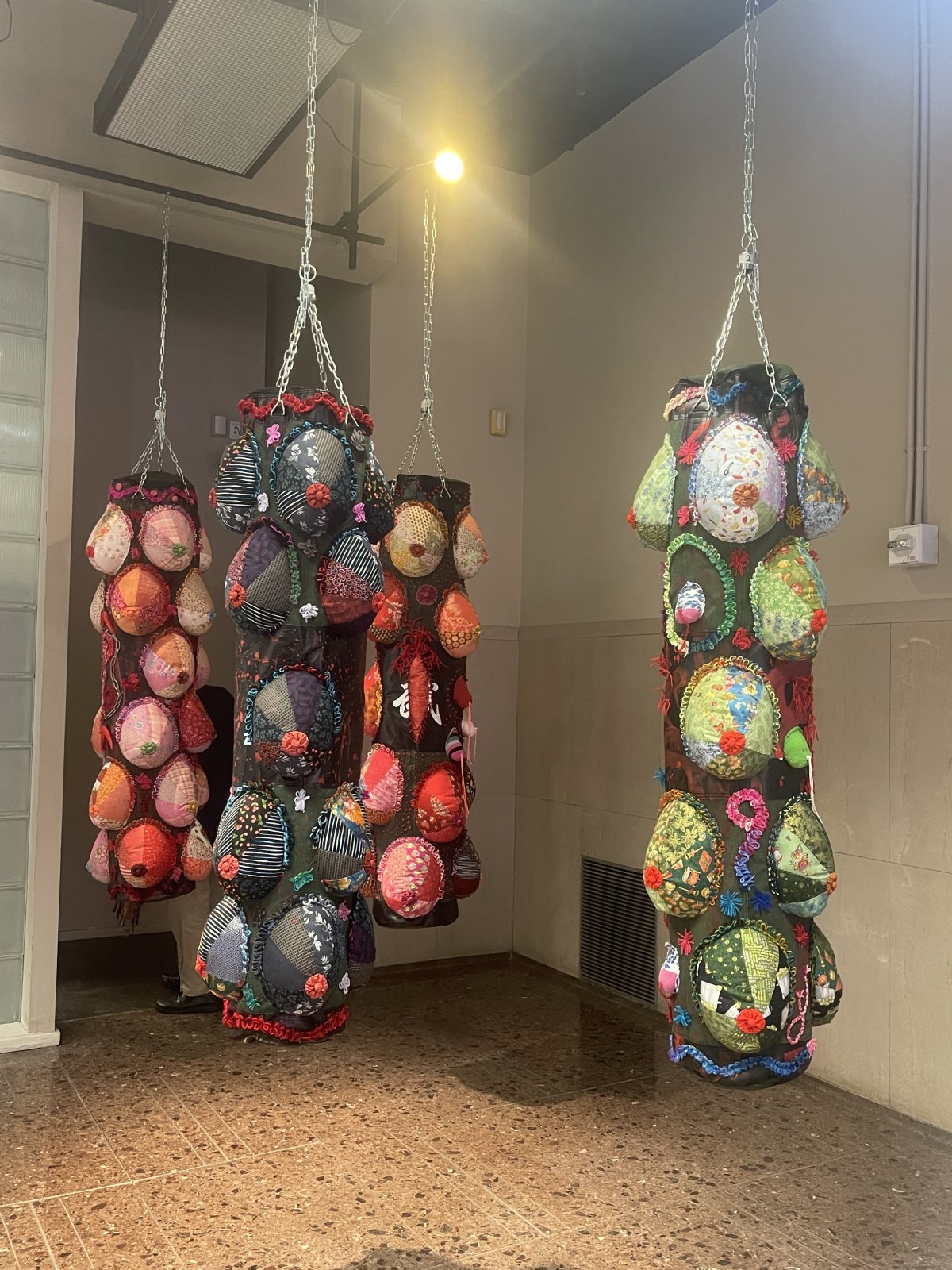 Punching Bags, 2012-21, fabric, canvas, leather, yarn, acrylic, ink, eah approx. 70 x 20 x 22 inches.
Still, such was Guo’s skill that she was invited to stay on as an instructor at the academy, where she met fellow teacher (and future international art star) Gu Wenda, whom she married in 1985. In keeping with Chinese mores of the time, she then immediately subordinated her career—and her entire life—to his. To support her husband, she moved to California in 1986, trying to study in San Francisco and Los Angeles but mostly waitressing and sending money home. When Gu joined her in 1987, he devoted himself fulltime to making art and learning English, while Guo worked at menial jobs, attended classes, kept house, and tried to complete an occasional artwork. After a joint stint at York University in Toronto, the pair moved to New York in 1988. In 1993, Gu abandoned her, and they divorced in 1995.
Guo’s bitterness over a decade of marital exploitation, including alleged battering, animates some of the fiercest paintings in the show. Echoing Frida Kahlo’s self-portraits, Supper (2000) depicts a bare-breasted young Guo seated next to Gu at a table as he dines on her heart, still tethered to her torn chest by veins and arteries. In Self-Portrait (2010), we see Guo’s angry visage on a caged, twisting leopard with the feet of a hog. A work from her 2011 acrylic-and-ink “Choking” series shows the artist green-faced with a lolling tongue and hands gripping her throat. The Last Blow (2012) presents her as a female boxer knocked back against the ropes.
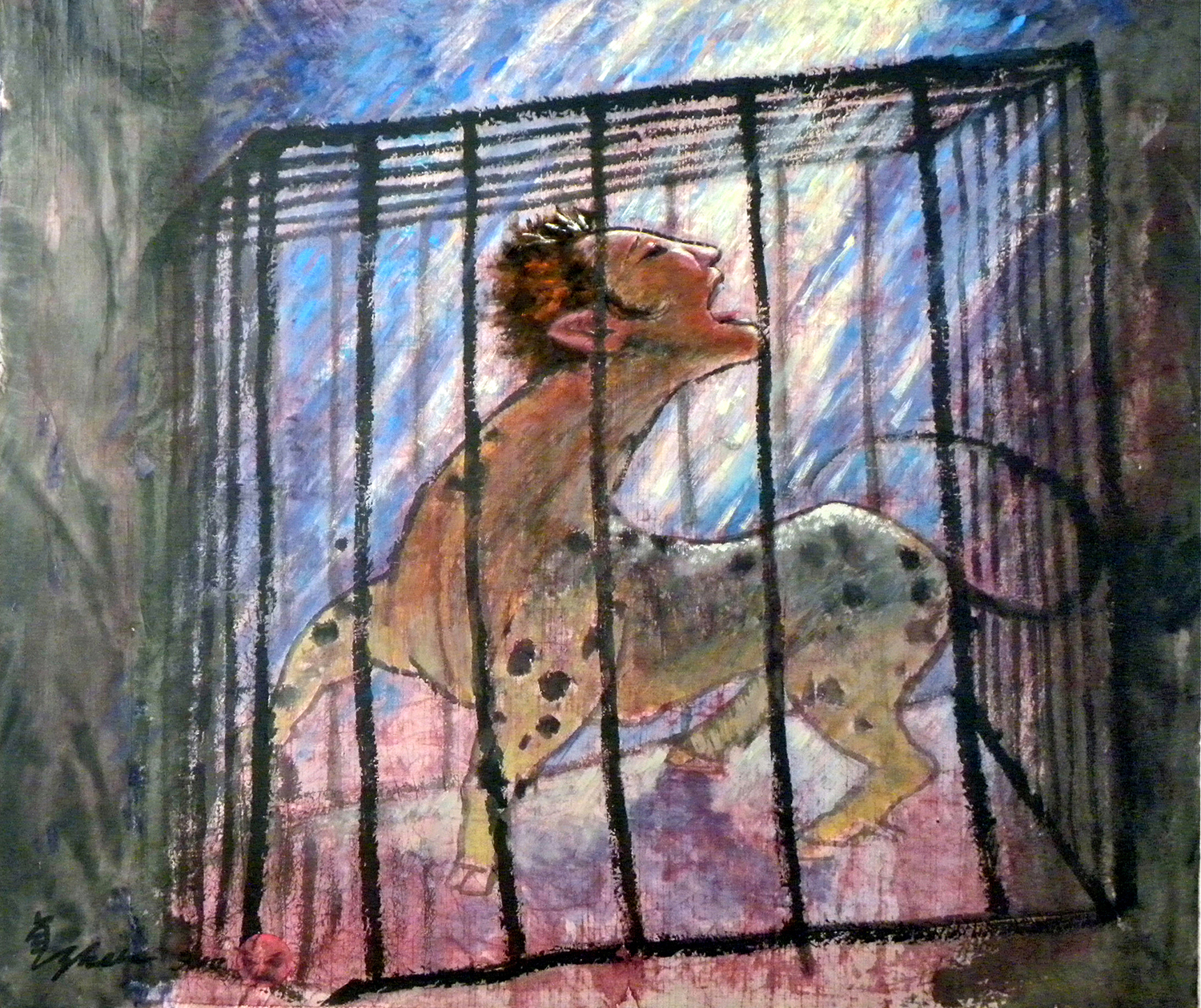 Self-Portrait, 2010, acrylic and ink on rice paper, 40 by 50 inches.
Yet physicality was to be, in several senses, her salvation. In addition to boxing, she took up karate under the tutelage of her new spouse, Robert Weinberg, an NYC criminal investigator whom she married in 1997. Finally appreciated for herself and encouraged in her profession, she gave birth to a daughter, commemorated as a charming child in several paintings in the survey. Since then, artworks—sculptures, textiles, and installations as well as paintings—have flowed from Guo in abundance, many bearing her signature motif: myriad large female breasts. The wall piece Women (2012-25) comprises 18 papier-mâché examples inscribed with phrases like “What is this for God knows” and “Lonely are you my hometown and I return to you.” Love, Kindness, Passion, Desire (2020) is a 19½-foot-wide tapestry dense with fabric mammary glands that resemble colorful antique Chinese caps shaped like melon halves. Similar “breasts” subdue and transform four suspended implements of male violence in Punching Bags (2012-21), deftly subverting the old macho-era cliché “she’s his punching bag.”
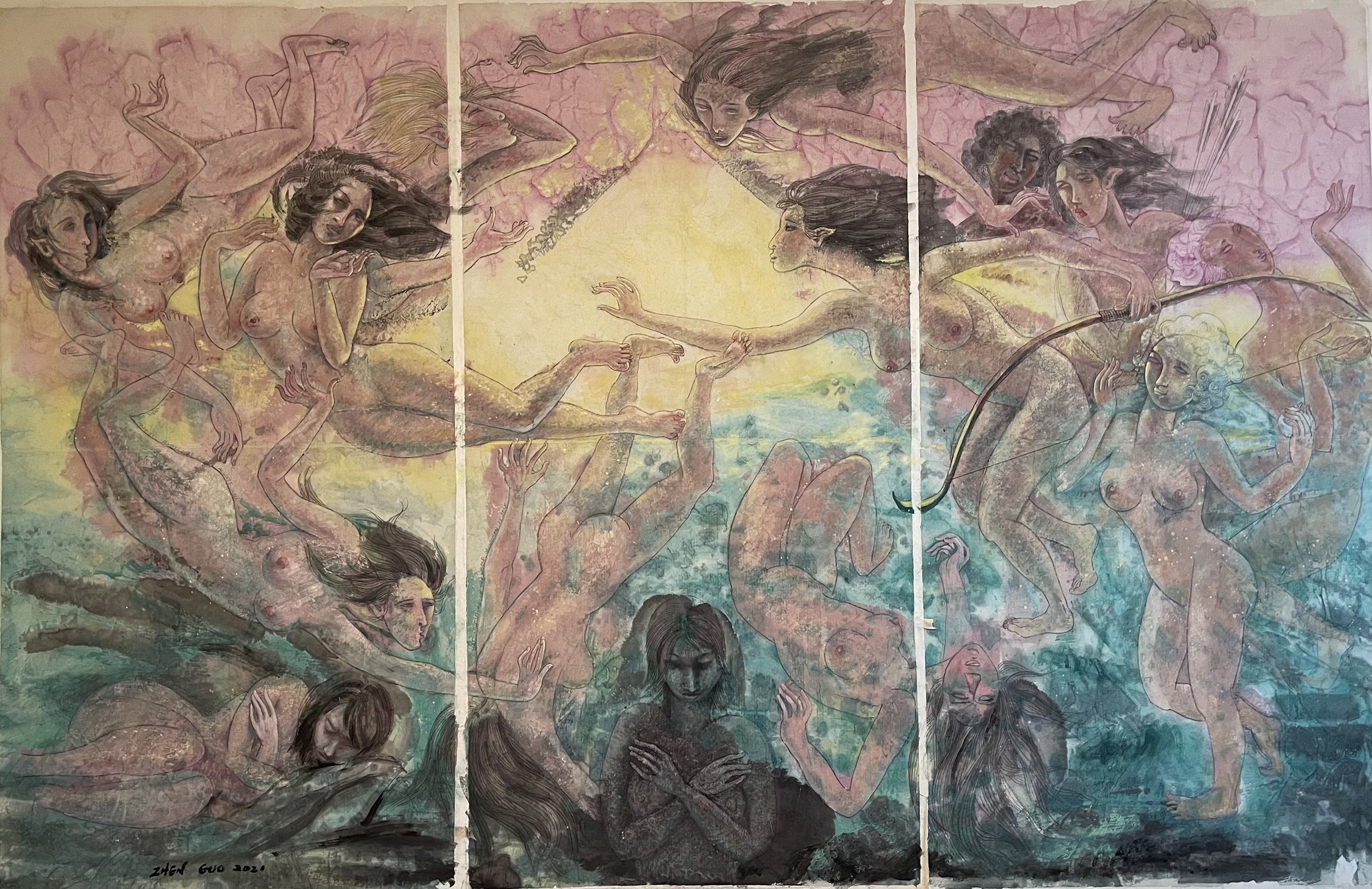 Together, 2021, acrylic and ink on rice paper, 19 x 118 inches.
As Guo’s confidence has grown, so too has her feminist militancy. In part because of the persistence of age-old convention, in part because Mao had supposedly granted women social equality in the Communist struggle, Western-style feminism has never been a major theme in contemporary Chinese art. The cohort of avant-garde artists who attained global prominence in the key period of 2000 to 2010—Zhang Xiaogang, Xu Bing, Ai Weiwei, Cai Guo-Qiang, Gu Wenda, Zhang Huan, Huang Yong Ping, Yang Fudong, etc.—was largely a boys’ club. Female artists who won notice—Cao Fei, Lin Tianmiao, Xing Danwen, Cui Xiuwen, and a few others—tended to keep their references to women’s issues oblique and subtle. In contrast, perhaps because she has lived so long in the US, Guo’s focus has been constant, insistent, hortatory, and formally varied.
At the Mishkin Gallery, several enraged portraits limned female faces from the international news: a fatal rape victim in India, a trafficked Chinese woman dog-chained in a rural shed and forced to bear eight children, a Ukrainian war survivor. Among these images was a 2010 self-portrait showing Guo, who has now exhibited globally for some 40 years, baring her teeth and snarling behind the superimposed words “Resistance Takes [a] Village.” Elsewhere, dreamy nude evocations of the eternal female—Phases of the Moon (1988), Who Am I? (2005), Together (2021), Singing in the Sunset (2023)—were offset by figures representing the ongoing struggle toward true equality for women: Ruth Bader Ginsberg, the Guerrilla Girls, Chinese revolutionary poet Qiu Jin (beheaded in 1907).
Lest we miss the act now message, the show concluded with two yarn-and-fabric portraits of a multi-armed, tongue-extruded Kali—the Hindu goddess of time and transformation, who devastates old material forms for the sake of new spiritual enlightenment. In Kali Musician (2025), the deity plays a stringed instrument and two drums, meanwhile holding a human skull at her crotch. Kali Among Us (2025) finds the sacred destroyer wielding a mallet (shades of Nietzsche’s Twilight of the Idols: How to Philosophize with a Hammer), a large paintbrush, and a sword. In the brochure for Changing Cultures, Guo describes women, so long oppressed and abused, as existing “between the swamp and the ideal.” Her compelling artworks leave little doubt about her agenda. For Guo, making clearly just demands, backed by ability, perseverance, and strength, is the best way to move one’s self—and others—through the patriarchal muck to the light.
Changing Cultures: Zhen Guo, A Retrospective was on view at the Mishkin Gallery, Baruch College, New York, March 12-June 11, 2026.

Richard Vine
Richard Vine is the former managing editor of Art in America and author of hundreds of critical articles, interviews, and reviews. His eight books include New China, New Art (2008) and Odd Nerdrum: Paintings, Sketches, and Drawings (2001), as well as the artworld crime novel SoHo Sins (2016). He has taught and lectured around the world, and curated exhibitions in Beijing, New Delhi, Hangzhou, Ho Chi Minh City and New York.
view all articles from this author