Whitehot Magazine
October 2026
"The Best Art In The World"
"The Best Art In The World"
October 2026
Gregory Hodge: Chromatic Undulations
By RAPHY SARKISSIAN | July 2, 2026
Something of Poussin, of German Romanticism, of Seurat—overlapping yet belonging to none. Dominated by wood-hewn tones and carrying with them the weight of painting's history, these landscapes are formally and cerebrally compelling in equal measure. In this austere and self-reflexive exhibition titled Recall, Gregory Hodge, an Australian painter living and working in Paris, presents a world wherein figuration and nonfiguration undulate in dialectical interplay across the pictorial field.
This dialectical interplay manifests itself through art-historical iconography and a cunningly devised material process. While Hodge's figurative subjects evoke classical genres, his application of paint conveys a sense of the Jacquard weave, with patterns of warp and weft culminating in sceneries that insist on semblance as much as on chromatic patterning. Six large landscape paintings in which trees are the dominant motif occupy the main gallery, whereas two floral still lifes serve as a preface. With the exception of Millefleur II, which dates to 2025, this body of work was executed in 2026, capturing a distinct period of transition from his earlier plurality of genres to an engrossing landscape series defined by phenomenological reciprocations. Here the temporal act of moving closer dissolves the scenery into chromatic traces, only for the atemporal illusion of the classical vista to rebuild itself as the viewer steps back.
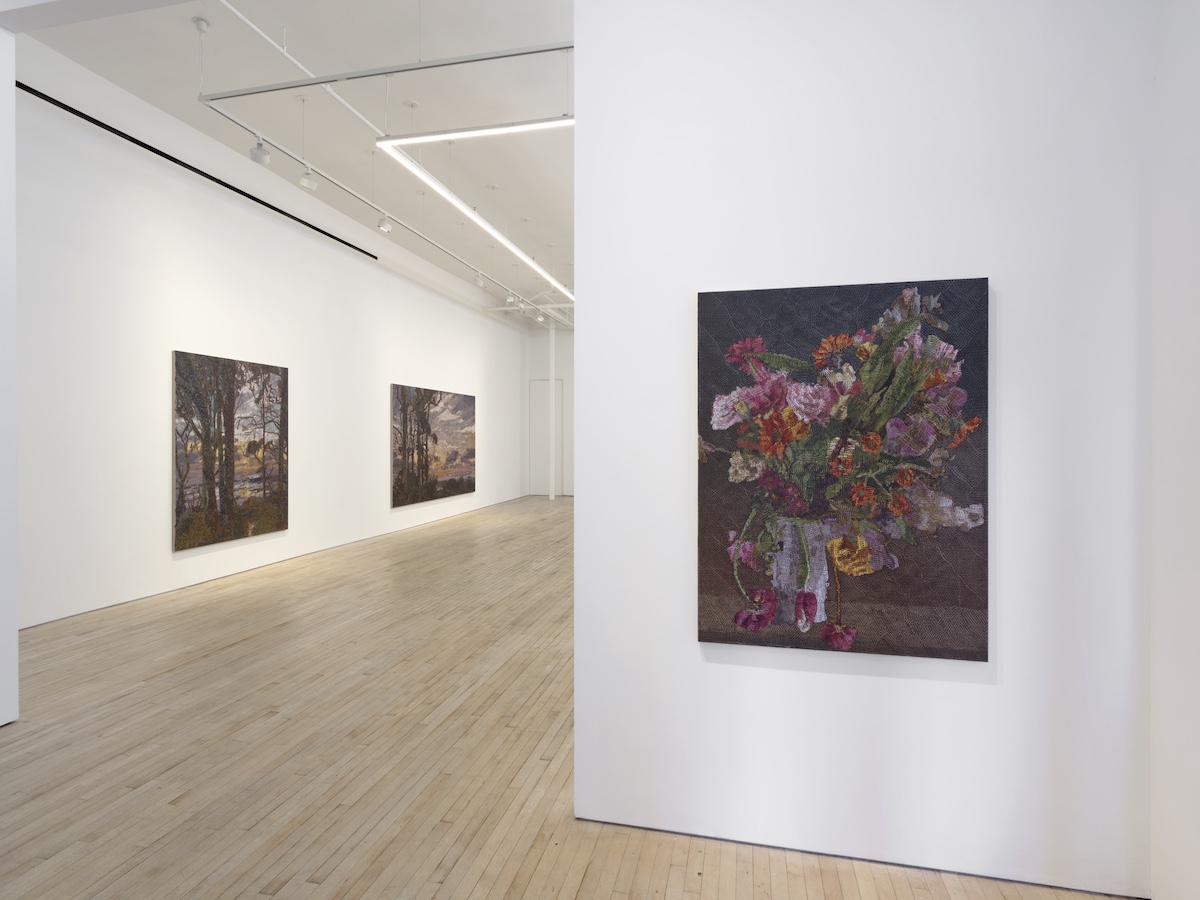
Installation view of Gregory Hodge: Recall at Nino Mier Gallery, Tribeca, New York. © Gregory Hodge. Photo: Elisabeth Bernstein. Courtesy the artist and Nino Mier Gallery.
In this pair of still lifes Hodge plays with scale: Studio Still Life #1 retains a traditional arrangement of vase and flowers, its scale approaching that of the landscapes, while Millefleur II captures a single floral cluster in magnified close-up, its dimensions rivaling the landscapes themselves. Through a Rococo painterliness of execution and a Baroque atmospheric depth, these canvases entwine allusions to weaving and the history of painting. The forest paintings are rooted in Hodge's habitual walks through the Bois de Vincennes—Paris's largest park, situated between his home and studio—while a series of coastal works reach back to memories of Australia. Yet by stripping away the identifying markers of these locales, Hodge suspends specific allusions, producing an anonymous scenery that evades a purely literary reading. Instead, the visual field fluctuates between abstraction and pictorial representation.
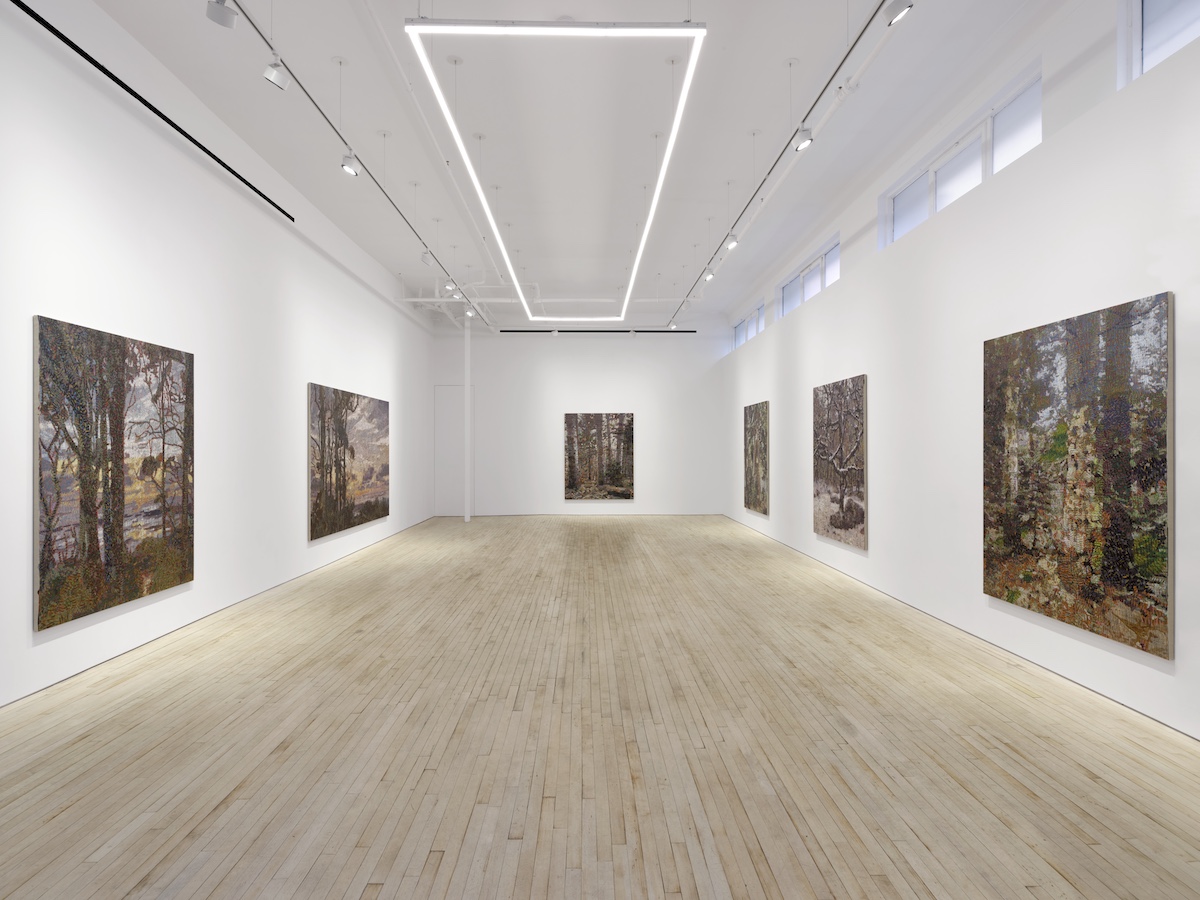
Installation view of Gregory Hodge: Recall at Nino Mier Gallery, Tribeca, New York. © Gregory Hodge. Photo: Elisabeth Bernstein. Courtesy the artist and Nino Mier Gallery.
The painting titled Recall reveals itself as a tapestry of a forest, where half a dozen massive tree trunks, their tops cropped from view, stand side by side in the foreground, while behind them a multitude of trees dissolves into a ghostly wash of color. Within this compressed forest, figure and ground exchange roles throughout, their dense interaction punctuated only by a sliver of open sky at the upper center. Even in the sky the same fabric-like mark-making persists, animating the peeling bark below with color embroidered into stitch-like, nearly darned modulations. Through these crocheted articulations of color, Recall binds opticality to tactility just as it binds imitation to abstraction, each pair inseparable from the other.
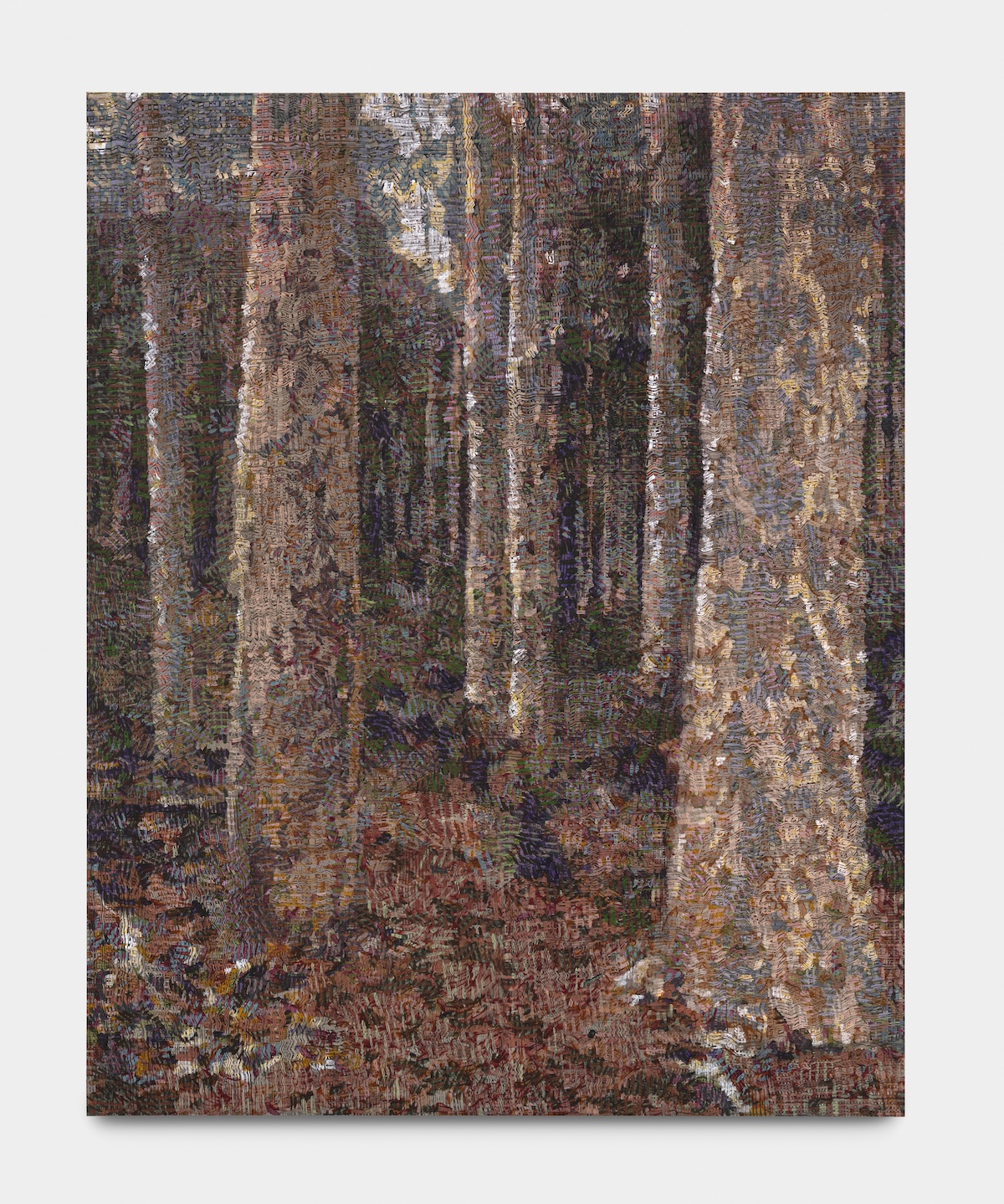
Gregory Hodge, Recall, 2026. Acrylic on linen. 78 5/8 x 63 inches. © Gregory Hodge. Photo: Nicholas Knight. Courtesy the artist and Nino Mier Gallery.
This unstable figuration within the visual field generates a pulsating opticality, suspending the observer within a dialectical tension between sensory apprehension and cognitive recognition. It is here that one is taken aback by Hodge's insistence that neither painting nor vision can escape their own conditions of possibility: figure and ground, figuration and its dissolution, materiality and light, color and surface. These paintings attest to the phenomenological weight of Alois Riegl's insight that our visual faculty, denied access to the haptic depth of solid bodies, can only encounter two-dimensional surfaces. From Jacob van Ruisdael's brooding forests to Claude Lorrain's luminous horizons, from Jean-Baptiste-Camille Corot's silvery atmospheres to John Constable's meteorological precision and Paul Cézanne's structural planes, landscape painting has been continually reinvented. Hodge contributes to this tradition with a pictorial language where marks weave rhythmic threads into a tapestry of chromatic assimilation. Ultimately, this work sets the transience of vision against painting's own ontological facticity, standing as a permanent trace of a temporal process that settles irreversibly on a flat surface.
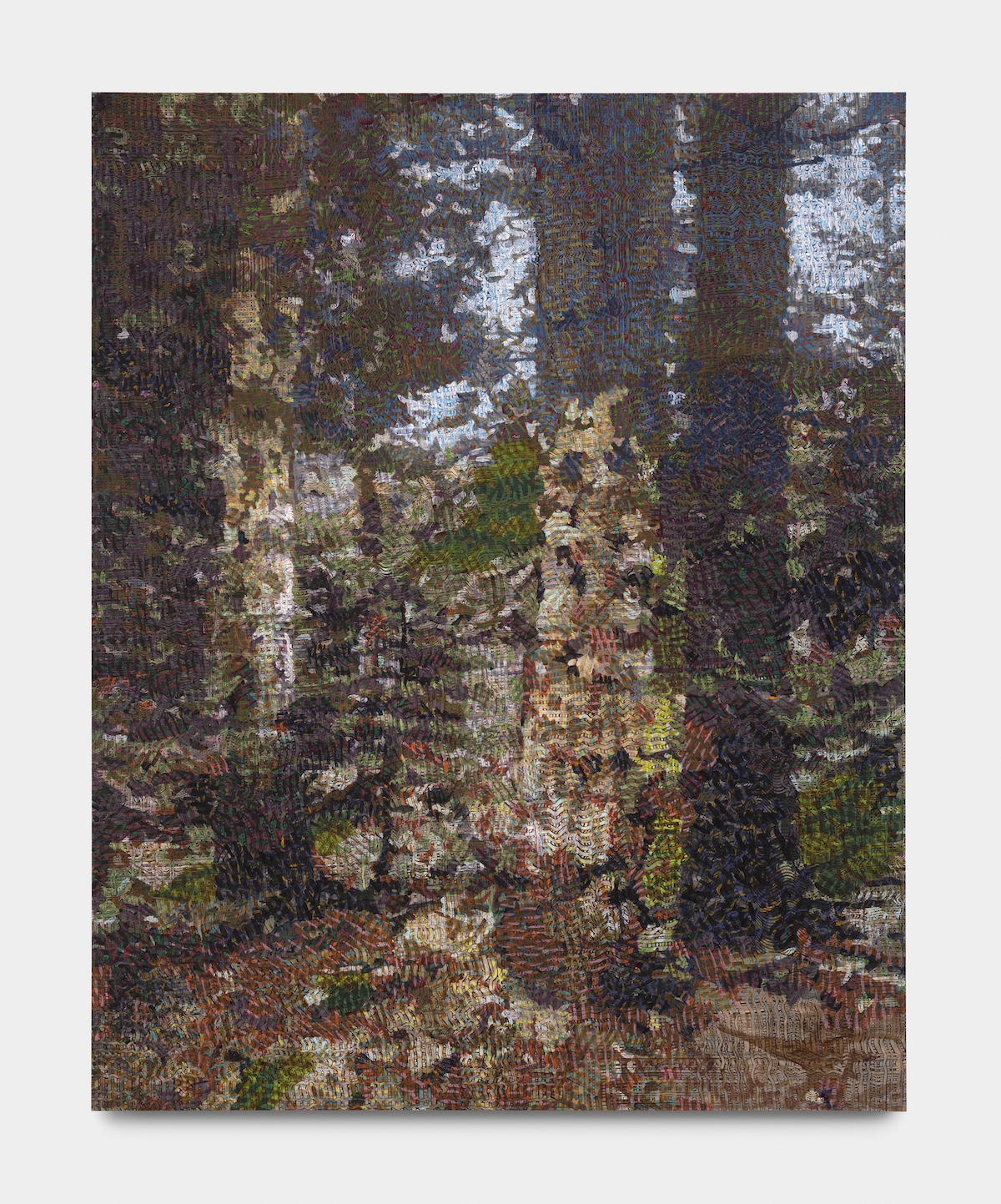
Gregory Hodge, Afterimage, 2026. Acrylic on linen. 78 5/8 x 63 inches. © Gregory Hodge. Photo: Nicholas Knight. Courtesy the artist and Nino Mier Gallery.
This same rhythmic logic governs Overhang and Afterimage, each offering sceneries that are highly atmospheric yet become pictorially unresolved up close. From afar, Overhang resolves into dark and medium browns for its tree trunks, a dark olive for its branches, light gray for the sky, and faded yellow for the background terrain. Yet each of these chromatic shades consists of a calculated set of colors obtained through Hodge's improvised comb-trace method. Viewed from a short distance, the gestalt surrenders to medium and facture, as what first registered as foliage and shadow dissolves into the very acrylic marks that constructed it. It is precisely at this close proximity that the canvas reverberates with the Chevreulian optical system championed by Georges Seurat. Much like Seurat’s systematic dismantling of form into isolated points of color, Hodge breaks the picture plane down into a woven lattice of linear marks. Using custom combs and sponges to sweep and scrape translucent layers, he replaces Seurat’s pointillist dots with micro-strands of paint that trace the patterns of the warp and weft. The swiped marks function as striated tracks, their outer perimeters often carrying darker, anchoring pigments while their inner bands reveal contrasting, luminous hues. Whereas Seurat placed distinct dots of pure color side by side—relying on chromoluminarism to reconstitute them within the observer's retinal and cognitive faculty—Hodge works in undulations of lines. The underlying optical logic remains comparable, but the visual syntax of the swiped mark belongs to a pictorial praxis that is distinctly Hodge's.
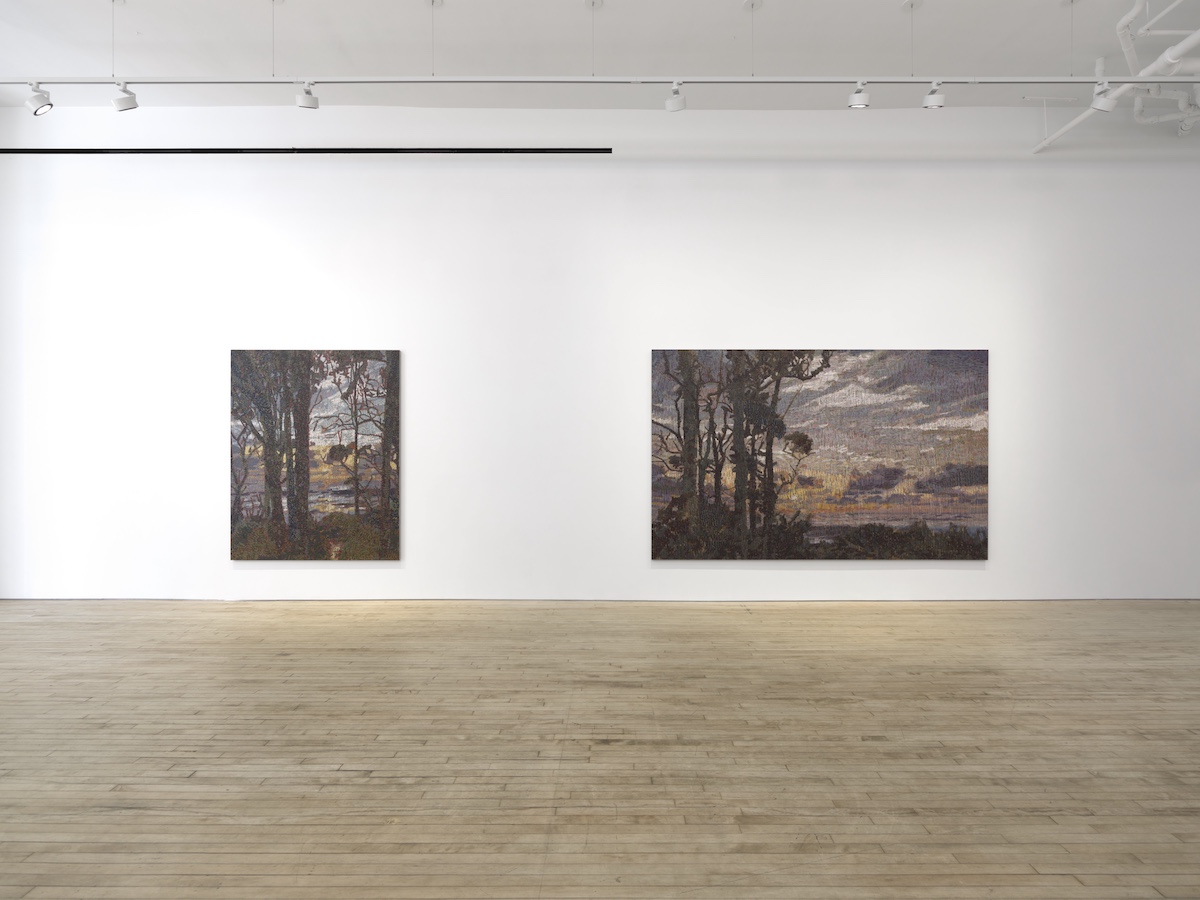
Installation view of Gregory Hodge: Recall at Nino Mier Gallery, Tribeca, New York. © Gregory Hodge. Photo: Elisabeth Bernstein. Courtesy the artist and Nino Mier Gallery.
Upon the gallery's north wall, Evening hangs on the left as a vertical vista, balanced on the right by the panoramic sweep of Late in the Day. Together, they capture changing moments of fading light, granting the wall an almost cinematic dimension. Standing before these two paintings, one thinks of Lorrain, of the hazy atmospheric light and lyrical foreground shadow of his Pastoral Landscape: The Roman Campagna of the Metropolitan Museum. While Hodge's vision echoes an Arcadia suspended between day and dusk, his swiped, wave-like marks simultaneously recall the pixelation of digital screens. This shared breakdown of light aligns Evening and Late in the Day with an Impressionist treatment of color as chromatic flux. Yet Hodge’s patterning ultimately parts ways with that tradition's loose touch, forming instead a hand-generated analogue to the rhythmic intersections of weaving.
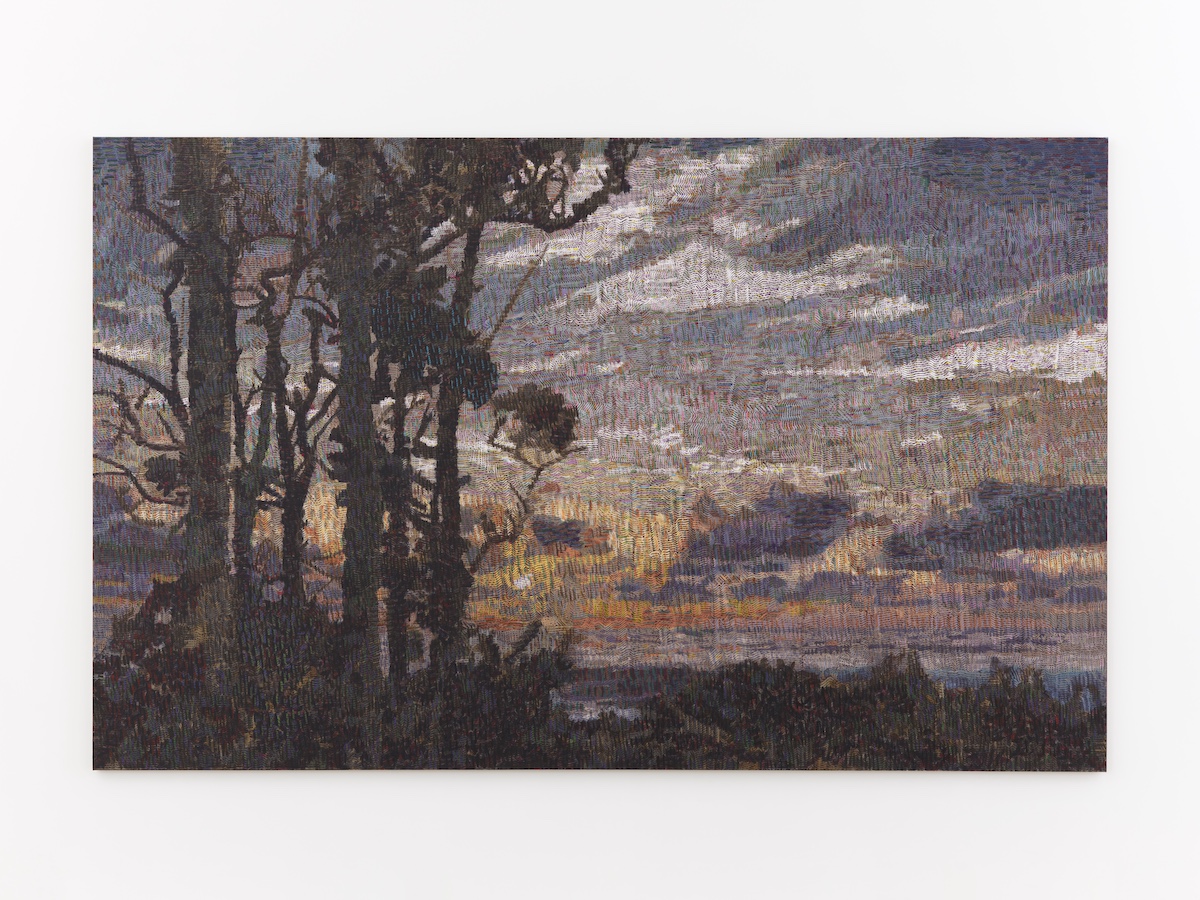
Gregory Hodge, Late in the Day, 2026. Acrylic on linen. 78 ¾ x 126 inches. © Gregory Hodge. Photo: Nicholas Knight. Courtesy the artist and Nino Mier Gallery.
Constable returned repeatedly to Hampstead Heath, London's most storied open landscape, to meditate on light, atmosphere, and the weight of the sky. So too Hodge walks the Bois de Vincennes, the same park Jean-Jacques Rousseau traveled to visit the imprisoned Denis Diderot. As a critic, Diderot would later review Claude-Joseph Vernet’s landscapes by imagining himself walking inside the painted scenes, treating them as spaces no less credible than reality. Diderot prized nothing more than a landscape's verisimilitude, achieved precisely by concealing the artifice that produced it. Two and a half centuries later, Hodge redirects that principle of trompe l'oeil: he lets his artifice surface and fade, echoing vision's own constant negotiation between observational reality and painting's perspectival languages. That same negotiation had already animated Chuck Close, who began as a photorealist before the grid became his system of resemblance, serving as a mechanism for constructing likeness from discrete, optically mixed units. Hodge replaces the rigid grid with a system that is as purposeful as it is random. His wavering skeins engage in a pictorial dialogue with the weave of the linen beneath them, entertaining both flatness and depth, both the medium’s essentiality and its mimetic capacity.
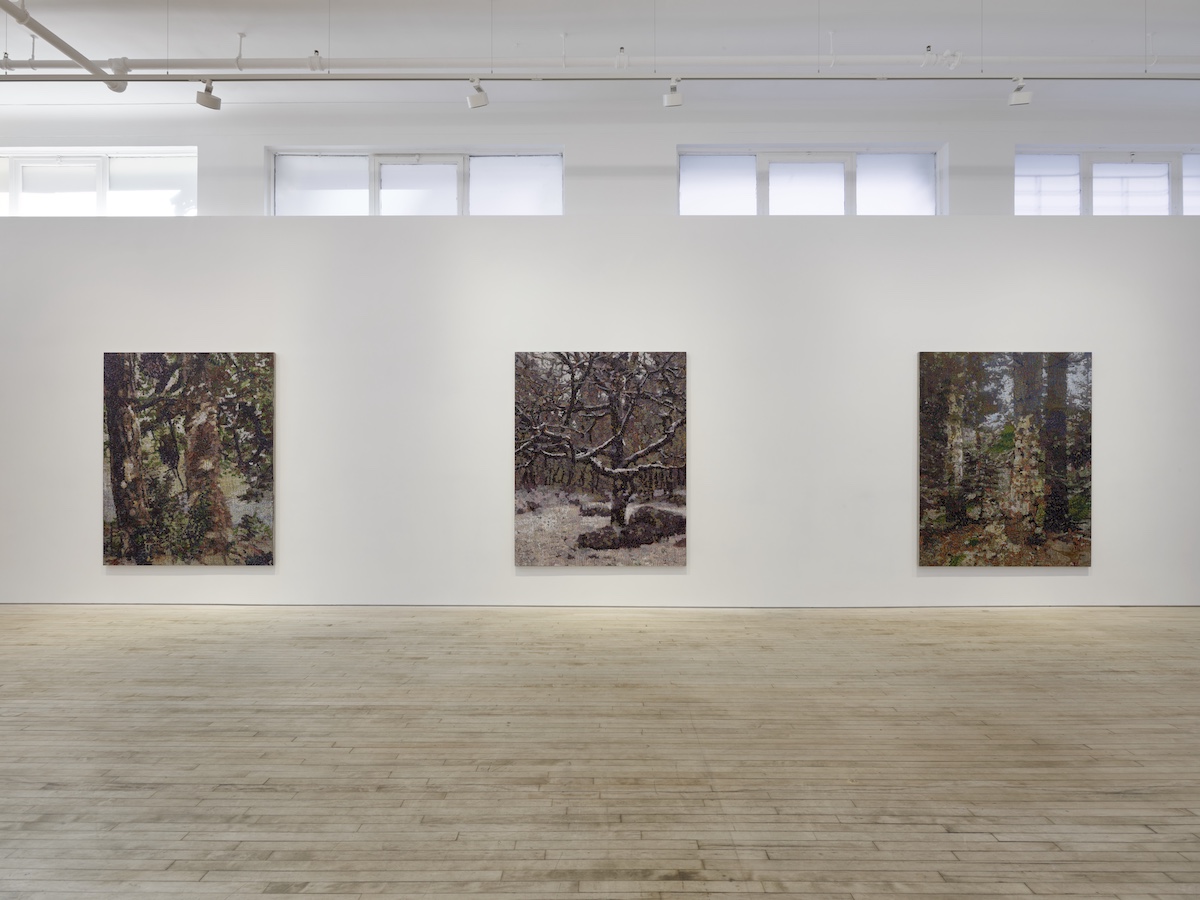
Installation view of Gregory Hodge: Recall at Nino Mier Gallery, Tribeca, New York. © Gregory Hodge. Photo: Elisabeth Bernstein. Courtesy the artist and Nino Mier Gallery.
Beyond the canvas, these paintings enfold the active process of seeing, as if a given image here unmakes its own eidetic afterimage within the pictorial field. These formal and perceptual dialogues unfold in tandem, operating like a visual fort/da game. Just as Sigmund Freud’s toddler cast away and retrieved the wooden spool to negotiate presence and absence, Hodge's marks stage a rhythmic hide-and-seek between figure and ground. The beholder's eye perpetually throws the imagery into abstraction (fort) only to pull it back into legibility (da) through a cognitive glance. The eye and mind continually negotiate between the formation of imagery and its dissolution, enacting that tension Riegl identified between purely observing the optical and inferring the tactile. The exhibition Recall unravels inferences of a park in Paris and a coastline in New South Wales as avenues into a genealogy of painting's history, here summoned and rewoven by Gregory Hodge into chromatic undulations that remain shimmering.
Gregory Hodge: Recall
Nino Mier Gallery
380 Broadway, New York, NY
April 10–May 6, 2026

Raphy Sarkissian
Raphy Sarkissian received his masters in studio arts from New York University and is currently affiliated with the School of Visual Arts in New York. His recent writings on art include essays for exhibition catalogues, monographs and reviews. He has written on Rachel Lee Hovnanian, Anish Kapoor, KAWS, David Novros, Sean Scully, Liliane Tomasko, Dan Walsh and Jonas Wood. He can be reached through his website www.raphysarkissian.com.
view all articles from this author