Whitehot Magazine
October 2026
"The Best Art In The World"
"The Best Art In The World"
October 2026
Gladwell Projects' Multiversal Gallery
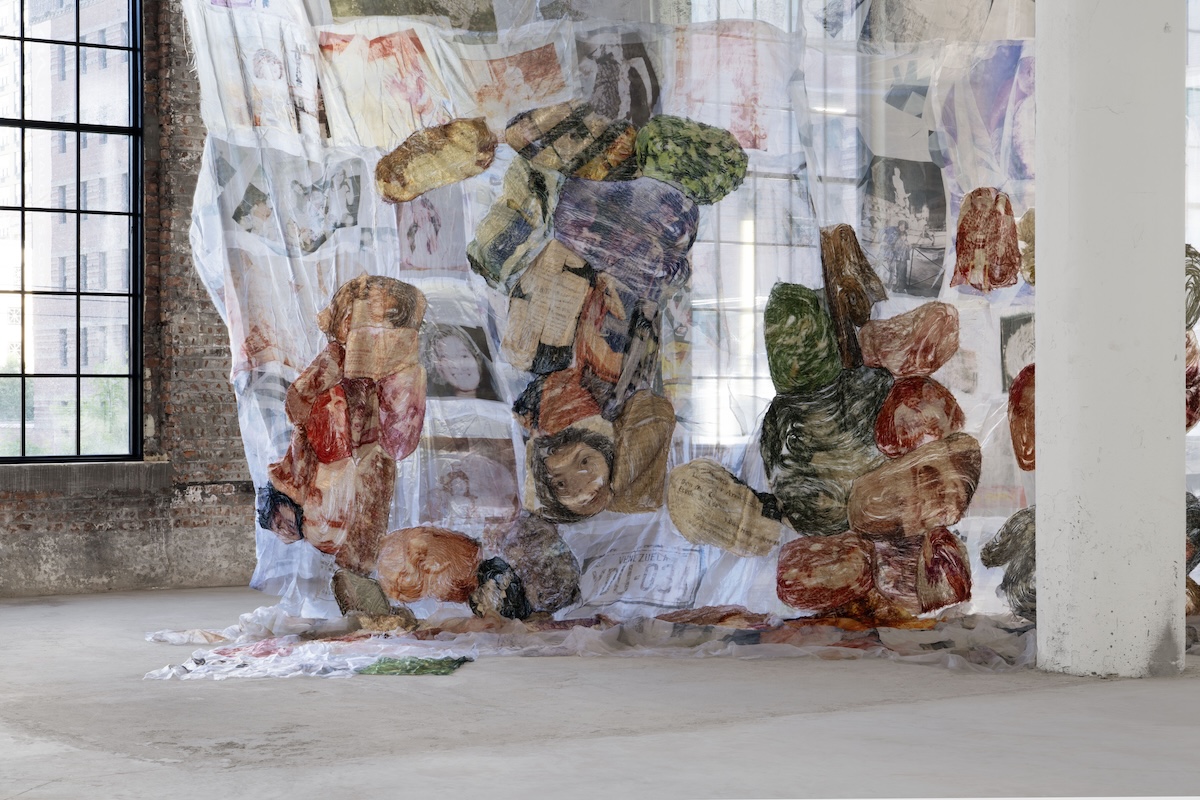
Installation View: Lisu Vega: Las raices hablan... El recuerdo susurra, 2025, Gladwell Projects. Courtesy of Gallery.
By EMANN ODUFU, August 20th, 2026
Walking through the Gladwell Projects’ temporary space in Jersey City can feel a little like moving between worlds. Across six floors, six solo exhibitions unfold with their own visual languages, atmospheres and internal logics. The deeper you move through the building, the more it begins to resemble a multiverse, almost like turning the dial on a radio and discovering a different frequency on every floor.
What impressed me most, however, was the ambition. Gladwell Projects founder Christiana Ine-Kimba Boyle, who describes herself as a dealer with a curatorial eye, had effectively mounted her own pop-up museum. As a curator, I was inspired by the resolve to take up space on that scale and the wherewithal to actually pull it off. As a writer, I left overwhelmed by how much I had seen and appreciated, sincerely unsure which exhibition was my favorite or where I would place my focus in the piece I knew I would write.
Our walkthrough lasted nearly two hours, possibly the longest I have ever experienced, yet it never felt overbearing. There was simply a lot to encounter. Moving between six exhibitions, each occupying a unique way of seeing, required time, and that time allowed our conversation to move beyond the mechanics of an exhibition walkthrough into something more expansive.
What became clear was the degree of care underlying Gladwell Projects. Boyle’s approach moves fluidly between dealing, curating, contextualizing and community-building. Inside what could have remained a sterile industrial warehouse, the intervention felt expansive yet warm and welcoming, a testament as much to the mind behind the project as to the artists whose creative brilliance filled its floors.
The following conversation grew out of what can only be described as a marathon of an exhibition walkthrough, beginning with the curatorial decisions that shaped the shows before expanding into questions of canon-building, intuition, community and the role of galleries in a rapidly transforming art world.
Emann Odufu: One of the coolest things about the show was that it didn’t really feel like six solo shows gathered together under one roof. It felt more like entering a multiverse. Every floor was its own distinct world, with its own atmosphere and internal logic, but they all remained connected. I was curious about your role as a curator and whether, for this intervention, it was less about producing an exhibition than orchestrating an encounter between multiple worlds.
Christiana Ine Kimbe Boyle: I see myself as a dealer first, but there is this element to the way I work where I’m consistently thinking about canonizing artists and the reciprocal relationship between dealing, curating and contextualizing. I’m always a dealer with a curatorial eye and vision.
With these exhibitions, what was really important to me was thinking about how we were going to occupy space at this scale, which is so rare. I think about institutions like MASS MoCA or Crystal Bridges, where there’s this balance between making sure the space doesn’t outshine the work and vice versa. The artists had an idea of the space and its history, but they also remained very true to their practices. For me, it was about figuring out which floors made sense for each artist and then making decisions that would amplify their visions further.
Yes, sometimes it felt like there was this symbiotic relationship between the exhibitions and the building itself. There were moments when I assumed something had been installed by an artist, only to discover it was already there. How much did the architecture determine how you organized the shows?
A lot. Trevor Warren, for example, paints at such a monumental scale that the viewer can sometimes get overwhelmed or lost in the picture. The fourth floor has lower ceilings and this almost grid-like configuration, which created very intimate moments with his paintings. Even the harsh fluorescent lighting works because his paintings are so hyper-fluorescent and colorful.
Or with Chiffon Thomas’ space, the columns almost act like little vignettes for each piece. I didn’t want the space to overpower the conversation around the work. I wanted it to further emphasize why these artists are so brilliant. There was also a lot of kismet and serendipity in how this project came together. As a dealer, you want to control and refine and tighten. But I almost feel like the strength of these exhibitions came from leaning into uncertainty and what felt natural rather than hyper-controlled.
I definitely think that comes across. At one point I noticed graffiti on a wall and asked you if it was part of the artist’s work. You said no, and I remember thinking, that’s so weird. The colors and logic of what was already there reflected the artist’s practice so closely that I assumed the artist had put it there.
The building also reminded me of those warehouse exhibitions in Berlin, except we’re in Jersey City, which I loved as a Jersey guy. You’ve described this project as a Kunsthalle rather than simply a gallery exhibition. Why did that framework feel right?
I’m consistently occupying nontraditional spaces in some capacity, and I try to navigate my programming that way too. Especially in this moment when the art market is rapidly shifting, creating programming that has purpose beyond the commercial aspect is incredibly important. Occupying a space like this is an intervention in and of itself. It feels institutional. It is a gallery exhibition and a commercial venture, but there can be that level of intentionality and academic rigor at the same time.
So, yeah, I’ll do a mini museum in Jersey. Why not? Everything else is kind of burning down and renewing. Why not challenge the status quo and do something audacious?
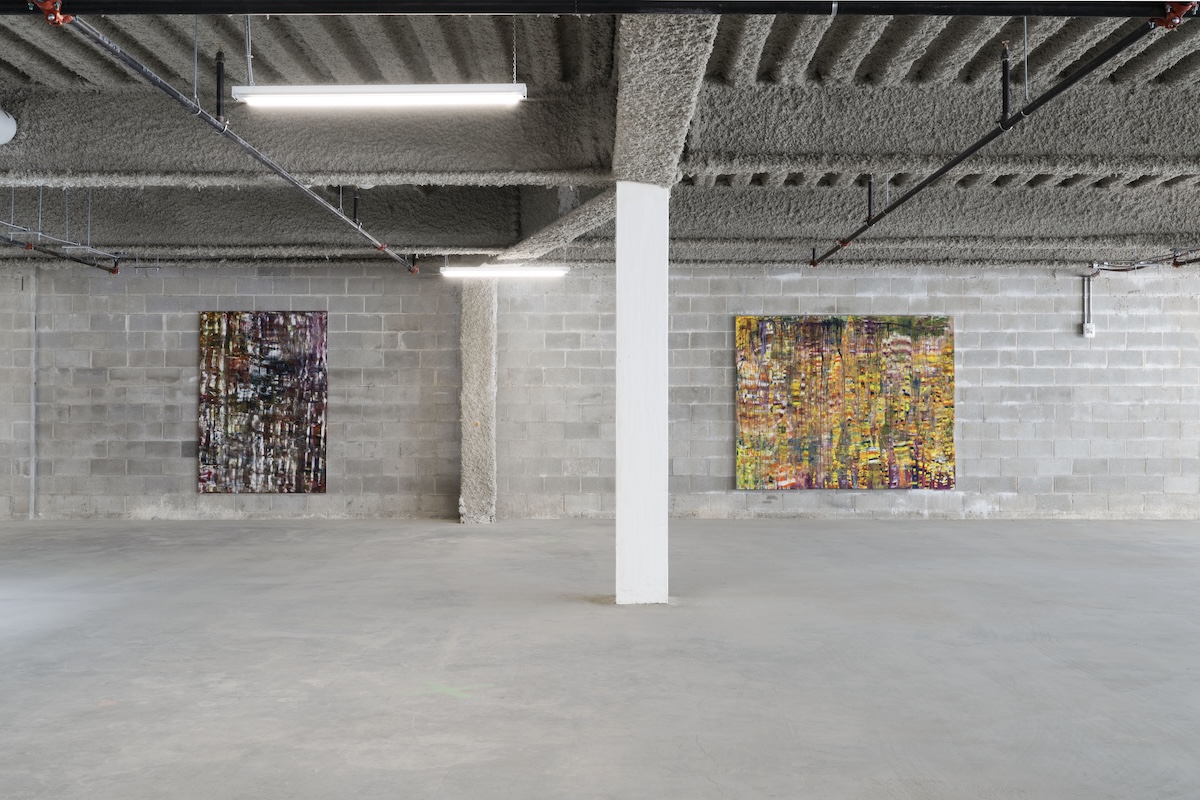
Installation View, Trevor Warrem: With Two Eyes, 2026, Gladwell Projects. Courtesy of Gallery
And what does it actually take to pull something this audacious off?
A lot of community and a lot of planning. I’m very grateful to have collectors who are supportive of my vision and the artists I’m working with.
So much of this comes down to your network and community but also being scrappy and smart. I’ve worked in galleries with very talented people and learned the back end of things, so I understand how to feasibly cut corners while still being professional. Things like this really can get done. It just takes a lot of planning.
You’ve mentioned this idea of canonizing an artist a few times. What does canonization actually mean to you?
We’re living in the canon, right?
I think that’s something we fail to understand because we’re actively going about our business and our lives. But as a gallery, I immediately think about archiving, contextualization, and market-building. That’s my job as a dealer. If I’m not building that foundation, I’m not doing my job. You want there to be rigorous conversation around your artists’ work. That comes from programming. It comes from what we’re doing right now. It comes from many different avenues.
I think the idea of canonizing artists and market-building has become so hyper-commercial that we’re not actually thinking about how to immortalize and archive history with these artists. Of course I’m a business. I want to make money. But I also feel like the way to make money is to do solid programming where your artists are properly contextualized, and people understand the value of what they’re doing. That’s what creates markets.
That’s interesting because I’m working on a piece about this gallery that existed in Newark, called Aljira right now, and I’ve been thinking about exactly this. There are galleries and spaces that pave the way, and the market pays attention after the work has already been done. People contextualize these artists, and later the market comes along and says, okay, now this makes sense to us.
I’ve worked on both sides of that spectrum. I’ve worked in blue-chip galleries that pick up artists once their markets are essentially greenlit, versus smaller galleries doing the challenging work of really trying to create a story. For me, the only way this gallery and my artists can grow is to continuously develop ambitious, well-researched, intentional programming and have that speak for itself.
That’s why I feel like having a curatorial eye is almost a superpower as a dealer. It allows you to see things not solely from a commercial perspective, but to think about the intangible assets that can create tangible assets in the future. I think about dealers like Paula Cooper and Leo Castelli. At the core of what they were doing, they were thinking about the canon and how to contribute to that conversation. When you lead with that, I think that’s the most powerful way to create stability for your program.
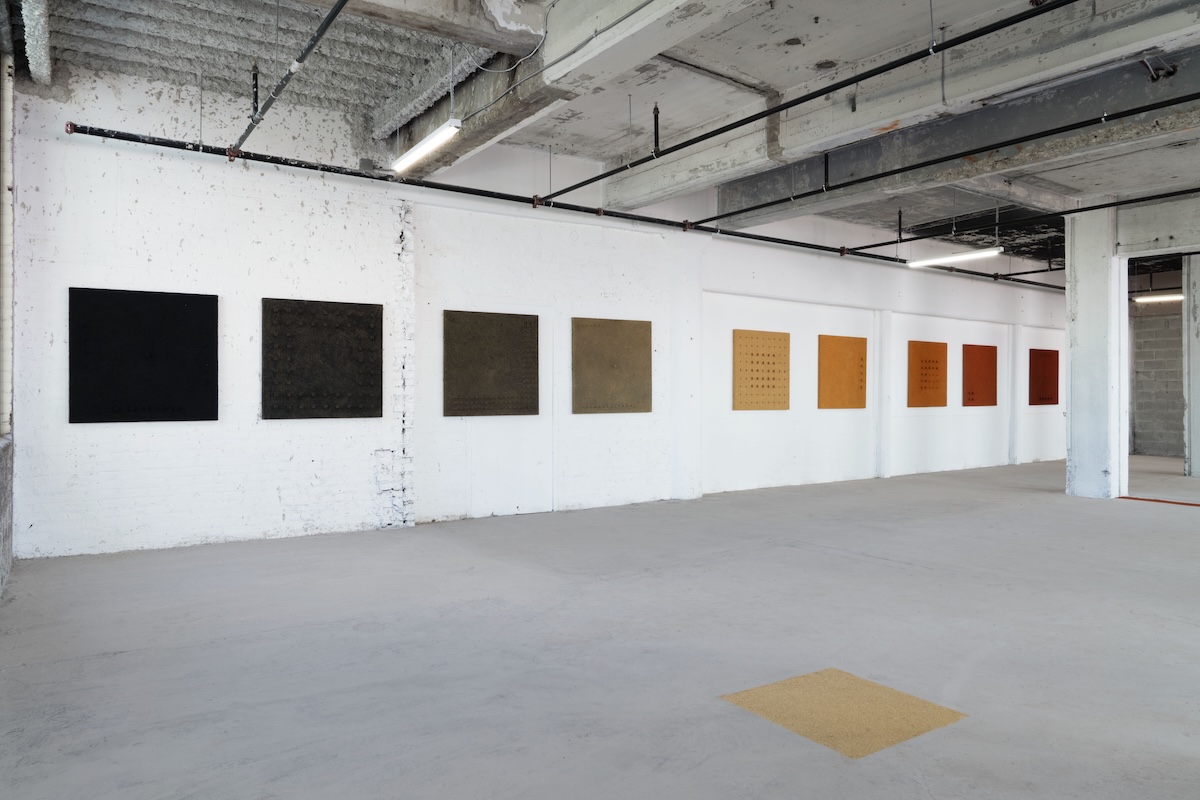
Installation View: Purvai Rai: Cartography of the Grounded Sky, 2026, Gladwell Projects, Courtesy of Gallery
When you’re thinking on that scale, how do you decide which artists deserve your time and energy? Is it intuition, shared philosophy, or something else?
It’s both intuition and shared philosophy. Especially because I work with a lot of emerging and mid-career artists, it’s never top of mind for me to think, I’m going to sell this work so easily. People respond to genuine connection. When they see your conviction behind an artist’s practice, your understanding and vision, and you’re able to tell that story and show the value, that’s how you make sales. A lot of times I’ll know an artist for a while before something fully materializes. I like the slow burn. I feel like the most powerful relationships and opportunities come out of being intentional. It’s part of Gladwell’s branding: “Do nothing without intention.” A big part of it is having a connection first, before anything else.
Something else I noticed is that your exhibitions don’t seem interested in representing a single community or fitting the gallery into one category. There can be this pressure, especially with younger galleries, to specialize. You don’t seem particularly interested in doing that.
Why limit myself, especially this early in the gallery’s existence? I want to work with artists who I think are doing important things and making important work. I work with artists like Kylie Manning, Chiffon Thomas, Lisu Vega, Chunghee Yun, and more. If the work is good, I want to show it. That’s really my biggest focus: showing really, really good work.
I also think there was a point when specialization itself was an intervention. There were communities that simply weren’t being showcased. That’s part of what I’m thinking about with Aljira. They did it because these artists couldn’t get shown elsewhere. We’re obviously not living in a utopia now, but the conditions people are creating within have changed. Every generation carries a different cross. If the conditions change, the model can change too.
Absolutely. I will say there is a consistent theme of me showing artists who, in some way, have been overlooked or marginalized, whether in the current moment or from a historical perspective. That comes from my experience as a Black woman navigating the world and the art world. I have a particular soft spot for that, and it’s a big part of the choices I make. But I think a strong suit of mine is having diverse programming, and that’s not only connected to people’s backgrounds.
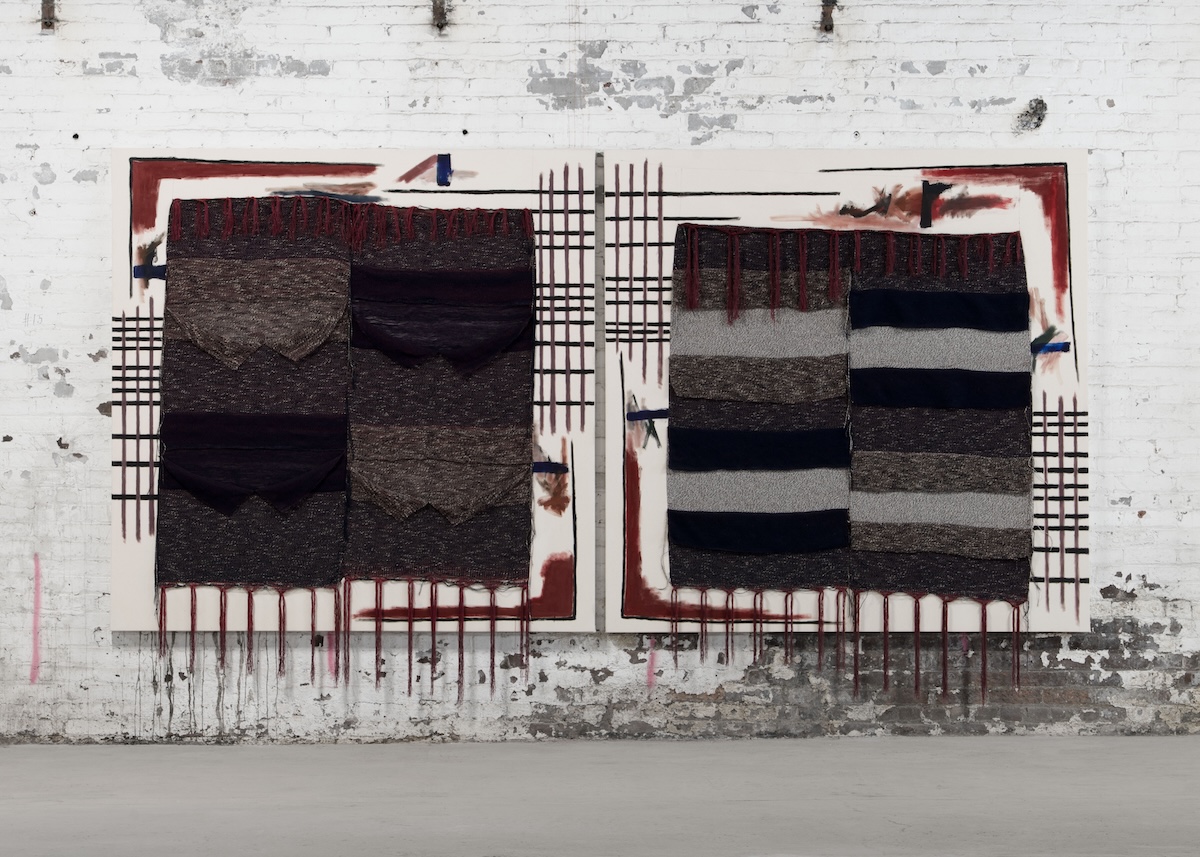
Vamba Bility, Blackcademicss (Diptych), 2025–2026, Woven wool, nylon, cotton, acrylic yarn, oil, sewn canvas, Gladwell Projects, Image Courtesy of Gallery
Although every artist has their own visual language, together they somehow feel like they’re participating in the same conversation. What have these artists revealed to one another, or to you, by being shown together that you might not have seen otherwise?
That is such a good question. To be honest, I feel like I’m still uncovering a lot of that. I’m starting to pick up on more intimate similarities between artists in the building, even in terms of working styles and processes. I think about Lisu and Vamba’s connection through textiles and this idea of deconstruction and reconstruction.
I feel like it’s still unfolding. That’s something I find beautiful about this process and why I think it’s important for us to have longer exhibition runs. Shows are opening and closing way too quickly. I’ve also been hosting performances in the space, and artists presenting in the building come to those. There have been some really beautiful interactions.
I recently read something arguing that in a moment when the gallery system is so uncertain, the thing that will sustain people is community: communities of artists and communities of people supporting artists. The performances seem to contribute to that. How have they activated the building?
We’ve had three performances so far.
Chiffon produced a performance called Fugitive Pleasures, after the exhibition title. There’s a work in the exhibition that references the Zong, the slave ship known for the massacre of more than 130 enslaved Africans who were thrown overboard as a ploy to commit insurance fraud, writing off the loss of these lives for profit.
Chiffon created over 5,000 individually cast miniature feet. During the performance, he spreads them throughout the space and then slowly collects every single one. The viewer follows him, so there’s this voyeuristic quality but also an energetic exchange.
Vamba activated his exhibition using the loom installed in the space, hooking it up to a synthesizer, drum, and radio to create an improvised sound performance. Trevor also has a major interest in experimental sound and invited musicians Leila Bordreuil and Luke Stewart to do a live improvised performance.
It’s about activating the exhibitions in ways that naturally speak to each artist’s practice. A space like this is so hard to come by. It would be a shame not to.
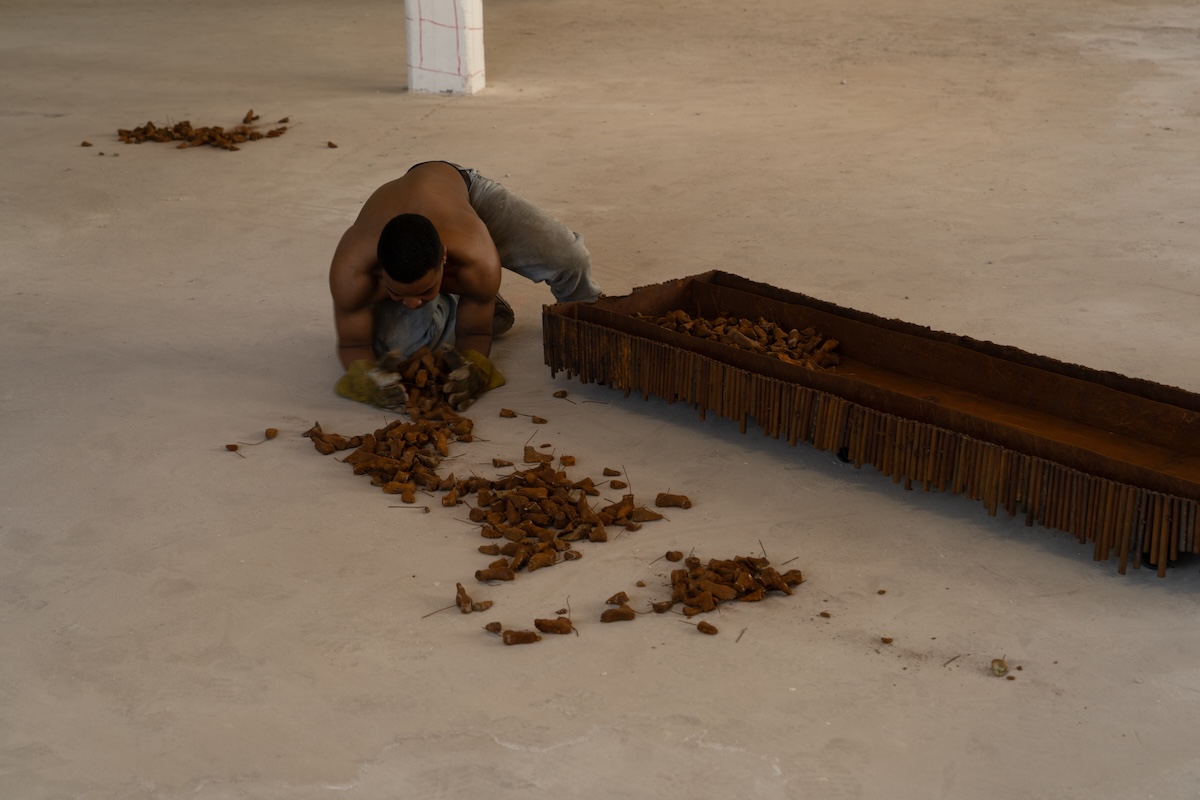
Chiffon Thomas performing as part of Fugitive Pleasures, 2026, Gladwell Projects, Courtesy of Gallery.
I think performance does something else too. It’s such a huge industrial space. When we walked through, there was something really cool about that warehouse feeling. But performance changes the relationship to that scale. I’m trying to find the exact word, but it makes the space feel ….
Warmer.
Exactly. It makes it warmer….. So, what’s next?
After this, I’ll be presenting Lisu Vega’s work at the Armory Show in September in Platforms.
I also just signed a contract for a space in the Marais in Paris for October. I’m doing an exhibition about artist couples and partnerships called Je t’aime quand même, or I love you anyway. It’ll open during Art Basel Paris and run just before Paris Photo.
And then a solo presentation of new ceramic and textile works by Lisu Vega at NADA Miami. It will be her homecoming which I’m so excited about.

Emann Odufu
Emann Odufu is an independent art and culture critic, filmmaker, and curator from Newark, New Jersey, whose work explores contemporary art and Black visual culture through Afro-Futurism, narrative, and cultural memory. His writing and creative work has appeared and been featured in The New York Times, HuffPost, Paper Magazine, Office Magazine, and The Brooklyn Rail, and his curatorial practice includes exhibitions at the Liu Shiming Foundation, National Arts Club, MoCA Westport, Friedrichs Pontone Gallery, and Leila Heller Gallery. He has spoken at Harvard University, Yale University, the British Film Institute, and the National Academy of Design.
view all articles from this author