Whitehot Magazine
October 2026
"The Best Art In The World"
"The Best Art In The World"
October 2026
Layers of Transformative Journeys: Garo Hakimian at Space 776
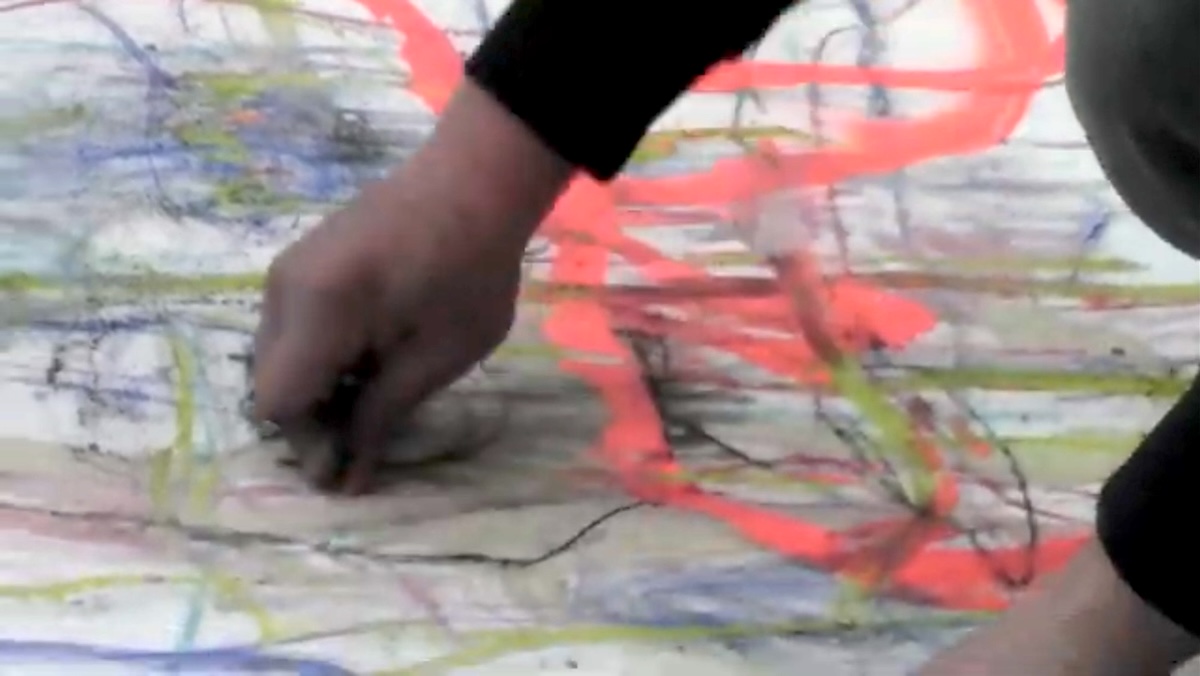 Still from Garo Hakimian: Work Process and Interview c/o Maria Yoon, Private Museum Tours, 2025
By ALFRED ROSENBLUTH, May 22, 2025
For the past month, New York City’s Lower East Side has been home to Layers of Transformative Journeys; the debut solo show of Montréal’s Garo Hakimian. Anchored there within the unassuming quarters of Space 776, five wall-sized paintings - wrested from the Quebec tundra by Curator Maria Yoon - shimmer in congress with the distant memory of the environs’ iconic cultural reigns of Andy Warhol and Lou Reed. We turn our attention from this reverie and the adjacent street’s graffiti-stained fences to the gallery’s glass storefront and enter through the transparent double doors.
On a monitor to our left flicker scenes from Hakimian’s studio interview; before us and to the right hang three large-scale works that feature a range of techniques and approaches. Beginning with Fish of God (2022), we are confronted by a tapestry of collaged canvas fragments, one of which confidently sags off the frame’s bottom left quadrant. The titular figure, suspended above a cut-out scaffolding of jagged calligraphy, anoints its domain of flapping canvas waves with bile issuing in black rivulets from its toothed lips. To the right hangs WWIV (2022), a pluriform self portrait whose chaotic legions verge on abstraction against a backdrop of alternating patches of reds, pinks, blacks, and yellows. Hakimian’s approach of working his canvases from every side is not always evident, but in this work's bottom right corner, one can observe vertical paint drips rise in contradiction to it's displayed orientation. Completing Space 776's north wall is Dog Eat Dog (2022). Here, we depart from the apocalyptic palimpsests of the prior works and approach this show’s most straightforward elements of representation. Like a neo-cubist Ralph Steadman, Garo scrawls across the lips of this self-consuming hybridity “NO STyle LiKe Picasso”. What we critically glean from the range of these works’ aesthetic variations is how few limitations Garo places on the expression of his perceptual flexibility and by extension, his prioritization of personal artistic evolution over stylistic consistency - vision and instinct over perfection.
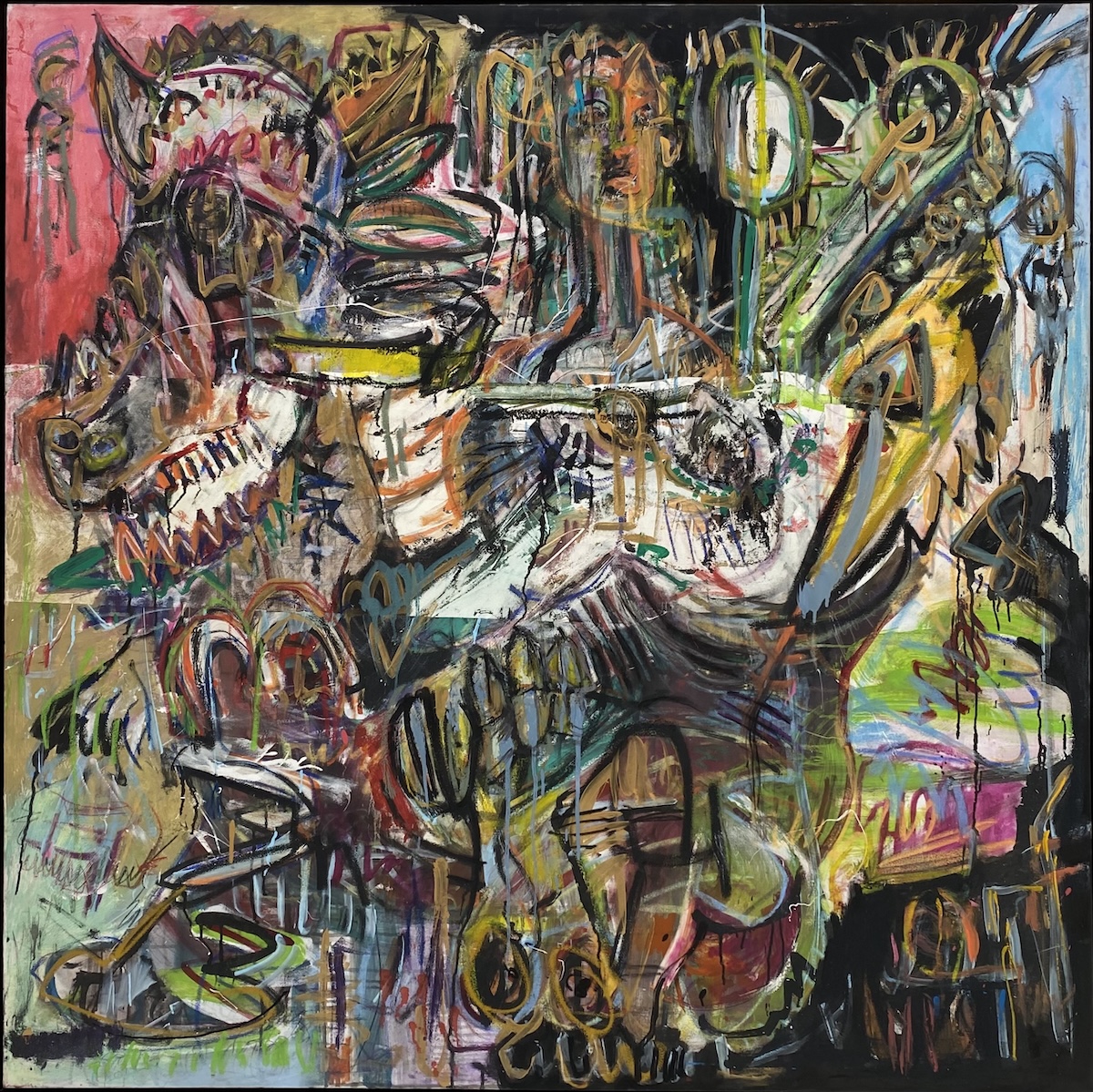 WWIV, 2022, Oil on Canvas, Spray Paint, Oil Stick, Charcoal, Mixed Media, 60 x 60 inches
Only by witnessing the activity of Hakimian’s Montreal studio can one grasp this ethic’s centrality to his work. There, one encounters walls festooned with countless works suffering innumerable layers of revision; the show's curator, Maria Yoon, describes becoming intoxicated by the overwhelming sight. While the works she culled from this churning storm are technically finished, no work from Hakimian’s oeuvre can be conceived as complete. Although approved for exhibition, they are more accurately understood as fragmentary distillations of Garo’s ceaseless activity, articulated by his signature mantra, “never finished”
But one need not accept at face-value that Garo’s studio is a cauldron of fire; the curious have only to log on to instagram which, until this recent debut, has been the sole platform where Garo faithfully documents his torrid labors.
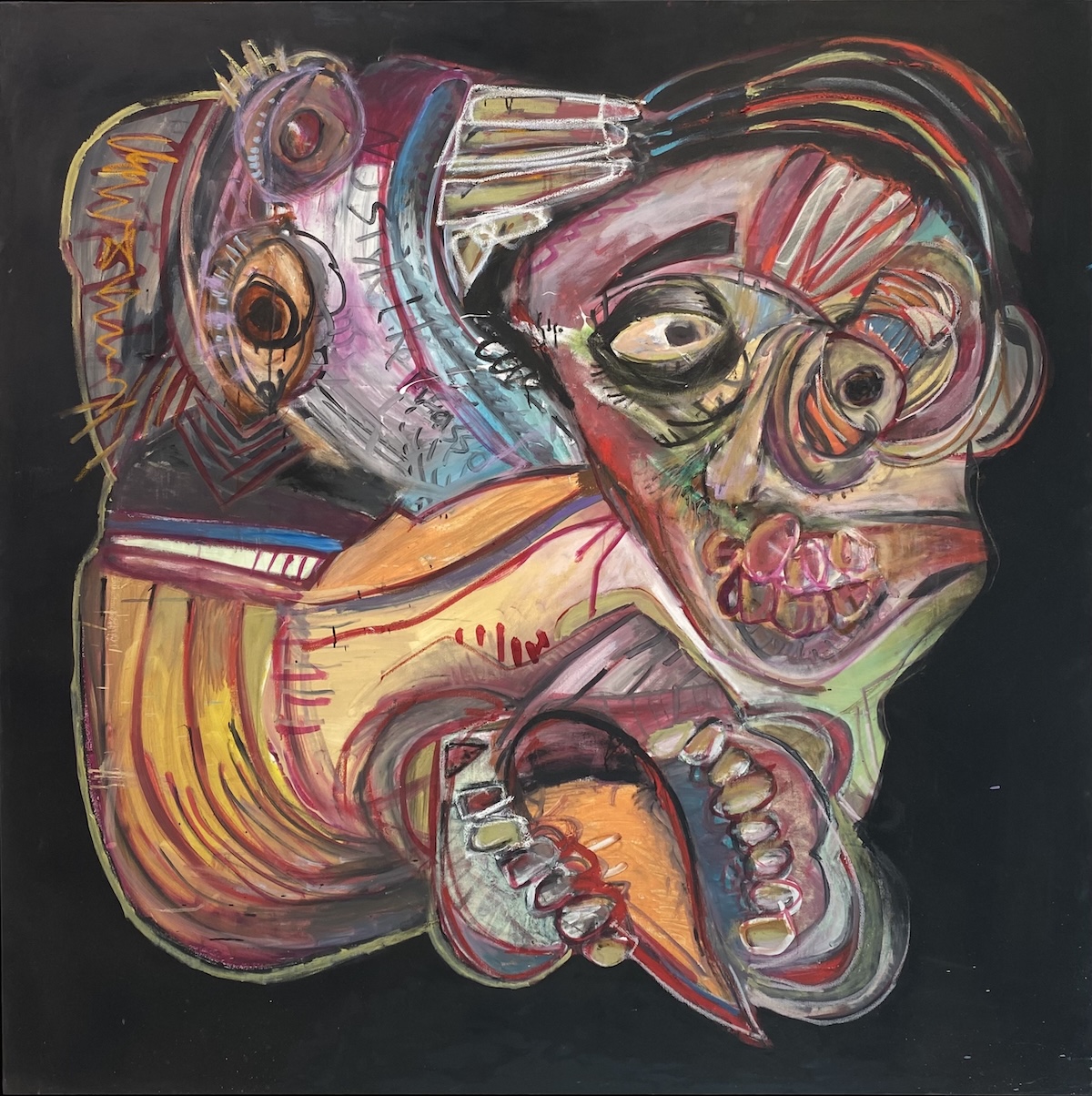 Dog Eat Dog, 2022, Oil on Canvas, Spray Paint, Oil Stick, Charcoal, Mixed Media, 60 x 60 inches
Like a “boxer training for a fight”, Garo initiates and moves through works relying on instinctual responses rather than adhering to a preconceived plan. At no point could the resulting cuts and tears in works such as Man In Cross (2022) be mistaken with affectation or stylistics. Garo himself addresses this issue in an interview with Teddy Duncan of FAD Magazine: “The tears and rips — they’re not aesthetics. They’re wounds”*(more to be said of this later). As for his choice of medium, Hakimian selects any that can employed in total service to his unfolding vision as apprised for their capacity to capture the immediacy of his synaptic reactions. Even final works are subject to dissolution as Maria Yoon once lamented. Paradoxically, it is this emphasis on ceaseless activity that allows the potential for every piece to surpass formal and stylistic limitations which concessions to perfection would otherwise heed.
There is likewise no reducing Garo to his influences, which are nonetheless undeniably present in each canvas. Picasso, Basquiat, Baselitz, even Bacon, all echo through the mutations of Garo’s lexicon. This adherence to 20th century forms of expression could make Hakimian an easy figure to overlook, however, in tragic resonance with the conditions of his predecessors’ lifetimes - Picasso’s and Baselitz’s in particular - Garo’s visceral dialect of Modernism naturally responds to the geopolitical precedent of authoritarian rule and state-sanctioned genocide. One can’t help but draw a historic throughline between Hakimian’s WWIV to Picasso’s May 1937 opus, Guernica.
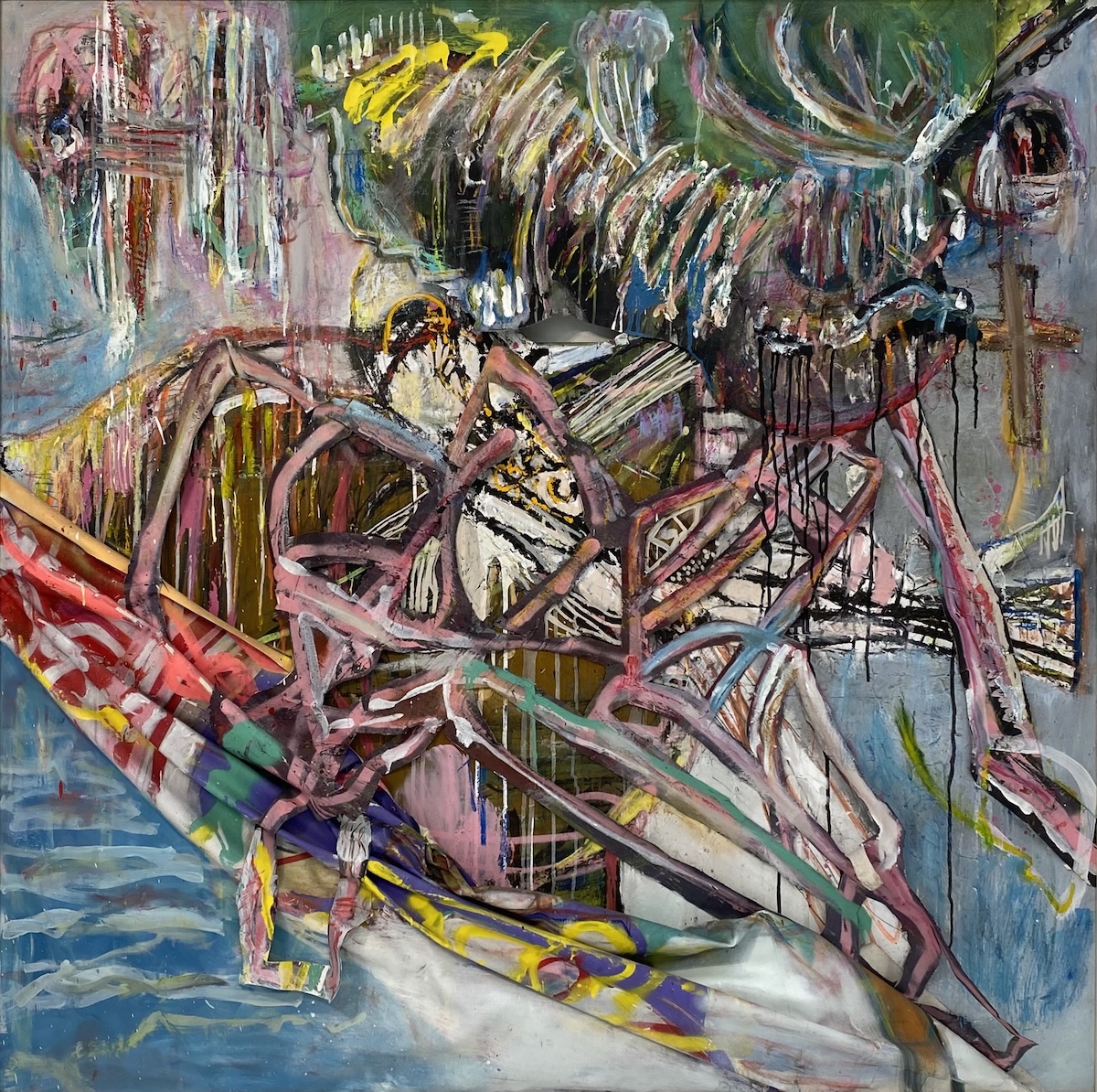 Fish of God, 2022, Oil on Canvas, Spray Paint, Oil Stick, Charcoal, Canvas Folds, Mixed Media, 60 x 60 inches
As a first generation descendent of the Armenian diaspora Hakimian, himself is no stranger to such conditions, as anyone familiar with modern history would know. However the pathos so evident throughout his oeuvre is not rooted in the heritage of the Armenian people alone; of the wounds confessed in Hakimian’s canvases, his father’s tragic and sudden passing remains “the one that never closed”. The depth of this loss and the influence Garo’s father had on his artistic development seem impossible to overstate. One would indeed be hard-pressed to find an upbringing more supportive to a mind, such as Garo's, that was predisposed to art. Garo’s sister, Nanor, reports about their father, Razmik:
“Our dad loved art more than anything [...] He constantly encouraged artists to pursue their work and helped promote their artworks to a wider audience. Our home was filled with paintings, sculptures, art books—art was everywhere [...] He supported it passionately and played a major role in fostering an environment where art thrived.”
Yet to whatever extent his work is predicated by suffering, it “is not the theme” Garo states, “it’s the soil.” And it is by virtue of their wounded nature imparted by Hakimian that each fragment distilled from his studio’s primordial churnings throbs with numinous potential. If we view every work as the self-portrait that Hakimian asserts them to be, we can better interpret his process as the repeated transmutation of the living self recorded in material.
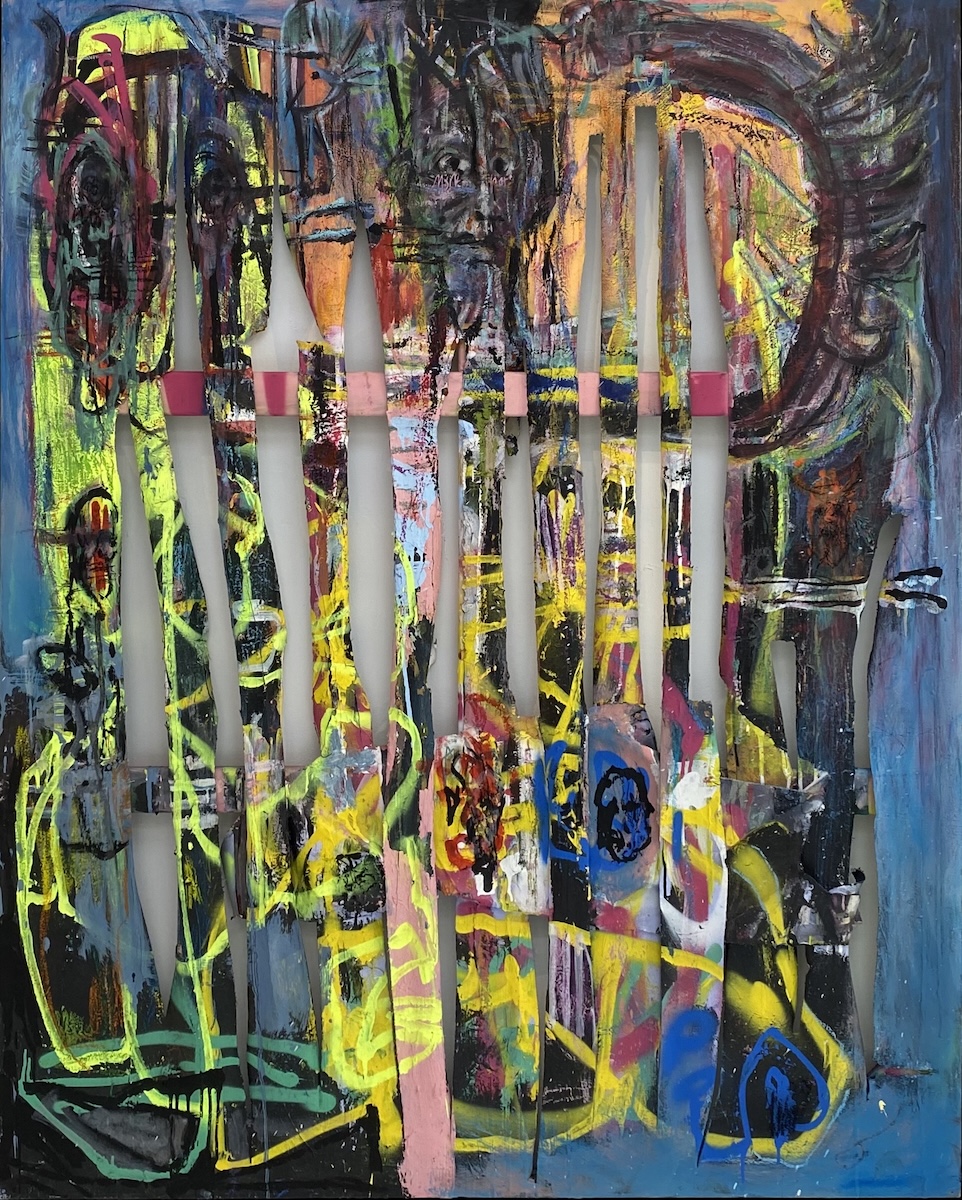
Man In Cross, 2022 Oil on Canvas, Spray Paint, Oil Stick, Charcoal, Canvas Cut-Outs, 48 x 60 inches
Even motifs bearing extant connotations flicker as open signifiers; the cross that appears in Fish of God, for instance, does so more as an emblem of his strongly-felt Armenian identity and personal faith than as an institutional seal. Indeed, whatever the significance these works contain for Garo, his expectation for the viewer to “find their own gospel” in them betrays an implicit humility and respect for his audience. Such an attitude likewise discloses an awareness that any effort to impart a fixed meaning would only serve to undermine the works’ vitality.
“It’s growing” Garo Hakimian utters from the monitor. We reflect on the show title Layers of Transformative Journeys; on how every cycle through undoing and resurrection is borne within his work’s material remains. It’s raining now. We take a departing glance before exiting through a second pair of glass doors, a grey head sadly peers back over bars of torn canvas as we wrench open a broken umbrella. As a sudden gust of wind sends pedestrians hurried and shivering in every direction; the cleansing beauty of this chaos washes over us, mirroring the lesson of Garo’s practice; his embrace of imperfection and transmutation through persistence.
* “This is not an exhibition: An interview with Garo Hakimian on suffering, transformation and artistic production” by Teddy Duncan, FAD Magazine, 12 May 2025
Layers Of Transformative Journeys, Garo Hakimian, curated by Maria Yoon, runs from May 2 - 21, 2025 at SPACE 776, New York, NY

Alfred Rosenbluth
Alfred Rosenbluth is an artist and researcher currently residing in the Philadelphia area. You can find him at @_aallffrreedd on instagram or through his website at www.alfredrosenbluth.com
view all articles from this author