Whitehot Magazine
October 2026
"The Best Art In The World"
"The Best Art In The World"
October 2026
Say It with Flowers: In Full Bloom, the title of Bruce Helander’s current exhibition at the Ann Norton Sculpture Gardens in West Palm Beach
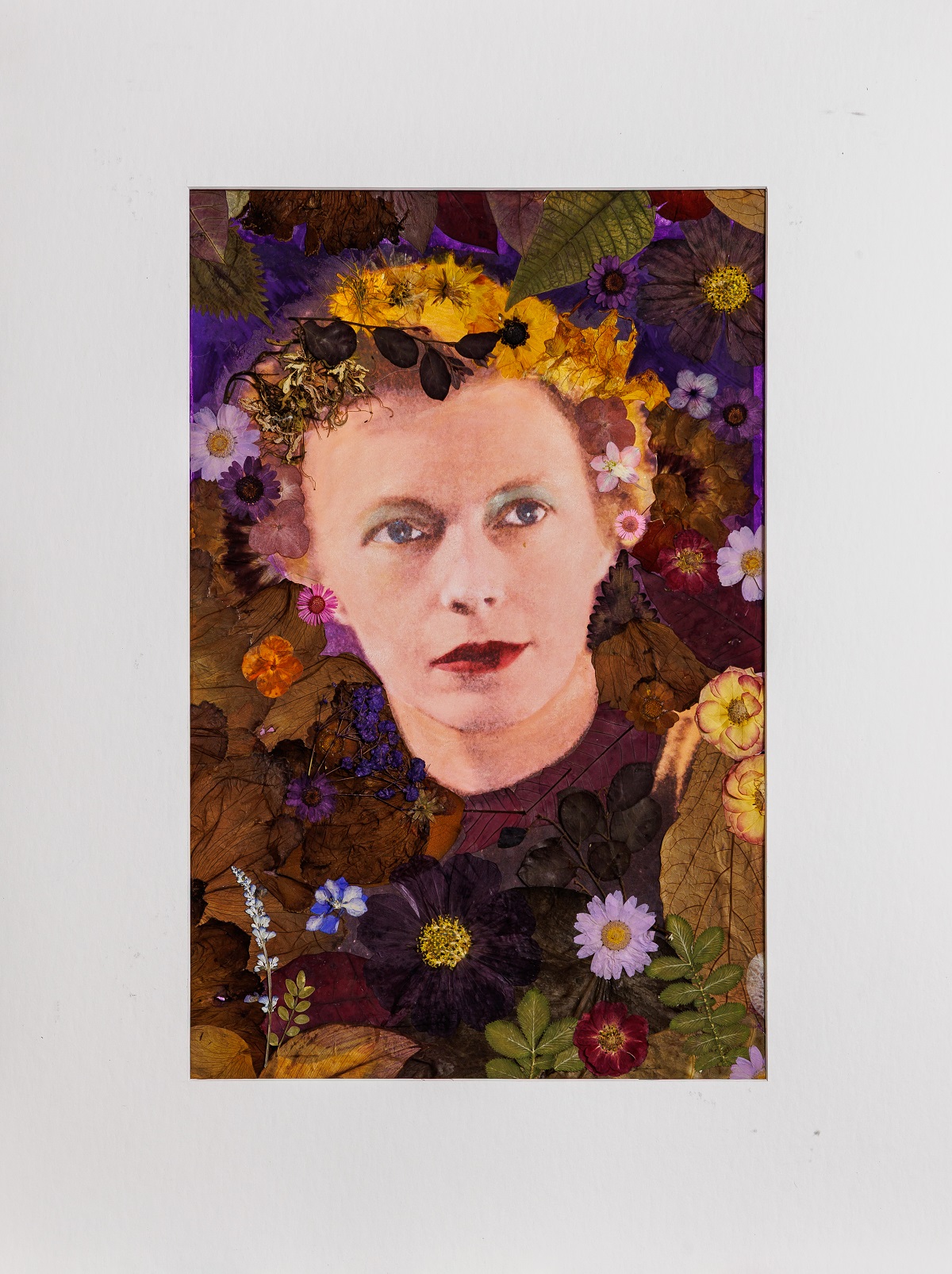 ANN NORTON by Bruce Helander
By ANTHONY HADEN-GUEST, October 16th, 2026
Upper-class Victorian women affixed pictures that pleased them into books, onto lampshades and wherever else decades before Picasso and Braque brought collage into Modernism, and they also turned making patterns from pressed flowers into a popular craft. The Ism here, though, is Hobbyism. With In Full Bloom, the title of Bruce Helander’s current exhibition at the Ann Norton Sculpture Gardens in West Palm Beach, he has employed flower petals as the raw material in making the twenty-plus portraits of prominent area women that present a striking new form of collage art.
Helander’s creative concentration has been collage from his early days. He was putting pieces of paper together in high school before he knew the word collage, and during his time at the Rhode Island School of Design, he wasn’t painting but making collages out of vintage paper picked up at flea markets. I’ll add that he would later become provost of RISD at age thirty, moving on to become a curator and multiple gallerist, putting on such shows as Five Floridians, which featured John Chamberlain, Duane Hanson, Jules Olitski, Robert Rauschenberg and James Rosenquist, at his Worth Avenue, Palm Beach gallery in 1988. And Helander is also, of course, a critic and a writer of numerous books, with his latest on glass artist Dale Chihuly and painter Franz Kline.
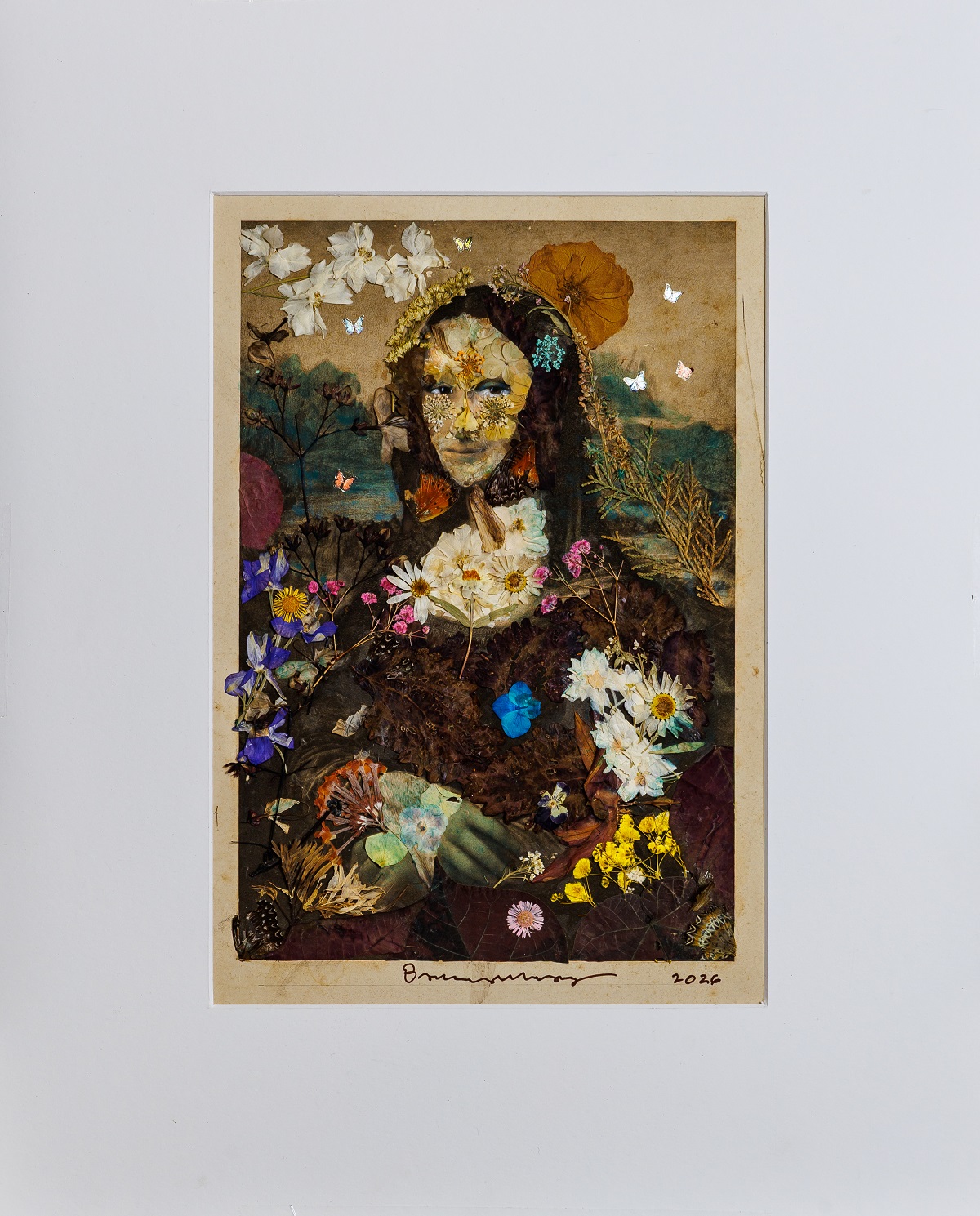 MONA LISA by Bruce Helander
So back to the collages. The flowers got into the picture quite literally when he and his wife, Claudia, moved into a new home in West Palm Beach. “It had a big garden with flowers dropping onto the ground,” he said. “For some reason we decided to pick up the blooms. We brought them into my studio and flattened them between the pages of big books.” While his artistic plan for the pressed and dried flowers was not immediately apparent, they soon inspired a new direction in collage material. “What really set it off was a flower collage I did for Dale Chihuly, the glass artist, as a birthday gift,” he said. “That was the first attempt.”
It seems an organic development. Helander’s mother was a fashion designer and garden designer, and he works closely with his wife, Claudia. “She is from Bogota, Colombia, which is the flower capital of the world,” he said. “When she came to the US, she went to a school for flower arranging and floral design. She has a vocabulary of familiarity with plants, which has been valuable insight for me on the flower portraits.”
That’s how things were when Helander was given an artist residency at the Ann Norton Sculpture Gardens. “I was asked what I would like to do,” he told me. “I said, ‘Well, the gallery is surrounded by gardens. I will do something completely different. Pressed flower collage portraits of prominent women.’”
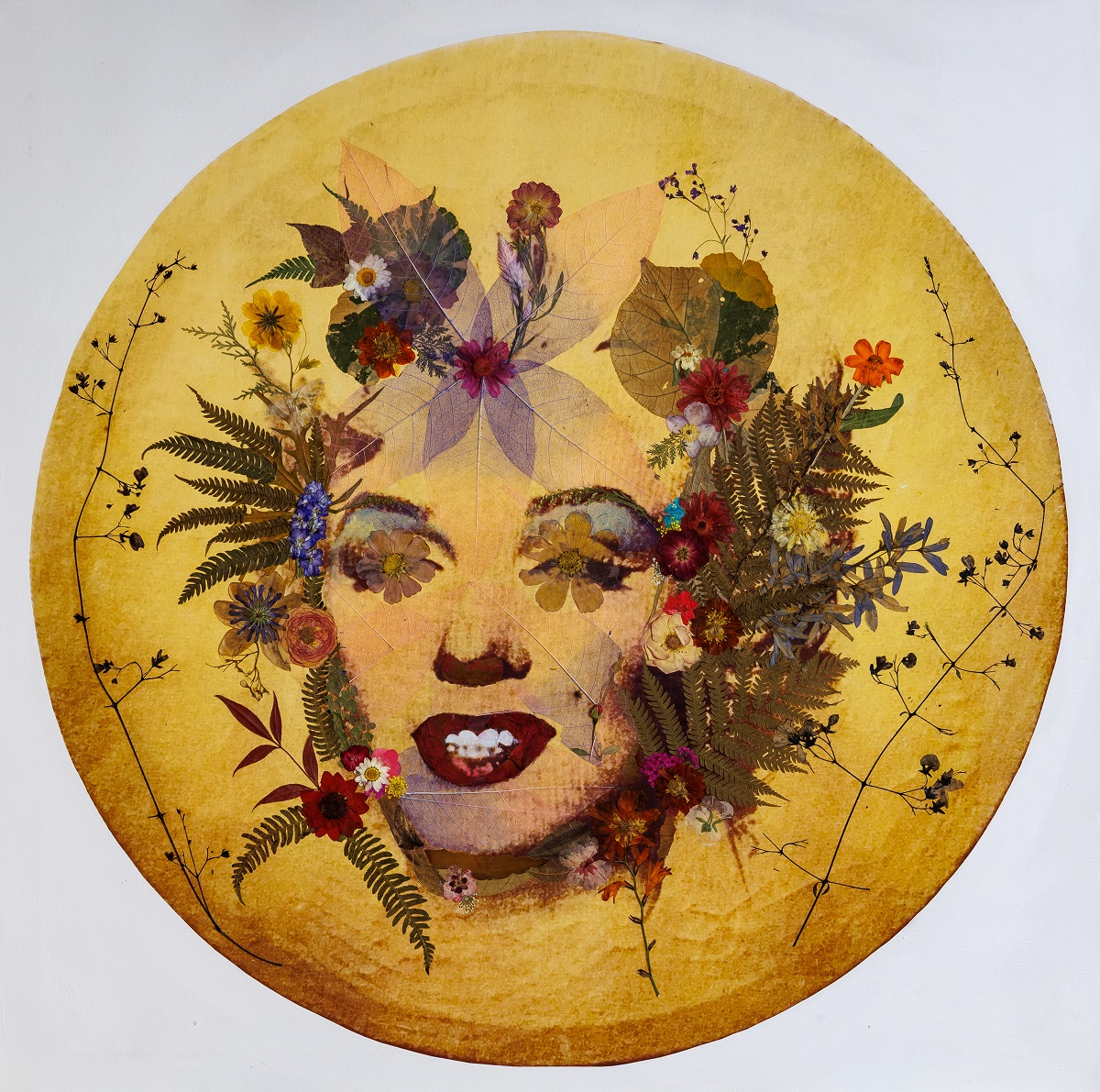 MARILYN Eyes Shut, Bruce Helander
He approached his collectors, many of whom were well-known Palm Beach figures. “They all contributed a photograph,” he said. “So, I’ve been working on them. I do them in batches. And I came up with the title In Full Bloom—Flowers in the Garden.”
Why women only?
“I tried it as an experiment with men’s faces and it doesn’t work,” he said. “Flowers have always had a connection to femininity and delicacy. Putting flowers on a man’s head and a rose in his mouth just didn’t work. You don’t have the right visual chemistry.”
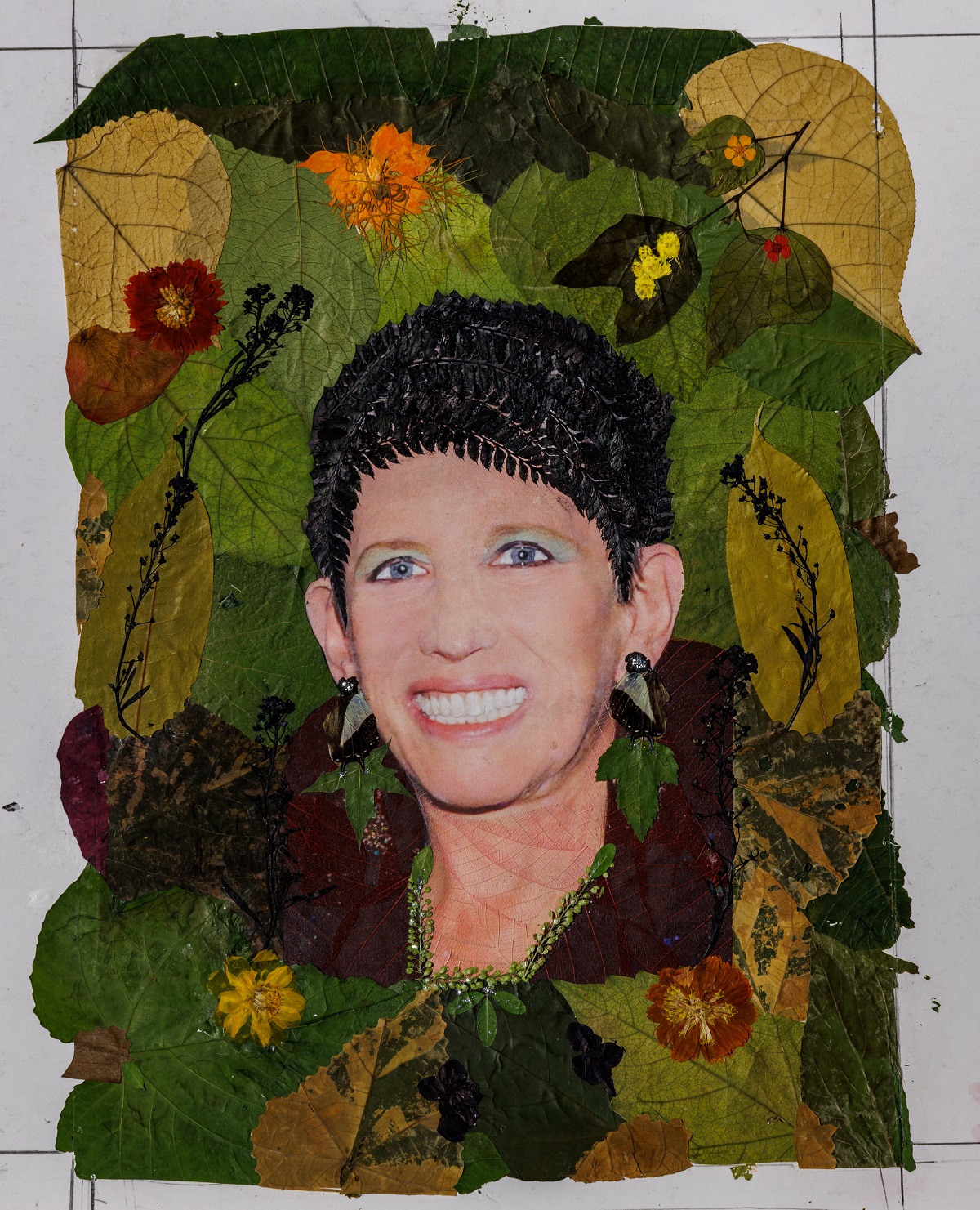
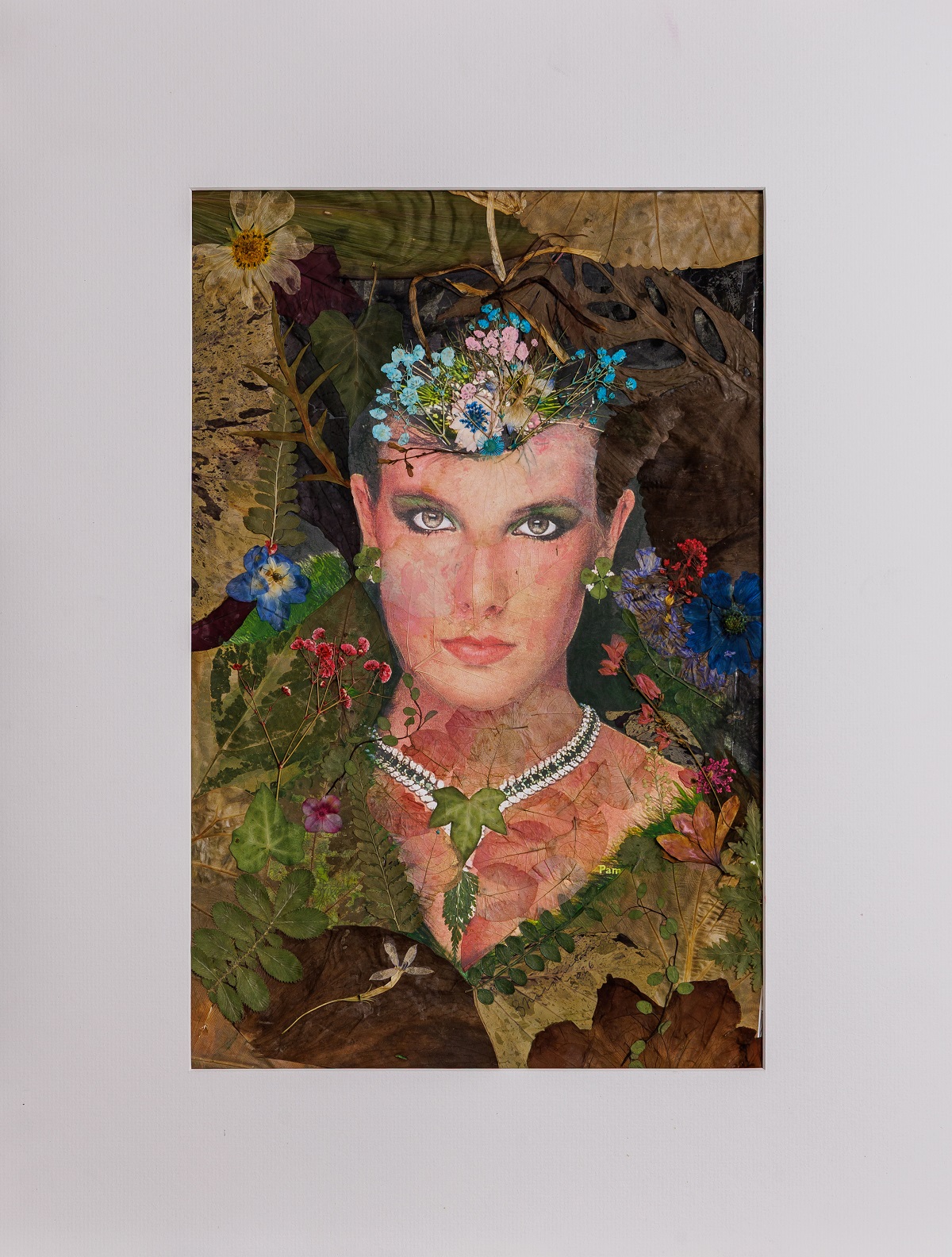
So, to the process. “It starts with a photograph,” Helander said. “Then the photograph is enlarged. Whether it’s a black and white photograph or an older photograph, when you blow it up from a maybe four-inch oval or square to eighteen inches high, which is what the collage pieces are, you lose the detail and the luxury of the surface. So, I watercolor the facial features first to make them more vibrant, usually a toning up of the skin or a little green eyeshadow, like a makeup artist, until I have a painterly face. Then I add, very delicately, organic materials such as leaves, ferns and flowers, for the hair and background.”
“We couldn’t count on flowers blooming in our gardens all the time,” he said. He learned, though, that there is a surprising, worldwide network of individuals who press flowers for sale, and his studio purchased these materials from independent shops run by a variety of collectors, from a petal-besotted stay-at-home mom based in Ukraine to another who lives in the UK. And the dried materials can always surprise and inspire.
The works are all portraits. Shrewd move, this. Making the use of unusual raw material a central factor in art can distract attention from other elements in the work. Portraiture supplies a focus, though, and Helander’s painterly skills are such that this is a non-issue.
 BETH DeWOODY, Bruce Helander
I noted that Helander’s portraits struck me as equally strong but as different presences. Several, like those of art collectors Jane Holzer and Beth DeWoody, Ann Norton herself and Audrey Gruss, are executed with classical finesse. But other subjects, such as Amanda Schumacher and Kim Frisbie, seem to have become a part of plant life.
“I don’t have a strict plan of action,” Helander said. “I let the faces, depending on the hair, the skin tone, call out to me.” That’s where the drawing and painting come in, namely the handling of materials: the flower petals picked up in the Helanders’ back garden, as well as those found in the online shops. “In my studio, I have maybe a hundred boxes, cigar boxes, shoeboxes, whatever, and they are filled with different categories of dried leaves and blossoms,” he said. “Just like an artist with a palette. I have a palette of boxes, but it’s not color, it’s a palette of pieces of dried natural material that have an aesthetic character, and I am cutting them up and rearranging them.”
 PAMELA O'CONNOR by Bruce Helander
‘Collage drawing’ with petals is a different procedure from using a pen or a pencil, indeed interestingly so. “Artists love finding a new direction. And often finding a new direction by mistake,” he said. “Lucky accidents happen all the time. You are looking for an eyebrow. And all of a sudden, you see it in a tuft of grass. Once I started going with it, I thought, this is inventive and non-traditional portraiture, with a characteristic signature of collage.”
So Helander felt ready to connect his floral busts with tradition. “Portraits have always been there,” he said. “The first altered portrait that I can think of—and that’s what I’m doing, I’m altering portraits—was Duchamp’s decision to add a goatee and mustache to the Mona Lisa, which is the most important portrait of all time, and the most popular painting in the Louvre. The second most famous artist who appropriated portraits was Andy Warhol. And the most recognized, celebrated portrait that Warhol made is Marilyn Monroe. So, I printed them out. And then I started putting living materials on them, dried flowers… vines and leaves…”
He does not attempt to mimic them, though. Leonardo’s Mona Lisa has a covert smile. Helander’s has a peaceful look. Of the Warhol, he added, “I am using the same principle that Andy utilized, an embellished portrait. Instead of brushstrokes I’m using flower petals.”
What are the flowers that represent the eyes? “They are marigolds and daisies. The eyes and the nose and the lips are all made of dried flowers. So that was an adventure of appropriation.”
So, the combination of inventiveness and forms that have a built-in organic aesthetic has developed into a memorable exhibition that depends on the inherent attractiveness of nature combined with the intuitive sense of repurposing some of the environment’s most dazzling imagery into an intimate narrative.
The exhibition continues through January 10, 2027. For more information: https://ansg.org/series/in-full-bloom-flowers-in-the-garden
Anthony Haden-Guest
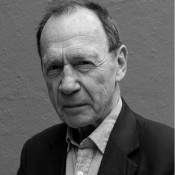
Anthony Haden-Guest (born 2 February 1937) is a British writer, reporter, cartoonist, art critic, poet, and socialite who lives in New York City and London. He is a frequent contributor to major magazines and has had several books published including TRUE COLORS: The Real Life of the Art World and The Last Party, Studio 54, Disco and the Culture of the Night.
view all articles from this author